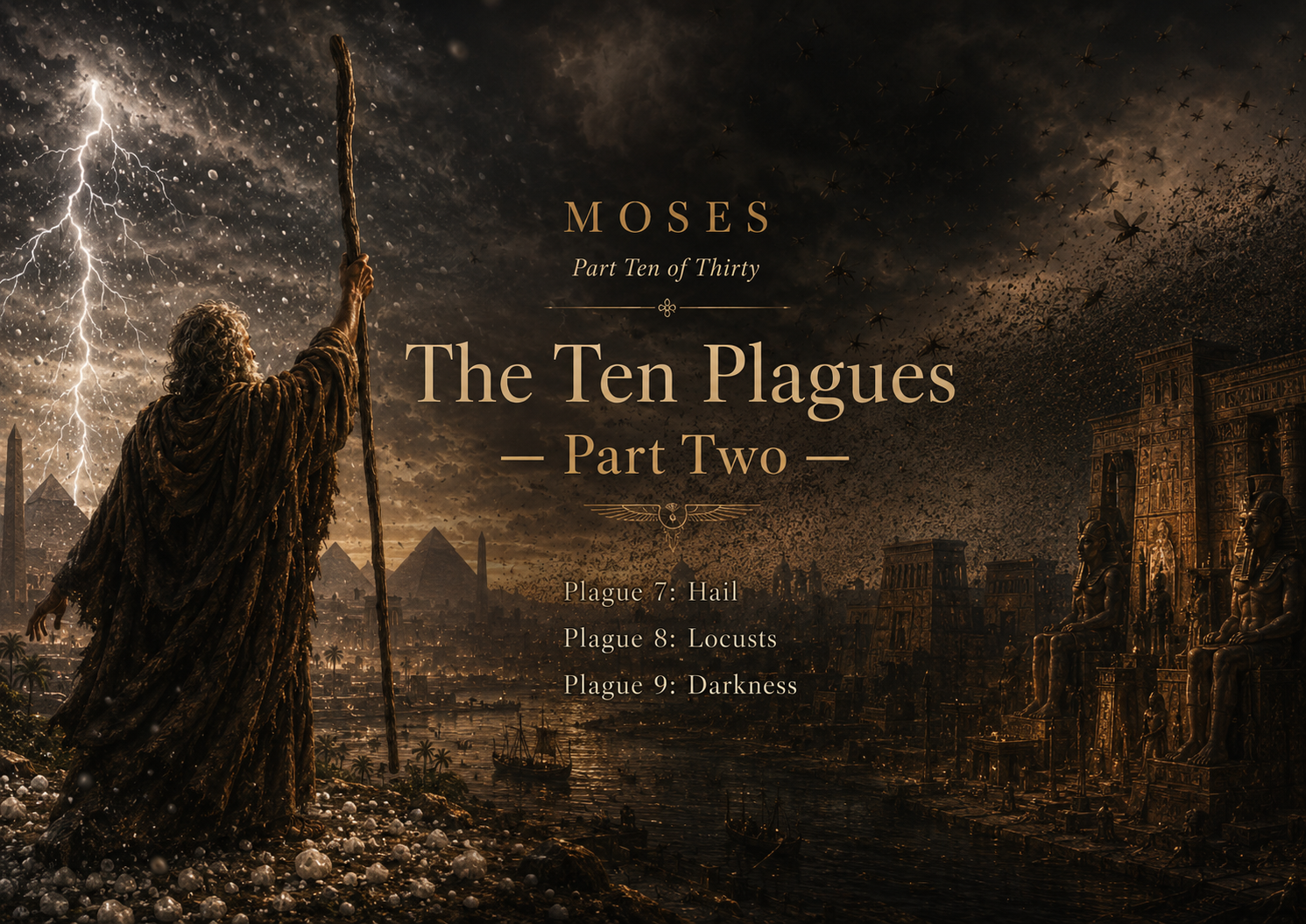
"The LORD rained hail upon the land of Egypt... There was hail and fire flashing continually in the midst of the hail, very heavy hail, such as had never been in all the land of Egypt since it became a nation."
— Exodus 9:23–24
Before You Begin This Study
Please Read These Passages First
Part Ten covers Plagues Seven through Nine — the final three plagues before the Passover night. Please read the entire passage straight through before engaging with the commentary. Notice the escalating desperation in Pharaoh's responses, the new voices entering the conversation, and the way the darkness of Plague Nine is described in ways that transcend a simple weather event.
Pay particular attention to Exodus 9:20 — one of the most quietly significant verses in the entire plague narrative. And to Exodus 10:7 — the moment when Pharaoh's servants speak up. The court is fracturing. The question is whether Pharaoh will hear it.
Exodus 9:13–10:29 Exodus 9:16 Joel 1:1–12 Psalm 105:28–36 Romans 9:17
Optional deeper reading:
The Egyptian Hymn to Ra (the sun god — targeted by Plague 9);
Joel 1–2 (the locust as instrument of divine judgment — drawing on the Exodus template);
Matthew 27:45 (three hours of darkness at the crucifixion — the direct New Testament echo of Plague 9);
Amos 5:18–20 (the Day of the LORD as darkness, not light).
Exodus 9:13 -21
Exodus 9:22-35
Exodus 10:1-11
Exodus 10:12-20
Exodus 10:21-29
The Story
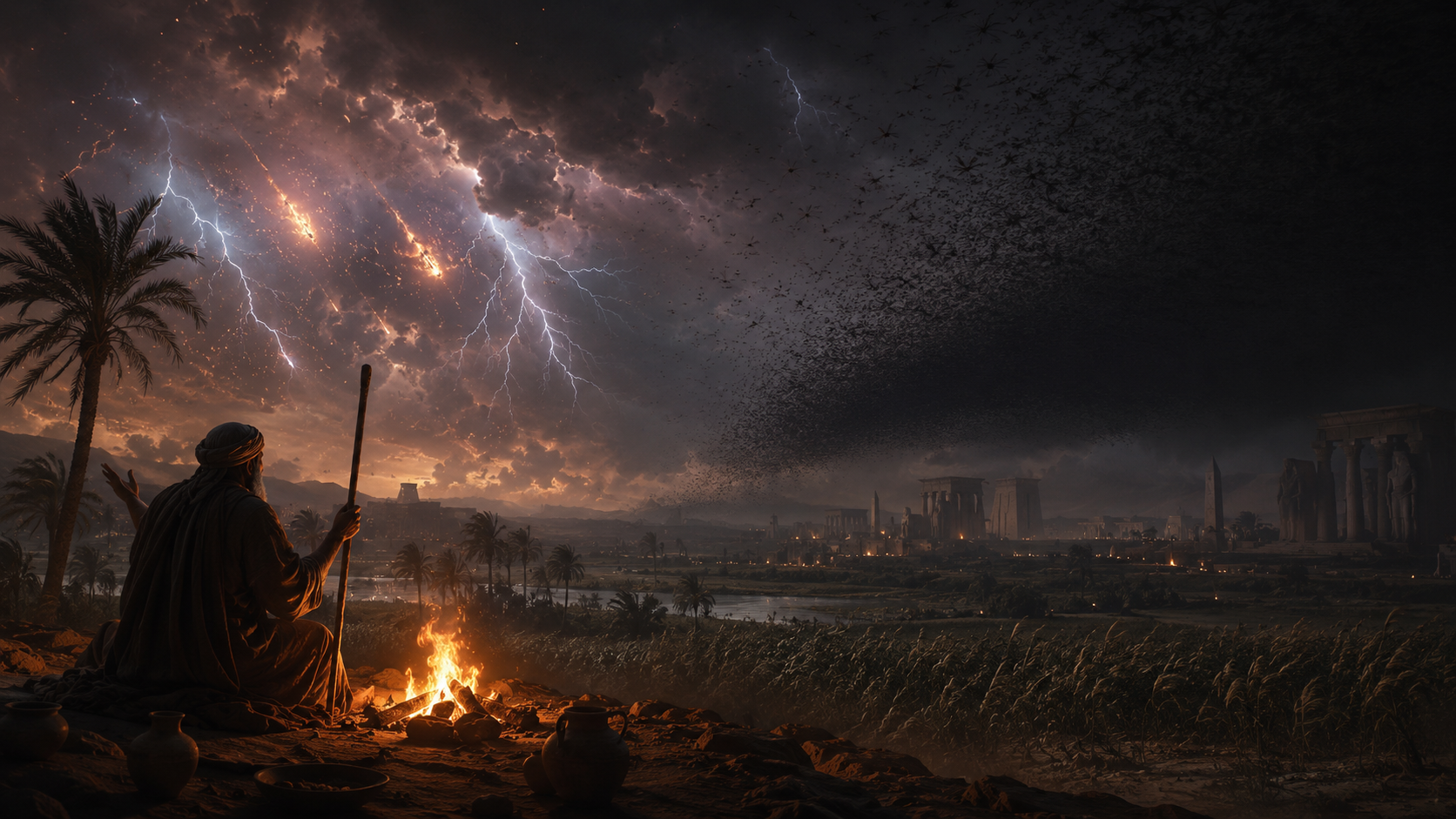
A Campfire Telling: The Storm, the Swarm, and the Dark
Settle in. This is what happened next.
Six plagues had come and gone.
The Nile had run red. The frogs had invaded every private space. The gnats had risen from the earth itself. The flies had blanketed everything. The livestock had died. Boils had broken out on every Egyptian body — on the magicians, on the priests, on the servants and the nobles and the people in the street. Six plagues. And Pharaoh had hardened himself against every one of them, riding each wave of suffering and refusing, every time, to let the people go.
By now, something had shifted in Egypt. Not in Pharaoh — not yet. But around him. The people were quieter than they used to be. The priests had stopped performing rituals they no longer had faith in. The merchants who relied on the Nile had lost everything and rebuilt and lost again. The farmers whose sacred cattle were dead stood in empty fields. There was a tiredness in Egypt — the tiredness of people who had been watching their gods fail them, one domain at a time, and did not know what to do with what they were seeing.
And then came the seventh plague.
Moses went to Pharaoh with a warning. This time the warning was longer, more urgent, more specific than any before it. It contained something new: a direct statement from God about why Pharaoh still existed at all.For this very purpose I have raised you up — to show my power in you, so that my name might be proclaimed in all the earth.Not a threat. A declaration of cosmic purpose. Pharaoh was not merely an obstacle. He was an instrument — a stage on which YHWH's authority over human empire would be displayed for every nation that heard the story.
Moses said: tomorrow I will cause very heavy hail to fall, such as has never been in Egypt since the day it was founded. Anything in the field — people or animals — that is not brought under shelter will die when the hail falls on them. Get your servants and your livestock inside.
And here — quietly, almost without comment, in a single verse that most readers pass over — something remarkable happened. Exodus 9:20:"Then whoever feared the word of the LORD among the servants of Pharaoh hurried his servants and his livestock into the houses."Some of the Egyptians believed Moses. They acted on the warning. They brought their animals in. And they survived. And those who did not believe left their animals in the field. And they died in the hail.
The judgment of Egypt was not indiscriminate. The word of YHWH was available to everyone who would receive it — Egyptian as well as Israelite. Those who feared the word lived. Those who did not, died. The Exodus contains, even in its judgment, the offer of salvation to anyone willing to trust the God of Israel over the gods of Egypt.
Then the hail came.
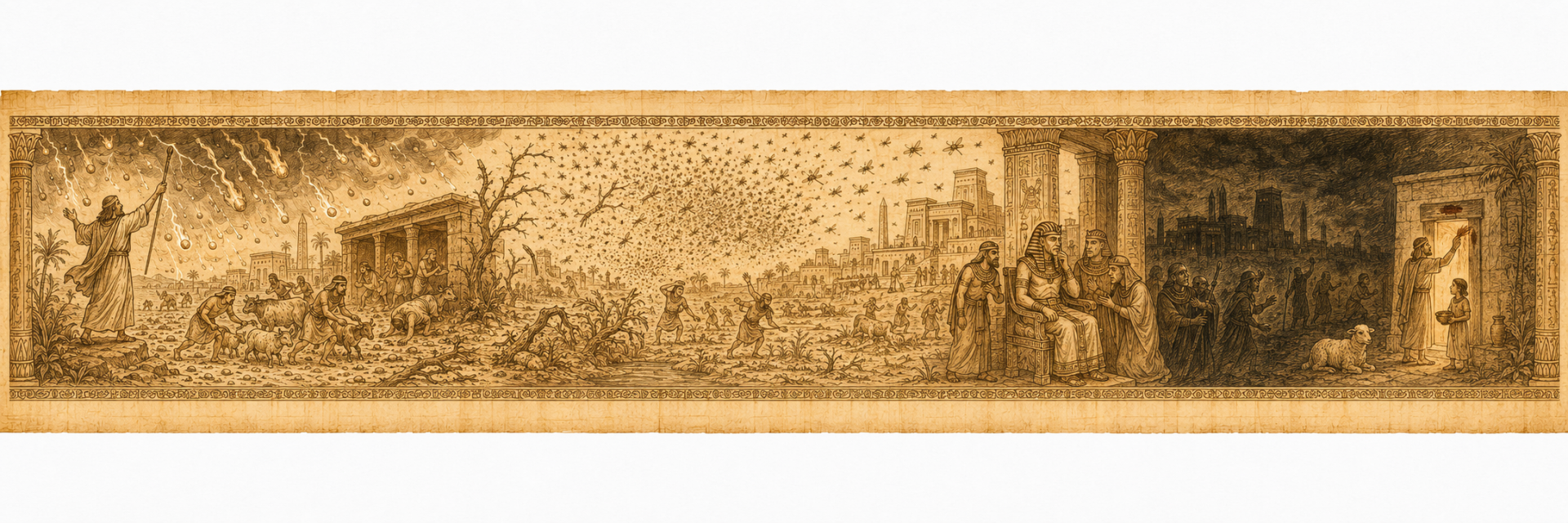
It was not ordinary hail. Exodus 9:24:there was hail and fire flashing continually in the midst of the hail — very heavy hail, such as had never been in all the land of Egypt since it became a nation.Hail and fire together. Lightning embedded in the storm, igniting what the ice did not destroy. Everything in the open field was struck down — people, animals, every plant, every tree. The flax was in bud. The barley was in ear. The grain harvest of Egypt was destroyed in a single storm.
All of it, except Goshen.
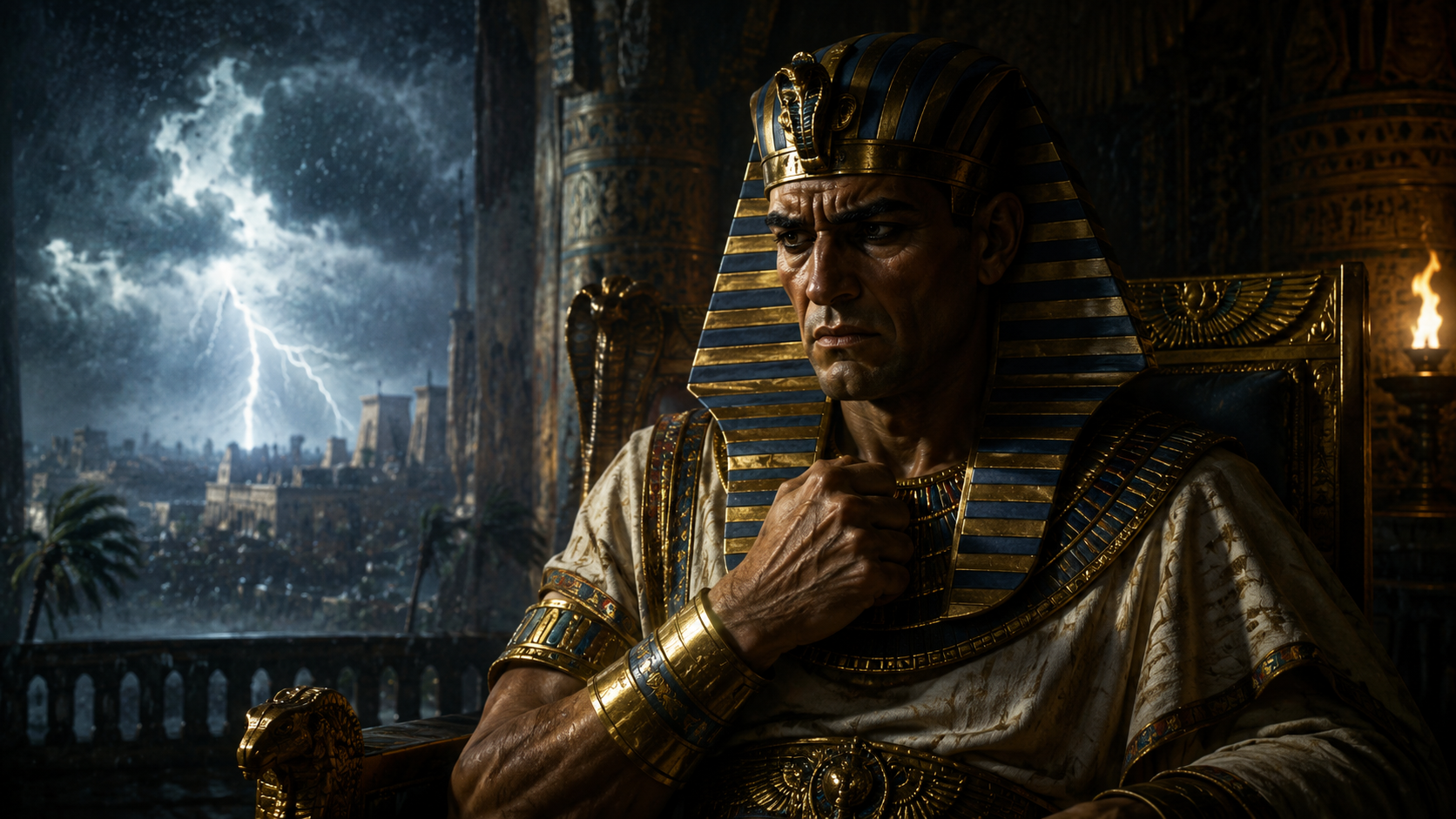
Pharaoh summoned Moses and Aaron. He said: this time I have sinned. The LORD is in the right, and I and my people are in the wrong. Plead with the LORD, for there has been enough of God's thunder and hail. I will let you go. Moses went out and spread his hands toward heaven. The hail stopped. The thunder ceased. The rain no longer poured down on the earth.
And Pharaoh saw that the rain and the hail and the thunder had ceased. And he sinned again and hardened his heart. And so did his servants.
He had said: this time I have sinned. And then he hardened himself the moment the pressure lifted. Seven plagues. Seven opportunities. And seven times: the relief came and the hardening followed, as certain as tide.
The Story Continues — Plague Eight
God said to Moses: go to Pharaoh. I have hardened his heart and the heart of his servants — that I might show these signs of mine among them. And that you may tell in the hearing of your son and your son's son how I have dealt harshly with Egypt and what signs I have done among them. That you may know that I am the LORD.
The plagues were being recorded. Not just performed. They were meant to be told. Father to son, generation to generation. The Exodus was designed from the beginning to be a story that would not stop being told. And it has not stopped. Three thousand years later, Jewish families sit down at the Passover table and tell this story again. Every year. The plagues are named. The wine is spilled for each one. The story is told because it was told, because it was told, all the way back to a generation of people who watched it happen and were commanded to tell their children what they had seen.
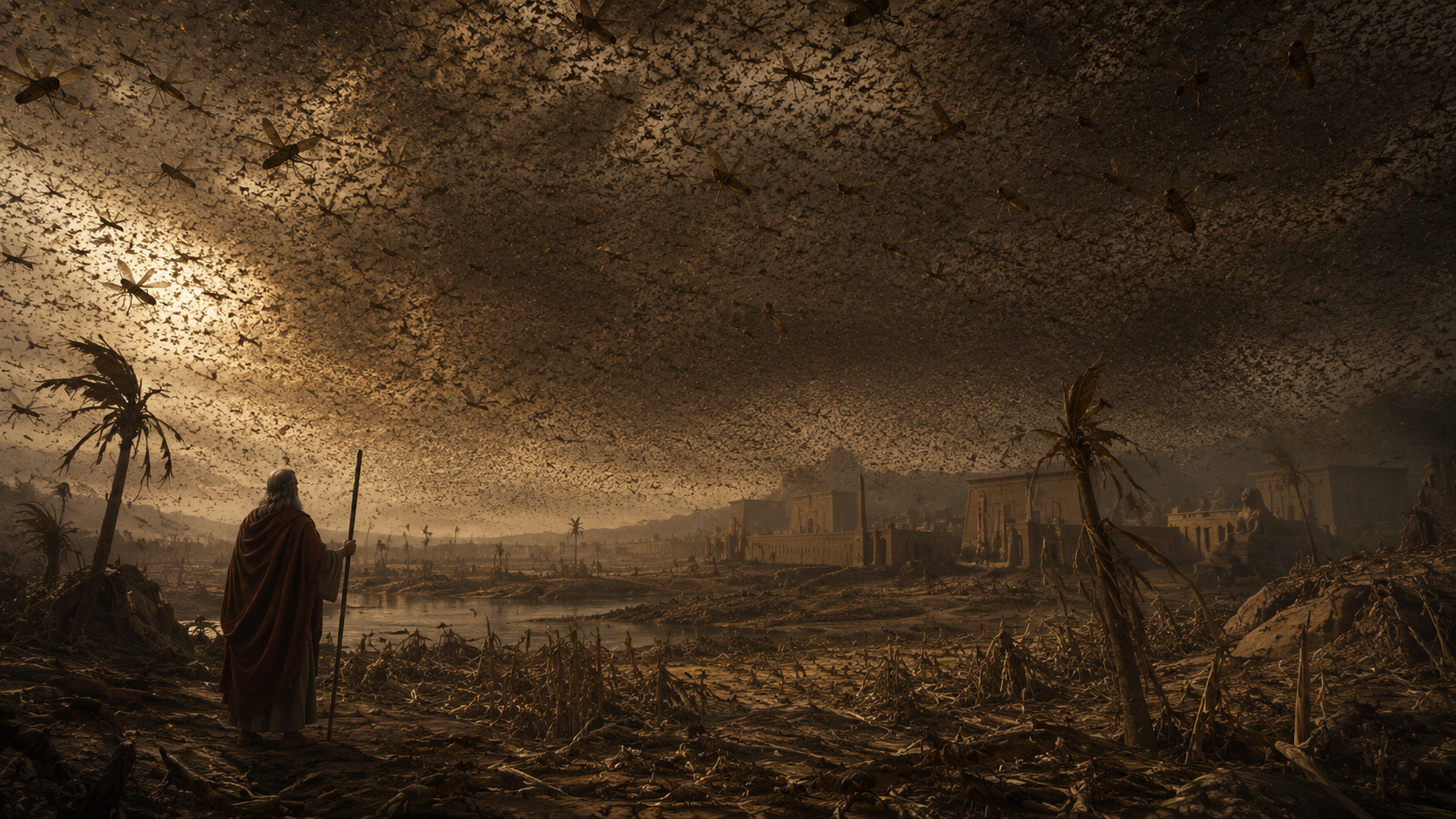
Then Moses stretched out his staff over Egypt, and the LORD drove an east wind across the land all that day and all that night. And when it was morning, the east wind had brought the locusts.
They covered the face of the whole land so that the land was darkened. They ate every plant in the land and all the fruit of the trees that the hail had left. Not a green thing remained, neither tree nor plant of the field, through all the land of Egypt.
The land was darkened. That phrase. The locusts were so dense, so absolutely covering, that the sky was blocked and the land below fell into shadow. Egypt, the richest agricultural civilisation in the ancient world, was stripped bare. The fields Hapi's floodwaters had watered, the grain Osiris was believed to sustain, the crops Renenutet the harvest goddess was supposed to protect — gone. All of it. In a morning.
And this time, something new. Before Moses and Aaron were even brought before Pharaoh, his servants spoke. Exodus 10:7:"Then Pharaoh's servants said to him: How long shall this man be a snare to us? Let the men go, that they may serve the LORD their God. Do you not yet understand that Egypt is ruined?"Do you not yet understand that Egypt is ruined. His own court. His own servants. Saying out loud what everyone in Egypt already knew.
Egypt was ruined. Not just damaged. Not just suffering. Ruined.
And even then, Pharaoh only partially yielded. He brought Moses back and said: go and serve the LORD your God. But he demanded to know exactly who would go. When Moses said: we will go with our young and our old, with our sons and daughters, with our flocks and herds — Pharaoh refused. Only the men. Leave your families. Leave your children. Go without your future.
Moses refused. All of us or none of us. That is what YHWH requires. The negotiation collapsed. The locusts stayed. Moses stretched out his hand, and the LORD drove them into the Red Sea. Not one locust remained. And Pharaoh hardened his heart. He did not let the people go.
The Story Reaches Its Penultimate Night
Nine plagues. And now the ninth.
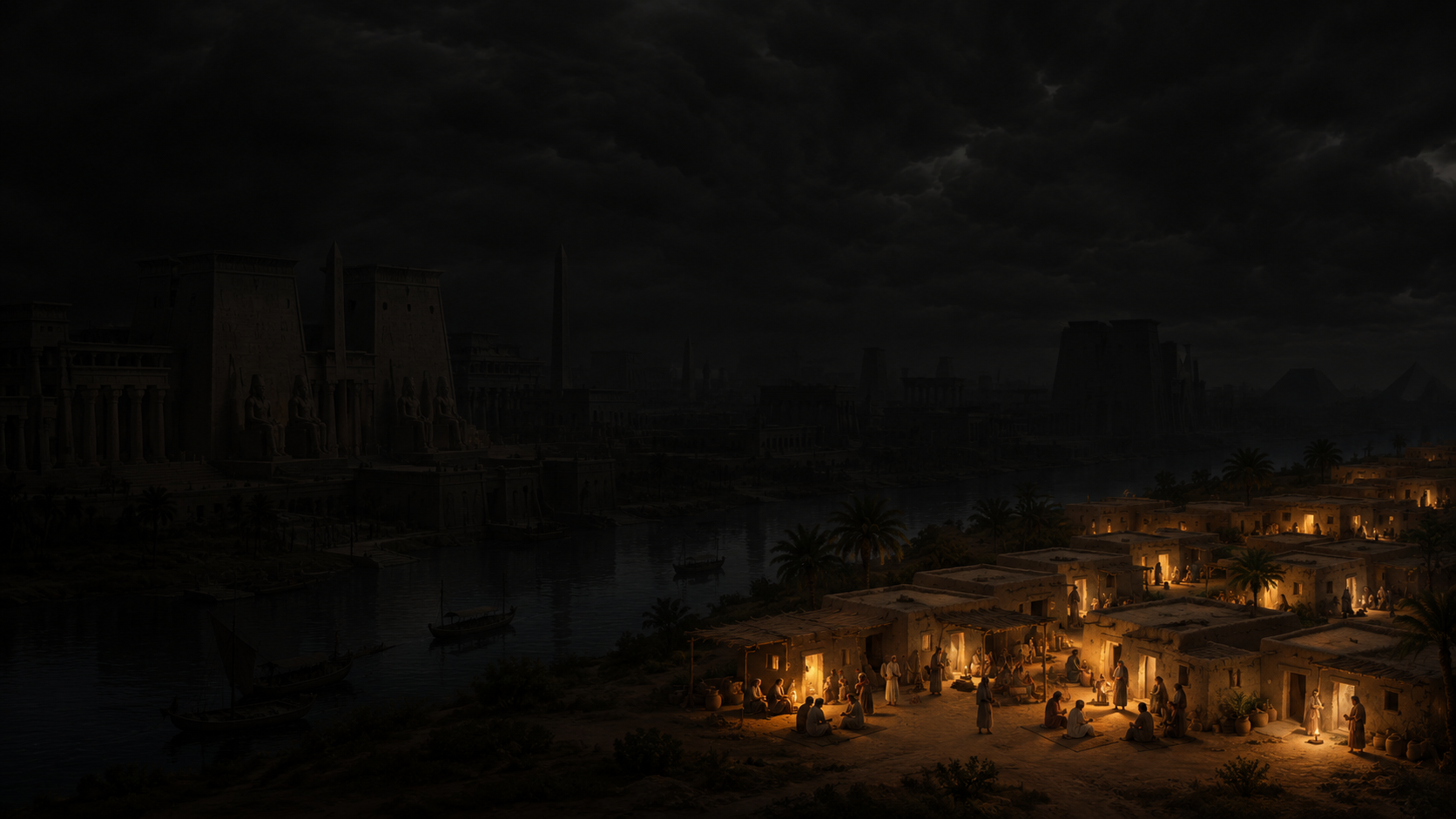
Moses stretched out his hand toward heaven, and there was thick darkness in all the land of Egypt three days. They did not see one another. And no one rose from his place for three days. But all the people of Israel had light where they lived.
Three days of darkness so complete that the text says people could not see each other. Could not move. Did not rise. This was not a cloudy day or an eclipse. This was something that entered the bones — a darkness you could feel, as Exodus 10:21 says:Moses stretched out his hand toward heaven, and there was pitch darkness in all the land of Egypt three days. You could feel the darkness.
And Israel had light. In their homes. In Goshen. Light. Not because of better geography or lucky weather. But because the God who made the darkness exempted His people from it. In the middle of nine plagues, YHWH maintained light for those who belonged to Him. That detail — so easy to pass over — is one of the most important in the entire plague narrative.
And Ra — the sun god. Pharaoh himself, the Son of Ra, the one whose divine title was bound up with the power of the sun — Pharaoh lived for three days in darkness while Hebrew slaves had light in their houses. The theological inversion is total. The bottom of Egypt became the top. The slave quarter had light. The palace was dark. The prisoner had what the king did not.
Pharaoh summoned Moses one more time. He said: go, serve the LORD. Your children may go with you. But your flocks and your herds shall remain. Go, but leave your economic future behind.
Moses said: not a hoof shall be left behind. Our livestock will come with us. We do not know with what we will serve the LORD until we arrive there. Every animal comes.
And Pharaoh's anger burned. He said: get away from me. Take care never to see my face again, for on the day you see my face you shall die.
Moses said: as you say. I will not see your face again.
Nine plagues. And Pharaoh had gone from I do not know the LORD to I will kill you if I see you again. The confrontation had reached its absolute limit. There was one plague left. And neither Moses nor Pharaoh would be the same after it.
The Passover night was coming.
The lamb was coming.
The blood on the doorposts was coming.
And then — the long walk out.
Where We Are: A Recap of the Story So Far
Nine parts in — the full arc before we go deeper
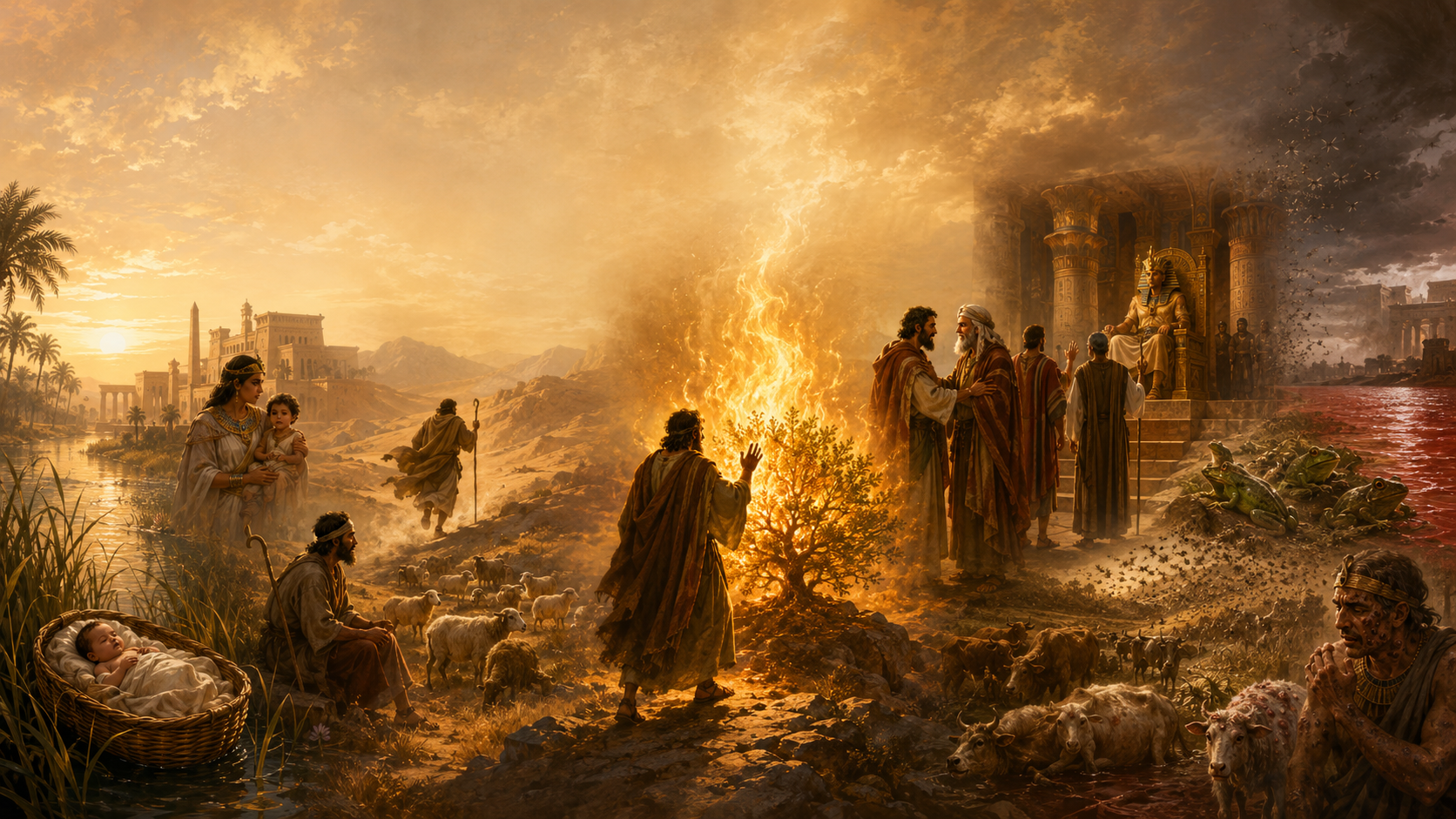
Before we dive into the deep study of Plagues Seven through Nine, let us orient ourselves in the full story. Nine parts in, this is the arc we have traced:
-
Parts 1–2: The World, Jochebed, and the Basket. Egypt at the height of its power. Seventy people became a nation. Four hundred years of silence and slavery. A mother who weaved a basket and trusted her son to the river. The princess who chose mercy. The name Moses — drawn out of water.
-
Parts 3–4: The Palace, the Pit, and the Flight. Moses raised in two worlds — Egyptian face, Hebrew heart. The killing of the overseer. The rejection by his own people. The flight to Midian. The man who sat down at a foreign well with nothing.
-
Part 5: The Desert School. Forty years of formation in hiddenness. Three phases of the Midian years. Jethro's teaching. The slow stripping of palace presumption. The man who had finally learned how to be small.
-
Part 6: The Burning Bush. The ordinary Tuesday morning. The bush that burned without consuming. I AM WHO I AM. Five objections. The gift of Aaron. The Name disclosed for the first time in its fullness.
-
Part 7: The Road Back. The strange attack at the lodging place. Zipporah's courage with the flint knife. The reunion kiss at Horeb. Aaron telling everything. The people of Israel bowing their heads and worshipping.
-
Part 8: Pharaoh Says No. Walking back into the palace. Let my people go. Pharaoh's theologically honest refusal: I do not know the LORD. The punitive escalation — straw removed, quotas maintained. Moses' second crisis of faith. The seven-fold promise of Exodus 6.
-
Part 9: The First Six Plagues. The 3-3-3-1 literary structure. The Nile to blood, Hapi dismantled. Frogs, Heqet inverted. Gnats from the dust, Geb's domain weaponised. The magicians' confession — this is the finger of God. Flies, the Goshen distinction drawn. Livestock dead, Hathor and Apis judged. Boils, Sekhmet's healers covered and silenced. The judicial hardening formally begins.
Now we are in the second half. The plagues escalate to a new register. Property has been destroyed. Bodies have been afflicted. Now, with Plague Seven, death enters the open field in a way it has not before. And with Plague Nine, light itself is taken from Egypt's sky.
We are seven, eight, nine of ten. The Passover night is one plague away. Everything we study in Part Ten is the penultimate movement — the final building of pressure before the night that changes everything.
Hail: Fire and Ice from the Sky
Exodus 9:13–35 — The agricultural destruction of Egypt, and a warning that saves lives
Hail — Fire and Ice Barad (בָּרָד) — Hail Exodus 9:13–35
Egyptian Gods Targeted
Nut — the sky goddess, depicted as a woman arching over the earth, her body forming the vault of heaven. She was the mother of Osiris, Isis, Seth, and Nephthys. The sky was her body. What fell from the sky was under her domain. YHWH used her own domain as the instrument of destruction.
Shu — the god of air and atmosphere, who held the sky aloft. Tefnut — goddess of moisture and weather. The storm comes from the domain of these two — and they cannot prevent it or control it.
Seth — the god of storms, chaos, and the desert, sometimes associated with thunder. Seth was not always a villain in Egyptian theology — he protected Ra's solar barque against the chaos serpent Apep. But even Seth's power over storms is shown to be subordinate. YHWH controls the storm Seth was supposed to embody.
Natural Science Background
Egypt receives almost no rainfall normally — the entire agricultural system depends on Nile irrigation, not rainfall. A hailstorm of any significant size in the Nile delta would be an extraordinary event. The combination of hail and embedded lightning described in Exodus 9:24 — barad v'esh mitlakachat b'tokh habarad ("hail and fire seizing itself in the midst of the hail") — describes what meteorologists call a supercell thunderstorm with embedded lightning, where electrical discharge occurs within the hail matrix itself. This is a phenomenon documented in severe convective storms and produces exactly the effect described: simultaneous hail and continuous lightning flashing through it.
The timing is significant: Exodus 9:31–32 tells us the flax and barley were destroyed (they were in bud and ear respectively) but the wheat and spelt were not yet ripe and so survived. This agricultural precision dates the plague to January–February in the Egyptian calendar — the season when flax and barley are in their final growth stages. The wheat survives — but only to be consumed by the locusts of Plague Eight. The ecology of the plagues is sequential and coherent.
The Most Important Verse in This Plague — Exodus 9:16
The warning before Plague Seven contains the most explicit statement of the purpose of the entire plague sequence. Exodus 9:16:
"But for this purpose I have raised you up, to show you my power, so that my name may be proclaimed in all the earth."
God is speaking directly to Pharaoh — and He is not saying: I am going to destroy you. He is saying: I have raised you up. He has positioned this particular man, at this particular moment in history, for a purpose that extends beyond Egypt and beyond this confrontation. The display of divine power over Pharaoh's resistance is meant to be heard by nations that have never heard of YHWH. The Exodus is a global epistemological event dressed as a regional political crisis. Paul quotes this verse in Romans 9:17 as one of the key texts for understanding divine sovereignty and election.
The Detail Almost Everyone Misses — Exodus 9:20
"Then whoever feared the word of the LORD among the servants of Pharaoh hurried his servants and his livestock into the houses."
Some Egyptians believed the warning. They acted on it. They survived. This single verse shatters the idea that the plagues were an indiscriminate assault on the Egyptian people. YHWH made the warning public and available. The response to it was a matter of individual choice. Whoever feared the word of the LORD — the same language used of the Hebrew midwives in Exodus 1:17. Fear of God, regardless of ethnicity, produces protective action.
This is the early appearance of what will become explicit in the Passover narrative: the blood on the doorpost protects whoever is behind it. The criterion is not ancestry. It is whether you trust and act on the word of YHWH. Rahab the Canaanite will be saved the same way. Ruth the Moabitess will join the covenant people the same way. The grace of the Exodus is wider than Israel.
Pharaoh's Confession — and Why It Was Not Genuine
Exodus 9:27–28, 34–35 — The Confession and the Retraction
Verse 27–28
"Then Pharaoh sent and called Moses and Aaron and said to them, 'This time I have sinned; the LORD is in the right, and I and my people are in the wrong. Plead with the LORD, for there has been enough of God's thunder and hail. I will let you go, and you shall stay no longer.'"
Hebrew Analysis — The Anatomy of Incomplete Repentance
chatati hapa'am — "I have sinned this time." The phrase hapa'am — "this time" — is a small but devastating qualifier. It frames the confession as specific rather than comprehensive. Pharaoh is not saying: I have been wrong throughout. He is saying: this particular plague, this specific moment, has been too much. The apology is calibrated to the current pain, not to the underlying condition.
YHWH ha-tzaddik — "the LORD is the righteous one." This is a legal declaration — Pharaoh is acknowledging that YHWH's case is just. But the acknowledgement is forensic, not transformative. He is conceding a point, not changing his heart. This is the difference between intellectual assent to the truth and the kind of surrender that actually changes the direction of one's life.
The structure of Pharaoh's "repentance" throughout the plague narrative follows a consistent and instructive pattern: suffering produces confession; relief produces retraction. This is not repentance in the biblical sense — teshuvah, the turning of the whole person. It is crisis management. And the text is honest about it without moralising excessively. It simply shows us what happens: the hail stopped, and Pharaoh sinned again.
Verse 34–35
"But when Pharaoh saw that the rain and the hail and the thunder had ceased, he sinned again and hardened his heart, he and his servants. So the heart of Pharaoh was hardened, and he did not let the people of Israel go, just as the LORD had spoken through Moses."
The Pattern Reaches Its Full Expression
Seven plagues. Seven times this pattern: pressure produces apparent yielding; relief produces hardening. The text by now has established this as a law of Pharaoh's inner life. The reader begins to expect the retraction before it comes. This is a sophisticated piece of character writing — by the seventh plague, the narrator no longer needs to surprise us. We know. And we know that Pharaoh knows, at some level, that he is going to harden again — and cannot stop himself.
This is the condition Paul is pointing to in Romans 7 when he describes the sinner who does what he does not want to do and cannot do what he wants. The hardened heart is not simply stubborn. It is in bondage. Pharaoh is not merely making bad choices. He has become the kind of person who can only make this choice. The judicial hardening is not punishing him for a single decision. It is confirming a direction that the pattern of his whole life has established.
And yet: three plagues remain. God has not withdrawn the opportunity. The pattern will play out two more times before the door closes entirely at Plague Ten.
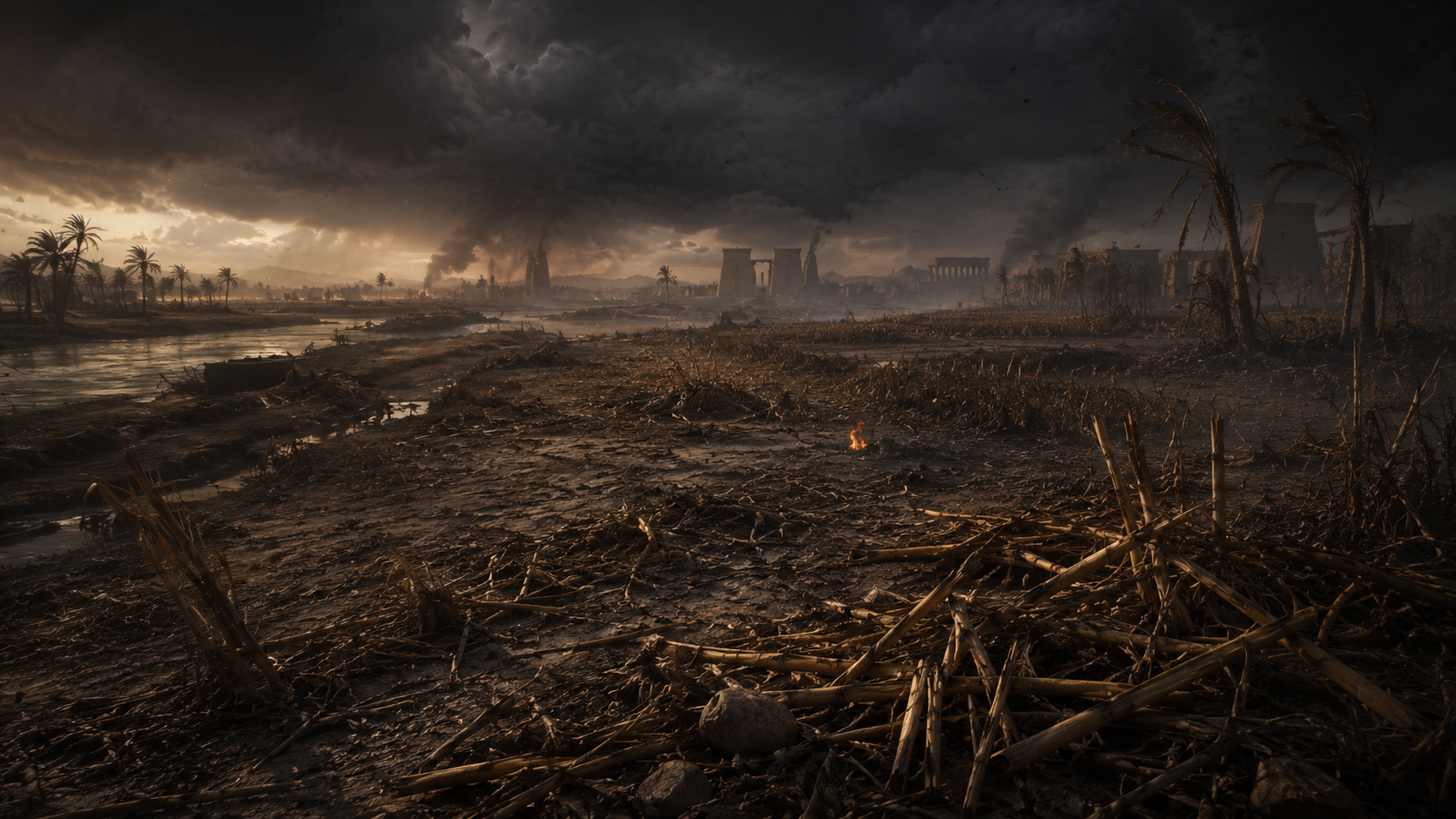
The Agricultural Destruction: What Egypt Lost
Historical & Cultural Context — Egypt's Agricultural Economy
Egypt's entire economic and religious life was built on agriculture. The annual Nile flood deposited the rich black silt that made the Nile Valley the most productive agricultural land in the ancient world. Grain — barley and wheat primarily — was the basis of Egyptian wealth, the commodity that sustained the army, the priests, the state laborers, and the population. Egypt was the breadbasket of the ancient Mediterranean world.
The Ebers Papyrus and Anastasi Papyri describe the agricultural calendar in detail. Barley and flax were winter crops, maturing in January–February. The hail of Plague Seven, explicitly said to destroy the barley and flax while the wheat survived, places this plague with remarkable precision in the Egyptian agricultural year. The destruction of these two crops alone would have been an economic catastrophe.
The connection to the harvest goddess Renenutet — a snake-headed or cobra-hooded goddess worshipped at harvest time and believed to ensure good yields — is important here. Renenutet was specifically invoked to protect crops from vermin and storm damage. Her failure during the plagues is not incidental. She was the deity whose specific job was to prevent exactly this. Instead: hail. Fire. Everything in the open field struck dead.
And then locusts would consume what little remained. The two plagues work in tandem, systematically stripping Egypt of the agricultural surplus that had made it great. By the end of Plague Eight, there was nothing green left in Egypt. Not a leaf on a tree. Not a blade of grass. Not a plant of any kind. The richest farmland in the world had been reduced to dust.
Hail and the Revelation 16 Connection
Revelation 16:21 describes the final bowl judgment: "And great hailstones, about one hundred pounds each, fell from heaven on people; and they cursed God for the plague of the hail, because the plague was so severe."
The explicit echo of Exodus 9 is intentional. The final judgment of human empire in the book of Revelation uses the same instruments as the judgment of Egypt — the archetypal human empire — in the Exodus. Hail is not merely a meteorological phenomenon in Scripture. It is a signature weapon of divine judgment on systems that claim dominion over God's creation: Psalm 18:12–13; Joshua 10:11; Isaiah 28:2. Each time, hail marks the moment when heaven asserts its authority over earth's claims.
The Christological connection runs specifically through Matthew 27:45, where the crucifixion is accompanied by three hours of darkness — directly echoing Plague Nine. The judgment that fell on Egypt as a consequence of rejecting God's word falls on Jesus as he bears the judgment of the world. The plagues are not only historical events. They are the vocabulary God uses to describe what sin costs and what redemption requires.
Locusts: The Living Darkness
Exodus 10:1–20 — The land is stripped bare, and the court cracks open
Locusts Arbeh (אַרְבֶּה) — Locust Swarm Exodus 10:1–20
Egyptian Gods Targeted
Nepri — the grain god, protector of the harvest, depicted holding grain stalks. The locusts devoured his entire domain.
Renenutet — the harvest goddess, specifically responsible for protecting crops from vermin. Her complete failure to protect Egypt's agricultural yield demonstrates her powerlessness before YHWH.
Min — the god of fertility and the harvest, patron of desert travellers and caravans, associated with the lettuce plant and agricultural abundance. His sacred domain is stripped.
Osiris — God of the dead and resurrection, also associated with vegetation and grain. The death and revival of vegetation was understood in Egyptian theology as Osiris' own death and resurrection. Locusts devouring every green thing was, theologically, a statement about Osiris' inability to sustain his own domain.
Natural Science Background
The desert locust (Schistocerca gregaria) is one of the most destructive insects on earth. A single swarm can contain 40–80 million individuals per square kilometre and consume their own weight in food each day. A large swarm can consume as much food as 35,000 people in a day. They travel with prevailing winds — exactly as described in Exodus 10:13 (east wind bringing them) and 10:19 (west wind removing them).
The 2020 East African locust swarms — the worst in seventy years — destroyed crops across Kenya, Somalia, Ethiopia, and India. Satellite images showed swarms so dense they registered on weather radar. Ancient sources describe locusts blocking out the sun and creating near-total darkness at midday. The connection to the darkness of Plague Nine may not be coincidental — severe locust infestations actually do reduce light levels significantly.
The ecological cascade is complete: dead fish (Plague 1) → frog explosion and die-off (Plague 2) → insects (Plague 3) → flies (Plague 4) → disease (Plagues 5–6) → crops destroyed by hail (Plague 7) → what remained consumed by locusts (Plague 8). The plagues follow real-world ecological sequencing with extraordinary precision.
The Purpose Statement — Exodus 10:1–2
Before Plague Eight, God gives Moses the most explicit statement of the plagues' ultimate audience — and it is not Pharaoh. It is future generations.
"Go in to Pharaoh, for I have hardened his heart and the heart of his servants, that I may show these signs of mine among them, and that you may tell in the hearing of your son and your son's son how I have dealt harshly with Egypt and what signs I have done among them, that you may know that I am the LORD."
That you may tell. Father to son, son to grandson. The plagues were designed to generate testimony. They were meant to become a story that would not stop being told — and it hasn't. The Passover Seder has been conducted every year for three thousand years, retelling these plagues, naming them, spilling wine for each one, asking the four questions, telling the children again. The plagues are not a historical episode. They are a living theological tradition, repeated annually because God designed them to be repeated annually.
The Cracking of Pharaoh's Court
Before Moses even arrives, Pharaoh's own servants intervene. Exodus 10:7: "Then Pharaoh's servants said to him, 'How long shall this man be a snare to us? Let the men go, that they may serve the LORD their God. Do you not yet understand that Egypt is ruined?'"
Ha'lo teda ki avdah Mitzrayim? — Do you not yet understand that Egypt is ruined? The servants are not pleading for theological reasons. They are making an economic and political assessment. This is not a court of believers. These are pragmatists who can see what their master cannot: the kingdom is gone. Whatever spiritual resistance Pharaoh maintains, Egypt has been functionally destroyed.
This fracture in the court is theologically significant. The hardening of Pharaoh does not mean everyone around him is equally hardened. The people closest to him — the ones who have watched nine plagues up close — can see reality more clearly than their king. Power has a way of insulating its holder from the consequences of their decisions. Pharaoh lives in a palace; his servants are in the field. They know what Egypt actually looks like now.
What Most Readers Miss: The Four Negotiating Positions
Across the plague narrative, Pharaoh makes four distinct offers to Moses — each one slightly more concessive than the last, each one falling short of what YHWH requires. Understanding the pattern reveals the theological principle at stake: God will not accept a partial release of people He has claimed as entirely His own.
Pharaoh's Four Negotiating Positions — and Why Each Was Refused
Position 1 — "Sacrifice here in Egypt" (Plague 4, Exodus 8:25): You can worship, but stay in Egypt. God's answer: No. You cannot worship YHWH while remaining under Pharaoh's authority. Worship requires separation. You cannot serve two masters. The spiritual life cannot be conducted inside the kingdom that enslaves you.
Position 2 — "Go, but not too far" (Plague 4, Exodus 8:28): Go, but stay within my reach. Keep it provisional. God's answer: No. Half-freedom is not freedom. The call to follow God is not a call to go a little distance and retain the option to return.
Position 3 — "Only the men may go" (Plague 8, Exodus 10:11): The adults can go. Leave the children. Leave the future. God's answer: No. The covenant includes the children. The faith is generational. YHWH does not call fathers to freedom while leaving their children in bondage. The command is: bring your sons and daughters.
Position 4 — "Go, but leave your livestock" (Plague 9, Exodus 10:24): Go, but leave your economic collateral. Leave something I can use to bring you back. God's answer: Not a hoof. Israel's wealth and resources are not Pharaoh's leverage. Everything that belongs to Israel — present and future, children and animals — belongs to YHWH's covenant people and must go with them.
Each offer is spiritually recognisable. Every one of them has a modern equivalent: the person who is willing to acknowledge God as long as they don't have to change their context, their family arrangements, their financial priorities, or their future planning. YHWH's answer is consistent across all four: all of you, all that you have, all of your future belongs to Me. Half-surrender is not surrender.
Exodus 10:1–2 — Why the Plagues Are Being Told
Verses 1–2
"Go in to Pharaoh, for I have hardened his heart and the heart of his servants, that I may show these signs of mine among them, and that you may tell in the hearing of your son and your son's son how I have dealt harshly with Egypt and what signs I have done among them, that you may know that I am the LORD."
l'ma'an t'sapper b'oznei vincha — "that you may tell in the hearing of your son." The verb sapper — to tell, to recount, to narrate — is the root of the word sefer (book) and mispar (number). This is not casual conversation. This is commanded narrative transmission. The plagues are being performed so they can be told, so that the telling can be performed again.
The immediate audience of the plagues is Egypt. But the intended audience across time is every generation of Israel — and through Israel, the world. Paul quotes Exodus 9:16 in Romans 9:17 to a Roman audience centuries later. The story has been doing exactly what God designed it to do: traveling through time in human memory and telling the world about YHWH.
viyda'tem ki-ani YHWH — "that you may know that I am the LORD." The formula returns. This is not merely about historical memory. It is about living knowledge of God's identity — transmitted generation to generation through the retelling of what He did in Egypt. The plagues are the foundation of Israel's theological education. Every time a parent sits with a child at Passover and says "we were slaves in Egypt," they are continuing the transmission God commanded here.
Locusts in Joel and the New Testament — The Living Theology of the Locust
The prophet Joel builds his entire theology of the Day of the LORD around a locust invasion (Joel 1–2). The language he uses — "a nation has invaded my land, mighty and beyond number" (Joel 1:6) — deliberately echoes Exodus 10 while describing a contemporary catastrophe. For Joel, the locust swarm is not merely agricultural disaster. It is a theological message: this is what the Day of the LORD will look like. This is the scale of judgment that awaits the nations that have set themselves against God.
Then in Acts 2:17–21, Peter quotes Joel 2:28–32 to explain Pentecost. The Spirit is poured out. The same section of Joel that begins with locust judgment ends with the promise of the Spirit. The path from locusts to Pentecost runs through the Exodus — through the pattern of judgment, repentance, and restoration that the plagues establish. Joel understood the Exodus. Peter understood Joel. And on Pentecost Sunday, the pattern completed a cycle it had begun in Egypt.
The locust also appears in Revelation 9:3–10 — demonic locusts that come from the Abyss and torment those who do not have the seal of God. The Exodus locust plague is the template. Just as God's locusts left Goshen untouched and only afflicted Egypt, the Revelation locusts are told not to harm those sealed by God. The criterion is the same: whose are you? The judgment pattern established in Egypt is the governing pattern of all judgment throughout Scripture.
The Darkness You Could Feel
Exodus 10:21–29 — Three days without light, and the moment Pharaoh's last door closes
Darkness Choshech (חֹשֶׁךְ) — Thick Darkness Exodus 10:21–29
Egyptian Gods Targeted
Ra — the supreme sun deity, king of the gods, father of Pharaoh. The sun was Ra's journey across the sky in his solar barque — a daily cosmic event that sustained the universe itself. Every morning when the sun rose, Ra had defeated Apep the chaos serpent and brought light and order to creation. Without Ra's daily journey, creation would collapse into chaos.
Three days of darkness was not merely bad weather. It was a declaration that Ra had been defeated. Not by Apep the chaos serpent — but by YHWH. The God of Israel had stopped the sun god's journey for three days. Ra's fundamental claim — I sustain the light of the world — was shown to be false. He sustained nothing. YHWH sustained everything, including the right of the sun to rise.
Pharaoh himself was identified as the Son of Ra and the living Horus. His divine authority derived from the sun god. Three days of darkness was an attack not just on Ra but on the foundation of Pharaoh's divine claim to rule. In the darkness, Pharaoh was just a man in a dark room. His deity was absent. His cosmic authority was suspended. He could not see, could not move, could not maintain the divine order he was supposed to embody.
Natural Science — What Kind of Darkness?
Several natural explanations have been proposed for Plague Nine, none of them fully adequate to the text's description of a darkness you could "feel" lasting three days:
Khamsin sandstorm: The khamsin is a hot, dry, sand-bearing wind that blows into Egypt from the desert, reducing visibility to near zero and lasting one to three days. The sand particles fill every space — including the lungs — and create a physically oppressive atmosphere. The description "darkness that can be felt" (Exodus 10:21 — choshech asher yimashesh) could describe the tactile quality of sand-laden air.
Volcanic winter effect: Some scholars have connected the plague sequence to a major volcanic eruption (possibly Santorini/Thera, c. 1628 BC) that may have ejected enough ash into the atmosphere to cause multi-day darkness at regional scale. The dating is contested, but the phenomenon is scientifically documented.
Dense locust cloud: As noted in Plague Eight, severe locust swarms reduce light levels significantly. If Plague Nine followed immediately, the residual locust population combined with their shed carapaces could have contributed to reduced light.
The most theologically significant element: the darkness did not affect Goshen. Israel had light. Whatever natural mechanism contributed to the darkness, its precise geographical limitation to non-Goshen Egypt is the signature of divine control.
Darkness That Can Be Felt — The Hebrew
choshech asher yimashesh — "darkness that can be felt/groped." The verb mashash means to grope, to feel one's way by touch. This darkness is tactile. It is not merely the absence of light but a presence in itself — something thick, heavy, physically oppressive.
This precise Hebrew phrase connects directly to Deuteronomy 28:29, where the covenant curse for disobedience includes: "you shall grope at noonday, as the blind grope in darkness." The darkness of Plague Nine is both a historical event and a living embodiment of the covenant curse — Egypt, which has rejected YHWH's covenant demands, experiences in its body the very condition described as the penalty for covenantal unfaithfulness. The plagues are not only judgment. They are enacted Scripture.
Amos 5:18–20 describes the Day of the LORD as darkness rather than light — "as if a man fled from a lion, and a bear met him." The eschatological Day of the LORD that Israel dreaded is prefigured in Egypt's darkness. And Jesus, in Matthew 27:45, hangs on the cross for three hours in darkness — exactly echoing the three days of Plague Nine. The judgment that fell on Egypt falls on the Son of God as He bears the sin of the world.
Israel Had Light — The Full Theological Weight
Exodus 10:23: "They did not see one another. No one rose from his place for three days, but all the people of Israel had light where they lived."
The Goshen distinction reaches its most dramatic expression here. Egypt cannot see. Cannot move. Is paralysed in total darkness. And in the same country, under the same sky, Israel has light.
This is the theological inversion that the entire plague sequence has been building toward. The greatest power in the world — built around the worship of the sun, identifying its king with the sun god — sits in three days of darkness. While the slaves it despised have light in their hovels.
John 8:12: "I am the light of the world. Whoever follows me will not walk in darkness, but will have the light of life." Jesus makes this statement in the context of the Feast of Tabernacles — one of the three pilgrimage festivals rooted in the Exodus. He is claiming for Himself what YHWH claimed at Plague Nine: the power to give light in the darkness. The God who gave Israel light while Egypt was dark gives light to all who follow His Son.
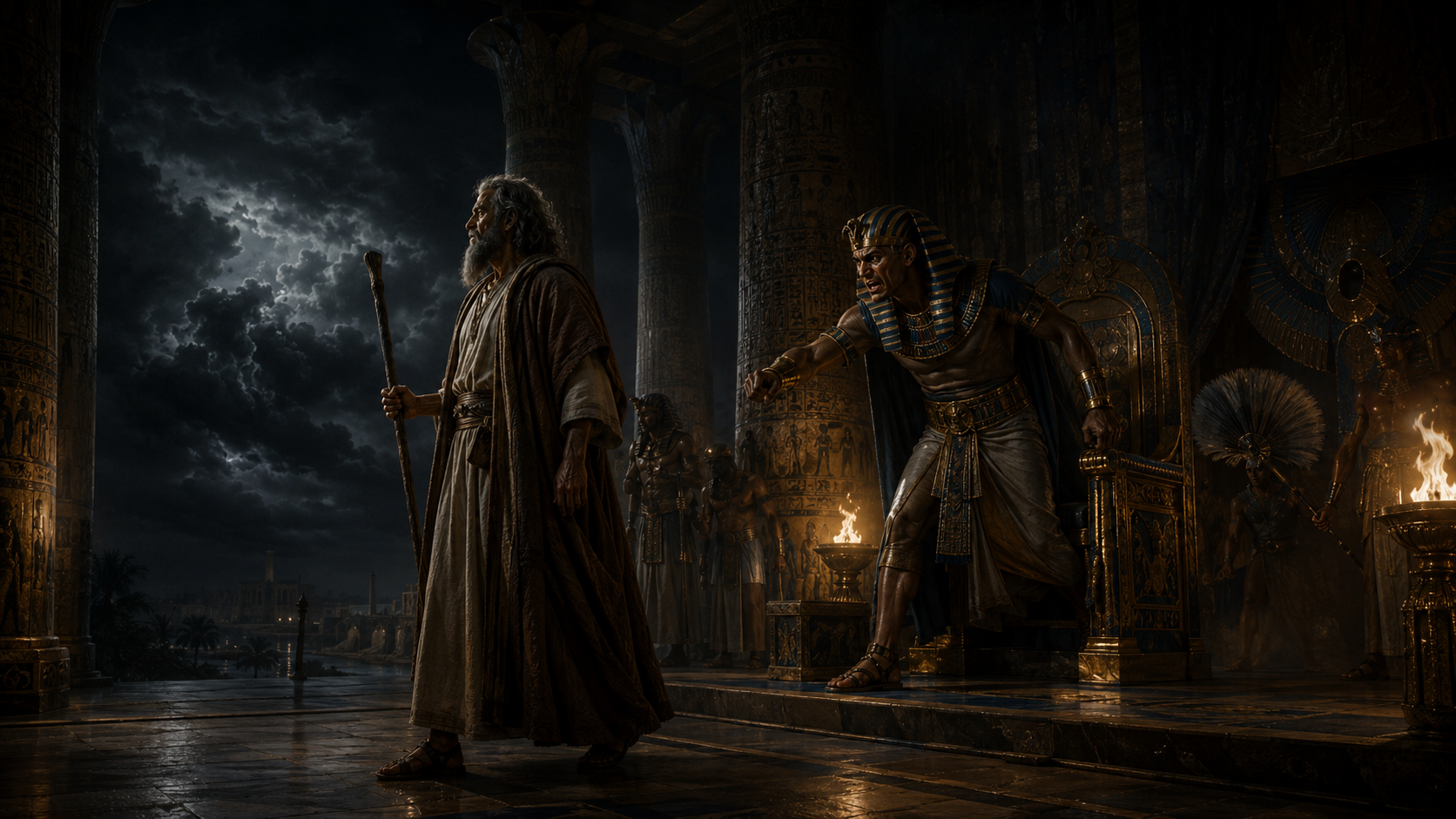
The Final Confrontation — Exodus 10:24–29
Exodus 10:24–29 — The Last Conversation
Verses 24–26
"Then Pharaoh called Moses and said, 'Go, serve the LORD; your little ones also may go with you; only let your flocks and your herds remain behind.' But Moses said, 'You must also let us have sacrifices and burnt offerings, that we may sacrifice to the LORD our God. Our livestock also must go with us; not a hoof shall be left behind, for we must take of them to serve the LORD our God, and we do not know with what we will serve the LORD until we arrive there.'"
Hebrew Analysis — "Not a Hoof Shall Be Left Behind"
lo tishaker parsah — "not a hoof shall remain/be left behind." The word parsah (hoof, divided hoof) is specific and concrete. Moses is not making a general statement about completeness. He is talking about hooves — individual hooves of individual animals. Not one. Not a single one.
This level of specificity is deliberate. Pharaoh's final offer is: go, take your children, but leave your livestock. It is economically sophisticated — the livestock represent Israel's wealth, their means of sacrifice, and their agricultural future. Without the animals, they cannot truly worship (they need sacrificial animals), cannot survive long-term (they need breeding stock), and are economically dependent on Pharaoh's goodwill to return what he holds.
Moses refuses with equal specificity. Not a hoof. We cannot even know what we will need until we arrive. The obedience of the Exodus is open-ended — it does not calculate the minimum required. It goes with everything. Nothing held back.
Verses 27–29
"But the LORD hardened Pharaoh's heart, and he would not let them go. Then Pharaoh said to him, 'Get away from me; take care never to see my face again, for on the day you see my face you shall die.' Moses said, 'As you say! I will not see your face again.'"
The Door Closes
lek me'alai — "Get away from me." The door has closed. For nine plagues, Pharaoh has repeatedly summoned Moses — needed him, negotiated with him, begged him to pray, watched him perform signs. Now Pharaoh expels him permanently. Never see my face again or you will die. The relationship between Pharaoh and Moses — strained, adversarial, but open — is formally ended.
ken dibarta — "As you say." Moses' final word to Pharaoh before Plague Ten is one of the most understated lines in the Bible. No dramatic declaration. No theological statement. Just: as you say. Moses accepts the terms. He will not see Pharaoh's face again. He does not need to. YHWH has one more thing to say to Egypt — and it will not require another audience.
Note the irony embedded in Pharaoh's threat: "you shall die if you see my face." Before the next morning, Pharaoh will have lost his own son. The threat of death moves from Pharaoh to Moses and back to Pharaoh's own house. He threatens death and receives it. Not as divine punishment for the specific threat — but as the culmination of ten plagues' worth of choices all pointing in the same direction.
The Darkness and the Cross — The Most Profound Christological Connection
Matthew 27:45: "Now from the sixth hour there was darkness over all the land until the ninth hour." Three hours of darkness at midday, from noon (the sixth hour) to three in the afternoon (the ninth hour), while Jesus hung on the cross.
Every Jewish reader of Matthew would have heard the echo of Exodus 10 — three days of darkness in Egypt, now three hours of darkness at Calvary. The connection is not accidental. Matthew is drawing the typological line explicitly: Jesus on the cross is enduring the judgment that fell on Egypt. The darkness that God sent as judgment on the nation that enslaved His people now falls on the Son of God who is bearing the sin of the world.
But there is an inversion as significant as the echo. In Egypt, the darkness fell on Egypt and Israel had light. At Calvary, the darkness falls on the Son of God — and through His endurance of it, light becomes available to everyone. The one who said "I am the light of the world" enters the darkness of divine judgment so that no one else has to. The ninth plague and the ninth hour are connected by more than numbers. They are connected by the logic of redemption: judgment absorbed by the one who did not deserve it, so that those who deserved it might have light.
In Goshen during Plague Nine: Israel had light where they lived. In John 8:12: "Whoever follows me will not walk in darkness, but will have the light of life." The same God. The same promise. The same light. Three thousand years apart.
The Cracking Court: Egypt Fractures From Within
What nine plagues did to the people around Pharaoh — and what it tells us
One of the most overlooked theological dimensions of the second half of the plague narrative is what is happening to the people around Pharaoh. While the hardening narrative focuses on the king, the text carefully documents the progressive disintegration of the Egyptian court — the widening crack between Pharaoh's stubborn will and the reality his servants are living in.
A Timeline of the Court's Collapse
- Plague 3 (Gnats):The magicians tell Pharaoh: "This is the finger of God." First crack. The king's own religious advisors acknowledge divine power operating beyond their system. Pharaoh does not listen.
- Plague 6 (Boils):The magicians cannot stand before Moses because of the boils. They disappear from the narrative permanently. Egypt's religious-medical establishment is incapacitated. The court has lost its theological expertise.
- Plague 7 (Hail):Exodus 9:20 — "whoever feared the word of the LORD among the servants of Pharaoh hurried his servants and livestock inside." Some servants independently choose to trust Moses' warning. They are no longer simply following Pharaoh's lead. Individual conscience is beginning to operate independently of royal command.
- Plague 8 (Locusts):The servants speak directly to Pharaoh before Moses is even summoned: "How long shall this man be a snare to us? Let the men go. Do you not yet understand that Egypt is ruined?" The court has reached a consensus that contradicts the king's position. They are not afraid to say it to his face.
- After Plague 9 (Darkness):Pharaoh expels Moses permanently. He is now isolated — his magicians gone, his servants openly disagreeing with him, his court fractured, his country destroyed. He is holding a position that everyone around him has already abandoned. He is the last man still hardened.
This progression matters theologically. The hardening of Pharaoh is not the hardening of Egypt. The Egyptian people are not a monolith. Individual Egyptians — servants who feared God's word, people who chose to bring their livestock inside — made different choices. The Exodus narrative is careful to preserve this distinction. It is Pharaoh alone who drives Egypt's destruction by the tenth plague. His court tried to stop him. They could see what he could not.
There is a pastoral principle here: the isolating effect of hardness. A hardened heart gradually loses its advisors, its support, its reality-checking relationships. People who once had access to Pharaoh — the magicians, then the servants — progressively lose the ability to reach him. By the end, he is expelling his last available intercessor. The hardened heart, sustained over time, creates a kind of prison: the person inside can no longer be reached by those outside who can see clearly.
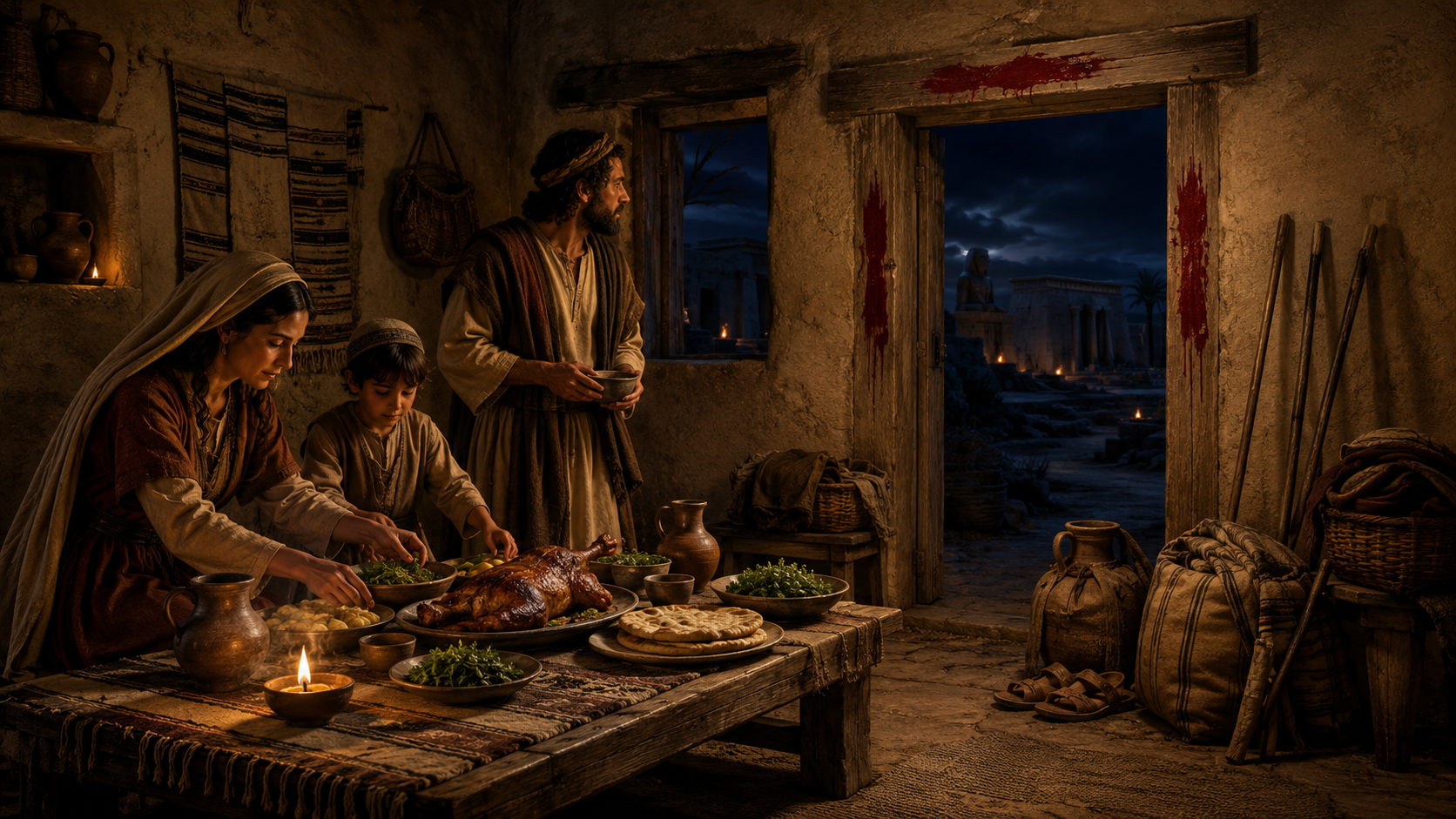
The Buildup to Passover
Everything the first nine plagues are preparing — and why the tenth stands alone
Nine plagues. And they have accomplished something that we may not fully appreciate until we stand on the threshold of the tenth. They have made the Passover intelligible.
Without the nine plagues, the Passover night is inexplicable — a strange ritual involving blood on doorposts, a meal eaten in haste, a night of death, and a sudden departure. With the nine plagues, every element of the Passover makes complete sense. The plagues are the context that gives the Passover its meaning. Let us map how:
How Nine Plagues Prepare Us to Understand the Passover
The blood on the doorpost makes sense because of Plague 1. The Nile turned to blood. Blood is the signature of divine judgment in this narrative — the substance that marks the presence of YHWH's action. When the angel of death sees blood on a doorpost, it is not an arbitrary signal. It is the covenant sign, in the language of blood that has pervaded the plagues from the beginning.
The lamb makes sense because of Plague 5. The death of livestock attacked Hathor, Apis, and Egypt's sacred animals. The Passover lamb is a Hebrew sacrifice of the very animals Egypt considered divine — a declaration of Israel's theology versus Egypt's at the moment of departure. They are not slaughtering their food animals. They are sacrificing what Egypt worshipped and applying its blood to their doorposts.
The urgency makes sense because of all nine plagues. After nine plagues and nine hardenings, the Israelites know that Pharaoh's word cannot be trusted. When he finally says "go," they cannot wait for morning. The bread does not have time to rise. Everything that happens on the Passover night is conditioned by nine plagues' worth of knowing who Pharaoh is.
The Goshen distinction makes sense in its ultimate form. The blood on the doorpost is the final Goshen marker — the visible sign that separates households under YHWH's protection from households under judgment. Every previous Goshen exemption — the flies, the livestock, the boils, the hail, the darkness — has been building to this: one night when the line between protected and unprotected is drawn in blood.
The firstborn makes sense as the culmination of the entire sequence. Pharaoh opened the plague sequence by ordering the death of Hebrew firstborn sons (Exodus 1:22). YHWH named Israel as His firstborn son (Exodus 4:22–23). Nine plagues have demonstrated YHWH's authority over every domain of Egyptian life. The death of Egypt's firstborn is the final, complete, and irreversible answer to Pharaoh's opening act: You killed My firstborn. I will take yours.
The tenth plague is not merely the largest of ten events. It is the culmination of a ten-part argument. Nine plagues have established, domain by domain, that YHWH is Lord of everything. The tenth establishes that He is Lord over life and death itself. And in establishing that, it creates the condition for the Passover — the night when God's judgment and God's mercy meet at a doorpost, separated by nothing more than blood.
Nine Plagues and the New Testament — The Complete Christological Pattern
We have traced Christological connections through each individual plague. But it is worth pausing to see the whole pattern at once. The nine plagues, taken together, make a Christological argument that the New Testament writers clearly understood:
The plagues demonstrate God's sovereignty over every domain. Jesus' miracles make the same claim — water to wine, healing, feeding thousands, commanding storms, raising the dead. He is Lord of every domain the plagues addressed. The miracle-worker of the Gospels is identified, by the pattern of His works, as the same God who sent the plagues.
The plagues demonstrate that God's judgment is neither arbitrary nor universal. The Goshen distinction, the warning before Plague Seven, the salvation of individual Egyptians who feared God's word — these establish that God's judgment is precise, purposeful, and avoidable by those who trust His word. The Gospel makes the same claim: judgment is coming, but the blood of the Lamb covers those who trust it.
The plagues generate the Passover, which generates the Exodus, which prefigures the cross. Paul's summary in 1 Corinthians 5:7 — "For Christ, our Passover lamb, has been sacrificed" — could not be written without the nine plagues. The Passover only has meaning because of what preceded it. The cross only has meaning as a Passover because of what preceded the first Passover. Remove the plagues and the cross loses its richest Old Testament context.
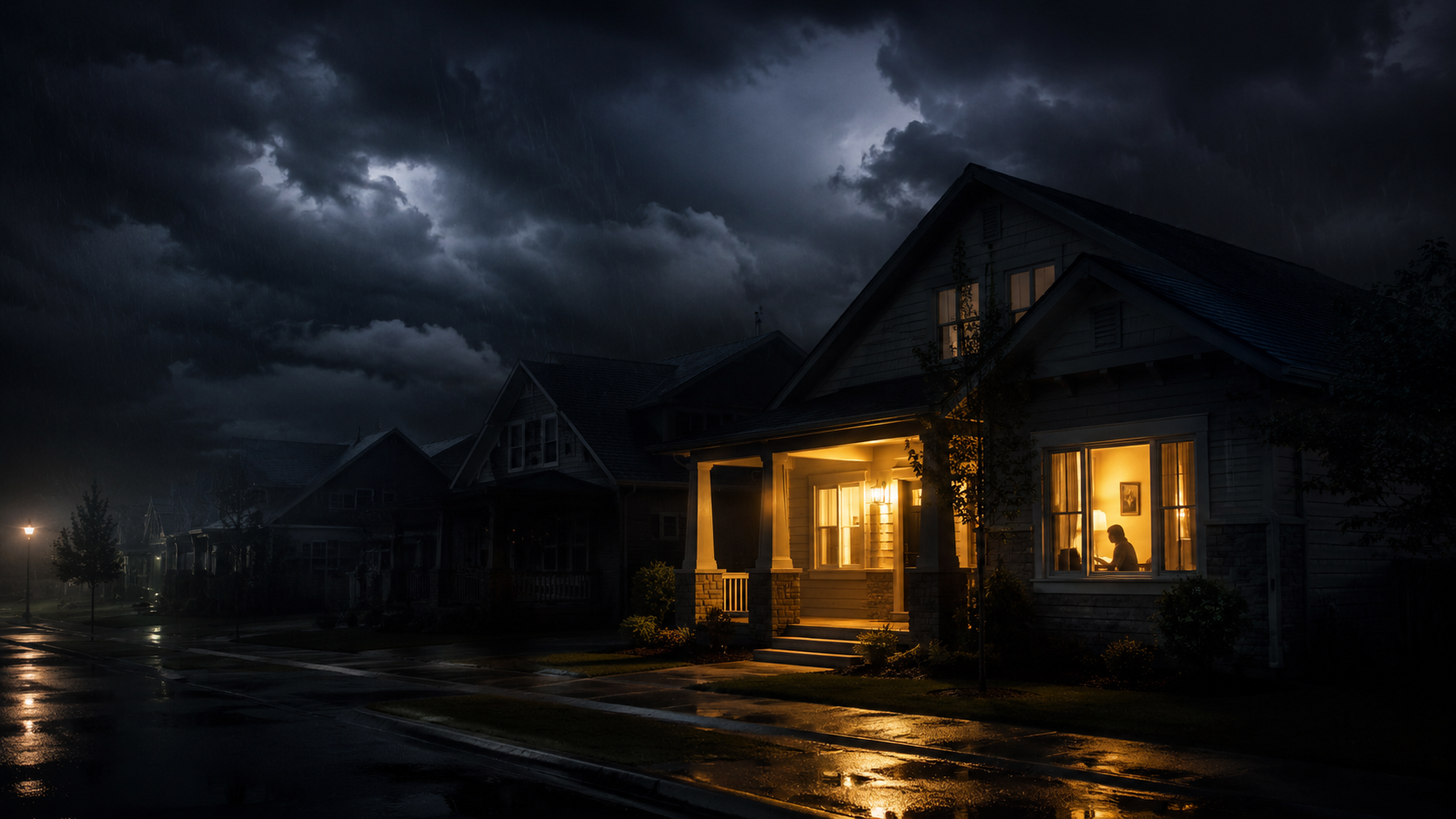
Devotional
The Light That the Darkness Could Not Overcome
Three days of darkness in Egypt. And in Goshen — light.
The same sky. The same country. The same sun that was not rising. And yet: Israel had light where they lived.
We do not know exactly how this worked. We know that it did. We know that whatever darkness covered Egypt, it stopped at the edge of where God's people were. Not because of anything about Goshen — not its geography, not its elevation, not its people's moral superiority. But because of whose they were. They belonged to the God who controls the light. And He kept the light on for His own people, in the dark, while the greatest empire in the world sat paralysed three days in total blackness.
John opens his Gospel with the language of this plague and its inversion. In the beginning was the Word, and the Word was with God, and the Word was God. In him was life, and the life was the light of men. The light shines in the darkness, and the darkness has not overcome it. He is not speaking abstractly. He is drawing a line from Goshen to Bethlehem, from the light in the slave quarters to the Light who is the life of the world. The God who kept the lights on in Goshen became a person, walked into the darkness of human history, and announced: the darkness does not get the last word.
Pharaoh sat in his palace in the dark. He was the Son of Ra. He was the light of Egypt. He was the man in whom the sun god was supposed to live. And he could not see his own hand in front of his face for three days while Hebrew slaves had lamplight.
There is something here about what it means to belong to God in a dark season. Not an exemption from every hard thing — the Israelites were still slaves when the darkness fell. They were still in Egypt, still waiting for the liberation that had been promised. But they had light. In the middle of their not-yet, they had light. In the middle of Pharaoh's darkness, God kept the lights on for the people he was coming to rescue.
Whatever darkness is around you today — whatever third-day darkness you are sitting in, waiting for something to change, waiting for the morning that has not come yet — this is the word of the God who controls the light: your people will have light where they live. The darkness has not overcome it. And the One who is the light of the world is not finished.

Reflection & Discussion Questions
Personal Reflection
1. Exodus 9:20 says that "whoever feared the word of the LORD among the servants of Pharaoh hurried his servants and livestock inside." Some Egyptians chose to trust and act on the warning. This suggests that the Exodus was not purely ethnic — anyone who trusted YHWH's word could shelter under it. How does this detail challenge any tendency to read the Exodus as "God saving Israel and judging everyone else"? And what does it tell you about the nature of salvation?
2. Pharaoh's four negotiating positions — stay in Egypt, don't go far, only the men, leave your livestock — each represent a partial surrender that is ultimately refused. Which of these four positions do you most recognise in your own spiritual life — the tendency to come to God conditionally, keeping something back? What is the thing you most struggle to bring with you all the way?
3. The court's progressive fracturing — from the magicians' confession to the servants' blunt "Egypt is ruined" — shows that the hardening isolates. By Plague Nine, Pharaoh has lost every person who could give him honest counsel. Have you seen this pattern in your own life or others' — how stubbornness gradually removes the voices that could help? What breaks this cycle?
Deeper Study
4. Read Joel 1:1–12 and then Exodus 10:1–20 side by side. How does Joel use the locust plague template? What theological point is he making by presenting a contemporary locust disaster as a "Day of the LORD" event? And how does Acts 2:17–21 (Peter quoting Joel at Pentecost) bring this full circle?
5. The darkness of Plague Nine is described as choshech asher yimashesh — darkness you could feel/grope. Matthew 27:45 records three hours of darkness at the crucifixion. John 8:12 records Jesus claiming to be "the light of the world" at the Feast of Tabernacles (which commemorated the Exodus). Connect these three texts into a single theological statement. What is the New Testament claiming about Jesus in relation to Plague Nine?
6. God says in Exodus 10:1–2 that the plagues are being performed so that Moses' children and grandchildren can be told what God did. This is a command to intentional narrative transmission. What is the Exodus equivalent in your own family or community? What stories of God's faithfulness are you responsible for transmitting to the next generation? Are you doing it?
7. The nine plagues build toward the Passover by making each of its elements intelligible. Go back and read the list in Section VI (How Nine Plagues Prepare Us to Understand the Passover). Which connection did you find most surprising or most moving? And how does understanding this preparation change how you approach the Lord's Supper — the New Testament Passover meal?
Closing Prayer
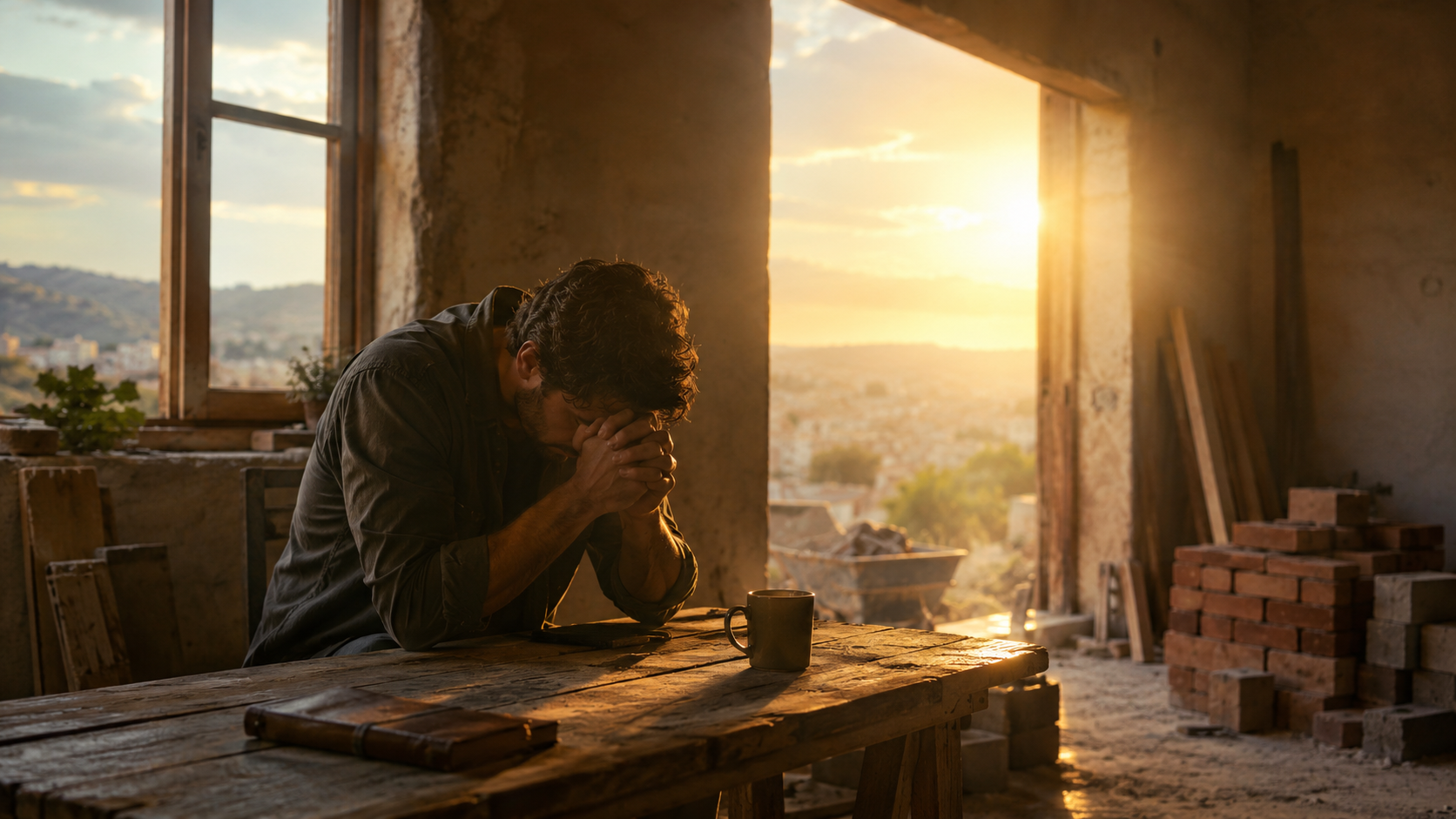
A Prayer Before the Passover Night
LORD —
We have sat with nine plagues. Nine systematic demonstrations that there is no domain of creation outside Your authority — not the sky, not the harvest, not the light itself. Nine opportunities for Pharaoh to yield that he did not take. Nine moments of what the magicians recognised as the finger of God, and what Pharaoh chose to look away from.
We sit now on the threshold of the tenth. The one that stands alone. The one that has no natural explanation, no ecological cascade, no scientific parallel. The one that was always, from the beginning, the answer to what Pharaoh started in Exodus 1 when he ordered the Hebrew boys thrown into the Nile.
We ask You to prepare our hearts for the Passover night. Not merely intellectually — not just to understand the theology. But to feel the weight of it. The lamb. The blood. The doorpost. The angel passing over. The firstborn of Egypt and the firstborn of God meeting at the boundary of judgment and mercy.
For those of us who have been sitting in our own kind of Egyptian darkness — three days of not being able to see, not being able to move, not knowing when the light would come back — thank You for the word that Goshen had light. That Your people had light where they lived. That the darkness did not overcome it. That we live in Goshen with you and that you always provide a way. Thank You that the same promise is ours in Christ: whoever follows me will not walk in darkness, but will have the light of life.
And thank You that we have been told this story. That father told son, and son told grandson, and somewhere in the chain of telling, it reached us. We are the grandchildren Moses was told to tell. We are the ones in whose hearing the story was to be recounted. And here we are, still hearing it, still astonished by it, still finding in it the deepest things we know about who You are and what You have done.
One more plague. And then: the Passover.
The Lamb is coming. In Jesus name we pray,
Amen.
Coming Next in the Series
Part Eleven: The Passover Night — The Lamb, the Blood, and the Long Walk Out
The culminating plague. The institution of the Passover meal. The blood on the doorposts. The death of Egypt's firstborn and the protection of Israel's. The command to eat in haste with your sandals on. The midnight cry. And then — the walk out. We will study the Passover in its full Old Testament depth, its New Testament transformation in the Last Supper, and what it means that Paul says: "Christ, our Passover lamb, has been sacrificed."
Add comment
Comments