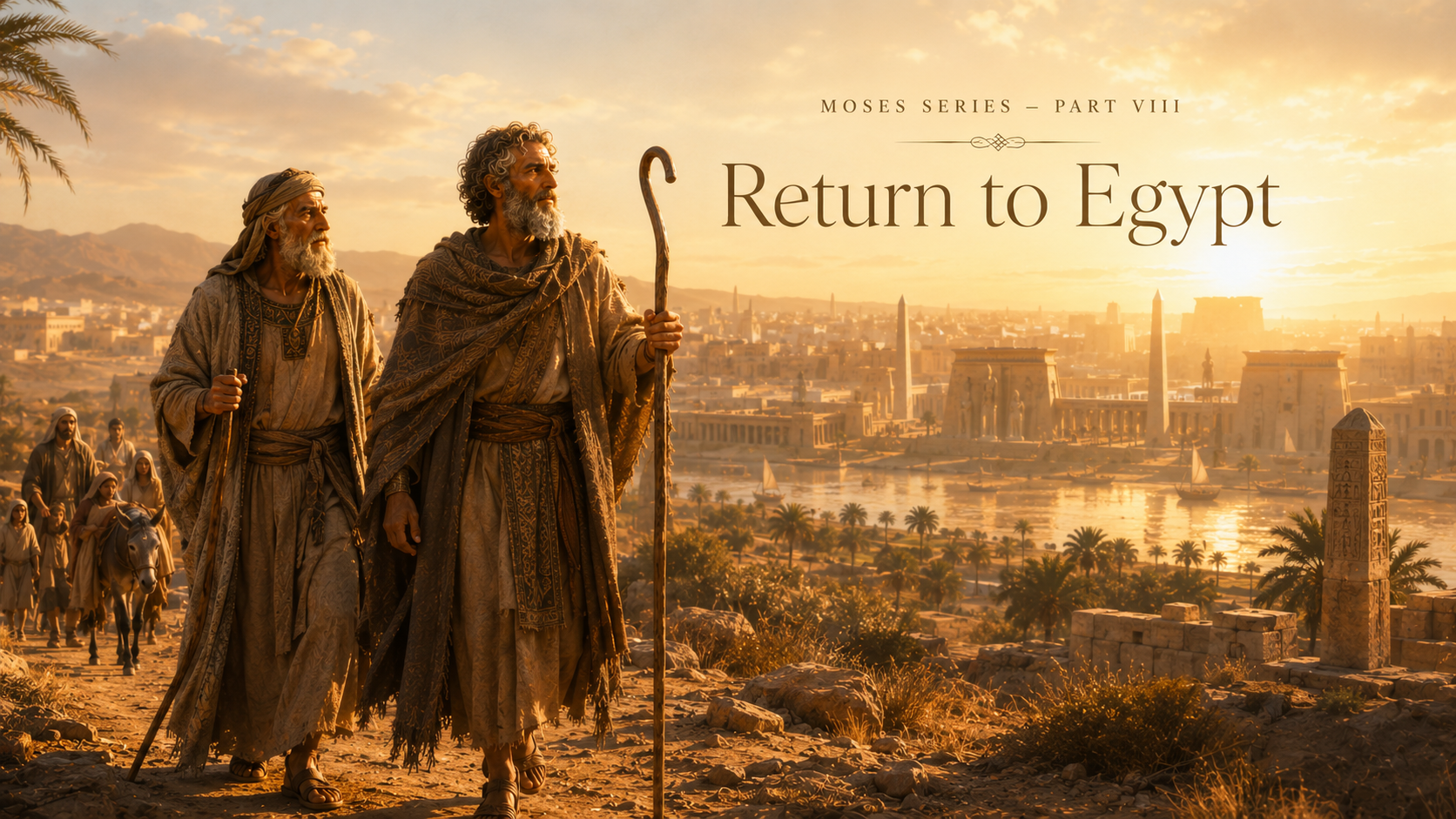
"Let my people go, that they may serve me in the wilderness."
— Exodus 7:16

Before You Begin This Study
Please Read These Passages First
Ok so there is alot of reading in this sitting. So take your time. Part Eight covers the return to Egypt, the first confrontation with Pharaoh, and the devastating aftermath when God appears to make everything worse before anything gets better. Read these passages slowly — especially Exodus 5:22–6:12 where Moses argues with God again after the initial failure. Notice how closely it mirrors his burning bush protests.
Pay particular attention to the precise words of Exodus 5:1 — the theological freight in "Let my people go" — and to Exodus 4:21 where God announces in advance that He will harden Pharaoh's heart. That announcement, before Moses even meets Pharaoh, is the key to understanding everything that follows.
Exodus 4:29–5:23 Exodus 6:1–12 Exodus 7:1–7 Romans 9:14–21 Ezekiel 2:1–10
Optional deeper reading:
Exodus 3:19–22 (God's advance disclosure of the whole plan);
Deuteronomy 2:30 (another hardened heart — Sihon of Heshbon);
Isaiah 6:9–13 (the hardening of Israel itself — quoted seven times in the NT);
John 12:37–41 (John citing Isaiah 53 and 6 to explain why Israel rejected Jesus).
The Story
The Road Back to Everything He Had Left
An imaginative reconstruction of Moses' return to Egypt
The following narrative reconstructs the biblical account using historical geography, Egyptian court culture, and the textual record. Where Scripture is silent, sanctified imagination serves — always in submission to the text.
Egypt announced itself before he could see it.
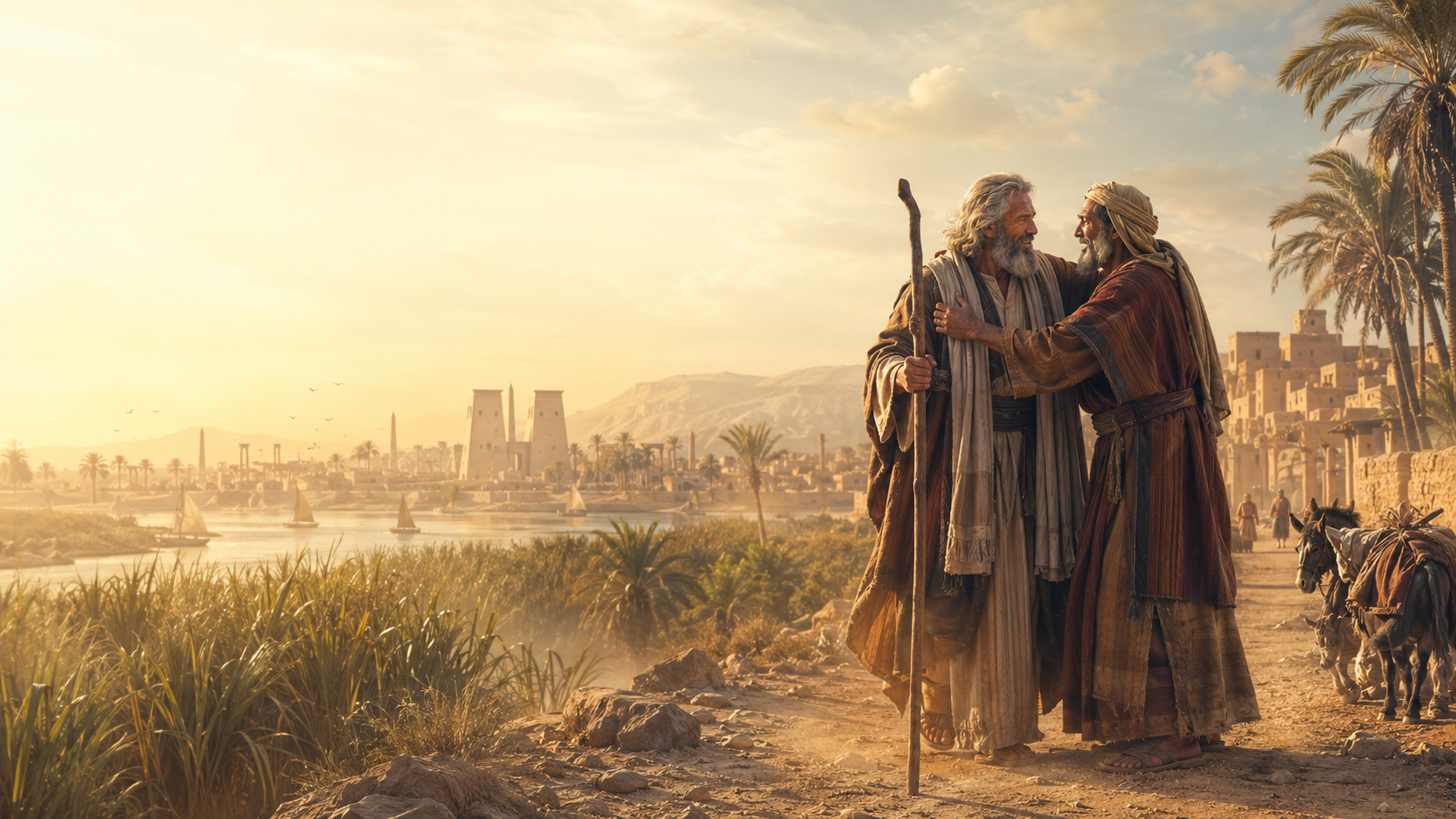
The smell came first — the particular combination of mud and river and sun-baked brick and rotting vegetation that meant the Nile delta was close. Moses had not smelled it in forty years. He had not expected it to do what it did to him: to reach back through four decades of desert and find the boy who had grown up there, the boy who had eaten at gold-plated tables and slept in rooms with painted ceilings and never once considered that this smell meant home. He stood on the road with his staff in his hand and the donkey and Zipporah behind him and breathed it in and felt something complicated move through him that he could not entirely name.
He had been a prince here. He had been a fugitive here. He had killed a man here and watched his people reject him here. And now he was coming back as a prophet — which was something different from both, and possibly more dangerous than either.
Aaron was waiting for him on the road. They had not stood in the same place at the same time for forty years. Moses looked at his brother's face — older now, lined by the same decades that had lined his own, but carrying something Moses recognised as the same blood, the same mother's features, the same lineage of Levi — and Aaron looked at him. And they embraced. The text does not dwell on it. But forty years of separation ended on a road that smelled of Egypt, between two old men who had, between them, been called to do something no human being had ever done before.
They went first to the elders of Israel. They spoke. Aaron did the signs. The people believed and worshipped — as we noted in Part Seven. And then there was nothing left to do but the thing they had come to do. They had to go to Pharaoh.
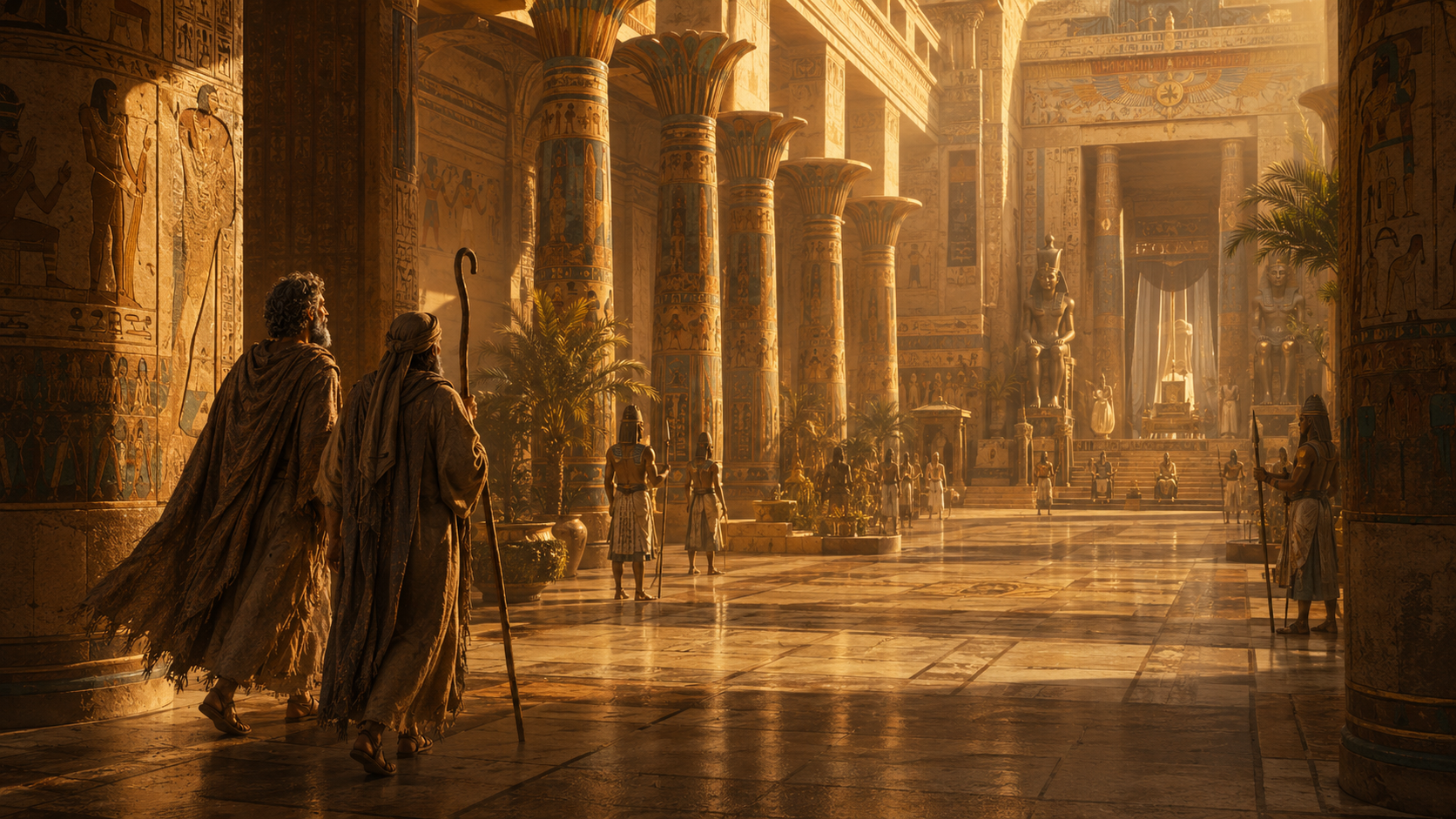
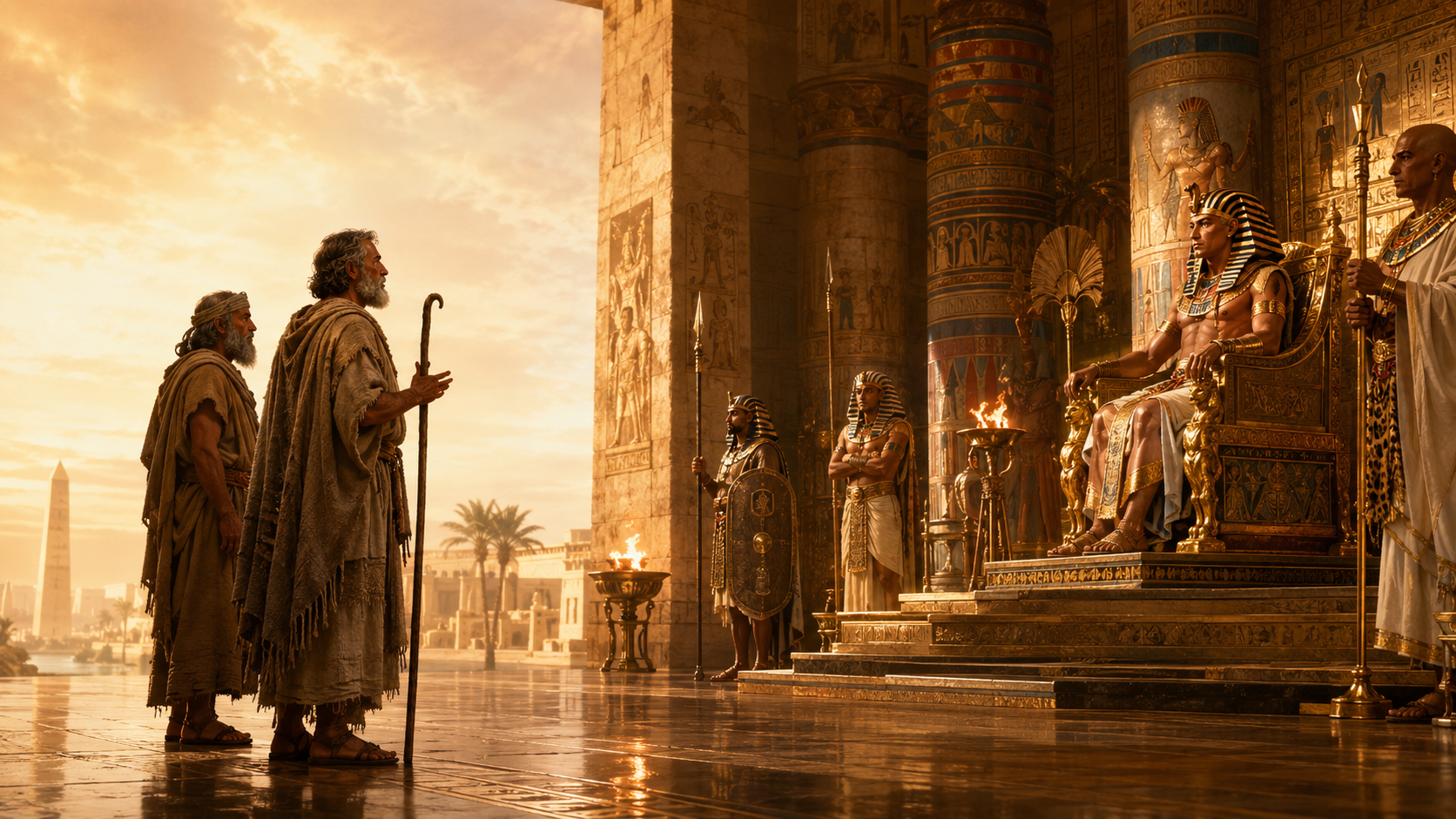
The throne room was built for intimidation. Moses had known rooms like this since childhood — he had walked these corridors as a prince, had known the particular quality of the painted light that filtered through the clerestory windows onto the floors of polished limestone. He had known the smell of the incense, the sound of the courtiers moving in rehearsed deference, the particular silence that fell over a room when the Pharaoh looked at someone.
He had been one of those people who moved through this world as if they belonged to it. He was not that anymore. He was an eighty-year-old shepherd with a staff and a brother and a message he had been told to deliver regardless of the response it produced.
Pharaoh looked at him. Perhaps he recognised him — the fugitive prince, returned old and strange, no longer wearing the linen that would have marked his status but the rough clothing of a desert man. Perhaps he had only heard of him in stories, a footnote from his father's reign. The text does not say what Pharaoh saw when Moses and Aaron walked in. It only says what Moses and Aaron said.
They said: Thus says the LORD, the God of Israel: Let my people go, that they may hold a feast to me in the wilderness.
And Pharaoh said: Who is the LORD, that I should obey his voice and let Israel go? I do not know the LORD, and moreover I will not let Israel go.
It was, in its way, the most theologically honest thing Pharaoh ever said. He genuinely did not know YHWH. In his world, YHWH was the god of a slave people — an unrecognised deity with no temple in Egypt, no cult image, no priestly establishment, no record of power. Why would the Lord of the Two Lands, the Living Horus, the Son of Ra, obey the demands of an unrecognised foreign deity represented by two old men with a shepherd's stick?
It was, from where Pharaoh stood, an entirely reasonable position. And it was about to be demolished.
Walking Into the Palace He Had Left
What it meant — psychologically, culturally, and theologically — to return
The Psychology of Return
The return of Moses to Pharaoh's court is one of the most psychologically rich moments in the entire narrative — and one that the text handles with characteristic restraint, trusting the reader to feel the weight that it does not name explicitly.
Moses had grown up in this palace. He had eaten in these halls. He had been educated in the most sophisticated system in the ancient world, in rooms very close to this one. He had left forty years ago as a fugitive with a warrant on his head. And now he was walking back in — not as a returning prince, not even as an ambassador with diplomatic immunity, but as the representative of a God this court did not recognise, carrying a demand this Pharaoh would consider laughable.
The Pharaoh Moses confronted was not the same man who had wanted him dead. Acts 7:23 and Exodus 7:7 tell us Moses was forty when he fled and eighty when he returned. Forty years had passed. The old Pharaoh — almost certainly the one who had issued the warrant for his arrest — was dead. There was a new king in Egypt. Possibly the son, or even the grandson, of the Pharaoh Moses had fled. Moses was not returning to a personal enemy. He was returning to an institution — the office of Pharaoh, the sacred kingship of Egypt, the living embodiment of a god-system he had been educated inside but never believed in.
Whether Moses experienced anything like nostalgia or grief as he walked those corridors again, the text does not say. What the text does say, with understated precision, is what happened when the two men finally stood face to face.
Egyptian Court Protocol: What an Audience with Pharaoh Actually Looked Like
Historical & Cultural Context — Royal Audiences in New Kingdom Egypt
The granting of an audience with Pharaoh was not a casual matter in New Kingdom Egypt. It required formal request through intermediaries — the court's chief stewards, viziers, or heralds who managed access to the royal presence. Foreign delegations and petitioners typically waited days or weeks before being admitted.
The audience chamber itself was designed to overwhelm. Egyptian royal throne rooms were built on an enormous scale — the hypostyle hall at Karnak, built by Ramesses II, had 134 columns, the largest reaching 24 metres in height. The approach to the throne was typically through a series of progressively more exclusive spaces, each one filtering out lower-ranked petitioners. By the time a delegant stood before Pharaoh, they had passed through multiple spaces designed to remind them of their insignificance.
The physical act of prostration before Pharaoh was obligatory — kneeling, face to the ground, sometimes kissing the earth before the royal feet. The royal titles recited at the beginning of any formal address could themselves take several minutes: Pharaoh was simultaneously the Living Horus, the Strong Bull, the Two Ladies, the Golden Horus, and the Son of Ra, among numerous epithets. To address Pharaoh informally was to risk severe punishment.
Moses and Aaron do not prostrate. They do not recite the royal titles. They do not petition. They deliver a demand. The audacity of this — from the perspective of Egyptian court culture — cannot be overstated. They walk into the most powerful royal court in the world and deliver a command as if they outrank the man on the throne. Because in their theology, they do.
Who Was This Pharaoh?
We face the same question we have navigated since Part One: which Pharaoh? The two main candidates for the Pharaoh of the Exodus — under the early and late date frameworks — are Amenhotep II (c. 1453–1419 BC under the early date) and Ramesses II (1279–1213 BC under the late date).
The Two Main Pharaoh Candidates
Ramesses II (Ramesses the Great) — The most frequently depicted Pharaoh of the Exodus in popular culture. His reign was characterised by colossal building projects using conscript and slave labor, including Pi-Ramesses (directly referenced in Exodus 1:11). He fought the Battle of Kadesh against the Hittites (c. 1274 BC), declared himself victorious in what was probably a draw, and commissioned more temples and statues than any other Pharaoh in Egyptian history. He reigned 66 years. His mummy, discovered in the Deir el-Bahari cache in 1881 and now in the Cairo Museum, shows a man who died in his nineties, with severe arthritis, dental abscesses, and hardening of the arteries. His red hair, unusually pale complexion, and aquiline nose are well-preserved.
The case against Ramesses as the Exodus Pharaoh: his successor Merneptah's famous "Israel Stele" (c. 1208 BC) refers to Israel as a people already in Canaan — "Israel is laid waste, his seed is no more" — which, if the Exodus occurred under Ramesses, leaves very little time for the entire wilderness period and conquest. Some scholars argue this strengthens the case that the Exodus was earlier than Ramesses.
Amenhotep II — Under the early date (1446 BC Exodus), Amenhotep II is the Pharaoh of the confrontation. His reign (c. 1427–1397 BC) is archaeologically significant: an inscription from his Memphis stele refers to captives from a Canaanite campaign including Apiru (Semitic laborers), and his successor Thutmose IV — notably a younger son, not the firstborn — became Pharaoh, consistent with the loss of the firstborn in the tenth plague. The Dream Stele of Thutmose IV explicitly states that the god Horemakhet appeared to him and promised him the throne, possibly implying he had not been the expected heir — consistent with the death of an older brother.
For our study, we hold both dates honestly. The theological significance of the confrontation does not depend on the GPS coordinates or the hieroglyphic name of the man on the throne. What matters is what the text says about the encounter.
"Let My People Go": The Most Politically Dangerous Sentence in the Ancient World
A deep study of Exodus 5:1 — every word and its weight
"Afterward Moses and Aaron went and said to Pharaoh, 'Thus says the LORD, the God of Israel, "Let my people go, that they may hold a feast to me in the wilderness."'"
Exodus 5:1
This is one of the most theologically and politically loaded sentences in the entire Bible. Four words in the Hebrew demand — shalach et-ammi ("let go my people") — that have echoed through three thousand years of liberation theology, political resistance, and redemptive typology. Let us unpack every element.
Exodus 5:1 — Phrase by Phrase
Thus says the LORD
"Ko amar YHWH"
Hebrew & Historical Analysis
Ko amar YHWH — "Thus says the LORD." This is the standard prophetic messenger formula — the phrase that introduces a divine word delivered by a human messenger. In ancient Near Eastern diplomatic practice, messengers delivered messages verbatim on behalf of their sender, often prefaced with "thus says [king/lord]." The formula signals that what follows is not Moses' own opinion but a direct quotation of the one who sent him.
This messenger formula appears over 400 times in the Hebrew prophets. Moses uses it here in its inaugural appearance in Scripture — before Isaiah, before Jeremiah, before Ezekiel. Moses is the first prophet to stand before a human authority and say: I am not speaking for myself. Thus says the LORD.
The use of the divine name YHWH — not merely "the god of Israel" — is deliberate and confrontational. This is not a generic deity making a demand. This is the I AM, whose name has just been disclosed at the burning bush, the God who claims ownership of Israel by covenant. The name is itself a theological statement: the one speaking outranks Pharaoh in the most fundamental possible way.
Let my people go
"Shalach et-ammi"
shalach et-ammi — "Let go my people" or "Send away my people." The verb shalach means to send, to release, to let go. It is the same root used throughout the Joseph narrative when Jacob releases his sons to go to Egypt (Genesis 43:14). It carries the sense of deliberate releasing from one's grip — an act that requires the consent and action of the one holding.
ammi — "my people." The possessive pronoun is everything here. Not "the Hebrew people." Not "the Israelite slaves." My people. YHWH's ownership claim over Israel is being asserted directly against Pharaoh's ownership claim. Pharaoh treats the Hebrews as state property — a labor resource belonging to Egypt. God says: they belong to Me. This is a property dispute between two sovereigns — and one of them is the God who made the world.
The political and economic implications were staggering. The Hebrew workforce was the engine of Egypt's massive building projects. To release them was to empty the quarries, the brick pits, the construction gangs of the delta cities. The demand was not just theological — it was existential for the Egyptian economy.
That they may hold a feast to me
"V'yachogu li"
v'yachogu li — "that they may celebrate/feast to me." The verb chagag means to hold a festival, to celebrate a pilgrimage feast. This is the root of chag — the Hebrew word for festival, used for the three great pilgrimage festivals: Passover, Shavuot, and Sukkot.
The stated reason — a three-day feast in the wilderness — has puzzled many readers. Is Moses asking for permanent release or just a temporary departure? Scholars have debated this for centuries. Three main positions:
(1) Moses is asking only for three days — a legitimate partial request before the full demand. (2) Moses is deliberately obscuring the full demand, allowing Pharaoh a face-saving intermediate response while pursuing the ultimate goal of permanent departure. (3) The "three-day feast" is a genuine first step: even a temporary religious exemption would establish a precedent for Hebrew assembly, worship, and identity separate from Egyptian control — a principle that, once established, could not be unestablished.
What is certain: Pharaoh refuses even this. The incremental approach fails entirely. Which sets the stage for God's escalating confrontation.
In the wilderness
"Bamidbar"
bamidbar — "in the wilderness." This is the Hebrew title of the fourth book of Moses (what we call Numbers — titled in Hebrew after its opening words, but Bamidbar in the Jewish tradition, literally "In the Wilderness").
The wilderness as the place of meeting with God is a consistent biblical motif from this point forward. Israel will not worship YHWH inside Egypt. They must go out to meet Him — away from the Nile, away from Pharaoh's territory, into the desert where God's voice is clearer and the competing claims of Egypt's gods have no jurisdiction. The wilderness is not simply a geographical location. It is a theological space — the place between slavery and inheritance where the covenant is formed and the character of a people is shaped.
Pharaoh's Response: The Theology of "I Do Not Know YHWH"
Pharaoh's response in Exodus 5:2 deserves as much attention as Moses' demand: "Who is the LORD, that I should obey his voice and let Israel go? I do not know the LORD, and moreover I will not let Israel go."
In Hebrew, miy YHWH asher eshma b'kolo — "Who is YHWH that I should hear/obey his voice?" The word shama means both to hear and to obey — in Hebrew the concepts are inseparable. To truly hear is to obey. Pharaoh is saying: I do not recognise this YHWH as a valid authority in my world. He has no standing in my religious system. He has no temple in Egypt, no record in our annals, no demonstrated power. I owe him nothing.
This response echoes through the entire Exodus narrative. The ten plagues are, at one level, God's answer to this question. Each plague is a demonstration of YHWH's jurisdiction over a domain Pharaoh had assigned to an Egyptian deity. By the end of the plagues, Pharaoh and the whole of Egypt will know who YHWH is — exactly as God announced in Exodus 7:5: "The Egyptians shall know that I am the LORD when I stretch out my hand against Egypt and bring out the people of Israel from among them."
Key Phrase — "That You May Know That I Am The LORD"
The phrase "that you/they may know that I am the LORD" (lema'an teda ki ani YHWH) is one of the most theologically significant recurring phrases in the Exodus narrative. It appears at least 14 times in Exodus alone. Each plague is not merely a humanitarian intervention to free slaves — it is an epistemological event. God is teaching the world who He is through the pressure of historical events.
This pattern reaches its apex in Exodus 9:16 where God says directly to Pharaoh: "But for this purpose I have raised you up, to show you my power, so that my name may be proclaimed in all the earth." Paul quotes this verse in Romans 9:17. The Exodus is not only a rescue mission. It is a declaration of divine identity broadcast to every nation that hears about it.
The Hardened Heart: The Most Theologically Difficult Problem in Exodus
What does it mean that God hardened Pharaoh's heart — and is this just?
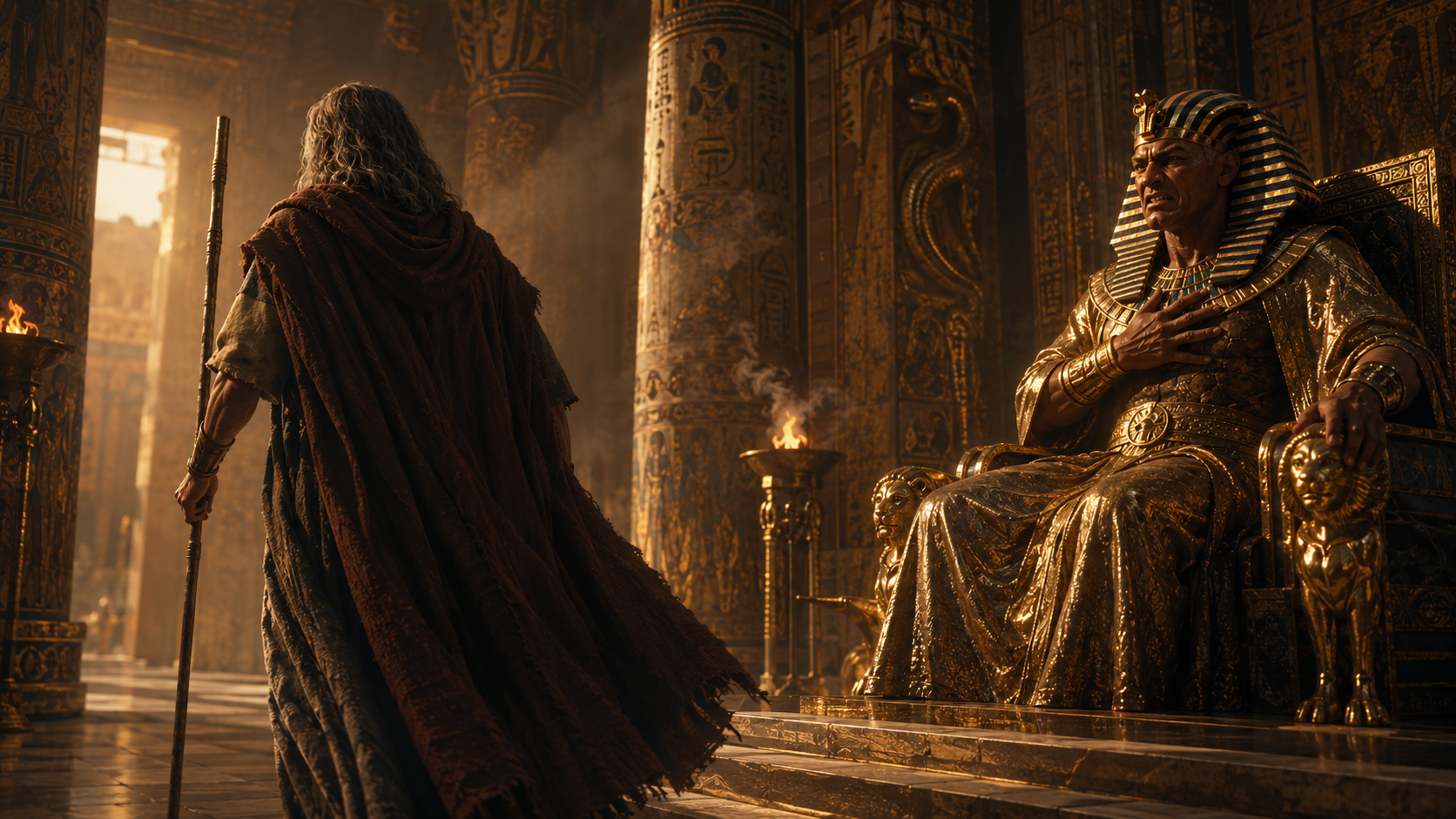
No theological problem in the book of Exodus has generated more debate, more commentary, and more wrestling than the hardening of Pharaoh's heart. It sits at the intersection of divine sovereignty and human free will — two of the most contested concepts in Christian theology — and it does not resolve neatly in either direction. This is where careful scholarship, honest exegesis, and theological humility are all simultaneously required.
The Three Hebrew Verbs for Hardening
Before we can engage the theological question, we must understand the Hebrew text precisely, because there are actually three different Hebrew verbs used to describe what happens to Pharaoh's heart — and they have different semantic ranges and different subjects.
Hebrew Word Study — Three Verbs of Hardening
1. Chazaq (חָזַק) — "to be strong, to strengthen, to be firm, to be courageous." Used both of God hardening (YHWH chazaq et-lev Paroh — Exodus 4:21; 9:12; 10:20, 27; 11:10; 14:4, 8, 17) and of Pharaoh's heart strengthening itself. The verb does not inherently mean hardness in the sense of callousness — it means fortifying, making firm. Pharaoh's heart becomes firm, resolute, unwilling to yield.
2. Kaved (כָּבֵד) — "to be heavy, to be weighty, to be honoured, to be burdensome." Used of Pharaoh hardening his own heart (Exodus 8:15, 32; 9:34) and also of God making it heavy (Exodus 10:1). The heaviness of the heart is the weight of stubbornness — the heart so laden with self-interest, pride, and political calculation that it cannot move toward mercy.
3. Qashah (קָשָׁה) — "to be hard, to be severe, to be fierce." Used only in Exodus 7:3 with God as subject: "I will harden [aqsheh] Pharaoh's heart." This is the strongest term — hardness in the sense of brittleness, unyieldingness, severity. It is also the rarest of the three.
Crucially, the subject of the hardening alternates throughout the narrative. Sometimes it is God who hardens. Sometimes it is Pharaoh who hardens his own heart. The traditional scholarly count: Pharaoh hardens his own heart approximately 10 times; God hardens it approximately 10 times. The distribution is remarkably even — and almost certainly intentional.
The Sequence Matters: Pharaoh Hardens First
One of the most important and frequently overlooked details about the hardening narrative is the sequence in which the two agents of hardening appear. Although God announces His intention to harden Pharaoh's heart in Exodus 4:21 (before Moses even meets Pharaoh), the first actual hardening events in the narrative are Pharaoh hardening his own heart.
Plagues 1–5: In every case where a plague is performed and then removed, Pharaoh's heart is described as hardening — and in most of these cases, Pharaoh is the subject. He sees the miracle. He experiences the relief when the plague is removed. And then he hardening himself — he goes back to his previous position, refuses to release Israel, doubles down on his refusal.
Only from Plague 6 onward — after Pharaoh has repeatedly and freely chosen to harden himself — does the text consistently describe God as the agent of hardening. The pattern is: Pharaoh's free choices establish the direction of his heart; God then confirms and reinforces the direction Pharaoh has already freely chosen.
This is what the early Church Father Origen (184–253 AD) called the principle of judicial hardening: God does not impose a hardened state on a naturally open heart. He confirms the hardness that the heart has chosen for itself. As John Calvin put it: "God only hardens after long and patient endurance."
Egyptian Theology and the Hardened Heart: A Critical Cultural Context
Egyptian Cultural Context — The Heart in Egyptian Theology
Understanding the hardened heart requires understanding what the ancient Egyptians believed about the heart — because Moses and the original audience of Exodus were thinking in categories shaped by this cultural context.
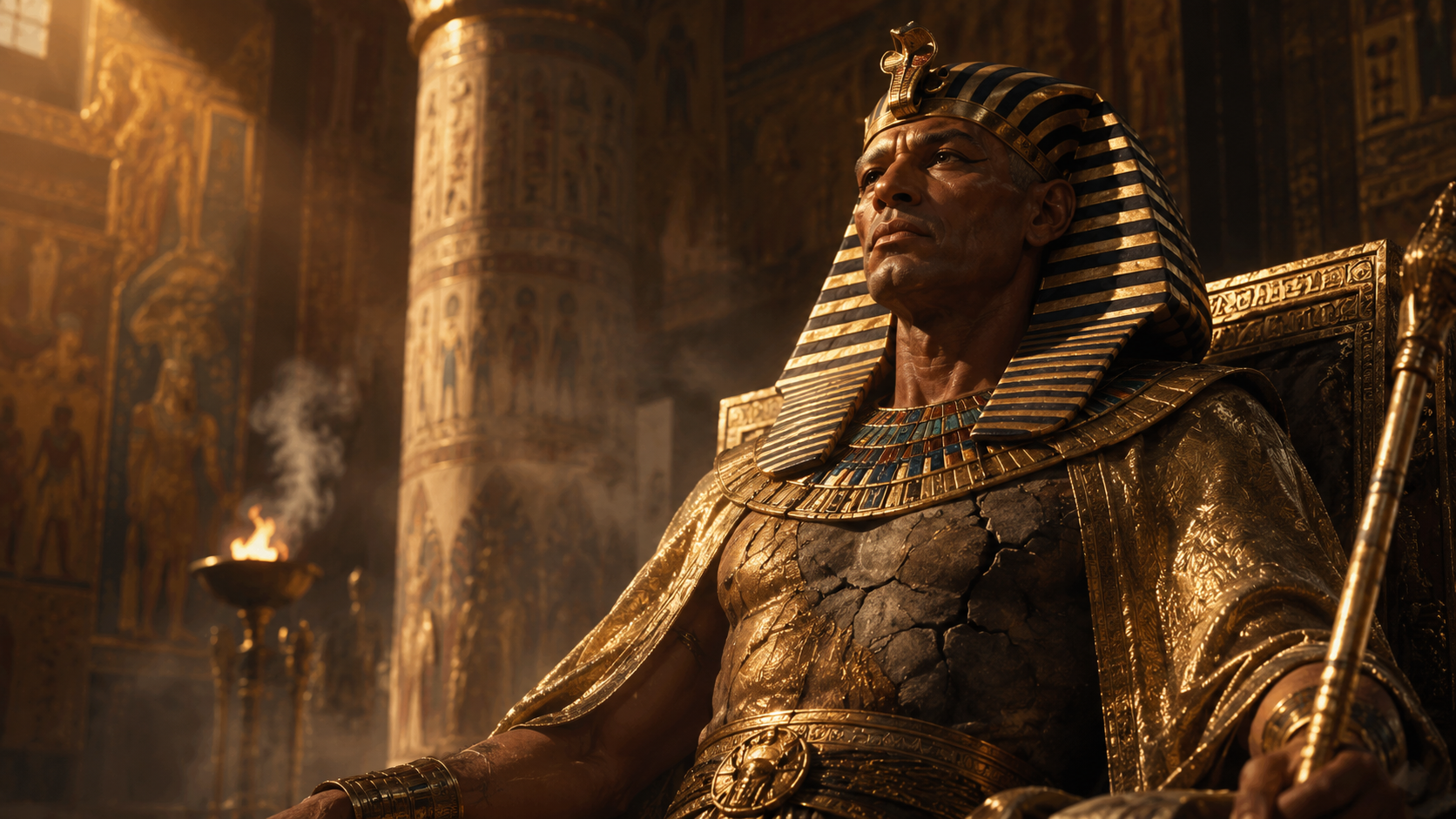
In Egyptian theology, the heart (ib or haty) was the seat of intelligence, will, personality, and moral character — far more than an organ of emotion. The heart was what made a person who they were. The famous Book of the Dead depicts the judgment scene in which the deceased's heart is weighed against the feather of Ma'at (divine order/truth/justice). If the heart was heavier than the feather — weighed down by sin, selfishness, and injustice — it was devoured by the monster Ammit and the person ceased to exist.
A "heavy heart" in Egyptian anthropology was specifically a morally burdened heart — one weighed down by the corruption of unjust deeds. The Hebrew kaved (heavy) applied to Pharaoh's heart would resonate with this Egyptian framework: his heart has become too heavy with injustice to pass judgment. It cannot be balanced against Ma'at. The hardening of Pharaoh's heart is, in the cultural idiom Exodus is using, a declaration that Pharaoh has failed his own theology's standard of justice.
Furthermore, in Egyptian royal theology, the heart of Pharaoh was believed to be guided and sustained by Ra and the other gods. A Pharaoh whose heart was functioning properly was a Pharaoh in whom the gods were at work. A Pharaoh whose heart hardened and led him toward catastrophic decisions was a Pharaoh whose divine guidance was being removed. The Exodus narrative turns Egyptian royal theology against itself: YHWH is the one actually determining the quality of Pharaoh's heart, not Ra. The plagues are not only attacks on Egyptian theology — they are an argument within it.
The Philosophical and Theological Problem
Even with all the above nuance, the theological problem of divine hardening does not disappear. Paul faces it directly in Romans 9:17–21, quoting Exodus 9:16:
"For the Scripture says to Pharaoh, 'For this very purpose I have raised you up, that I might show my power in you, and that my name might be proclaimed in all the earth.' So then he has mercy on whomever he wills, and he hardens whomever he wills. You will say to me then, 'Why does he still find fault? For who can resist his will?' But who are you, O man, to answer back to God? Will what is moulded say to its moulder, 'Why have you made me like this?'"
Romans 9:17–20
Paul does not resolve the tension philosophically. He affirms the reality of both divine sovereignty ("he has mercy on whomever he wills, and he hardens whomever he wills") and human accountability (Pharaoh is still "at fault" — he is not merely a puppet). And when pushed on the apparent unfairness of this, Paul does not offer a philosophical resolution. He appeals instead to the creature's epistemic limit before the Creator: "who are you, O man, to answer back to God?"
This is not intellectual evasion. It is a recognition that the question itself — "is it fair for God to harden Pharaoh?" — contains an assumption about God that may be wrong. It assumes God is subject to a standard of fairness external to Himself that we can evaluate and hold Him to. Paul is challenging the assumption. The clay does not interrogate the potter's design. But neither — and this is crucial — does the narrative present Pharaoh as an innocent victim of divine manipulation. He is a man who enslaved a people, who killed children, who repeatedly chose hardness every time God gave him an opportunity to relent. The hardening confirms a direction already chosen.
Five Scholarly Positions on the Hardening
1. Simple Divine Causation (Calvinist reading): God sovereignly determined Pharaoh's heart from eternity. The hardening is God's sovereign decree, and Pharaoh's apparent free choices are themselves within God's decreed will. Proponents: John Calvin, Jonathan Edwards. Strength: takes the divine-subject passages at full face value. Weakness: struggles with passages where Pharaoh clearly hardens himself first.
2. Divine Foreknowledge and Permission: God hardened Pharaoh in the sense of permitting and confirming the hardness God foreknew Pharaoh would freely choose. God's hardening is the withholding of the softening grace He might otherwise have given. Proponents: Arminius, Wesley. Strength: preserves human responsibility. Weakness: can seem to subordinate divine agency to human choice.
3. Judicial Hardening: Pharaoh freely hardened himself through Plagues 1–5. God's hardening from Plague 6 onward is a judicial judgment — God confirming and intensifying the direction Pharaoh has already chosen. Proponents: Origen, many Reformed and Catholic interpreters. Strength: respects both the sequence and the dual agency in the text. Generally the most exegetically defensible position.
4. Cognitive Dissonance: The miraculous signs, rather than softening Pharaoh, actually deepened his resistance because they threatened his worldview so fundamentally. Each plague should have softened him but instead intensified his psychological need to deny their implications. The "hardening" is a natural cognitive response to cognitively intolerable data. Proponents: Some psychological-anthropological readings. Strength: psychologically plausible. Weakness: reduces divine action to psychology.
5. The Narrative as Corporate, Not Individual: The "Pharaoh" in Exodus may function less as a specific historical individual and more as a type — the representative of human empire's resistance to divine sovereignty. The hardening is not about one man's metaphysical status but about the pattern of how human power responds to divine claim. Proponents: Some canonical-critical scholars. Strength: frees the narrative from individual determinism problems. Weakness: risks losing the historical specificity the text seems to intend.
When God Makes Things Worse: Exodus 5–6
The first failure, the increase in suffering, and Moses' second crisis of faith
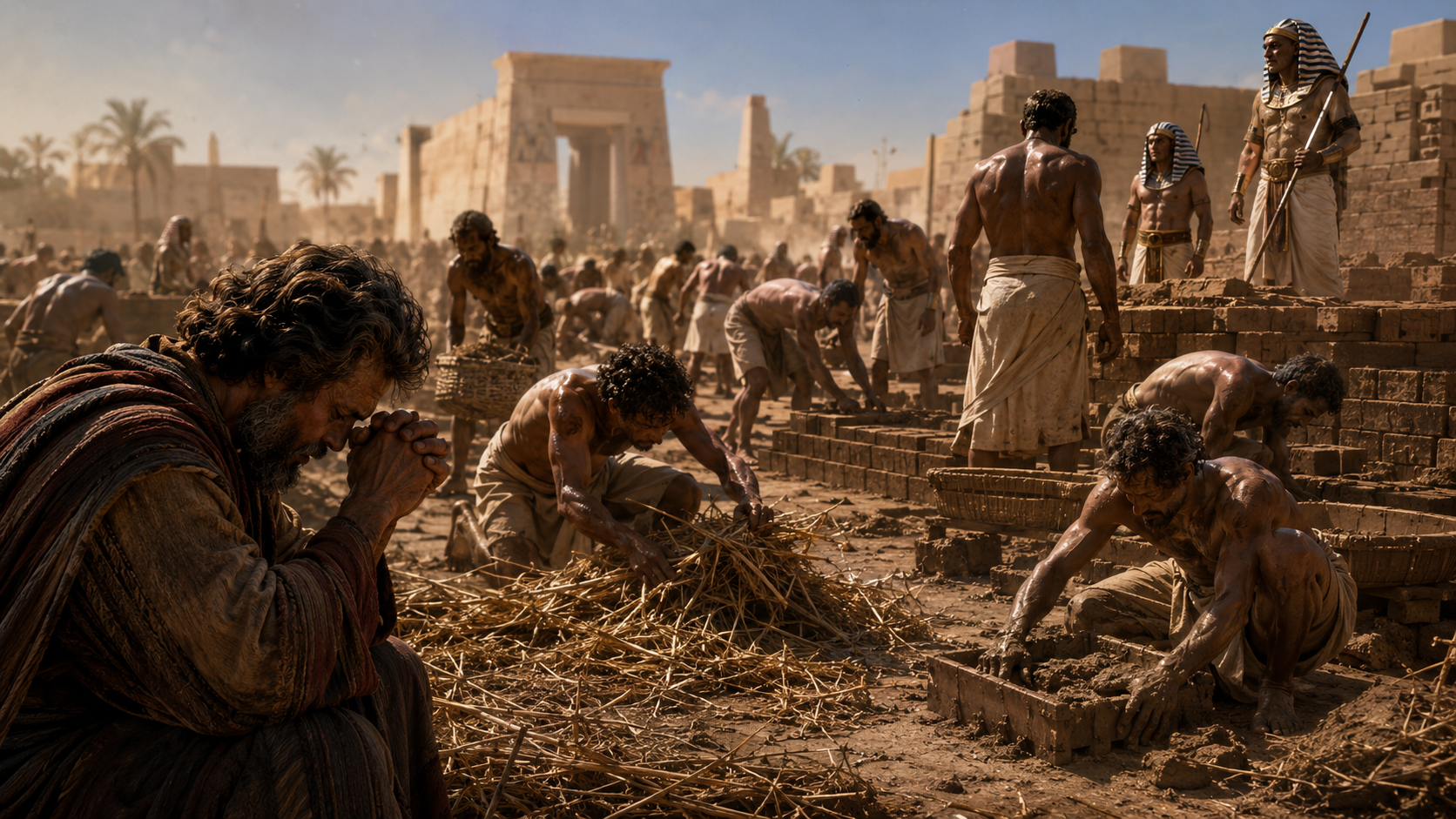
After Moses and Aaron deliver their demand and Pharaoh refuses, the narrative takes a turn that almost no one expects the first time they read it: things get dramatically, verifiably, immediately worse for the Hebrew people. Not better. Worse.
Pharaoh's response to Moses' demand is not merely refusal. It is punitive. Exodus 5:6–9: He removes the straw supplied for brick-making. The Israelites must now gather their own straw while maintaining the same quota. The foremen are beaten when the quotas are not met. The text is specific and brutal about the details: "Let heavier work be laid on the men that they may labour at it and pay no regard to lying words." Pharaoh identifies Moses' message as "lying words." The divine commission is, in Pharaoh's framing, propaganda that distracts workers from their duties.
The Hebrew foremen, caught between impossible quotas and an Egyptian beatings regime, turn on Moses and Aaron: "The LORD look on you and judge, because you have made us stink in the sight of Pharaoh and his servants, and have put a sword in their hand to kill us." (Exodus 5:21). Moses is being blamed by the very people he came to save. His mission has not improved their condition. It has made it measurably worse.
And then Moses does something remarkable and human and entirely consistent with everything we know about him: he turns to God and complains.
Exodus 5:22–23 — Moses' Second Crisis of Faith
Exodus 5:22–23
"Then Moses turned to the LORD and said, 'O Lord, why have you done evil to this people? Why did you ever send me? For since I came to Pharaoh to speak in your name, he has done evil to this people, and you have not delivered your people at all.'"
lama hare'ota la'am hazeh — "Why have you done evil to this people?" The word ra'a (evil, harm, calamity) is shockingly direct. Moses is accusing God of causing harm to the very people He commissioned Moses to help. This is lament at its most raw — not poetic lament but confrontational lament, the kind that borders on accusation.
This is Moses returning to the posture of the burning bush. He is questioning God again — not about his own inadequacy this time, but about God's apparent failure to act. You sent me. I came. Things are worse. Where are you? The pattern of Hebrew lament prayer — crying out to God about apparent divine absence or failure — is here at its most unfiltered.
v'hatzzel lo-hitzalta — "and you have not delivered your people at all." The emphatic construction (infinitive absolute) intensifies the accusation. Moses is not hedging. He is saying: you have completely, utterly, absolutely failed to deliver. The mission has not merely stalled — it has produced the opposite of its intended result.
What is remarkable is that God does not rebuke Moses for this prayer. He answers it — with one of the most theologically rich reassurances in the entire Old Testament (Exodus 6:1–8).
God's Response: Exodus 6:1–8 — The Covenant Name Renewed
God's response to Moses' complaint in Exodus 6:1–8 is not a rebuke. It is a recommissioning — one of the most dense and beautiful theological passages in the Pentateuch. God speaks in a series of seven "I will" statements that function as a covenant charter:
Exodus 6:6–8 — The Seven "I Will" Statements (The Seven-Fold Promise)
1. "I will bring you out from under the burdens of the Egyptians" — Liberation from oppression. The word sevel (burden, hard labor) — the same word we identified in Exodus 2:11 (the burden Moses looked upon) and in Isaiah 53:4 (the Suffering Servant who bears our sorrows). YHWH Himself takes on the role of the one who removes the burden.
2. "I will deliver you from slavery to them" — Rescue from bondage. The word natsal (to snatch away, to rescue) — the decisive intervention that extracts a person from a dangerous situation.
3. "I will redeem you with an outstretched arm" — The word ga'al — the go'el verb we explored in Part Four. God acts as the kinsman-redeemer of His people. The "outstretched arm" (zero'a netuya) becomes one of the iconic phrases of the Exodus — repeated in Deuteronomy 26:8, Psalm 136:12, and referenced in the Passover Haggadah to this day.
4. "I will take you to be my people" — Covenant incorporation. This is the covenant formula in its most concentrated form. The same formula appears at Sinai (Exodus 19:5–6), in the prophets (Jeremiah 31:33; Ezekiel 36:28), and in the New Testament (Revelation 21:3).
5. "I will be your God" — The reciprocal declaration. Israel takes YHWH as their God; YHWH takes Israel as His people. This is the bilateral covenant formula that undergirds the entire Old Testament covenant theology.
6. "I will bring you into the land" — The Abrahamic promise renewed. The Exodus is not the endpoint. It is the middle of a longer story that began with Abraham and ends in the land of promise.
7. "I will give it to you for a possession" — The gift of inheritance. Morasha (possession, inheritance) — what belongs to you by right, by promise, by the word of the covenant God.
These seven promises function as the covenant charter of the Exodus. They are the theological DNA of everything that follows. Every plague, every miracle, every covenant ceremony at Sinai — all of it is the unfolding of these seven declarations made to a man who complained that God had failed him, at the very beginning of the mission.
Why Did Things Get Worse First?
The question of why God allowed — indeed caused — the worsening of Israel's condition before the deliverance is one of the profound pastoral and theological questions of the Exodus narrative. Several dimensions are worth holding simultaneously:
- To reveal Pharaoh's true character. The punitive response to Moses' demand showed exactly what kind of man Pharaoh was — one who would increase suffering in response to a request for mercy. This exposure was part of the divine plan to demonstrate why Egypt had to be confronted, not negotiated with.
- To deepen Israel's desire for liberation. A people who were merely uncomfortable might have been content with modest improvement. A people whose condition was worsened — who had their straw removed, who were beaten by their foremen, who had been told that liberation was coming and saw only more suffering — were a people whose longing for deliverance had been pushed past the point of ambivalence. By the time the Passover night arrived, there would be no Israelite who preferred Egypt.
- To test and form Moses. The worsening was part of Moses' continuing formation. The burning bush Moses who arrived full of divine commission now faced what every leader eventually faces: the gap between the promise and the present reality. The capacity to hold the promise in the face of present contradiction — to remain faithful to the call even when the mission appears to be failing — is what transforms a commissioned person into a genuine prophet.
- To demonstrate that the deliverance was entirely God's work. If Israel had been released after a single polite request, one might argue that Pharaoh had simply been reasoned with. The grinding, escalating, catastrophic series of plagues that followed made one thing unmistakable: this was not diplomatic success. This was the power of God. No human strategy could account for what was about to happen.
Archaeological Windows: What We Can See
Physical evidence from the world of Exodus 5–6
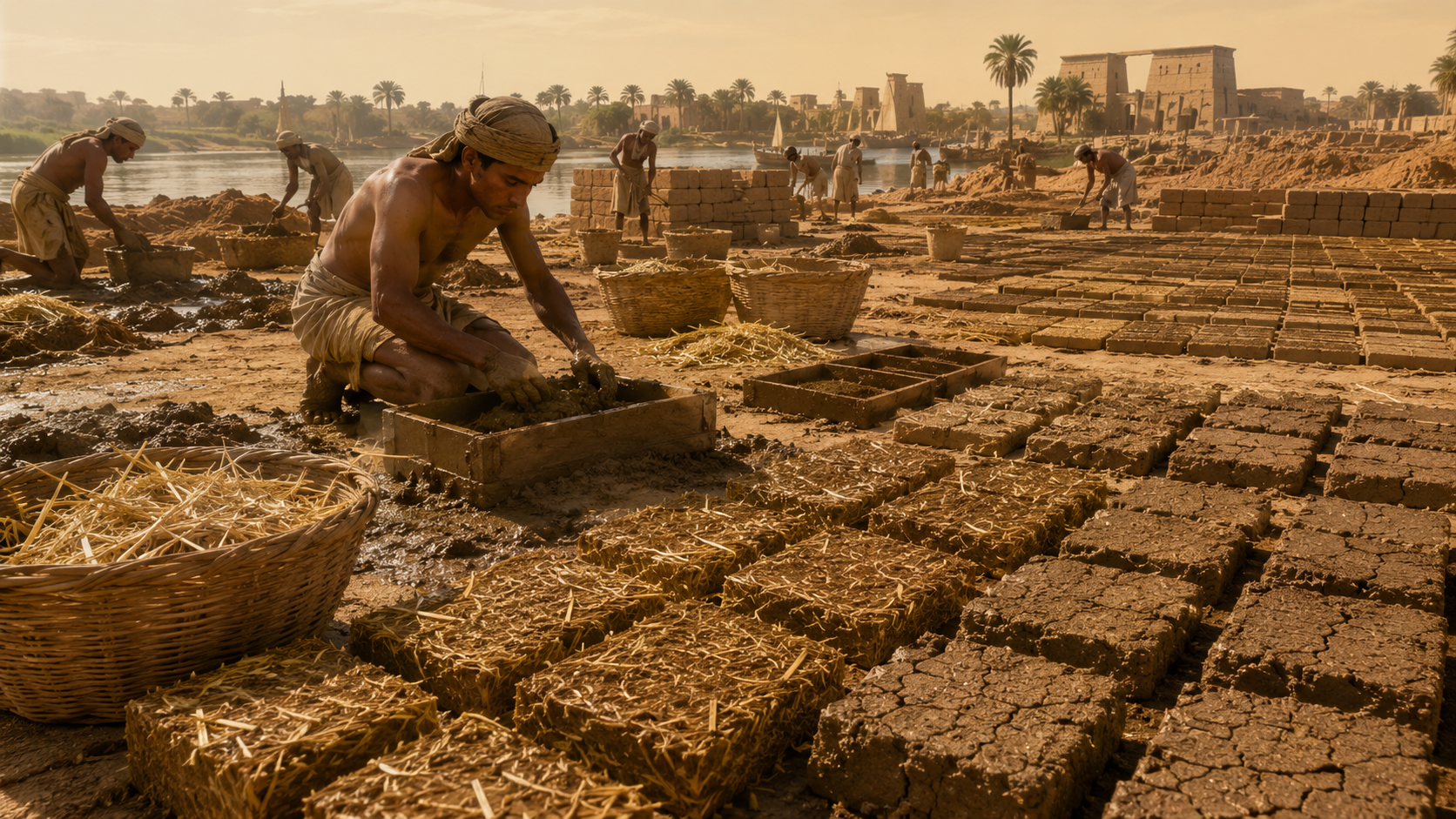
Brick-Making Without Straw: The Archaeological Evidence
Archaeological Context — Mud Brick Production in New Kingdom Egypt
Exodus 5's account of brick-making — and the removal of straw — is archaeologically precise in ways that could only come from a source with genuine knowledge of Egyptian brick production.
The Papyrus Anastasi III (New Kingdom, c. 1295–1186 BC) describes in detail the daily life of brick-making gangs, including the delivery of straw and the supervision of quotas. It mentions the distribution of reeds and straw for mixing with Nile mud — confirming that straw was an organised supply provided to state laborers, not something they gathered themselves.
The role of straw in mud brick: Modern materials science has confirmed what ancient builders knew empirically. Chopped straw (or stubble) mixed with mud dramatically improves the tensile strength of dried brick by distributing stress through the matrix — the same principle as steel rebar in concrete. Bricks made without straw or with insufficient organic material are significantly weaker and more likely to crack during drying. The archaeological record of New Kingdom Egyptian mud bricks regularly shows organic material (straw, chaff, reeds) in the mix. Bricks from sites in the delta region — including Tell el-Dab'a and Qantir (the likely locations of Pi-Ramesses) — have been analysed and show exactly this composition.
The Leiden Papyrus 348 (already referenced in Part One) records the distribution of rations to "Apiru who drag stone" for Ramessid construction — confirming Semitic workers in Egyptian state construction at precisely the relevant period. Several other administrative papyri from the same period record brick-production quotas: the standard quota was c. 2,000 bricks per gang per day. Failing to meet the quota resulted in punishment of the foremen.
The Exodus 5 account of Pharaoh removing straw while maintaining quotas is not a legendary embellishment. It reflects the actual administrative machinery of Egyptian forced labor with documentary precision.
Pi-Ramesses: The City Moses Came Back To
Archaeological Context — The City of Ramesses
Excavations at Qantir in the eastern Nile delta — identified as the site of ancient Pi-Ramesses — have produced remarkable evidence of the scale and organisation of the city Moses returned to. The site covers approximately 30 square kilometres and was one of the largest cities in the ancient world at its height under Ramesses II.
The remains include: an enormous royal palace complex with glazed tile floors and painted walls; horse stables capable of housing approximately 460 horses (one of the largest chariot parks in the ancient world); extensive industrial areas including metal-working, glass production, and faience manufacture; and abundant evidence of an organised labor force including Semitic workers.
The city was built largely with mud brick — the very material the Hebrew laborers were producing. Estimates from the archaeological evidence suggest the city required many millions of bricks for its construction. The logistics of such a building program align precisely with the large, organised labor gangs described in Exodus 1.
Moses walking into Pi-Ramesses was walking into the most impressive human construction project of the ancient world. The scale of what he was challenging — the wealth, the power, the military capacity, the religious authority of this city and its king — was immense beyond modern imagining.
Christological Connections: The Servant, the Demand, and the New Exodus
How the first confrontation with Pharaoh connects to the cross and the Gospel
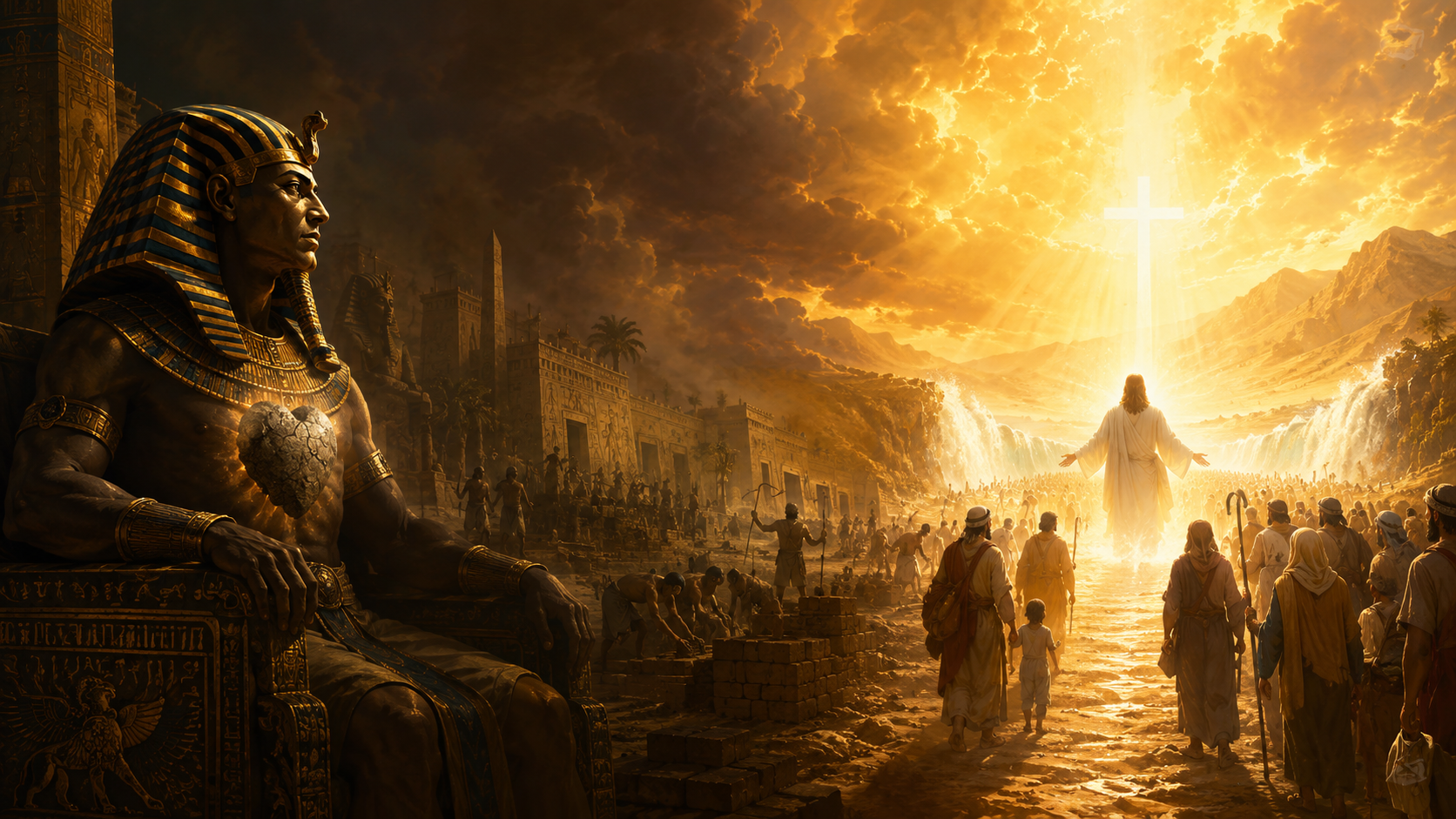
The demand shalach et-ammi — let go my people — is echoed and transformed throughout the New Testament in the language of redemption. The Greek word apolytrosis (redemption, release) that Paul uses in Ephesians 1:7 and Romans 8:23 shares the same conceptual root: the releasing of a people from bondage through the payment of a price or the exercise of superior power.
In the New Exodus that Christ accomplishes, the demand is directed not at a human Pharaoh but at the powers of sin, death, and spiritual bondage. Colossians 2:15: "He disarmed the rulers and authorities and put them to open shame, by triumphing over them in him." The language of Exodus — the public defeat of the enemy, the triumphal procession, the liberation of captives — is the language Paul uses to describe the cross. The cross is the ultimate "Let my people go" — the final liberation from the deepest bondage.
The New Exodus in Luke 9:31 and Isaiah 40–55
We noted in Part Five that at the Transfiguration, Moses and Elijah spoke with Jesus about His "departure" — the Greek word being exodon, His Exodus. Jesus' journey to the cross and through resurrection is explicitly understood in Luke as a new Exodus.
This connection is prepared by Isaiah 40–55, the section of Isaiah that scholars call "Deutero-Isaiah" or Second Isaiah. These chapters are saturated with Exodus language: "Prepare the way of the LORD in the wilderness... For you shall go out in joy and be led forth in peace" (Isaiah 55:12). The return from Babylonian exile is understood as a new Exodus. And then Jesus fulfils this at a yet deeper level — the ultimate new Exodus out of the captivity of sin and death itself.
The formula "that you may know that I am the LORD" — which we identified as the interpretive key of the plagues — appears in its New Testament form in John 8:28: "When you have lifted up the Son of Man, then you will know that I am he." The cross — the ultimate confrontation between divine love and human sin — is the event through which the world is meant to know who Jesus is. The Exodus pattern: suffering → display of divine power → liberation → covenant → the world knowing who YHWH is. The passion: suffering → resurrection → new covenant → the world knowing who Jesus is. The pattern is exact.
The Hardened Heart and the Hardening of Israel
John 12:37–41 makes a startling move in connecting the hardening of Pharaoh to the hardening of Israel in response to Jesus:
"Though he had done so many signs before them, they still did not believe in him, so that the word spoken by the prophet Isaiah might be fulfilled: 'Lord, who has believed what he heard from us, and to whom has the arm of the Lord been revealed?' [Isaiah 53:1] Therefore they could not believe. For again Isaiah said, 'He has blinded their eyes and hardened their heart, lest they see with their eyes, and understand with their heart, and turn, and I would heal them.' [Isaiah 6:10] Isaiah said these things because he saw his glory and spoke of him."
John 12:37–41
John applies Isaiah 6's hardening language — originally spoken about Israel's response to Isaiah's ministry — to Israel's response to Jesus. And he identifies the one whose glory Isaiah saw in Isaiah 6 as Jesus. The divine pattern of hardening is not only about Pharaoh. It recurs whenever divine revelation confronts human resistance. The Pharaoh dynamic — the miraculous sign, the initial hardening, the escalating confrontation — is replayed in miniature every time the Gospel is preached and rejected. Understanding Pharaoh helps us understand everything.

Devotional
When Obedience Makes Things Worse Before They Get Better
There is a particular kind of disorientation that comes from doing exactly what God told you to do — and watching things get worse.
Moses did not improvise. He did not freelance. He delivered the message he was given, to the person he was sent to, using the words he was told to say. He followed instructions precisely. And the result was that the people he was sent to help were now making bricks without straw, being beaten by their foremen, and blaming Moses for everything.
He went back to God and said, in essence: this is not going the way You said it would. You said You had seen the suffering. You said You had heard the groaning. You said You were coming down to deliver them. And now — since I arrived — the suffering has increased, the groaning has worsened, and the deliverance is nowhere in sight. Was I wrong about the burning bush? Was I wrong about the Name? Why have you done evil to this people?
This is what the Psalms call lament — and it is a fully honourable form of prayer. It is not faithlessness. It is the prayer of someone who takes God's promises seriously enough to confront Him when the evidence seems to contradict them. The lament psalms are not the B-team of Scripture. They are the prayers of people who believe God is real and present and powerful enough to be worth arguing with.
God's response to Moses' complaint is not "you've missed something" or "you should trust Me more." It is: here are seven things I will do. Here is My covenant name again. Here is My arm, stretched out for you. The seven-fold promise of Exodus 6 is not given to a man at the height of his faith. It is given to a man at the nadir of his confidence, in the moment when the mission looked most like failure.
If you are in Exodus 5 right now — if you said yes to the burning bush and the straw has been removed and the quotas have been increased and the people are blaming you — you are in the right part of the story. Not the last part. The middle part. The part that has seven promises on its way.
God is not finished. He was not finished with Israel in Exodus 5. He is not finished with you in yours.

Reflection & Discussion Questions
Personal Reflection
1. Moses walked back into the palace he had grown up in — not as a prince, but as a prophet. Have you ever had to return to a place or a situation from your past — not as the person you were then, but as the person God has made you since? What was that like? What did it require of you?
2. Pharaoh's response to "Let my people go" was to increase their suffering. Have you experienced a situation where doing the right thing, saying the right thing, made things measurably worse in the short term? How did you sustain faith in those circumstances?
3.Moses' prayer in Exodus 5:22–23 is raw accusation — "Why have you done evil to this people?" Many Christians feel they cannot pray this way. But Moses did, and God answered. What would it mean for you to bring your most honest complaints to God rather than your most polished ones? What holds you back?
Deeper Study
4. Study the three Hebrew verbs for hardening: chazaq (to strengthen/firm), kaved (to be heavy), and qashah (to be hard). Note which is used when, and by which subject. How does tracking these three different words change your understanding of the hardening narrative? Does it affect your theological position on divine sovereignty and human responsibility?
5. Read Romans 9:14–21 alongside Exodus 9:16. Paul refuses to resolve the sovereignty/free-will tension philosophically — he appeals instead to the creature's epistemic limits before the Creator. Do you find this response satisfying? Unsatisfying? How do you personally hold the tension between divine sovereignty and human accountability?
6. The seven "I will" statements of Exodus 6:6–8 were spoken to Moses at the lowest point of the mission. Read them slowly one by one. Which of the seven speaks most directly to where you are right now? Which is hardest to believe in your current season?
7. John 12:37–41 applies the Pharaoh-hardening pattern to Israel's rejection of Jesus, and identifies the glory Isaiah saw in Isaiah 6 as Jesus' glory. How does this connection change how you read Isaiah 6? And what does it suggest about the nature of divine revelation — that greater revelation can sometimes produce greater hardness rather than greater openness?
Closing Prayer
A Prayer from the Middle of the Worsening
LORD, God of Abraham, Isaac, and Jacob —
We have come to You with the prayer of Exodus 5. Why have You done evil to this people? Why did You ever send me? We have come obedient to the burning bush, faithful to the commission, carrying Your word to the place You sent us — and the straw has been removed and the quotas have not changed and the people are blaming us and we cannot see the seven promises from where we are standing.
Meet us here with what You gave Moses. Not an explanation. Not a philosophical resolution of our sovereignty questions. Just the seven words: I will bring you out. I will deliver you. I will redeem you. I will take you. I will be your God. I will bring you in. I will give it to you. Seven promises spoken by the God who said them before the first plague had been sent, before the first sign had changed a single thing, before anything in the visible world had moved in the direction of liberation.
We confess that we find it easier to trust You in the burning bush moment than in the Exodus 5 moment. That the commission is exhilarating and the straw-removal is not. Give us the faith that holds Your word in the face of contradicting evidence — that says, with Moses: I do not understand what is happening, but I know who sent me, and I know what He said, and I will go back and do it again.
And for those whose heart Pharaoh is asking You about — hardened hearts in our world, in our families, in ourselves — have mercy. The judicial hardening is real. But so is the God who said: I take no pleasure in the death of the wicked (Ezekiel 33:11). Hold both. Have mercy. Act as the God who redeems with an outstretched arm.
Your name shall be proclaimed in all the earth. We trust that. Even from Exodus 5.
Amen.
Coming Next in the Series
Parts Nine, Ten & Eleven: The Ten Plagues — God's Systematic Demolition of Egyptian Theology
The ten plagues are not random natural disasters. They are a precisely ordered, theologically intentional assault on the gods of Egypt — each plague targeting a specific deity, demonstrating YHWH's superiority over every domain of Egyptian life. We will examine each plague in detail: its Hebrew name, its Egyptian theological target, its natural science background, its literary structure in the text, and its Christological significance. Part Nine covers the buildup and the first three plagues. Parts Ten and Eleven take us through the remaining seven to the Passover night itself.
Add comment
Comments