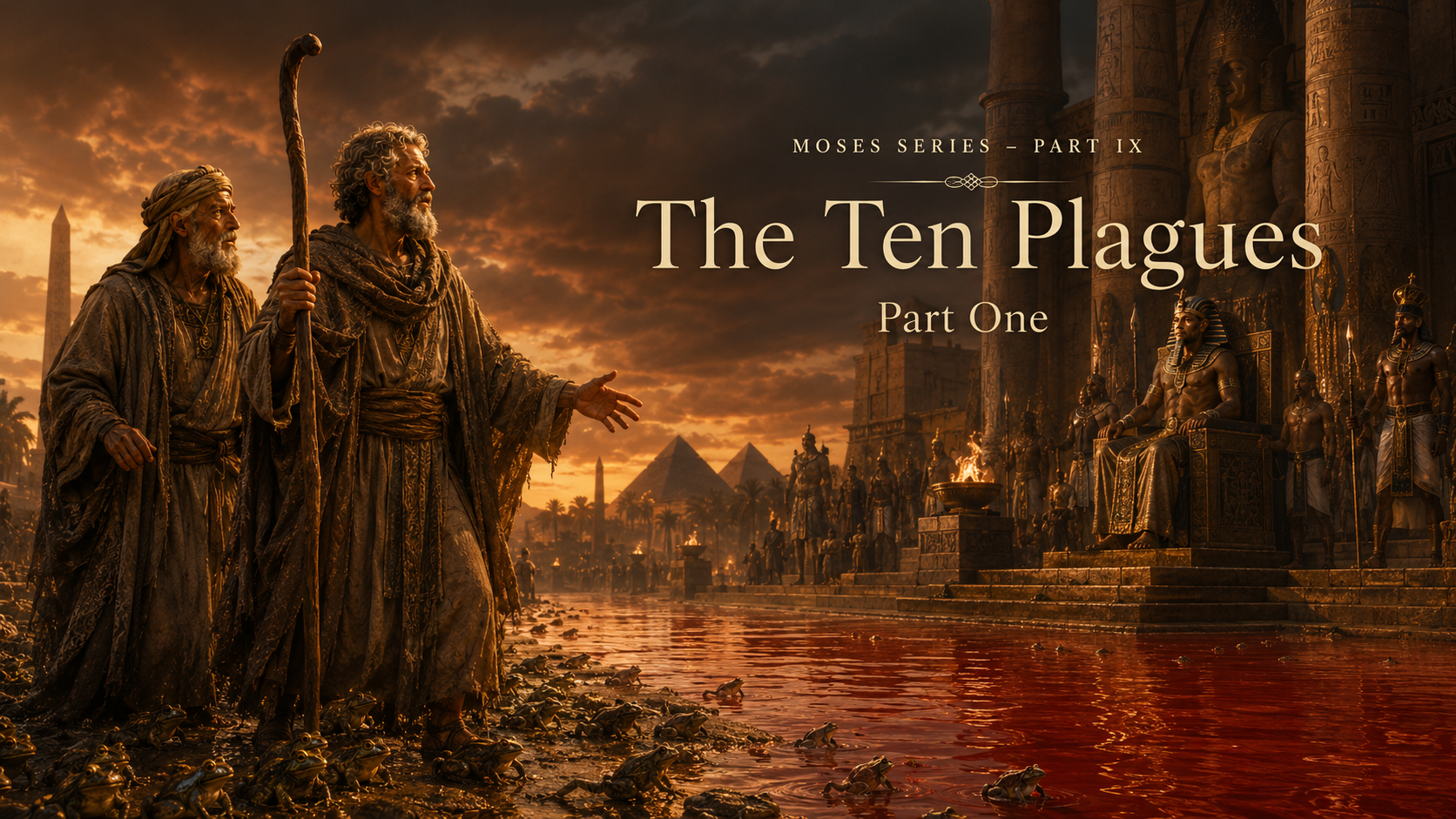
"I will execute judgements on all the gods of Egypt: I am the LORD."
— Exodus 12:12
Before You Begin This Study
Please Read These Passages First
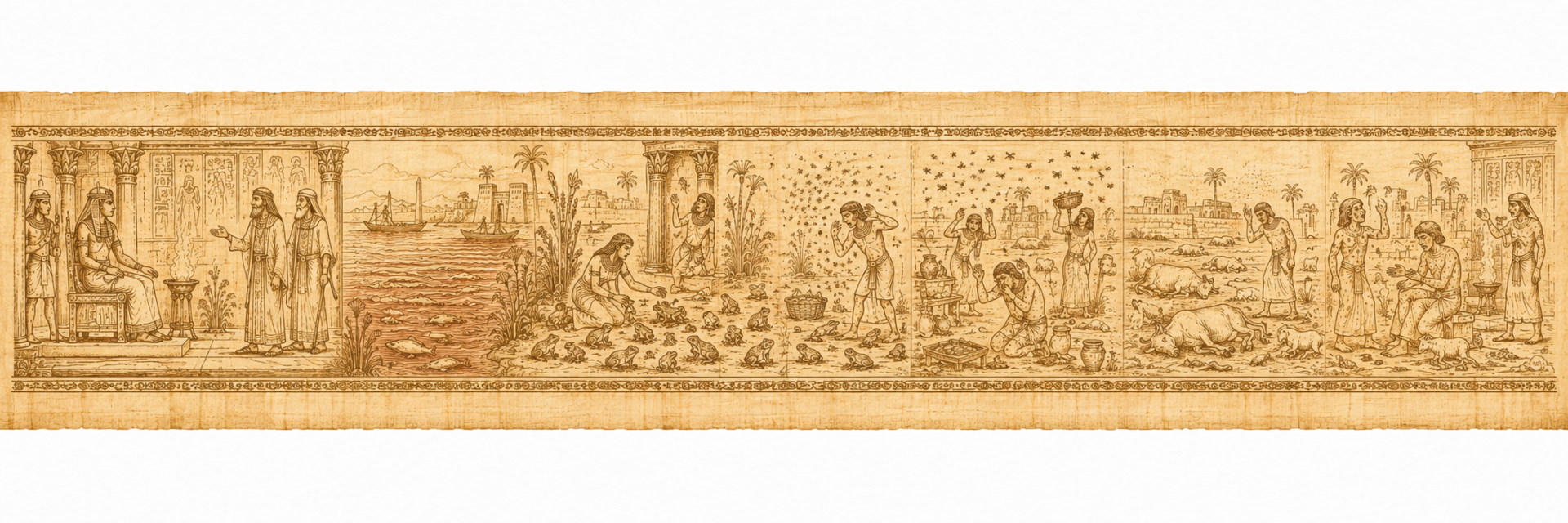
Part Nine covers the first six plagues.
Before reading the commentary, read the biblical text straight through from beginning to end — all the way from Exodus 7:14 to 9:12. Read it as narrative, not as a reference document. Let the cumulative weight of the plagues build. Notice how the pace and intensity escalate. Notice what happens to the magicians. Notice where Goshen is first mentioned.
Pay particular attention to the specific actions Moses and Aaron perform before each plague, the language of Pharaoh's responses, and when and how the hardening language changes. These details are carrying enormous theological weight.
Exodus 7:14–9:12 Exodus 12:12 Numbers 33:4 Psalm 78:43–51 Psalm 105:26–36
Optional deeper reading:
The Egyptian Book of the Dead (chapters relating to Hapi, Ra, Heqet, Nut, and Osiris — available in full translation);
The Hymn to the Nile (a genuine ancient Egyptian religious text);
John 2:1–11 (water to wine — the reversal of the first plague);
Revelation 16 (the bowl judgements as eschatological plagues recapitulating Exodus).
Exodus 7:14-24
Exodus 8:1-15
Exodus 8:16-19
Exodus 8:20-32
Exodus 9:1-7
Exodus 9:8-12
The story
Now listen carefully. Because what happens next is not what most people think it is.
The ten plagues are not random natural disasters that God sent to coerce a stubborn ruler. They are something far more precise. Far more devastating. Far more theologically brilliant.
They are a systematic, plague-by-plague demolition of the entire religious system of the most powerful empire the world had ever known. God Himself explained it in Exodus 12:12:
For I will pass through the land of Egypt that night, and I will strike all the firstborn in the land of Egypt, both man and beast. And on all the gods of Egypt — I will execute judgements. I am the LORD. On all the gods of Egypt. Not some. All.
The entire Egyptian pantheon was being put on trial. And every plague was a verdict.
Egypt worshipped over two thousand deities. But a core group governed the great domains of creation: the Nile, the earth, the sky, the animals, human health, and death. The Pharaoh himself was the nexus of the entire system — the living Horus, the son of Ra, the one whose divine authority held the whole cosmos in order.
To strike the plagues was to strike the gods who stood behind Pharaoh’s power. One by one. Domain by domain. Until there was not a single claim that Egyptian theology had made that had not been proved false by YHWH’s superior sovereignty.
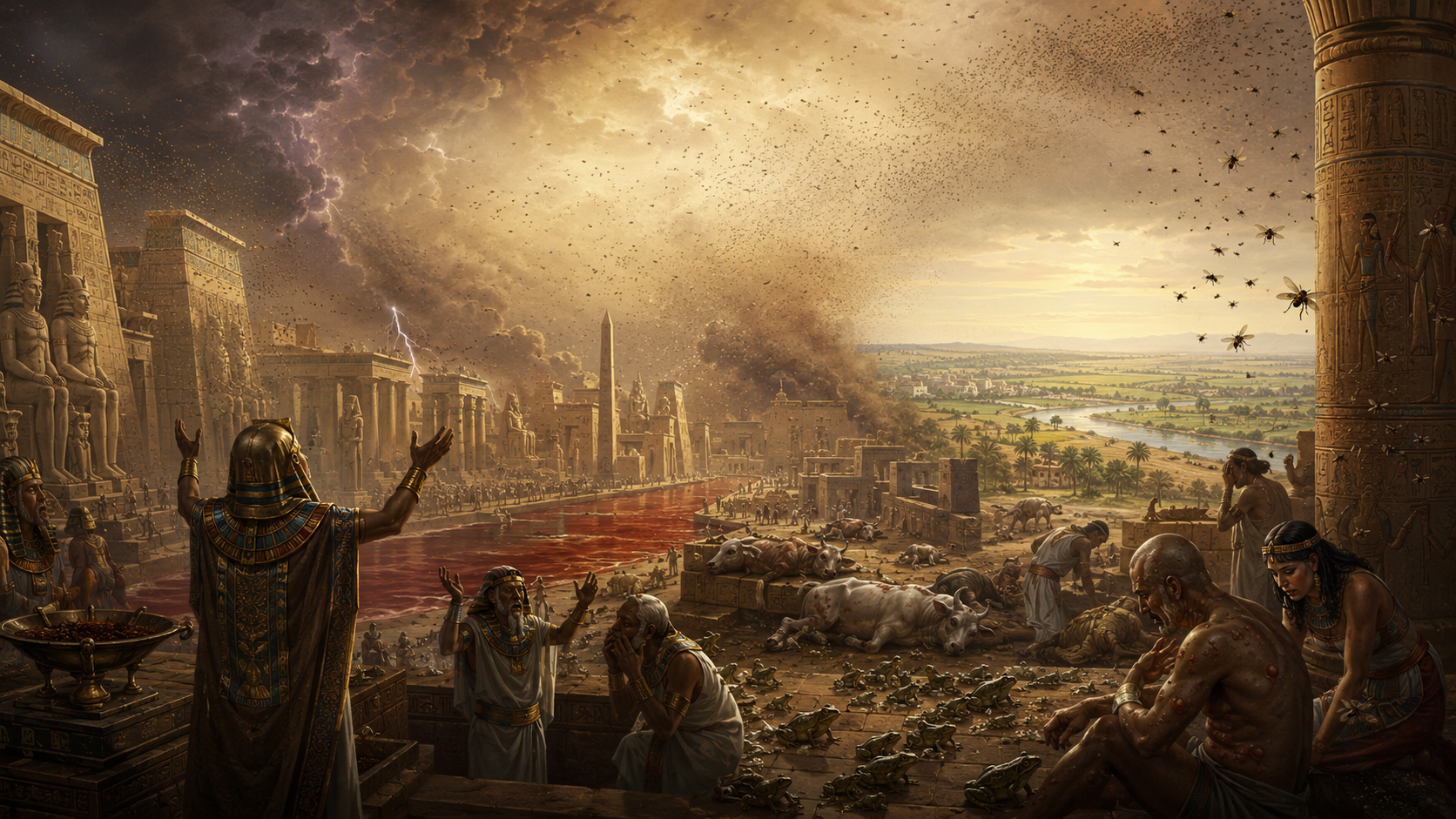
First: the Nile turned to blood.
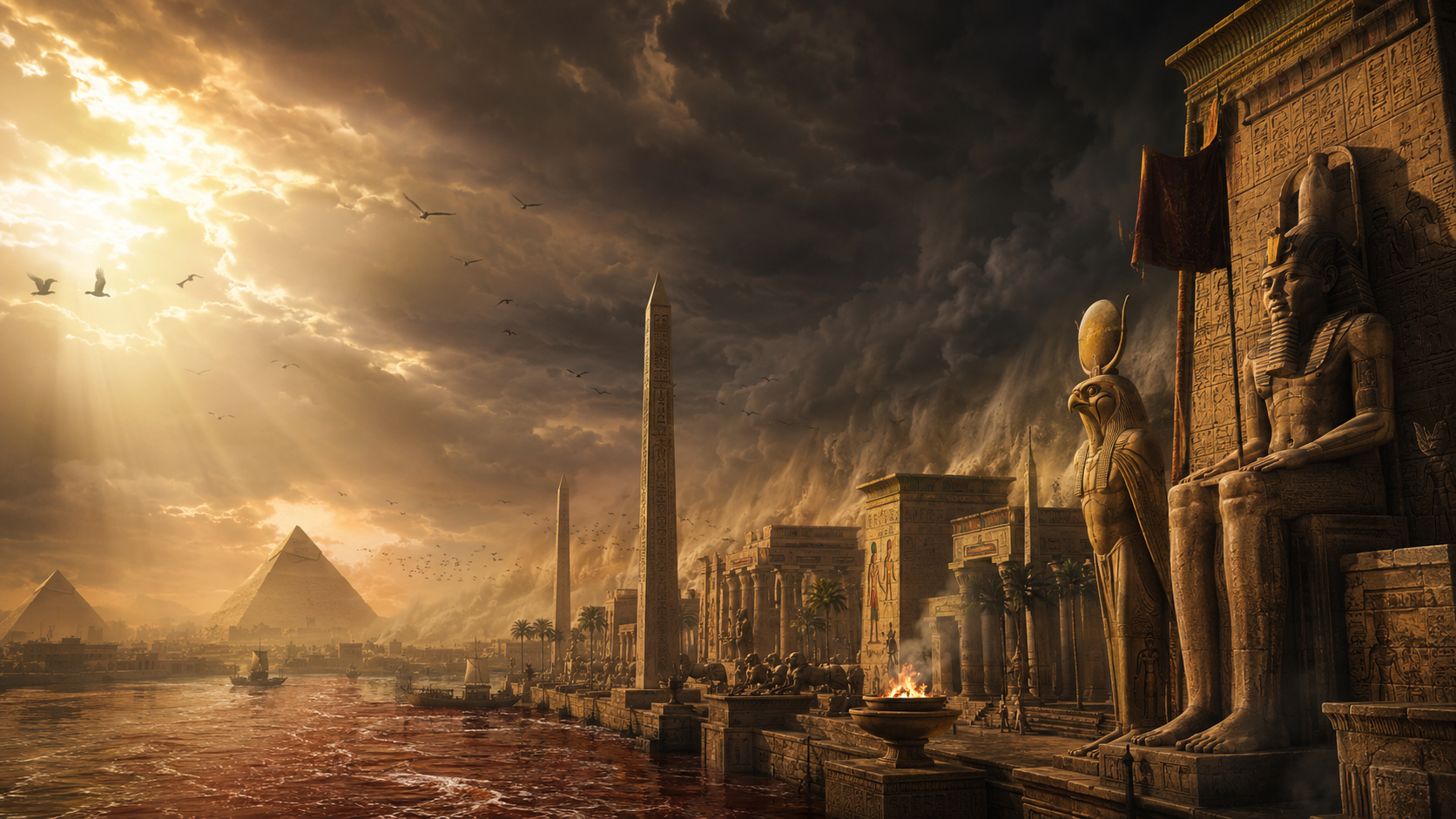
Moses met Pharaoh at the river in the morning — at the king’s dawn ritual of homage to Hapi, the Nile god, the source of all Egyptian life. Aaron raised his staff.
The Nile turned. All of it — the canals, the ponds, the reservoirs, every vessel of water in Egypt. Red.
The fish died. The smell reached the city before the colour did. And for seven days, the sacred river of Egypt ran the colour of judgment. Hapi was supposed to protect the Nile. Khnum was supposed to guard its source. Osiris — whose very bloodstream the Nile was said to be — was supposed to sustain it.
YHWH turned it to blood. And Pharaoh went back inside his palace. He did not take even this to heart. The hardening was not dramatic defiance. It was something colder.
Indifference.
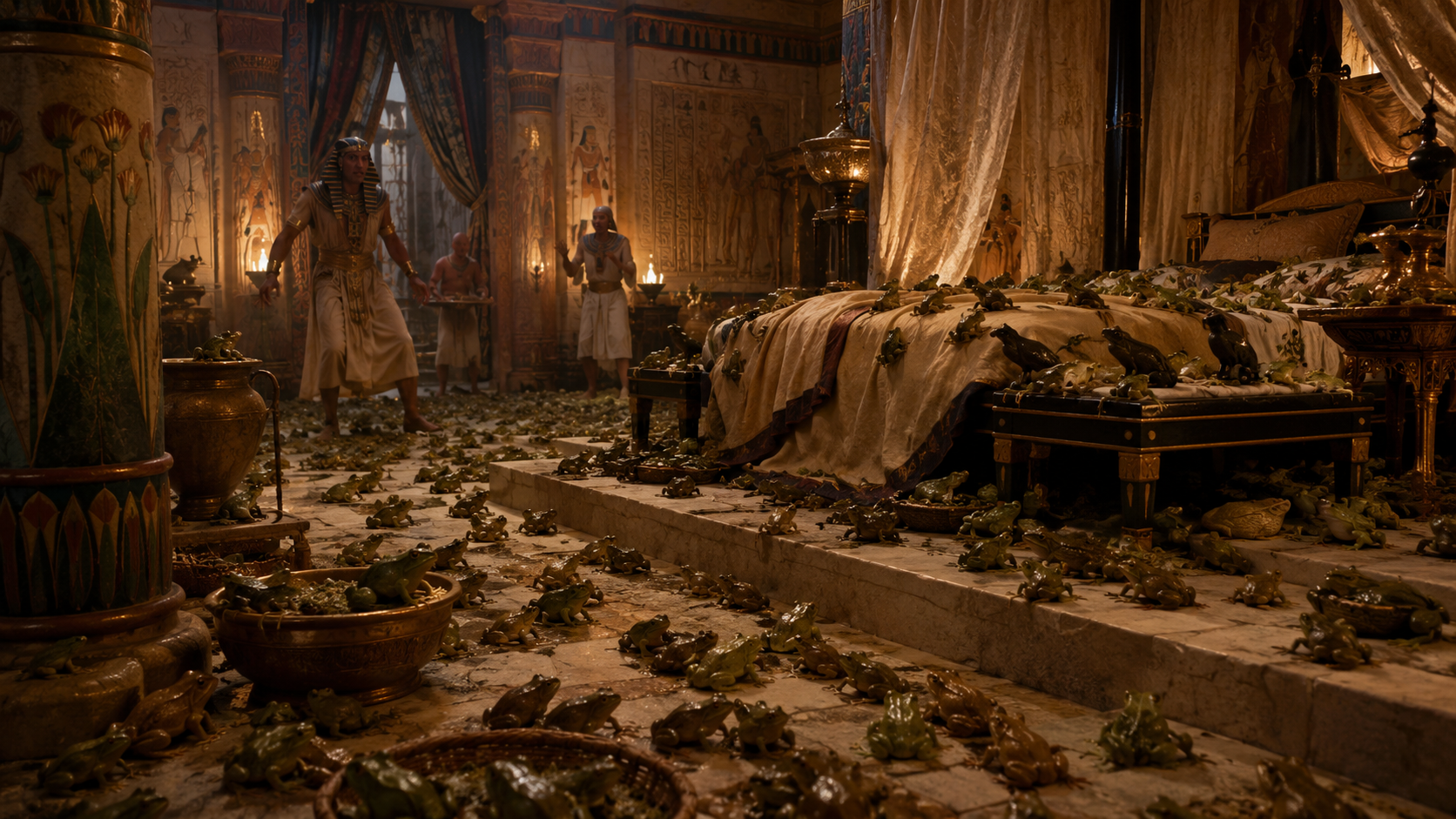
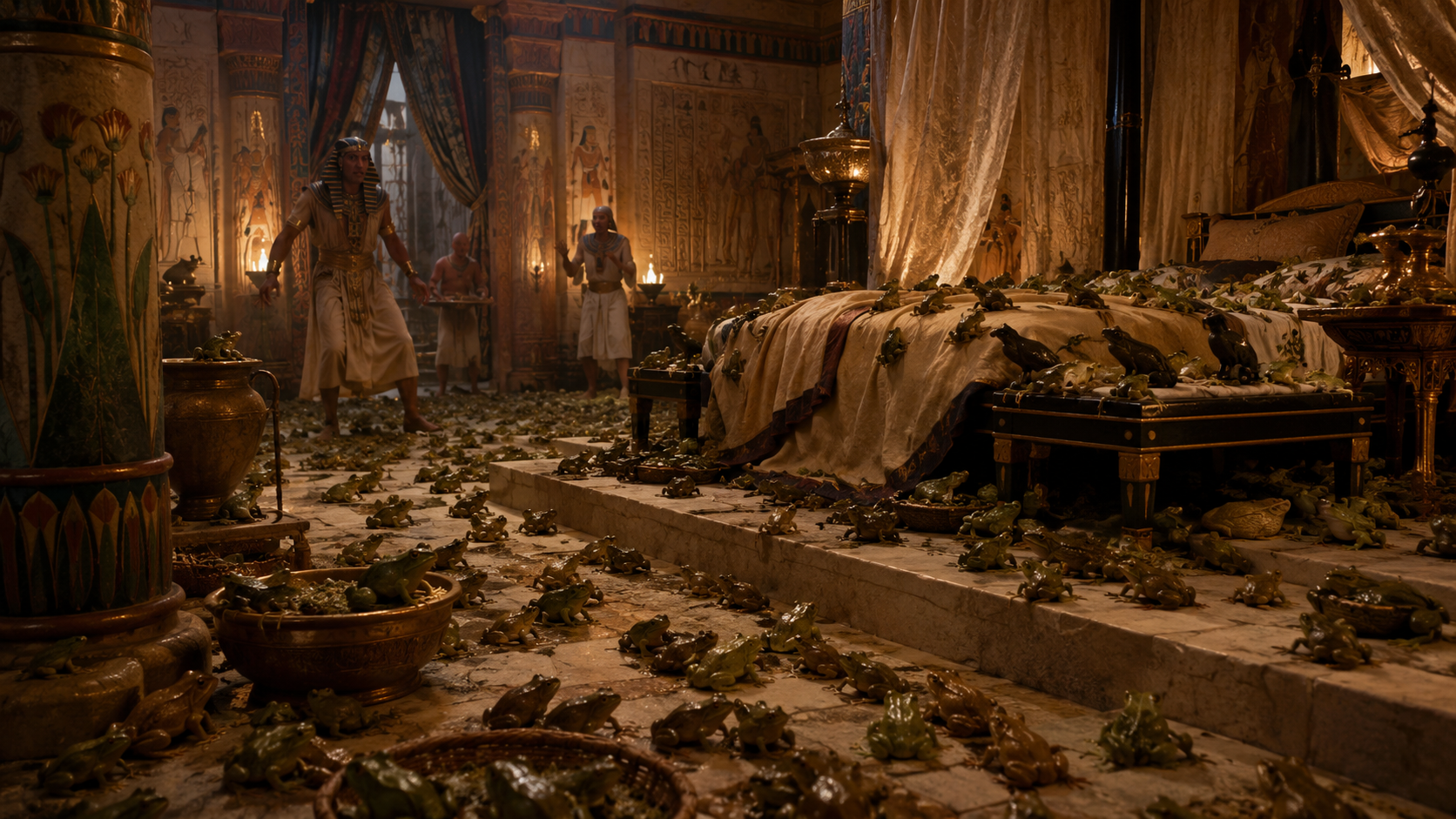
Then frogs came up out of the Nile. Millions of them. Into the ovens, the kneading bowls, the beds, the houses. Into Pharaoh’s own bedroom. Into his bed.
The sacred frog goddess Heqet — the goddess of fertility, of childbirth, of new life, one of the most ancient and beloved in the Egyptian pantheon — her sacred animal became the instrument of Egypt’s infestation. Pharaoh summoned Moses and Aaron. He said: plead with your God to take away the frogs. I will let the people go.
Moses said: name the time. When shall I pray for you? And Pharaoh said, in one of the strangest moments in the entire narrative: tomorrow.
Tomorrow. Not now. Not immediately. Tomorrow.
Even surrounded by frogs. Even in extremis. Even with the promise of relief within his grasp — Pharaoh chose one more night with the frogs rather than immediate surrender to YHWH’s authority.
The rabbis noticed this. One of them wrote: Pharaoh was a fool. A fool prefers to live one more night with the frogs rather than be immediately free.
It is the psychology of the hardened heart at its most exposed. Not defiance. Not courage. Just the stubborn preference for manageable misery over the humiliation of acknowledging Who is in charge.
God removed the frogs at the appointed time, with precision. The frogs died at the exact moment Moses prayed — not before, not after. Nature does not do this. YHWH does this.
And Pharaoh hardened his heart.
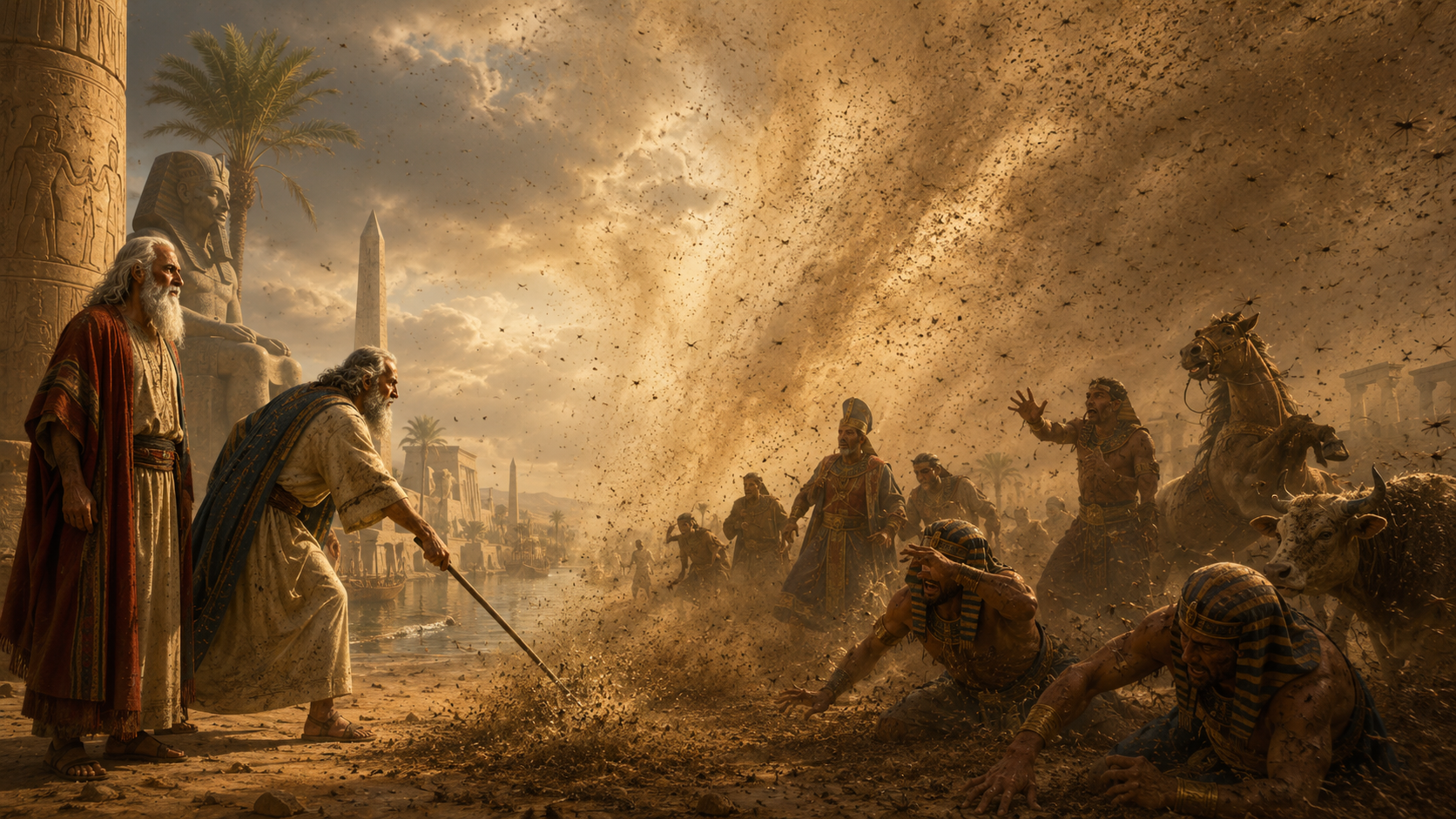
Then came gnats from the dust of the earth. The earth god Geb — whose domain every handful of Egyptian dirt was — saw his substance weaponised against his own people. And something new happened.
The magicians of Egypt — the court sorcerers, the graduates of the great temple schools, the men who had replicated the blood and the frogs — could not produce gnats. They tried. They failed. And they said to Pharaoh: This is the finger of God.
It is one of the most remarkable confessions in the ancient world. Egypt’s own religious professionals — the ones whose entire vocational identity was the management of supernatural power on behalf of the Egyptian state — stood before their master and said: we are out of our depth. What is happening here operates at a level our training cannot access.
This is the finger of God.
Pharaoh did not listen to them.
Flies came next — swarms of them, covering all of Egypt. And here, for the first time, something new appeared.
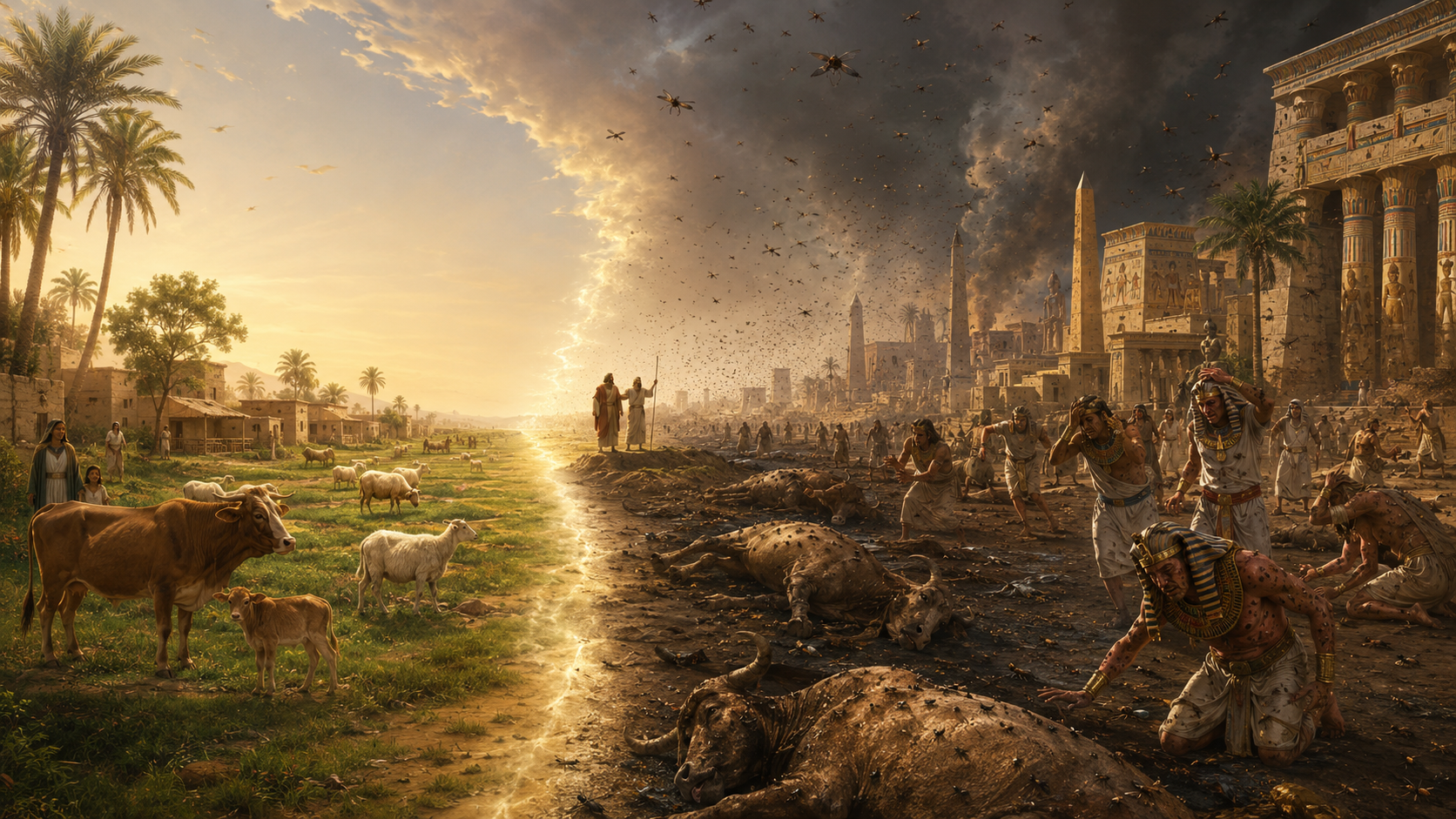
God said: on that day I will set apart the land of Goshen, where my people dwell, so that no swarms of flies shall be there. Goshen was exempt. The line was drawn.
YHWH’s people, inside Egyptian territory, were being visibly separated from Egypt’s judgment. The physical geography was becoming a theological statement.
Then the livestock died.
Egypt’s sacred cattle — Hathor’s cows, the Apis bull of Memphis, the Mnevis bull of Heliopolis, all the sacred animals that the gods had claimed as their own — they died. And Pharaoh checked.
He sent investigators to Goshen. He verified it personally. The report came back: not one Israelite animal was dead. Every word was true.And Pharaoh hardened his heart. Evidence checked. Confirmed. And hardened anyway.
Then came boils from soot scattered in the air — painful eruptions covering every Egyptian body.
And the magicians, whose entire vocation was the healing of disease in the name of Sekhmet, the medical goddess — they could not stand before Moses. They were covered in the same boils. They could not protect themselves. They could not heal themselves. After this plague, they disappear from the narrative entirely.
Egypt’s religious professionals had said: this is the finger of God. Now they could not stand before the owner of that finger.
And Exodus 9:12 records something that had not quite been said before.
Up until now, Pharaoh had hardened his own heart — he had chosen his direction, again and again, each time God gave him the chance to relent.
But now: the LORD hardened the heart of Pharaoh. The judicial hardening. The confirmation of the direction freely chosen.
Six plagues. Not one of Egypt’s gods had been able to protect its domain. Not Hapi the Nile-god. Not Heqet the frog-goddess. Not Geb the earth-god. Not Hathor the cow-goddess. Not Sekhmet the healing-goddess.
The river, the earth, the animals, the human body — every domain Egypt had assigned to a deity was under YHWH’s authority. And Pharaoh still would not yield.
There were four more plagues to come. Hail that would kill everything in the open field. Locusts that would devour what the hail left. Darkness so profound it could be felt. And then — the last thing.
The one thing.
The death of the firstborn.
But that story — the Passover night, the blood on the doorposts, the long walk out of Egypt under the moon — that is the next chapter.
The Framework: What the Plagues Actually Are
Not natural disasters — a precision theological demolition of an entire religious system
Before we examine a single plague, we need to establish the framework through which all ten must be understood. Without this framework, the plagues are a series of impressive natural disasters. With it, they are one of the most sophisticated and devastating theological arguments in human history.
The Declaration That Interprets Everything
"For I will pass through the land of Egypt that night, and I will strike all the firstborn in the land of Egypt, both man and beast; and on all the gods of Egypt I will execute judgements: I am the LORD."
Exodus 12:12
Numbers 33:4 reinforces this: "...the Egyptians were burying all their firstborn, whom the LORD had struck down among them. On their gods also the LORD executed judgements." This is not metaphor. The plagues are explicitly described, in the Bible's own interpretive commentary, as divine judgements on the gods of Egypt. Not on the Egyptian people as an abstract collective. On their gods specifically — on the theological system that undergirded Egyptian power, identity, and empire.
This means the plagues must be read on two levels simultaneously: the natural/historical level (what actually happened to Egypt) and the theological/polemical level (which deity is being addressed, what theological claim is being made, what aspect of Egyptian religion is being dismantled). Miss the second level and you have missed the point entirely.
Egypt's Theological System: What Was Being Attacked
Egyptian Religion — The System Moses Was Dismantling
Egyptian religion was not a casual cultural feature. It was the operating system of Egyptian civilisation. Every aspect of Egyptian life — agriculture, kingship, law, medicine, architecture, death, afterlife — was organised within a theological framework. To challenge Egyptian theology was to challenge the foundations of Egyptian society itself.
The Egyptian pantheon contained over 2,000 named deities, but a smaller core set governed the major domains of creation. The Pharaoh himself was the pivot of the entire system: he was the living Horus, the son of Ra, the one who maintained ma'at (divine order) between the gods and the human world. His power was literally divine. His authority was literally cosmic.
When YHWH attacks Egypt through the plagues, He is not attacking a secular state that happens to have some religious customs. He is attacking a totalising theological system in which every domain of life — water, land, sky, animals, human health, and death itself — was claimed by, protected by, and accountable to specific named deities. The plagues work through the Egyptian system, not around it: they target each deity in turn, demonstrating YHWH's authority over every domain Egypt's gods claimed to rule.
This is why Exodus 12:12 says "on all the gods of Egypt I will execute judgements." Not some. All. The entire pantheon is being put on trial — and found wanting.
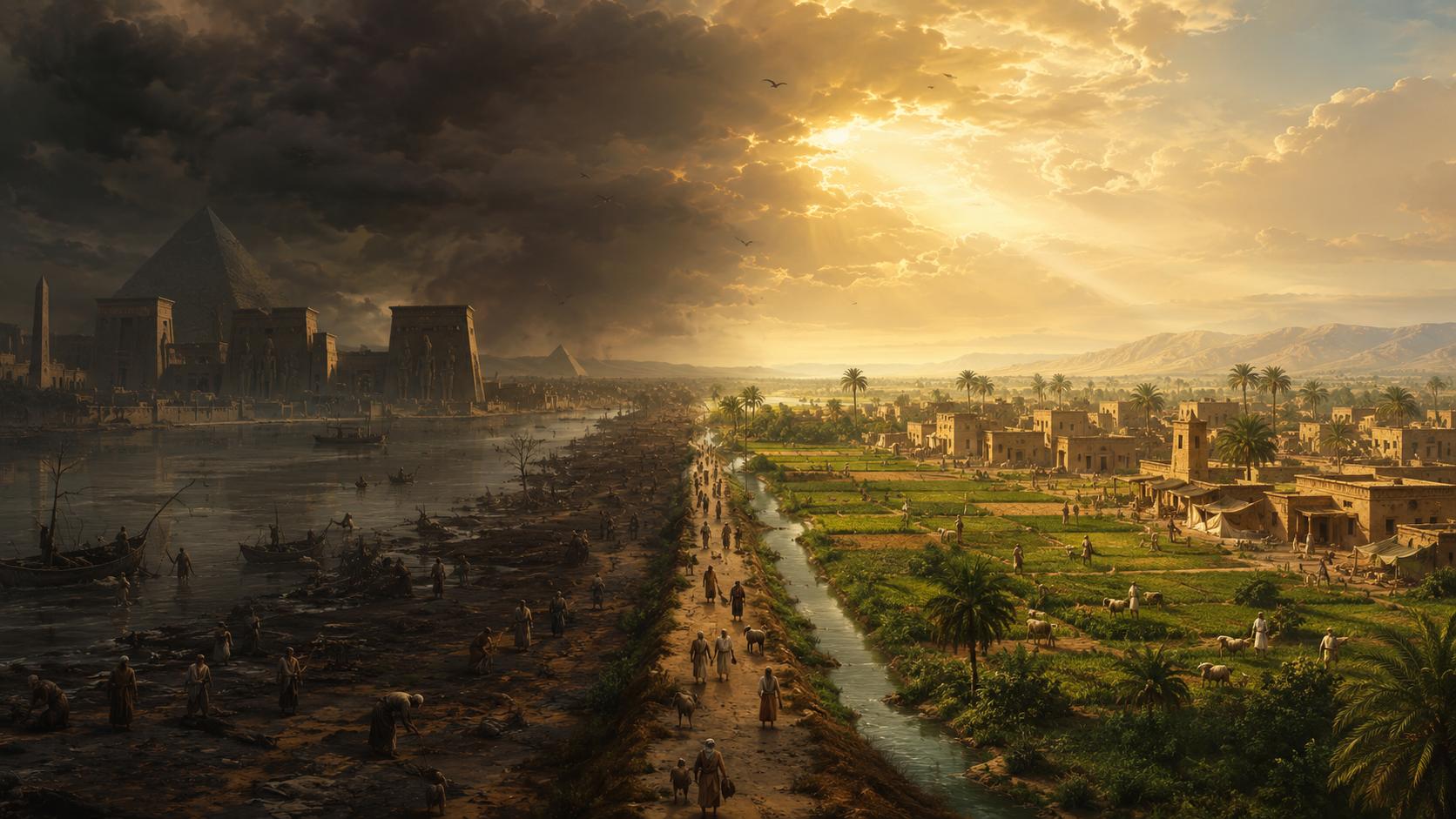
The Literary Structure of the Plagues: A Three-Group Pattern
One of the most overlooked features of the plague narrative is its precise literary structure. The ten plagues are not arranged randomly. Scholars, most prominently Umberto Cassuto and later John Currid, have identified a clear three-group pattern with each group of three sharing structural characteristics:
Before we examine a single plague, we need to establish the framework through which all ten must be understood. Without this framework, the plagues are a series of impressive natural disasters. With it, they are one of the most sophisticated and devastating theological arguments in human history.
The 3-3-3-1 Literary Structure of the Plagues
Group 1 — Plagues 1, 2, 3 (Blood, Frogs, Gnats): Moses confronts Pharaoh in the morning for Plague 1. Plague 3 comes with no warning at all. The magicians can replicate Plagues 1 and 2 but are defeated by Plague 3 — this is the first fracture in Egyptian religious power.
Group 2 — Plagues 4, 5, 6 (Flies, Livestock Death, Boils): Moses confronts Pharaoh in the morning for Plague 4. Plague 6 comes with no warning. First appearance of the Goshen distinction — God separates Israel from Egypt within the plagues. The magicians cannot replicate Plague 6 — they stand before Moses broken, unable to heal themselves. The magicians disappear from the narrative after Plague 6.
Group 3 — Plagues 7, 8, 9 (Hail, Locusts, Darkness): Moses confronts Pharaoh in the morning for Plague 7. Plague 9 comes with no warning. Each plague in this group involves Pharaoh's servants beginning to negotiate and plead — the court is cracking.
Plague 10 — Death of the Firstborn: Stands alone as the culmination. Preceded by the longest warning section in the narrative (Exodus 11). Accompanied by the institution of the Passover — the meal that will be eaten for eternity. This is the plague that breaks Egypt, breaks Pharaoh, and liberates Israel.
This pattern — discovered through close literary analysis — reveals that the plague narrative is not a loosely organised collection of stories but a tightly constructed literary and theological argument with escalating intensity and clear internal logic.
The Goshen Distinction: A Detail Most Readers Miss
Beginning with the fourth plague (Flies — Exodus 8:22), something new appears: God explicitly separates the land of Goshen, where the Israelites live, from the rest of Egypt. The flies swarm all of Egypt — but not Goshen. The livestock die — but only Egyptian livestock, not Israel's. The darkness covers Egypt — but Israel has light.
This distinction is often noticed but rarely examined for its full theological significance. It serves several purposes simultaneously:
- It demonstrates that the plagues are targeted, not accidental.If the plagues were merely natural disasters, they would not stop at a specific geographical boundary. Their precise limit at the edge of Goshen proves they are directed — controlled, intentional, purposeful.
- It separates YHWH's people from Egypt within history.Before the Passover and Exodus formally separate Israel from Egypt, God is already drawing a line. The physical boundary between Goshen and Egypt becomes a visible sign of the covenant distinction between YHWH's people and Pharaoh's people.
- It creates a living theological argument inside Egypt.The Egyptians could see Goshen. They could see that their land was devastated and the Hebrew quarter was not. This observation was itself a theological statement: YHWH has jurisdiction here. Ra does not.
- It foreshadows the Passover night.The blood on the doorposts in Exodus 12 is the visible marker of the final Goshen distinction — the line between judgment and protection. The plagues' Goshen exemptions are preparation for reading the final night correctly
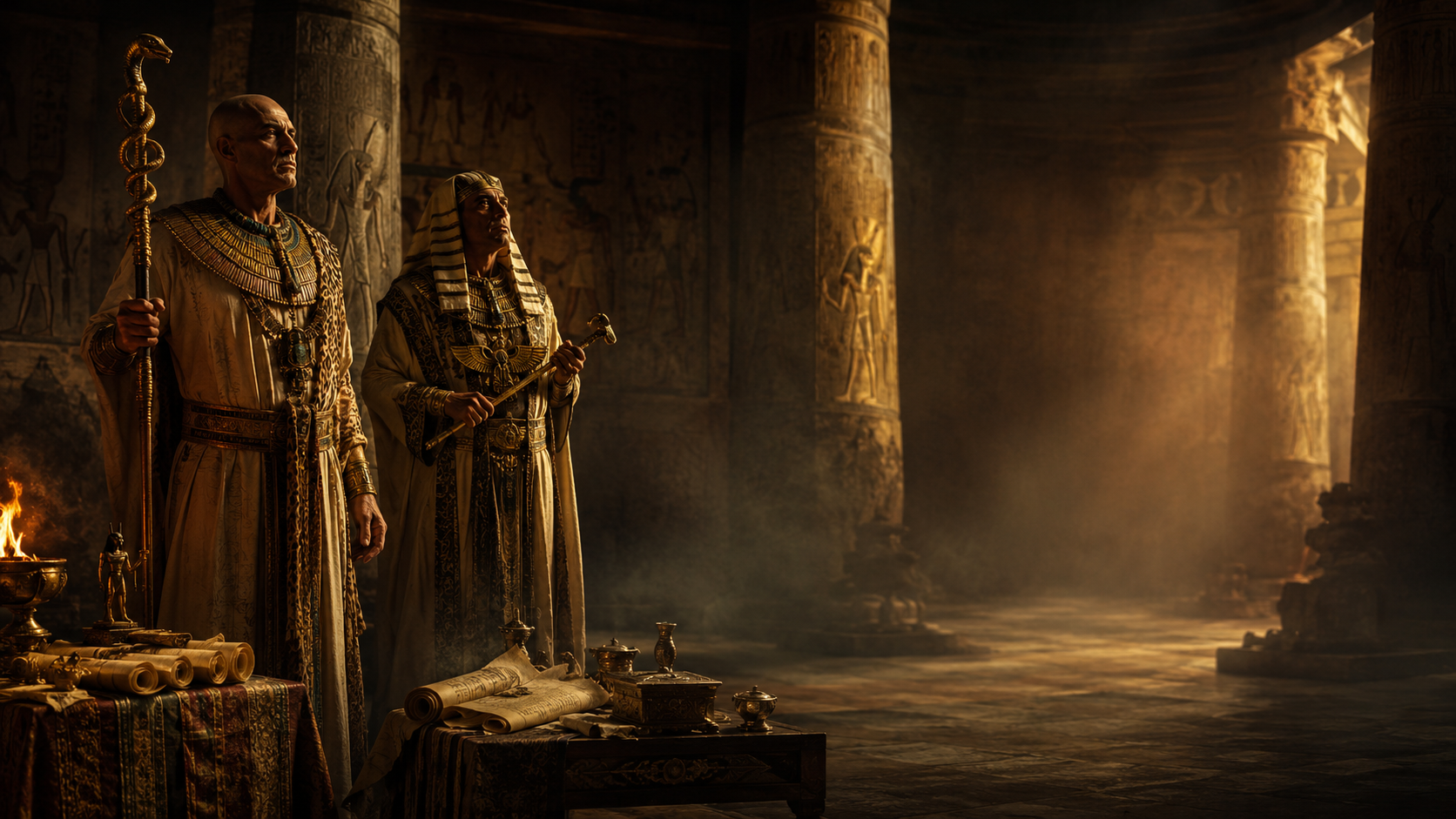
The Magicians of Egypt: Jannes and Jambres
Who were they, what could they do, and when and why did they break?
One of the most consistently underexamined elements of the plague narrative is the role of the Egyptian magicians — the court practitioners who replicate the first two plagues and are then progressively dismantled. They are among the most theologically significant figures in the Exodus, precisely because their story is a microcosm of the entire confrontation: human occult power meeting divine power and, in stages, being undone.
Who Were They? Their Historical and Cultural Identity
Historical & Cultural Context — Egyptian Court Magicians
The Hebrew words used for the Egyptian practitioners are chartumim (Exodus 7:11) — commonly translated "magicians" or "sorcerers" but more precisely meaning "sacred scribes" or "those who use a stylus." The term relates to chartom, meaning a stylus or engraving tool, suggesting these were literary-religious specialists who worked with sacred texts and ritual formulae.
Egyptian texts from the New Kingdom period describe a class of religious specialists called hery seshta ("those who are over the mysteries") and kher heb ("lector priests") who were specialists in magical texts, healing formulae, and ritual performance. These were highly educated men — graduates of the per-ankh ("House of Life"), the temple school attached to major Egyptian temples, who trained in theology, medicine, and ritual magic simultaneously.
The Westcar Papyrus (c. 1600 BC, predating Moses) contains detailed accounts of Egyptian court magicians performing exactly the kinds of acts the Exodus magicians perform — transforming objects and animals, manipulating natural substances. These accounts show that such abilities were real within Egyptian religious experience — whether one attributes them to demonic deception, natural skill, or both.
Their names — not given in Exodus — appear in extrabiblical tradition. 2 Timothy 3:8 names them: Jannes and Jambres. Paul uses them as a type of false teacher: "just as Jannes and Jambres opposed Moses, so these men also oppose the truth." These names appear in Jewish literature including the Damascus Document (from Qumran) and the Targum of Pseudo-Jonathan, suggesting they were known in ancient Jewish tradition even where not preserved in the canonical text.
What They Could Do — And Its Theological Significance
The magicians replicate the first two plagues: the staff becoming a serpent (Exodus 7:11–12), water turning to blood (7:22), and frogs covering Egypt (8:7). This is one of the most theologically uncomfortable aspects of the Exodus for many readers. If God's signs can be replicated by Egyptian sorcerers, does that not undermine their evidential value?
The discomfort is instructive. The biblical response to the magicians' power is not to deny it but to demonstrate its inferiority and its ultimate limits. Several things are carefully established:
- Aaron's staff swallows theirs. When the magicians produce serpents, Aaron's staff-serpent eats them (Exodus 7:12). This detail is not decorative. It is the first demonstration of a consistent principle: Egyptian occult power has real but limited capacity, and YHWH's power comprehends and surpasses it. The sign of God's servant consumes the counter-signs of Pharaoh's servants. This will be the pattern for the entire plague series.
- Replicating a plague is not the same as removing it. The magicians can turn water to blood — adding to the disaster. They can produce frogs — adding to the infestation. But they cannot reverse a single plague. They cannot turn blood back to water. They cannot remove the frogs. The limitation of their power is that it can copy the form of God's acts but cannot undo them. This is precisely the limitation of all counterfeit power.
- Deuteronomy 13:1–3 prepares us for this. God explicitly warns Israel that prophets who perform signs and wonders may still be false prophets:"If a prophet or a dreamer of dreams arises among you and gives you a sign or a wonder, and the sign or wonder that he tells you comes to pass, and if he says, 'Let us go after other gods,' you shall not listen." Signs do not, by themselves, validate the source. The magicians' ability to replicate signs does not validate their theological claims — it tests Israel's discernment.
The Breaking Point: Plague 3 — "This Is the Finger of God"
The third plague — gnats or lice from the dust of the earth — is the hinge of the magicians' story. When they attempt to replicate it, they cannot. And then they say something extraordinary: "This is the finger of God" (Exodus 8:19).
The phrase etzba Elohim — the finger of God — is remarkable. The magicians are not converting to YHWH-worship. They are making a professional assessment: this is not natural magic, not ritual power, not anything within our technical repertoire. Whatever is happening here is operating at a level that our training and our gods cannot access or replicate. They recognise a power operating outside the system they work within.
But Pharaoh does not listen to them. Exodus 8:19: "But Pharaoh's heart was hardened, and he would not listen to them, as the LORD had said." The magicians have been more honest than their master. They recognise the finger of God. Pharaoh does not. This contrast is the beginning of the fracturing of Egyptian religious authority — the specialists in Egyptian power are the first to admit that Egyptian power has met its limit.
By Plague 6 (boils), the magicians cannot even stand before Moses — they are covered in the same boils as every other Egyptian (Exodus 9:11). "The magicians could not stand before Moses because of the boils, for the boils came upon the magicians and upon all the Egyptians." They are not exempt. They have no special protection. They are, in the end, as vulnerable as every other creature in Egypt — subject to the same God who commands the plagues. After Plague 6 they disappear from the narrative entirely.
The Magicians and 2 Timothy 3 — A New Testament Echo
Paul's use of Jannes and Jambres in 2 Timothy 3:8–9 is one of the most precise intertextual references in the New Testament. He warns Timothy about false teachers in the last days and compares them to these men: "just as Jannes and Jambres opposed Moses, so these men also oppose the truth, men corrupted in mind and disqualified regarding the faith. But they will not get very far, for their folly will be plain to all, as was that of those two men."
The pattern Paul identifies: (1) False teachers initially appear to have power and credibility — they can replicate some things. (2) They oppose those who carry genuine divine authority. (3) Their limitations are eventually exposed. (4) Their "folly becomes plain." The magicians' defeat is a type of the defeat of all counterfeit spiritual authority — prefiguring the eschatological unmasking of every power that has set itself against the truth.
Jesus addresses the same pattern in Matthew 7:22–23: "On that day many will say to me, 'Lord, Lord, did we not prophesy in your name, and cast out demons in your name, and do many mighty works in your name?' And then will I declare to them, 'I never knew you; depart from me, you workers of lawlessness.'" The magicians who could produce signs but not remove plagues anticipate every figure who claims divine power without genuine divine relationship.
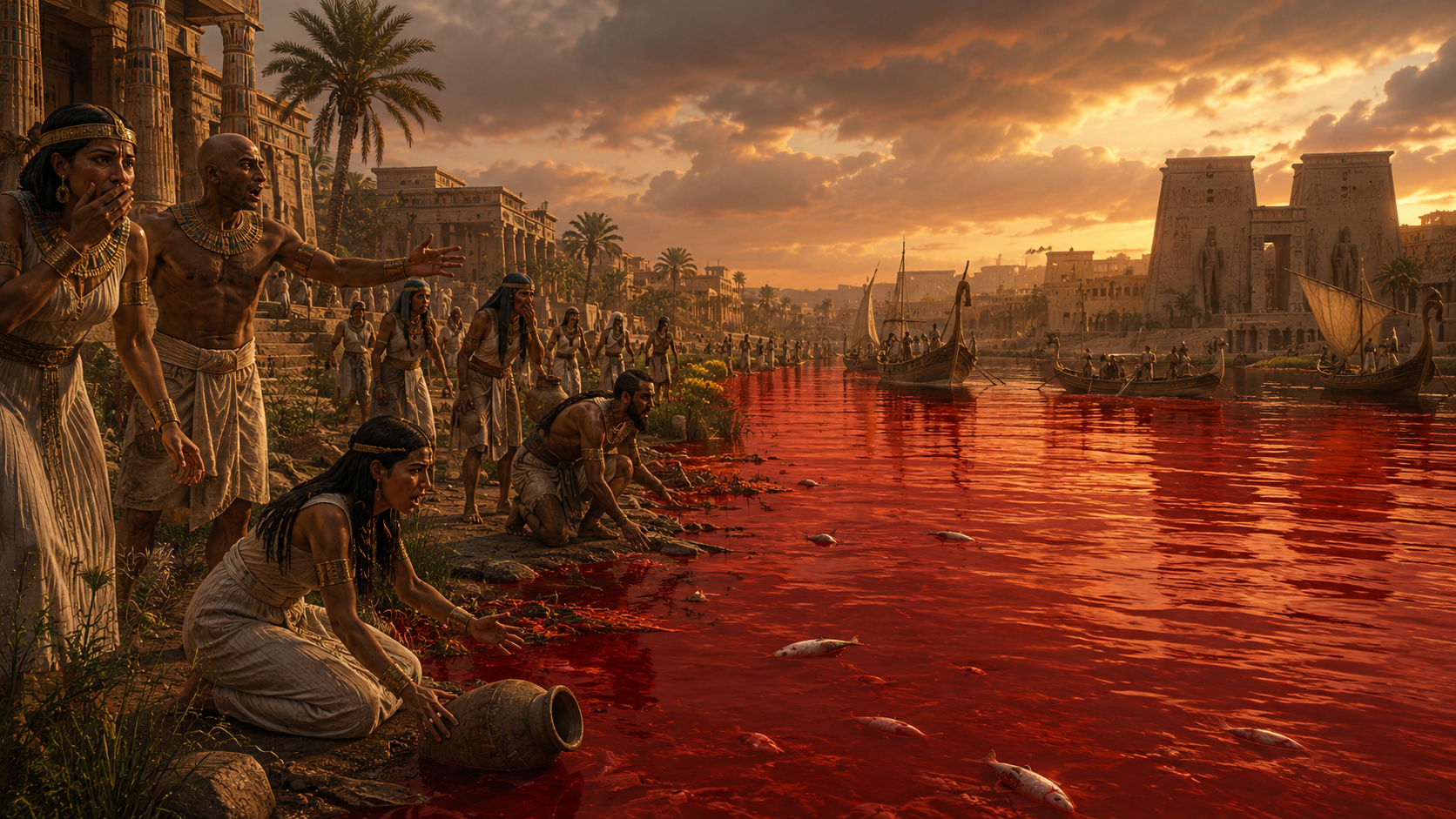
The Nile Turns to Blood
Exodus 7:14–25 — The assault on the god of Egypt's life
I . Water into Blood Dam (דָּם) — Blood Exodus 7:14–25
Egyptian God Targeted
Hapi · Khnum · Osiris
Hapi — the god of the Nile inundation, source of Egypt's agricultural fertility. Depicted as a well-fed man with blue or green skin, carrying lotus plants. The annual Nile flood was Hapi's gift — the basis of all Egyptian life, food, and civilisation.
Khnum — the ram-headed potter god who moulded humans on his potter's wheel and protected the source of the Nile at the first cataract.
Osiris — the Nile was considered the bloodstream of Osiris, the god of death and resurrection. The river's colour and fertility were identified with his body.
Theological Significance
The Nile was not merely Egypt's water supply. It was Egypt's god — the source of all life, fertility, and civilisation. Turning it to blood was simultaneously an attack on Hapi, a desecration of what was considered Osiris' body, and a declaration that YHWH has sovereignty over the very substance of Egyptian existence.
Exodus 7:17: "By this you shall know that I am the LORD." The formula appears immediately — the plague is explicitly framed as an epistemological event. Its purpose is knowledge: knowledge of YHWH's identity.
The seven days between this plague and the next (Exodus 7:25) is significant — a week of the Nile as blood, a sustained demonstration, not a brief sign.
Natural Science Background
Several natural explanations have been proposed. The most compelling: red algae (Burgundy Blood, Oscillatoria rubescens or a similar cyanobacterium) producing a toxic bloom in the Nile. Such blooms, documented in modern times in other water bodies, can produce reddish discolouration, oxygen depletion, and massive fish die-offs — exactly matching the text's description of fish dying and the water being undrinkable.
Archaeologist Manfred Bietak and others have noted that such algal events, while rare, are documented phenomena in the Nile system. The text does not require us to choose between "natural" and "miraculous" — the miracle may be in the precise timing, scale, and control of an event that has natural components.
Points to Jesus
The most startling Christological connection: Jesus' first miracle is the reversal of Plague 1. In John 2:1–11, Jesus turns water into wine at Cana. The plague turned water into blood (death, judgment, undrinkability). Jesus turns water into wine (life, celebration, abundance).
John's Gospel uses this as the first of seven signs, deliberately echoing the plague structure. Where the Exodus plagues turn good things into death, Jesus' signs turn ordinary things into abundant life. The New Exodus reverses the Old Exodus judgments.
Additionally: Revelation 16:3–4 describes eschatological bowl-judgments that directly recapitulate this plague: "The second angel poured out his bowl into the sea, and it became like the blood of a corpse." The Exodus plague is the template for God's end-time judgments.
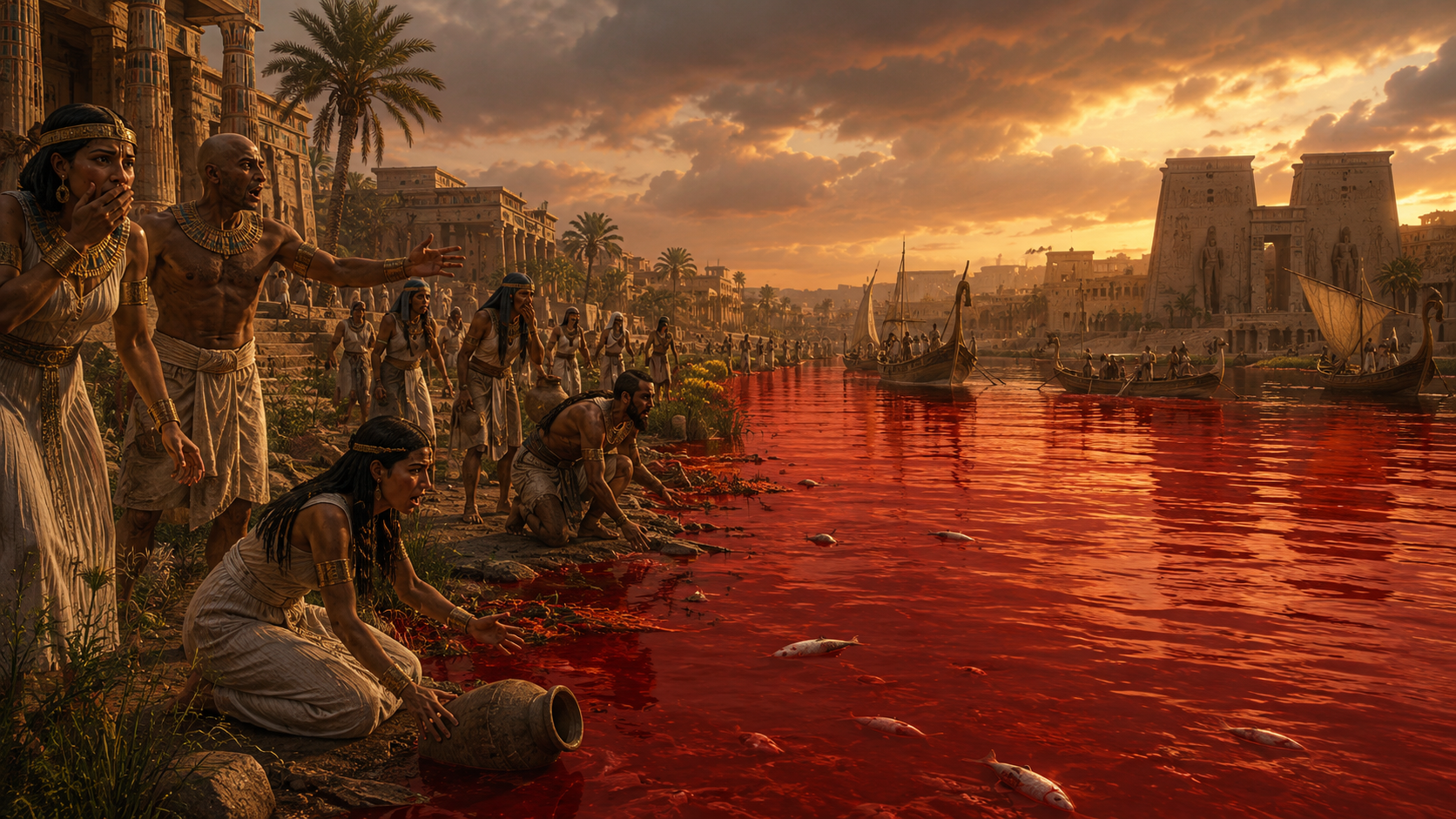
The Story Behind the Text
Egyptian God Targeted
It was the season when Pharaoh came to the river. The Egyptian king performed regular rituals at the Nile's bank — not merely political appearances but religious acts of homage to Hapi, the source of Egypt's life. The morning was ordinary. The river was its usual brown-green, carrying the memory of the Ethiopian highlands in its current. The court was assembled. The priests had prepared their offerings.
Moses and Aaron were waiting on the bank. They had not been summoned. They had simply arrived, because God had told Moses: go to Pharaoh in the morning, when he goes out to the water (Exodus 7:15). There is something deliberately confrontational about this — choosing the moment of Pharaoh's religious observance at the sacred river to make the first public declaration of YHWH's authority. Not in the throne room, not in a formal audience. At the Nile. At the place where Pharaoh worshipped the god YHWH was about to dismantle.
Aaron raised his staff over the waters. The Nile — all of it, the canals, the ponds, the reservoirs, every vessel of water in Egypt — turned. The fish began to die. The smell reached the city before the colour did, rising from the river in the heat. And for seven days, the sacred river of Egypt ran the colour of judgment.
Pharaoh turned and walked into his palace. Exodus 7:23: "And Pharaoh turned and went into his house, and he did not take even this to heart." He dismissed it. He turned his back on the Nile running red. And the hardening was confirmed.
Exodus 7:14–23 — Key Phrases
Verse 15
"Go to Pharaoh in the morning, as he is going out to the water, and stand on the bank of the Nile to meet him."
Historical & Hebrew Analysis
yoredh al-hamayim — "going out to the water." The Egyptian king performed regular dawn rituals at the Nile. Whether these were primarily religious or personal ablutions is debated — but the text assumes Pharaoh's morning visit to the river was a regular and known practice. The confrontation is staged at the most sacred point of Pharaoh's day.
hinatzeiv liqra'to — "stand to meet him." The verb natzav in the Hithpael means to station oneself, to take a deliberate stand. Moses does not encounter Pharaoh accidentally. He positions himself. This is an ambush at the river — a prophetic act of confrontation chosen for maximum theological impact.
Verse 17
"Behold, with the staff that is in my hand I will strike the water that is in the Nile, and it shall turn into blood."
Theological Analysis
v'nehepkhu ledam — "and it shall be turned into blood." The verb hafakh (to turn, to overturn, to transform) is a powerful word — used of the overturning of Sodom (Genesis 19:25), the transformation of a rod into a snake (Exodus 7:15), and elsewhere for radical reversal. The Nile is not merely coloured — it is overturned. Transformed. Its essential nature temporarily reversed from life-source to instrument of death.
Verse 23
"And Pharaoh turned and went into his house, and he did not take even this to heart."
The First Hardening in Action
v'lo shat libo gam-l'zot — "and he did not set his heart even to this." The phrase "set the heart" (shat lev) is the Hebrew idiom for giving serious attention, taking something to heart. Pharaoh's response to the first plague is not anger, not fear, not negotiation. It is dismissal. He turns away. The hardening is not a sudden supernatural imposition — it is an act of deliberate inattention. He chooses not to let it mean anything.
This is one of the most chilling verses in the plague narrative precisely because it is so ordinary. No dramatic defiance. Just a man who has seen a river run red for seven days, watched his fish die, smelled the stench of it — and turned around and went home as if nothing had happened. This is what fully hardened looks like: not outrage but indifference.
The Frogs
Exodus 8:1–15 — The goddess of fertility invades Pharaoh's bedroom
II . Frogs Tzfardea (צְפַרְדֵּעַ) — Frog Exodus 8:1–15
Egyptian God Targeted
Heqet — The Frog Goddess
Heqet — depicted as a woman with a frog's head, or as a frog itself. She was the goddess of fertility, childbirth, and the protection of newborn children. Her symbol was the frog. Egyptian women wore frog amulets during pregnancy. Heqet assisted Osiris in his resurrection and helped guide the souls of the dead. She was not a minor deity — she was one of the oldest and most intimate goddesses in the Egyptian pantheon, present at birth and at death.
The inversion: Heqet was the goddess of life, fertility, and protection. YHWH uses her sacred animal — the frog — as an instrument of infestation and misery. What was a symbol of blessing becomes a plague of contamination. The frog, sacred to Heqet, becomes the frog that ruins every meal, every bed, every private space in Egypt.
Theological Significance
The most overlooked detail in Plague 2 is who asks for its removal — and how. Pharaoh summons Moses and Aaron and says: "Plead with the LORD to take away the frogs from me and from my people, and I will let the people go." (Exodus 8:8)
Moses' response is extraordinary. He says to Pharaoh: "Be pleased to command me when I am to plead for you." He gives Pharaoh the choice of timing. Pharaoh says: "Tomorrow." And Moses says: "Be it as you say."
Why tomorrow? Why not right now? The rabbis asked this for centuries. The most spiritually searching answer: Pharaoh prefers one more night with the frogs to the immediate acknowledgement that YHWH is the one who controls the frogs. Even in extremis, even surrounded by frogs, Pharaoh defers his need for YHWH's help by one night — as if the delay gives him back some measure of control. This is the psychology of the hardened heart at its most exposed: preferring manageable misery to immediate surrender.
Natural Science Background
Naturally, a mass die-off of fish in the Nile (following Plague 1) would remove the primary predator of frog eggs and tadpoles. The logical ecological consequence of the Nile's pollution would be an explosion in the frog population — exactly what Plague 2 describes. The plagues are not randomly ordered. They follow a coherent ecological cascade, each one making the next more likely.
The frogs came up out of the Nile and covered Egypt: into the ovens, the kneading bowls, the beds, the houses. The text is precise about the locations, and they are exactly what an overwhelmed frog population would do — seeking warmth and moisture in human habitations. The detail of frogs in Pharaoh's bedroom and on his bed (Exodus 8:3) is particularly pointed: not even the most private spaces of the king's palace are exempt from YHWH's reach.
Points to Jesus
Heqet was the goddess of birth and midwifery — the one who, in Egyptian mythology, assisted at the birth of gods and kings. The second plague is an assault on the very symbol of birth and new life in Egypt.
Jesus is described in John 1:3 as the one through whom "all things were made." He is the true source of life and birth — not Heqet, not any fertility deity. John 10:10: "I came that they may have life and have it abundantly." The God who turned Heqet's sacred symbol into an instrument of misery is the same God who, in Christ, turns death into the birth canal of resurrection life.
The connection also runs through Revelation 16:13: three unclean spirits "like frogs" come out of the mouths of the dragon, beast, and false prophet. The frog — symbol of counterfeit spiritual power — appears in the eschatological judgment as the mark of satanic deception. Egypt's sacred animal becomes the symbol of the final enemy.
The Story Behind the Text
Exodus 8:8–15 — Pharaoh's First Negotiation
Verse 8
"Then Pharaoh called Moses and Aaron and said, 'Plead with the LORD to take away the frogs from me and from my people, and I will let the people go to sacrifice to the LORD.'"
Historical & Hebrew Analysis
yoredh al-hamayim — "going out to the water." The Egyptian king performed regular dawn rituals at the Nile. Whether these were primarily religious or personal ablutions is debated — but the text assumes Pharaoh's morning visit to the river was a regular and known practice. The confrontation is staged at the most sacred point of Pharaoh's day.
hinatzeiv liqra'to — "stand to meet him." The verb natzav in the Hithpael means to station oneself, to take a deliberate stand. Moses does not encounter Pharaoh accidentally. He positions himself. This is an ambush at the river — a prophetic act of confrontation chosen for maximum theological impact.
Verse 17
"Behold, with the staff that is in my hand I will strike the water that is in the Nile, and it shall turn into blood."
Theological Analysis
v'nehepkhu ledam — "and it shall be turned into blood." The verb hafakh (to turn, to overturn, to transform) is a powerful word — used of the overturning of Sodom (Genesis 19:25), the transformation of a rod into a snake (Exodus 7:15), and elsewhere for radical reversal. The Nile is not merely coloured — it is overturned. Transformed. Its essential nature temporarily reversed from life-source to instrument of death.
Verse 23
"And Pharaoh turned and went into his house, and he did not take even this to heart."
The First Hardening in Action
v'lo shat libo gam-l'zot — "and he did not set his heart even to this." The phrase "set the heart" (shat lev) is the Hebrew idiom for giving serious attention, taking something to heart. Pharaoh's response to the first plague is not anger, not fear, not negotiation. It is dismissal. He turns away. The hardening is not a sudden supernatural imposition — it is an act of deliberate inattention. He chooses not to let it mean anything.
This is one of the most chilling verses in the plague narrative precisely because it is so ordinary. No dramatic defiance. Just a man who has seen a river run red for seven days, watched his fish die, smelled the stench of it — and turned around and went home as if nothing had happened. This is what fully hardened looks like: not outrage but indifference.
Gnats from the Dust
Exodus 8:16–19 — The earth itself becomes the enemy, and the magicians say "God"
III Gnats / LiceKinim (כִּנִּים) — Gnats/Lice Exodus 8:16–19
Egyptian God Targeted
Geb — The Earth God
Geb — the god of the earth itself, depicted as a man lying on the ground, whose laughter was said to cause earthquakes. Geb was one of the Ennead of Heliopolis — the nine primordial deities — and was considered the father of Osiris, Isis, Seth, and Nephthys. The earth belonged to Geb. Its productivity, its stability, its very substance was under his authority.
When Aaron struck the dust of the earth and it became gnats (Exodus 8:16–17), he was turning Geb's own domain against Egypt. The sacred substance of the earth god becomes the instrument of plague. Every handful of dirt in Egypt is now potentially hostile. The ground they stand on has been turned against them.
What Changes at Plague 3 — The Breaking of the Magicians
Plague 3 is structurally pivotal in three ways. First, it comes without prior warning — the first plague in the narrative where God does not give Pharaoh advance notice. This represents an escalation: the gracious warning period is not permanent.
Second, the magicians cannot replicate it. For the first time, Egyptian occult power meets a task it cannot perform. The staff-to-serpent, the water-to-blood, the frogs — these were within the range of Egyptian ritual performance. Kinim from dust is not. The system has been exceeded.
Third, the magicians make their extraordinary confession: etzba Elohim hi — "This is the finger of God" (Exodus 8:19). The use of Elohim rather than YHWH is significant — they are not confessing the covenant God of Israel. They are acknowledging that a power operating outside Egyptian theological categories is at work. This is professional religious acknowledgment, not conversion. But it is more honest than anything Pharaoh has said.
Natural Science & Translation Questions
The Hebrew word kinim is uncertain in its precise meaning — translated as gnats, lice, or mosquitoes by different scholars. The Septuagint renders it as skniphes (gnats or sandflies); the Vulgate uses sciniphes. Modern scholarship generally favours mosquitoes or biting gnats. Ecologically, massive frog death (Plague 2) would leave enormous quantities of decomposing organic matter — an ideal breeding ground for biting insects.
The specific detail that they came "from the dust of the earth" (Exodus 8:17) is significant: either the ground itself seems to produce them (a miraculous element emphasising the divine origin) or they emerge from the dust/soil where their larvae were already present — a detail that would resonate with the Egyptian understanding of the earth as Geb's domain.
The detail that they afflict both people and animals distinguishes this plague from the first two, which primarily affected the Nile and its environment. The plague is escalating in scope.
Points to Jesus
The "finger of God" language is remarkably specific. In Luke 11:20, Jesus uses the exact same phrase: "But if it is by the finger of God that I cast out demons, then the kingdom of God has come upon you." Matthew's parallel has "Spirit of God" — suggesting Luke's "finger of God" is an intentional Exodus echo.
Jesus is identifying His exorcisms with the same divine agency the Egyptian magicians identified at Plague 3. The magicians said: this is the finger of God, meaning a power that exceeds our system. Jesus says: my exorcisms are the finger of God, meaning the kingdom of God is present and operating in ways that exceed the systems of this age. The same phrase. The same recognition. The same power.
Additionally: Exodus 31:18 says the Ten Commandments were "written with the finger of God." The same divine finger that wrote the Law in stone and drove gnats from Egyptian dust — this is the finger Jesus claims is at work in His ministry. The connection encompasses creation, covenant, and kingdom.
Flies, Livestock, and Boils: The Second Group
The Goshen distinction appears — and the magicians are silenced
IV Flies / Swarms Arov (עָרוֹב) — Swarms / Wild Animals Exodus 8:20–32
Egyptian God Targeted
Khepri · Uatchit
Khepri — the scarab-beetle god, the divine force of creation and self-generation. The scarab dung beetle was one of Egypt's most sacred animals — representations of Khepri were worn as amulets, carved into seals, and placed on the hearts of the dead. The "sun beetle" rolling his ball of dung was considered a metaphor for the sun god Ra rolling the sun across the sky.
The plague of arov — traditionally translated "flies" but possibly meaning "mixture" of insects including flies, beetles, and other insects — desecrates the sacred. Egypt's holy insects become an instrument of infestation. The beetle that symbolised divine self-creation becomes the creature that ruins Egyptian homes.
The Goshen Distinction — First Appearance
This is the critical plague. Exodus 8:22–23: "But on that day I will set apart the land of Goshen, where my people dwell, so that no swarms of flies shall be there, that you may know that I am the LORD in the midst of the earth. Thus I will put a division between my people and your people."
The Hebrew word for "division" is peduth — redemption, separation, the price of release. The same root as padah (to redeem). God is not merely separating geography. He is performing a visible act of redemption — marking a people as His. The land-boundary between Goshen and Egypt is a physical expression of the covenant-boundary between YHWH's people and Pharaoh's.
Pharaoh's first real negotiation now follows: "Sacrifice here in the land." Moses refuses — not merely strategically, but theologically: the animals Israel would sacrifice are animals Egypt considers sacred. To sacrifice them in Egypt would cause an riot. The theological conflict between the two systems is irreconcilable on Egyptian soil.
V Death of Livestock Dever (דֶּבֶר) — Pestilence / Plague Exodus 9:1–7
Egyptian God Targeted
Hathor · Apis · Mnevis · Khnum
Hathor — the cow goddess, one of the most beloved in the Egyptian pantheon. Goddess of love, beauty, music, motherhood, and joy. Depicted as a woman with cow's horns. The Pharaoh was often depicted nursing at Hathor's breast — she was the divine mother of the king.
Apis — the sacred bull of Memphis, considered the living incarnation of Ptah (later of Osiris). The Apis bull was one individual animal selected for physical perfection and kept in a special enclosure at Memphis. Its death and burial were major religious events. YHWH kills Egypt's livestock — including, presumably, the sacred bulls.
Mnevis — the sacred bull of Heliopolis, connected to Ra. The ram of Mendes connected to Banebdjed. The agricultural and sacred animals of Egypt are targets — every one of them a divine symbol made mortal by YHWH's word.
What Most Readers Miss
Exodus 9:7 contains one of the most quietly devastating verses in the plague narrative: "And Pharaoh sent, and behold, not one of the livestock of Israel was dead. But the heart of Pharaoh was hardened, and he did not let the people go."
Pharaoh checks. He sends investigators to Goshen to verify the report. He gets back definitive confirmation: every word was true. Not one Israelite animal is dead. The miracle is verified by his own intelligence service. And then: he did not let the people go.
This is the hardened heart at its most documented. Pharaoh has evidence. He has checked it personally. He has confirmation from his own sources. And he hardens anyway. At this point in the narrative, the hardening is not a matter of insufficient evidence. It is a matter of a will that will not yield regardless of evidence. This is why Paul can use Pharaoh in Romans 9 — not as an innocent victim but as the representative of a specific kind of human resistance: the will that observes the evidence and chooses not to be moved by it.
VI Boils Sh'chin (שְׁחִין) — Boils / Skin Sores Exodus 9:8–12
Egyptian God Targeted
Sekhmet · Thoth · Isis (as healer)
Sekhmet — the lion-headed goddess of medicine, disease, and healing. She was believed to send plagues and disease as punishment, but also to cure them. Her priests were Egypt's physicians. She was the one to placate when disease struck, the one to pray to for healing.
Thoth and Isis — both associated with healing in Egyptian tradition. The Edwin Smith Papyrus and the Ebers Papyrus (genuine ancient Egyptian medical texts) show the sophisticated intersection of medical knowledge and religious ritual in Egyptian healing.
The plague of boils specifically targets the skin — the surface where Egyptian medical and religious expertise would intervene. YHWH sends a disease that Egypt's entire medical-religious complex cannot treat.
The Fall of the Magicians and the Archaeology of Ash
The plague is initiated through a unique ritual: Moses takes handfuls of soot from a kiln and throws it into the air. In Egyptian theology, the kiln or furnace was associated with the underworld, with purification, and with the god Sokar. Moses takes the substance of an Egyptian sacred context and turns it into the instrument of plague. This is YHWH working within Egyptian symbolic categories while overturning them.
The result: boils on all Egyptians and their animals. And the magicians could not stand before Moses because of the boils. The professionals of Egyptian religious medicine — the ones whose entire vocation was the management of disease in the name of Sekhmet — are themselves afflicted. They cannot heal themselves. They cannot protect themselves. They cannot stand. The final vestige of Egyptian religious authority in the plague narrative collapses at Plague 6. After this, they are never mentioned again.
Exodus 9:12 then records something new: "But the LORD hardened the heart of Pharaoh." For the first time, God is explicitly the subject of the hardening with no mention of Pharaoh's self-hardening. The judicial hardening has now been formally activated — because Pharaoh has repeatedly and freely chosen his direction through six plagues. From this point, God's hardening confirms the course Pharaoh has set.
What We Are Supposed to See: The Pattern and Its Purpose
Six plagues in — what the narrative is building, and what it means
The Escalation Principle
After six plagues, a clear escalation pattern has been established. The plagues move from the periphery to the centre of Egyptian life — from the Nile (peripheral to daily human experience) to the body of Pharaoh's subjects (the centre of human experience). They move from reversible to irreversible — the Nile returned to normal; the livestock are permanently dead. They move from affecting the environment to affecting human bodies — the boils are the first plague that marks human flesh directly.
This escalation is not gratuitous. It is instructional. God is teaching two audiences simultaneously: Egypt (who YHWH is and what He can do) and Israel (who their God is and what He claims to own). The plagues are a public education in divine sovereignty — conducted at a scale no human being could dispute.
What Most Christians Miss: The Plagues as Worship Disruption
The deepest level of the plague narrative — one that almost entirely disappears in popular treatments — is its function as a disruption of Egyptian worship. Each plague specifically targets a deity that Egyptians worshipped, made sacrifices to, and relied on for protection in exactly the domain being struck. The plagues are not merely natural disasters. They are acts of liturgical vandalism — a systematic dismantling of the entire Egyptian devotional system.
Consider: every morning when an Egyptian priest performed the dawn ritual opening of the temple, offering incense and prayer to Ra — the sun was still rising after Plague 3. But the earth around the priest was crawling with gnats. Every day when a farmer prayed to Hapi for a good flood season — his animals were dead from Plague 5. Every time a patient sought healing from Sekhmet's priests — the priests themselves were covered in Plague 6's boils and could not stand.
The Egyptian is not just suffering. The Egyptian is watching their entire theological framework — the system that gave their life meaning, structure, and hope — being dismantled piece by piece. By the time the tenth plague arrives, there is not a single Egyptian deity whose domain has not been shown to be under YHWH's superior authority.
The Plagues and Egyptian New Year Theology
Several scholars (including John Currid in Ancient Egypt and the Old Testament) have argued that the plagues are specifically timed to coincide with the Egyptian agricultural and religious calendar. The Nile flood season — when Egypt celebrated Hapi and the gods of the river — was also when the first plague struck. The frog population explosion follows naturally from the flood. The insect plagues follow the ecological disruption of the flood season.
If the plagues indeed follow the Egyptian agricultural calendar, then the theological targeting is even more precise: YHWH is not merely attacking Egyptian deities in the abstract. He is attacking them at the exact moment of their annual celebration — the times when Egyptians would have expected their gods to be most active and most powerful. The New Year, when Hapi was honoured and the flood was celebrated, becomes the occasion of YHWH's first demonstration of authority over the Nile. The gods are struck in their own season of triumph.
The Plagues and the Letter to the Hebrews
The writer of Hebrews, in Chapter 11, includes Moses in the great hall of faith and references the Exodus events as acts of faith. But there is a less obvious Hebrews connection: Hebrews 11:28 specifically says Moses kept the Passover and the sprinkling of blood "so that the Destroyer of the firstborn might not touch them." The plagues — specifically the final plague — are woven into the faith narrative of the New Testament not as displays of power but as acts of faith-dependent navigation through divine judgment.
The plagues ask of Israel: do you trust YHWH's instructions enough to follow them exactly, even when what is happening around you is terrifying? The answer in Exodus is not always yes — but the Passover night requires it. And Hebrews 11 honours Moses specifically for his faithful navigation of that night. The plagues are not just an argument against Egyptian theology. They are a formation of Israelite faith.
The Plagues and the Book of Revelation: The New Exodus Judgment
The book of Revelation — in Chapters 8–9 (trumpet judgments) and Chapter 16 (bowl judgments) — deliberately and systematically recapitulates the Exodus plagues at an eschatological scale. This is not coincidence. It is the New Testament's declaration that the Exodus was the template for God's final judgment on the systems of human empire that oppose His purposes.
Revelation's bowl judgments: Bowl 1 — painful sores on those who worship the beast (Plague 6: boils). Bowl 2 — the sea becomes blood (Plague 1). Bowl 3 — rivers become blood (Plague 1). Bowl 4 — the sun scorches people (connected to the darkness plague's inversion). Bowl 5 — darkness covers the beast's kingdom (Plague 9). Bowl 6 — frogs from the mouths of the dragon, beast, and false prophet (Plague 2).
The pattern is exact. What God did to Egypt, He will do to the final human empire that sets itself against His people. The Exodus plagues are not merely ancient history. They are the governing template of divine justice throughout history — repeated whenever human power reaches the extreme of Pharaoh's defiance, until the final Exodus into the new creation.
And at the centre of all of this is the Passover Lamb — first instituted to protect Israel through the ten plagues, and ultimately revealed as Jesus Christ (1 Corinthians 5:7; John 1:29; Revelation 5:6). The Lamb who was slain is the answer to the judgment that the plagues represent — the One who takes the judgment on Himself so that His people, marked by His blood, pass through unharmed.

Devotional
When God Dismantles the Things We Trusted Instead of Him
The Egyptians did not worship nothing. They worshipped everything — the river, the earth, the sky, the animals, the cycle of birth and death. They built enormous temples to the powers they relied on. They made sacrifices to the forces that sustained their lives. They developed sophisticated theological systems that explained the cosmos, gave meaning to suffering, and promised order in the face of chaos.
And the plagues dismantled every one of them. Not because Egypt was unusually wicked in its religious practice by ancient Near Eastern standards. But because every system that claims to be the source of life and order — every system that puts something other than the living God at the centre of existence — is, in the end, a house built on the wrong foundation. And YHWH was willing to demonstrate that, publicly and comprehensively, before all of Egypt and the watching world.
The uncomfortable question the plagues ask us is this: what are the things we have placed our confidence in, that YHWH might need to dismantle before we understand who He really is? The Nile was real. The frogs were real. The sacred bulls were real. Egypt's trust in them was not irrational — it was based on genuine experience of their provision. But it was misplaced. The source of the Nile's blessing was not Hapi. It was the God who made Hapi's domain and could turn it to blood at a word.
Most of us do not worship Egyptian gods. But we do place our confidence in things that are genuinely good — health, financial security, relationships, systems of meaning we have built or inherited. And sometimes God dismantles exactly those things to show us what is actually holding up the universe. Not to punish us. To liberate us from a confidence that was always too small for what we were made for.
The magicians said: "This is the finger of God." They recognised when they had met something that exceeded their system. The question the plague narrative asks every reader is: when God has shown you the finger — when something has exceeded your system, exceeded your gods, exceeded your explanations — do you have the honesty to say so? And do you have the courage to let that recognition become something more than professional acknowledgment?
The magicians could name the finger of God. Only Pharaoh refused to follow where it pointed. The difference between them is not intelligence or skill. It is whether you are willing to be moved by what you see.

Reflection & Discussion Questions
Personal Reflection
1. The plagues are a systematic dismantling of the things Egypt trusted instead of YHWH. Looking at your own life — not for condemnation but for honest reflection — what are the "Egyptian gods" in your world? The things you trust for provision, security, identity, or meaning that are genuinely good but that have become substitutes for God rather than gifts from Him?
2. Pharaoh's pattern throughout the plagues is: cry out when in pain, harden when the pain is removed. This is the pattern of crisis-faith that never becomes settled faith. Do you recognise this pattern in yourself? What would it look like to move from crisis-faith to covenant-faith — trusting God when the pressure is off, not only when the frogs are in your bed?
3. The magicians said "this is the finger of God" — they recognised the divine origin of the plagues. But they did not change their allegiance. Recognition without reorientation. Can you think of moments in your own life where you recognised something as the finger of God — a conviction, a sign, a circumstance — but did not let it reorient you? What held you back?
Deeper Study
4. Map the 3-3-3-1 literary structure of the plagues across Exodus 7–12. Note the pattern of morning confrontations, no-warning plagues (3rd, 6th, 9th), and the escalation of magician failure. What does this structure tell you about how the plague narrative was composed and what it was designed to communicate?
5. Read Psalm 78:43–51 and Psalm 105:26–36 — the two great poetic retellings of the plagues. Note what each Psalm emphasises and what each omits. What theological point is each Psalm making in its retelling? How does reading the plagues through the Psalms change your understanding of their purpose?
6.Jesus says in Luke 11:20 "if it is by the finger of God that I cast out demons, then the kingdom of God has come upon you" — deliberately echoing Exodus 8:19. What is Jesus claiming about His exorcisms by using this language? And what is He claiming about Himself — about who is speaking through Him?
7.The bowl judgments in Revelation 16 systematically recapitulate the Exodus plagues. Read Revelation 16 alongside Exodus 7–9. What does this structural echo tell you about how John understood the relationship between the Exodus and the end of history? And what does it suggest about the character of God — that His final judgments use the same pattern as His first great act of liberation?
Closing Prayer
A Prayer Before the Final Plagues
LORD of the plagues, LORD over the Nile, LORD of the earth and sky and all living things —
You are the God who proved, in ten acts of sovereign precision, that there is no domain of creation that is outside Your authority. Every river, every creature, every harvest, every human body — all of it answers to You. Not to any other God made by man but To You.
We confess that we have, in our own ways, distributed our trust across a pantheon of lesser things. We have treated the good gifts of Your creation — health, money, relationships, systems of meaning — as if they were themselves the source of our security rather than stewards of Your provision. Forgive us for the small-scale Egypts we have built within our lives.
We ask today for the honesty of the magicians during the third plague— to recognise the finger of God when we see it, even when we cannot replicate it, even when it exceeds everything we thought we understood about how the world works. And we ask for the courage to go further than the magicians went — not just to name the finger but to follow where it points.
For those whose hearts are hardening right now — who are in the pattern of Pharaoh, crying out in pain and hardening in relief — be patient with them as You were patient through six plagues. Not because there is no limit to Your patience, but because You take no pleasure in the death of the wicked, and the six plagues tell us You will try again and again before the tenth.
You are the God who will not be denied. You are the God whose name will be proclaimed in all the earth. You are the God who always provides a way and who always hears our groaning and have made plans for our good through the ultimate Passover lamb. Even through the plagues. Even through the frogs in the bed and the blood in the river and the gnats from the dust. Even through all of it.
You are the LORD.
In your might name Jesus,
Amen.
Coming Next in the Series
Part Ten: The Ten Plagues — Part Two
Plagues Seven through Nine: Hail, Locusts, and Darkness. The plagues escalate to a new level of destruction — hail that kills everything in the open field, locusts that devour what the hail left, and three days of total darkness so profound it can be felt. We examine the gods behind each, the growing fracture in Pharaoh's court as his servants plead with him to release Israel, the final negotiating positions that fail, and the buildup to the Passover night — the darkest and most extraordinary night in Israel's history.
Add comment
Comments