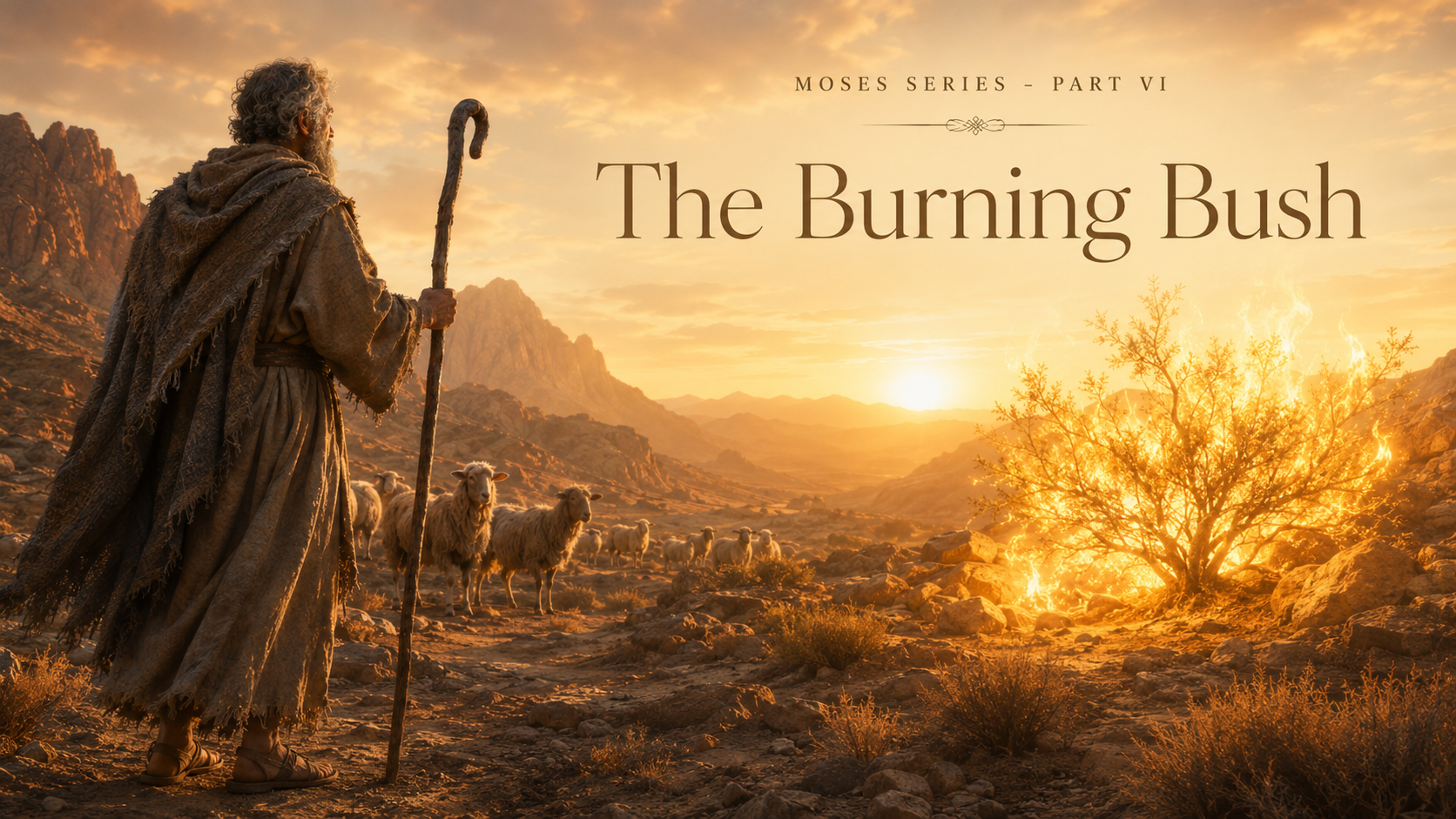
"And Moses hid his face, for he was afraid to look at God."
— Exodus 3:6

Before We Begin
Please Read These Passages First
Part Six is the great hinge of Moses' life — everything before it is preparation, and everything after it flows from it. Please read these passages slowly and more than once. The burning bush conversation is long, dense, and theologically staggering. Let it land before the commentary opens it up.
Pay particular attention to Moses' five objections and God's responses. Notice what Moses is really saying underneath each one. And notice how God meets every objection not with impatience, but with provision.
Exodus 3:1–22 Exodus 4:1–17 Exodus 4:27–31 John 8:48–59 Acts 7:30–34
Optional deeper reading: Isaiah 6:1–8 (Isaiah's calling — compare to Moses); Jeremiah 1:4–10 (Jeremiah's calling — virtually identical objections); Judges 6:11–24 (Gideon's calling at a theophanous encounter). Also: Exodus 18 (Jethro's visit) to understand Jethro's theological knowledge when Moses returns.
Play Scripture

What Were Those Forty Years Actually Like?
The life Moses was living when the bush began to burn
We have spent Part Five mapping the broad geography of Moses' Midian years. But before we can fully appreciate the burning bush, we need to inhabit those forty years more specifically. We need to understand what Moses was actually doing — the texture of his daily existence, the rhythms that shaped him, the relationships that formed him, and the slow internal changes that forty years of desert life produced. Because the burning bush does not appear to a stranger. It appears on a route Moses knows, at a mountain he has visited many times, on a morning that begins entirely like every other morning.
The Arc of the Forty Years — Three Phases
Forty years is not a single undifferentiated block. It is a generation — long enough to contain distinct phases of a man's life. Moses arrived in Midian at forty. He left at eighty. Those decades can be roughly divided:
Phase One — Arrival and Disorientation (Years 1–5 approximately). Moses arrives a fugitive, traumatised, carrying the full weight of what he has done and what he has lost. He has killed a man. He has been rejected by his own people. He has been hunted by Pharaoh. He has crossed a wilderness alone. He sits down at a well — the first moment of rest after the longest sprint of his life — and a story begins to form around him without his seeking it. He is taken in by Jethro. He is given work, and a wife, and eventually a child. These early years are likely characterised by a kind of numbness — the gradual settling of the shock of displacement. He names his son "a stranger there." That is where his heart is in Year One.
Phase Two — Becoming (Years 6–30 approximately). The middle decades are the formation years. This is when Moses stops being a palace man who tends sheep and becomes a desert man — one of the most profound transformations a human being can undergo. He learns the terrain so thoroughly that he will later navigate it with two million people. He learns the rhythms of pastoral nomadic life: the seasonal migrations between pastures, the reading of weather and stars, the management of the flock through lambing and drought and predator season. He becomes, in his forties and fifties, genuinely excellent at something — keeping things alive in a place designed to kill them. His son Gershom grows up. A second son, Eliezer, is born. Moses becomes a grandfather figure within the Midianite community.
Phase Three — The Long Settling (Years 31–40). By his sixties and seventies, Moses is an old man by ancient standards. The fire of the palace years, the passion that drove him to kill an Egyptian and be rejected by his own people, has long since cooled. What remains is not indifference — but a deeper, quieter quality. He knows who he is. He knows he is a stranger in this land. He knows his people are enslaved in Egypt — he has never forgotten — but the burning urgency that once drove him to act unilaterally has been replaced by something harder to name. Perhaps it is patience. Perhaps it is resignation. Perhaps it is the quiet that falls on a man who has stopped expecting his own life to have the shape he once imagined for it. He has made peace with being a shepherd. He is good at it. And that, as far as he knows, is what the rest of his life will be.
The Daily Routine of a Desert Shepherd
The ordinary morning that became the most extraordinary morning in history
What a Normal Day Looked Like
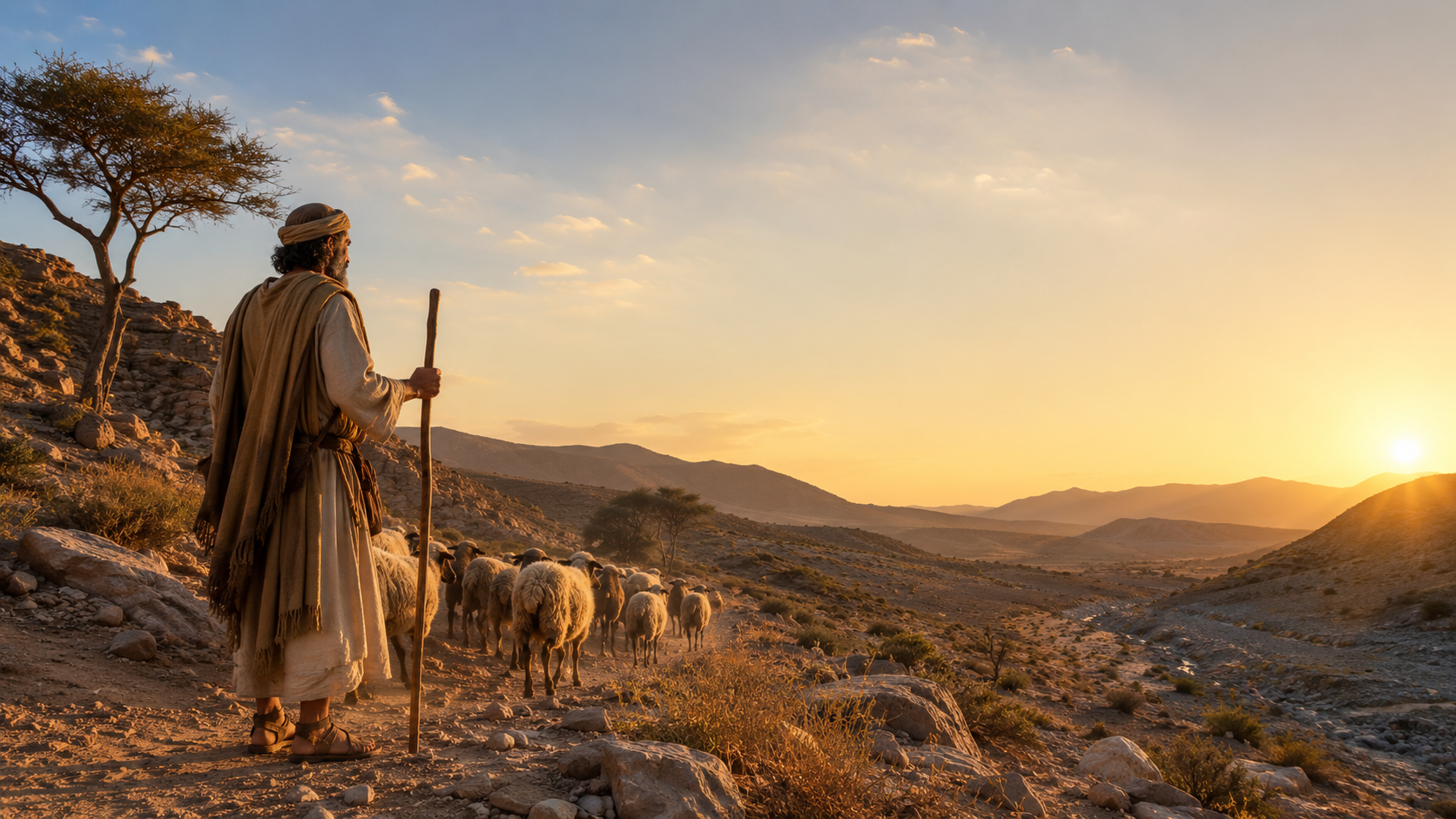
To understand why the burning bush is so extraordinary, we must first understand how ordinary the morning was. Moses was not on a vision quest. He was not fasting and praying at a holy site. He was doing what he did every single day of every single week of every single year for four decades: taking the flock out to graze.
Historical & Cultural Context — The Shepherd's Daily Rhythm
Pastoral nomadic shepherding in the ancient Near East followed a well-established daily pattern documented across Mesopotamian, Egyptian, and Bedouin sources. The typical day began before dawn. The shepherd rose while it was still dark to water the flock from the overnight cistern or well — sheep need to drink before grazing in the heat, and the cooler hours are when they drink most efficiently. This is likely what Moses was doing in the dark before leading the flock out.
By first light, the flock was moving. In semi-arid terrain, shepherds followed established seasonal routes — circuits they repeated year after year, moving between known water sources and grazing areas. These routes could cover fifteen to thirty kilometres in a day. The shepherd walked with them or slightly ahead, reading the ground for hazards, watching the animals for signs of illness or distress, always alert to predators.
The midday heat was when the flock rested in whatever shade was available — under a cliff face, in a narrow wadi, beneath a spreading acacia. The shepherd rested too, but lightly — this was when predators were most active in some seasons. In the late afternoon, the flock grazed again as temperatures fell. By dusk, they were being brought back toward water and the night enclosure.
Moses would have known every step of his regular circuit with the intimacy of someone who had walked it hundreds of times. He would have known which rocks cast shadow at which hour, which dry riverbed held residual moisture long into the dry season, which hillside the flock preferred in late spring. The mountain of Horeb was almost certainly a landmark on his regular circuit — a known place, a familiar silhouette against the sky.
He Had Been to Horeb Before
This is one of the most humanly significant details of the burning bush account: Moses did not set out to find God. He set out to find grazing. Exodus 3:1 says he "led his flock to the west side of the wilderness and came to Horeb." The Hebrew vayinhag — he led — is the verb of ordinary pastoral work. He was doing his job. He had done it on this route, to this mountain, countless times before.
Think about what that means. Horeb was not strange to Moses. It was familiar. He had probably sheltered his flock in its shadow on dozens of occasions. He knew its approach, its foothills, the sounds it made in the wind. He had passed the particular place where the bush was growing — that specific acacia or thornbush — many times before. It had never done anything remarkable. It was just a bush.
And then one morning it was burning. And then, as Moses watched, he realised it was burning but not being consumed. And he did the thing that saved his life and changed the world: he turned aside to look.
The Significance of "He Turned Aside"
Exodus 3:3–4: "Moses said, 'I will turn aside to see this great sight, why the bush is not burned.' When the LORD saw that he turned aside to see, God called to him out of the bush."
The text is explicit: God spoke when Moses turned aside. Not before. Not to call him to turn aside. The divine voice comes as a response to human attentiveness. Moses was not summoned from a distance. He was drawn by curiosity — and it was his willingness to stop, to notice, to investigate the unexpected ordinary thing that brought him into the conversation that changed everything.
There is a theology here about how God so often works: not in irresistible supernatural compulsion, but in the quiet burning of something unusual that invites human attention. The question is always whether we will slow down enough to notice. Moses did. And God was waiting for exactly that moment.
The Family Network: Were They Ever Really Lost to Each Other?
Moses, Miriam, Aaron — forty years of distance and connection
One of the most fascinating questions about Moses' Midian years is one that Scripture never directly answers: what was his relationship with Miriam and Aaron during those four decades? Were they completely cut off? Did they communicate? Did they know where he was? Did he know what was happening in Egypt?
The text does not give us a neat answer. But the historical, geographical, and textual evidence suggests something far more nuanced than a forty-year radio silence — and the implications for how we understand Moses' confidence in returning to Egypt are significant.
What We Know for Certain
-
Midian and Egypt were not worlds apart. The Midianites were active traders along the major caravan routes connecting Egypt, Arabia, and Canaan. Genesis 37:28 shows Midianite traders operating directly in Egypt. Moses, living in a Midianite priestly household, would have been in regular contact with people who moved between the two worlds. He was not in a communications blackout.
- Aaron is specifically described as already coming to meet Moses in the wilderness
(Exodus 4:27 — "the LORD said to Aaron, 'Go into the wilderness to meet Moses.' So he went and met him at the mountain of God and kissed him"). God directs Aaron to find Moses at Horeb — which implies Aaron knows the general region Moses inhabits. You do not go to find someone whose whereabouts are completely unknown.
- The Israelites in Egypt maintained kinship networks.
The Hebrew slave community, while geographically confined, maintained tribal and family identity intensely — it was one of the few things Pharaoh could not take from them. Miriam and Aaron would have been known figures within the community (Miriam as a prophetess, Exodus 15:20; Aaron as a Levite with community standing). The whereabouts of their famous fugitive brother, even in exile, would have been tracked through family networks and the Midianite trade routes.
-
Moses knows the political situation in Egypt. God specifically tells Moses in Exodus 4:19 that "all the men who were seeking your life are dead" — suggesting Moses was aware of the danger and would have known when the Pharaoh who hunted him died. This information had to have reached him somehow. The Midianite trade network is the most plausible channel.
A Proposed Reconstruction: The Family Connection
The caravan came through Midian perhaps twice a year — merchants moving between Egypt and Arabia, carrying linen and grain westward and spices and copper eastward. And sometimes, among the goods and the gossip and the commercial transactions of these journeys, there were messages. A word passed from a Levite in the brick pits of Pi-Ramesses to a Midianite tra0der who knew the shepherd at the well of Jethro's clan. A report that the Pharaoh was ill. That the quotas had been raised again. That Miriam had spoken a word of prophecy and been noticed. That Aaron's son had been born. Small things, passed through multiple hands, arriving months late and incomplete — but arriving.
And in the other direction: word that Moses was alive. That he had a wife, a son, that he served the household of the priest of Midian. That he was in the wilderness beyond the Gulf, in the territory of Horeb. Miriam and Aaron would have known, in broad outline, where their brother was. Not with GPS precision. But with the rough geographic knowledge of people who know the trade routes and have enough kin along them to pass a message.
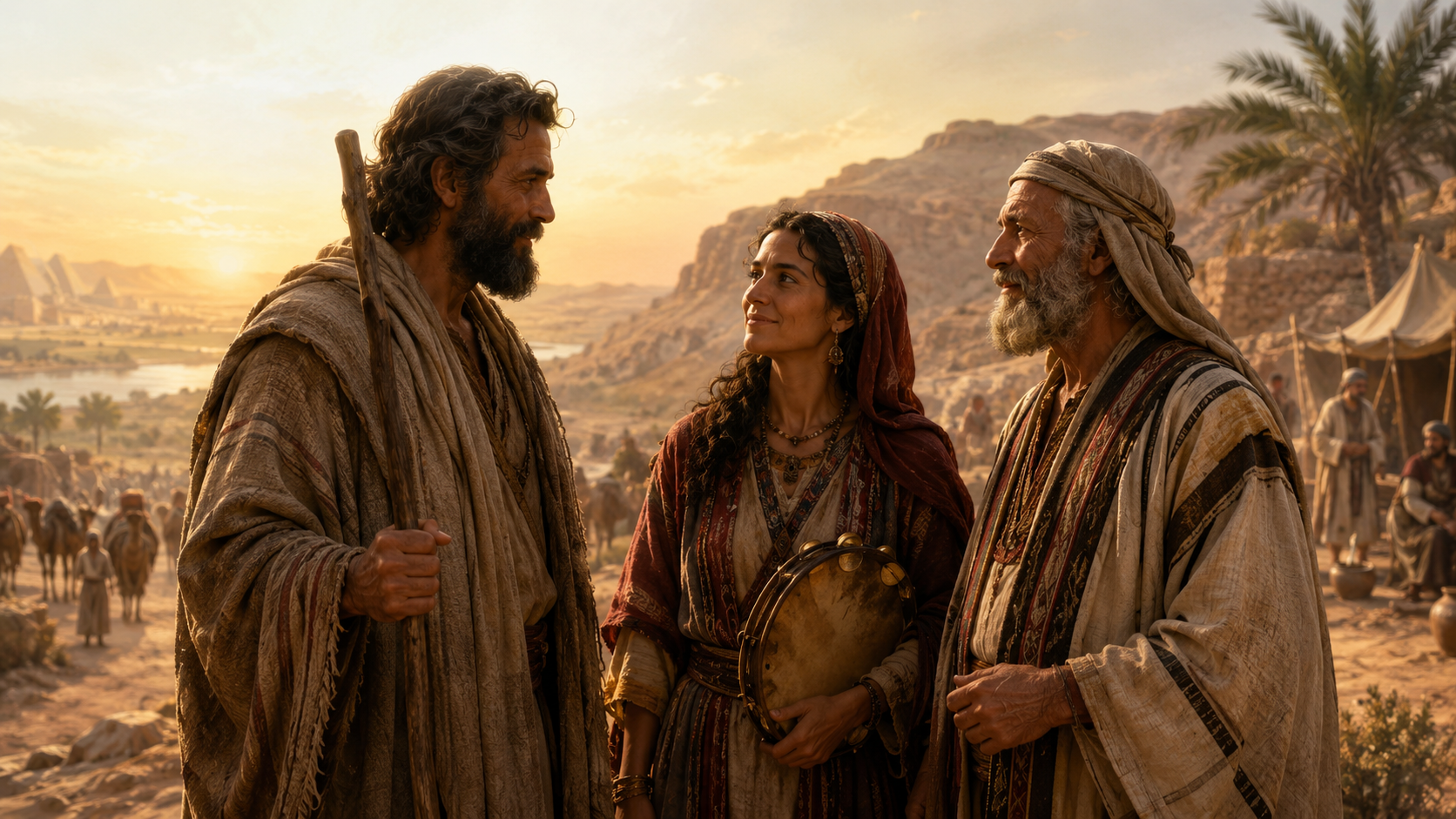
This does not mean Moses and his siblings were close, or that the relationship was warm. Forty years of separation creates distance that is more than geographical. Moses had built an entire life in Midian — a wife, two sons, a place in a community. The brother who had left Egypt in a blaze of violence and failed solidarity was a different man from the quiet shepherd who would one day return. The relationship between Moses and Aaron, when they finally meet at Horeb, is a reunion of people who know each other but must, in some ways, relearn each other.
Miriam's Role: The Prophetess in the Community
Miriam, by the time of the Exodus, is described as a prophetess and a leader of women in Israel (Exodus 15:20). She leads the women in the song of the sea with tambourines and dancing — this is not the act of someone who has been passive and voiceless for forty years. She has been active, vocal, spiritually authoritative within the Hebrew community throughout the Midian years.
Numbers 12:2 gives us a glimpse of Miriam's spiritual self-understanding: "Has the LORD spoken only through Moses? Has he not spoken through us also?" This is said after the Exodus — but the confidence in it suggests a long history of prophetic ministry. Miriam had been speaking, leading, and carrying spiritual authority in the Hebrew community long before Moses returned. She was not a passive recipient of Moses' leadership. She was a parallel stream of it — and the older sibling who had watched Moses' basket float away on the Nile now watched the whole nation follow her brother through the sea.
Aaron: The Eloquent Brother
Exodus 4:14 describes Aaron as "the Levite" — his tribal identification emphasised as a marker of authority and community standing. He is also specifically said to be "a good speaker" (ki-dabber yedabber hu — he can surely speak). This rhetorical gift was not new at the burning bush moment. Aaron had been using his voice within the Hebrew community for decades. He was a recognized figure — a man people listened to.
The relationship between Moses and Aaron before the burning bush is not a blank. They are brothers, with all the complexity that implies. They share a mother — Jochebed, the woman who made the basket and paid to nurse her own son. They share a heritage — the tribe of Levi, the tribe that will be consecrated to God's service. And they share the particular trauma of a family torn apart by empire: one child sent into the palace world, two kept in the slave quarter. What that does to siblings over eighty years — the guilt, the distance, the incomprehension, the love that never fully resolves into understanding — the text does not tell us. It only shows us the reunion.
And when they meet at Horeb, Aaron kisses his brother (Exodus 4:27). In the ancient Near East, this is the kiss of covenant, of reconciliation, of pledged loyalty. The long separation ends with a kiss. And then they walk toward Egypt together.
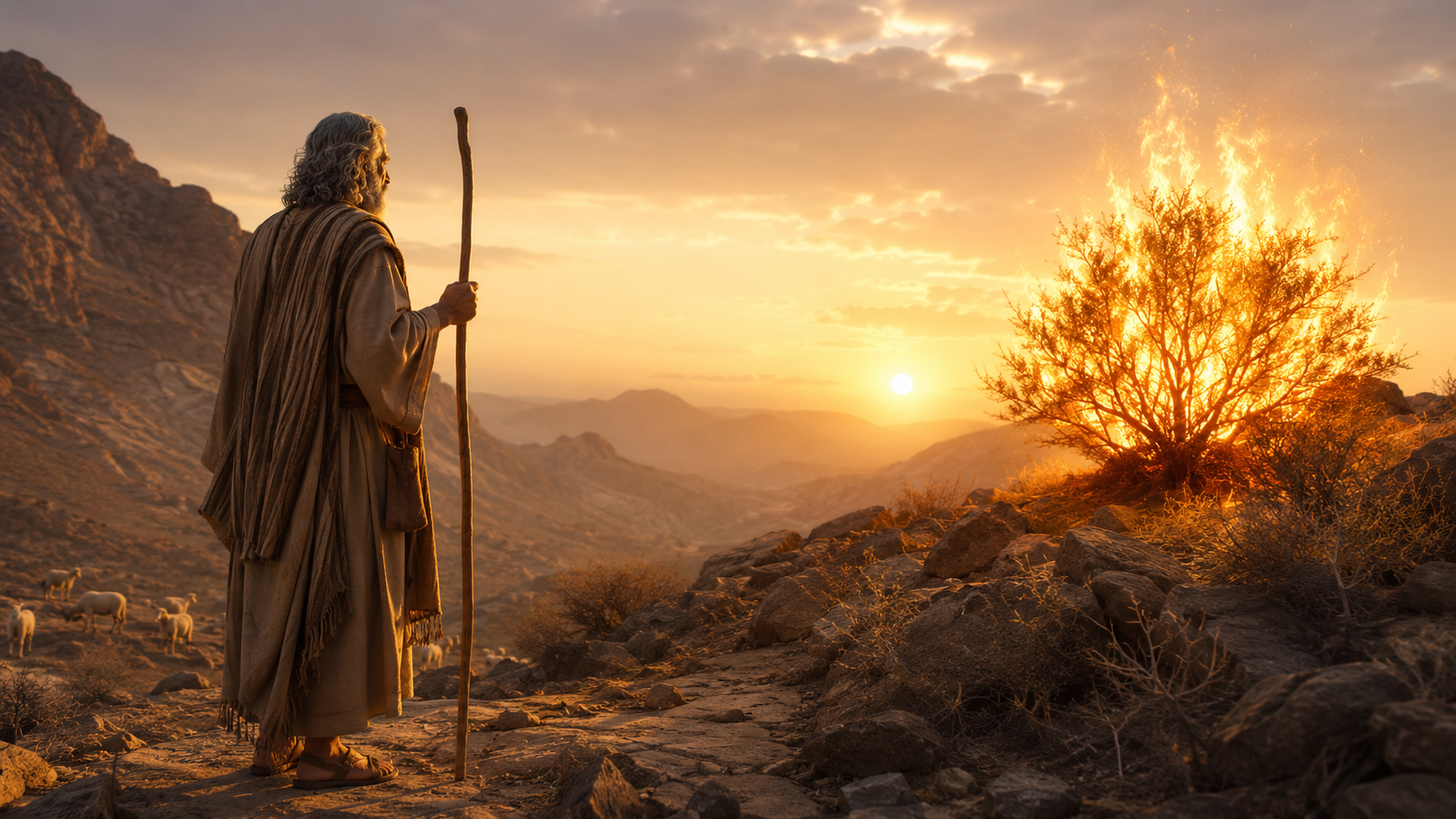
The Burning Bush: The Story
An imaginative reconstruction of the most important morning in Moses' life
He had been awake since the third watch of the night.
That was normal. The flock was restless in late spring — the grass was beginning to thin near the lower pastures, and the animals could smell the better grazing higher up, toward the mountain's western face. Moses had learned, over forty years, that a restless flock was better moved than held. He gathered his staff, told Zipporah where he was going — she knew the route, she had known it for decades — and went out in the dark with the sheep.
He was eighty years old. He moved like a man who has spent decades in the desert: economically, without wasted motion, reading the ground beneath his feet without having to look directly at it. He knew this terrain the way he knew his own hands. The mountain of Horeb rose to his right as the sky began to lighten, the same silhouette it had always been, its slopes catching the first copper of dawn.
He had been to this particular hillside perhaps a hundred times. The scrubby vegetation, the scattered acacia, the one large thorn bush that grew in the shelter of a rock shelf — he knew it all. He had once had to pull a lamb out from behind that exact rock. He knew the particular shade a normal summer morning cast on this ground. He knew what burned brush looked like — dry lightning occasionally struck the hillside in summer, and a bush would smoulder for hours before the desert wind put it out.
This was not that.
The bush was engulfed. Not smouldering — engulfed, entirely, with the bright orange-white of a full fire. And the branches were not blackening. The leaves were not curling. The fire was consuming nothing. It simply was — burning completely and destroying nothing, burning with a presence that made the ordinary morning feel very thin, like paper held up to a bright light, and Moses could see through the thinness of it to something vast on the other side.
He stopped. He stared. He said, quietly, to no one in particular — or perhaps to himself, the habit of a man who has lived forty years largely alone: I will turn aside to see this great sight, why the bush is not burned.
And the moment he turned toward it — not away, toward it — everything changed.
Moses. Moses.
The voice came from the fire. Not from above it, not from around it — from within it. Two syllables. His name, twice. The doubling of a name in Hebrew is the marker of intimate, urgent address: Abraham, Abraham at the altar on Moriah. Samuel, Samuel in the temple at Shiloh. Saul, Saul on the road to Damascus. The doubled name means: I know you. I am speaking to you specifically. This is not a general announcement. This is personal.
And Moses said: Here I am.
The same words Abraham said on Moriah. The same words Isaiah will say in the temple vision. Two Hebrew words — hineni. Here I am. Not "who are you?" Not "what do you want?" Just: present. Available. I am here. It is the most spiritually naked thing a human being can say to God, because it contains no agenda and no protection. Just presence.
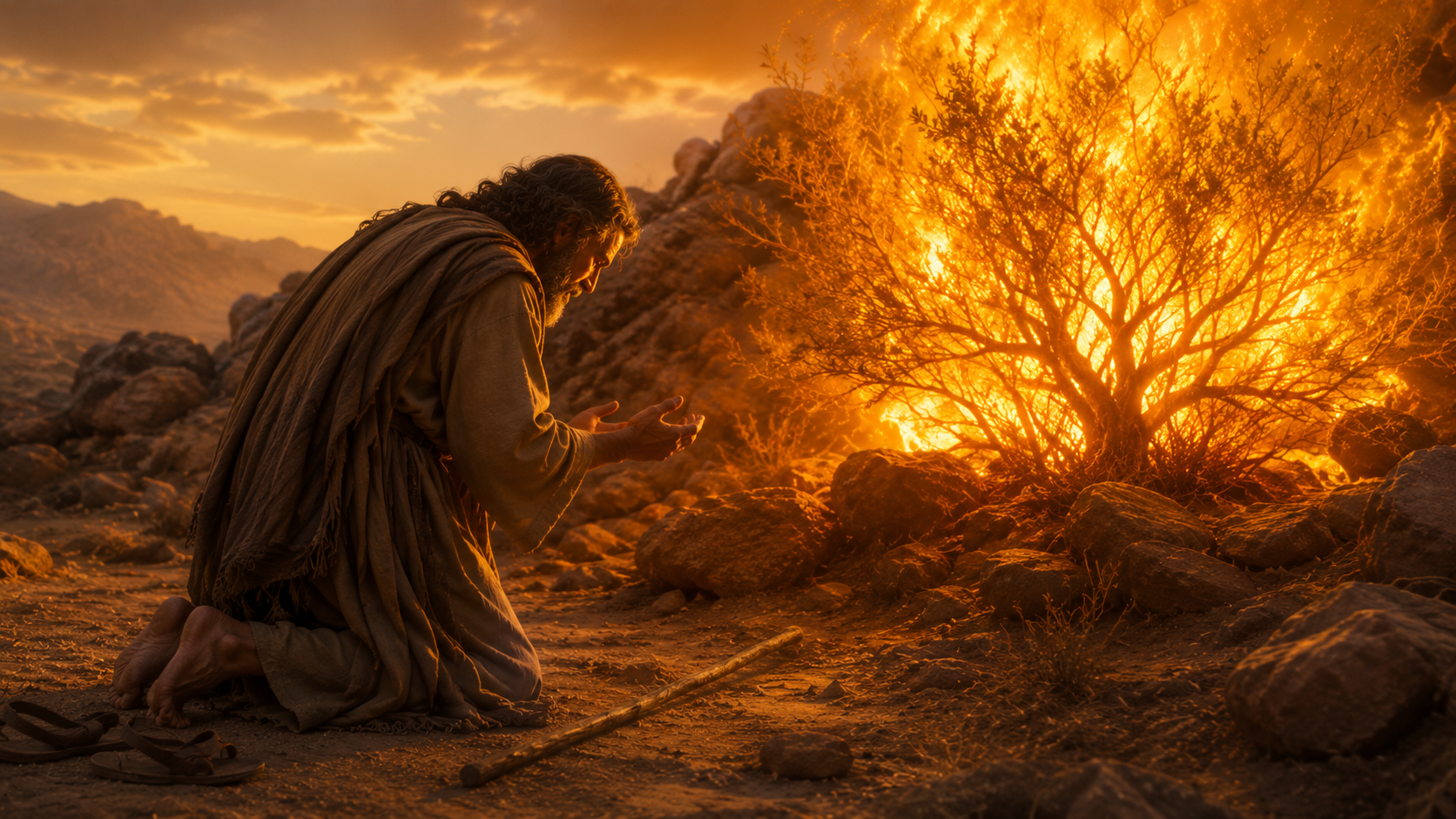
Then the voice: Do not come near. Take your sandals off your feet, for the place where you are standing is holy ground.
Moses reached down and unfastened his sandals. His feet touched the ground — the same ground he had walked a hundred times. It was holy. It had always been holy. He just hadn't known it.
Then: I am the God of your father, the God of Abraham, the God of Isaac, and the God of Jacob.
And Moses hid his face. Because he understood, in the sudden clarity of that moment, what he was in the presence of. This was not a local deity. This was not the god of a particular mountain or a particular weather pattern. This was the God of the promise. The God whose name was in his mother's name. The God his people had been groaning toward for four hundred years. And Moses was afraid to look at Him.
Verse by Verse: Exodus 3:1–22
Every phrase of the burning bush conversation examined
Exodus 3:2–3 — The Bush
Verses 2–3
"And the angel of the LORD appeared to him in a flame of fire out of the midst of a bush. He looked, and behold, the bush was burning, yet it was not consumed. And Moses said, 'I will turn aside to see this great sight, why the bush is not burned.'"
mal'ak YHWH — "the angel of the LORD." This phrase in the Old Testament frequently designates a direct theophanic appearance of God Himself — not a created angelic being distinct from God, but the LORD appearing in a form accessible to human perception. The burning bush is a theophany — a direct self-disclosure of God. Compare Genesis 16:7–13 (the angel of the LORD who is identified as God speaking in first person) and Genesis 22:11–16 (the same pattern at Moriah).
v'hassneh einenu ukal — "and the bush was not consumed." The Hebrew root akal (to eat, to consume) is the same used for fire consuming a sacrifice. The fire is real. The fire is full. And yet: nothing is eaten. The bush is not diminished. This is fire that gives without taking — the theological opposite of destructive fire. It is the perfect image of a God whose holiness does not destroy what He inhabits.
asurah-na v'er'eh — "I will turn aside to see." The word sur means to turn away from one's path, to deviate. Moses makes a deliberate choice to leave his route and investigate. And it is precisely this moment of attentive curiosity that triggers the divine speech. God's initiative and human attentiveness are both necessary. This is not compulsion. It is invitation met by response.
Exodus 3:4–6 — The Holy Ground
Verses 4–6
"When the LORD saw that he turned aside to see, God called to him out of the bush, 'Moses, Moses!' And he said, 'Here I am.' Then he said, 'Do not come near; take your sandals off your feet, for the place where you are standing is holy ground.'"
Moshe Moshe — The doubled name. In every case of a doubled name in Scripture, it marks a pivotal covenantal moment: Abraham, Abraham (Genesis 22:11); Jacob, Jacob (Genesis 46:2); Samuel, Samuel (1 Samuel 3:10); Martha, Martha (Luke 10:41); Simon, Simon (Luke 22:31); Saul, Saul (Acts 9:4). The doubling communicates: complete attention, intimate address, urgent importance. God is not calling for Moses in a crowd. He is calling him by name, twice, in the singular.
hineni — "Here I am." One of the most spiritually loaded phrases in the Old Testament. It is the response of Abraham, Jacob, Samuel, Isaiah, and Ananias in Acts 9. It is an unconditional response — no conditions, no negotiations, no "who are you?" Just: I am present. I am available. Whatever you are about to say, I am here to hear it. Moses says it before he knows what is being asked of him. That is what makes it faith.
admat-kodesh — "holy ground." The word kodesh (holy) means set apart, belonging to God, different in kind from ordinary creation. Moses is standing on ground that is holy — but not because of what it is made of. It is holy because God is there. Wherever God fully manifests His presence, the ground becomes holy. This has profound implications: holiness is not a property of places but of divine presence. The ground at Horeb was ordinary ground the day before. It became holy when God appeared.
Exodus 3:7–10 — God Has Seen, Heard, Known, and Come Down
Verses 7–10
"Then the LORD said, 'I have surely seen the affliction of my people who are in Egypt and have heard their cry because of their taskmasters. I know their sufferings, and I have come down to deliver them out of the hand of the Egyptians and to bring them up out of that land to a good and broad land... And now, behold, the cry of the people of Israel has come to me, and I have also seen the oppression with which the Egyptians oppress them. Come, I will send you to Pharaoh that you may bring my people, the children of Israel, out of Egypt.'"
This passage contains five verbs of divine engagement — each one a theological statement of the first order:
ra'oh ra'iti — "I have surely seen" (infinitive absolute construction — emphatic, certain, complete). The doubling of the verb intensifies it beyond ordinary seeing. God has not glanced at Egypt. He has truly, fully, completely seen everything.
shama'ti — "I have heard their cry." The same root as the Shema (Shema Yisrael — Hear O Israel). The God who commands Israel to hear is Himself the God who hears. Divine hearing is not passive reception. In Hebrew thought, to hear is to engage, respond, act.
yadati — "I know their sufferings." The word yada — the intimate, relational knowing we have traced through the series. God knows the suffering of His people the way a parent knows the pain of a child — from the inside, not from a clinical distance.
vayered — "I have come down." God descends. This is not the God of Aristotle — the unmoved mover who remains impassively above creation. This is a God who comes down — into Egypt, into history, into the burning bush, into the life of an old shepherd. The descent of God is the heartbeat of biblical theology.
v'es'lach'cha — "I will send you." The divine descent does not bypass human agency. God comes down — and then sends a man. The Incarnation works the same way: God descends in Christ, and then sends the Church. The pattern is consistent: divine initiative through human instrumentality.

I AM WHO I AM: The Divine Name
The most theologically dense verse in the Old Testament
"God said to Moses, 'I AM WHO I AM.' And he said, 'Say this to the people of Israel: I AM has sent me to you.' God also said to Moses, 'Say this to the people of Israel: The LORD, the God of your fathers, the God of Abraham, the God of Isaac, and the God of Jacob, has sent me to you. This is my name forever, and thus I am to be remembered throughout all generations.'"
Exodus 3:14–15
This is the verse. The most contested, most studied, most theologically significant verse in the entire book of Exodus — and one of the most important in all of Scripture. Moses asks God His name. And God answers in a way that has occupied Jewish and Christian scholars for three thousand years.
Hebrew Word Study — Ehyeh Asher Ehyeh (אֶהְיֶה אֲשֶׁר אֶהְיֶה)
The phrase Ehyeh asher ehyeh is built on the Hebrew verb hayah — to be, to exist, to become, to happen. The verb is in the first person singular imperfect (incomplete action) form. This tense in Hebrew does not simply describe static being — it describes active, ongoing, continuous existence or becoming.
Three major translations represent three genuine dimensions of the phrase:
"I AM WHO I AM" (ESV, NIV, most English versions) — emphasises God's absolute, self-sufficient being. He exists from Himself, by Himself, for Himself. He is not dependent on anything outside Himself for His existence. The philosophical tradition calls this aseity — from Latin a se, from Himself. This is the God who simply IS, in a way nothing else simply is.
"I WILL BE WHO I WILL BE" (some scholars, emphasising the imperfect tense) — emphasises God's dynamic, active, future-oriented self-disclosure. He is not defining Himself in static terms but in terms of ongoing revelation. He will be known through what He does. His character will be demonstrated through history.
"I AM THE ONE WHO CAUSES TO BE" (some ancient and modern scholars) — reads hayah in a causative sense. God is not merely one who exists — He is the source of all existence, the one by whose action everything else is. This reading has ancient support and profound theological weight.
The profundity of the name is that it contains all three simultaneously. He is the self-existent One. He is the dynamically present One. He is the source of all being. The name is a theological universe compressed into three words.
Why Moses Needed to Know the Name
In the ancient Near East, a god's name was not merely a label. It was the access code to their power and the description of their character. To know the name was to know whom you were dealing with — their jurisdiction, their nature, their record. Every god had a name: Ra, Osiris, Baal, Marduk, Asherah. Moses knew this. He had been educated in Egyptian theology. He understood exactly what he was asking when he said: "What is your name?"
He was asking: What kind of God are you? What is your jurisdiction? What is your track record? What can the Israelites trust you for? Because when I go to these people who have been enslaved for four hundred years, who have been crying out and apparently being ignored for generations, I need to tell them not just that Someone has sent me, but who has sent me — and why that Someone can be trusted to do what they say.
The answer — YHWH, the I AM, the self-existent, dynamically present, source-of-all-being God — is not a deflection. It is the most complete possible answer. It is God saying: I am not like the gods of Egypt. I do not have a domain or a portfolio or a constituency. I am not the god of rain or the god of fertility or the god of the underworld. I AM. Full stop. I am the ground of being itself. Every other god is contingent. I am not. Every other power has a source above it. I do not. And I have chosen to be known by Israel as YHWH — the one who IS — which is also the one who was, and is, and is to come.
John 8:58 — The Most Explosive Statement Jesus Ever Made
In John 8, Jesus is in a heated dispute with Jewish leaders who challenge His authority and His claims about Abraham. The exchange culminates in verse 56: "Your father Abraham rejoiced that he would see my day. He saw it and was glad." The leaders are bewildered: "You are not yet fifty years old, and have you seen Abraham?" (8:57).
And then Jesus says it. Seven words in Greek. The most theologically explosive sentence in the New Testament: "Before Abraham was, I AM." (Greek: prin Abraam genesthai, ego eimi.)
Notice what He does not say. He does not say "before Abraham was, I was" — which would make the grammatically obvious claim that He is older than Abraham. He says "before Abraham was" (past tense, completed action — genesthai, "came into being") "I AM" (present tense, absolute, incomplete). He applies to Himself the exact same construction as the burning bush name. He is not claiming to be very old. He is claiming to be the I AM — the one who spoke from the fire to Moses — the YHWH who revealed Himself as self-existent being.
The leaders understood perfectly. They did not say "that's a confusing grammar claim." They picked up stones to stone Him — because to them, what He said was blasphemy of the highest order. You do not claim the divine name for yourself unless you are either God or a blasphemer. There is no middle ground. The reaction of the crowd is itself the best commentary on what Jesus meant.
The burning bush and John 8:58 are the same self-disclosure, centuries apart. The same God. The same name. The same "I AM." The voice in the fire and the voice in the temple court belong to the same person.
YHWH: The Unpronounceable Name
The four consonants of the divine name — Yod, Heh, Vav, Heh (YHWH) — are called the Tetragrammaton (Greek for "four letters"). Jewish tradition, out of profound reverence for the name, ceased pronouncing it aloud after the Second Temple period. When reading Scripture, Jews substitute Adonai (Lord) wherever YHWH appears. This is reflected in most English Bible translations, which render YHWH as "LORD" (in small capitals).
The original pronunciation of the name was lost with the end of the Temple priesthood (70 AD) and has been a matter of scholarly debate ever since. The most widely accepted reconstruction among scholars is "Yahweh" (two syllables, emphasis on the second). "Jehovah" is a medieval European hybrid — the consonants of YHWH combined with the vowels of Adonai to remind readers to say Adonai instead.
Moses heard the actual pronunciation of the name. He then had to carry it in his memory — and in the trembling of what it meant — back down the mountain and across the wilderness and into the presence of Pharaoh. The name was not just a sound. It was a declaration of who had sent him. And nothing in Moses' forty years of desert formation had prepared him for the weight of carrying that name.
Five Objections: The Most Honest Conversation in Scripture
What Moses actually said — and what God actually answered
What happens between Exodus 3:10 and 4:17 is one of the most remarkable dialogues in all of literature. God announces His plan — Moses will lead Israel out of Egypt. And Moses, standing barefoot before a burning bush on holy ground, having just heard the voice of the self-existent God of the universe, does something extraordinary:
He argues. Five times. He pushes back, protests, qualifies, deflects, and finally pleads for someone else to be sent. And God — with extraordinary patience — answers every single objection. Not with impatience. Not with withdrawal. With provision, with signs, with the deepest possible theological assurances, and finally with the gift of Aaron.
These five objections are not mere timidity. They are the objections of a man who knows himself very well — who has been humbled by forty years of desert — and who has learned to be suspicious of his own confidence. Understanding what is underneath each one changes everything about how we read them.
Exodus 3:11 — "Who am I?"
Moses Says
"Who am I that I should go to Pharaoh and bring the children of Israel out of Egypt?"
On the surface: an identity objection. I am nobody. I am a shepherd. I am a fugitive. I am an eighty-year-old man with a flock of someone else's sheep.
Underneath: this is genuine. The Moses at the burning bush has none of the palace presumption left. He is not performing humility — he has actually arrived at it. The man who once assumed he could deliver Israel by his own hand now genuinely does not believe he can.
Exodus 3:11
God Answers
"But I will be with you."
God does not answer the question. He reframes it. "Who am I?" is the wrong question. The right question is "Who is with me?" God's answer to inadequacy is not "you are actually more adequate than you think." It is: "I will be with you." The mission does not rest on Moses' ability. It rests on God's presence.
The sign given: "you will worship God at this mountain" — the proof will come after the obedience, not before. Faith precedes confirmation.
Exodus 3:12
Exodus 3:13 — "What is your name?"
Moses Says
"If I come to the people of Israel and say to them, 'The God of your fathers has sent me to you,' and they ask me, 'What is his name?' what shall I say to them?"
This is not simply a curiosity question. It is an authority question. In the ancient world, backing a claim with a divine name was how you established credibility. Moses is saying: I need credentials. I need something the people can verify. Give me a name they can interrogate.
It is also possibly Moses' most sincere question — he genuinely wants to know the God who is sending him.
Exodus 3:13
God Answers
"I AM WHO I AM... Say this to the people of Israel: I AM has sent me to you... The LORD, the God of your fathers... This is my name forever."
The most theologically dense answer in the Old Testament. God gives not just a name but a description of His nature — self-existent, dynamically present, the source of all being. He then grounds it in relational history: the God of Abraham, Isaac, and Jacob. The philosophical name and the relational name together. Abstract being and covenant faithfulness as two expressions of the same reality.
Exodus 3:14–15
Exodus 4:1 — "They will not believe me"
Moses Says
"But behold, they will not believe me or listen to my voice, for they will say, 'The LORD did not appear to you.'"
This objection is rooted in Moses' specific traumatic experience. He tried to act on Israel's behalf once before. They rejected him: "Who made you a ruler and a judge?" He knows, from hard experience, that the Hebrew people do not automatically trust or accept him. His fear is not paranoid — it is historically grounded.
Underneath this objection is also something Moses cannot quite say out loud: I do not trust myself to be believed. I have been rejected once at full cost. I cannot bear to go back and be rejected again.
Exodus 4:1
God Answers
Three signs: the staff becomes a serpent; the leprous hand is healed; water becomes blood.
God takes Moses' specific fear — of not being believed — and addresses it with concrete, verifiable, repeatable signs. Not just words but actions. The signs are not magic tricks; they are enacted theological statements: God has power over creation (staff/serpent), over the human body (leprosy), and over Egypt's sacred Nile (water/blood). Each one is a preview of the plagues to come.
Exodus 4:2–9
Exodus 4:10 — "I am not eloquent"
Moses Says
"Oh, my Lord, I am not eloquent, either in the past or since you have spoken to your servant, but I am slow of speech and of tongue."
This is the most intriguing objection because Acts 7:22 says Moses "was mighty in his words and deeds." Biblical scholars have offered several explanations: Moses may have had a stutter or speech impediment; his Egyptian may have deteriorated after forty years in Midian; he may have lacked confidence in his Hebrew (or the slave community's dialect); or he may have simply been contrasting himself with professional court orators. The objection is probably a compound of real limitation and fear.
Underneath: I will be embarrassed. I will not be able to say the words. When I stand before Pharaoh — the man whose household I once belonged to — I will fail to speak.
Exodus 4:10
God Answers
"Who has made man's mouth? Who makes him mute, or deaf, or seeing, or blind? Is it not I, the LORD? Now therefore go, and I will be with your mouth and teach you what you shall speak."
God does not promise that Moses will become eloquent. He promises to be with Moses' mouth — to supply the words as they are needed. This is the theology of divine empowerment: God does not call the equipped; He equips the called. The limitation is real. The provision is also real. And the provision is greater than the limitation.
Exodus 4:11–12
Exodus 4:13 — "Please send someone else"
Moses Says
"Oh, my Lord, please send someone else."
This is the most naked objection of all. No more theological questions. No more specific qualifications. Just: please. Not me. Someone else. Anyone else.
It is the cry of a man who has reached the end of his arguments and is now speaking from pure terror. He has run out of reasons and is left with the simple, honest, exhausted request: I do not want to do this. Four words in Hebrew. The most human thing Moses says in the entire encounter.
Exodus 4:13
God Answers
First: the anger of the LORD was kindled against Moses. God's patience is not limitless. This is the first and only moment in the entire exchange where the text records divine anger. Five objections have stretched the conversation to its limit.
And then — despite the anger — God provides: "Is there not Aaron, your brother, the Levite? I know that he can speak well... He shall speak for you to the people, and he shall be your mouth, and you shall be as God to him."
God is angry. And He provides anyway. This is grace under provocation — the most complete form of it.
Exodus 4:14–16
Why Aaron Changed Everything
The brother who made the impossible possible — and what their reunion actually meant
Understanding why the promise of Aaron is the decisive turning point in Moses' willingness to go requires understanding what Aaron meant to Moses — not just practically, but emotionally, relationally, and theologically.
What Aaron Gave Moses That God's Signs Couldn't
- A voice. Moses' deepest fear, under all the objections, is the fear of standing alone in front of people and failing to speak. Aaron's eloquence was not merely a practical solution to a communication problem. It was God's way of saying: you will not stand alone. Someone will be at your side whose gift covers your lack. Moses needed a partner, not just a provision. God gave him a person.
- A witness. In the ancient world, a testimony required confirmation. One voice could be doubted. Two voices — especially when one of them was already known and trusted in the Hebrew community — had a different weight. Aaron was already established among the Israelites. His arrival alongside Moses would signal to the community that this was not one confused old man but a coordinated movement.
- A brother. This is the most underappreciated dimension. Moses had been alone for forty years. Not just geographically — existentially. He was a man between worlds, belonging fully to neither. The promise of Aaron is the promise of the restoration of family, of someone who shares his blood and his history and his mother's face. He would not go back to Egypt as a lone stranger. He would go back as part of a family.
- A connection to the community he had been separated from. Aaron was embedded in the Hebrew community in ways Moses simply was not. He knew the people. The people knew him. Moses going back to Egypt alone would have been an outsider's return. Moses going back with Aaron was a homecoming — at least in part, for both of them.
The Meeting at Horeb — What the Reunion Was Like
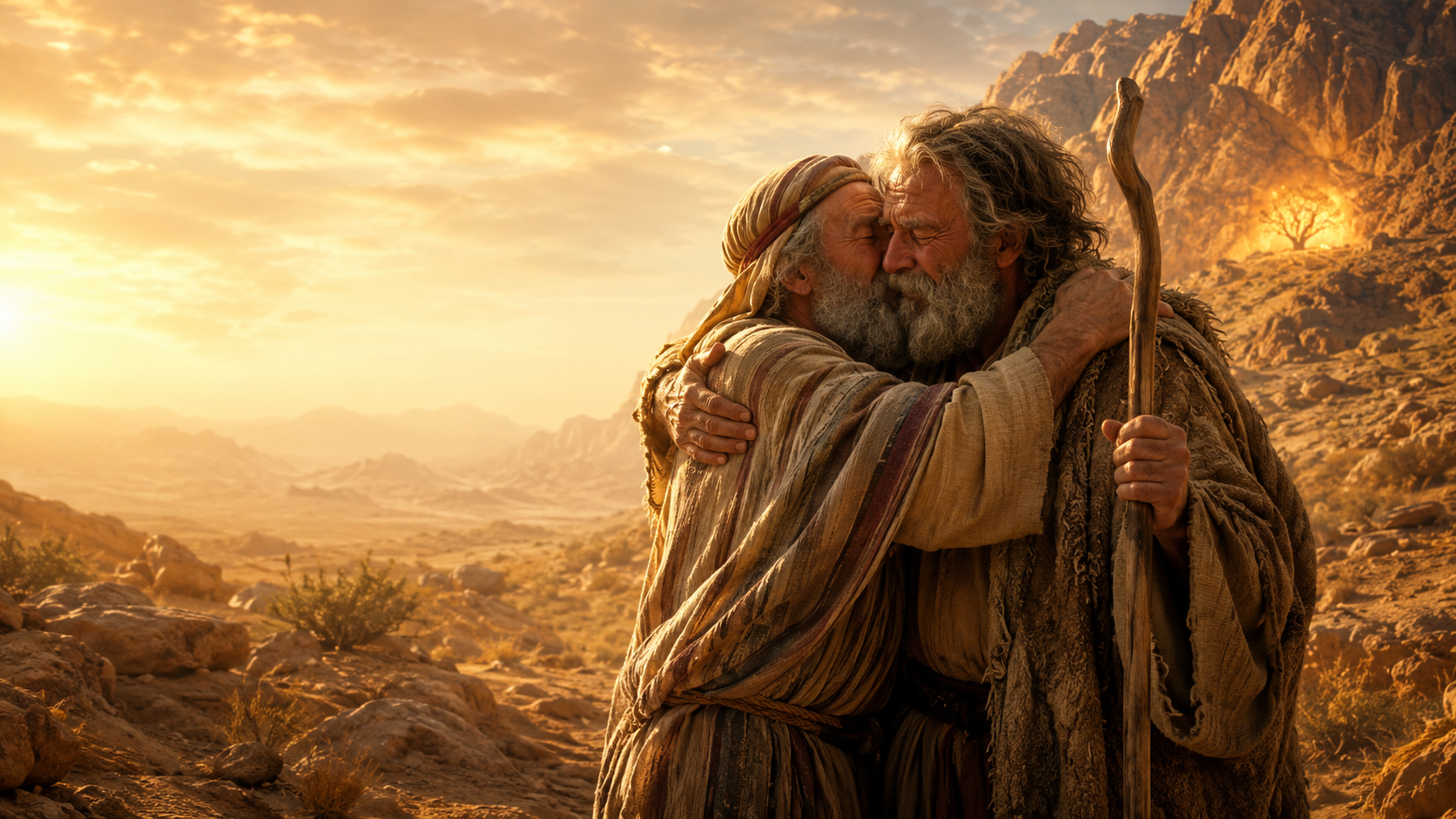
Exodus 4:27 is one of the briefest but most emotionally loaded verses in the entire Moses narrative: "The LORD said to Aaron, 'Go into the wilderness to meet Moses.' So he went and met him at the mountain of God and kissed him."
Aaron walks into the wilderness to find his brother. He has not seen him in forty years. He goes to the mountain of God — Horeb — which means he knows, at minimum, the general territory where Moses lives. The Midianite trade routes have done their work. Someone has told Aaron where his brother is. He sets out.
And he kisses him.
In the ancient Near East, the kiss between men was the gesture of covenant, of loyalty pledged, of a relationship formally claimed. Jacob kissed his relatives in Canaan. Joseph wept on his brothers' necks and kissed them. The prodigal son's father runs to meet him and kisses him. The kiss is the embrace of restoration — the physical declaration that the separation is over, that whatever was broken between them is now being mended, that they are, whatever else they have become, still brothers.
Moses, standing at the mountain where he has just encountered the God of his fathers, receives the kiss of his brother. Two restorations in one morning: the God he had not known he was waiting for, and the brother he had not dared to hope for. The man who fled Egypt alone and sat down by a foreign well with nothing would now return with both the divine name on his lips and his brother at his side.
And then Moses told Aaron everything. And Moses told Aaron all the words of the LORD with which he had sent him, and all the signs that he had commanded him to do (Exodus 4:28). Everything. The burning bush. The I AM. The signs. The five objections. The anger of God. The provision of Aaron. All of it. And Aaron believed. And they went together to gather the elders of Israel. And they spoke all the words. And they did all the signs. And the people believed. And they bowed their heads and worshipped.
Forty years of desert. Five objections at a burning bush. One kiss from a brother. And then — finally — a people on their knees.
The Bush as a Symbol: Israel in Egypt
The early rabbis noticed something about the burning bush that is easy to miss: the choice of a bush — a thorn bush, a small scrubby desert plant — as the vessel of divine fire was not random. In the rabbinic tradition (Exodus Rabbah 2:5), the choice of the lowly bush is a deliberate statement: God chose the most humble, ordinary, thorny plant to manifest His presence in, rather than a cedar or a palm tree, because He was choosing to identify with the most lowly, ordinary, afflicted people — Israel in Egypt.
The bush is Israel. Surrounded by fire — the fire of Egyptian oppression, the fire of slavery and suffering and the overseer's whip — yet not consumed. Four hundred years of fire. And the people, like the bush, are still there. Still burning. Still alive. Still a bush in a desert that has not been able to kill them.
And God manifests His presence in the burning, unconsumed bush. He is in the suffering. Not watching from a safe distance — inhabiting it. The burning bush is not only a sign of God's power. It is a sign of God's solidarity with the afflicted. The God who speaks from the fire is the God who has been in the fire all along.
The Bush and the Cross — An Extended Typology
The bush-as-Israel typology extends further. If the bush represents Israel under oppression — surrounded by fire but not consumed — then the Christological reading of the symbol becomes staggering.
Jesus, the true Israel — who recapitulates in His own life the history of Israel (Egypt, Exodus, wilderness, covenant, promised land) — goes into the ultimate fire. Not the metaphorical fire of slavery, but the actual fire of divine judgment on human sin. He enters the burning. He takes the consuming. He is not protected from consumption the way the bush was. He is consumed — fully, completely, on the cross. The fire that Israel's suffering only approximated falls entirely on Him.
And yet — three days later. Not consumed in the way death was supposed to work. Risen. The fire of death could not keep Him. The grave could not consume Him. He is the bush that should have burned to ash and instead stands, unconsumed, on the other side of the fire, alive in a way that death cannot touch again ("death no longer has dominion over him" — Romans 6:9).
The burning bush is therefore a prophecy of the Resurrection. The God who appeared in unconsumed fire was previewing the One who would pass through the consuming fire of judgment and emerge — unconsumed, living, carrying the marks of the fire but alive beyond all fire. The bush burns at Horeb. And three thousand years later, in a garden near Jerusalem, the tomb is empty.

Devotional
The God Who Answers Every Objection
Devotional Reading
There is something deeply comforting about Moses' five objections. Not because God accepts them — He doesn't. He answers them, one by one, and in the end tells Moses to go. But because the presence of the objections themselves tells us something about the kind of God we are dealing with.
This is a God who can be argued with. A God who listens to every fear and addresses it. A God who provides signs for the one who cannot believe without them, who gives a partner to the one who cannot stand alone, who speaks with patience through four rounds of protest before — in a single moment of honest anger — providing the very thing that breaks the deadlock. Moses said "please send someone else," and God said "here is Aaron" — and in saying it changed the entire direction of Moses' life.
Your objections are not impressive to God. He has heard them all. He has heard "who am I?" from Moses and Gideon and Jeremiah and every soul He has ever called to something beyond what they thought they could do. He has heard "I cannot speak" and "they will not believe me" and "please, someone else." None of these are new to Him. And He answers every one.
But notice what He does not do. He does not tell Moses that his fears are wrong. He does not say "you are actually quite adequate." He does not minimise the real difficulty of what He is asking. He simply says: I will be with you. I will be with your mouth. I will give you signs. I will give you Aaron. The provision is always personal, always specific, always exactly matched to the exact fear.
Whatever you are standing before today — whatever burning bush has interrupted your ordinary Tuesday, whatever impossible assignment has found you barefoot and afraid on holy ground — God's answer to your specific objection is not "you're more capable than you think." It is the same answer He gave Moses. I will be with you. Not I will make you adequate. I will be with you.
Take off your sandals. The ground you are on is holier than you know. And the One speaking your name — twice — is not finished with you yet.

Reflection & Discussion Questions
Personal Reflection
1.Moses turned aside from his normal route to look at something unusual — and that act of attentiveness is what opened the divine conversation. In your own life, are there unusual, unexpected, or inexplicable things that you have not yet turned aside to examine? What would it mean to "turn aside and look" in your current season?
2.Which of Moses' five objections do you most recognise in yourself? "Who am I?" / "They won't believe me" / "I can't speak" / "Send someone else" — which one has most often kept you from the thing God was calling you toward? What has God's response to that specific objection been?
3.God provided Aaron as the answer to Moses' fifth and final objection — a person, not just a power. Has there been a moment in your life where God's answer to your fear was a person He sent to walk alongside you? How did that change what you were able to do?
Deeper Study
4.Read Isaiah 6:1–8 and Jeremiah 1:4–10 alongside Exodus 3:1–4:17.
Map the structural parallels between the three calling narratives. What elements do they all share? What is different? What does the consistency of the calling pattern suggest about how God works with human beings He is drawing into His service?
5.The three translations of Ehyeh asher ehyeh — "I AM WHO I AM," "I WILL BE WHO I WILL BE," and "I CAUSE TO BE"
— each emphasise a different aspect of God's nature. Which of these three dimensions of the divine name is hardest for you to hold onto in your own spiritual life, and why?
6.Read John 8:48–59 carefully. Note that the crowd's response to "Before Abraham was, I AM" is to pick up stones. This is not a confused reaction — they understood exactly what Jesus was claiming. How does understanding the weight of the Exodus 3:14 background change how you read John 8:58? And what does it do to the question "Who do you say that I am?"
7.The rabbinic tradition identifies the burning but unconsumed bush with Israel in Egypt — surrounded by affliction but never destroyed. Can you identify a "burning bush" community in the world today — people who, by any human calculation, should not still be here, but are? What does the bush symbol say about God's relationship to that community?
Closing Prayer
I AM WHO I AM —
That You have a name at all — that You chose to be known, to be named, to be addressed — is itself the beginning of grace. You did not have to tell Moses anything. You could have spoken from the fire and given instructions and sent a man without a name to a people who had forgotten Yours. But You told him. You opened Yourself to be known. You said: this is who I am. This is My name forever.
We thank You that You are not a God who hides behind mystery as an excuse not to be held to anything. You gave Moses Your name. You gave Israel Your covenant. You gave the world Your Son — who is the name made flesh, the I AM who became one of us so that we could know You the way Moses could not yet know You, face to face, without a veil.
We confess that we have our own five objections. That we have stood before our own burning bushes — the places where You have been calling, quietly, persistently, without consuming Himself — and we have said: who am I? They won't believe me. I can't speak. Please send someone else. We have said all of it, Lord. And You have heard all of it.
Meet us in our specific fears today. Answer our specific objections with Your specific provisions. Give us our Aaron — the person, the gift, the companion who makes the impossible possible. And when all our arguments run out and we are standing barefoot on ground we did not know was holy, saying simply "please, not me" — meet us there with the patience that met Moses, and the anger that would not let him go, and the provision that sent him anyway.
Here we are. Say our name again. We are listening.
In the name of the I AM who became Jesus of Nazareth —
Amen.
Coming Next in the Series
Part Seven: The Reluctant Prophet — Every Excuse Moses Made and What God Said Back
We go deeper into the five objections as a theological unit — mapping them against the calling narratives of Isaiah, Jeremiah, Gideon, and Paul. We explore what Moses' reluctance tells us about the nature of divine calling, why God so consistently chooses people who do not want to be chosen, what happens to Moses between the burning bush and the first confrontation with Pharaoh, and the strange attack in Exodus 4:24–26 where God meets Moses on the road and seeks to kill him.
Add comment
Comments