Pentecost · Post Three of Three · The Final Post
Acts 2:42 — Into the Future
The Four Pillars · The Paraclete Who Stays · The Shape of Every Christian Life Since
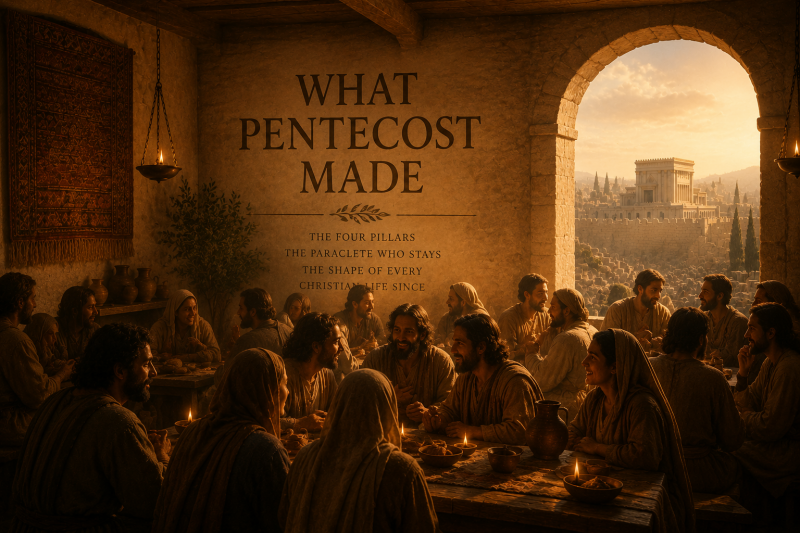
"And they devoted themselves to the apostles' teaching and the fellowship, to the breaking of bread and the prayers. And awe came upon every soul, and many wonders and signs were being done through the apostles."
Acts 2:42–43 · The Immediate Result of Pentecost · The Church's First Self-Description
After the Fire
Three Thousand People — and What They Did Next
By the end of Pentecost day, the community of 120 had become a community of more than 3,000.
Think about what that meant practically. That morning, 120 people had gathered in an upper room. By evening, 3,120 people were part of a community that had no building, no organisation, no name yet, no institution, no liturgy, no theology written down, no leadership structure beyond the eleven apostles and the recently chosen Matthias. They had a risen Lord they had not all met, a Spirit they had just received, a commission to go to the ends of the earth, and the promise that the risen Christ would be with them always.
What happened next was not planned. It was not the result of a strategy meeting or a mission document. Acts 2:42–47 describes what the new community began doing immediately, organically, as if the Spirit who had just entered them was already reshaping their instincts and appetites toward the things that sustained life. Four things, listed with the simplicity of someone describing what was simply obvious — the way you might describe what a healthy person naturally does: eats, sleeps, breathes, moves. This is what Spirit-filled people did. They could not help it.
Acts 2:42 · The Four Pillars
The Four Things That Built the Church
Acts 2:42 lists four activities that "they devoted themselves to" — using the same Greek word, proskarterountes, as Acts 1:14 uses for the ten days of prayer. Devoted, persevering, not letting go. These were not occasional activities or seasonal practices. They were the continuous rhythm of the new community — the shape of its daily life from the day of Pentecost forward.
The First Pillar · Acts 2:42
Τῇ διδαχῇ τῶν ἀποστόλων — The Apostles' Teaching
The first thing the 3,000 did was sit and listen. The apostles taught — and what they taught was what they had been taught: the forty days' curriculum, the opened Scriptures, the cross and resurrection as the centrepiece of the whole Old Testament. This was not devotional inspiration or spiritual experience. It was content — the story, the theology, the meaning. Acts 2:42 places teaching first because the community that had just received the Spirit immediately submitted itself to instruction. The experience of Pentecost did not replace the need for teaching; it created an appetite for it. The community that has been genuinely met by God always wants to understand more about the God who met them. The apostles' teaching became the foundation of what would eventually be written down as the New Testament — and every Christian since who reads Scripture is sitting in that first classroom.
The Second Pillar · Acts 2:42
Τῇ κοινωνίᾳ — The Fellowship
The Greek word koinōnia is one of the most mistranslated words in the New Testament. In modern church usage it has come to mean socialising — coffee after the service, friendly conversation, the pleasant company of like-minded people. But koinōnia in the New Testament means participation, sharing, a genuine communal life in which what one person has is shared with others. Acts 2:44–45 unpacks what this looked like in practice: "And all who believed were together and had all things in common. And they were selling their possessions and belongings and distributing the proceeds to all, as any had need." This was not merely pleasant company. It was a community in which the economic consequences of belonging together were real. Koinōnia is the same word Paul uses for "partnership in the gospel" (Philippians 1:5) and for the "sharing" in Christ's sufferings (Philippians 3:10). The early church took it seriously enough to rearrange their finances around it.
The Third Pillar · Acts 2:42
Τῇ κλάσει τοῦ ἄρτου — The Breaking of Bread
The phrase "breaking of bread" carries a double reference that the early community would have understood simultaneously. In one sense, it meant simply eating together — the regular communal meals that are described in Acts 2:46 as happening "day by day, attending the Temple together and breaking bread in their homes." In another sense — and the two are inseparable in early Christianity — it meant the Eucharist: the re-enactment of the Last Supper, the bread broken and the cup poured as Jesus had commanded. The Emmaus road had shown the disciples that recognition of the risen Christ came "in the breaking of bread" (Luke 24:35). The early community gathered around a table because the table was where the risen Lord had always made himself known. Every meal in the new community was potentially a Eucharistic meal. Every breaking of bread was a memory and an encounter simultaneously.
The Fourth Pillar · Acts 2:42
Ταῖς προσευχαῖς — The Prayers
The Greek uses the definite article — not merely "praying" but "the prayers." This suggests established, specific prayer practices rather than spontaneous individual petition. The early community continued to attend the Temple for the daily prayer hours (Acts 3:1: "Peter and John were going up to the Temple at the hour of prayer, the ninth hour"). They were Jewish believers who maintained the structured prayer rhythm of Jewish religious life while adding the new content of prayer in the name of Jesus. They had just come from ten days of concentrated corporate prayer. They did not stop. The Pentecost community was born in prayer, shaped in prayer, and continued in prayer. The fire that came was not the end of the praying — it was its result, and its continuation.
These four pillars — teaching, fellowship, breaking of bread, and prayer — are not a programme invented at a committee meeting. They are the spontaneous, organic expression of what a Spirit-filled community naturally does. Every healthy Christian community that has existed in the twenty centuries since Pentecost has organised itself around these four activities. Every one that has abandoned any of the four has gradually lost something essential. They are not arbitrary traditions. They are the load-bearing walls of the Church.
Acts 2:43–47 · The Community That Emerged
What Life Looked Like in the Days After
Acts 2:43–47 is five verses describing the Jerusalem community in the weeks and months after Pentecost. It is the most compact vision of the early Church in the New Testament, and it has served as both inspiration and rebuke to Christians in every generation since.
Verse 43: "Awe came upon every soul." The Greek phobos — fear/awe — is the ancient religious category that marks an encounter with the holy. Not terror but the trembling recognition that something greater than ordinary life is present and operating. The early community lived with this awe as a daily experience: signs and wonders were happening through the apostles, and the people who witnessed them were not blasé about it. Awe — the habitual, grateful recognition that you are not living in an ordinary world — is the atmosphere in which the early Church moved.
"And the Lord added to their number day by day those who were being saved."
Acts 2:47 · The Summary Line · The Church's Growth Was God's Work, Not the Community's Programme
Verse 44–45: "All who believed were together and had all things in common. And they were selling their possessions and belongings and distributing the proceeds to all, as any had need." This is the most radical social practice in the New Testament outside the Gospels. The early community did not merely feel warmly toward one another. They restructured their economic lives around common need. This was not communism in any ideological sense — it was the practical expression of koinōnia, of a community that had heard "love your neighbour as yourself" and taken it with complete seriousness. The Pentecost community was not a prayer group that happened to be friends. It was a society with a different economic ethic.
Verse 46: "And day by day, attending the Temple together and breaking bread in their homes, they received their food with glad and generous hearts." Two locations: the Temple courts for public worship and proclamation, and homes for the intimate breaking of bread. The early Church was both public and domestic — present in the city's central religious space, and woven into the private fabric of domestic life. Neither location was optional. The public presence gave the community its witness; the domestic intimacy gave it its depth.
Verse 47: "Praising God and having favour with all the people. And the Lord added to their number day by day those who were being saved." The growth was daily. And it was God's doing — "the Lord added." The community was not running a growth strategy. It was living the four pillars and the radical common life, and God was sending people toward it. The magnetism of genuine community — genuine teaching, genuine fellowship, genuine prayer, genuine bread-breaking — has always been the most powerful evangelism available to the Church.
The Spirit Who Stays
Who the Holy Spirit Actually Is — and What He Does
Pentecost gave the Church the Holy Spirit. But who is the Holy Spirit? The question is enormous and the New Testament answers it from many angles — but the most important and least discussed answer comes from the words Jesus himself used in the Farewell Discourse on the night before his death, when he promised the Paraclete.
Παράκλητος
Paraklētos · John 14:16 · The Most Misunderstood Title for the Spirit
What it literally means: Paraklētos combines para (alongside) and klētos (called/summoned). The standard translation is "Comforter" (KJV) or "Counsellor" or "Helper" or "Advocate" (ESV, NIV). Every one of these translations catches something true and misses something else. The word was used in Greek law courts for the person who stands alongside the defendant and speaks on their behalf — not exactly a lawyer, but a trusted advocate, someone who knows the case and knows the person and speaks from that combined knowledge.
What Jesus said about him: In John 14–16, Jesus made five specific promises about the Paraclete. He will be with you forever (John 14:16) — not a temporary gift. He lives with you and will be in you (John 14:17) — a change from the external-guidance model of the Old Testament to interior dwelling. He will teach you all things and remind you of everything Jesus said (John 14:26) — not a new revelation but the illumination of what has already been given. He will bear witness about Jesus (John 15:26) — his primary work is not to draw attention to himself but to make Jesus real to people. And he will convict the world of sin, righteousness, and judgment (John 16:8) — the uncomfortable work of the Spirit, who tells the truth about what is true whether or not we want to hear it.
Why "Comforter" is not enough: The old KJV translation of paraklētos as "Comforter" has shaped how many Christians think of the Spirit — as a source of emotional reassurance, a divine presence that makes you feel better when you are sad. This is part of what the Spirit does. But the Paraclete of John 14–16 is also the one who convicts, teaches, guides into truth, bears witness, and glorifies Christ. He is not primarily a comfort-giver. He is the person of the Trinity who is with you in every dimension of your life — in the courtroom, in the study, in the grief, in the mission, in the confusion — and who speaks, acts, and works from within you rather than at a distance from you. He is alongside, permanently, in every circumstance, doing the full range of what a trusted counsellor-advocate does. That is the Paraclete who came at Pentecost.
Jesus had made one more extraordinary statement about the Spirit in John 16:7: "It is to your advantage that I go away, for if I do not go away, the Helper will not come to you."
The disciples had not believed this when he said it — how could his departure possibly be an advantage? But the logic was precise.
While Jesus was physically present in Palestine, his personal presence was limited to one place at a time. The Paraclete is not limited.
The Paraclete is simultaneously present with every believer in every location in every century. The Spirit who came at Pentecost is as present in your room as he was in the upper room. He is not diminished by distance, by time, or by numbers. Every person who has ever lived in the forty centuries since Pentecost and received the Spirit has received the same Spirit in the same fullness. The arrival on the day of Pentecost was the hinge that made this universality possible.
The Spirit's Work in You
What the Spirit Does in Every Believer's Life
The Spirit who came at Pentecost did not come only for that one generation. Peter's invitation at the end of his sermon was explicit: "The promise is for you and for your children and for all who are far off, everyone whom the Lord our God calls to himself" (Acts 2:39).
The "far off" — in Jewish usage a phrase meaning the Gentile nations — were included in the promise. Every person who has ever come to faith since that morning has received the same Spirit. Here is what the New Testament says that Spirit actually does in a person's life.
1
He Convicts of Sin
John 16:8: "He will convict the world concerning sin and righteousness and judgment." The uncomfortable gift: the Spirit tells the truth about what is wrong in you, what is still unaligned with God. Not to condemn — Romans 8:1 is explicit: "there is therefore now no condemnation for those who are in Christ Jesus." But to show, with the kindness of a good doctor, what needs treatment. The experience of genuine spiritual conviction — the feeling of being "cut to the heart" as the Pentecost crowd was — is the Spirit's work, not willpower or emotional manipulation.
4
He Produces the Fruit
Galatians 5:22–23: "The fruit of the Spirit is love, joy, peace, patience, kindness, goodness, faithfulness, gentleness, self-control." This list describes not achievements but growths — things that develop over time in a life lived in the Spirit's presence. They cannot be produced by willpower. They are the organic result of abiding in the source. Jesus said "I am the vine; you are the branches. Whoever abides in me and I in him, he it is that bears much fruit, for apart from me you can do nothing" (John 15:5). The fruit is the Spirit's to produce. The abiding is the believer's to maintain.
2
He Bears Witness to Christ
John 15:26: "He will bear witness about me." The Spirit's primary self-effacing work is to make Jesus real and present to those who follow him. He does not draw attention to himself. He illuminates the face of Christ. Every moment in which Scripture comes alive, in which you sense the presence of Jesus rather than merely read about him, in which worship moves from performance to encounter — that is the Spirit's witnessing work. He is the one who makes the historical Jesus a present reality rather than a distant figure of antiquity.
5
He Intercedes in Prayer
Romans 8:26: "The Spirit helps us in our weakness. For we do not know what to pray for as we ought, but the Spirit himself intercedes for us with groanings too deep for words." When you do not know what to say — when the circumstances are too complex or painful for language, when the prayer dries up — the Spirit is praying in and through you with a depth and accuracy that exceeds what you could articulate. The prayer life of a believer is never only human speech. It is Spirit-assisted speech, or Spirit-only groanings when speech fails, always arriving before the Father with the intercession of both the Spirit and the Son (Romans 8:34).
3
He Teaches and Reminds
John 14:26: "He will teach you all things and bring to your remembrance all that I have said to you." The Spirit does not produce new revelation beyond what Christ revealed — he illuminates and applies what has already been given. The experience of a Scripture passage suddenly meaning something it never meant before, of a truth you knew intellectually landing with personal weight — this is the Spirit's teaching work. He is the living commentary on the living Word, available personally, always.
6
He Distributes Gifts for the Body
1 Corinthians 12:4–7: "There are varieties of gifts, but the same Spirit... To each is given the manifestation of the Spirit for the common good." The Spirit does not give gifts for personal enrichment or spiritual status. He gives them "for the common good" — for the building up of the community. The variety of gifts (teaching, prophecy, healing, administration, service, tongues, wisdom, knowledge, faith, and many others) maps onto the variety of the community's needs. No one person has all the gifts. The community needs everyone's gifts. The diversity is the design.
How Pentecost Shaped Everything After
The Permanent Consequences of One Morning
Pentecost was a single day. Its consequences have lasted for twenty centuries and are still running.
The Permanent Theological Consequences
The Spirit changed the address of God's presence.
Before Pentecost, God's presence was associated with specific locations — the Tabernacle, the Temple, the Holy of Holies.
The veil that was torn on Good Friday opened the access. Pentecost established the new address: the bodies of believers. Paul writes in 1 Corinthians 3:16: "Do you not know that you are God's temple and that God's Spirit dwells in you?"
Every believer is now what the Temple was. The presence of God is not localised in a building that requires a priestly system to access.
It is present in every person who has received the Spirit — in every house, every workplace, every difficult conversation, every hospital ward, every prison. Pentecost made the presence of God mobile, personal, and universal.
The Spirit made the Old Testament readable in a new way.
The disciples who had listened to Jesus open the Scriptures for forty days were equipped by Pentecost to do the same for others.
Peter's sermon at Pentecost was a demonstration of what that opened reading looked like: the whole Old Testament converging on Jesus, the cross, and the resurrection. This is the reading method that produced the New Testament.
Every New Testament author was a Jew, writing from within the Hebrew Scriptures, showing how the whole story found its culmination in Christ. The Spirit who opened their minds at Pentecost continues to be the one who makes the Bible coherent rather than confused — showing how the pieces fit, how the promise becomes fulfilment, how the shadow becomes substance.
The Spirit made the mission possible.
Acts 1:8 had described a geographical programme: Jerusalem, Judea, Samaria, the ends of the earth. Pentecost did not begin that programme — it powered it.
The Pentecost pilgrims carried the gospel to their home nations. Paul, empowered by the same Spirit, carried it to Turkey, Greece, and Rome. Within thirty years of Pentecost, the gospel was in every major city of the Roman Empire. Within three centuries, the Roman Empire itself had been officially Christianised. The power Jesus had promised — "you will receive power when the Holy Spirit comes upon you" — was real, measurable, historically documented power. It turned fishermen into the founders of the world's largest institution.
The Promise That Is Still Open
You Are Inside the Pentecost Story
Peter's invitation at Pentecost was explicit: "The promise is for you and for your children and for all who are far off, everyone whom the Lord our God calls to himself" (Acts 2:39). Two thousand years of Christian history is the story of the Spirit continuing to come upon "all who are far off" — people of every nation, every language, every century, whom God has called to himself.
You are one of those people. If you have received the Spirit, you have received the same Spirit who came in fire in Jerusalem on that Shavuot morning. Not a smaller version, not a later edition, not a remote echo.
The same Spirit, in the same fullness, for the same purposes: to make Jesus real to you, to transform you from the inside out, to equip you for the mission, to pray through you when you cannot pray, to distribute gifts for the common good, to produce fruit that will last, and to carry you — as the Pentecost pilgrims carried the gospel home — into the particular corner of the world where you have been placed.
"And they devoted themselves to the apostles' teaching and the fellowship, to the breaking of bread and the prayers."
Acts 2:42 · The Shape of the Christian Life · Still, Two Thousand Years Later, the Same Four Pillars
The four pillars of Acts 2:42 are still the load-bearing walls. The teaching of the apostles — now written in the New Testament, still opening minds. The fellowship — real koinōnia, the kind that costs something. The breaking of bread — the Eucharist, still the place where the risen Christ makes himself known.
The prayers — the fourth watch of the night, the morning prayer, the prayer that doesn't know what to say but shows up anyway. These are not optional extras for the especially devout. They are the basic diet of a person who has received the Spirit and intends to keep living from that gift.
The day of Pentecost was the birthday of the Church. But it was also the first day of an age that has not ended. The Spirit who came has not left. The fire still burns. The promise is still open.
And if you look carefully enough at any gathering of people devoted to the apostles' teaching and the fellowship and the breaking of bread and the prayers — in a cathedral or a tin-roofed building, in a city or a village, in any language of the fifteen hundred and counting — you will see the same community that first gathered in an upper room in Jerusalem on the morning the wind came.

What We Usually Miss
The Depths Beneath the Familiar Story
The four pillars are in a specific order — and the order matters
Teaching comes first in Acts 2:42. Not fellowship, not prayer, not even the Eucharist. This is not accidental. The community that had just been set on fire by the Spirit immediately submitted itself to the word. Emotional and spiritual experience without doctrinal grounding produces enthusiasm that does not last. Doctrine without Spirit produces orthodoxy that does not live. The early community held both: the fire had come, and now they sat under teaching. Every generation of Christianity that has been both warm and sound has maintained this order: the Spirit ignites, the Word shapes.
Koinōnia was an economic reality, not a social nicety
The early church's koinōnia included selling possessions and distributing to those in need (Acts 2:45). This was not an optional add-on for the especially generous. It was the community's basic practice, described alongside teaching and prayer as one of the four foundational activities. The Western church has often domesticated koinōnia into "fellowship" meaning coffee and casual conversation. But the Greek word and its New Testament context insist on more: a genuine sharing of material reality, a community in which nobody has too much while others have too little. Whether or not this looks exactly like Acts 2 in different economic contexts, the challenge is real: has your community life changed what you do with your money?
The Spirit is a person, not a force
Popular Christian speech about the Spirit often treats him as an impersonal force — "the Spirit moved," "I felt the Spirit," as if the Spirit were a spiritual weather system moving across the congregation. But Jesus consistently uses personal pronouns for the Spirit: "he will teach you," "he will testify about me," "he will convict the world" (John 14:26; 15:26; 16:8). The Spirit is not a divine energy or a spiritual atmosphere. He is the third person of the Trinity — fully personal, fully relational, fully knowable. He can be grieved (Ephesians 4:30). He can be quenched (1 Thessalonians 5:19). He intercedes with specific groaning (Romans 8:26). He distributes gifts "as he wills" (1 Corinthians 12:11). Every one of these implies personhood. The fire at Pentecost was the arrival of a person, not a power.
The Lord added — the Church did not grow itself
Acts 2:47 — "And the Lord added to their number day by day those who were being saved." This is theologically precise. The active subject is "the Lord." The community did not add to itself. It did not run a membership campaign. It devoted itself to the four pillars, radiated the life of the community, and God brought people toward it. This does not mean evangelism is passive — Acts records vigorous, courageous proclamation. But the results were not the community's to take credit for. They were God's additions. The early Church was not trying to grow. It was trying to be faithful. Growth was what God did with faithfulness. This is still the pattern.
Pentecost was the beginning of the harvest, not the harvest itself
The Feast of Firstfruits (Nisan 17) had marked Christ's resurrection as the first of a harvest to come. The Feast of Weeks (Shavuot/Pentecost) — fifty days later — marked the continuation of that harvest. The 3,000 baptised on Pentecost were not the final count. They were the next firstfruits — the beginning of what Paul would call the full harvest, when "the whole creation... will be set free from its bondage to corruption and obtain the freedom of the glory of the children of God" (Romans 8:21). The Pentecost harvest that began in Jerusalem is still being gathered. Every person who comes to faith adds to the number. Every community that forms around the four pillars is another field yielding grain. The feast is not yet over. The Spirit is still being poured out on all flesh. The harvest is still coming in.
Study Guide · Final Post
Questions for Reflection & Discussion
The four pillars — teaching, fellowship, breaking of bread, prayer — were not invented at a planning meeting. They emerged organically from a community filled with the Spirit. Honestly: of the four, which one is most deeply alive in your own life right now? Which one is the weakest? What does the weakness of that one cost you — and what might it look like to strengthen it?
Acts 2:42 · Colossians 3:16 · Hebrews 10:24–25
Koinōnia — genuine fellowship — in Acts 2 included selling possessions and distributing to those in need. It was economic, not just social. What would it look like for your community to practise genuine koinōnia rather than pleasant sociability? Is there a need around you that you have the capacity to meet — and have not, because meeting it would cost something real?
Acts 2:44–45 · 1 John 3:17 · 2 Corinthians 8:14
Jesus said the Paraclete — the Spirit — "will bear witness about me" and "will teach you all things." The Spirit's primary work is to make Jesus real and to illuminate the Word. Has there been a moment in your life when Scripture came alive in a way it never had before, or when you sensed the presence of Jesus with unusual clarity? What produced that moment — and what might it take to live more consistently in that kind of Spirit-opened attentiveness?
John 14:26 · John 15:26 · Psalm 119:18
Pentecost made the presence of God mobile — not confined to a building or a system, but inhabiting every believer in every place. Your body is a temple of the Holy Spirit. How does that truth change what you think of as "sacred space"? And how does it change what you think is possible in the ordinary, non-church moments of your week?
1 Corinthians 6:19 · 2 Corinthians 6:16 · John 4:23
Acts 2:47 says "the Lord added to their number day by day." The community was not trying to grow — it was trying to be faithful to the four pillars. Growth was what God did with their faithfulness. Is there a way your community, or your own spiritual life, has been trying to produce results that are actually God's to produce? What would it look like to let go of the results and focus on the faithfulness?
Acts 2:47 · 1 Corinthians 3:6 · John 15:5
Peter said at Pentecost: "The promise is for you and for your children and for all who are far off." You are one of the "far off" — distant in time, in geography, in culture from that upper room in Jerusalem. The same Spirit, the same promise, the same invitation. Looking back over this whole series — from the ten days of waiting to the day the wind came to the community that emerged — what is the one thing you are taking forward differently? And what does Peter's invitation mean to you personally, right now?
Acts 2:39 · Romans 8:14–16 · Ephesians 1:13–14
Dig Deeper — Sources & Further Reading
Acts 2:42–47 — Read as a Single Portrait
The most compact description of the early Church — five verses that have served as the vision and the rebuke of Christian community for twenty centuries. Read slowly.
1 Corinthians 12–14 — The Gifts of the Spirit
Paul's most extended treatment of how the Spirit distributes gifts for the common good — and why the diversity of gifts requires the unity of the body to make sense
John 14–16 — The Paraclete Passages
Read all three Paraclete sections as a unit: what Jesus promised the Spirit would do, how personal and specific the promises are, and what the Spirit's own testimony about himself consists of
Galatians 5:16–26 — The Fruit of the Spirit
Read as a description of what a life looks like that has been given entirely to the Spirit's forming work — what changes, what grows, what diminishes, over a lifetime of Spirit-shaped living
"The promise is for you and for your children and for all who are far off, everyone whom the Lord our God calls to himself."
Acts 2:39 · Peter · The Pentecost Invitation · Still Open · Still Being Answered
The Pentecost Series — Complete
Post One — The Ten Days of Waiting · The Upper Room · The 120 · Jerusalem on the Eve of Shavuot
Post Two — The Day the Wind Came · The Sound, the Fire, the Tongues · Peter's Sermon · Three Thousand Baptised
Post Three — What Pentecost Made · The Four Pillars · The Paraclete Who Stays · The Shape of Every Christian Life Since
Add comment
Comments