Pentecost · Post One of Three
Days 41–49 · The Upper Room · Jerusalem
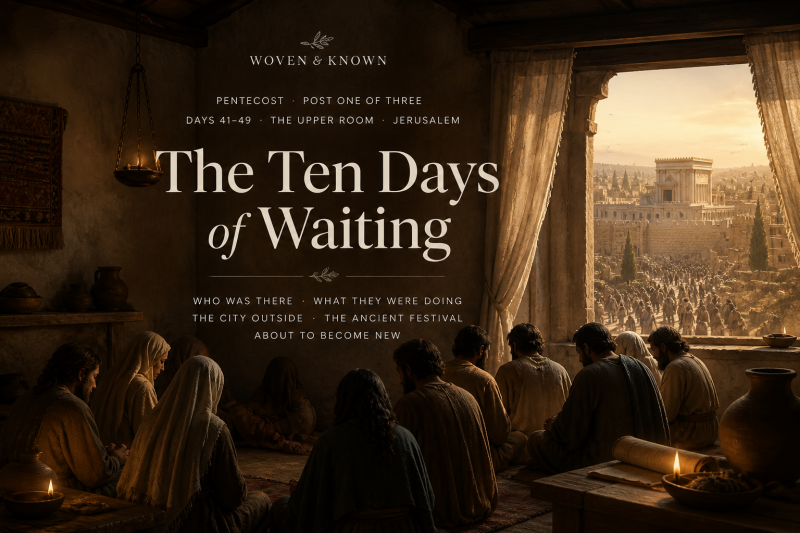
"All these with one accord were devoting themselves to prayer, together with the women and Mary the mother of Jesus, and his brothers."
Acts 1:14 · The Upper Room · The Ten Days Before the Fire
The Setting
Jerusalem, Fifty Days After Passover
They walked back down the Mount of Olives the way they had come. A Sabbath day's journey — roughly a mile — between the mountain of the Ascension and the city of the locked room. Behind them, the sky was ordinary again. The cloud had gone. Ahead of them, Jerusalem was alive with the noise and colour of the approaching Feast of Weeks.
It was Sivan, the third month on the Hebrew calendar. The wheat harvest was ripening across Judea and Galilee. In a week's time, Jerusalem would swell to several times its normal population — pilgrims arriving from every corner of the Roman Empire and beyond, speaking fifteen languages between them, all converging on the Temple courts to offer the firstfruits of the wheat harvest and to remember the day, fifteen centuries earlier, when God had descended on a smoking mountain and given his Law to a nation.
The disciples knew the city's rhythms. Most of them had been making this Passover-to-Shavuot journey their whole lives. They knew what Jerusalem looked like in festival season: the roads packed with travellers, the inns full, the streets loud with a dozen languages, the Temple courts densely crowded with the faithful from Egypt, Mesopotamia, Cappadocia, Rome, Arabia. They had watched it happen every year. This year would be different in ways none of them could yet imagine.
But first: they had been told to wait.
"He ordered them not to depart from Jerusalem, but to wait for the promise of the Father, which he said, 'you heard from me; for John baptised with water, but you will be baptised with the Holy Spirit not many days from now.'"
Acts 1:4–5 · Jesus · Final Instructions Before the Ascension
Ten days. From the Ascension on the fortieth day after the resurrection to the Feast of Pentecost on the fiftieth. Ten days in a city that was filing up around them with pilgrims who had come to remember the giving of the Law. Ten days in which the eleven disciples who had fled Gethsemane, hidden in a locked room, and watched their Lord disappear into a cloud were going to discover what it meant to wait on God with everything you had — and what happened when God honoured that waiting in a way nobody expected.
The Upper Room · Acts 1:12–14
The Room, the People, the 120
Acts 1:13 names the place: "the upper room where they were staying." Almost certainly the same room — or the same building — as the Last Supper, on the southwestern hill of Jerusalem above the Kidron Valley. A large, privately owned space that had been made available to the disciples. In the days before Pentecost, it had become the gathering point of everyone who had known and followed Jesus.
Acts 1:15 counts them: "about 120." Not twelve. Not eleven. One hundred and twenty people — a number that carries its own symbolic weight in Jewish tradition, since a community of 120 was considered the minimum required to establish a legal Jewish community with its own court. Whether Luke was aware of this or simply recording the historical count, the number describes a community — not a hiding place, not a remnant, but a genuine, functioning assembly of people who belonged together.
Who were the 120? Acts 1:14 gives us three groups: the eleven disciples (Matthias would shortly bring them back to twelve), the women who had followed Jesus from Galilee — "and Mary the mother of Jesus" (named specifically, probably because she was notable as the one who had not fled), and his brothers. The explicit mention of Jesus's brothers is significant. These are the same siblings — James, Joses, Simon, and Judas — who had not believed during the ministry, who had thought Jesus was out of his mind (Mark 3:21), who had goaded him to perform miracles publicly (John 7:3–5). Now they were in the upper room. The resurrection appearance to James had done its work. The family that had doubted together was now praying together.
Peter — The Leader Becoming Himself
Peter had already given his first leadership speech — the address to the 120 about replacing Judas (Acts 1:15–22), showing an extraordinary fluency with Scripture that the forty days had built. He cited Psalms 69 and 109, connected them to Judas's fate, and proposed the criteria for a replacement apostle: someone who had been with them from the baptism of John through to the Ascension, who could be a witness of the resurrection. This was not the man who had denied Jesus by a charcoal fire. This was someone being rebuilt, step by step, into the apostle he had been commissioned to be. In the upper room, with ten days to wait and nothing to do but pray, Peter was becoming the Peter of Pentecost.
Mary the Mother of Jesus — Present at Every Threshold
Luke names Mary specifically — "Mary the mother of Jesus" — in a list of people who otherwise remain anonymous. This is deliberate. Mary had been present at the Annunciation, the Nativity, the Temple presentation, the wedding at Cana, the foot of the cross, and now the upper room before Pentecost. She had been told by the angel that the child she would bear would be "filled with the Holy Spirit" (Luke 1:15). She had heard Simeon's prophecy about the sword that would pierce her soul. She had watched the sword's fulfilment at Golgotha. Now she sat in the upper room, devoting herself to prayer with the community her son had assembled, waiting for the Spirit she had been living alongside since before his birth. There is something irreducibly moving about her presence here: the mother present at every beginning of her son's story, present at this one too.
James, the Lord's Brother — The Sceptic Who Stayed
James had not believed in Jesus during the ministry (John 7:5). He had been to the resurrection appearance — the private one that Paul mentions in 1 Corinthians 15:7 — and it had overturned everything. Now he was in the upper room praying with his mother and his late brother's disciples. Within months he would be leading the Jerusalem church. Within years he would be its most important figure — presiding over the Jerusalem Council, writing the epistle that bears his name, dying as a martyr rather than deny his risen brother. The ten days of prayer in the upper room were the final shaping before James the sceptic became James the pillar. He was there. He was praying. He was waiting.
The Women — Faithful at Every Point
The women who had been at the cross, the burial, and the empty tomb were in the upper room — named collectively but not individually in Acts 1:14. Luke's Gospel tells us their names: Mary Magdalene, Joanna, Mary the mother of James, Salome, and others (Luke 24:10). These were not peripheral figures who happened to be present. They were the people who had stayed when everyone else ran. They were the first witnesses of the resurrection. They had been in the locked room on Sunday evening. They had been in the Galilee period. They were still there, ten days before Pentecost, devoted to prayer with the rest of the community. The Spirit who was coming was coming on them too. Joel 2:28 had promised it: "your sons and daughters shall prophesy." And they did.
Matthias — Chosen But Barely Known
Matthias was chosen by lot from two candidates to replace Judas and restore the Twelve to their full number (Acts 1:23–26). The criteria were precise: he had to have been with the disciples from John's baptism through the Ascension, a witness of the entire arc. He met those criteria — which means he had been following Jesus from the very beginning, present for everything, and yet never once named in any Gospel. He is one of the great anonymous figures of the New Testament: faithful, present, eyewitness to everything, invisible in every account except this one moment of selection. After Acts 1, he disappears from the record entirely. But he was there, in the upper room, receiving the Spirit with the rest of them. History may not have remembered his name. The Spirit was not interested in fame.
What Prayer Looked Like
Devoted Themselves to Prayer — What That Actually Meant
Acts 1:14 says the 120 "with one accord were devoting themselves to prayer." It is easy to read past the phrase. But it holds more than it appears.
The Greek word for "devoting themselves" is proskarterountes — a word that means persevering in something, continuing steadfastly, not letting it go. It is used of Jesus remaining in places (Mark 3:9), of the early church's continued commitment to teaching and fellowship (Acts 2:42), and of prayer specifically (Romans 12:12: "be persistent in prayer"). This was not casual or occasional prayer. This was concentrated, sustained, communal prayer — morning and evening, through the heat of the day, over ten days, with the wholeness of the community oriented in the same direction.
Jewish prayer in the first century was structured around specific hours — the morning shacharit, the afternoon minchah, and the evening ma'ariv. Jesus and his disciples had always observed these hours. In the upper room, the 120 were almost certainly praying in accordance with this rhythm — but going beyond it, filling the spaces between the formal hours with the kind of corporate seeking that the prophet Joel had described and that Jesus had promised would be answered.
"One accord" — the Greek homothymadon — appears ten times in Acts. It means not merely agreement but a convergence of desire, a singleness of intent. They were not all praying different things. They were a community aimed together at the same point, with the same longing, in the same posture.
Acts 1:14 · The Greek homothymadon · The Quality of the Waiting
What were they praying for? The text does not say exactly. But Acts 1:4 and 1:8 frame the context: they had been told the Spirit was coming "not many days from now," and that they would receive power to be his witnesses "to the ends of the earth." They were praying for something they had been promised but could not yet see, could not produce for themselves, and could not schedule. They were learning — in those ten days — the discipline that every generation of the Church has had to learn: how to wait actively, expectantly, with intention, for a divine act that only God can initiate.
This is the first novena. The Roman Catholic tradition of nine days of prayer before a feast — the novena — derives from these ten days in the upper room (nine full days plus the eve). What began as a community's response to a specific instruction became a permanent pattern in the Church's prayer life. Every novena since then is an echo of a hundred and twenty people in a Jerusalem upper room, praying with one accord, waiting for fire.
The World Outside the Room
Jerusalem Was Filling Up
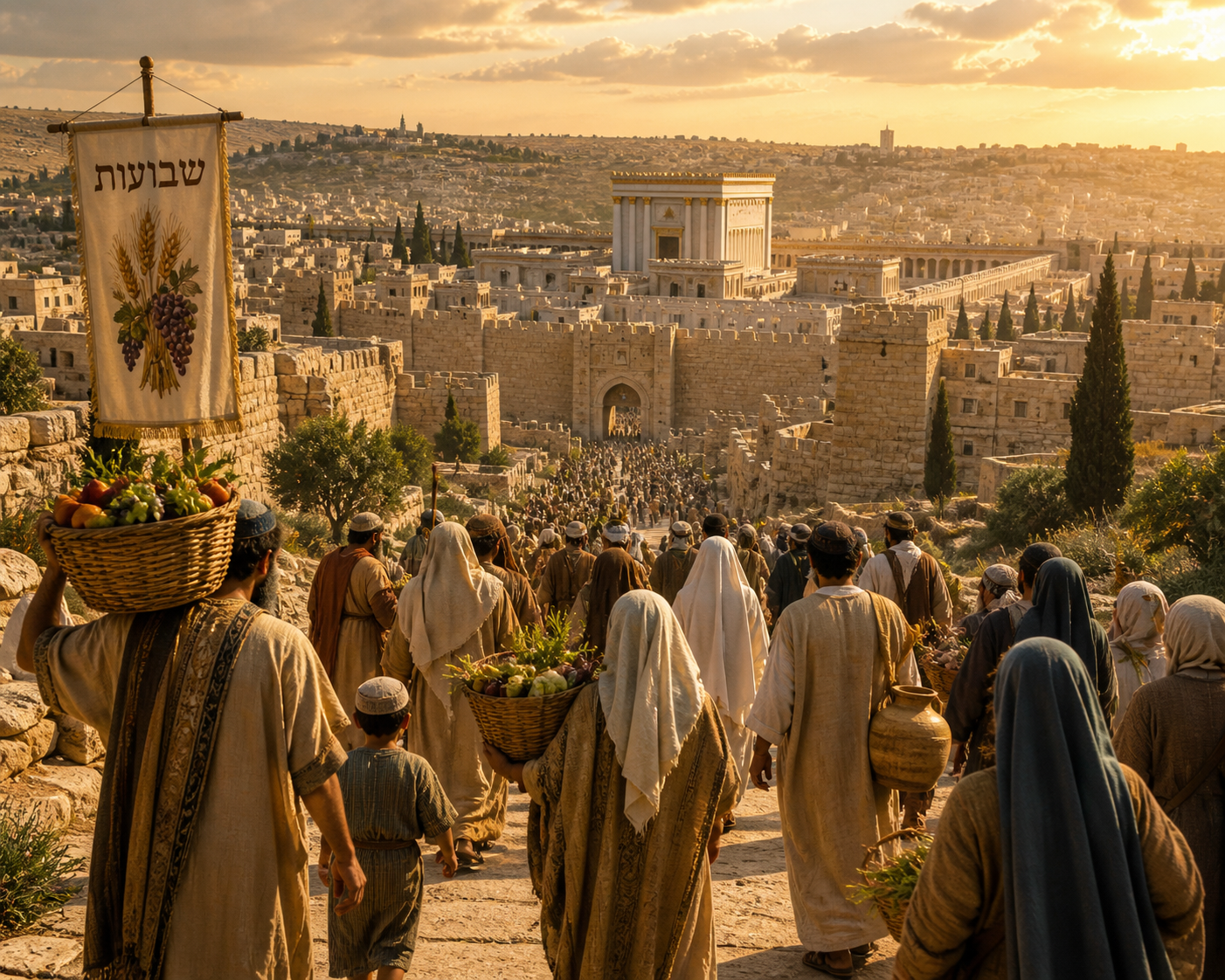
While 120 people prayed in an upper room, Jerusalem was transforming around them.
Shavuot — the Feast of Weeks, called Pentecost in Greek from pentēkostē, "fiftieth day" — was one of the three great pilgrimage festivals commanded in Deuteronomy 16:16. Every adult Jewish male was required to appear before the Lord in Jerusalem three times a year: at Passover, at Shavuot, and at Sukkot. The practical effect was that Jerusalem, normally a city of perhaps 40,000–80,000 people, swelled massively during the festivals. Josephus records figures suggesting several hundred thousand pilgrims for Passover. Shavuot brought its own enormous crowds.
Where They Came From
Acts 2:9–11 lists fifteen distinct regions: Parthia, Media, Elam, Mesopotamia, Judea, Cappadocia, Pontus, Asia, Phrygia, Pamphylia, Egypt, Libya near Cyrene, Rome, Crete, and Arabia. This list traces a geographic arc from the Iranian plateau in the east through the Fertile Crescent, across Asia Minor, through North Africa, and around to Rome and the Mediterranean islands. It is not exhaustive — Luke says "every nation under heaven" — but these fifteen named regions give a sense of the international breadth of the crowd. Diaspora Jews had been scattered across the empire for centuries following the Assyrian and Babylonian captivities. Many maintained deep loyalty to Jerusalem and made the pilgrimage when they could afford it.
What Shavuot Was Celebrating
On its agricultural surface, Shavuot marked the end of the barley harvest (which began at Passover, when the Firstfruits offering was made) and the beginning of the wheat harvest. The Mishnah (Bikkurim 3:3) describes festive processions into Jerusalem: pilgrims carrying decorated baskets of firstfruits — fresh figs, grapes, pomegranates, olives, dates, and wheat — led by an ox with gilded horns, flute players going before them, singing Psalms of Ascent. The city would have been vivid, loud, and full of agricultural abundance. The disciples watching from the upper room would have heard the flutes and seen the processions below.
The Sinai Dimension
By the first century, Shavuot had acquired a second, deeper meaning. Jewish tradition — recorded in the Talmud (Shabbat 86b) and Midrash — held that the giving of the Torah on Mount Sinai had occurred on Shavuot. The timing worked: Israel left Egypt at Passover, arrived at Sinai "in the third month" (Exodus 19:1), and received the Law approximately seven weeks later — at precisely the timing Shavuot marked. So the pilgrims flooding into Jerusalem were not just celebrating a harvest. They were commemorating the day God had descended on a mountain in fire and thunder and spoken his covenant to a people. The synagogue reading for Shavuot was Exodus 19–20: the Sinai theophany. The Spirit who was about to fall on the upper room would do so while the city was already meditating on the day God descended in fire.
The Mishnah's Description of the Processions
"The flute was played before them until they were nigh to Jerusalem; and when they arrived close to Jerusalem they sent messengers in advance, and ornamentally arrayed their firstfruits." (Mishnah Bikkurim 3:3). The processions were festive, public, and musical. The whole city participated. Even as the 120 prayed in their upper room, Jerusalem below was filling with people who had made long journeys in faith and celebration, bringing their first produce as an offering to God. Within hours, those same pilgrims would be confronted by a sound and a sight that no festival had ever offered before.
18 Mount Sinai was covered with smoke, because the Lord descended on it in fire. The smoke billowed up from it like smoke from a furnace, and the whole mountain[b] trembled violently.
Exodus 19:18

What Shavuot Was — and What It Was About to Become
The Ancient Festival That Had Always Been a Prophecy
The Jewish calendar's three great festivals were not random agricultural commemorations. They were a narrative structure — a story told in time through celebration. Passover told the story of the Exodus: the Lamb slain, the blood on the doorposts, the people freed from slavery. The Feast of Firstfruits (Nisan 17, the Sunday after Passover) told the story of the first harvest pulled from the ground — which Paul would call the resurrection of Christ. And Shavuot — fifty days later — told the story of what happened when the freed people received the covenant at Sinai: God descended, spoke, and bound himself to his people in a Law written on stone.
Each feast was both historical commemoration and prophetic anticipation. Passover was not merely Egypt — it pointed forward to the true Passover Lamb. Firstfruits was not merely barley — it pointed forward to the firstborn from the dead. And Shavuot was not merely Sinai — it pointed forward to something Jeremiah had described in words that every devout Jew knew by heart:
"Behold, the days are coming, declares the LORD, when I will make a new covenant with the house of Israel and the house of Judah... I will put my law within them, and I will write it on their hearts."
Jeremiah 31:31, 33 · Written c. 620 BC · The Promise That Shavuot Was Pointing Toward
The Sinai-Pentecost Parallel: What Every Jewish Pilgrim Already Knew
The Midrash on Exodus 20:18 records a tradition that at Sinai the voice of God was "split into seventy languages," so that each nation would hear the commandments in their own tongue. The rabbis were wrestling with how one voice could be heard by a whole nation — and they imagined it as a miracle of universal comprehension. "The voice went out and was divided into seven voices and from seven voices into seventy tongues, so that all the nations will hear" (Midrash Shmot Rabbah, on Exodus 20). This is the tradition that the Jerusalem pilgrims brought with them to Shavuot — a tradition about a single divine speaking heard in every language. The disciples had no idea that within ten days, their city would experience exactly this.
The comparison goes further.
At Sinai: thunder and violent wind, fire on the mountain, the mountain shaking (Exodus 19:16–19).
At Pentecost: a sound like a rushing violent wind, fire appearing and resting on each person (Acts 2:2–3).
At Sinai: Moses went up to God and God spoke, giving the Law.
At Pentecost: the Spirit came down, and God spoke through ordinary people in every language.
The parallels are not accidental. Luke, writing for an audience steeped in the Sinai narrative, was making the comparison deliberately. This was a second Sinai — not a repetition but a fulfilment. The same God who descended on the mountain was now entering the people themselves.
The disciples waiting in the upper room did not know the exact moment the Spirit would come. They did not know the form it would take. But they were waiting on the right day — the feast that had always been a rehearsal for this — in the right city, where the largest possible audience of devout, Scripture-saturated Jewish pilgrims from every nation was already gathered. The timing was not theirs. It was God's. And it was exact.
Prophecy Already Written
What the Prophets Had Said Was Coming
The disciples praying in the upper room were devout Jews who had grown up saturated in the prophetic literature. Many of the texts they were meditating on contained explicit promises about a coming outpouring of the Spirit — promises they had heard in synagogue, discussed in their homes, and possibly read with Jesus during the forty days when he opened their minds to the Scriptures. What was about to happen was not improvised by God in response to a desperate situation. It was the fulfilment of a prophetic vision that had been building for seven centuries.
| The Prophecy | What It Said Was Coming |
|---|---|
| Joel 2:28–29 · c. 835 BC "I will pour out my Spirit on all flesh; your sons and daughters shall prophesy, your old men shall dream dreams, and your young men shall see visions. Even on the male and female servants in those days I will pour out my Spirit." | The key prophecy Peter cited at Pentecost. Notice what it overturned: in the Old Testament period, the Spirit came on specific people — judges, kings, prophets — for specific tasks. Joel promised universal outpouring. Every person. Every age. Every class. Male and female servants — the lowest social category — included. Peter would quote this verbatim to explain what the crowd was witnessing (Acts 2:17–18). |
| Jeremiah 31:31–34 · c. 620 BC "I will make a new covenant... I will put my law within them and write it on their hearts... they shall all know me, from the least of them to the greatest." | The explicit contrast: old covenant = Law on stone tablets, mediated through Moses, requiring an intermediary class (priests, Levites, prophets). New covenant = the Spirit within every person, direct access, universal knowledge of God. On Shavuot — the anniversary of the stone tablets — the Law was written on hearts instead. The feast became its own fulfilment. |
| Ezekiel 36:26–27 · c. 593 BC "I will give you a new heart and put a new spirit within you... And I will put my Spirit within you and cause you to walk in my statutes." | Ezekiel's promise followed the valley of dry bones (ch.37) — the image of a dead people restored to life by breath and Spirit. The sequence was deliberate: resurrection first, then the Spirit given to the living. Jesus had risen. The Spirit was coming. The valley of dry bones was walking. |
| Isaiah 44:3 · c. 700 BC "I will pour water on the thirsty land and streams on the dry ground; I will pour my Spirit upon your offspring and my blessing on your descendants." | The image of water poured generously — not a few drops but a downpour — on dry ground. Isaiah 32:15 uses the same language: "until the Spirit is poured upon us from on high." The language of abundance, saturation, excess. Not a cautious giving of some Spirit to some people. An outpouring. The word Peter would use at Pentecost: "he has poured out this that you yourselves are seeing and hearing" (Acts 2:33). |
| Numbers 11:29 · c. 1400 BC "Would that all the LORD's people were prophets, that the LORD would put his Spirit on them!" | Moses's great wish — spoken when the Spirit came on the seventy elders at the Tent of Meeting and two others in the camp began to prophesy. Moses was not threatened by the expansion; he wished it were universal. Joel took up Moses's wish and made it a promise. Pentecost fulfilled what Moses had longed for in the desert: all the LORD's people prophets, the Spirit on everyone. |
What We Usually Miss
The Depths Beneath the Waiting
1
The timing was not random — it was the most strategically perfect moment possible
If you were going to launch the public announcement of the gospel to the world, you could not have chosen a better moment than Shavuot in Jerusalem. The city held the largest possible concentration of devout, Scripture-knowing, multi-lingual Jewish pilgrims from every corner of the known world. When the Spirit came and these pilgrims heard the disciples in their own languages, they would return to Parthia, Media, Elam, Egypt, Rome, and Arabia as the first carriers of the gospel. The "ends of the earth" commission of Acts 1:8 was being seeded at this moment, through these pilgrims, in this city, on this feast. God had been preparing the audience for fifteen centuries.
2
The 120 included everyone the world would have dismissed
Women. Brothers who had doubted. Fishermen. A tax collector. A Zealot. People from Galilee — which the Jerusalem establishment considered provincial and backward. The 120 gathered in the upper room were not the powerful, the educated, the politically connected, or the religiously credentialled. They were the people God had always used: the unlikely ones who had been with Jesus. Joel's prophecy was already being enacted in the composition of the group: sons and daughters, old and young, servants and free. The Church before Pentecost looked nothing like what the world would choose as the founding community of its most consequential movement. It looked exactly like what God always chooses.
3
The first novena — ten days of prayer — became the pattern for all waiting on God
The disciples could have gone home. They could have dispersed to Galilee, waited there, and returned when something happened. Instead they stayed in the city that had killed their Lord, in an upper room, together, in concentrated prayer. This is the model that became the novena, that became the prayer meeting, that became the vigil. Every time the Church has gathered to pray with sustained attention for a specific act of God — before a mission launch, before a council, before an ordination — it has been re-enacting these ten days. The waiting was not passive. It was the most active thing available to people who could not produce what they needed but could position themselves to receive it. They prayed. Then the fire came.
4
On Shavuot, the Law was given on stone — at Pentecost, on hearts
The Jeremiah 31 prophecy of the new covenant — "I will write my law on their hearts" — was made in direct contrast to the Sinai covenant where the Law was written on stone tablets. On Shavuot, when the anniversary of Sinai was being celebrated and Exodus 19–20 was being read in synagogues across Jerusalem, God fulfilled the new covenant promise in the most dramatically appropriate way: the same feast, the same city, the same God — but not stone this time. The Spirit writing the law of love into the interior of every believer. The external code replaced by internal transformation. "Not on tablets of stone but on tablets of flesh, that is, of the heart" (2 Corinthians 3:3).
5
Mary was there — the woman who had first received the Spirit was present when the Spirit was given to all
Luke is the only Gospel writer who records the Annunciation, and he is the one who names Mary specifically in Acts 1:14. The angel had told her: "The Holy Spirit will come upon you, and the power of the Most High will overshadow you" (Luke 1:35). She had experienced the Spirit's presence in a uniquely intimate way — the Spirit had overshadowed her and she had conceived and borne the one who would pour out that same Spirit on all flesh. Now, in the upper room, she was among the 120 who waited and prayed and received the Spirit together. She who had first known the Spirit's coming was present for the moment when the Spirit was given to everyone. There is a beautiful theological symmetry in Luke's careful placement of her name: the story that began in one woman's room now overflowed into a city.
Study Guide
Questions for Reflection & Discussion

The 120 were told to wait — not to plan, not to evangelise yet, not to launch the mission. They prayed for ten days before anything happened. Is there a situation in your life right now where God is calling you to wait rather than act? What is the difference between faithful waiting — proskarterountes, devoting yourself expectantly — and passive inaction? What does "one accord" prayer look like for you personally?
Read: Acts 1:14 · Isaiah 40:31 · Psalm 27:14
The 120 included women, brothers who had doubted Jesus, people of low social standing, and Galilean fishermen. This was not the founding community anyone would have assembled. What does the composition of the upper room group tell you about how God builds his Church? Is there someone in your own community you might be undervaluing or overlooking because they don't look like what you'd expect?
Acts 1:14 · 1 Corinthians 1:27–28 · Joel 2:29
The Shavuot festival was the anniversary of the giving of the Law at Sinai — the day God wrote on stone tablets. Jeremiah had promised a day when God would write the same Law on human hearts instead. How has the Holy Spirit made the difference between law-following as external obligation and law-living as internal desire in your own experience? Where do you still feel you are working from stone tablets rather than a changed heart?
Jeremiah 31:31–34 · 2 Corinthians 3:3 · Romans 8:2–4
Joel 2:28 promised that the Spirit would be poured out on "all flesh" — sons and daughters, old and young, servants of both sexes. This was a radical democratisation of access to God compared to the Old Testament pattern. What does "all flesh" mean for how you understand your own access to the Spirit? Are there ways you have treated the Spirit's presence as something that belongs to certain kinds of people more than others?
Joel 2:28–29 · Acts 2:17–18 · Galatians 3:28
The timing of Pentecost — on the feast that celebrated both the harvest and the giving of the Torah — was not accidental. God had been preparing the audience for fifteen centuries. When you look back at the story of your own life, can you trace a similar providential timing — moments where events converged in ways that only made sense in retrospect? What does the perfect timing of Pentecost say about how God orchestrates the moments he acts?
Acts 2:1 · Galatians 4:4 · Ecclesiastes 3:11
Mary, who had first received the Spirit at the Annunciation, was present in the upper room when the Spirit was given to everyone. She carried the weight of the whole story — the birth, the cross, the resurrection — into that prayer meeting. What does her presence there say about the value of those who have been faithful over the long arc, who carry the full story in their bodies and memories? Who in your own community carries that kind of faithful, long-arc witness?
Acts 1:14 · Luke 1:35 · Luke 2:51
Dig Deeper — Sources & Further Reading
Acts 1:12–26 — Read as a Unit
The community gathering, Mary and the brothers named, Matthias chosen, Peter's first leadership speech — all of it leading to the moment the room was ready for what was coming
Jeremiah 31:31–34 — The New Covenant Promise
The foundational prophecy Shavuot was pointing toward: law on stone replaced by law on hearts, external code replaced by internal transformation — and fulfilled at Pentecost
Mishnah Bikkurim 3:2–4 — The Shavuot Processions
The Mishnah's description of the festive processions bringing firstfruits to Jerusalem: gilded oxen, flute players, ornamental baskets. The world the disciples were watching from the upper room window - Some translations can be found here [It opens in a new page]
Exodus 19:1–20:21 — The Sinai Theophany
Read alongside Acts 2:1–4: the wind, the fire, the thunder, the divine speaking. The synagogue reading for Shavuot — the passage the Jerusalem pilgrims were meditating on when the Spirit fell
Joel 2:28–32 — The Spirit on All Flesh
Read in full before Pentecost: Peter's sermon text. Notice what is radical about it — not the Spirit on special people for special tasks, but the Spirit on all flesh, universally, overturning every previous pattern
"When the day of Pentecost arrived, they were all together in one place."
Acts 2:1 · The Simplest Sentence About the Most Significant Morning Since Easter

Add comment
Comments