Pentecost · Post Two of Three
Day 50 After Passover · The Feast of Weeks · Jerusalem
The Sound · The Fire · The Tongues · Peter's Sermon · Three Thousand Baptised
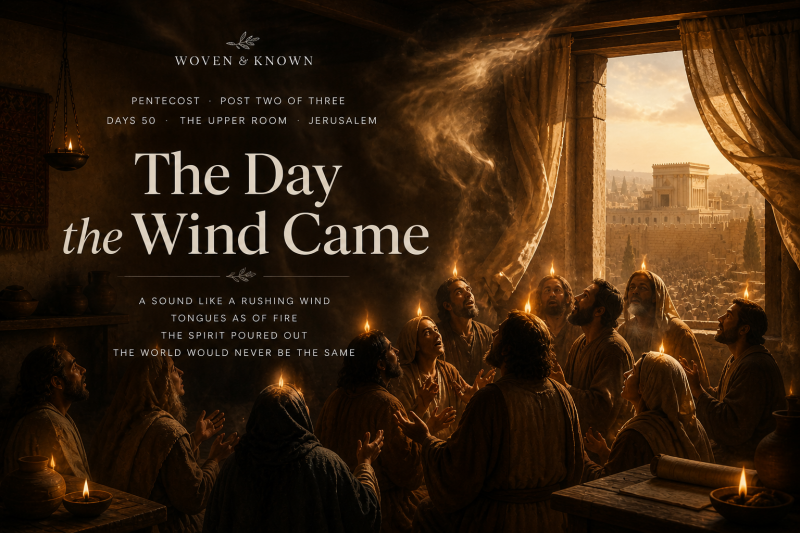
And suddenly there came from heaven a sound like a mighty rushing wind, and it filled the entire house where they were sitting. And divided tongues as of fire appeared to them and rested on each one of them. And they were all filled with the Holy Spirit and began to speak in other tongues as the Spirit gave them utterance."
Acts 2:2–4 · The First Moment of Pentecost · The Morning Everything Changed
The Morning
Nine in the Morning — and the World Was Never the Same
It was "the third hour of the day" — nine in the morning, by the Jewish reckoning that divided daylight into twelve equal parts beginning at sunrise. The time of the morning Temple sacrifice. The time when the city of Jerusalem was already alive and loud, pilgrims moving through the streets with their baskets of firstfruits, the flutes playing in the processional columns, the Temple courts filling with worshippers. The ten days were over. The disciples were together. And then:
Sound. Not a wind — "a sound like a mighty rushing wind." The distinction matters: Luke is careful. He does not say wind swept through the room. He says a sound came from heaven that was like a violent, rushing wind — the kind of sound that fills a space completely, that you feel in your chest before you understand it with your ears. It did not rustle papers or blow out lamps. It filled the house. It was coming from somewhere above ordinary weather, below the ordinary threshold of prayer, and it arrived without warning in the middle of a gathered community doing what they had been doing for ten days.
Then: fire. Not real flames — "divided tongues as of fire appeared." Individual, separate — one for each person in the room — resting, not burning. The word "divided" is significant: the Greek diamerizomenai means distributed, apportioned individually. This was not a communal blaze consuming them collectively. It was a personal, individual gift, given to each one, settling on each one, distinct. One hundred and twenty separate flames resting on one hundred and twenty separate people.
Then: speech. They were "filled with the Holy Spirit and began to speak in other tongues as the Spirit gave them utterance." Acts 2:4 uses two different Greek words for the speaking — the disciples themselves "began to speak," but the content and form was "as the Spirit gave them utterance." Both active: the people opened their mouths and spoke. Both Spirit-driven: the words that came out were not their own vocabulary.
This was not a private experience. By design, it could not be. The sound that had filled the house had been heard outside. The crowd began to gather.
What the Tongues Actually Were
Xenolalia — Not Ecstasy but Communication
The word "tongues" in Acts 2 has generated more theological controversy than almost any other word in the New Testament. But the text of Acts 2 is actually precise and specific about what happened — and it is different from what the word "tongues" usually evokes in modern Christian discourse.
| γλῶσσα / διάλεκτος Glōssa / Dialektos · Two Different Greek Words · One Specific Phenomenon |
|---|
| What Luke uses: Acts 2 uses two distinct Greek words. In verse 4, the disciples "began to speak in glōssais (other tongues/languages)." In verse 6, the crowd was bewildered "because each one was hearing them speak in his own dialektō (dialect/native language)." The word dialektos — from which we get "dialect" — means the specific spoken language of a particular region or people. It is the most precise word available for "native tongue." |
| What was happening was xenolalia — from the Greek xenos (foreign) and lalia (speech). The disciples were speaking actual, identifiable, human languages that they had never learned. The crowd was not mystified by babbling. They were stunned because Galilean fishermen were speaking fluently in Parthian, Median, Elamite, the several dialects of Mesopotamia, Cappadocian Greek, Pontian Greek, Egyptian Aramaic, Libyan Punic, Latin, and Cretan. The crowd's response confirms this: "Are not all these who are speaking Galileans? And how is it that we hear, each of us in his own native language?" (Acts 2:7–8). |
| This was the reversal of Babel. At Babel (Genesis 11), a single unified language was fragmented into many, and humanity was scattered. At Pentecost, the Spirit crossed every language barrier simultaneously, and scattered humanity from fifteen nations heard a single message in their own tongues. The curse was being undone. The scattering was being reversed. Not by everyone speaking the same language again — but by the Spirit making the one message accessible in every language at once. |
| The rabbinic parallel is striking. A Midrash on Exodus 20 (Shmot Rabbah 5:9) records a tradition that at Sinai, the divine voice was "split into seventy tongues" so that all nations could hear it. On that same feast day, fifteen hundred years later, a community of 120 people filled the house with a sound like wind and spoke in at least fifteen known languages simultaneously. The Jerusalem pilgrims celebrating the anniversary of Sinai experienced a new Sinai — complete with the divine voice distributed in every tongue. |
Acts 2:13 records that some people in the crowd mocked: "They are filled with new wine." This accusation is itself evidence about what they were witnessing. People do not accuse someone of drunkenness when they are speaking an unintelligible language — they accuse them of madness. The drunkenness accusation suggests the observers were hearing speech that was energetic, joyful, and fluent — the kind of behaviour that, without the miraculous explanation, looked like uninhibited celebratory excess. Peter addressed the accusation directly: "These people are not drunk, as you suppose, since it is only the third hour of the day." Nine in the morning. Jewish piety required fasting until at least nine before drinking on a feast day. The argument worked: the crowd stayed and listened.

The Fire
Why Fire — and Why One Flame Per Person
Fire in the Hebrew Scriptures was the most consistent symbol of the divine presence. The burning bush that was not consumed (Exodus 3:2). The pillar of fire that led Israel through the wilderness (Exodus 13:21). The fire that fell on Elijah's altar and consumed the sacrifice (1 Kings 18:38). The cloud and fire of the glory of God filling the Temple at its dedication (2 Chronicles 7:1–3). God had always come in fire. The disciples in the upper room — saturated in the Hebrew Scriptures — would have understood fire's arrival as unmistakable: this is God here.
But there is something specific about the Pentecost fire that distinguishes it from all the previous divine-fire moments: it was individual. The fire at Sinai was on the mountain — a collective, overwhelming presence that terrified the whole nation. The fire in the Temple filled the whole building as a corporate event. But on Pentecost, the fire was divided — one tongue per person, resting specifically on each individual in the room. The democratisation Joel had promised was enacted even in the form of the sign. The Spirit was not coming to fill a building or rest on a mountain. He was coming to inhabit people. Each one. Individually. Personally.
"What the Temple was to the Old Covenant — the dwelling place of God, the place where his presence rested — every believer was about to become under the New Covenant. The fire was distributed because the dwelling place was being distributed."
Acts 2:3 · 1 Corinthians 6:19 · The Shift from Building to Body
Paul would later make this explicit: "Do you not know that your body is a temple of the Holy Spirit within you?" (1 Corinthians 6:19). The fire that had rested on the Temple now rested on individual believers. The presence that had required a building was now portable, personal, and universal. The veil of the Temple had been torn on Good Friday — opening the way. Pentecost was the Spirit walking through the opened door and taking up residence in flesh.
Study Break... If You got this Far, Give us an Amen.

The Three-Stage Presence of God
The movement of the divine presence through history has three phases.
At Sinai, the pillar of fire and cloud accompanied Israel externally — moving with them, guiding them, but remaining distinct from them. The people could not touch the mountain when God was on it. At the Temple of Solomon, the glory filled the building — the divine presence located in one place, accessible to the nation through a system of priests, sacrifices, and ceremonies. The fire was in the Holy of Holies, behind a thick curtain. But at Pentecost, the divine presence moved inside individual people. No building, no intermediary, no curtain. "I will dwell in them and walk among them" (2 Corinthians 6:16, citing Leviticus 26:12). The movement is from external accompaniment (Sinai), to local residence (Temple), to universal indwelling (Pentecost).
The theological consequence is enormous:
every believer since Pentecost is a temple. Not a very good one, necessarily. Not a consistently holy one. But a genuine one — a location where the divine Spirit actually dwells, permanently, without requiring sacrifice or ceremony to access. The Spirit is not visiting when you pray. He is already there. Pentecost changed the address of God's presence from a building on Mount Zion to wherever his people are.
The Crowd Gathers
"The Whole World Had Come to Them"
The sound drew them. Acts 2:6: "When this sound occurred, the crowd came together." This was already a city packed with pilgrims from fifteen regions. The streets were already busy with processional columns bringing firstfruits to the Temple. When a sound like a rushing wind filled a building in an upper room and crowds of people burst from it speaking in languages they had never learned, the natural effect was what it always is when something inexplicable happens in a crowded city: people stopped, gathered, and stared.
Luke gives us a remarkable sociological portrait of the crowd: "bewildered," "amazed," "astonished," and — at the fringes — mocking. This is precisely the range of human responses that an unexplainable event produces. The ones who recognised their own language being spoken by Galileans were moved from bewilderment to astonishment. "Are not all these who are speaking Galileans?" (Acts 2:7). This detail is culturally specific and important: Galileans had a recognisable accent. Jerusalem pilgrims from Judea — the religious establishment, the educated classes — regarded Galileans as provincial, rough-edged, insufficiently educated. The idea that a group of Galileans was fluently speaking Parthian, Median, and Elamite was not just miraculous; it was socially upside-down. God had chosen the wrong people again, and they were speaking languages they had no business knowing.
Then Peter stood up.
The Sermon · Acts 2:14–36
The Most Important Speech in Christian History
"But Peter, standing with the eleven, lifted up his voice and addressed them."
Seven weeks earlier, this same man had sat by a charcoal fire in the High Priest's courtyard and denied three times that he even knew Jesus. Now he stood in the streets of Jerusalem before a crowd of thousands of pilgrims, with the city packed, with the religious authorities who had engineered the crucifixion still in power — and lifted his voice. Luke says he "lifted up his voice" — epēren tēn phōnēn — a phrase that indicates public, formal declamation. This was not a private conversation or a quiet explanation. This was an announcement.
The sermon Peter gave is the first recorded Christian sermon in history. It is also, arguably, the most theologically sophisticated piece of impromptu preaching in the New Testament — a tightly structured argument from three Old Testament texts, arriving at a conclusion that, on any ordinary day in first-century Jerusalem, would have resulted in immediate arrest. The fact that three thousand people believed it instead is itself part of what requires explanation.
"Men of Judea and all who dwell in Jerusalem, let this be known to you, and give ear to my words. For these people are not drunk, as you suppose, since it is only the third hour of the day. But this is what was uttered through the prophet Joel..."
Acts 2:14–16 · Peter · The Opening of the First Christian Sermon
The structure of the sermon is worth understanding carefully, because it reveals how the forty days of teaching had reorganised Peter's reading of Scripture. Jesus had opened his mind to understand the Scriptures — and what Peter preached at Pentecost is the direct product of that opening. He used three texts, each one doing a specific piece of the argument.
First Move · Joel 2:28–32 · Acts 2:16–21
"And in the last days it shall be, God declares, that I will pour out my Spirit on all flesh, and your sons and your daughters shall prophesy... And it shall come to pass that everyone who calls upon the name of the Lord shall be saved."
Peter's first move was to explain what the crowd was seeing and hearing. He quoted Joel 2 almost verbatim — but he changed one word. Joel's original text said "afterward I will pour out my Spirit." Peter's version reads "in the last days" (Acts 2:17). This was not error or laziness. It was a deliberate theological declaration: what you are witnessing is not merely a continuation of the prophetic tradition. This is the inauguration of the last days — the age of the Spirit, the beginning of the end, the era Joel had said would come before the day of the Lord. By applying "last days" language to Pentecost, Peter was making a sweeping claim: the age you have been waiting for has arrived. It has arrived today. It has arrived because Jesus rose from the dead. The Spirit is the evidence that the last days are here.
Second Move · Psalm 16:8–11 · Acts 2:25–32
"For you will not abandon my soul to Hades, or let your Holy One see corruption... You have made known to me the paths of life."
Peter's second move was to prove the resurrection from the Psalms — specifically from a Psalm the crowd knew well, attributed to David. His argument is a masterpiece of first-century Jewish exegesis. David wrote "you will not abandon my soul to Hades." But David died. David's tomb was there in Jerusalem — everyone knew where it was. So David was not writing about himself. He was a prophet who "saw in advance and spoke about the resurrection of the Christ, that he was not abandoned to Hades, nor did his flesh see corruption" (Acts 2:31). The Psalm was always about a descendant of David who would not decay — and Jesus, who died and rose before corruption, was that descendant. This move reread the Psalms through the resurrection lens Jesus had given him on the Emmaus road and in the forty days.
Third Move · Psalm 110:1 · Acts 2:34–36
"The LORD said to my Lord, 'Sit at my right hand, until I make your enemies your footstool.'"
Psalm 110:1 — the most quoted Old Testament verse in the entire New Testament — was Peter's final move and his most explosive. David again: "the LORD said to my Lord." Two different divine titles in one verse. If David wrote it, who is David's "Lord"? Not a descendant of David, since no descendant of a king could be that king's Lord. This verse implied a figure who was both David's son (descended from his line) and David's Lord (superior to him). Jesus had quoted this same Psalm in the Temple on Tuesday of Holy Week to stump the Pharisees (Matthew 22:44). Peter now used it to complete the argument: "God has made him both Lord and Christ, this Jesus whom you crucified." The name that had been declared at the cross — "King of the Jews" — was now being proclaimed with its full theological content: Lord, in the sense Psalm 110 meant it. God's own Lord. The one seated at the right hand. The one David called his superior. Them.
The sermon's conclusion was a blade: "Let all the house of Israel therefore know for certain that God has made him both Lord and Christ, this Jesus whom you crucified" (Acts 2:36). The "you" was not general. It was directed at the Jerusalem crowd — the same population, many of them, who had been there fifty days earlier when the crowd had cried "crucify him" and Pilate had complied. Peter was not accusing from a safe distance. He was standing in the same city, making the same accusation that had led to the arrest and execution of his Lord. And he was saying it out loud, in public, to thousands of people, backed by the Holy Spirit and three Old Testament texts.

The Response · Acts 2:37–41
Cut to the Heart — and Three Thousand Baptised
Acts 2:37: "When they heard this, they were cut to the heart."
The Greek word is katanygēsan — pierced through, stabbed, cut deeply. It is a strong, physical metaphor for a response that was not intellectual agreement but visceral conviction. The crowd had come to see what was happening with the Galileans and their languages. They stayed through a sermon. And at the end of it, with Peter's "this Jesus whom you crucified" hanging in the air, three thousand people were pierced to the heart. They said to Peter and the other apostles: "Brothers, what shall we do?"
Peter's answer was precise. "Repent and be baptised every one of you in the name of Jesus Christ for the forgiveness of your sins, and you will receive the gift of the Holy Spirit" (Acts 2:38). Four elements, in order: repent, be baptised, receive forgiveness, receive the Spirit. Not a complex programme. Not a long process of instruction before admission. On this day, in this city, the threshold was clear: turn around (metanoeō — repentance, a complete reorientation of direction), be baptised in the name of Jesus, and receive what had already been poured out in the upper room.
Archaeological Records
Where did they baptise three thousand people in Jerusalem? The city sat in the Judean mountains with no river or significant body of water nearby. The Pool of Siloam existed but could not process three thousand immersions in a day. The answer lies beneath the Temple Mount. Archaeological excavations in the late twentieth century, and particularly the discovery of the Second Temple-era stepped streets leading to the southern gates of the Temple Mount, revealed more than 125 mikva'ot — Jewish ritual immersion pools — cut into the bedrock around the Temple's southern approach.
These mikva'ot were used by worshippers before entering the Temple precincts — a daily ritual of purification that every observant Jew understood. The same pools used for generations of Shavuot pilgrims preparing to bring their firstfruits to the Temple were now, on this Shavuot, the site of Christian baptism. The stone steps and rock-cut pools that have been excavated along the southern wall of the Temple Mount are almost certainly the pools where Peter baptised the three thousand. They could process many people simultaneously — each pool typically held between 200 and 300 gallons, deep enough for full immersion, with steps leading down on one side (for entering) and up on the other (for leaving, now ritually clean).
The symbolism is resonant: the same pools used for Jewish purification before entering God's presence were now the place where three thousand people entered a new relationship with God through the name of the risen Jesus.
Acts 2:41: "So those who received his word were baptised, and there were added that day about three thousand souls."
Three thousand in a single day. This is an extraordinary number — roughly twenty-five times the size of the community of 120 that had been in the upper room that morning. It is also historically plausible given the setting: a city full of devout pilgrims, already in a worshipful posture, many of them hearing the gospel in their native tongue for the first time. The community that had been assembled quietly over forty days of private resurrection appearances exploded, on one morning, into the largest public religious community in Jerusalem.
And then Acts 2:42 describes what they did next. Not what they planned to do. What they immediately, instinctively, organically began to do — as if the Spirit who had just entered them was already reshaping their appetites toward the things that mattered.
The Experience
What It Would Have Felt Like — from the Inside
Acts does not describe the inner experience of the 120 as the Spirit came. It describes the external phenomena — sound, fire, speech. But from the disciples' perspective, from inside the experience, we can piece together something of what was happening from what they said and did immediately after.
Luke says they were "filled with the Holy Spirit." The Greek eplēsthēsan — were filled — is a passive verb. They did not produce the filling. They received it. The image is of a vessel being filled with something from outside itself — not willpower, not emotional effort, not spiritual achievement, but a gift arriving from a source beyond them and entering them completely. John 7:38–39 had described it in advance: "Whoever believes in me, as the Scripture has said, 'Out of his heart will flow rivers of living water.'" And John adds: "Now this he said about the Spirit, whom those who believed in him were to receive." The disciples in the upper room had been dry riverbeds for seven weeks since the crucifixion. Now the water came.
"They were all filled with the Holy Spirit and began to speak in other tongues as the Spirit gave them utterance."
Acts 2:4 · The Filling and the Speaking · Active Passivity
There is a grammatical precision worth noting: "they began to speak" (active) "as the Spirit gave utterance" (Spirit's action). Both are true simultaneously. The disciples opened their mouths and formed words — genuine personal agency. But the words that came were Spirit-given. This is the double nature of Spirit-empowered action throughout Acts and throughout the Christian life: the human acts, but from a source that is not merely human. Paul would later describe it as "I worked harder than any of them, though it was not I, but the grace of God that is with me" (1 Corinthians 15:10). The "I" and the "grace" are not alternatives. They operate together, with grace being primary.
What the disciples almost certainly felt — the New Testament vocabulary is consistent on this — was what Luke elsewhere calls chara megale, great joy (Luke 24:52), and what he will soon describe as the characteristic feature of the new community (Acts 2:46: "with glad and generous hearts"). Something had changed inside them. Not a resolution of all their problems or the arrival of certainty about every question. But a presence. A fullness. A sense of being accompanied by something — someone — who had not been there before in this way, and whose arrival changed what was possible. Peter could not explain it in abstract categories. He opened his mouth and preached. That was explanation enough.
What We Usually Miss
The Depths Beneath the Familiar Story
Peter's sermon was not spontaneous — it was the product of the forty days
Peter cited Joel 2, Psalm 16, and Psalm 110 in a tightly argued sequence. He made sophisticated midrashic moves — reading David as a prophet pointing beyond himself, reinterpreting "you will not see corruption" as a resurrection text — that required genuine scriptural expertise. This was not improvisation by an uneducated fisherman. This was the fruit of forty days in which the risen Christ had opened his mind to understand the Scriptures. Luke 24:45 was the seedbed for Acts 2:14–36. What sounded like Spirit-given improvisation was actually the eruption, in the Spirit's power, of what had been carefully prepared in the weeks of teaching. The Spirit does not bypass preparation — he works through it.
The miracle was in the speaking — not just the hearing
Some scholars have argued that the Pentecost miracle was purely in the hearing — that the disciples spoke in one language and each hearer miraculously heard their own. But Acts 2:4 says the disciples "spoke in other tongues" (glōssais), and Acts 2:11 records the crowd saying "we hear them telling in our own tongues the mighty works of God." The word is the same: glōssais and glōssais. The speakers were producing what the hearers were receiving. This was xenolalia — genuine foreign language production — not a hearing miracle alone. Luke uses both glōssa (tongue/language) and dialektos (dialect/native language) precisely to make clear that the crowd heard specific, recognisable languages from their home regions.
The 3,000 returned to fifteen nations as the first missionaries
Acts records no missionary journey to Parthia, Media, Elam, Mesopotamia, Egypt, Libya, or Arabia in the early chapters. There is no record of Peter or Paul going to these places. And yet Paul, writing to Rome, can assume that the gospel is already known there before he arrives (Romans 1:8: "your faith is proclaimed in all the world"). The Pentecost pilgrims went home. They carried the gospel to Mesopotamia, to North Africa, to the Iranian plateau, to Rome — in their own languages, as witnesses of what they had heard and seen. The early Christian communities in those regions that predate any recorded missionary journey are explained by the Pentecost pilgrims returning. The Spirit seeded the world in a single day through fifteen language groups of devout, Scripture-knowing people who had been at the right place at the right time on the right feast.
"Cut to the heart" — the Greek describes physical pain
Acts 2:37 uses katanygēsan — from nyssō, to stab or pierce. This is the same root as the word used in John 19:34 for the spear piercing Jesus's side. The crowd was not intellectually persuaded or emotionally moved in a gentle sense. They were stabbed. The sermon landed in them the way the spear had landed in Christ — a penetrating, unavoidable wound. This is what genuine conviction of sin produces: not mild regret but a sharp, interior pain caused by the recognition of what one has done and who one has done it to. "What shall we do?" is the cry of people in genuine distress, not mild curiosity. The Spirit who had come with fire and wind was also working through a sermon to produce the most uncomfortable gift he gives: honest self-knowledge in the presence of God's holiness.
The Pentecost miracle is the permanent model, not the standard expectation
One of the most common misunderstandings about Pentecost is the assumption that because it happened this way once, every experience of the Spirit should produce wind and fire and foreign languages. But Pentecost was a specific, unrepeatable inauguration — the opening act of the age of the Spirit, the public announcement that the new covenant had arrived. The wind and fire were signs appropriate to an inaugural moment, just as the cloud and fire at Sinai were signs appropriate to the giving of the Law. Not every encounter with God on Mount Sinai came with thunder and lightning. Not every reception of the Spirit comes with tongues of fire. What Pentecost inaugurated — the universal indwelling of the Spirit in every believer — is permanent and ongoing. The signs that announced the inauguration were specific to the moment. The reality those signs announced is the permanent gift.
Study Guide
Questions for Reflection & Discussion
The Pentecost miracle reversed the curse of Babel — one message received in every language simultaneously. God had scattered humanity at Babel for pride; he reunited it at Pentecost through the Spirit. What does this tell you about what the Spirit's primary work is in the world? And what does the fact that the reversal came through ordinary people speaking — not a divine voice from heaven — tell you about the Spirit's method of working?
Acts 2:6–8 · Genesis 11:7–9 · Revelation 7:9
The tongues of fire rested individually on each person — one per person, not a collective blaze. The divine presence moved from the Temple (one building) to every believer (universal dwelling). Paul later says your body is a temple of the Holy Spirit. What practical difference does it make to your daily life — at work, in your home, in difficult conversations — if you genuinely believe that the Spirit of God is dwelling personally within you right now?
Acts 2:3 · 1 Corinthians 6:19 · John 14:17
Peter's sermon was built on three Old Testament texts that he had been taught to read through the resurrection during the forty days. His confidence came from knowing the Scriptures, not just from emotional fervour. What is the relationship between Spirit-empowerment and Biblical preparation in your own life? Is there a way you have been expecting the Spirit to do what only study can build, or expecting study to do what only the Spirit can produce?
Acts 2:14–36 · Luke 24:45 · 2 Timothy 3:16–17
The crowd was "cut to the heart" — katanygēsan, a stabbing, piercing pain — by Peter's sermon. The text says they cried out "what shall we do?" Have you ever experienced this kind of genuine conviction — not mild guilt but a sharp, honest recognition of who you are before God? What produced it? And what did the Spirit do with it in you?
Acts 2:37 · John 16:8 · Psalm 51:17
Peter's answer to "what shall we do?" was: repent, be baptised, receive forgiveness, receive the Spirit. It was not a waiting list or a long preparation. The threshold was clear and the gift was immediate. Is there a way you have been making the entry into full relationship with God more complicated than Peter's four-part answer? And is there something in that list — repentance, baptism, forgiveness, Spirit — that you have received but not yet fully believed applies to you?
Acts 2:38 · Romans 10:9 · Galatians 3:2
The 3,000 who were baptised on Pentecost returned to fifteen nations as the first missionaries — most of them unnamed, none of them commissioned in any formal sense, simply carrying what they had received. Your baptism, your faith, your experience of the Spirit are not private possessions. They are, structurally, for the same purpose: to be carried back to where you come from. Who in your world has not yet heard the gospel in a language they can actually receive — not foreign-language miraculous, but personally understandable, in the vocabulary of their life?
Acts 2:9–11 · Acts 1:8 · 2 Corinthians 5:20

Dig Deeper — Sources & Further Reading
Acts 2:1–41 — Read in One Sitting
The complete Pentecost narrative — sound, fire, tongues, crowd, sermon, response — as a single arc. Notice how each moment leads to the next with narrative inevitability
Genesis 11:1–9 — The Tower of Babel Read before Acts 2 to feel the weight of the reversal. What Babel broke, Pentecost began to repair — not by erasing languages but by crossing them with a single message
Joel 2:28–32 · Psalm 16:8–11 · Psalm 110:1 Read Peter's three proof texts before and after reading his sermon. Feel the difference between the prophecy and its fulfilment — and notice what Peter added, changed, and drew out
"Repent and be baptised every one of you in the name of Jesus Christ for the forgiveness of your sins, and you will receive the gift of the Holy Spirit. For the promise is for you and for your children and for all who are far off, everyone whom the Lord our God calls to himself."
Acts 2:38–39 · Peter · The Pentecost Invitation · Still Open

Add comment
Comments