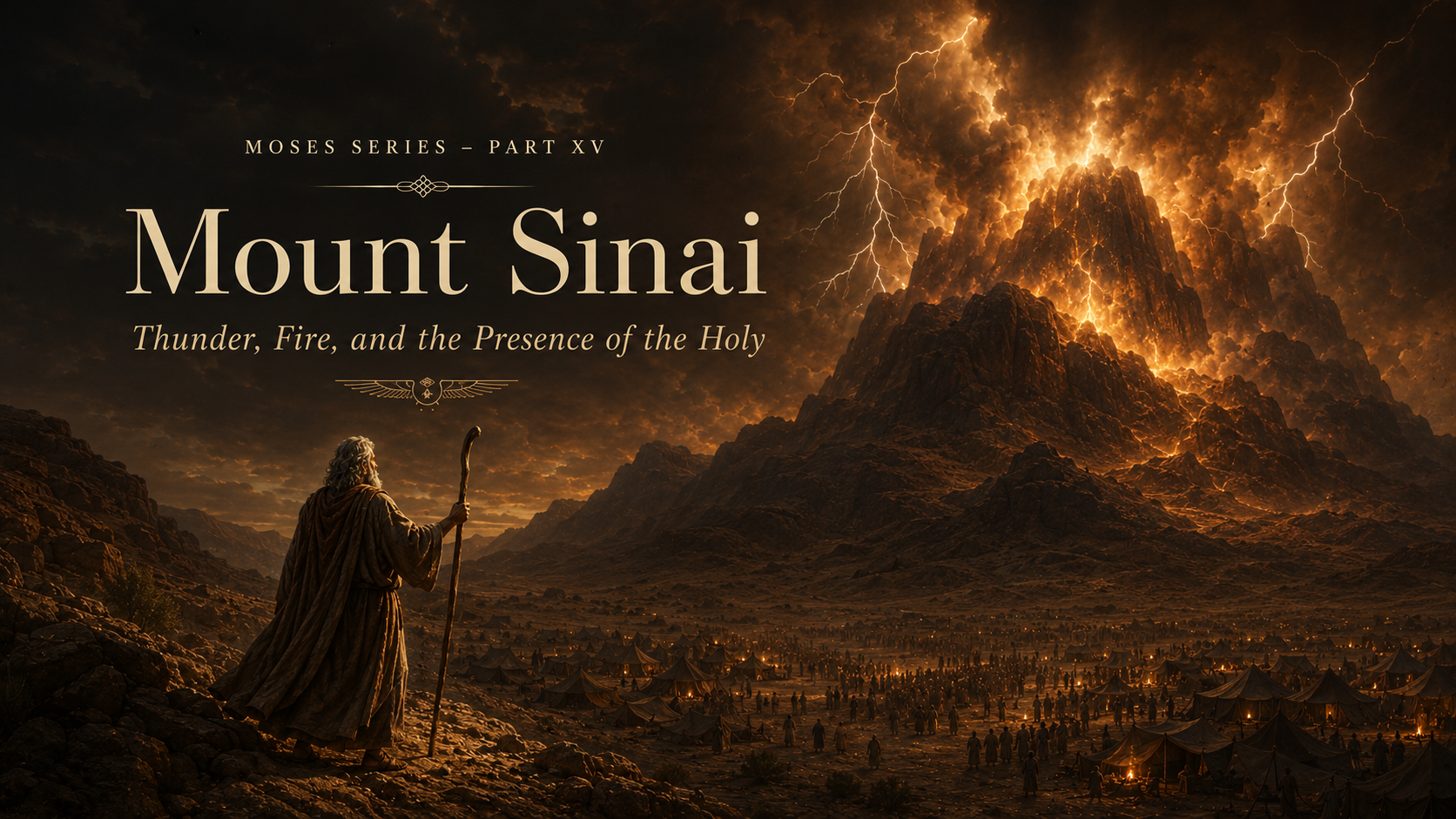
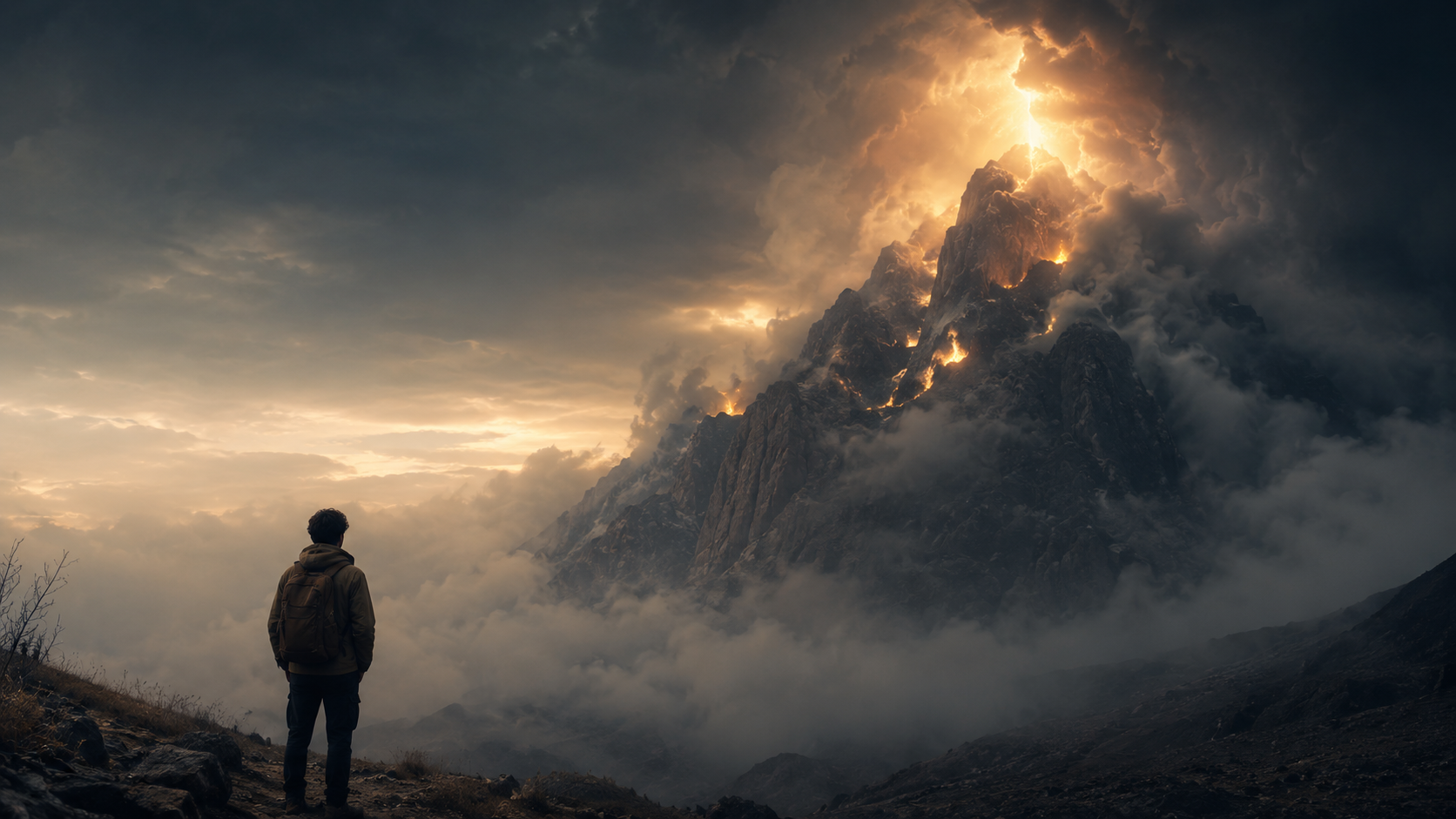
"Now Mount Sinai was wrapped in smoke because the LORD had descended on it in fire. The smoke of it went up like the smoke of a kiln, and the whole mountain trembled greatly."
— Exodus 19:18
Please Read These Passages First
Part Fifteen covers the theophany at Sinai — the descent of God in fire and smoke and earthquake upon the mountain. This is the theological and narrative centre of the entire book of Exodus. Every chapter before it has been preparation. Read the full passage slowly and without rushing. Let Exodus 19 do what it was written to do: overwhelm you.
As you read, notice two things above all: (1) The extraordinary precision of the three-day preparation ritual — what is commanded, in what order, and why. (2) The contrast between the people, who stand far off in terror and beg Moses to speak for them, and Moses, who alone goes into the thick darkness where God was. That contrast is the structural heart of the entire Sinai encounter.
Exodus 19:1–25 Exodus 20:18–21 Deuteronomy 4:9–14 Hebrews 12:18–29 Acts 2:1–4
Optional deeper reading:
Deuteronomy 5:22–29 (Moses' own retrospective on why the people stood far off — and what God said about it);
Psalm 68:7–8 (the poet's retelling of Sinai);
Habakkuk 3:3–15 (one of the most dramatic Sinai-theophany poems in the Old Testament);
Galatians 3:19 (Paul on the role of the law given at Sinai);
Acts 7:38, 53 (Stephen on the angels at Sinai).
Exodus 19:1-6
Exodus 19:7-15
Exodus 19:16-20
Exodus 19:21-25
Exodus 20:18–21
Deuteronomy 4:9–14
The Story - The Mountain That Burned
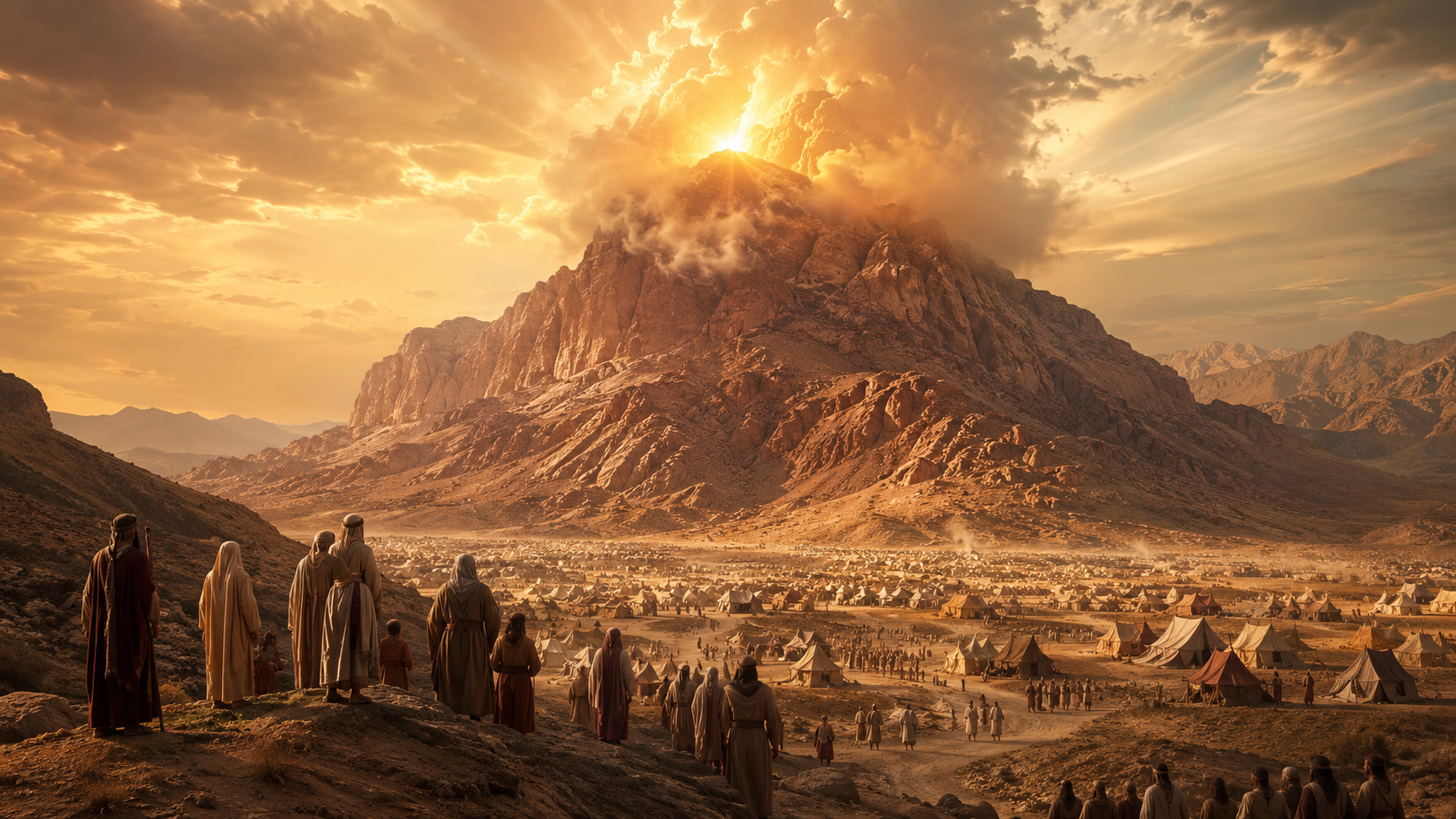
On the third new moon after leaving Egypt, they came to the wilderness of Sinai.
The Arrival and the Offer
Three months after leaving Egypt. One month after the crossing of the sea. Two weeks past the manna, past Marah, past the bitter water and the battle with Amalek and the visit of Jethro. They had been walking for three months through wilderness that did not love them — and now, on the third new moon, they came to the wilderness of Sinai.
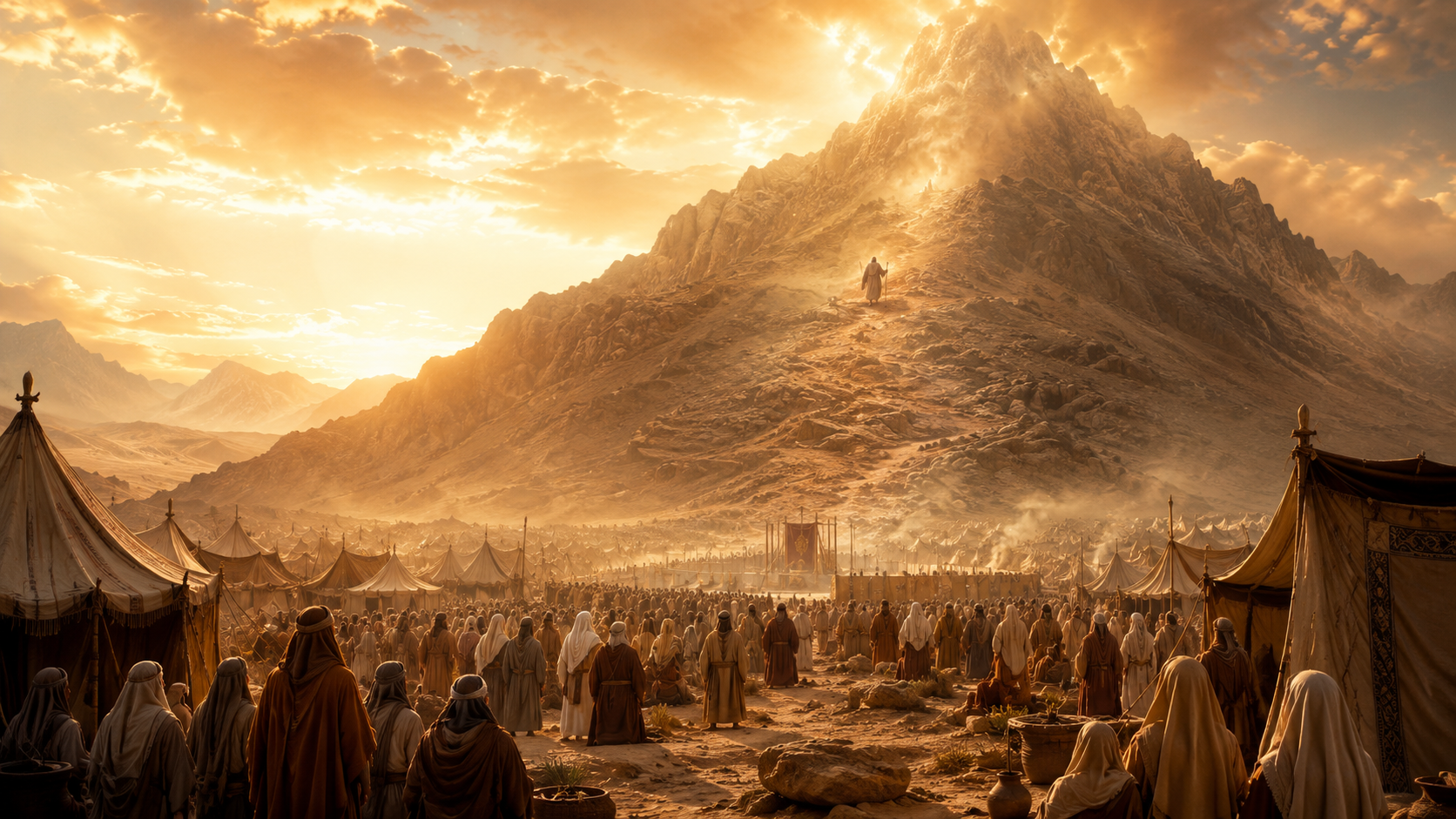
And Israel camped before the mountain.
Before the mountain. The phrase implies something about the mountain — that it had a face, a presence, a direction. They did not simply stop near it. They camped before it, as one might camp before a gate or a threshold. Something was already there, already waiting, already invested in what was about to happen.
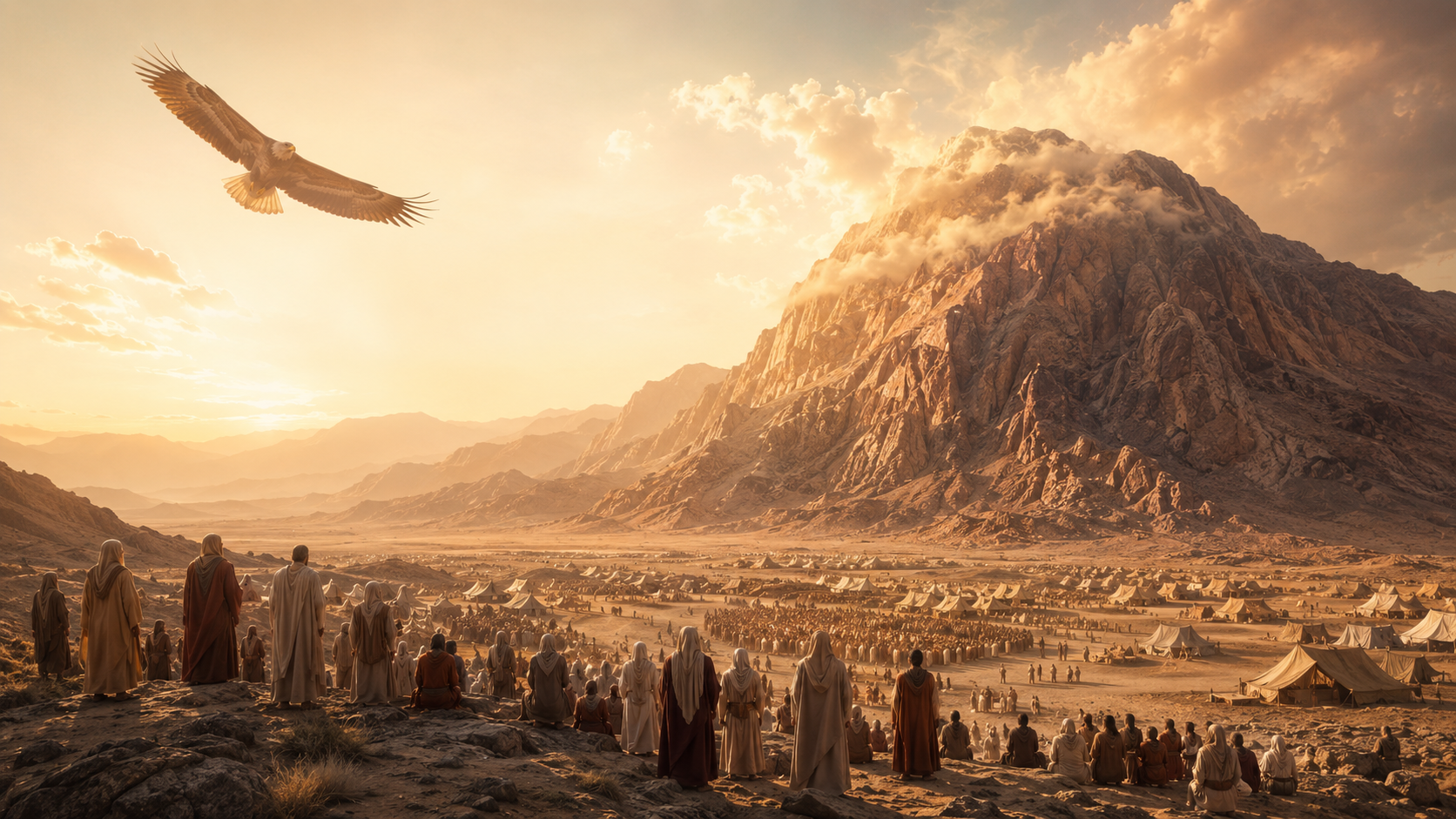
Moses went up to God. And the LORD called to him from the mountain, saying: "Thus you shall say to the house of Jacob, and tell the people of Israel: You yourselves have seen what I did to the Egyptians, and how I bore you on eagles' wings and brought you to myself. Now therefore, if you will indeed obey my voice and keep my covenant, you shall be my treasured possession among all peoples, for all the earth is mine; and you shall be to me a kingdom of priests and a holy nation."
Listen to the sequence of that offer. It does not begin with law. It does not begin with a list of requirements. It begins with memory — what I did to Egypt, how I carried you. The covenant offer begins with what God has already done, not with what Israel must now do. The obligation is rooted in the rescue, not the other way around. The law that will follow is not the means of earning the relationship. It is the shape of living within a relationship already established by grace.
And the people answered together and said: all that the LORD has spoken we will do. And Moses brought back their words to the LORD.
Three Days of Preparation
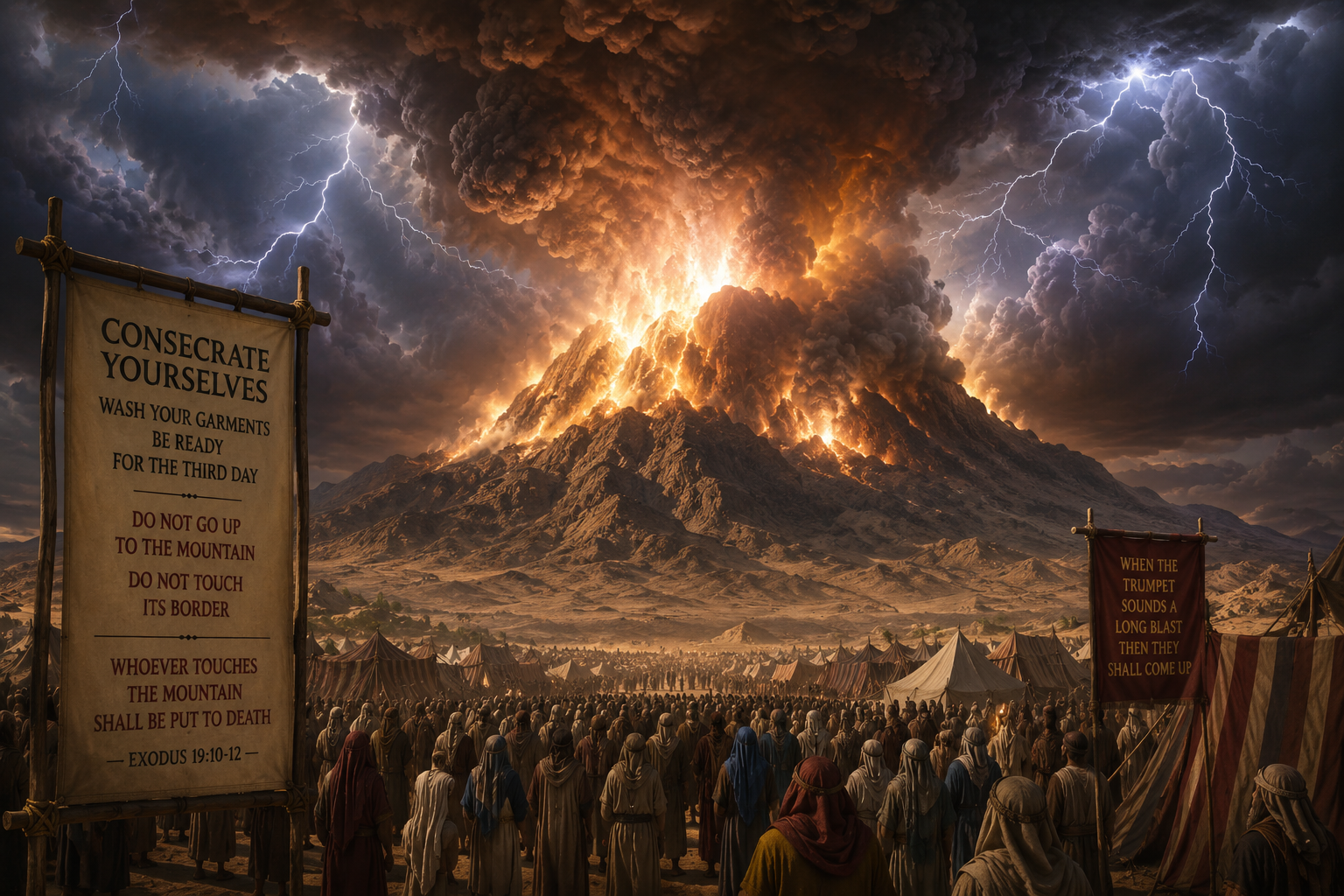
Then God said something that reordered the next three days of Israel's existence: go to the people and consecrate them today and tomorrow, and let them wash their garments and be ready for the third day. For on the third day the LORD will come down on Mount Sinai in the sight of all the people.
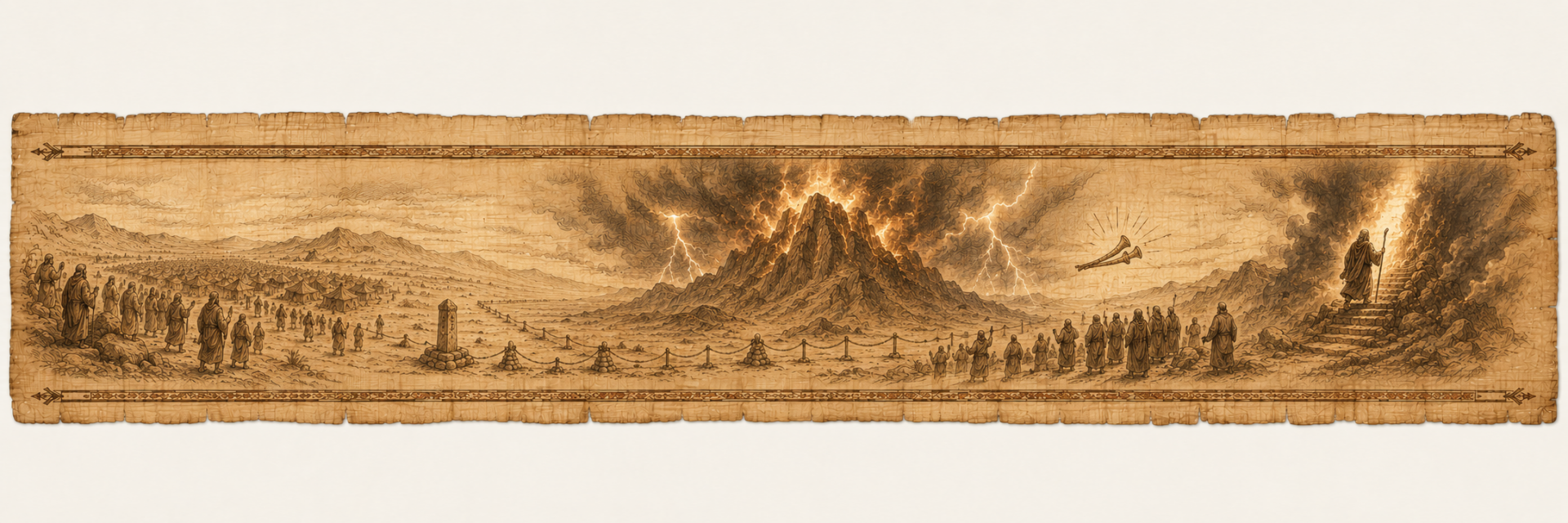
Three days. Wash your clothes. Consecrate yourselves. Set limits around the mountain — do not go up into it, do not even touch its border. The one who touches the mountain shall be put to death. No hand shall touch him — he shall be stoned or shot. Whether beast or man, he shall not live. Only when the trumpet sounds a long blast shall they come up to the mountain.
Why the washing? Why the boundaries? Why three days? We will examine all of this in the theological sections — but feel the weight of it first. God is about to do something on this mountain that requires three days of ritual preparation, the washing of every garment, physical and social boundaries drawn in the sand, and the threat of death for anyone who crosses them. Whatever is about to happen on this mountain is not a pleasant religious experience to be accessed casually. It is an encounter with the Holy — and holiness has always, from the burning bush onward, required preparation, distance, and the removal of what is ordinary before the extraordinary can be approached.
On the morning of the third day there were thunders and lightnings and a thick cloud on the mountain and a very loud trumpet blast. And all the people in the camp trembled. Then Moses brought the people out of the camp to meet God, and they took their stand at the foot of the mountain.
The foot of the mountain. Not the summit. Not halfway up. The foot. They stood as far down as they could stand while still being present. And what they saw — and heard — was this:
Mount Sinai was wrapped in smoke because the LORD had descended on it in fire. The smoke of it went up like the smoke of a kiln, and the whole mountain trembled greatly. And as the sound of the trumpet grew louder and louder, Moses spoke, and God answered him in thunder.
The trumpet was growing louder. Not fading as a natural sound fades with distance. Growing. Louder and louder. This was not a human instrument. No one was blowing it. The sound was coming from within the cloud on the mountain, getting more intense with every breath the people held, pressing into their ears with a volume that had no ceiling.
The People Far Off, Moses Alone
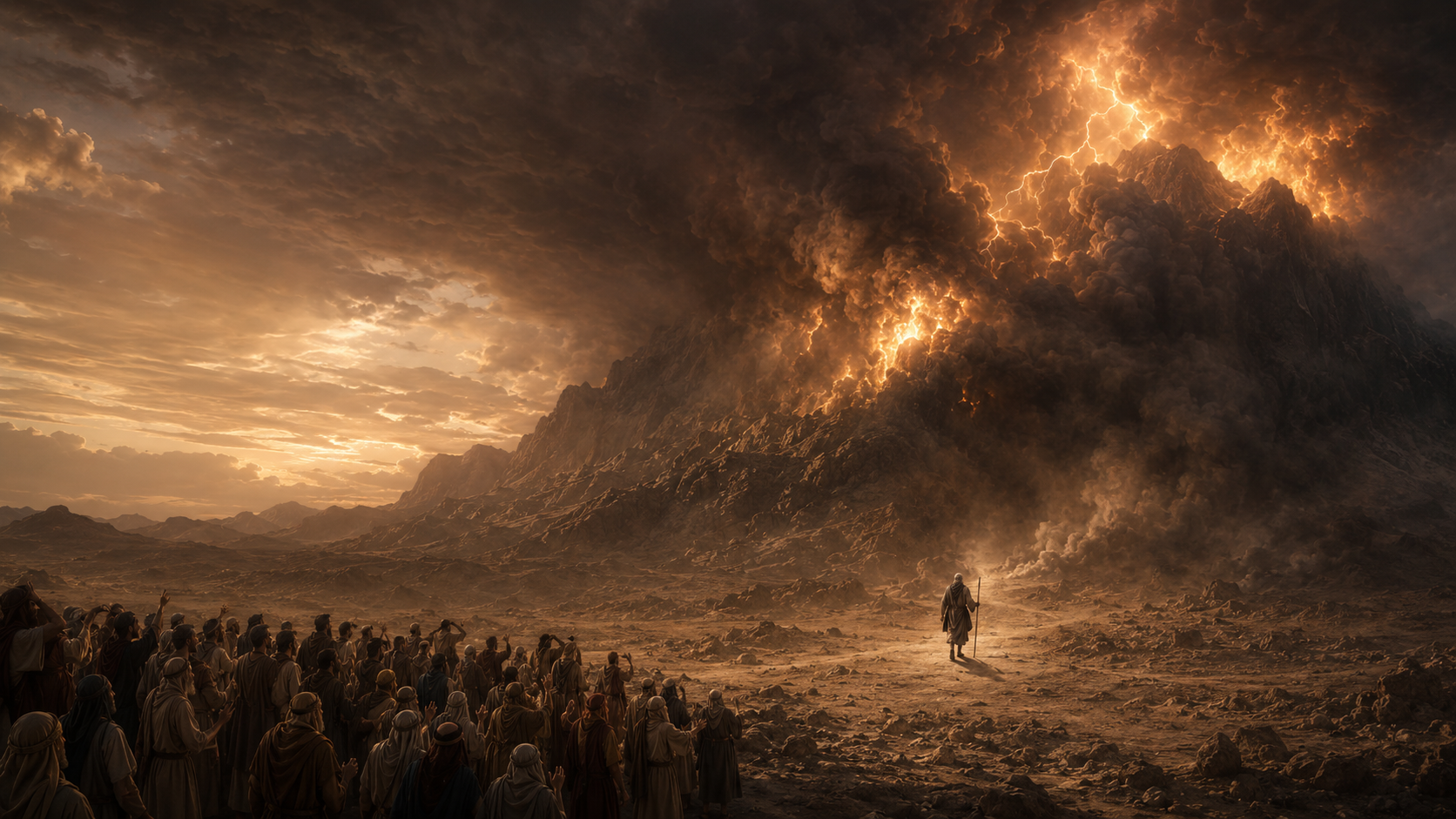
Now when all the people saw the thunder and the flashes of lightning and the sound of the trumpet and the mountain smoking, the people were afraid and trembled, and they stood far off and said to Moses:
"You speak to us, and we will listen, but do not let God speak to us, lest we die."
This is the pivot point of the entire Sinai narrative. The people could not stand in the presence of the holy God. They had been prepared for three days — they had washed their garments, kept themselves clean, kept their distance from the mountain as commanded. And when God descended, they could not bear it. The thunder alone — the lightning alone — the smoke alone — and they were backing away. Stand far off, they said to Moses. You go. We cannot.
Moses said to the people: do not fear, for God has come to test you, that the fear of him may be before you, that you may not sin.
Do not fear. But also: fear. That the fear of him may be before you. There are two kinds of fear at Sinai. One is the terror of the unprepared human before the holy — the flinching, retreating, cover-your-eyes fear that makes the people stand far off and beg Moses to go in their place. The other is the standing-before-awe kind of fear that reshapes you and keeps you from sin — the fear that is the beginning of wisdom. Moses is distinguishing them. Do not be afraid in the first sense. Do be afraid in the second.
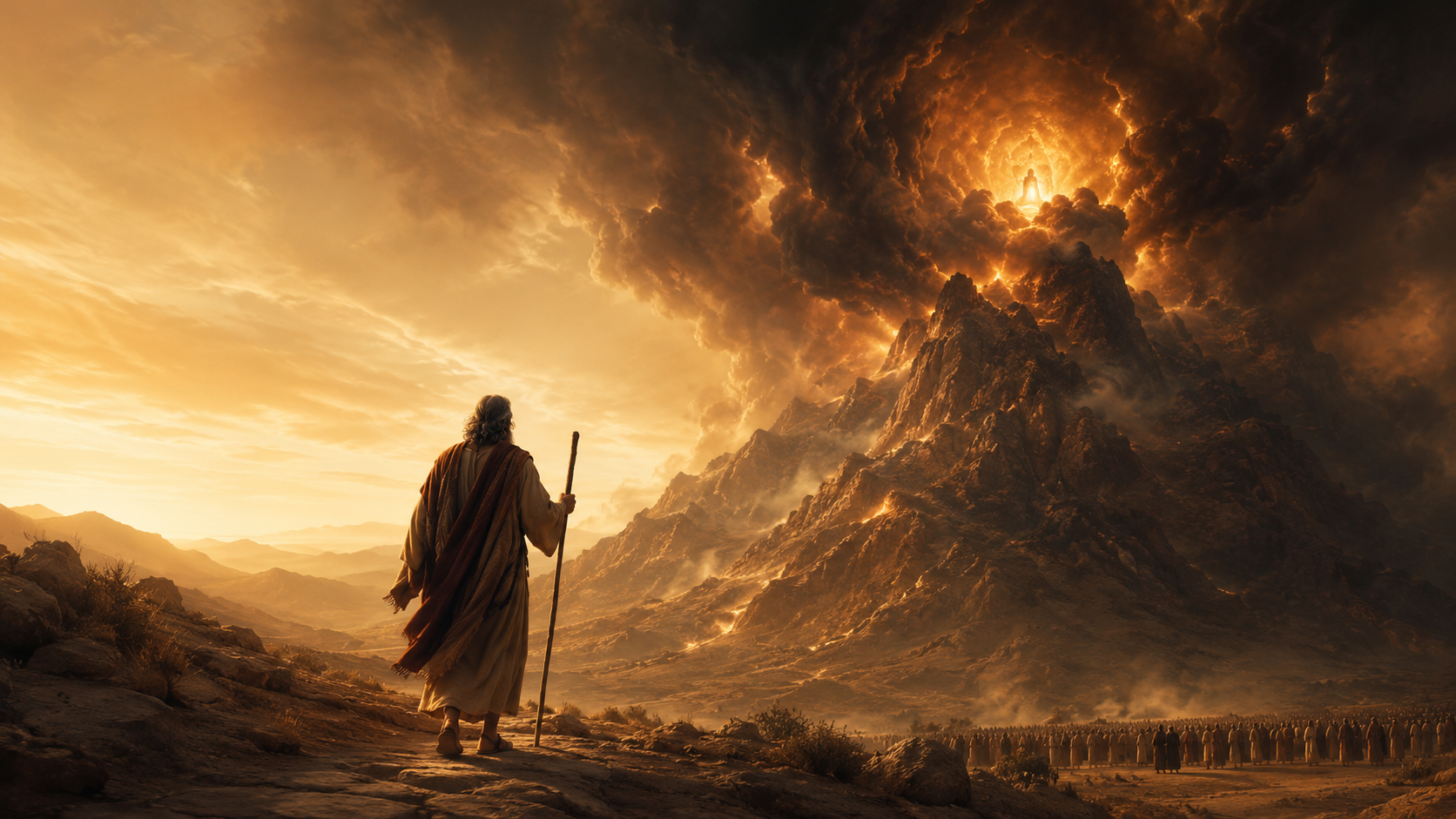
The people stood far off, and Moses drew near to the thick darkness where God was.
This is the sentence that changes everything. The cloud — the thick, impenetrable darkness at the summit of the burning, shaking, smoking mountain — was the place of God's presence. And the people stood far off. And Moses drew near.
The same man who hid his face at the burning bush forty years ago — the reluctant prophet, the man of five excuses, the man who said who am I that I should go, the man who asked to see God's glory and was told he could not see His face — this man drew near to the thick darkness where God was. Not despite the darkness. Into it.
The Arrival at Sinai: Exodus 19:1–2
Why the timing matters — and the geography of the sacred mountain
Exodus 19:1 gives us a rare, precise chronological marker: "On the third new moon after the people of Israel had gone out of the land of Egypt, on that day they came into the wilderness of Sinai." The third new moon — approximately three months after the Exodus — places Israel's arrival at Sinai in the third month of the Hebrew calendar, a detail that later Jewish tradition connected explicitly to the festival of Shavuot (Weeks/Pentecost), celebrated seven weeks after Passover.
Did You Know — Sinai and Pentecost: The 50-Day Connection
This is one of the most significant typological alignments in the entire Bible, and most Christians have never noticed it.
The Feast of Weeks (Shavuot in Hebrew, Pentecost in Greek — both meaning "fiftieth") was celebrated exactly fifty days after Passover. Jewish tradition, preserved in the Talmud (Shabbat 86b–88a), holds that Israel arrived at Sinai on the fiftieth day after the Exodus — and that the giving of the Torah at Sinai occurred on the same day that would later be designated as Shavuot/Pentecost.
Now follow the New Testament calendar: Jesus was crucified at Passover. He rose on the first day of the week. Fifty days after Passover — exactly on the Jewish festival of Pentecost, the annual celebration of the giving of the Torah at Sinai — the Holy Spirit descended on the disciples in Acts 2 with fire, wind, and the sound of a rushing mighty wind. The disciples were gathered together in Jerusalem celebrating Shavuot when it happened.
The Torah was given at Sinai on Pentecost — accompanied by fire, thunder, and the presence of God descending on a mountain. The Holy Spirit was given to the church at Pentecost — accompanied by tongues of fire and a sound like wind. God wrote His law on stone tablets at the first Pentecost. He wrote His law on human hearts at the second Pentecost (Jeremiah 31:33; 2 Corinthians 3:3). The fifty-day pattern holds across fifteen centuries. This is not coincidence. It is the calendar of redemption.
The Covenant Offer: Exodus 19:3–8
Eagles' wings, a treasured possession, and a kingdom of priests — the three great images of the covenant
Exodus 19:4–6 — The Three-Part Covenant Offer
Verse 4
"You yourselves have seen what I did to the Egyptians, and how I bore you on eagles' wings and brought you to myself."
On Eagles' Wings — The Opening Image
al-kanfei nesharim — "on eagles' wings." The eagle (or large raptor — nesher can refer to several large birds of prey including the griffon vulture) was known in the ancient Near East for a specific parenting behaviour described in detail in Deuteronomy 32:11: the eagle stirs up its nest, hovers over its young, spreads its wings, and bears them on its pinions. The imagery is of a parent bird that carries its young — lifting them before they can fly, sustaining them through their aerial journey by the parent's own wings.
God describes the entire Exodus — from Egypt to Sinai — as this single act of aerial carrying. Notice what is not said: it does not say "I led you" or "I guided you." It says "I bore you" — I carried you. You did not walk to Sinai by your own effort. You were carried. The Exodus was not Israel's achievement navigated with divine assistance. It was Israel borne on God's wings, arriving where God brought them.
And the destination: "brought you to myself." Not "brought you to Canaan." Not "brought you to freedom." Brought you to myself. The Exodus was not primarily about liberation from slavery. It was about being brought into relationship with the God who initiated the liberation. The land is the destination of the journey. God is the destination of the rescue.
Verse 5
"Now therefore, if you will indeed obey my voice and keep my covenant, you shall be my treasured possession among all peoples, for all the earth is mine."
Segulah — Treasured Possession
segulah — "treasured possession, special treasure." This word in the ancient Near East described the private treasury of a king — not his general wealth, but the collection of special items he personally valued above everything else. Gold in the general treasury was valuable but impersonal. The king's segulah was the treasure he personally prized, selected, and kept close.
God declares Israel His segulah. Out of all the nations of the earth (and He explicitly notes "all the earth is mine" — His ownership of all nations is the backdrop against which He chooses one), Israel is the one He personally treasures. Not because Israel is the largest, or the most powerful, or the most morally impressive. Deuteronomy 7:7 makes this explicit: "It was not because you were more in number than any other people that the LORD set his love on you and chose you, for you were the fewest of all peoples."
The segulah language becomes one of the richest images of divine love in both Testaments. Malachi 3:17 uses it for the remnant of God's people: "They shall be mine, says the LORD of hosts, in the day when I make up my treasured possession." And 1 Peter 2:9, quoting directly from Exodus 19:6, applies all three of its titles to the church: "a royal priesthood, a holy nation, a people for his own possession" — laos eis peripoiesin, "a people for a treasured possession." Every title God gave Israel at Sinai, Peter gives to the church.
Verse 6
"And you shall be to me a kingdom of priests and a holy nation."
Kingdom of Priests — The Most Radical Claim in the Ancient World
mamlekhet kohanim v'goy kadosh — "a kingdom of priests and a holy nation." In every culture of the ancient Near East, the priesthood was a small, exclusive, hereditary class — professionals who mediated between ordinary people and the divine. The Egyptians, the Babylonians, the Canaanites, the Hittites — in all of them, ordinary people had no direct access to the gods. That was the priest's job.
What God offers Israel at Sinai is something that had no cultural precedent: the entire nation as a priestly community. Not some Israelites would be priests (though the Levitical priesthood would later exist within this structure). The whole nation would have the character of a priesthood — direct access, mediating function between the nations and YHWH, consecrated and set apart. This was a religious democracy of an entirely unprecedented kind.
Revelation 1:6 quotes this directly as the identity of the redeemed in Christ: "he made us a kingdom, priests to his God and Father." Revelation 5:10: "you have made them a kingdom and priests to our God." The Sinai offer — which Israel would repeatedly fail to live up to — is fulfilled in the church as God's intended design for His people from the beginning. The kingdom of priests is what God always wanted from His people, in every age.
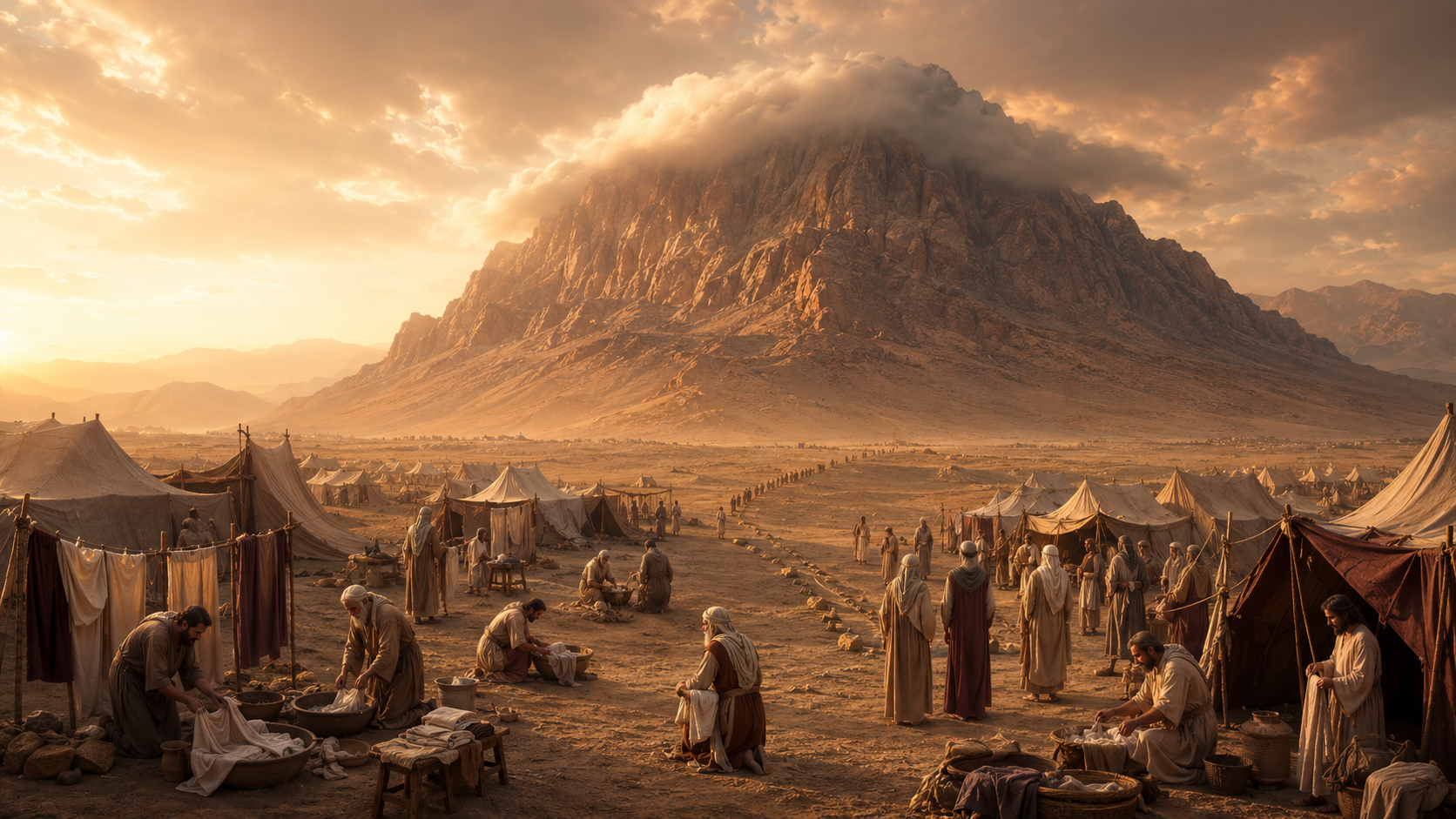
Three Days of Preparation: Exodus 19:9–15
Why God required three days, and what each command in the preparation ritual means
Exodus 19:9–15 contains the detailed instructions for Israel's preparation before the Sinai theophany. These instructions are often read past quickly as preliminary material before the main event. They are not. They are dense with theological meaning, and they establish patterns for holiness and divine encounter that run through the entire sacrificial system, the Tabernacle regulations, and the New Testament's understanding of how humans approach the Holy.
Exodus 19:10–15 — The Preparation Commands
Verses 10–11
"The LORD said to Moses, 'Go to the people and consecrate them today and tomorrow, and let them wash their garments and be ready for the third day. For on the third day the LORD will come down on Mount Sinai in the sight of all the people.'"
Consecration — Kadash
v'kidashtam — "and you shall consecrate them." The verb kadash — to sanctify, to set apart, to make holy — is the foundational verb of Israelite worship. To consecrate something is to remove it from ordinary use and dedicate it to sacred purpose. Persons, places, objects, times — all can be kadash.
The consecration required the washing of garments — an external, physical act that expressed internal, spiritual reality. The garments were dirty from three months of wilderness travel. Washing them was an act of putting off the ordinary, the everyday, the trail-dust of normal life — and stepping into a ritual cleanliness that prepared the body for the sacred encounter. It was not the washing itself that made them holy. It was the act of intentional preparation, the deliberate orientation toward the holy, expressed through a physical discipline.
Three days is a significant number in the biblical narrative: the third day is the day of divine action, of reversal, of the unexpected. Abraham lifted his knife on the third day at Moriah. Joseph released his brothers on the third day. Jonah emerged from the fish on the third day. And — most significantly — the resurrection of Jesus occurred on the third day. The pattern of three days of waiting followed by divine action is woven into the fabric of biblical narrative long before and long after Sinai.
Verses 12–13
"And you shall set limits for the people all around, saying, 'Take care not to go up into the mountain or touch the edge of it. Whoever touches the mountain shall be put to death. No hand shall touch him, but he shall be stoned or shot; whether beast or man, he shall not live. When the trumpet sounds a long blast, they shall come up to the mountain.'"
The Boundaries — Holiness Requires Distance
v'higbalta et-ha'am — "and you shall set limits/boundaries for the people." The verb goval (to set a border, a boundary, a limit) establishes a territorial zone of holiness around the mountain. The mountain is not merely a scenic backdrop for the covenant ceremony. It is the site of God's physical descent — and God's holiness is dangerous to unprepared human contact.
The death penalty for touching the mountain is not arbitrary severity. It reflects the same logic as the holiness regulations throughout Leviticus: the holy and the common cannot mix without consequence. A person in a state of ritual uncleanness who approaches what is holy does not merely violate a rule — they are, in the biblical theological framework, exposed to a kind of ontological incompatibility. The holiness of God is not simply an ethical category. It is a reality — like coming too close to a furnace. The death was not punishment. It was consequence.
The instruction that the violator "shall be stoned or shot" — killed at a distance, without direct contact — extended the logic further: even the corpse of the one who violated the boundary had become dangerous. No hand shall touch him. He must be dealt with from a distance. The holiness radiating from the mountain extended even to the body of the one it had consumed.
Verse 15
"And he said to the people, 'Be ready for the third day; do not go near a woman.'"
Sexual Abstinence Before the Theophany
The instruction to abstain from sexual relations during the three-day preparation is the most culturally jarring command for modern readers — but it fits precisely within the ancient purity framework. Sexual relations, in the Levitical system, created a state of temporary ritual impurity requiring ritual washing before participation in sacred contexts (Leviticus 15:18). This was not a negative judgment on sexuality itself — marriage and sexual union are affirmed throughout Scripture. It was the creation of a temporary sacred space, a deliberate suspension of the ordinary rhythms of life to concentrate entirely on the approaching holy moment.
Modern anthropologists of religion call this kind of practice "liminality" — the deliberate creation of a threshold state between ordinary life and sacred encounter. Israel was being prepared not merely externally but internally — every dimension of normal life paused, held in suspension, as the mountain prepared to speak.
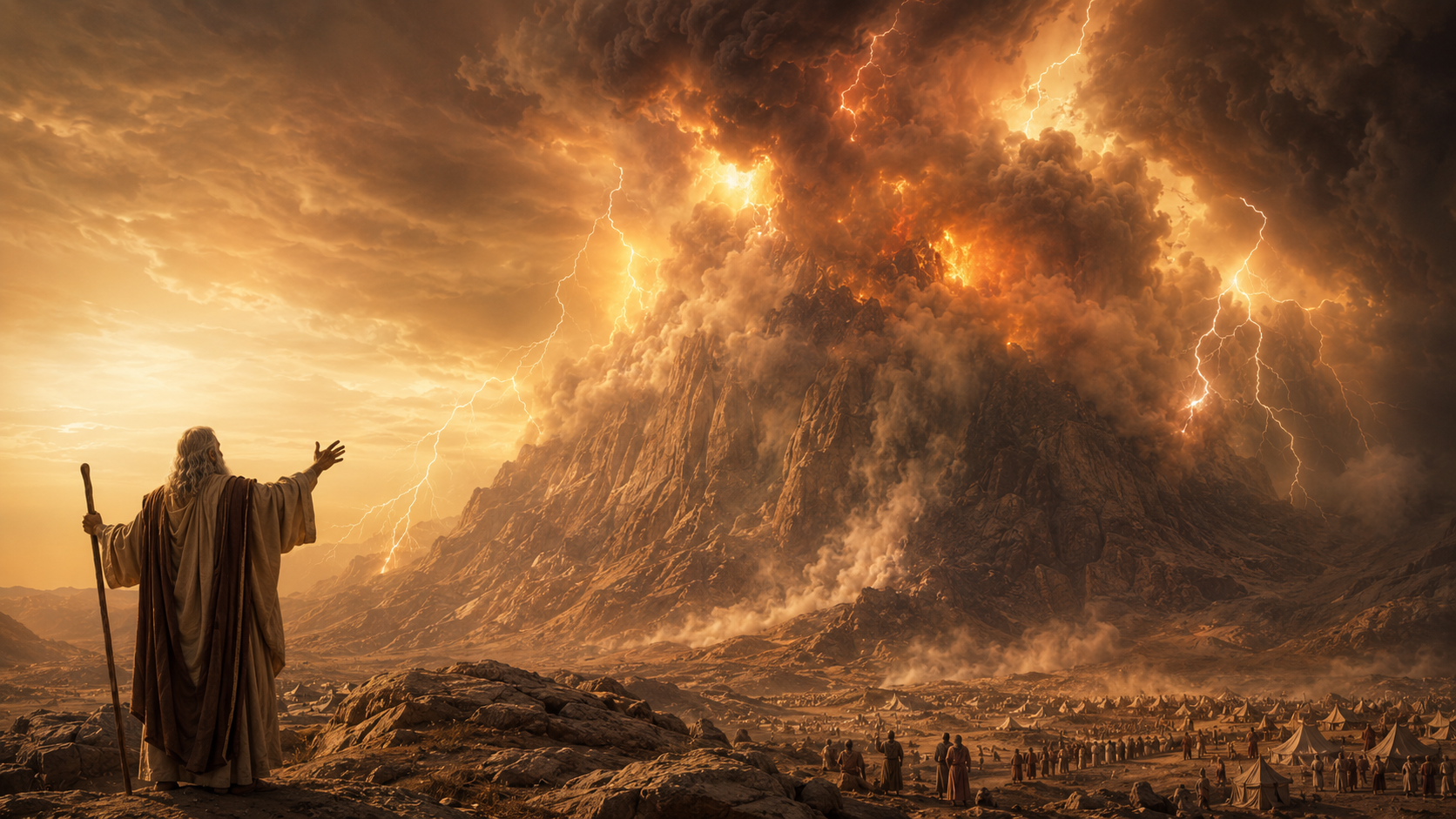
The Theophany: The Morning of the Third Day
Exodus 19:16–20 — Six simultaneous phenomena, and what each one means
Exodus 19:16–19 is one of the most compressed and multi-layered descriptive passages in the entire Old Testament. Six distinct phenomena are described occurring simultaneously as God descends on the mountain. Each one has theological weight. Together they constitute the most overwhelming theophany (divine appearance) in Scripture before the book of Revelation.
The Six Phenomena of the Sinai Theophany
1. Thunders and lightnings (qolot u'vrakim). The word qol means both "thunder" and "voice" — the dual meaning is not accidental. The thunders at Sinai are simultaneously the raw power of atmospheric storm and the voice of God. Every time Israel heard the thunder that morning, they heard the word of God expressed in a form they could not yet receive directly. The thunder was the voice they could bear; the spoken word was the voice that would have destroyed them.
2. A thick cloud (anan kaved). Kaved again — the word for "heavy," the same word as Moses' heavy arms at Rephidim, Pharaoh's hard heart, the burden of slavery. A heavy cloud. Not a decorative cloud or a sign cloud, but a cloud so dense it blocked sight, so thick it was impenetrable. This is the same cloud that had led Israel through the wilderness — the pillar of cloud — now settled on and saturating the mountain.
3. A very loud trumpet blast (qol shofar chazaq me'od). A shofar blast — the ram's horn — very loud, growing louder. Exodus 19:19 repeats that the sound grew "louder and louder." No human was blowing this trumpet. The sound was supernatural — what tradition calls the shofar of heaven, the trumpet of divine assembly. In later Jewish and Christian eschatology, the final gathering of God's people will be announced by a trumpet (Matthew 24:31; 1 Corinthians 15:52; 1 Thessalonians 4:16). The Sinai trumpet is the first instance of the divine assembly call that will culminate in the last trump at the end of history.
4. The mountain wrapped in smoke (Exodus 19:18). The smoke rose "like the smoke of a kiln" — the same image used in Genesis 19:28 when Abraham looked toward Sodom and saw "the smoke of the land going up like the smoke of a furnace." Fire consuming. God in fire — the burning bush, the pillar of fire, the Passover night's pillar — the fire at Sinai is the consummation of the fire imagery that has accompanied Moses' entire encounter with God. The fire at Sinai is not metaphor. It is the same divine fire that burned without consuming at the bush, now descending on a mountain large enough to hold it.
5. The whole mountain trembled greatly (yecheraed kol-hahar me'od). The earthquake. The ground beneath Israel's feet moved. The mountain — their fixed reference point, the solid geological fact they had been camped before for three days — was shaking. Everything that appeared stable and immovable was trembling at the presence of YHWH. This is a pattern throughout the Psalms (Psalm 68:8; 114:4–7) and the prophets: creation trembles in the presence of its Creator. The physical world does not merely observe divine presence — it responds to it, shakes before it, recognises its Maker in a way that humans sometimes fail to.
6. Moses spoke and God answered him in thunder. The final phenomenon is not a natural event but a conversation: Moses speaking and God responding in thunder/voice. In the midst of all the physical phenomena — the smoke, the fire, the quaking, the trumpet — there is dialogue. God is not merely displaying power. He is communicating. The theophany is not the point. The covenant that will follow is the point. The fire and smoke and earthquake are the frame. The word in the middle is the treasure.
The Natural and the Supernatural at Sinai
A recurring question in the scholarly literature is whether the Sinai theophany has a natural explanation — specifically, whether the phenomena of fire, smoke, earthquake, and trumpet might describe a volcanic eruption. The Arabian Peninsula does have ancient volcanic activity, and Jebel al-Lawz in northwest Arabia (proposed by some as the location of Sinai) shows evidence of past volcanic events.
Volcanic Hypothesis — What the Evidence Shows
The Sinai theophany shares some features with volcanic description: fire, smoke, the mountain trembling, the cloud. The Midian region of northwest Arabia has ancient volcanic features. Some scholars (notably those who favor the Jebel al-Lawz location in Arabia, including Charles Beke in the 19th century and more recently various popular researchers) have proposed that a volcanic event underlies the Sinai account.
However, several elements of the Exodus 19 account resist volcanic explanation: the theophany responds directly and immediately to Moses' movements (the LORD "came down" when Moses went up — verse 20); the sound was a trumpet growing louder rather than a volcanic roar; the event lasted a specific three-day prepared period rather than the unpredictable timeline of volcanic activity; and the cloud was described as moving interactively with Moses. The dominant scholarly position treats the account as a theophany — a divine self-disclosure using meteorological and geological phenomena as the medium of God's presence — rather than a volcanic event misremembered as divine encounter.
As with the plagues and the sea crossing: whether natural mechanisms were involved does not change the theological reality. What is described is divine action in, through, and beyond the physical world — not reducible to the physical causes, even if physical causes were present.
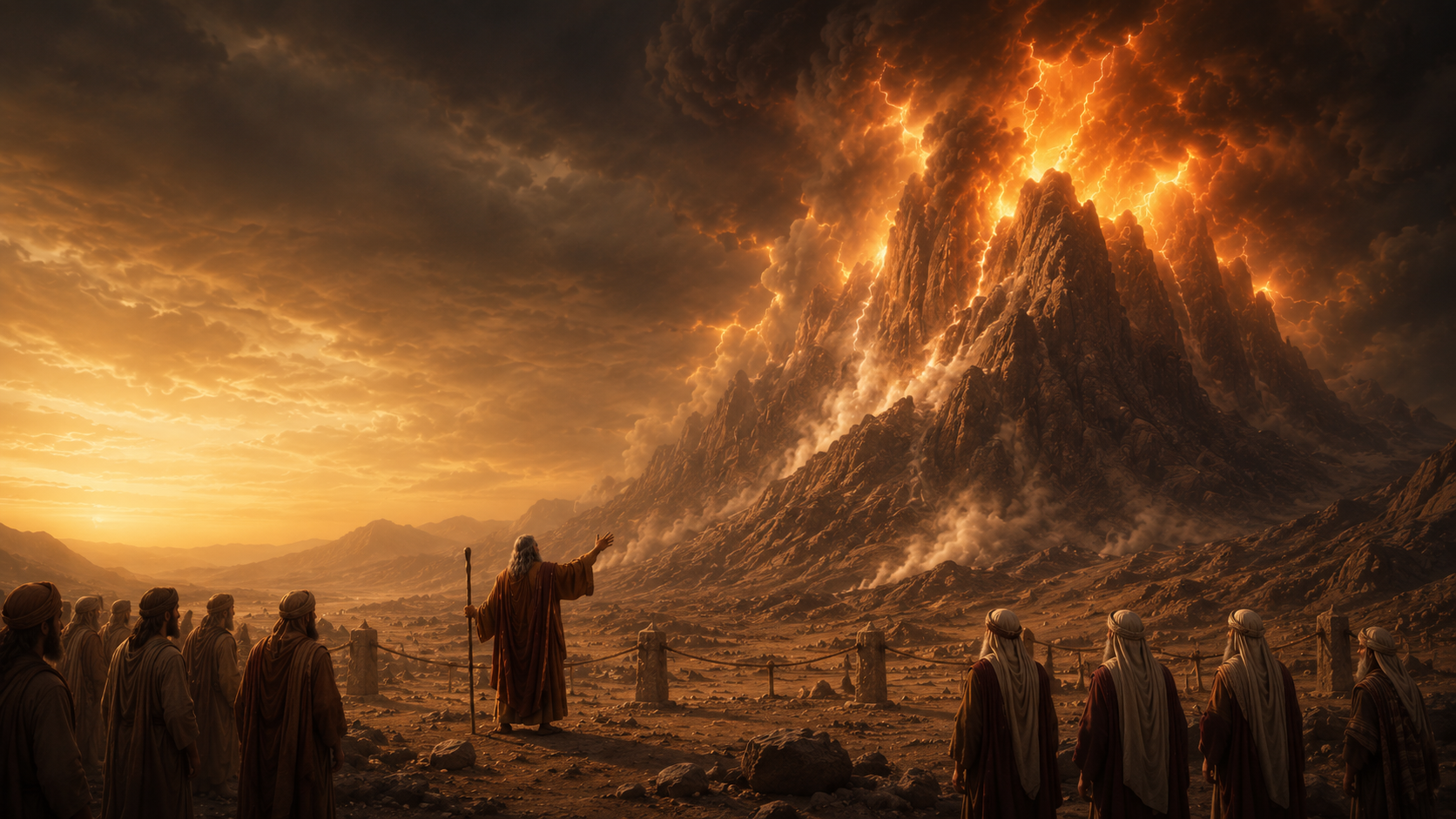
The Boundaries and the Broken Ones
Exodus 19:20–25 — Why God warned Moses twice about the boundaries
One of the strangest and most overlooked exchanges in the Sinai account occurs in Exodus 19:20–25. God calls Moses up to the summit — and then immediately sends him back down with a warning to reinforce the boundaries. Moses protests that the boundaries were already set. God insists: go back down and warn them again. Do not let the priests or the people break through to come up, lest the LORD break out against them.
Exodus 19:20–25 — The Double Warning
Verses 21–22
"And the LORD said to Moses, 'Go down and warn the people, lest they break through to the LORD to look and many of them perish. Also let the priests who come near to the LORD consecrate themselves, lest the LORD break out against them.'"
Hebrew Analysis — "Break Out"
pen-yifrotz YHWH bahem — "lest the LORD break out against them." The verb paratz (to break out, to burst through, to break through a boundary) is striking — it describes God as something that could burst through its own containment and cause destruction. This language describes God's holiness not as a passive quality but as an active force that, when met by what is incompatible with it, breaks out — like a fire that breaks out from a contained hearth when the barrier is removed.
Uzzah in 2 Samuel 6:6–8 touches the Ark of the Covenant when it tips, and dies on the spot. David is angry and afraid and calls the place "Perez-Uzzah" — the breaking-out of Uzzah. The same logic: holiness cannot be touched casually without consequence. David's subsequent fear — "How can the ark of the LORD come to me?" — echoes Israel's fear at Sinai. The Sinai warnings are not preparation for a one-time event. They establish the permanent theology of approach to the holy that governs Israel's entire worship life.
Verses 23–25
"And Moses said to the LORD, 'The people cannot come up to Mount Sinai, for you yourself warned us, saying, "Set limits around the mountain and consecrate it."' And the LORD said to him, 'Go down, and come up bringing Aaron with you. But do not let the priests and the people break through to come up to the LORD, lest he break out against them.' So Moses went down to the people and told them."
Moses' Gentle Protest — and Why God Insists Anyway
Moses' response is almost tender in its reasonableness: but you already told us. They know. The boundaries are set. Why are you sending me back to tell them what they already know?
God insists. Not because the people have forgotten, but because the danger of forgetting in the moment of experience is greater than the danger of being told twice. When the mountain is shaking and the fire is visible and the trumpet is getting louder and the ground is moving — in that moment, the human impulse is often the opposite of caution. Curiosity. The desire to get closer to the overwhelming thing. To see more. To touch.
The double warning reveals something important about God's relationship with human psychology. He knows that the spectacular can override the instructed. He warns twice not because He doubts Moses but because He knows human nature. The most dangerous moment for boundary-crossing is not in the calm before the theophany but in the overwhelming middle of it.
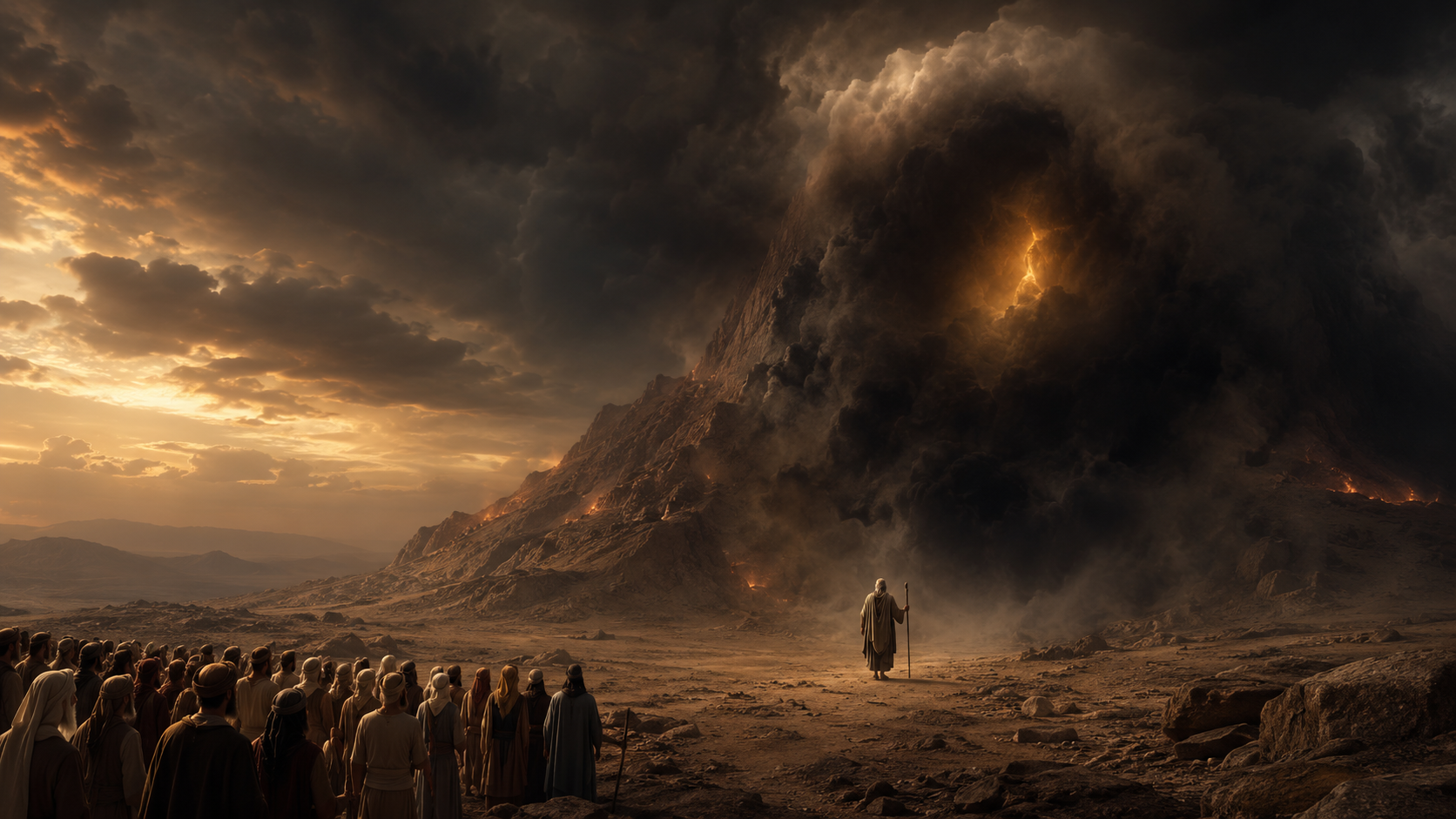
Into the Thick Darkness: Exodus 20:18–21
The most theologically decisive sentence in the Sinai narrative
"The people stood far off, and Moses drew near to the thick darkness where God was."
Exodus 20:21
This sentence is the structural and theological climax of the Sinai encounter. Everything in Exodus 19–20 builds to this moment of contrast: the people, on one side, standing far off; Moses, on the other, drawing near. The middle term between them is the thick darkness — and the stunning revelation that God is inside the darkness.
Hebrew Analysis — The Thick Darkness
ha'arafel — "the thick darkness, the deep gloom." This is a rare Hebrew word — not merely darkness (choshech) or even intense darkness, but a specific, dense, impenetrable darkness associated in the Old Testament with the hidden presence of God and the unapproachable core of divine mystery. It appears in only a handful of passages:
Exodus 20:21 — Moses drew near to the thick darkness where God was.
Deuteronomy 4:11 — Moses describes Sinai: "the mountain burned with fire to the heart of heaven, wrapped in darkness, cloud, and gloom (arafel)."
Deuteronomy 5:22 — "These words the LORD spoke to all your assembly at the mountain out of the midst of the fire, the cloud, and the thick darkness (arafel), with a loud voice."
1 Kings 8:12 — When Solomon's Temple is dedicated and the glory of the LORD fills it, Solomon says: "The LORD has said that he would dwell in thick darkness (arafel)." God's dwelling is in the thick darkness.
Psalm 97:2 — "Clouds and thick darkness (arafel) are all around him; righteousness and justice are the foundation of his throne."
The pattern is consistent: God dwells in the thick darkness. Not despite the darkness, but within it. The darkness is not the absence of God — it is the form His hiddenness takes when His full presence would be unbearable. The thick darkness is the veil between God's full reality and human capacity to encounter it without dying.
The Paradox of the Darkness
The mystic tradition in Christian theology — from Gregory of Nyssa (4th century AD) through Pseudo-Dionysius the Areopagite (6th century) to John of the Cross (16th century) — developed a whole theology of "divine darkness" from this passage. Gregory of Nyssa's Life of Moses uses Moses' entry into the thick darkness as the paradigm of the soul's deepest encounter with God: the closer you draw to God, the less you can see, the more ordinary categories of understanding fall away, the darker it gets — until you find yourself in the deepest darkness that is paradoxically also the fullest light.
This is the mystical paradox: God is simultaneously the source of all light and the one who dwells in darkness unapproachable. 1 Timothy 6:16 expresses it: He "dwells in unapproachable light" — so bright it reads as darkness to finite human perception. The burning bush burned with light but was not consumed. The pillar was fire in darkness. The mountain burned with fire and was covered with cloud. Light and darkness meet at the presence of YHWH, and the categories break down.
What the People Heard That Made Them Stand Far Off
Exodus 20:18–19: "Now when all the people saw the thunder and the flashes of lightning and the sound of the trumpet and the mountain smoking, the people were afraid and trembled, and they stood far off and said to Moses, 'You speak to us, and we will listen, but do not let God speak to us, lest we die.'"
The people have just heard — at least the beginnings of — the Ten Commandments. Exodus 20:1–17 contains the Decalogue, which God speaks directly to the assembled people (Deuteronomy 5:22 confirms God spoke the Ten Commandments "to all your assembly at the mountain, out of the midst of the fire"). The response of the people is immediate and absolute: stop. Not us. Moses, you go. We will hear it from you, but we cannot hear it from God directly.
Deuteronomy 5:24–26 preserves Moses' own retrospective account of what the people said: "Behold, the LORD our God has shown us his glory and greatness, and we have heard his voice out of the midst of the fire. This day we have seen God speak with man, and man still live. Now therefore why should we die? For this great fire will consume us. If we hear the voice of the LORD our God any more, we shall die." They have touched the edge of divine encounter and it has nearly destroyed them. They are asking for a mediator — someone to stand between them and the consuming fire of God's voice.
God's response to this request, in Deuteronomy 18:17–19, is extraordinary: He honours it. He tells Moses He has heard what the people said, that it was well-spoken, and that He will raise up a prophet like Moses through whom He will speak. The people's request for a mediator — born of terror, born of the honest recognition that they cannot survive direct encounter with holiness — becomes the seedbed of the promise of the coming Prophet, who will one day embody and complete everything Moses' mediation pointed toward.
Where Was Sinai? The Location Debate
The most debated geographical question in all of biblical studies — honestly examined
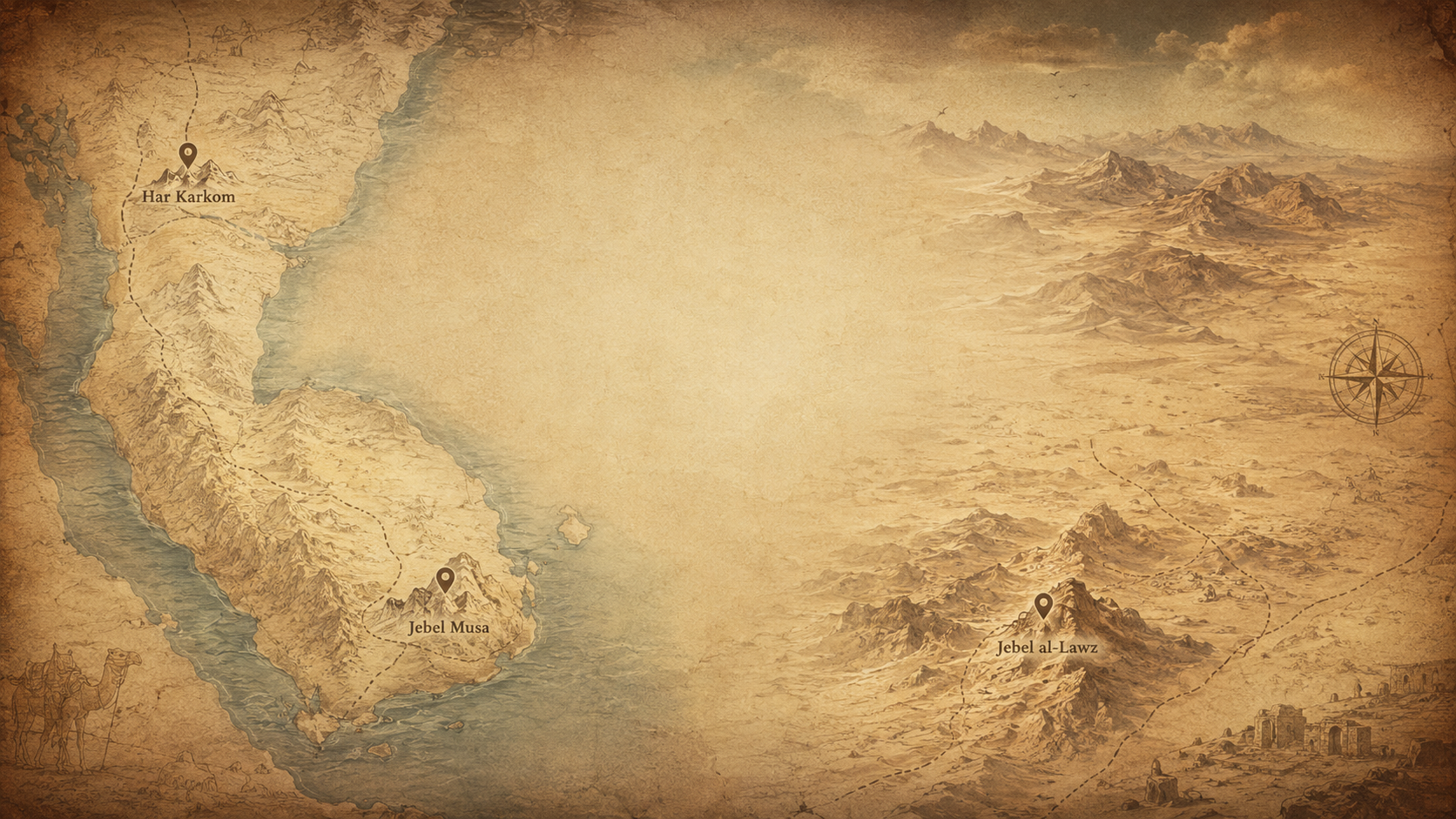
The location of Mount Sinai is one of the most contested questions in biblical geography. No site has been definitively identified, and the scholarly debate spans traditional pilgrimage sites, volcanic mountains in Arabia, and everything in between.
The Main Proposed Locations
1. Jebel Musa, Sinai Peninsula (traditional site, 4th century AD onwards). The mountain in the southern Sinai Peninsula, now home to St Catherine's Monastery, has been the traditional Christian pilgrimage site since at least the 4th century AD. It is approximately 2,285 metres high, in granite terrain, with a broad plain (Wadi er-Raha) at its base that could accommodate a large assembly. The Empress Helena (mother of Constantine) identified this site in the 4th century. Arguments for: long, continuous tradition; the plain at the base; the dramatic granite peaks match the mountain-of-God description. Arguments against: the Sinai Peninsula was Egyptian-controlled territory during the relevant period; pilgrimage tradition was established 1,500 years after the events; and there is no early documentary evidence connecting this site to Moses.
2. Jebel al-Lawz, northwest Arabia (Midian hypothesis). Some scholars and popular writers (including Howard Blumenthal and various others) identify Sinai with Jebel al-Lawz in northwestern Saudi Arabia, in the region of ancient Midian — arguing that Midian, where Moses served Jethro for forty years, was east of the Gulf of Aqaba in modern Saudi Arabia, and that "the mountain of God" should logically be near Jethro's home. Arguments for: the geographical logic of Moses returning to Midian's mountain; the volcanic features of the region potentially explaining the fire and smoke; the site's black-topped peak (possibly from ancient burning). Arguments against: no archaeological evidence; the site is heavily disputed; access has been restricted; claims about chariot wheels on the Gulf of Aqaba floor remain unverified.
3. Har Karkom, central Negev. Proposed by archaeologist Emmanuel Anati, who discovered extensive Bronze Age petroglyphs, altars, and cultic sites at this mountain in the Negev desert, suggesting it was a major ancient religious site. Arguments for: genuine archaeological evidence of ancient worship at this location. Arguments against: the proposed dating conflicts with most Exodus chronologies.
Honest conclusion: We do not know where Sinai was. The biblical text does not give us enough geographical information to identify the site definitively. The theological reality of what happened there — God descending, covenant given, people formed — does not depend on the GPS coordinates. The mountain exists. God descended. The rest awaits further evidence.
Did You Know — Sinai vs. Horeb: Two Names for One Mountain
The mountain appears in the Old Testament under two names: Sinai (used predominantly in Exodus and Numbers) and Horeb (used predominantly in Deuteronomy, and in Elijah's encounter in 1 Kings 19). Scholars debate whether these are the same mountain with two names, or two different peaks of the same mountain complex, or even two related but distinct sites.
The most widely accepted view is that they are two names for the same location, used by different sources or traditions. The name Sinai may derive from a connection to the moon-god Sin (the same lunar deity referenced in the wilderness of Sin); Horeb is related to the Hebrew word for "desert" or "desolation." Both appear in the context of the defining divine encounter with Moses and Israel, and both are described as "the mountain of God." Whatever the precise relationship, for theological purposes they refer to the same sacred place — the mountain where God descended, covenanted with Israel, and spoke through fire.
The Elijah connection is particularly beautiful: in 1 Kings 19, the exhausted, suicidal prophet is fed by an angel and told to journey to Horeb — the mountain of God. He walks forty days and forty nights (echoing Moses and Israel's forty-year wilderness) and arrives at the mountain where he, like Moses, encounters the divine presence — not in the wind or the earthquake or the fire, but in the still small voice. Elijah's Horeb encounter is deliberately patterned on Moses' Sinai encounter, using the same mountain to establish the same theological point: the prophetic word of YHWH, spoken in the quiet after the storm, is the substance of divine presence.
Moses Draws Near — The Man Who Could Not Stay Away
What the contrast between the people and Moses teaches about the theology of approach
The contrast in Exodus 20:21 is everything: "The people stood far off, and Moses drew near to the thick darkness where God was." It is not merely a description of physical positions. It is a portrait of two possible postures before the holy God — and a picture of what Moses had become through eighty years of formation.
At the burning bush (Exodus 3:6), Moses hid his face — he was afraid to look at God. The same response the people had at Sinai — backing away, covering the eyes, standing far off. But forty years later, at Sinai, something had changed. Moses did not hide his face. He drew near. To the thick darkness. Where God was.
What Had Changed in Moses — The Theology of Approach
The arc of Moses' entire story is an arc of approach. At the bush: hide your face. At Egypt: reluctant messenger. At the sea: hold your staff over the water. At Rephidim: stand on the hill and hold your arms up. And at Sinai: draw near to the thick darkness where God was.
Every encounter with God had drawn Moses closer. Not because the holiness of God had diminished — it had not. The mountain was still on fire. The trumpet was still growing louder. The ground was still shaking. But Moses had been changed by his encounters with this God — he had learned through forty years of hiddenness in Midian, through the burning bush, through every confrontation with Pharaoh, through every wilderness crisis — that the thick darkness was not the place God was absent. It was the place God most fully was. And Moses was not afraid of God's presence. He was drawn to it.
This is the theology of sanctification expressed in biographical form. The person who has walked with God long enough does not become less awed by holiness — but they become less paralysed by it. The awe deepens and becomes orientation rather than retreat. The fear that made Moses hide his face at the bush becomes the fear that walks into the thick darkness at Sinai — because there is nowhere else Moses wants to be.
Did You Know — The People's Fear, and God's Response to It
Deuteronomy 5:28–29 contains God's own commentary on the people's request for a mediator: "And the LORD heard your words, when you spoke to me. And the LORD said to me, 'I have heard the words of this people, which they have spoken to you. They are right in all that they have spoken. Oh that they had such a heart as this always, to fear me and to keep all my commandments, that it might go well with them and with their descendants forever!'"
God validates the people's fear. He says: they are right. And then He adds the longing of God that is one of the most tender expressions of divine emotion in the entire Old Testament: "Oh that they had such a heart as this always." God hears their terrified retreat and His response is not disappointment but longing. If only this holy fear could be sustained. If only the people who said "we will do all that the LORD has spoken" could keep doing it. If only the fear of Sinai lasted all the way to Canaan and beyond. Oh, that they had such a heart as this always.
They would not. The golden calf comes in Exodus 32 — less than forty days later. But God's longing expressed here becomes the substance of the New Covenant promise in Jeremiah 31 and Ezekiel 36: not the people trying harder to maintain the Sinai fear, but God giving them a new heart so that the fear of Him is permanent and internal rather than induced by external phenomena and fading within a month.
Sinai and Pentecost: The Two Mountain-Fires
Hebrews 12:18–29 — the most explicit New Testament comparison of Sinai and the New Covenant
"For you have not come to what may be touched, a blazing fire and darkness and gloom and a tempest and the sound of a trumpet and a voice whose words made the hearers beg that no further messages be given to them... But you have come to Mount Zion and to the city of the living God, the heavenly Jerusalem... and to Jesus, the mediator of a new covenant, and to the sprinkled blood that speaks a better word than the blood of Abel."
Hebrews 12:18–19, 22, 24
Hebrews 12:18–29 is the most sustained New Testament theological commentary on the Sinai theophany — and it does something extraordinary with it. It sets up a direct contrast between two mountains: the mountain that "may be touched" (Sinai — the mountain of the Law, the mountain the people could not approach, the mountain where God descended in fire and shaking) and Mount Zion (the heavenly Jerusalem, the mountain of the New Covenant, where the redeemed have already come through Jesus the mediator).
Hebrews 12 — Sinai vs. Zion
The contrast Hebrews draws is not between the Old Testament God and the New Testament God — the same God is at both mountains. The contrast is between two different relationships with that God, mediated through two different covenants and two different mediators.
At Sinai: fire, darkness, gloom, tempest, trumpet, voice that made the hearers beg for it to stop (Exodus 20:18–19). Even Moses said "I am terrified" (Hebrews 12:21, quoting Deuteronomy 9:19). The Sinai encounter was so overwhelming that even the one who approached the thick darkness was terrified.
At Zion: "innumerable angels in festal gathering... the assembly of the firstborn who are enrolled in heaven... God, the judge of all... the spirits of the righteous made perfect... Jesus, the mediator of a new covenant... sprinkled blood that speaks a better word than the blood of Abel." Not less holy. Not less God. But the mediation of the Son has opened a different kind of access — festal gathering, not terrified retreat; assembly, not standing far off; the mediator who absorbed the consuming fire so that His people could draw near without being consumed.
Hebrews 12:29 closes the comparison with the most important reminder: "for our God is a consuming fire." The God of Zion is the same God as the God of Sinai. The fire has not gone out. What has changed is the mediator who stands in it on our behalf, and the blood whose word covers us so that the fire refines rather than consumes.
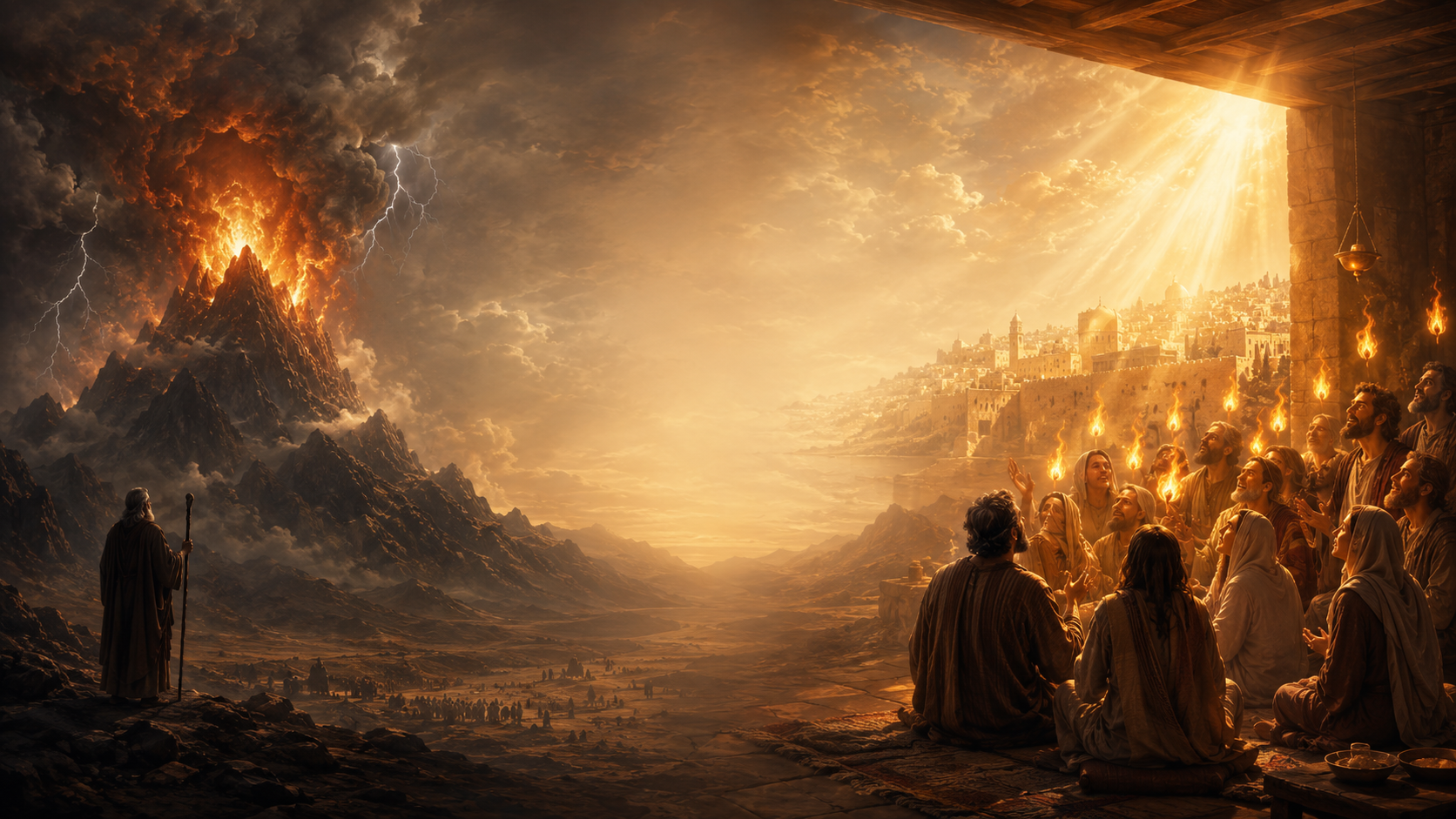
Acts 2 — The Sinai in the Upper Room
The Pentecost event in Acts 2 is explicitly patterned on the Sinai theophany — and most readers miss it because they do not know the Sinai account well enough to recognise the echoes.
At Sinai: fire descends on the mountain. At Pentecost: "divided tongues as of fire appeared to them and rested on each one of them" (Acts 2:3). At Sinai: a sound like a great trumpet, growing louder. At Pentecost: "suddenly there came from heaven a sound like a mighty rushing wind, and it filled the entire house" (Acts 2:2) — a sound from heaven, loud, filling the space. At Sinai: God speaks in a voice the people cannot bear — they beg Moses to mediate. At Pentecost: the disciples speak in every language of the known world so that every nation hears in their own tongue. At Sinai: 3,000 people die for idolatry after the golden calf (Exodus 32:28). At Pentecost: 3,000 people are baptised and added to the church (Acts 2:41). The numbers are not coincidental. The same day. The same count. Death at Sinai. Life at Pentecost.
Paul makes the contrast explicitly in 2 Corinthians 3:6–8: "the letter kills, but the Spirit gives life... if there was glory in the ministry of death, carved in letters on stone... will not the ministry of the Spirit have even more glory?" The Torah given at Sinai on stone tablets — the ministry of death, because the law reveals sin but cannot remove it. The Spirit given at Pentecost — the ministry of life, writing God's law not on stone but on human hearts. Jeremiah 31:33 is fulfilled fifty days after the Passover in which the Lamb of God was slain. The covenant written on hearts is the Sinai covenant renewed, internalised, made permanent by the Spirit.
Christ at Sinai: The Full Connection
The Transfiguration, the New Moses, and the fire that refines rather than destroys
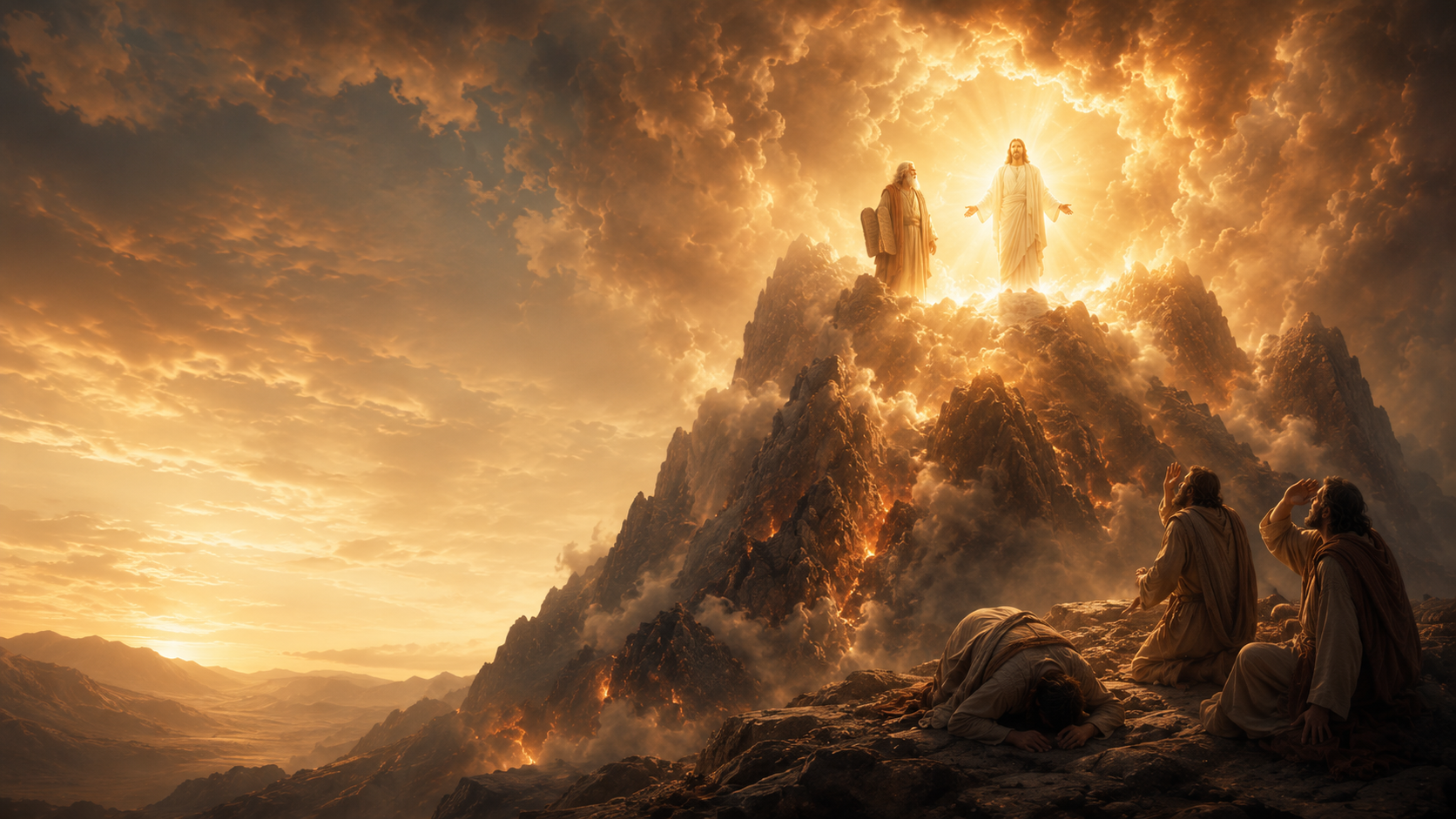
The Transfiguration as a New Sinai
Matthew 17:1–8 (and parallels in Mark 9 and Luke 9) describes the Transfiguration in language deliberately structured to echo the Sinai theophany. Jesus takes Peter, James, and John up a high mountain — as Moses took Aaron, Nadab, Abihu, and the seventy elders up to Sinai (Exodus 24:1). A bright cloud overshadows them — the cloud of divine presence that covered Sinai. A voice speaks from the cloud — the voice that spoke from the fire and cloud at Sinai. Moses himself appears — present at this new Sinai moment, representing the law given at the old one.
And the disciples' response: they fell on their faces and were terrified. Exactly as Israel was terrified at Sinai. And Jesus touches them and says: rise, and have no fear. The same reassurance Moses gave to Israel — "do not fear" — now spoken by the One who is greater than Moses, to people who have just witnessed a theophany on a mountain. The Transfiguration is not a random moment of glory. It is the new Sinai, with Jesus as both the mountain and the voice from the cloud — the presence who was previously behind the fire and smoke, now revealed in the form of the Son.
Jesus as the Prophet Like Moses — Deuteronomy 18:18
At Sinai, in response to the people's request for a mediator — "you speak to us, and we will listen, but do not let God speak to us, lest we die" — God tells Moses in Deuteronomy 18:17–19: "I will raise up for them a prophet like you from among their brothers. And I will put my words in his mouth, and he shall speak to them all that I command him."
This promise, embedded in the Sinai encounter itself, points directly to Jesus. Acts 3:22 and Acts 7:37 (in Peter's and Stephen's sermons respectively) both cite Deuteronomy 18:18 as fulfilled in Jesus. The prophet the people begged for at Sinai — the mediator who could stand between them and the consuming fire of God's voice and translate it into something they could receive — is Jesus. He is the Moses-like prophet, but greater: Moses mediated between God and Israel by going into the thick darkness. Jesus mediates between God and humanity by being both God and human simultaneously — the thick darkness and the people standing at its edge, united in one person.
John 1:17–18: "For the law was given through Moses; grace and truth came through Jesus Christ. No one has ever seen God; the only God, who is at the Father's side, he has made him known." The law given at Sinai through Moses. The God made known in Christ. The same God, the same mountain-fire, the same holy — now approached not from a distance but through the Son who dwells in the Father's side, who is the full disclosure of the thick darkness made visible and approachable.
Devotional
Drawing Near to the Thick Darkness
The people stood far off. And Moses drew near.
Both responses were understandable. The mountain was on fire. The ground was shaking. The trumpet was getting louder. Nobody had been to Sinai before. Nobody had a precedent for what was happening. Both standing far off and drawing near were responses to the same overwhelming reality — the descent of the living God on a mountain.
But only one of them was right. Not because the people were bad, or cowardly, or faithless — but because you cannot have what you were made for if you keep standing at a safe distance from it. The thick darkness was not the place of God's absence. It was the place of God's fullest presence. And the only way to receive what was in the thick darkness was to go into it.
There are thick darknesses in the life of faith. Seasons of prayer where nothing comes back. Stretches of Scripture where the meaning does not reveal itself immediately. Experiences of suffering where God seems to have descended in fire and smoke and the ground is shaking under you and you cannot make sense of what is happening. And the instinct — the very human, very understandable instinct — is to stand far off. To keep a safe distance. To send Moses in and receive the second-hand report.
But the God of Sinai is not found at a safe distance. He is found in the thick darkness. Not in the comfortable, well-lit, comprehensible places only — but in the impenetrable places, the places where your categories break down and your usual spiritual sight fails and there is nothing to do but go further in.
Moses did not know what was in the thick darkness when he walked toward it. He had never been there before either. He walked toward the darkness because he had learned, through forty years of desert school and bush fire and the slow terrible formation of a life spent with God, that the darkness was not empty. That the fire was not merely destruction. That the voice in the thunder was speaking, and he could not hear what it said from the foot of the mountain.
Whatever thick darkness you are standing before today — draw near. God is not behind you in the familiar and comfortable places, watching you retreat. He is in the darkness, waiting to be known. Draw near.
Reflection & Discussion Questions
Personal Reflection
1. The covenant offer of Exodus 19:4–6 begins not with law but with memory: "You yourselves have seen what I did to the Egyptians, and how I bore you on eagles' wings." God's call to obedience is rooted in what He has already done, not in Israel's performance. How does this sequence — grace first, then law — shape how you understand your own obligation to God? What would change in your spiritual life if you spent more time remembering what God has done before you focused on what you need to do?
2. The three days of preparation before the Sinai theophany required washing garments, setting limits, and abstaining from ordinary life. These were rituals of deliberate preparation for a holy encounter. What practices in your own life function as this kind of preparation — creating the internal and external space for genuine encounter with God? And where do you tend to approach God casually, without the kind of preparation the gravity of the encounter deserves?
3. "The people stood far off, and Moses drew near to the thick darkness where God was." Is there a thick darkness in your life right now — a place of incomprehension, suffering, or spiritual obscurity — that you have been standing away from? What would it mean to draw near to it rather than retreating to what is familiar and comfortable?
Deeper Study
4. The word segulah (treasured possession) in Exodus 19:5 describes the king's private treasury — the objects personally prized above all general wealth. God calls Israel His segulah. 1 Peter 2:9 applies the same language to the church. What does it mean for God to call you His treasured possession — not because of your value in some abstract market sense, but in the way a king prizes something he has personally chosen? Does that description feel true to you? What gets in the way of receiving it?
5.The Sinai-Pentecost parallel is one of the most profound in the entire Bible: fire descends, a sound from heaven fills the space, thousands respond — but at Sinai 3,000 die for idolatry, while at Pentecost 3,000 are baptised and added to the church. Paul in 2 Corinthians 3 calls the Sinai covenant the "ministry of death" and the Spirit's work the "ministry of life." What is the difference between law written on stone and law written on hearts? How does this distinction change how you understand the relationship between the Old and New Testaments?
6.Read Hebrews 12:18–29 carefully. What is the difference between standing before Mount Sinai (which may be touched, which blazed with fire, whose voice made the hearers beg) and standing before Mount Zion (the city of the living God, to Jesus the mediator)? Hebrews closes with "our God is a consuming fire" — the same fire of Sinai. What is different now about how that fire relates to the believer in Christ?
7.Deuteronomy 5:29 records God's longing: "Oh that they had such a heart as this always, to fear me and to keep all my commandments." This longing — that the Sinai fear would be permanent — is ultimately answered by the New Covenant promise of a new heart (Jeremiah 31:33; Ezekiel 36:26–27). How does the Holy Spirit in the New Covenant fulfil what the Sinai law could not produce in Israel? And how does understanding what God always wanted (permanent holy fear from the heart) change how you engage with both the Old and New Testaments?
Closing Prayer
LORD who descended in fire —
We have stood at the foot of the mountain. We have tried to imagine what it was to hear the trumpet growing louder and feel the ground shake and see the smoke rising like a kiln and know that You — the God who made the sea part and rained bread from heaven and sweetened the bitter water — You had come down. Right there. On the mountain we could see.
We confess that we are often the people who stand far off. Who ask for mediators and second-hand reports. Who want the benefits of Your presence without the consuming weight of it. Who have heard the thunder that is also Your voice and said: do not speak to us directly, lest we die. We understand why Israel said it. We have said it too.
But You said: Oh that they had such a heart as this always. Oh, that. And You promised what You longed for — the new heart, the inscribed law, the Spirit who writes Your commands not on stone but on the interior of who we are. You did not stop at Sinai. You sent the Spirit at Pentecost so that what Israel could not sustain from external fear, Your people could now live from internal love.
Make us into people who draw near. Who do not stop at the foot of the mountain. Who are willing to go into the thick darkness where You are — the incomprehensible places, the suffering places, the places where ordinary spiritual sight fails — because we have learned what Moses learned: that You are in the darkness, and the darkness is not empty, and You are worth any amount of shaking ground and growing trumpet to find.
You are a consuming fire. Burn away what cannot survive Your presence. Purify what can. And bring us near — not to the law carved on stone, but to Jesus, the mediator of the new covenant, whose blood speaks a better word than all of it. In Jesus name who carved the law in our hearts, Amen.
Coming Next in the Series
Part Sixteen: Mount Sinai II — The Ten Commandments
Having stood at the foot of the mountain and felt the ground shake, we now turn to what God spoke from the fire and cloud: the Ten Commandments. Part Sixteen examines the Decalogue in full — its structure, its Hebrew, its cultural background, its relationship to other ancient law codes, its divisions (the first tablet of God-directed commands, the second of human-directed commands), and what it meant to have a God who spoke His character as law to the people He had chosen. We will also examine why the Ten Commandments open not with a law but with a declaration of identity: "I am the LORD your God, who brought you out of the land of Egypt, out of the house of slavery."
Add comment
Comments