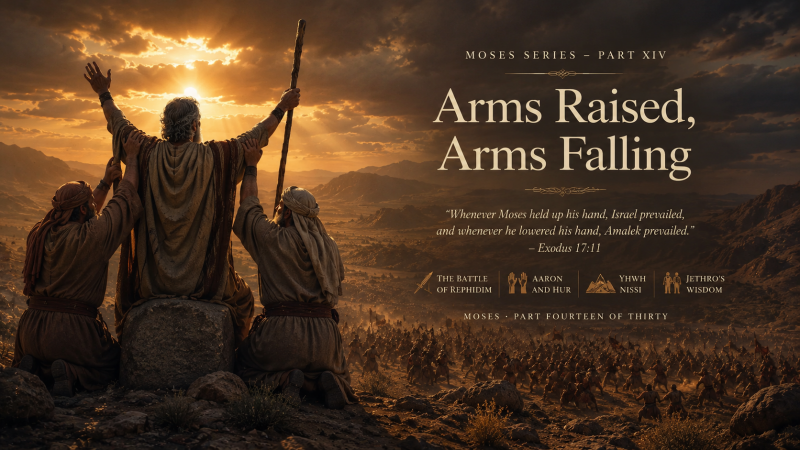
"Whenever Moses held up his hand, Israel prevailed, and whenever he lowered his hand, Amalek prevailed."
— Exodus 17:11
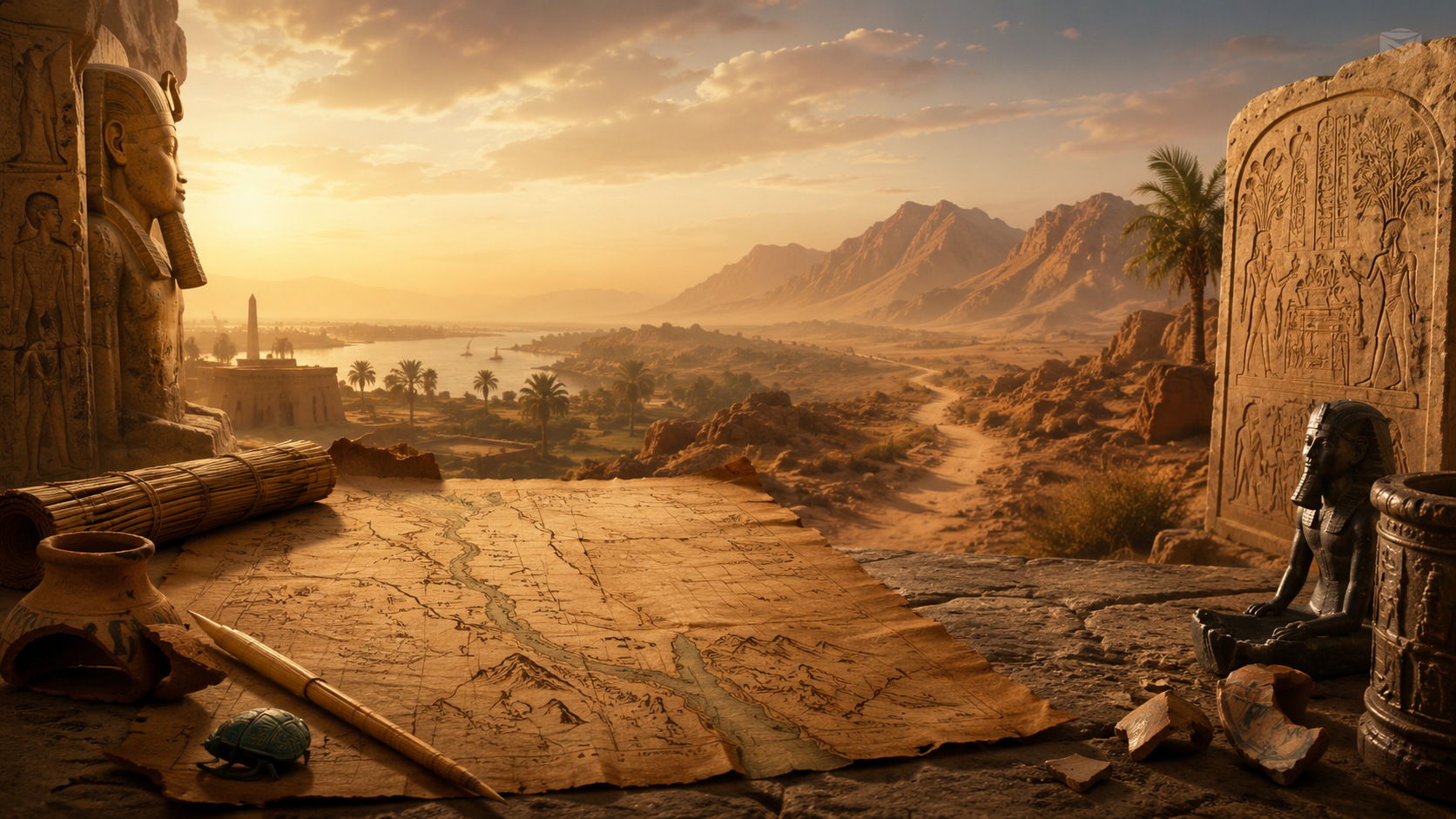
Please Read These Passages First
Part Fourteen covers two episodes that are rarely studied together but belong together: the battle against Amalek at Rephidim, and Jethro's visit with his famous leadership intervention. Read both passages before the commentary. They are short but extraordinarily dense.
As you read the Amalek account, notice what is happening on the hill above the battle simultaneously with what is happening in the valley below. The narrator switches between them deliberately. Pay attention to Moses' arms — what raises them, what lowers them, and what the solution is when they can no longer hold.
Exodus 17:8–16 Exodus 18:1–27 Deuteronomy 25:17–19 Hebrews 7:23–25 Romans 8:34
Optional deeper reading:
Numbers 14:43–45 (the Amalekites defeat Israel when Moses is absent from the hill — the exact reverse of Rephidim);
1 Samuel 15 (Saul's failure to destroy Amalek and what it cost him);
Esther 3:1 (Haman the Agagite — the Amalek thread resurfaces in an extraordinary way 900 years later);
1 Timothy 2:8 (Paul on lifting holy hands in prayer — rooted in this passage).
Exodus 17:8-16
Exodus 18:1-12
Exodus 18:13-27
Deuteronomy 25:17-19
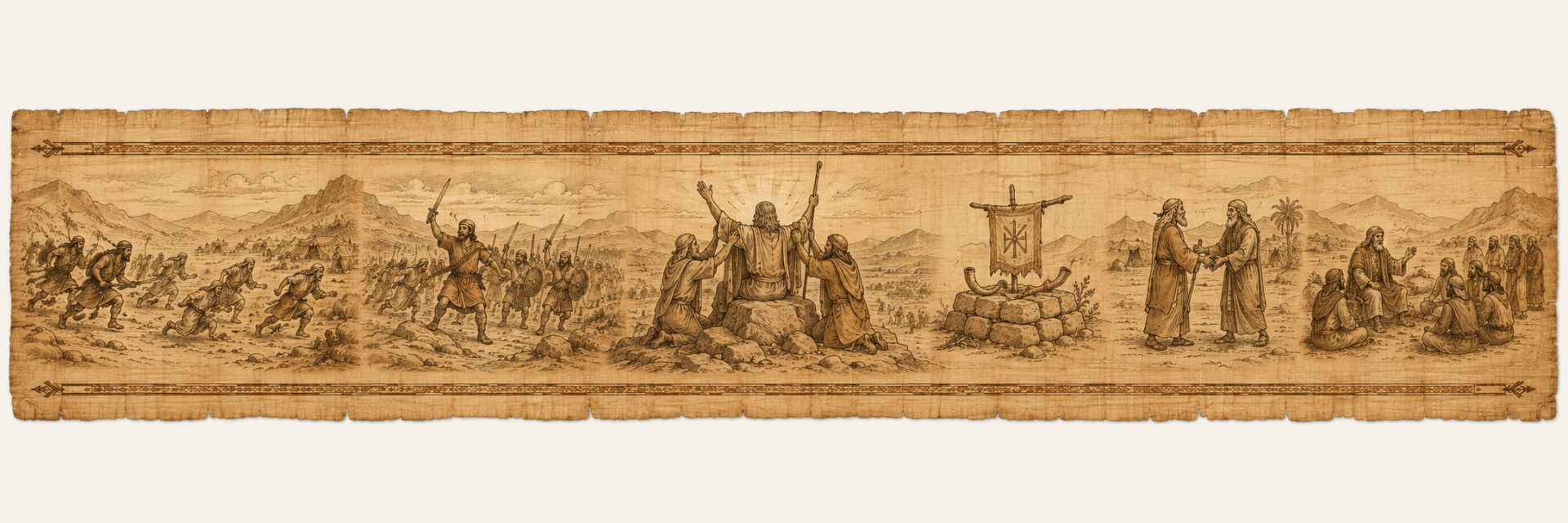
The Story
The Hill Above the Battle
What happened at Rephidim was not one story. It was two stories, simultaneous, inseparable.
Scene One: The Attack
They came without warning and without declaration.
Amalek. The word falls into the narrative of Exodus 17 with the bluntness of a blade: "Then Amalek came and fought with Israel at Rephidim." No introduction. No diplomacy. No attempt at negotiation or passage rights. They simply came. And they fought.
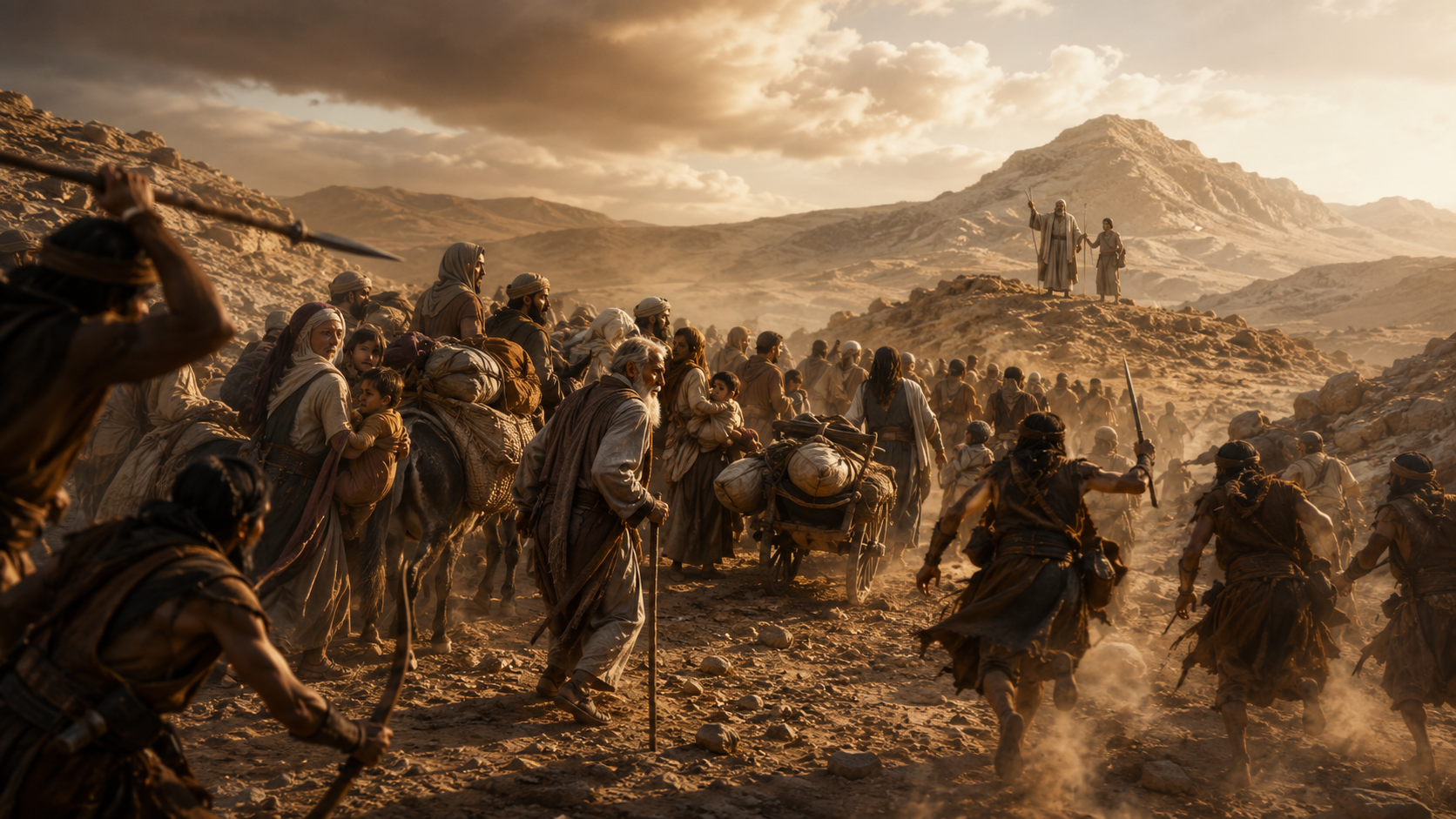
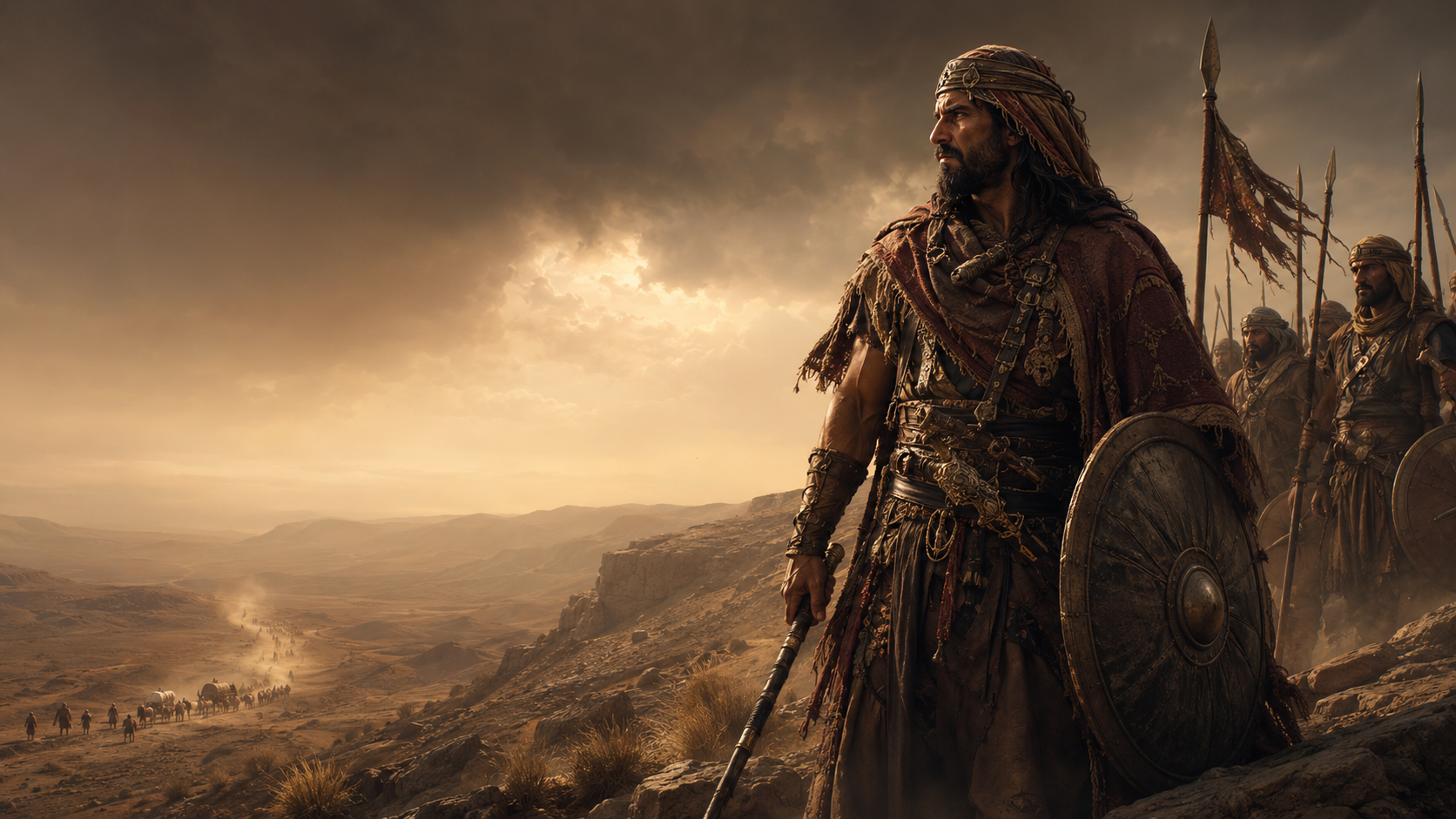
But the how of the attack matters enormously — and the text of Exodus 17 does not give it to us. For that, we go to Deuteronomy 25:17–18, where Moses, forty years later on the banks of the Jordan, tells the next generation exactly what happened:"Remember what Amalek did to you on the way as you came out of Egypt, how he attacked you on the way when you were faint and weary, and cut off your tail — those who were lagging behind you — and he did not fear God."
He cut off your tail. He did not attack the front of the column where the soldiers were. He attacked the back — where the old people were. The children. The sick. The ones whose sandals had worn through. The ones who were stumbling behind the main column, too exhausted to keep pace, too weak to defend themselves. Amalek found the most vulnerable and hit them there.
This is not a detail about ancient military tactics. This is a moral assessment that will echo through the entire Old Testament and into the book of Esther. Amalek became the symbol of the predatory spirit that targets the weak and the weary — the ancient archetype of the enemy who does not fight you at your strongest but waits for your moment of maximum exhaustion and hits from behind.
Moses said to Joshua: choose us men and go out and fight with Amalek. Tomorrow I will stand on the top of the hill with the staff of God in my hand.
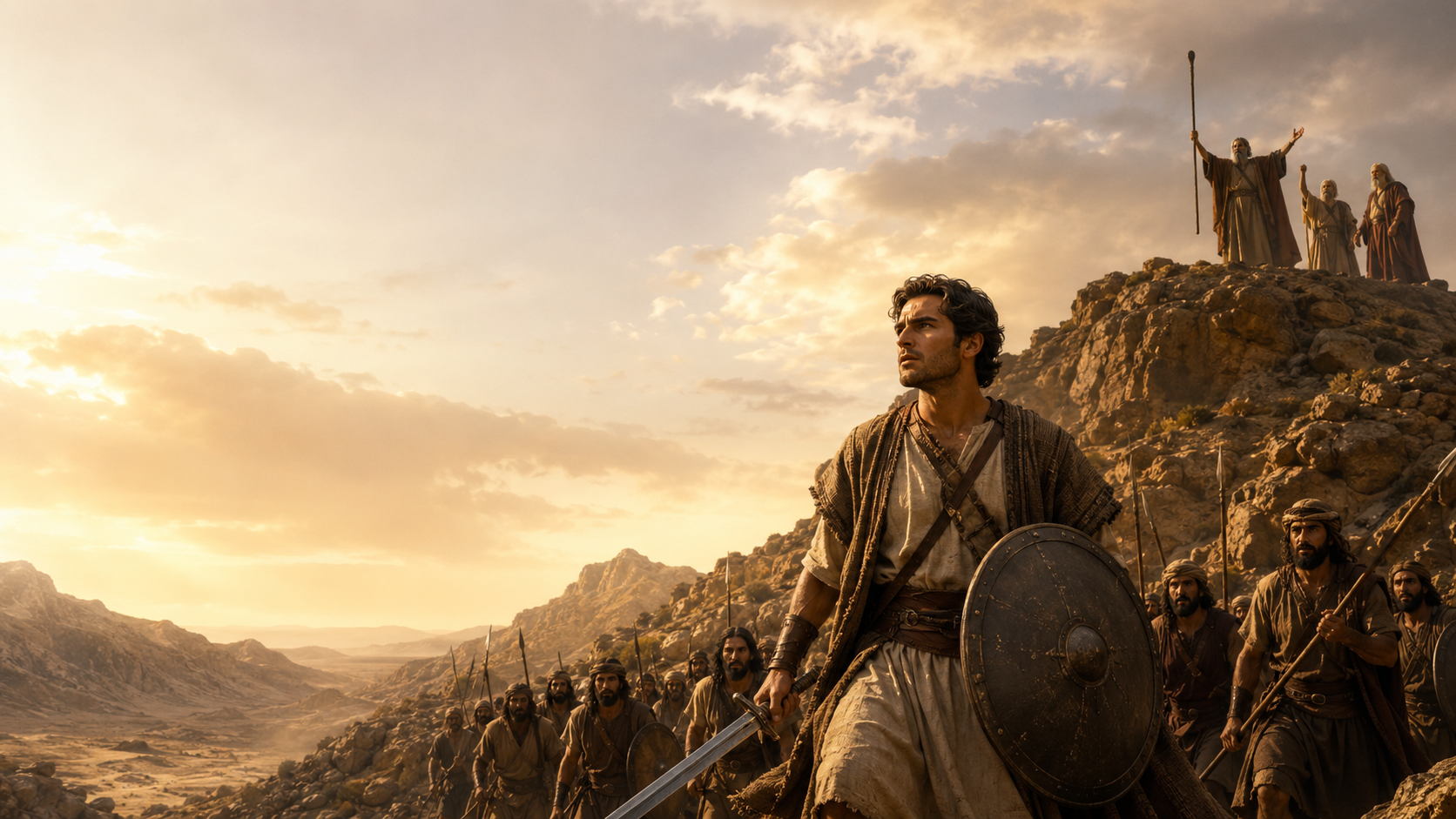
Joshua. The first mention of this name in Scripture. A young man, a military commander, about to fight his first battle. He will one day lead Israel across the Jordan. But today, at Rephidim, he is simply the man Moses trusts to hold the valley while Moses holds the hill.
Scene Two: The Hill
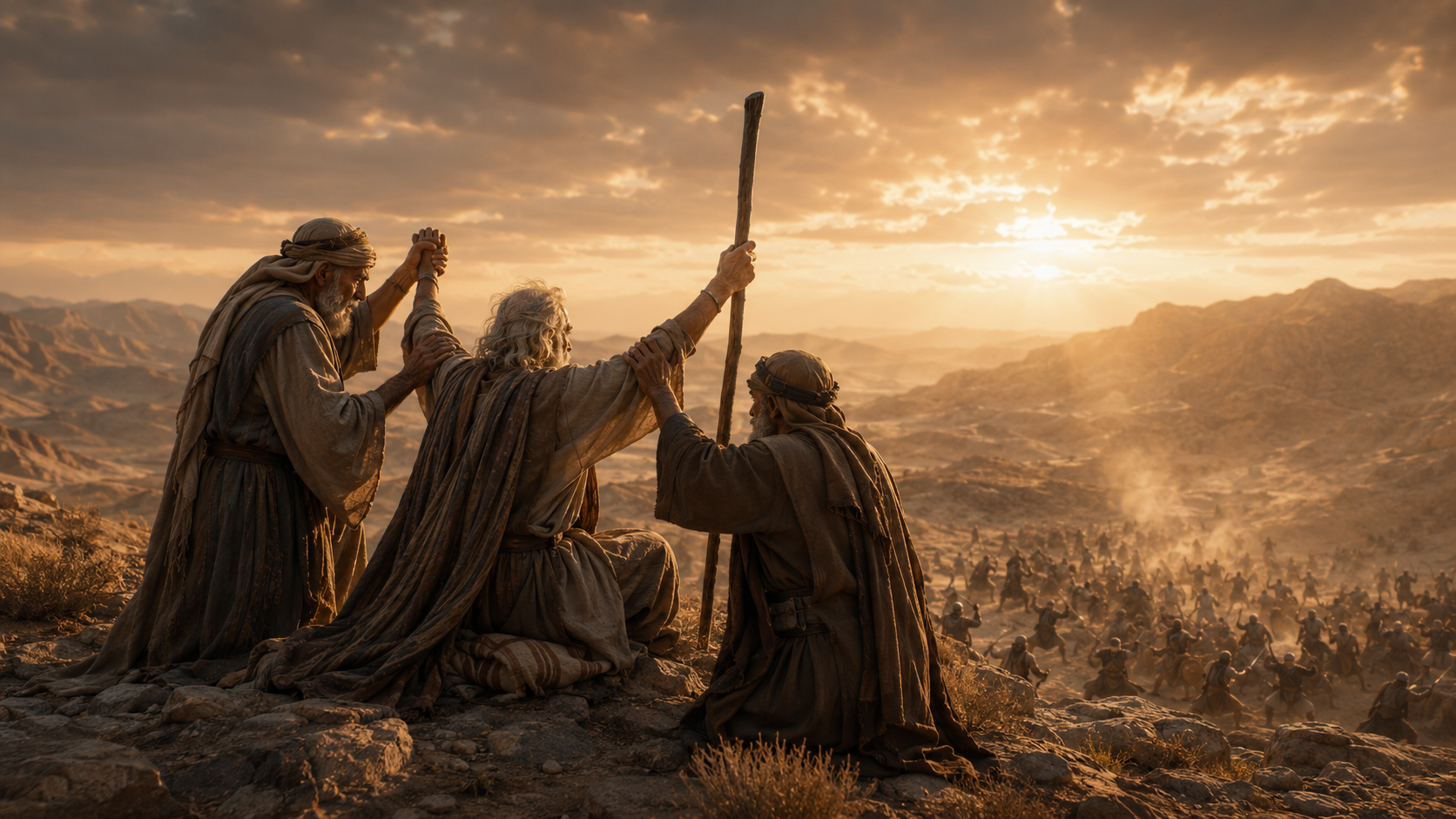
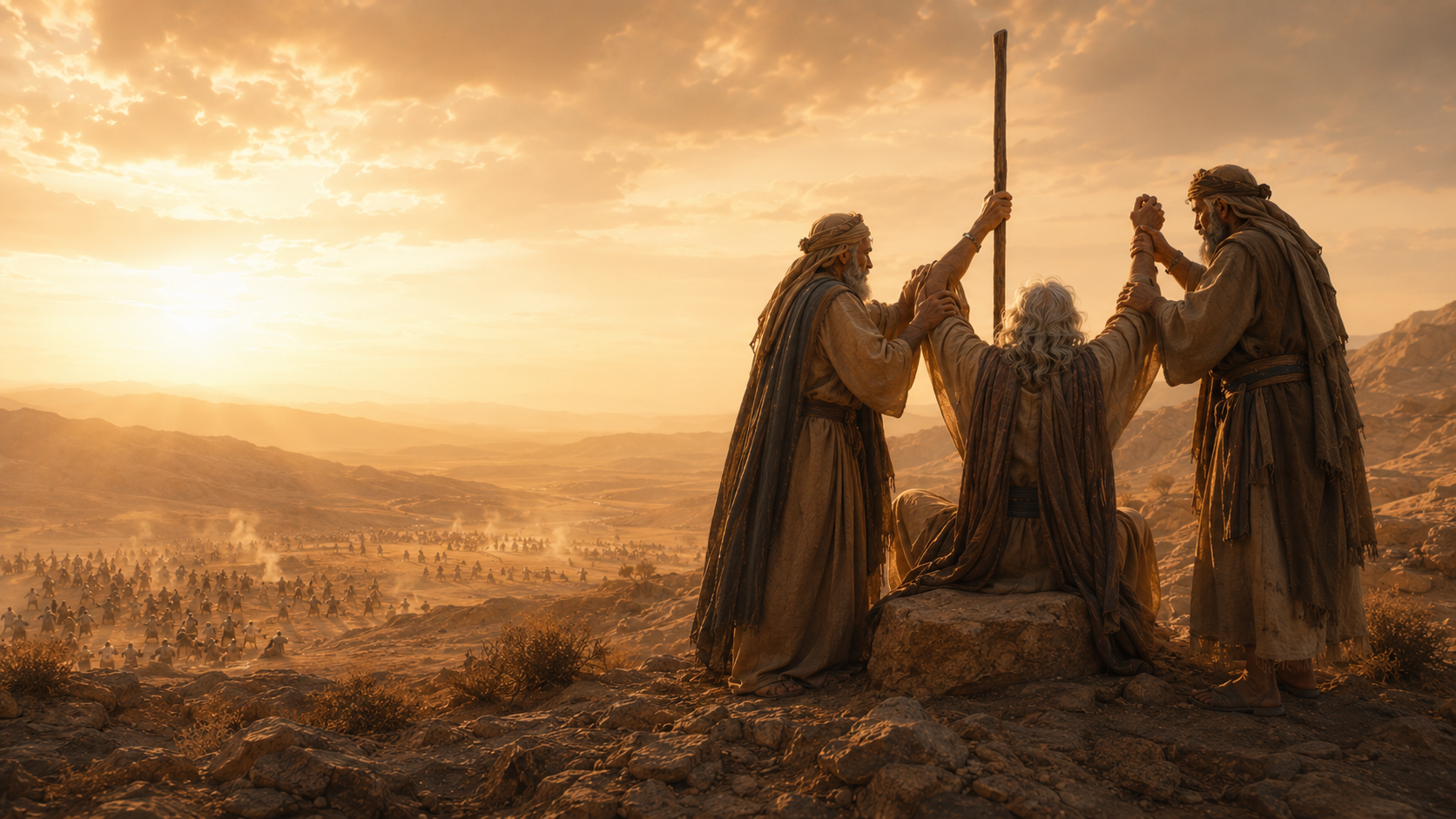
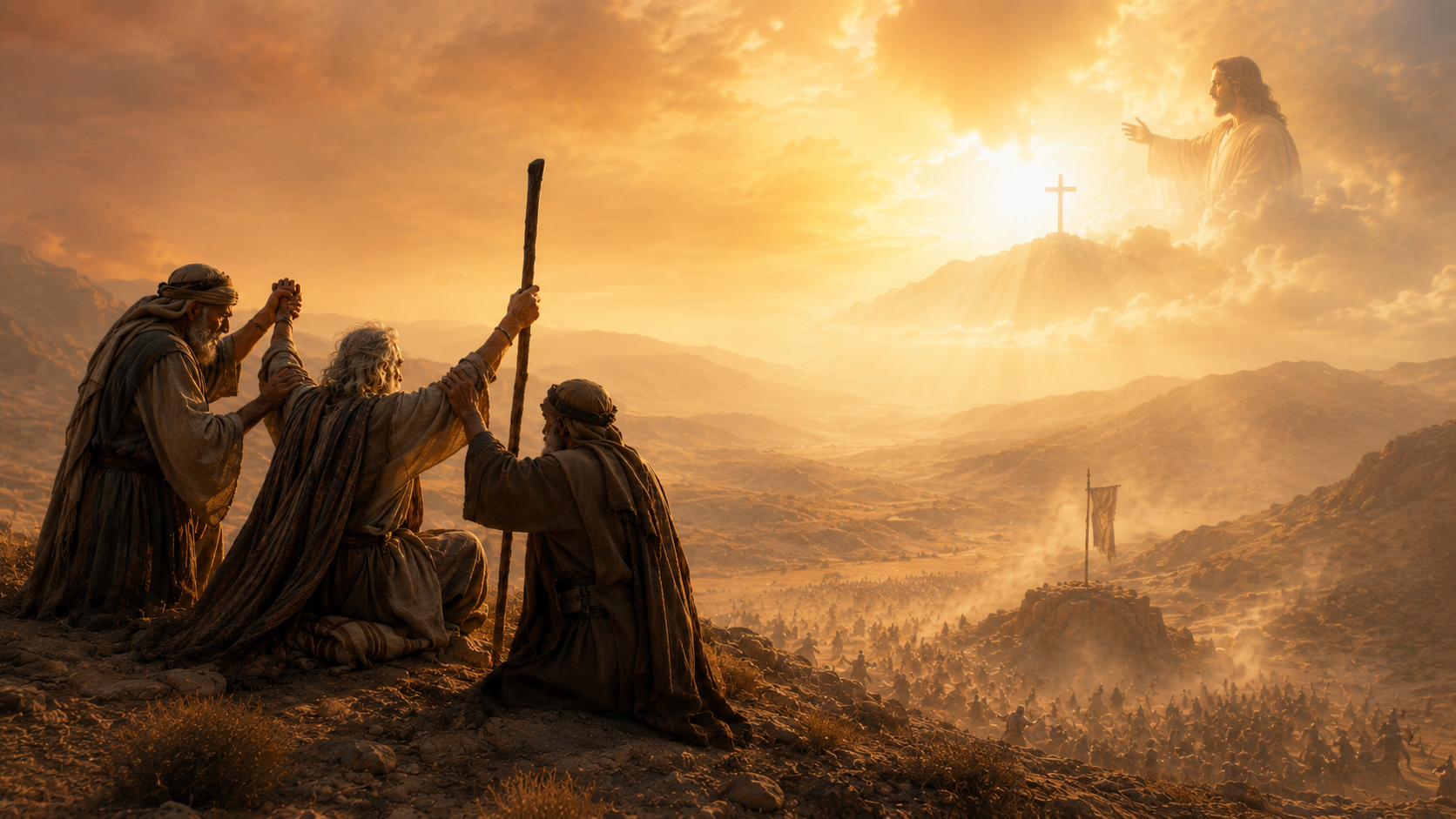
Moses went up. Aaron was with him, and Hur — whose identity we will examine closely because the tradition attached to him is remarkable. Three men on a hill above a battle they were not fighting. With a staff. Watching.
And then the most extraordinary cause-and-effect in the entire Old Testament:
Whenever Moses held up his hand, Israel prevailed. And whenever he lowered his hand, Amalek prevailed.
Read that again. The outcome of the battle in the valley depended not on the skill of the soldiers or the strategy of the general but on the position of an old man's hands on a hill above it. When Moses' hands were up, Israel was winning. When Moses' hands dropped, Amalek was winning. The text does not hedge this. It states it as direct cause and effect.
And Moses' hands grew heavy. Kaved — heavy — the same word used for Pharaoh's hardened heart, here used for exhausted arms. The weight of intercession. He could not hold them up. He was eighty years old, he had been standing on a hill with his arms raised, and the arms were failing.
What happened next is one of the most quietly beautiful moments in the entire book of Exodus. Aaron and Hur did not lecture Moses about his weakness. They did not ask him to try harder. They did not wait for him to collapse. They took a stone and put it under him. And he sat on it. And Aaron held up his arm on one side, and Hur held up his arm on the other side. And his hands were steady — the Hebrew word is emunah, faithful, steady, trustworthy — until the going down of the sun.
And Joshua defeated Amalek.
Not because Joshua was a brilliant commander. Not because Israel had superior weapons or tactics. Because an old man sat on a stone on a hill, held up by two men beside him, his arms steady until sunset. The battle was won on the hill before it was won in the valley.
Scene Three: Jethro Arrives
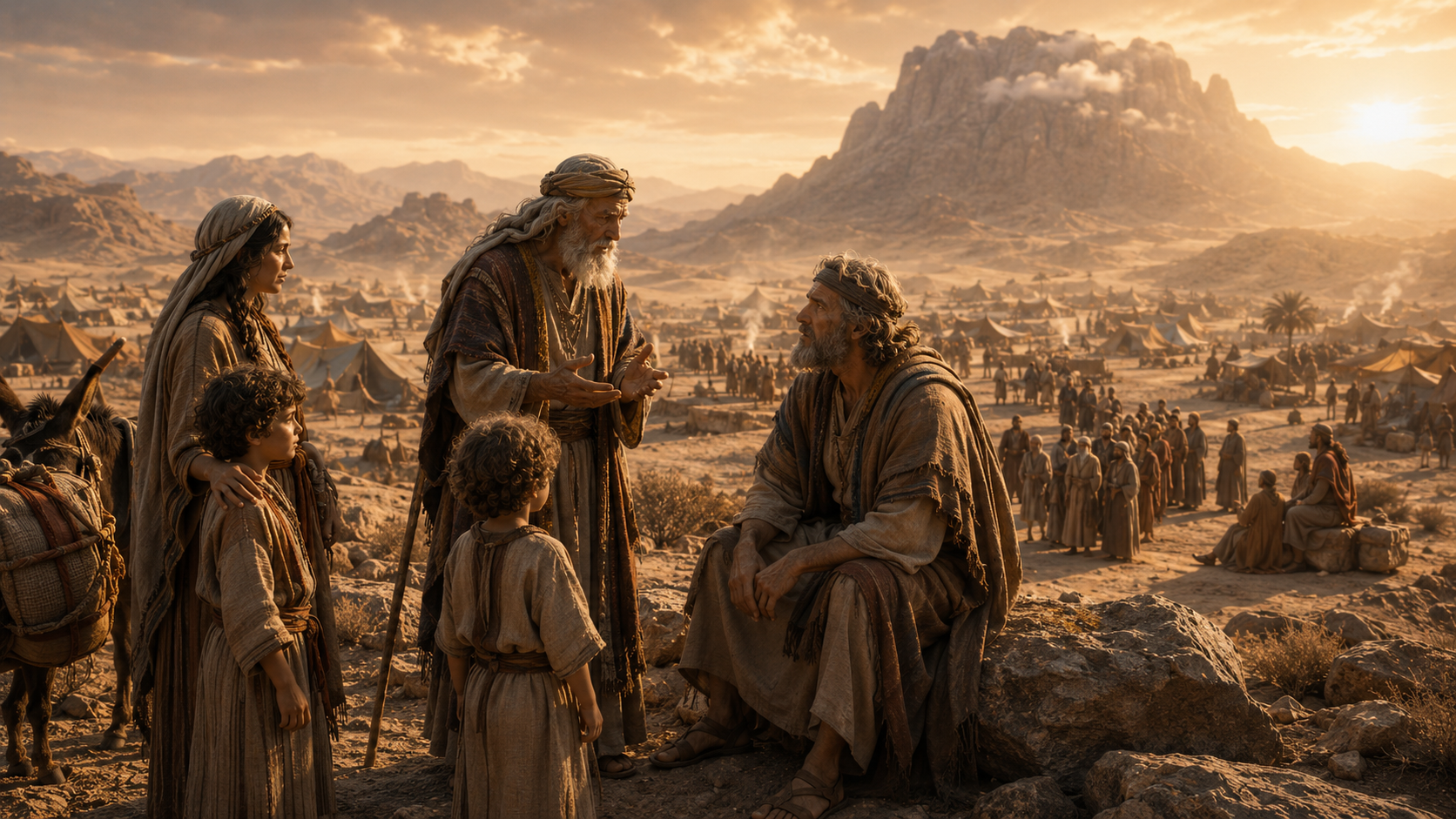
Some time after the battle — the text does not give us an exact interval, but it was after Israel had reached the mountain of God in the wilderness — a man came riding toward the camp. An old priest. Moses' father-in-law. Jethro of Midian, with Zipporah and the two boys: Gershom and Eliezer.
Moses went out to meet him and bowed down and kissed him. They asked after each other's welfare. And then Moses told Jethro everything — all that the LORD had done to Pharaoh and to the Egyptians, all the hardship they had encountered on the way, and how the LORD had delivered them. And Jethro rejoiced. And he said: blessed be the LORD who has delivered you. Now I know that the LORD is greater than all gods. And Jethro brought a burnt offering and sacrifices to God. Aaron came, and all the elders of Israel, and they ate bread with Moses' father-in-law before God.
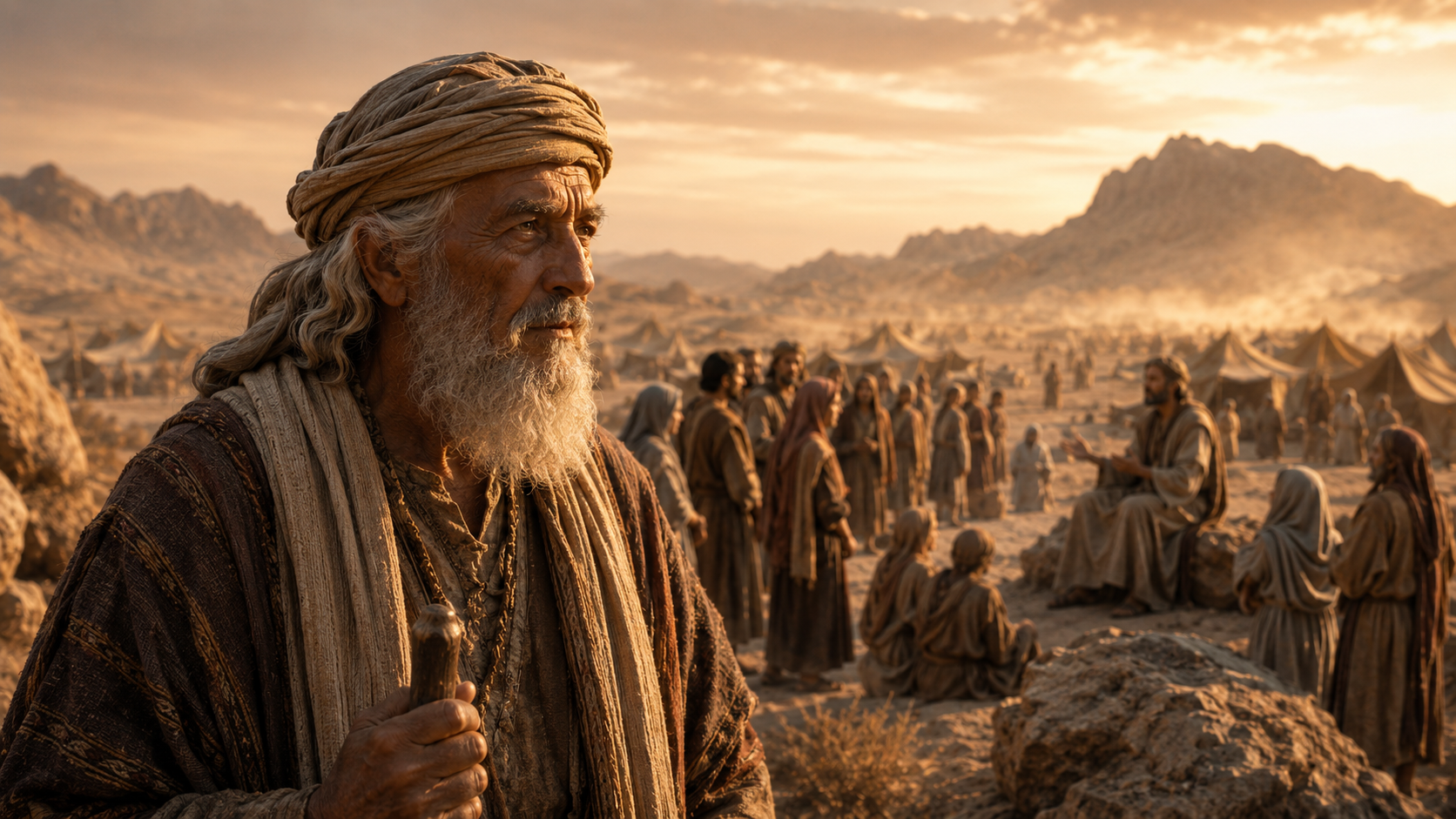
And the next morning Moses sat down to judge the people. And the people stood around him from morning to evening — a queue that stretched as far as the eye could see, waiting for Moses to settle every dispute, answer every question, render every decision.
Jethro watched. And when evening came and the last case had been heard and the people had gone home — Jethro sat down with his son-in-law and said what needed to be said with the directness of a man who had lived long enough not to waste words:
"What you are doing is not good. You and the people with you will certainly wear yourselves out, for the thing is too heavy for you. You are not able to do it alone."
You are not able to do it alone. Five words that changed the structure of Israelite society, established the principle of delegated authority, and saved Moses from the kind of burnout that destroys leaders who believe the mission depends entirely on them personally.
Jethro's solution was elegant: appoint capable, God-fearing, honest men as leaders of thousands, of hundreds, of fifties, of tens. Let them judge the small matters. Bring only the great cases to Moses. Moses would not be the only judge. He would be the court of final appeal. And the people would get faster justice, Moses would have time to breathe and pray and seek God — and the whole system would function sustainably instead of crumbling under the weight of one man's inability to be everywhere at once.
Moses listened. Moses did everything Jethro said. And the greatest leader in Israel's history learned that afternoon one of the things that great leaders most struggle to learn: you cannot carry what you were not designed to carry alone. Wisdom sometimes comes from outside the camp.
Who Was Amalek? The Enemy That Keeps Returning
The most persistent antagonist in the Old Testament — and what they represent
Amalek appears in Exodus 17 without introduction — but they are not unknown. Their origin is in Genesis 36:12: Amalek was the grandson of Esau (through his son Eliphaz and a concubine named Timna). This means the Amalekites were distant kin to Israel — descendants of Jacob's twin brother Esau. And from the beginning, the Esau-Jacob relationship was marked by conflict, rivalry, and the sale of a birthright.
The Amalek Thread Through Scripture — A Story That Spans 900 Years
Genesis 36:12 — Amalek is listed as a descendant of Esau. The enmity between Israel and Amalek has family roots going back to the womb of Rebekah where Jacob and Esau struggled before birth.
Exodus 17:8–16 — The first military encounter at Rephidim. Amalek attacks Israel from behind, targeting the weak and weary. God declares perpetual war against Amalek, and commands Israel to "blot out the memory of Amalek."
Numbers 14:43–45 — After Israel's failure at Kadesh Barnea (when they refused to enter Canaan), they repent and try to enter anyway without Moses' blessing or the ark. The Amalekites defeat them soundly. The same enemy that was defeated when Moses' hands were raised defeats Israel when Moses is absent from the battle. The Rephidim pattern runs in reverse.
Judges 6–7 — Amalek joins the Midianites in oppressing Israel, devastating their crops for seven years until Gideon is raised up.
1 Samuel 15 — God commands Saul to utterly destroy Amalek. Saul obeys partially — he spares King Agag and the best livestock. This act of partial obedience costs Saul his kingdom. Samuel kills Agag personally. But the seed of Amalek had escaped.
Esther 3:1 — Haman the Agagite — a descendant of Agag, the Amalekite king Saul failed to kill — rises to power in Persia and attempts the genocide of the entire Jewish people. The enemy Saul was supposed to eliminate resurfaces 500 years later with an even more devastating plan. The consequence of incomplete obedience reaches nine hundred years into the future.
The Amalek thread is one of the most sobering narratives in the entire Old Testament about the long-range consequences of partial obedience — and about the persistence of spiritual opposition to God's people.
Did You Know — The Attack from Behind
Deuteronomy 25:18 says Amalek "cut off your tail" — the Hebrew word is zanav (tail, rear), used as a military term for the rearguard of a marching column. The attackers specifically targeted those who were faint and weary at the back of Israel's march.
Why this matters theologically: The Amalekite attack was not a fair fight between armies. It was a predatory assault on the most vulnerable members of the community — the elderly, the sick, the children, those who simply could not keep pace with the column. Deuteronomy 25:18 adds the damning theological verdict: "and he did not fear God." The attack on the weak was the visible expression of a fundamental godlessness. The one who fears God protects the weak. The one who does not fears no one and attacks where the resistance is least.
This is why Amalek becomes the paradigmatic enemy in Israel's theology — not merely a rival tribe, but the embodiment of a particular spiritual posture: the predatory exploitation of human vulnerability. The command to "blot out the memory of Amalek" (Deuteronomy 25:19) is not ethnic bigotry. It is the final, complete rejection of a spirit — the spirit that sees the faint and weary not as those deserving protection but as those ripe for exploitation.
The Battle of Rephidim: Two Theatres, One Outcome
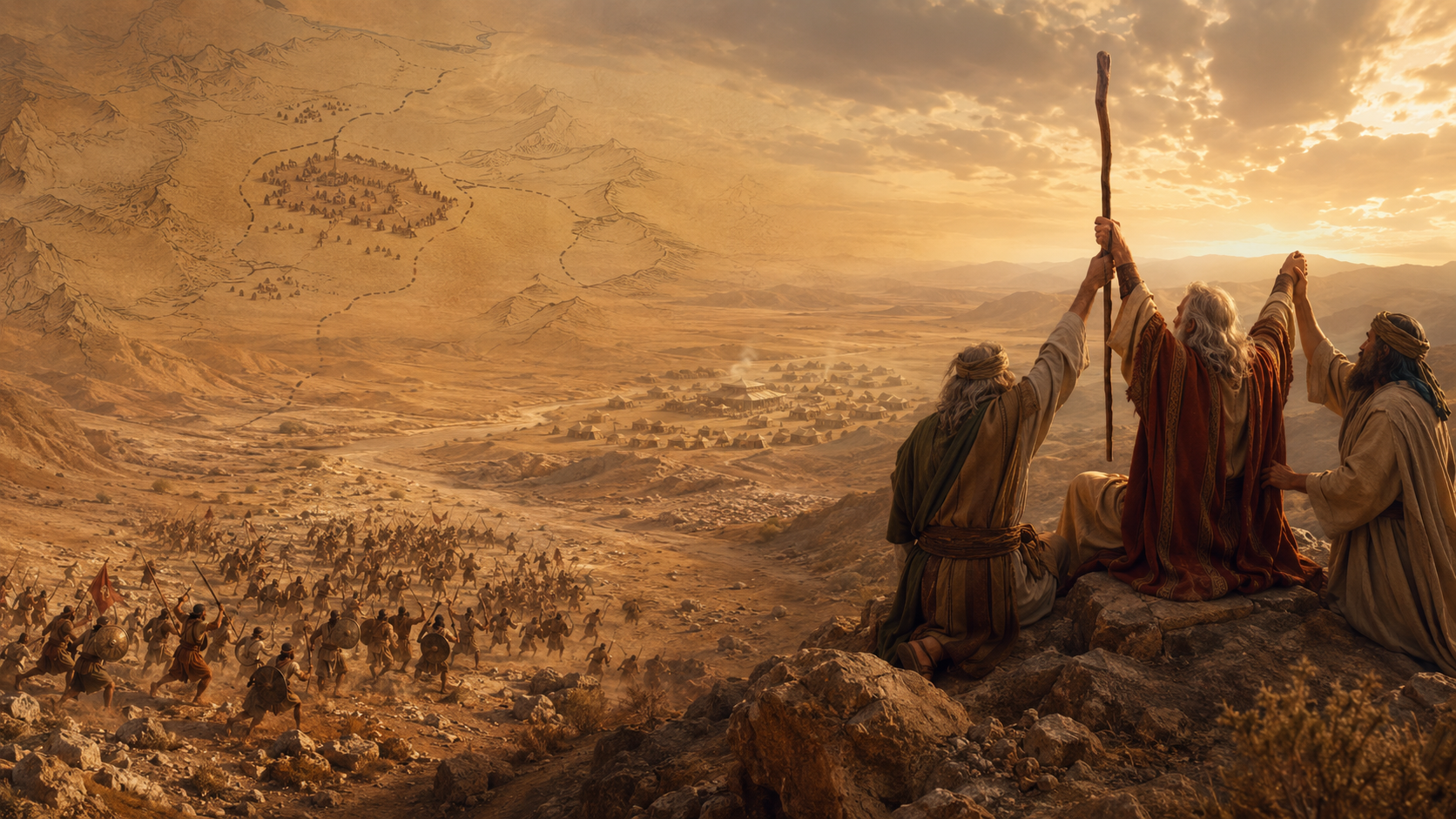
Exodus 17:8–13 — the most visually arresting battle account in the Old Testament
Exodus 17:9–13 — The Battle and the Hill
Verse 9
"So Moses said to Joshua, 'Choose for us men, and go out and fight with Amalek. Tomorrow I will stand on the top of the hill with the staff of God in my hand.'"
Joshua's First Appearance
This is the first mention of Joshua (Hebrew: Yehoshua — YHWH saves) in all of Scripture. He appears without introduction, which suggests he was already a known figure within the community — a leader of some standing who Moses trusted without explanation. He is given a military command for the first time here, setting up the extraordinary career that will culminate in the conquest of Canaan.
Note Moses' division of roles: Joshua fights the battle in the valley. Moses holds the hill with the staff of God. The same staff that struck the Nile and parted the sea is now being held aloft over a military engagement. The continuity of the instrument is deliberate — this is not a military strategy. It is a continuation of the same divine power that has been operating since Egypt.
Verses 11–12
"Whenever Moses held up his hand, Israel prevailed, and whenever he lowered his hand, Amalek prevailed. But Moses' hands grew heavy, so they took a stone and put it under him, and he sat on it, while Aaron and Hur held up his hands, one on one side, and the other on the other side. So his hands were steady until the going down of the sun."
Hebrew Analysis — Three Key Words
vay'hi yedei Moshe kvedim — "Moses' hands became heavy." Kaved — heavy, weighty, burdensome. The same word used for Pharaoh's hardened heart, for the burden of slavery, for the glory of God. Here it describes the physical weight of arms held up in intercession for hours. The word choice is not accidental — it connects the weight of intercession to the weight of everything else that has been heavy in this story.
va'yikchu even va'yassimu tachtav — "they took a stone and placed it under him." No elaborate throne. No cushioned seat. A stone. They found what was available and they used it. The humility of this image — the leader of two million people sitting on a rock because his arms gave out — is one of the most humanising moments in Moses' entire story.
emunah — "steady, faithful, trustworthy." His hands were emunah until sunset. This is the root of the Hebrew word for faith and faithfulness — amen. Moses' arms held steady with the same word used for God's own steadfast faithfulness. The intercession was sustained — not by Moses' physical strength, which had failed — but by the faithfulness of the men beside him.
What Was Actually Happening on the Hill?
The central interpretive question of this passage is: what was Moses doing with his hands? The text does not use the word "prayer" — it simply says he held up his hand (singular in v.11, plural in v.12). But the raised hands, the staff of God, the direct causal connection to the battle outcome, and the later biblical theology of "lifting holy hands" all point in the same direction: this was intercessory prayer enacted physically.
In ancient Near Eastern iconography, raised hands were the universal posture of petition before a deity — supplication, surrender, appeal. When Moses raised the staff and his hands toward heaven, he was positioning himself as the intermediary between Israel and YHWH, holding the channel of divine power open over the battle below. When his arms dropped, the channel weakened — not because God had withdrawn, but because the human mediator had physically dropped the posture of intercession.
This is theologically uncomfortable in the most productive way. It implies that the outcome of the battle was genuinely contingent — at least in part — on sustained human intercession. God had not predetermined the outcome independent of Moses' participation. The battle required both Joshua fighting in the valley and Moses interceding on the hill. Neither alone was sufficient. Both together were decisive.
The Arms of Moses: The Theology of Intercession
What this scene teaches about prayer, community, and the limits of individual leadership
The Core Theological Principle
The battle of Rephidim establishes one of Scripture's most fundamental principles of intercessory prayer: sustained intercession is not an individual enterprise. Moses needed Aaron and Hur. Not because he was weak — he was the most capable human being in the narrative. But because sustained intercession over extended time exceeds what any single person can maintain alone.
The scene is a picture of the church before it knows it is a picture of the church. One person holding the staff — the instrument of divine authority — raised toward heaven. Two people beside him, holding up the arms that would fall. The outcome of the spiritual battle depending not on one person's heroic endurance but on three people together maintaining what none could maintain alone.
Who Was Hur? — The Most Underappreciated Figure in This Story
Aaron needs no introduction by this point in the narrative. But Hur is mentioned almost in passing — "Aaron and Hur held up his hands" — and is rarely given the attention his role deserves. The identity of Hur, and what the tradition attached to him, deepens this passage considerably.
Historical & Textual Context — Who Was Hur?
Hur appears here (Exodus 17:12) and in Exodus 24:14, where Moses and Aaron leave the elders of Israel in the care of Aaron and Hur while Moses goes up the mountain to receive the law. These two appearances are his only biblical mentions, but they place him in positions of significant authority — one of the two men trusted to lead the entire community in Moses' absence.
The rabbinic tradition (based on Josephus' account in Antiquities of the Jews, 3.2.4) identifies Hur as the husband of Miriam — Moses' sister. If this is correct, Hur is not merely a military official or elder but a member of Moses' extended family, someone who understood the weight of what was at stake because he was bound to the mission by both loyalty and love.
Even more significantly: in Exodus 35:30, after the Tabernacle instructions are given, Moses names Bezalel son of Uri son of Hur as the master craftsman appointed by God to build the Tabernacle. Hur's grandson will build God's dwelling place among Israel. The man who held up Moses' arms at Rephidim was the grandfather of the craftsman who built the place where God would dwell. There is a line of faithful service running from the hill at Rephidim to the completed Tabernacle — and Hur stands at the beginning of it.
The Stone He Sat On — A Theology of Practical Support
The stone that Aaron and Hur placed under Moses is one of the most theologically modest and most practically important objects in the entire Exodus narrative. It does nothing supernatural. It is not a miracle. It is two men who saw a need and met it with what was immediately available.
They did not pray for Moses to have stronger arms. They did not rebuke him for his weakness. They did not wait for God to provide a supernatural solution. They picked up a stone and put it under him. And then they stood beside him and held his arms up. They used ordinary material — a rock from the desert floor — to solve an urgent practical problem in service of a spiritual battle.
This is a picture of what the body of Christ is supposed to be to its leaders. Not an audience that watches leaders perform until they collapse. Not a community that provides criticism when the leader's arms fall. A community of Aarons and Hurs who see the weight, find the stone, sit beside the weary one, and hold the arms up until the sun goes down.
Did You Know — The Arms of Moses in Christian Art
The scene of Moses with his arms raised at Rephidim became one of the earliest and most persistent images in Christian art — specifically because the Church Fathers read it as a direct type of the crucifixion. Justin Martyr (c. 160 AD) in his Dialogue with Trypho wrote: "For unless he did this, the people could not conquer, as we have shown, Moses by the symbol of the cross held it back." Tertullian (c. 200 AD) wrote that Moses' outstretched arms were a figure of the cross, and that Joshua's victory prefigured Christ's victory over the spiritual enemies of humanity.
The visual parallel is striking: Moses with arms extended on a hill, flanked by two companions, with the outcome of a cosmic battle dependent on his posture. The crucifixion: Jesus with arms extended on a hill, flanked by two crucified men, with the outcome of the battle against sin and death depending on what He endures with those outstretched arms.
Whether or not this typological reading was the original intent of Exodus 17, it has the virtue of theological coherence: the intercessor with arms raised, sustained by those beside him, winning a battle for others by what he does on the hill — this is the shape of the cross. Moses' arms at Rephidim are one of the earliest cross-shadows in the wilderness narrative.
Joshua: Israel's Next Leader Appears
The man who will succeed Moses takes the field for the first time
The appearance of Joshua at Rephidim is not merely a military detail. It is the introduction of Moses' successor. The man who will lead Israel across the Jordan, who will oversee the conquest of Canaan, who will distribute the land of promise to the twelve tribes — this man's first recorded action in Scripture is fighting a battle at Moses' command while Moses prays on the hill above him.
Hebrew Word Study — Yehoshua (יְהוֹשֻׁעַ)
Joshua's name is Yehoshua — a compound of YHWH (the divine name) and yasha (to save, to deliver). His name means: YHWH saves or YHWH is salvation.
This is identical in meaning to the name Jesus — Yeshua in Aramaic, the shortened form of Yehoshua. When the New Testament was translated into Greek, both Joshua and Jesus became Iesous. This means that every time the Greek Old Testament (the Septuagint) writes the name "Joshua," it writes the same word as the New Testament writes for "Jesus."
Hebrews 4:8 exploits this directly: "For if Joshua [Greek: Iesous] had given them rest, God would not have spoken of another day later on." The writer of Hebrews plays on the identity of the names: Joshua/Jesus — one led Israel into the earthly land of rest; the other leads God's people into the ultimate rest. The succession Moses → Joshua points forward to the succession Law → Christ.
Did You Know — Joshua's Other Name
Numbers 13:16 records something remarkable: Joshua's original name was Hoshea (from the same root yasha, meaning salvation, but without the divine prefix YHWH). Moses renamed him Yehoshua — adding YHWH to his name. The same pattern as Abram becoming Abraham, Sarai becoming Sarah — God adds to the name when He adds to the calling.
Moses renamed the man he was preparing to be his successor. He added the name of God to the name of a man who was already identified with salvation. As if to say: what you will do, you will not do in your own strength or your own identity. YHWH will save through you. Your very name will carry the announcement of your mission. And two thousand years later, a son of David would bear the same name, the full weight of the same announcement, for the whole world.
YHWH Nissi: The Altar and the Name
Exodus 17:14–16 — another new name of God, and the declaration of perpetual war
Exodus 17:14–16 — The Memorial and the Name
Verses 14–15
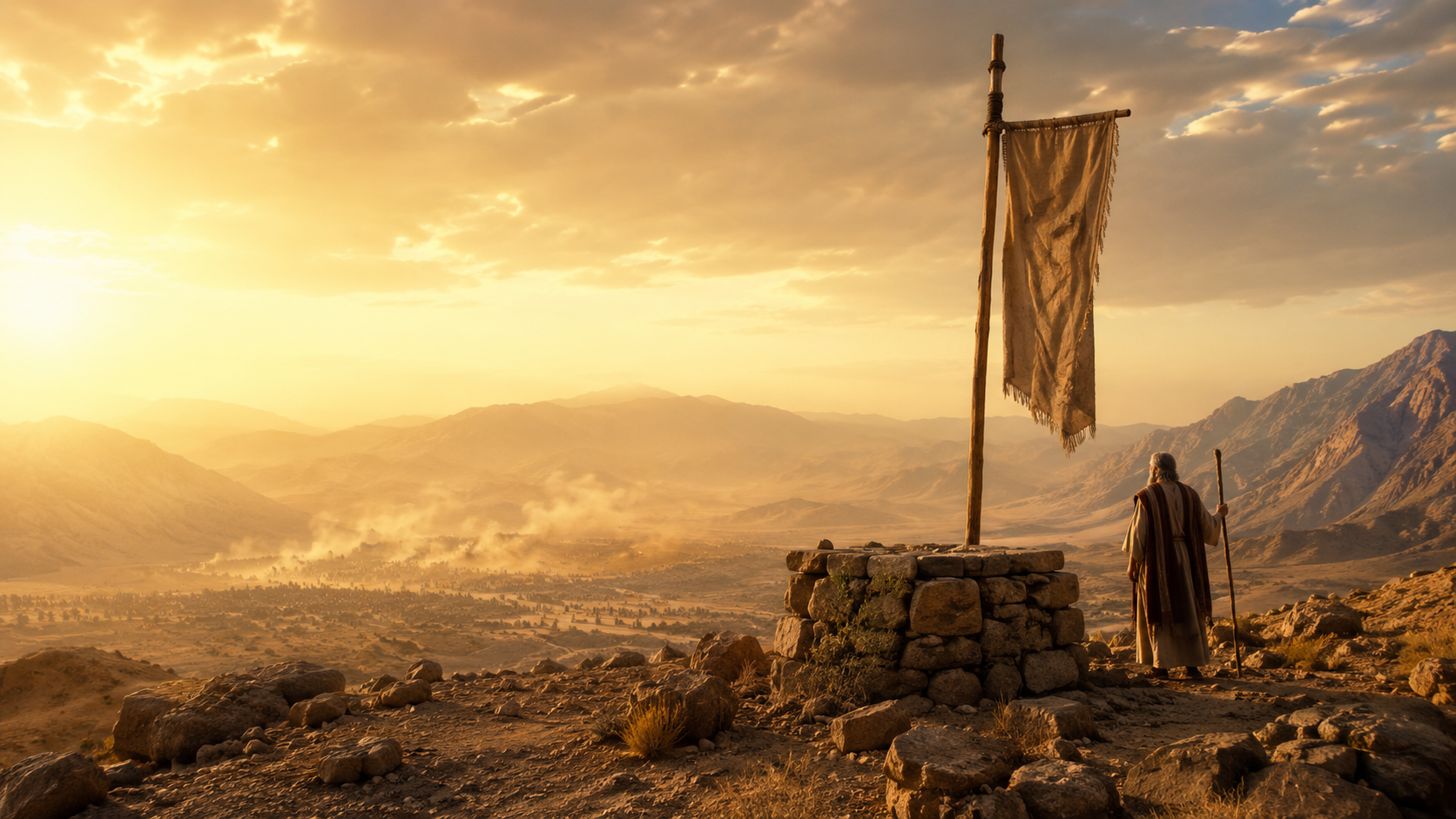
"Then the LORD said to Moses, 'Write this as a memorial in a book and recite it in the ears of Joshua, that I will utterly blot out the memory of Amalek from under heaven.' And Moses built an altar and called the name of it, 'The LORD Is My Banner.'"
YHWH Nissi — The Lord Is My Banner
YHWH Nissi — "The LORD is my banner/standard." Nes (banner, standard, signal) was the military flag or pole raised to rally troops and direct battle. In ancient Near Eastern warfare, the standard was the visible focal point of the army — the place the soldiers looked to know who was winning, where to rally, what direction to press. It was the sign of the commander's presence and authority.
Moses names the altar not after the victory, not after Joshua's military skill, but after YHWH as the battle standard. What won the battle was not the army in the valley — it was the LORD who was the true banner, the true rallying point, the true commander. The staff of God held aloft on the hill was the visible expression of the real banner: YHWH Nissi, the LORD whose presence is the signal for His people to press forward.
This is the second compound divine name revealed in the wilderness — after YHWH Rophecha (the LORD your healer) at Marah. The wilderness is a classroom in the names of God, each new crisis disclosing a new facet of the divine character. God reveals who He is through what His people need from Him at their most desperate moments.
Verse 16
"...A hand upon the throne of the LORD! The LORD will have war with Amalek from generation to generation."
The Most Difficult Verse in This Passage
Exodus 17:16 is one of the most debated verses in the Hebrew Bible. The text is uncertain: some manuscripts read ki yad al-kes Yah — "a hand is upon the throne of Yah," suggesting the divine throne is involved in the perpetual declaration of war against Amalek.
The traditional interpretation: God's throne itself is diminished while Amalek exists — YHWH's full sovereignty over creation cannot be complete while the spirit that Amalek embodies (predatory exploitation of the vulnerable) remains in the world. The war against Amalek is not a tribal conflict. It is the cosmic conflict between the character of God (who protects the weak) and the character of Amalek (who destroys the weak). This war will not end until the Amalek-spirit is completely eliminated.
The Revelation connection: Revelation 19 describes the final victory of the LORD of Hosts in battle against the enemies of His people — the ultimate fulfilment of the "war with Amalek from generation to generation." The perpetual conflict declared at Rephidim ends at the Second Coming when the One whose banner is raised over all creation wins the final battle in the valley.
Jethro's Visit: Wisdom from Outside the Camp
Exodus 18:1–27 — when the greatest leader in Israel needed someone else to tell him he was doing it wrong
The appearance of Joshua at Rephidim is not merely a military detail. It is the introduction of Moses' successor. The man who will lead Israel across the Jordan, who will oversee the conquest of Canaan, who will distribute the land of promise to the twelve tribes — this man's first recorded action in Scripture is fighting a battle at Moses' command while Moses prays on the hill above him.
Exodus 18 is one of the most practically significant chapters in the entire book of Moses — and one of the most surprising. It is the chapter where Moses, at the height of his leadership, receives a critique of his leadership from his father-in-law and immediately acts on it. No defensiveness. No appeal to divine authority. No "God told me to do it this way." Just: you are right. I will do what you say.
The Setting: What Moses Was Actually Doing
Exodus 18:13 paints the picture: Moses sat as judge over the people from morning to evening. The people stood around him from morning until evening. All day. Every day. An endless queue of disputes, questions, interpretations of God's laws, conflicts between community members — everything that required a decision came to Moses. One man. All decisions.
Jethro watched for one day. And then he said what he said: "What you are doing is not good." Not wrong in intention. Not sinful. Simply not good — not sustainable, not functional, not wise. The Hebrew lo-tov — not good — is exactly the opposite of what God declared over each day of creation (vayar Elohim ki tov — God saw that it was good). What Moses was doing was anti-creational: not ordered, not sustainable, not designed for flourishing.
Jethro's Assessment — Exodus 18:17–18
"What you are doing is not good. You and the people with you will certainly wear yourselves out, for the thing is too heavy for you. You are not able to do it alone."
Three statements. Each one worth examining:
"You will certainly wear yourselves out." The Hebrew is naval tibol — you will certainly wilt, wither, waste away. The verb naval is used for fading flowers and withering leaves. Jethro is watching Moses wither in front of his eyes. And he names it plainly.
"The thing is too heavy for you." Kaved mimcha — too heavy from you. The same kaved (heavy) word we saw in Moses' heavy arms at Rephidim, in Pharaoh's heavy heart, in the burden of slavery. The weight of leading two million people through the wilderness is the same word as everything else that has been too heavy in this story. Moses was carrying what no one person was designed to carry.
"You are not able to do it alone." Lo-tuchal asoto l'vaddecha. You. Cannot. Do it. Alone. This is not a criticism of Moses' capacity or character. It is a structural assessment. The system was wrong, not the person. Moses was doing what leaders do when they believe the mission requires them personally to be present in every decision: he was trying to be everywhere, and slowly crushing himself in the attempt.
The Solution: The First Organisational Chart in Scripture
Historical & Cultural Context — What Jethro Proposed
Jethro's proposal in Exodus 18:21–22 is the first explicit organisational hierarchy recorded in Scripture — and it is a remarkably sophisticated piece of management theory for the Bronze Age:
Selection criteria for leaders: capable men (anshei chayil — men of ability, character, and strength), who fear God (yir'ei Elohim — the foundational qualification: not merely talented but God-fearing), men of truth (anshei emet — committed to honesty and integrity), who hate dishonest gain (son'ei batza — incorruptible, without financial motivation for their decisions).
The tiered structure: leaders of thousands, leaders of hundreds, leaders of fifties, leaders of tens. This creates four tiers of judicial/administrative authority below Moses — roughly equivalent to what we would call supreme court (Moses), high court (thousands), appeals court (hundreds), local court (fifties), neighbourhood mediation (tens).
The division of cases: Small matters (the overwhelming majority of daily disputes) would be handled by lower tiers. Only the truly difficult, unprecedented, or theologically significant cases would come to Moses.
This structure becomes the template for Israelite governance throughout the Old Testament. The same tiered system appears in the organisation of the army (Deuteronomy 1:15), the arrangement of the camp (Numbers 2), and the administrative structure of the early monarchy. Jethro's advice at Sinai shaped Israel's institutional life for centuries.
And note where this wisdom came from: outside Israel. Jethro was a Midianite priest — not a member of the covenant community, not a worshipper of YHWH by birth or tradition (though his response to Moses' account of the Exodus suggests genuine theological awakening). The greatest organisational insight in the Exodus narrative was delivered by someone from outside the community. God's wisdom is not the exclusive property of the already-believing. He grants it where He will.
Did You Know — Jethro's Theological Journey
Exodus 18:10–12 records Jethro's response to Moses' account of everything God had done: "Blessed be the LORD, who has delivered you out of the hand of the Egyptians... Now I know that the LORD is greater than all gods." Then he offers a burnt offering and sacrifices to God, and Aaron and all the elders of Israel come to eat bread with him before God.
"Now I know" — ata yadati — suggests that Jethro had known about YHWH, perhaps even believed, but something about hearing the full account of the Exodus had produced a deeper knowledge. The word yada — the intimate relational knowing that appears throughout the Exodus — describes what happened to Jethro when he heard the story. He had known about the God of Israel. Now he knew.
Jewish tradition was divided about what to make of Jethro. The Talmud records significant debate about his status — was he a genuine convert? Some rabbis held that Jethro converted to Judaism. Others saw him as a righteous Gentile who acknowledged YHWH without formally joining Israel. Either way, his meal with Aaron and the elders before God, and his burnt offering, are signals of genuine worship — the outsider drawn in by the testimony of what God had done.
This is the Rahab pattern, the Ruth pattern, the pattern that will eventually become explicit in the New Covenant: testimony to what God has done draws the outsider toward the God who did it. Jethro heard the story. And something moved in him that led him to both worship and wisdom.
Christ Connections: The Intercessor, the Banner, the Better Joshua
How Rephidim and Jethro's visit point forward to the cross, the church, and Christ's ongoing intercession
Moses' Arms and Christ's Intercession — Hebrews 7:23–25
The scene on the hill at Rephidim — Moses with arms raised, sustained by Aaron and Hur, interceding for Israel while Joshua fought below — is the Old Testament's clearest image of what the New Testament calls Christ's ongoing intercession.
Hebrews 7:24–25: "but he holds his priesthood permanently, because he continues forever. Consequently, he is able to save to the uttermost those who draw near to God through him, since he always lives to make intercession for them."
Moses' intercession was limited by his humanity: his arms grew heavy, his strength failed, the sunset came. Christ's intercession is permanent: "he always lives to make intercession." Moses needed Aaron and Hur to sustain his arms. Christ needs no one to sustain His — the eternal Son at the right hand of the Father is the permanent, inexhaustible intercessor who never grows weary, whose arms never fall.
Romans 8:34 adds: "Christ Jesus is the one who died — more than that, who was raised — who is at the right hand of God, who indeed is interceding for us." The arms Moses raised at Rephidim were the shadow. The arms of the risen Christ, extended at Calvary and now raised in perpetual intercession at the Father's right hand, are the substance.
The Better Joshua — Hebrews 4:8 and the Name That Travels Through Time
Joshua won the battle of Rephidim and eventually led Israel into the promised land of Canaan. But Hebrews 4:8 makes a startling observation: "For if Joshua had given them rest, God would not have spoken of another day later on."
Joshua gave Israel geographical rest — the land. But Israel's rest in the land was always incomplete, always threatened, eventually lost. The land of Canaan was not the ultimate rest that God had promised. It was the type. The reality was something greater — a rest that the book of Hebrews calls the Sabbath rest still available to the people of God (Hebrews 4:9).
Jesus — Yeshua, the same name as Joshua — is the one who gives this greater rest. Matthew 11:28: "Come to me, all who labour and are heavy laden, and I will give you rest." The same offer Joshua made with a land, Jesus makes with Himself. Not a territory to occupy but a Person to abide in. Not a rest that can be taken away by Amalek or Babylon or Rome — a rest that no enemy can touch because it is found in the one who has conquered every enemy permanently.
Joshua fought Amalek while Moses prayed. Jesus conquered every spiritual enemy — sin, death, the grave — while His own intercession at Calvary sustained the battle. The names are the same. The mission is the same in structure. But the scale and the finality are incomparably greater. Moses' arms were held up by two men at Rephidim for one afternoon. Christ's arms were stretched out on a cross — held there not by Aaron and Hur but by nails, and by love — for the salvation of the world.
YHWH Nissi and the Church — The Banner Over the Beloved
YHWH Nissi — the LORD is my banner — becomes in the New Testament the image of Christ as the rallying point of His people. Isaiah 11:10 (quoted in Romans 15:12) describes the coming Messiah: "The root of Jesse, who shall stand as a signal [nes — banner] for the peoples — of him shall the nations inquire."
The banner raised at Rephidim to signal the LORD's presence in battle becomes, in Isaiah's eschatology, the Messiah raised among the nations as the signal for all peoples to gather. And in John 12:32, Jesus says: "And I, when I am lifted up from the earth, will draw all people to myself." Lifted up — the same word as Moses lifting the staff, the same visual as the banner raised on a hill — now applied to the crucifixion and resurrection. The cross is the ultimate nes, the ultimate banner, raised on the hill of Calvary so that from every direction of the earth, the weary and the war-worn can see it and know where to rally, where the battle turns, where the victory was won.
Song of Songs 2:4 uses the same word in its most intimate form: "He brought me to the banqueting house, and his banner over me was love." YHWH Nissi — from the battle flag on a desert hill to the banner of love over every one who belongs to the Son. The same word, the same God, the same unbroken thread of divine faithfulness.

Devotional
The Arms That Fall — and the People Who Hold Them Up
Moses' arms grew heavy.
Not because he was faithless. Not because he had stopped believing. Not because his prayer was ineffective. He had been standing on a hill with his arms raised since morning, and his arms grew heavy because he was human and arms do that. The spirit was willing but the flesh — even the flesh of the greatest prophet Israel ever knew — had its limits.
And Aaron and Hur did not leave him. They found a stone and they sat him down and they stood beside him and held up his arms until the sun went down. No drama. No speech. No theological commentary on what they were doing. They saw what was needed and they did it.
This is the community of faith at its most essential. Not the community that gathers to watch the gifted leader perform. Not the community that offers critique when the leader's arms fall. But the community of Aaron and Hur — people who see the weight, who do not wait for permission or instruction, who find the stone and use it and stand beside the one whose arms are failing and hold them up.
Every Moses needs an Aaron and a Hur. Every person called to sustained intercession, to long-term spiritual leadership, to the exhausting work of holding something up in prayer for years on end — every such person needs people beside them who will sit them down when they need it and hold their arms up when they can't.
And here is the thing Jethro said that is also true: you cannot do it alone. Moses could not judge two million people alone. You cannot carry what God designed the whole body to carry. The invitation is not to carry more than you were made to carry — it is to be part of a community where what is too heavy for one is distributed among many, where the stone is placed under the weary, where the arms are held until sunset.
Are you an Aaron or a Hur to someone right now? Is there a Moses in your life whose arms are falling — a leader, a pastor, a friend in the middle of a sustained spiritual battle — who needs you to stop watching and start holding? Find the stone. Stand beside them. Hold the arms. The battle in the valley depends on it.
And for those whose arms are falling: let them be held. The stone is not failure. It is the provision that makes the victory possible. Sitting down is not giving up. It is receiving what God sends through the people beside you.

Reflection & Discussion Questions
Personal Reflection
1. Amalek attacked the rear of the column — the faint, the weary, those lagging behind. Who are the "rear of the column" in your community? The people who are struggling to keep pace, who are exhausted, who are most vulnerable? What does it mean to protect and not exploit the faint and weary — and what is your role in that protection?
2.Moses' arms grew heavy and he needed Aaron and Hur to hold them up. Who are the Aaron and Hur in your life — the people who hold up your arms when your strength gives out? And are you an Aaron or Hur to someone else? Is there a person in your life right now whose arms are falling who needs you to stand beside them?
3.Jethro told Moses "you are not able to do it alone" — and Moses listened and acted immediately without defensiveness. What is the area of your life or leadership where you are trying to carry something that was designed for a community, not an individual? What is the equivalent of "the thing is too heavy for you" in your current season?
Deeper Study
4. Trace the Amalek thread from Genesis 36:12 through Exodus 17, Numbers 14, 1 Samuel 15, and Esther 3. What is the theological significance of the fact that Haman the Agagite (Esther's enemy) was a descendant of the Amalekite king that Saul failed to destroy? What does this 900-year thread teach about the long-range consequences of incomplete obedience?
5.The Church Fathers (Justin Martyr, Tertullian) read Moses' outstretched arms on the hill as a type of the crucifixion. Do you find this typological reading compelling? What are the specific structural parallels — and what is different? How does the comparison deepen your understanding of both the battle at Rephidim and the cross?
6.Read Hebrews 7:23–25 alongside Exodus 17:8–13. What is the difference between Moses' intercession on the hill (which could fail when his arms fell) and Christ's intercession at the right hand of the Father (which "always lives")? What does permanent, unceasing intercession mean for the believer's confidence before God?
7.Jethro was a Midianite priest — an outsider — and his advice restructured Israelite governance for centuries. What does this tell you about where God's wisdom comes from? Have you ever received life-changing wisdom from someone you would not have expected to carry it? What does Moses' immediate receptivity to Jethro's critique teach about the posture of genuine leadership?

Closing Prayer
A Prayer for Those Whose Arms Are Falling
YHWH Nissi — LORD our Banner —
You are the rallying point. When the battle is fiercest, when the enemy is gaining ground, when the army is looking for the signal that tells them where the commander stands — You are the banner on the hill. You are the standard around which Your people gather. You were lifted up at Calvary as the ultimate banner, and You draw all people to Yourself.
We thank You that You are not the kind of intercessor whose arms grow heavy. That You always live to make intercession for us. That there is no sunset after which You lower Your hands and the battle turns against us. The arms that were stretched on the cross are now raised at Your Father's right hand, and they will not fall. They will never fall.
We confess that we have sometimes tried to be Moses without an Aaron and Hur — carrying what we were not designed to carry alone, refusing to sit on the stone, trying to hold everything up by our own endurance until we collapse. Give us the humility of Moses who sat when he needed to sit, who let his arms be held, who received the stone as provision rather than experiencing it as failure.
We pray for the Aarons and Hurs — the people who stand beside the weary ones and hold them up. Who find the stone. Who don't wait to be asked. Make us that kind of community: attentive to those whose arms are falling, practical in our help, persistent until the sun goes down.
And we pray for the Jethros — the outside voices, the wise ones who see what we cannot see about our own systems and speak it plainly without cruelty. Give leaders the courage to hear what Jethro said, to receive it without defensiveness, and to act on it with the same speed Moses showed.
The battle is Yours. The victory is Yours. The banner is Yours. We will keep our eyes on the hill.
Amen.
Coming Next in the Series
Part Fifteen: Mount Sinai — Thunder, Fire, and the Presence of the Holy
Israel arrives at Sinai. The mountain smokes and shakes. The trumpet blast grows louder and louder. God descends in fire. The people are terrified and stand far off. And Moses — the man who hid his face at the burning bush — goes into the thick darkness where God was. Part Fifteen examines the theophany at Sinai in full: the three days of preparation, the boundaries around the mountain, what the fire and cloud and earthquake meant theologically, and what it meant for God to come down to a mountain and speak to a people in audible words.
Add comment
Comments