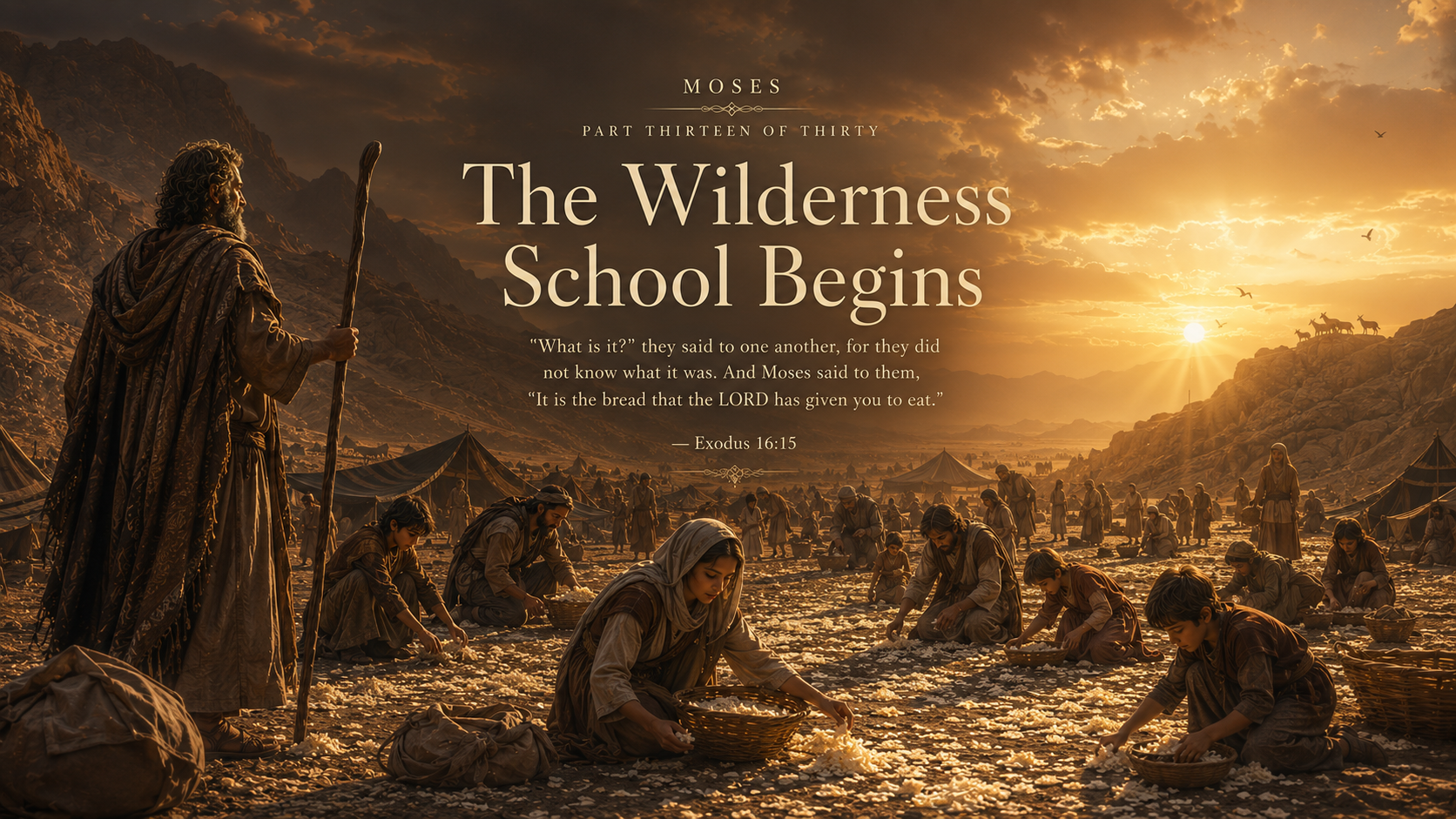
"What is it?" they said to one another, for they did not know what it was. And Moses said to them, "It is the bread that the LORD has given you to eat."
— Exodus 16:15
Please Read These Passages First
Before You Begin This Study
Part Thirteen covers one of the richest and most theologically layered stretches of the entire wilderness narrative. Please read the full passage through slowly before the commentary. Notice the rhythm of the wilderness testing: crisis — complaint — provision — test again. It repeats. This repetition is not accidental. It is the curriculum.
Pay particular attention to the specific instructions about the manna — especially the Sabbath regulations. The Sabbath appears here, in the wilderness, before Sinai. That detail changes everything about how you understand the Ten Commandments in Exodus 20.
Exodus 15:22–27 Exodus 16:1–36 Exodus 17:1–7
John 6:25–58 Hebrews 3:7–19
Optional deeper reading:
Numbers 11 (the deeper grumbling about manna, the quail, and the crisis of leadership);
Deuteronomy 8:1–5 (Moses' retrospective on the manna and what it was teaching);
Psalm 78:17–31 (the poet's theological retelling of the wilderness provision and rebellion);
Nehemiah 9:15–21 (the great prayer that rehearses the wilderness faithfulness of God);
1 Corinthians 10:1–13 (Paul's wilderness warning to the church).
Exodus 15:22-27
Exodus 16:1-7
Exodus 16:8-12
Exodus 16:13-21
Exodus 16:22-26
Exodus 17:1-7
The Story
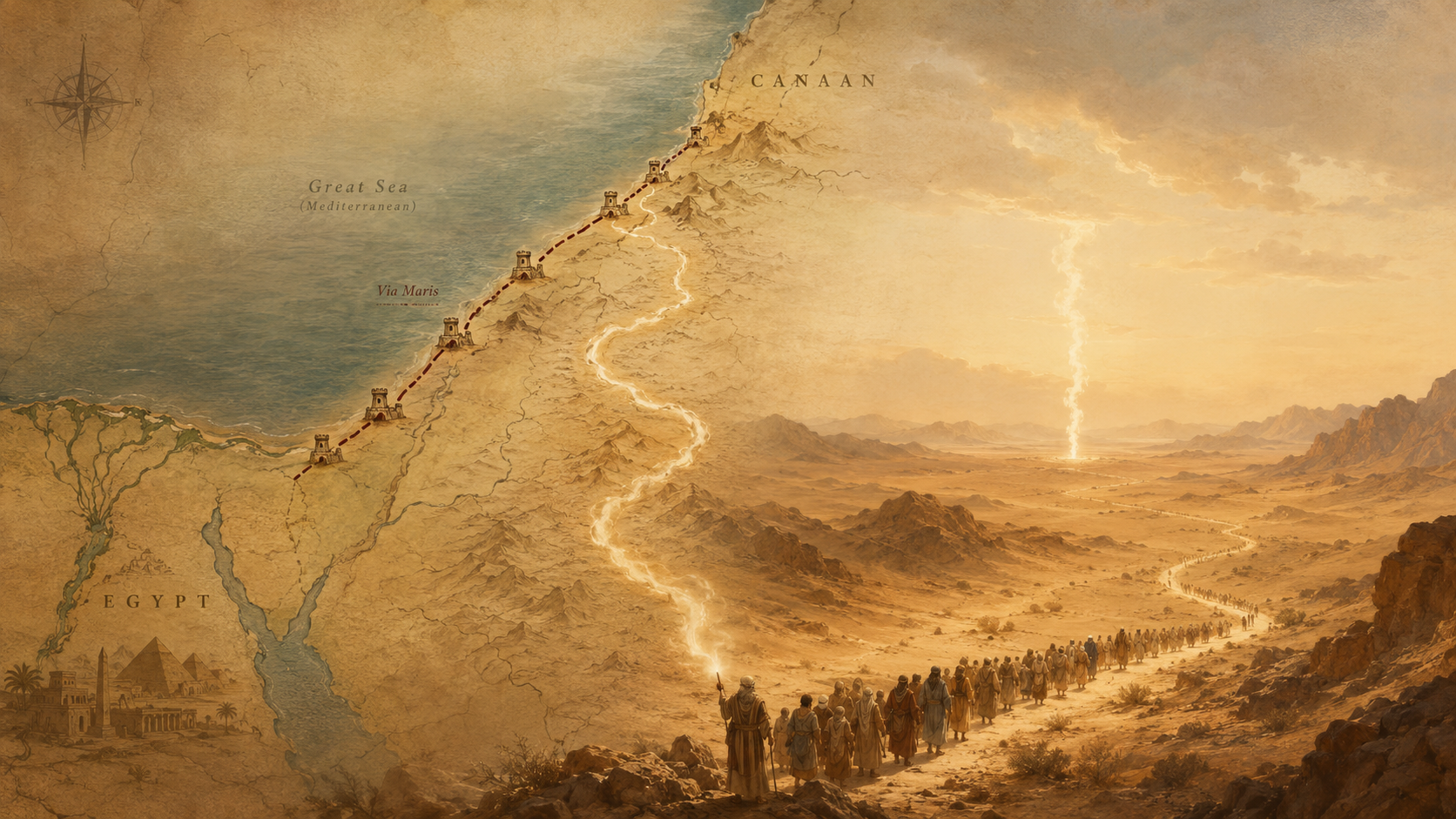
Three days out of Egypt. The school had just opened.
Three days after the crossing of the sea — three days — the people had no water.
Three days. That is all it took. From the far shore of the sea, where they had sung the Song of Moses with tambourines and dancing and looked back at the Egyptian army dead on the beach — to muttering and thirst and the beginning of the long, complicated, deeply human wilderness failure. Three days from miracle to crisis. Three days from singing to complaining. And in between: the desert of Shur, which is exactly what it sounds like — a vast, featureless expanse of wilderness east of Egypt, where the ground is rocky and white and the sun is a physical adversary and the difference between water and no water is the difference between life and death.
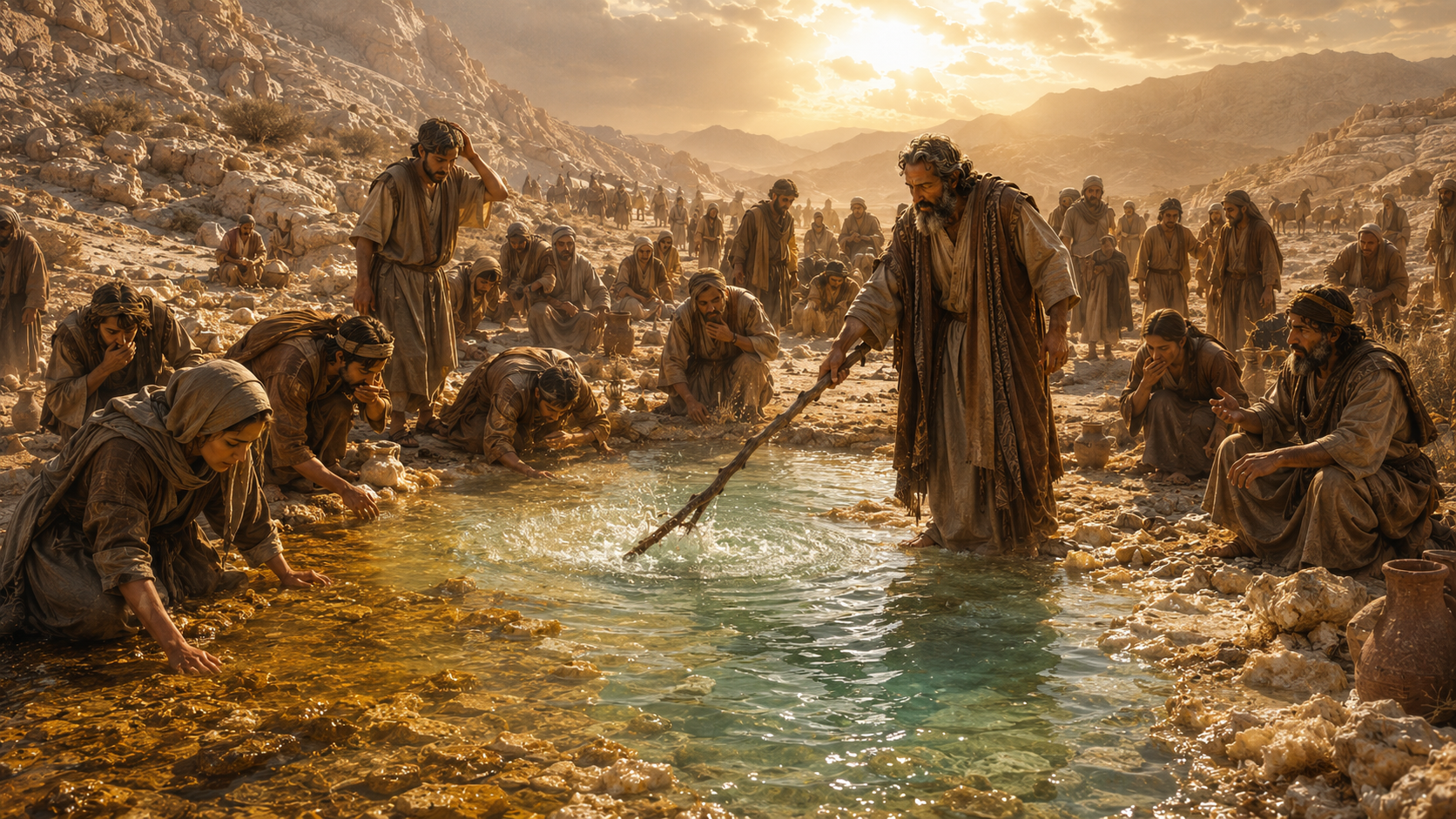
They found water at Marah. Finally — after three days of nothing — a spring, a pool, a source. And they ran to it. And they tasted it. And it was bitter. Undrinkable. The Hebrew word Marah means bitter — the same root used in Exodus 1:14 for the bitterness of slavery, the same root used for Naomi's self-renaming in Ruth 1:20 ("do not call me Naomi; call me Mara, for the Almighty has dealt very bitterly with me"). The place is named for its water. The water is named for how it tasted. And Israel, who had just watched YHWH turn the bitter Nile to blood and split the sea and drown Pharaoh's army — Israel looked at this bitter spring and said: what are we to drink?
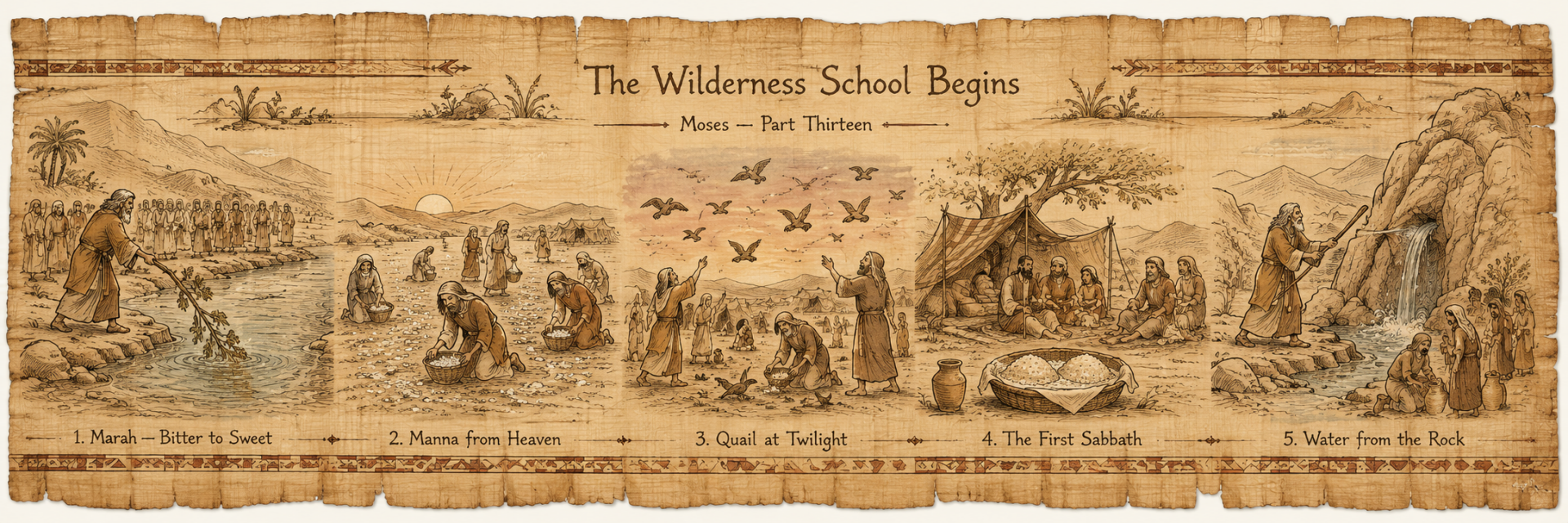
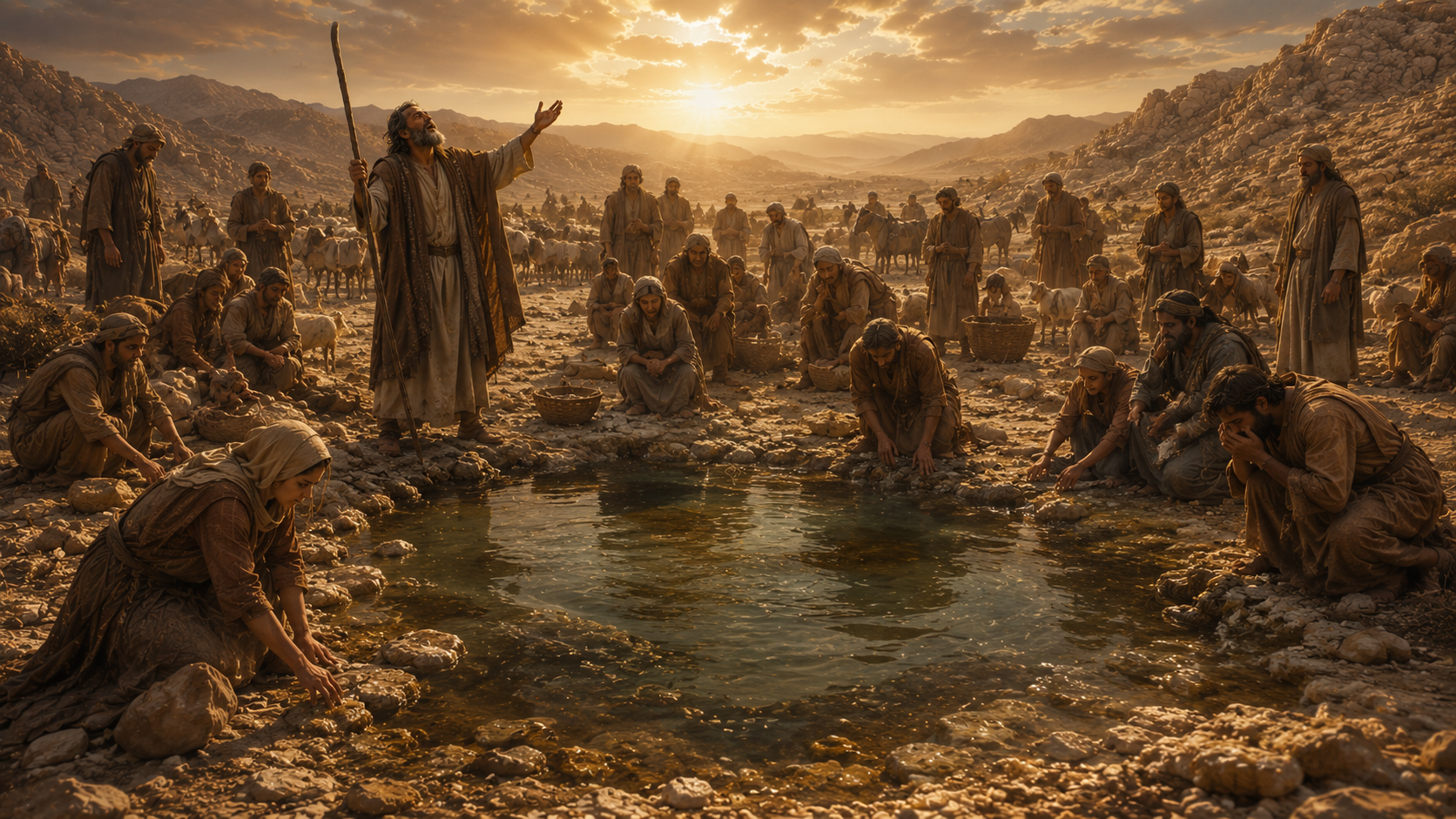
Moses cried to the LORD. And the LORD showed him a tree. Moses threw it into the water. And the water became sweet.
A tree made the bitter water sweet. The text says it as simply as that. A tree. Thrown into poisoned water. And the water was healed.
And then — immediately after the sweetening, in the same breath — God said something that reframes everything that has just happened. Exodus 15:25b–26: "There the LORD made for them a statute and a rule, and there he tested them, saying, 'If you will diligently listen to the voice of the LORD your God, and do that which is right in his eyes, and give ear to his commandments and keep all his statutes, I will put none of the diseases on you that I put on the Egyptians, for I am the LORD, your healer.'"
God healed the water. And then He said: I am YHWH Rophecha — the LORD your healer. And then He said: the crisis you just experienced was a test. The bitter water was not a divine mistake that required a correction. It was a classroom. Marah was not an accident on the way to Elim. It was the first lesson of the wilderness school.
The Bread That Fell From the Sky
Elim had twelve springs and seventy palm trees. They camped there. The text notes both numbers with the precision of people who had learned to count water sources. Twelve springs. Seventy palms. It was enough. It was good.
And then they left Elim. And the whole congregation of Israel came into the wilderness of Sin — which is not named for moral failing but possibly for the moon-god Sin, whose worship was widespread in the ancient Near East. And the whole congregation began to complain against Moses and Aaron in the wilderness.
Exodus 16:3:"Would that we had died by the hand of the LORD in the land of Egypt, when we sat by the meat pots and ate bread to the full, for you have brought us out into this wilderness to kill this whole assembly with hunger."
The meat pots of Egypt. The bread to the full. This is the wilderness mythology that Israel will build and rebuild throughout the forty years: a golden image of their slavery as somehow comfortable, even abundant, compared to the hunger of the desert. They are hungry and afraid, and so they have rewritten their past. They sat by meat pots. They ate bread to the full. As if Pharaoh were a generous host rather than a slave-driver. As if the bitterness of slavery that their ancestors had cried out about for four hundred years was actually a kind of feast. Fear rewrites the past. Hunger reimagines captivity as provision.
And God heard the complaint. And did not thunder. Did not rebuke. Did not call down judgment on a people who had, within six weeks of the greatest miracle in human history, told Him they'd rather be back in Egypt.
He gave them bread.
"Behold, I am about to rain bread from heaven for you."
Rain. Bread. From heaven. The metaphor is staggering: rain does not come from human effort or human supply chains. You cannot command it, schedule it, or pay for it. Rain simply comes — from above, from outside the economy of human effort, free, unexpected, beyond what any natural system could produce. And what rained from the sky was bread. Sustenance. The most basic human need, provided from the most inaccessible possible source. God was going to feed two million people in a desert, daily, for forty years, from the sky.
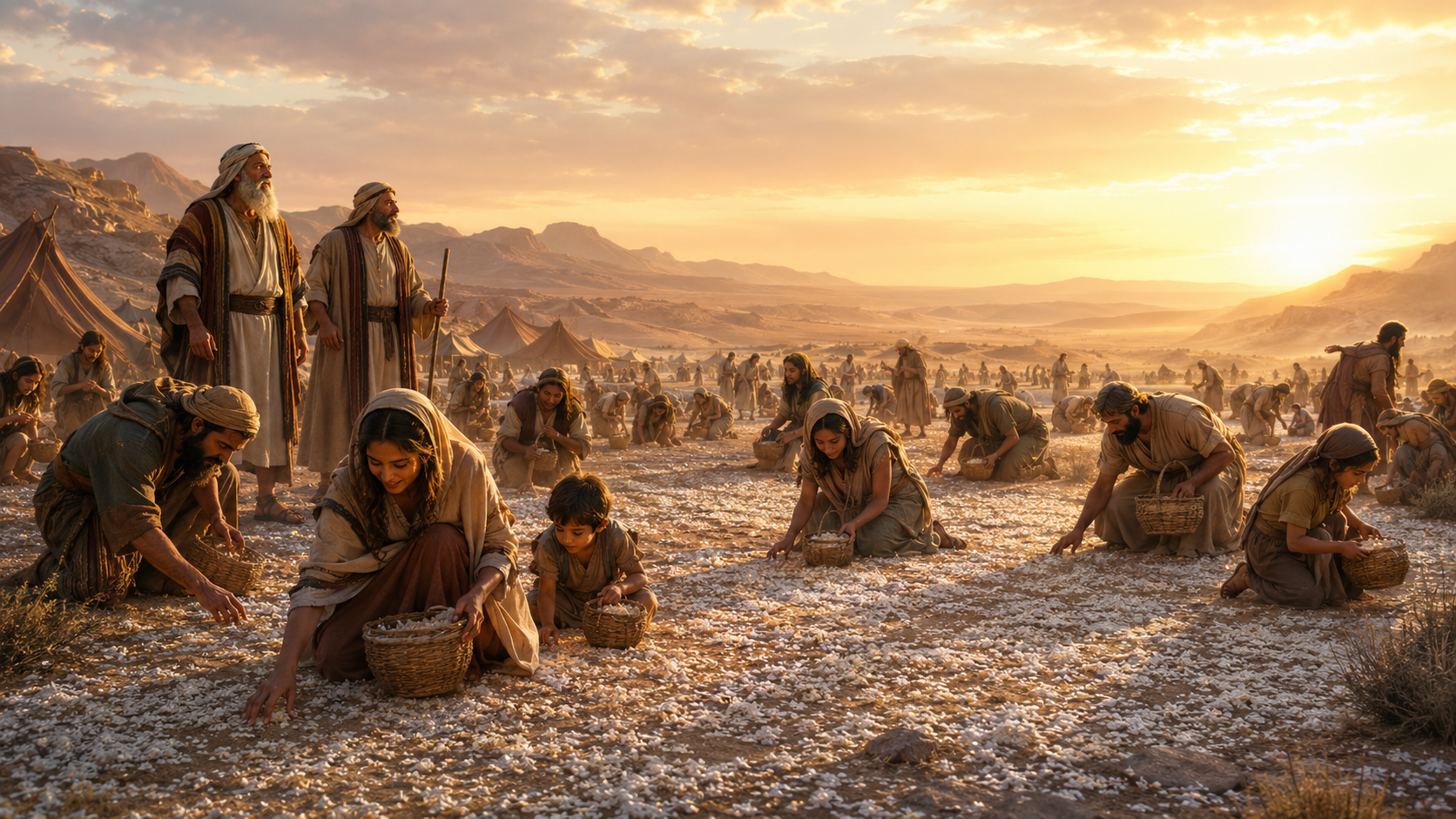
In the morning, when the dew lifted, there was something on the desert floor. Fine, flake-like, thin as frost on the ground. The people looked at it and said to each other: Man hu? What is it? And Moses said: it is the bread that the LORD has given you to eat.
And the thing they named with a question — "what is it?" — became its name. Manna. From man hu: What-is-it. For forty years, Israel ate What-is-it every morning and did not fully understand what it was.
The Sabbath and the Rock
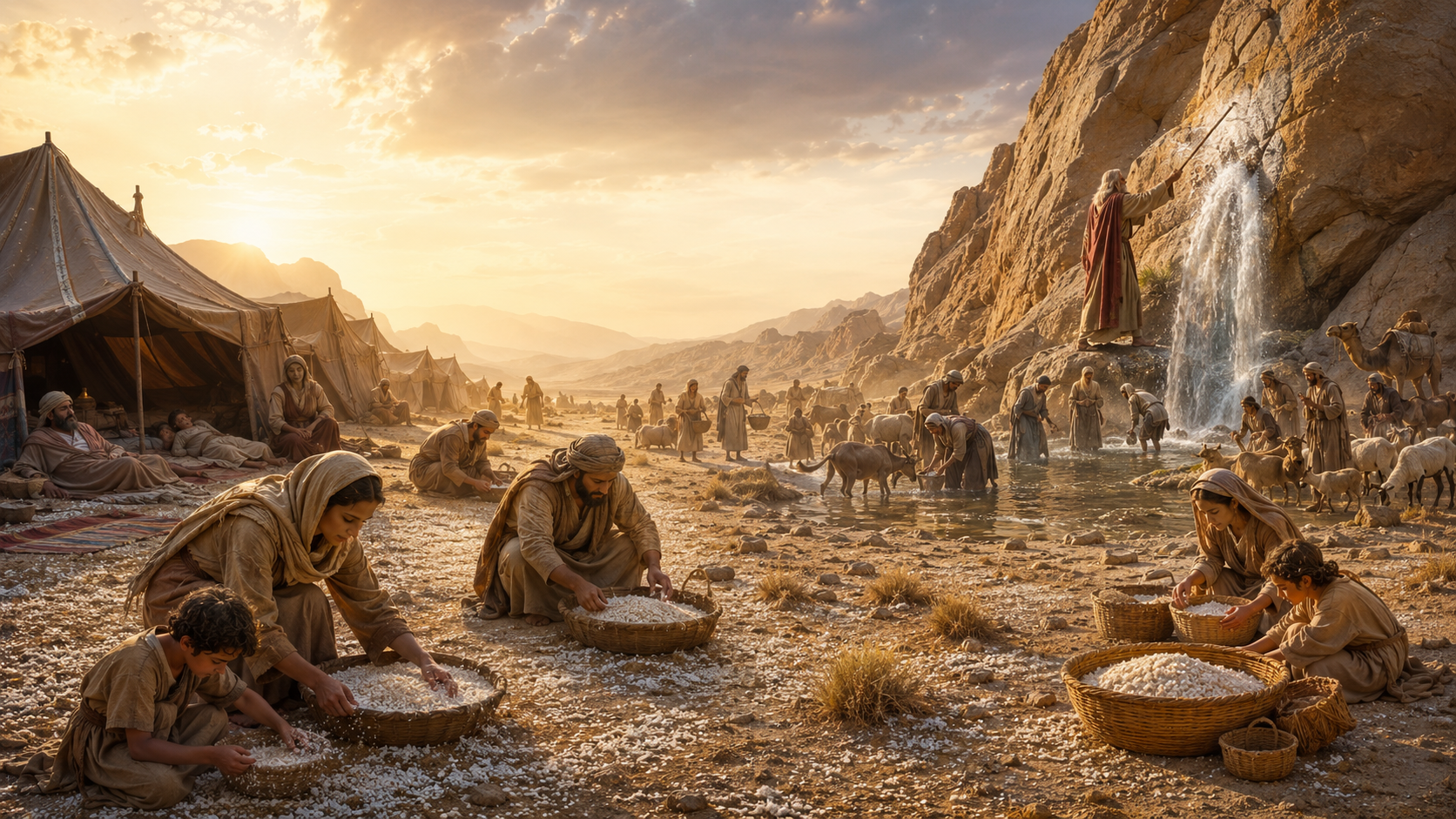
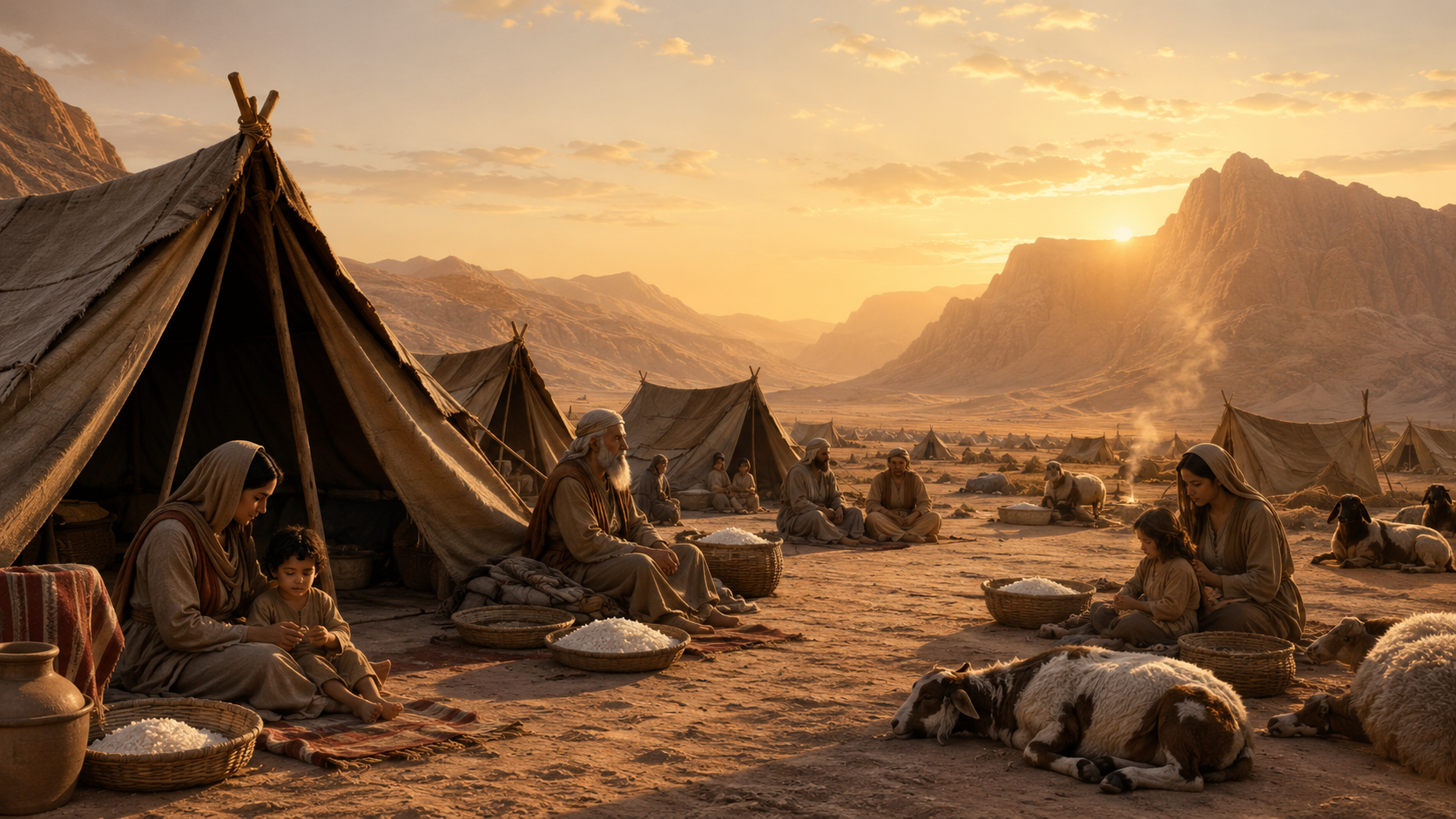
With the manna came rules. Daily, they were to gather enough for that day — one omer per person, no more. If they gathered more, it would rot overnight, breed worms, stink. They were not to store it. They were not to hedge against tomorrow's provision by taking more than they needed today. The manna was designed to be non-hoardable. Its chemistry — whatever it was — made stockpiling impossible. You could not secure your future with manna. You could only receive today's portion and trust that tomorrow's would come.
This is harder than it sounds. Every survival instinct says: take as much as you can while it's available. Store it. Prepare for scarcity. The manna said: don't. Receive what you need for today. Trust that God will provide tomorrow what He is providing now. This was daily training in the discipline that Jesus would later summarise in Matthew 6:11: give us this day our daily bread. Not this week's. Not this month's. Today's.
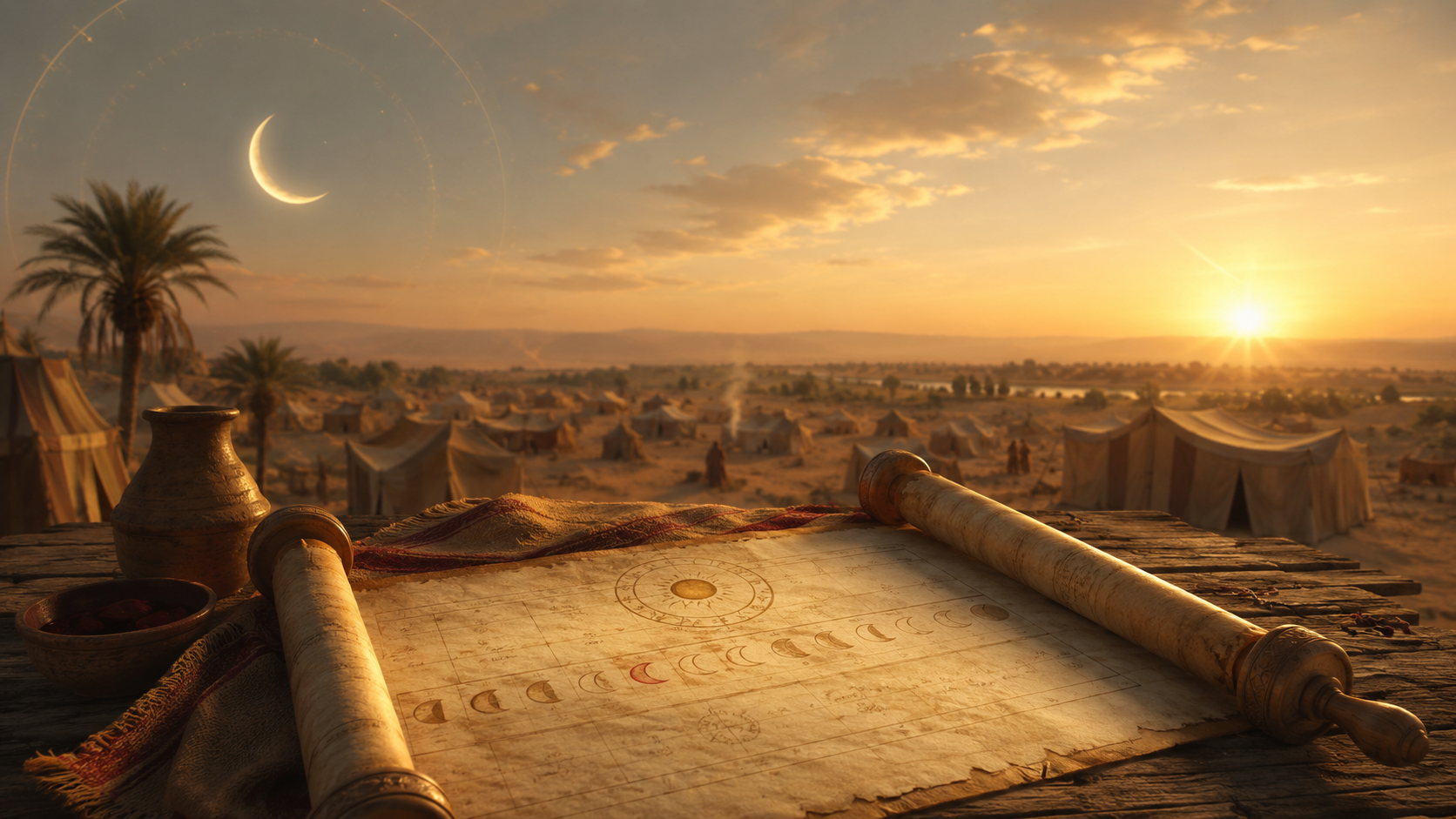
On the sixth day, something different. The manna doubled. Two omers per person appeared. And Moses said: eat today's portion and set aside the rest — because tomorrow is the Sabbath, a day of solemn rest. There will be no manna on the Sabbath. And so some people went out on the seventh day to gather, and found nothing. And the LORD said to Moses: how long will you refuse to keep my commandments and my laws?
The Sabbath arrived not as a commandment carved in stone at Sinai. It arrived as a rhythm built into the manna. The creation rest of Genesis 2 was being written into the daily bread of the wilderness. Before the covenant ceremony, before the law, before the mountain — Israel was already learning to live by a seven-day pattern in which the seventh day was different. Sacred. Empty of labour. Full of something harder to name.
And when Israel moved from Elim and the wilderness of Sin, they camped at Rephidim. And there was no water for the people to drink. And the people quarrelled with Moses and said: give us water to drink. And Moses said: why do you quarrel with me? Why do you test the LORD? And the people thirsted there for water, and the people grumbled against Moses and said: why did you bring us up out of Egypt, to kill us and our children and our livestock with thirst?
Moses cried out to the LORD: what shall I do with this people? They are almost ready to stone me.
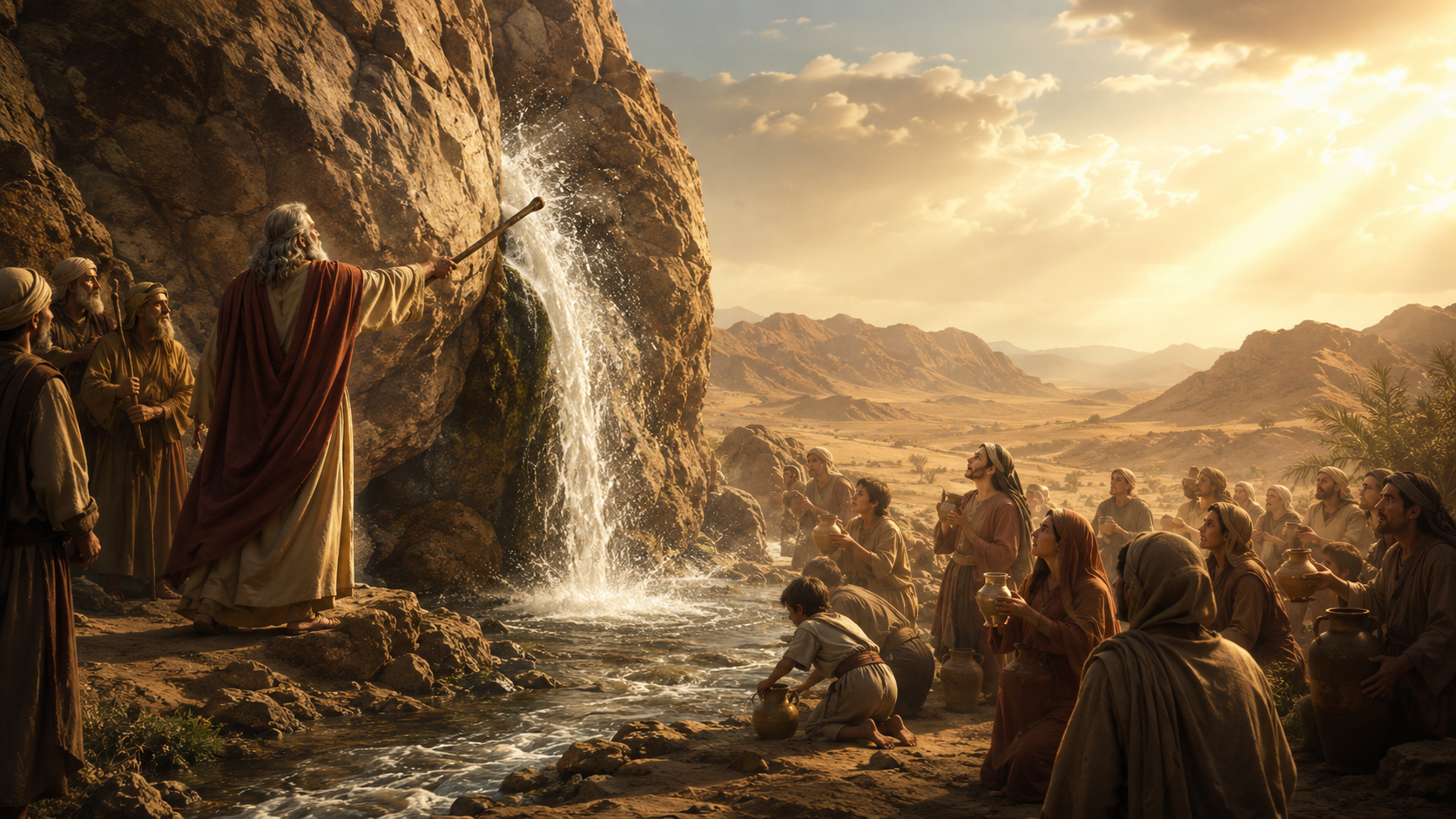
And the LORD said: take in your hand the staff with which you struck the Nile, and go. I will stand before you on the rock at Horeb, and you shall strike the rock, and water shall come out of it, and the people will drink. Moses did so, in the sight of the elders of Israel. He called the name of the place Massah and Meribah — Testing and Quarrelling — because of the quarrel of the people of Israel, and because they tested the LORD by saying: is the LORD among us or not?
Is the LORD among us or not? After the Passover night. After the sea. After the bitter water sweetened, after the manna every morning, after the quail at twilight, after the doubled portion on the sixth day — after all of it, the question: is the LORD among us or not?
The answer was: yes. He was standing on the rock. The water they were dying of thirst for was already in the rock. They just needed to strike it to release it. He was there. He had been there the whole time. They simply could not see it through their fear and their hunger and their thirty-day memory that kept looking backwards toward Egypt instead of forward toward Sinai.
Marah: The Bitter Made Sweet
Exodus 15:22–27 — The first test, the first healing, and a name of God you may never have heard
Marah is the first stop after the sea. Israel travels three days into the wilderness of Shur — a desert region on the eastern frontier of Egypt, likely in the northwestern Sinai Peninsula — and finds the only available water source is undrinkable. The crisis is immediate. In desert conditions, three days without water is already approaching the physiological limit for a large population. The complaint is urgent, not petulant. They are genuinely at risk.
Exodus 15:23–26 — The Bitter Water and Its Healing
Verses 23–25
"When they came to Marah, they could not drink the water of Marah because it was bitter; therefore it was named Marah. And the people grumbled against Moses, saying, 'What shall we drink?' And he cried to the LORD, and the LORD showed him a tree. And he threw it into the water, and the water became sweet."
Hebrew Analysis
Marah — bitter, from the root mar. The same root: merorim (the bitter herbs of the Passover meal, Exodus 12:8), vaymarer (the Egyptians "made their lives bitter," Exodus 1:14), and Naomi's self-renaming as Mara in Ruth 1:20. Bitterness in Scripture is always connected to suffering — it is the taste of slavery, of grief, of unhealed wounds.
vayitz'ak el-YHWH — "and he cried to the LORD." The verb tzaak (to cry out, to shout) is the same verb used in Exodus 2:23 when Israel cried out under their slavery — the cry that God heard. Moses does exactly what Israel did in Egypt: he takes the impossibility to God rather than trying to manage it himself. This is the first of many moments in the wilderness where Moses models the right response to an unsolvable problem.
va'yorehu YHWH etz — "and the LORD showed him a tree." The word etz means tree or wood. This is theologically loaded. The instrument of healing is a tree. Wood thrown into bitter water to make it sweet. We will return to this in the Christological section — but notice for now that the Bible's first act of water-healing is accomplished through wood, and its ultimate act of redemption involves a wooden cross transforming the bitterness of human sin.
Verse 26
"...I will put none of the diseases on you that I put on the Egyptians, for I am the LORD, your healer."
YHWH Rophecha — A New Divine Name
YHWH Rophecha — "the LORD your healer" — or more literally "YHWH who heals you." This is the first of several compound divine names revealed in the wilderness period, each one disclosing a new dimension of God's character in the context of a specific crisis. The pattern: God reveals who He is through what He does in the moment Israel most needs exactly that thing.
The word rapha (to heal) appears throughout the Hebrew Bible in contexts ranging from physical healing to the restoration of broken relationships to the healing of nations (Jeremiah 33:6; Isaiah 57:18–19). YHWH Rophecha is not merely a medical claim. It is a covenantal promise: I am the God who restores what is broken, sweetens what is bitter, makes drinkable what was undrinkable. I am the Healer — of water, of bodies, of nations, of histories.
The conditional structure — "if you will listen... I will not put diseases on you" — is not a threat but the nature of covenant: certain conditions produce certain outcomes. The healing God offers is available to a listening, obedient people. The diseases of Egypt — all ten plagues — were the consequences of Egypt's non-listening. Israel's health will come through its listening. Torah (divine instruction) and healing belong together in the Hebrew mind.
The Tree at Marah: A Theological and Natural Footnote
Was There a Natural Explanation? The Moringa Tree Hypothesis
Several scholars and naturalists have proposed that the tree God showed Moses may have been the Moringa peregrina — a tree native to the Sinai Peninsula and surrounding regions, whose seeds are documented to have water-purifying properties. Modern research has confirmed that Moringa seeds contain compounds (polyelectrolytes) that cause fine suspended particles in turbid water to clump and settle, clarifying and purifying the water. Some modern humanitarian organisations actually use Moringa seeds as a low-cost, natural water purification agent in developing contexts.
Does this natural mechanism explain the Marah miracle? As with the other Exodus plagues and miracles, the question is not whether God can use natural mechanisms — He clearly can and does. The question is: who showed Moses the specific tree? God did. The miracle is in the revelation and the specific application — and in the theological meaning attached to it. Whether Moringa's chemistry was involved or not, the theological reality stands: God made bitter water sweet through a tree, and declared Himself the Healer of His people.
Did You Know — Elim's Numbers
After Marah, Israel arrives at Elim (Exodus 15:27): "where there were twelve springs of water and seventy palm trees, and they encamped there by the water."
Twelve springs and seventy palms — these numbers are not incidental. Twelve is the number of the tribes of Israel. Seventy is the number of the elders of Israel (Exodus 24:1), the number of Jacob's descendants who went to Egypt (Genesis 46:27), and the traditional number of nations in the table of nations (Genesis 10). In Hebrew symbolic numerology, God led His twelve-tribe people to a place with twelve springs — exactly enough for each tribe — and seventy palms, the shade of the seventy nations. The resting place is numerologically perfect. This may be coincidence. It may be Providence writing with numbers. The tradition of Jewish interpretation noticed it and has never stopped noticing it.
Manna: What Is It?
Exodus 16:1–36 — The most extraordinary daily provision in human history, and what it was actually teaching
The manna account in Exodus 16 is one of the most detailed, most specific, and most theologically intentional miracle accounts in the entire Torah. It is not a brief note about miraculous food. It is a 36-verse extended narrative that specifies the quantity, the appearance, the taste, the method of preparation, the daily timing, the Sabbath exception, the command to preserve a jar of it, and the duration. Every detail is load-bearing theology.
What Manna Actually Was
The Physical Description — What Did It Look, Taste, and Feel Like?
Appearance: Exodus 16:14 — "a fine, flake-like thing, fine as frost on the ground." Numbers 11:7 elaborates: "the manna was like coriander seed, and its appearance like that of bdellium" (a translucent, resin-like substance with a pearl-like quality). It appeared each morning after the dew lifted, covering the desert floor like a natural occurrence.
Taste: Exodus 16:31 — "like wafers made with honey." Numbers 11:8 — "the taste of it was like the taste of cakes baked with oil." Honey-wafers and oil-cakes. Not survival rations. A food with genuine flavour, sweetness, richness. God did not feed Israel with something barely edible. He gave them something that tasted good.
Quantity: One omer per person per day (approximately 2 litres). For a population of even the most conservative estimates of the Exodus assembly (hundreds of thousands), the daily total represented an enormous volume of food materialising from nothing.
Preparation: Numbers 11:8 — "the people went about and gathered it and ground it in handmills or beat it in mortars and boiled it in pots and made cakes of it." It required actual kitchen work. It was not swallowed raw. Israel had to process it — grind it, cook it, bake it. Even miraculous provision required human participation.
Duration: Forty years. Exodus 16:35 and Joshua 5:12 together confirm: the manna began the day Israel needed it in the wilderness of Sin and stopped the day after they ate the produce of the land of Canaan for the first time, the day after they crossed the Jordan. Not one day early. Not one day late.
Hebrew Word Study — Manna (מָן)
The word manna comes from the Aramaic/Hebrew expression man hu — literally "What is it?" When the Israelites first saw it, they said to each other: man hu? What is this? (Exodus 16:15). Moses then explains what it is. But the name they gave it was the question they asked when they first encountered it — and they never quite stopped asking. Even after forty years of eating it every morning, Israel never fully understood what manna was. It remained, to the end, "What is it?" — the mystery food, the unexplained daily provision from a source beyond human knowledge.
Has anything been identified as a natural parallel? The Sinai has a substance secreted by certain insects feeding on the tamarisk tree (Tamarix nilotica) — a honey-like flake that falls on the ground and is still called "man" by local Bedouin today. It does appear seasonally (June–August) in small quantities and melts in the sun. Some scholars have proposed this as the natural core of the manna miracle. However: this natural substance appears only seasonally, not year-round; it is available in tiny quantities, not enough to sustain millions; it does not come daily; and it does not double on the sixth day or cease on the seventh. If this is the natural basis, the miracle is in the quantity, the timing, the regularity, and the Sabbath-precision — all of which far exceed anything the natural phenomenon can produce.
The Manna's Rules — and What They Were Teaching
The manna came with five specific rules, each one a lesson embedded in the daily bread of the wilderness.
Rule 1: Gather only what you need for today.
One omer per person. No more. This is counter-instinctual for people who have spent four hundred years in scarcity — whose entire survival orientation was "take more when it's available." The manna trained out the scarcity mindset by making hoarding impossible. Tomorrow's manna would come tomorrow. Today's trust is enough for today.
Rule 2: Do not keep any until morning.
Whatever was left over — even a little — bred worms and stank (Exodus 16:20). This was not metaphorical. The manna literally decomposed overnight if kept. You could not accumulate it. You could not invest it. You could not secure your future with it. This forced daily dependence. Every morning was a new act of trust: will it come again? And every morning — for forty years — it did.
Rule 3: On the sixth day, gather twice as much.
The double portion appeared before the people knew about the Sabbath — God's provision preceded the instruction. They noticed the double portion, came to Moses puzzled, and he explained: one portion for today, one portion for tomorrow — because tomorrow is the Sabbath. This is the first explicit institution of the weekly Sabbath rhythm in the wilderness. Remarkably, the doubled portion kept overnight without spoiling (Exodus 16:24) — the one exception to Rule 2, built into the manna's design.
Rule 4: No work on the Sabbath — no gathering.
Some people went out on the seventh day to gather and found nothing (Exodus 16:27). God asked Moses: how long will you refuse to keep my commandments? The Sabbath was already a commandment before the Ten Commandments were given at Sinai. The wilderness manna revealed that the Sabbath rhythm was not Sinai's invention — it was creation's pattern, written into the bread of the wilderness.
Rule 5: Keep an omer of manna forever.
Exodus 16:33–34 — Moses instructed Aaron to take a jar of manna and place it before the LORD, to be kept throughout all generations. This jar of manna was later placed inside the Ark of the Covenant (Hebrews 9:4) — the most sacred object in Israel's worship, alongside the tablets of the law and Aaron's rod that budded. The bread of the wilderness, preserved in the Ark, was a perpetual testimony: this is what God gave us in the desert. This is who He proved Himself to be.
Did You Know — The Manna Never Changed
Numbers 11 records that later in the wilderness, Israel became so tired of manna that they wept over it. They cried about it. "We remember the fish we ate in Egypt that cost nothing, the cucumbers, the melons, the leeks, the onions, and the garlic." They listed the vegetables of their slavery with nostalgia that would be comical if it weren't so spiritually revealing. And then: "but now our strength is dried up, and there is nothing at all but this manna to look at" (Numbers 11:6).
Forty years of honey-flavoured wafers. The same food every morning for four decades. In Numbers 11:8, the Israelites are grinding it, boiling it, baking it — trying to make something different out of it. They are cooking the miraculous bread in hopes of variety. They cannot make it into something other than what it is. The manna is the manna, every morning, until the day it stops.
There is a profound theology here. God provides precisely what is needed — not necessarily what is wanted. The manna was sufficient. It was even good. But it was not what the people wanted after a while. The wilderness test is not only: will you trust God to provide? It is also: will you receive what He provides with gratitude, or will you look at the miraculous provision and wish it were something else?
Deuteronomy 8: Moses' Retrospective on Why the Manna
Deuteronomy 8:2–3 — The Purpose of the Manna, Explained 40 Years Later
Deuteronomy 8:2–3
"And you shall remember the whole way that the LORD your God has led you these forty years in the wilderness, that he might humble you, testing you to know what was in your heart, whether you would keep his commandments or not. And he humbled you and let you hunger and fed you with manna, which you did not know, nor did your fathers know, that he might make you know that man does not live by bread alone, but man lives by every word that comes from the mouth of God."
Hebrew Analysis — The Purpose Disclosed
l'anot'cha — "that he might humble you." The verb anah (to humble, to afflict, to bring low) is the same root used for the affliction of Israel in Egypt. The wilderness was a different kind of affliction — not Pharaoh's oppression but God's formation. Both were anah. Both humbled. But one was servitude under empire; the other was discipleship under grace.
l'nassotcha — "testing you." Every manna morning was a test: will they follow the instructions? Will they trust? Will they be content with today's provision? Will they rest on the Sabbath? The test was not about whether God knew the answers. He knew. It was about whether Israel knew themselves — what their hearts were actually made of, whether their faith was real or merely the faith of people who had not yet been tested.
lo al-halechem l'vado yichyeh ha'adam ki al-kol-motza pi-YHWH — "Man does not live by bread alone, but by every word that comes from the mouth of God." This is the verse Jesus quotes to Satan in the wilderness temptation (Matthew 4:4; Luke 4:4). Jesus, fasting forty days and forty nights in the wilderness (echoing Israel's forty years), is offered bread. He quotes Moses' retrospective on the manna. The manna taught Israel that life depends on God's word more fundamentally than on physical sustenance. Jesus demonstrates that He Himself lives by this principle. He will not turn stones into bread to satisfy hunger that the Father has not provided for. He will wait for the Father's word.
The Quail at Twilight — An Often-Missed Provision
Exodus 16:12–13 — Quail in the Evening
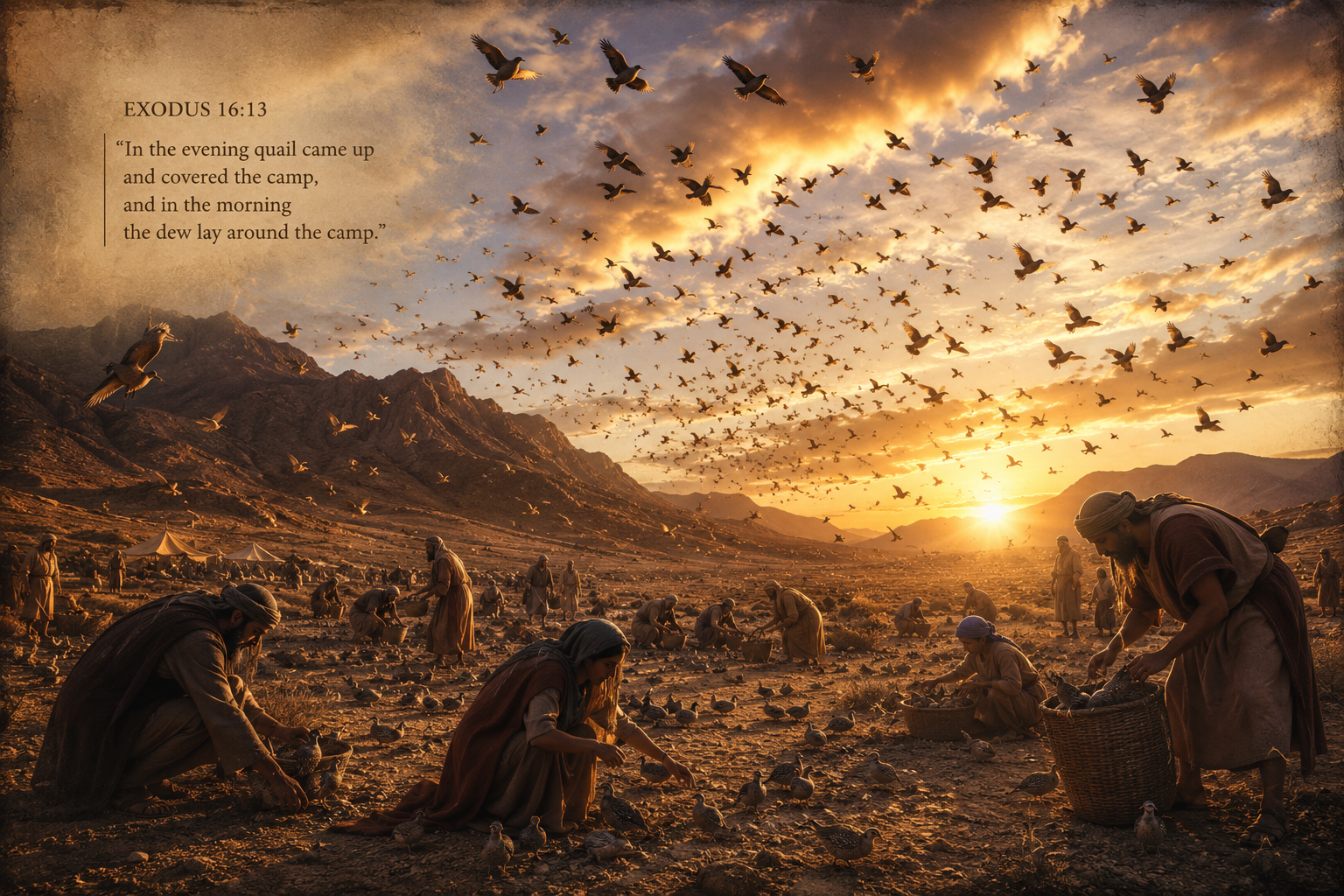
Before the manna appeared in the morning, quail appeared in the evening. Exodus 16:13: "In the evening quail came up and covered the camp." This provision is often overshadowed by the dramatic manna narrative, but it is equally miraculous and reveals something about how God hears complaints.
Israel had complained specifically about meat — "we sat by the meat pots" (Exodus 16:3). God answered this specific complaint with quail — actual meat, flying into the camp. The provision matched the complaint at its most specific. God did not provide a general nutritional substitute. He gave them what they asked for, in the very form they were craving.
The Natural Mechanism: Quail (Coturnix coturnix) migrate seasonally across the Sinai Peninsula — they cross the peninsula in enormous numbers in spring and autumn, flying exhausted from their sea crossing and landing wherever they can rest. They are extremely easy to catch in this exhausted state. This migration route is well-documented by ornithologists. The miracle at Marah-level (as with the manna) lies in the precise timing and scale — but the natural mechanism is real and observable. This is YHWH working with His own creation, not around it.
Note for Deeper Study: The Numbers 11 quail account is darker than Exodus 16 — there, the people's craving becomes obsession, and God gives them so much quail that it becomes a plague. The contrast between Exodus 16 (gracious provision) and Numbers 11 (provision become punishment) is one of the wilderness narrative's most theologically complex threads. Exodus 16 is the gift. Numbers 11 is what happens when the gift becomes an idol.
The Sabbath Before Sinai
The most significant theological surprise in Exodus 16 — the seventh day already sacred
This is perhaps the single most important detail in Exodus 16 that most readers miss entirely. The Sabbath is revealed here — not at Sinai. The Ten Commandments in Exodus 20:8–11 say "Remember the Sabbath day, to keep it holy." Remember. Not "observe for the first time." Remember. The Sabbath command at Sinai assumes Israel already knows about the Sabbath. Because they do. It was built into the manna six weeks before Sinai.
The Sabbath in Exodus 16 — Before the Law
Exodus 16:23–26: Moses told the people that the sixth day's double portion was for eating and for keeping until morning — because tomorrow, the seventh day, is "a Sabbath of solemn rest (Shabbat Shabbaton), a holy Sabbath to the LORD." This is the first explicit occurrence of the word Shabbat as a day designation in the Torah.
The Sabbath rhythm was not invented at Sinai. It was created at the beginning — Genesis 2:2–3: "on the seventh day God finished his work that he had done, and he rested on the seventh day." The creation Sabbath was built into the fabric of time before any human law existed. What the wilderness manna does is reveal that this creation rhythm is also a human rhythm — that Israel is to live by the same pattern God demonstrated in the beginning: six days of work, one day of rest. Not as a law to be kept under penalty, but as a gift to be received, already present in the design of time itself.
The Sabbath command at Sinai does not establish the Sabbath. It establishes Israel's covenant obligation to honour what was already true about the universe. "Remember" the Sabbath day — remember what you learned in the wilderness, what you learned from the manna, what the creation week has always been telling you: time has a rhythm, and the seventh beat is different.
Did You Know — The Sabbath is Unlike Every Other Commandment
The fourth commandment (the Sabbath) is the longest of the Ten Commandments — nearly twice the length of any other. Exodus 20:8–11 takes four verses to address something the other commandments handle in one or two words. It grounds itself in creation ("for in six days the LORD made heaven and earth... and he rested on the seventh day") rather than in covenant history (the way the other commandments are grounded). It extends to servants and sojourners and even animals — the only commandment that includes livestock in its scope. And it grounds human rest in divine rest. You rest because God rested. Your weekly rhythm echoes the rhythm of the cosmos.
The Sabbath is the only one of the Ten Commandments that is not universally affirmed by Christian ethics as a permanent moral law. Early Christians shifted worship to the first day of the week (Sunday — the day of resurrection), raising the question of whether the Sabbath was a moral law, a ceremonial law, or something else entirely. Colossians 2:16–17 describes the Sabbath as a "shadow of things to come, but the substance belongs to Christ." Hebrews 4 speaks of a "Sabbath rest" still available to the people of God — a rest that the Canaan entry did not fully achieve. The Sabbath points beyond the seventh day to the ultimate rest of the people of God in the fullness of the Kingdom.
Water from the Rock: Massah and Meribah
Exodus 17:1–7 — The rock at Horeb, and the question that haunts the wilderness
Exodus 17:1–7 — The Quarrel at Rephidim
Verses 1–4
"The whole congregation of the people of Israel moved on from the wilderness of Sin by stages, as the LORD commanded, and camped at Rephidim, but there was no water for the people to drink. Therefore the people quarrelled with Moses and said, 'Give us water to drink.' And Moses said to them, 'Why do you quarrel with me? Why do you test the LORD?' But the people thirsted there for water, and the people grumbled against Moses and said, 'Why did you bring us up out of Egypt, to kill us and our children and our livestock with thirst?' So Moses cried to the LORD, 'What shall I do with this people? They are almost ready to stone me.'"
Hebrew Analysis — Two Names for One Place
Massah u'Meribah — "Testing and Quarrelling." Moses gives this place two names for the same event, reflecting two dimensions of what happened. Massah from nasah (to test, to try) — what Israel did to God. Meribah from riv (to contend, to quarrel, to bring a legal case) — what Israel did to Moses.
The place name becomes one of the most referenced negative examples in the entire Hebrew Bible. Psalm 78:17–20; Psalm 95:8–9; Psalm 106:32–33; Hebrews 3:8 — all cite Massah and Meribah as the paradigmatic case of wilderness rebellion, the failure of faith that should never be repeated. The place is named, memorised, and perpetually referenced as a warning. Don't be like Israel at Meribah.
hayesh YHWH b'kirbenu im-ayin — "Is the LORD among us or not?" This is the question at the heart of the Rephidim crisis — and it is the question at the heart of every crisis of faith. Not: does God exist? But: is He here, in this, in my specific situation right now? The theological content of faith is not merely theism. It is presence-with-me. And Israel, in the wilderness, could not consistently hold onto the conviction of God's specific presence with them, no matter how many signs they had received.
Verses 5–7
"And the LORD said to Moses, 'Pass on before the people, taking with you some of the elders of Israel, and take in your hand the staff with which you struck the Nile, and go. Behold, I will stand before you there on the rock at Horeb, and you shall strike the rock, and water shall come out of it, and the people will drink.' And Moses did so, in the sight of the elders of Israel."
God Stands on the Rock
hineni omeid l'fanecha sham al-hatzur b'Chorev — "Behold, I will stand before you there on the rock at Horeb." The most extraordinary detail in this account is not the water from the rock. It is where God is when Moses strikes the rock. He is already there. Standing on it. The water that Israel needs is inside a rock where God is standing.
This image — God already present in the place of provision, standing on the very source of what His people need — is a compressed theology of divine presence in crisis. Israel is asking "Is the LORD among us or not?" And God has already positioned Himself on the answer: He is on the rock. He is at the source. He was always there. The question was whether Israel had the faith to find Him there.
Paul will draw on this image in 1 Corinthians 10:4: "the Rock was Christ." The spiritual rock that accompanied Israel through the wilderness, the rock on which God stood at Horeb, from which water flowed at Moses' strike — Paul identifies this as Christ. The pre-incarnate Son of God, standing on a desert rock, full of water, waiting for the strike that would release it. This is one of the most startling Christological identifications in the New Testament.
Did You Know — Two Rock-Striking Incidents, One Major Difference
There are two water-from-the-rock incidents in the Torah. This one, in Exodus 17 at Horeb, where Moses is told to strike the rock — and Numbers 20 at Kadesh, near the end of the forty years, where Moses is told to speak to the rock, not strike it.
In Numbers 20, Moses strikes the rock twice in anger instead of speaking to it as instructed — and this single act of disobedience costs him the right to enter the Promised Land. God says: "Because you did not believe in me, to uphold me as holy in the eyes of the people of Israel, therefore you shall not bring this assembly into the land that I have given them."
Why so severe a consequence for what seems like a small difference? Many commentators, drawing on Paul's 1 Corinthians 10:4 identification of the rock as Christ, have proposed a typological explanation: the rock needed to be struck once (the cross — Christ crucified once for all, Hebrews 10:10). After the first striking, it produced water forever when spoken to. By striking the rock again, Moses symbolically re-crucified Christ — performing the irreversible sacrifice again as if it had not been sufficient the first time. The typological integrity of the sign required that the rock be struck once. Moses, in his anger, violated that pattern — and the consequences were permanent.
The Grumbling Pattern — and What It Reveals
Understanding the wilderness murmuring as theology, not moral failure
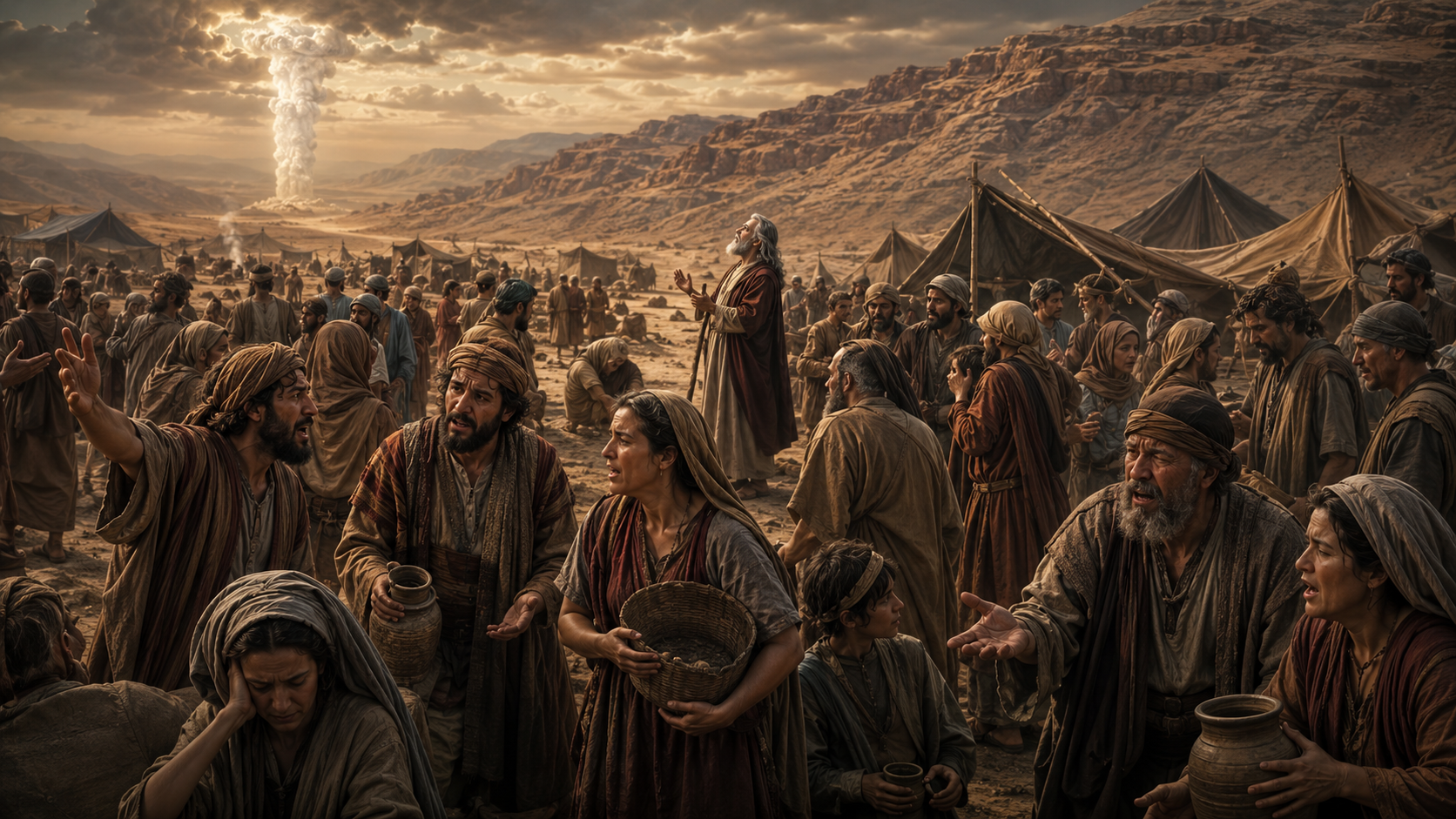
A surface reading of the wilderness narrative leaves many readers frustrated with Israel. The pattern seems so simple: God does something spectacular. Israel is grateful. Three weeks later, Israel is complaining again. Repeat. Forty years. Why couldn't they just trust? Why was gratitude so impossible to sustain?
This is a fair question — but it is also a question that assumes the reader would have done better, which is almost certainly wrong. The wilderness murmuring is not a portrait of an exceptionally faithless people. It is a portrait of the human condition under extended trial. And the New Testament takes it with the utmost seriousness — not as a story about Israel's particular weakness but as a warning for every subsequent generation.
Hebrew Word Study — Lun / Telunot (לון / תְּלוּנֹת) — Grumbling
The primary word for the Israelite grumbling is lun (or lon) — to grumble, to murmur, to complain, to lodge a complaint overnight. The extended form telunot (grumbling, complaints) appears repeatedly in Exodus 16. The word carries a specific sense: not a casual complaint but a settled, sustained opposition — the kind of complaint you "lodge" with someone, that you nurse overnight and bring fresh in the morning. It is the sustained posture of discontent, not a momentary outburst.
Significantly, every grumbling in the wilderness is addressed to Moses and Aaron — but the text consistently clarifies that it is ultimately directed at God. Exodus 16:8: "Your grumbling is not against us but against the LORD." This is the theological horror of the wilderness complaining: the people believe they are criticising their human leaders, but they are actually filing a complaint against God. They are saying, to the One who parted the sea for them: you are not enough. You have not provided. You have failed.
Grumbling requires selective memory.
The Israelites in the wilderness consistently misremember Egypt as a place of abundance ("meat pots," "bread to the full," fish, cucumbers, melons, leeks, onions, garlic — Numbers 11:5). In every case, the remembered bounty of Egypt is set against the current privation of the wilderness. The problem is that the "abundance" of Egypt was the abundance of slaves — food given to sustain the labor of the enslaved, not the generosity of a benevolent master. Fear and hunger distort memory in a specific direction: toward the familiar past and away from the promised future.
Grumbling has a short memory.
The cycle repeats because each new crisis feels like the first — as if none of the previous provisions have occurred. Israel is hungry and says: God has abandoned us to die. As if there was no water at Marah. No manna. No quail. Each crisis is experienced as total, final, unprecedented — because fear collapses the timeline to the present moment only.
Grumbling tests leadership.
Moses is the object of Israel's complaints, and the wilderness narrative is partly a story of how to lead a people through extended trial. Moses' consistent response — crying out to God rather than managing the complaint from his own resources — is the leadership model the text commends. He does not absorb the people's anxiety and try to fix it with his own cleverness. He takes it to God
Grumbling can coexist with genuine faith.
This is perhaps the most important pastoral insight in the wilderness narrative. The Israelites who grumble at Marah and at Sin and at Rephidim are the same people who crossed the sea and sang the Song of Moses. The Psalms — particularly the lament psalms — demonstrate that God expects and accommodates honest expressions of distress, accusation, and despair. The difference between legitimate lament and sinful grumbling is subtle: lament cries out to God; grumbling turns away from God. Both can sound like complaining from the outside.
Paul's Warning in 1 Corinthians 10 — Don't Be Like Israel at Massah
1 Corinthians 10:6–11: "Now these things took place as examples for us, that we might not desire evil as they did. Do not be idolaters as some of them were... We must not put Christ to the test, as some of them did and were destroyed by serpents, nor grumble, as some of them did and were destroyed by the Destroyer. Now these things happened to them as an example, but they were written down for our instruction, on whom the end of the ages has come."
Paul applies the wilderness failures directly to the Corinthian church — and by extension to every subsequent generation of Christians. The wilderness is not ancient history to be read with anthropological detachment. It is a mirror held up to the Christian community: this is what it looks like when the people of God abandon the daily discipline of trust in sustained trial. This is what the church will do if it does not learn from Israel's example.
The specific warning: "do not grumble, as some of them did." The grumbling that cost Israel their entry into the promised land is a live possibility for any community that received the grace of God, experienced His provision, and then — in the middle of the journey — decided that His provision was not enough. The wilderness test is not a uniquely Israelite test. It is the test of every generation between redemption and consummation.
Devotional
Daily Bread — and What We Learn from Eating It Every Day
The wilderness school runs on a single schedule: daily provision, daily dependence, daily trust.
Not weekly. Not monthly. Not the annual celebration of a great redemptive event. Daily. Every morning, before you can do anything else, you have to go out and pick up the thing that will sustain you today. And you have to pick up only enough for today. And you have to trust — against every survival instinct, against every economic logic, against the voice of every catastrophe that has ever made you want to hoard and secure and hedge — that tomorrow's portion will appear tomorrow.
The manna is the curriculum of daily dependence. Israel did not graduate from it. They ate it every morning for forty years and still, at the end of their lives in the wilderness, they were not perfect at trust. They were better than they were. They were formed. They were more than the people who came out of Egypt. But they were not cured. The manna shaped them, year by year, morning by morning, one omer at a time — the way all formation works: repetitively, incrementally, through ordinary daily practice rather than single dramatic transformation.
Jesus teaches us to pray: give us this day our daily bread. Not this year's bread. Not this decade's bread. Today's. The prayer is structured on the manna pattern. You ask for today. You trust for tomorrow. You gather what you need and no more. And you begin again tomorrow.
Some of us are in the wilderness of Sin right now — looking at what God has provided and saying: but is this enough? Is this what You promised? I was expecting something more. Something different. Something that didn't taste exactly the same as yesterday and the day before. The manna is honey-sweet on day one. On day two hundred and forty, you are grinding it in a mill and wishing for something else.
The wilderness school is not designed to give you what you want. It is designed to show you what you need — and it turns out what you need is not variety. What you need is God. Daily. In whatever form He sends His provision. The manna tastes like the answer to the question you actually asked, which is deeper than "what shall we eat?" It is: will He be faithful? The answer comes every morning.
Every morning for forty years, it came. Whatever your Marah is today — whatever bitter water you cannot drink — the tree is coming. The provision is already there, on the rock, waiting. Go out and gather your omer. There will be enough. There has always been enough.
Reflection & Discussion Questions
Personal Reflection
1. Israel arrived at Marah three days after the greatest miracle in their history — and immediately complained. Three days from singing to grumbling. Can you identify moments in your own life where the distance between a profound experience of God's provision and the next crisis of trust was embarrassingly short? What does this tell you about the nature of faith — that it is not a permanent achievement but a daily practice?
2. The manna rules — no hoarding, only enough for today, rest on the seventh day — were training in daily dependence. Which of these rules do you find hardest to live by in your own life? The "only enough for today" principle, the "no hoarding" of provision, or the Sabbath rest? What does your resistance reveal about what you actually trust?
3. Israel in Numbers 11 wept over the manna — they were so tired of it they cried. They romanticised their slavery to have something to compare it to favourably. Have you ever been so weary of God's current provision that you have found yourself nostalgic for the Egypt you left behind — the job, the relationship, the life before the calling? What does Moses' response to Israel's manna-weeping teach you?
Deeper Study
4. The Sabbath appears in Exodus 16 — before Sinai — built into the manna's chemistry. And the Sabbath commandment in Exodus 20 says "remember" rather than "observe for the first time." What does this sequence suggest about the relationship between the creation Sabbath (Genesis 2), the wilderness Sabbath (Exodus 16), and the Sinai Sabbath (Exodus 20)? How does understanding the Sabbath as a creation pattern rather than a Sinai invention change how you relate to rest?
5.Read John 6:25–58 alongside Exodus 16. Map the correspondences Jesus draws between the manna and Himself. Why do many of Jesus' disciples leave after the "eat my flesh, drink my blood" statement (John 6:66)? What were they expecting from the "bread from heaven" metaphor that they weren't prepared to receive?
6.God stands on the rock at Horeb before Moses strikes it — the provision is already in the rock where God is present. Paul says the Rock was Christ. What does God's posture — standing on the source of provision before it is released — tell you about how God's provision relates to His presence? Is it possible to have God's presence without His provision? His provision without His presence?
7.The tree at Marah — thrown into bitter water to make it sweet — is one of the earliest cross-shadows in the wilderness narrative. The Church Fathers read it as a type of the cross. Do you find this typological reading compelling, or does it feel like reading in? What is the difference between a legitimate typological connection and an imposed one? And what is the significance of a tree being the instrument of healing throughout the biblical narrative (Marah → Calvary → the tree of life in Revelation 22)?
Closing Prayer
YHWH Rophecha — LORD our Healer —
You led Israel through the bitterest water and made it sweet. You rained bread from heaven every morning for forty years and never missed a day. You stood on the rock that would produce water before Moses even knew to look there. You built the Sabbath into the chemistry of the manna before Sinai so that Israel would rest before it was a law — because You knew they needed rest more than they knew to ask for it.
Forgive us for being like Israel at Marah — three days from miracle to complaint. For the short memory that makes each crisis feel unprecedented. For the selective memory that makes Egypt look like abundance when we are hungry. For the suspicious whisper: is the LORD among us or not? As if You had not always been standing on the rock with the water inside it, already there, waiting for the strike.
Teach us the manna discipline. Give us this day our daily bread — today's, not tomorrow's, not a year's supply. Teach us to gather what we need and trust that tomorrow's portion will come tomorrow, because it came yesterday, and every day before that, and will come again. Help us to rest on the seventh day without anxiety — trusting that the doubled portion of the sixth is enough, that the rhythm You built into creation is the rhythm we are made to live inside.
For those standing at Marah right now — tasting water they cannot drink after a journey that was already too long — show them the tree. For those gathering their omer and wondering if today's provision will stretch far enough — let them find that they gathered exactly enough, as the instruction promised. For those at Rephidim, thirsty and frightened and one step from stoning their leader, asking: is the LORD among us or not — show them the rock. Show them where You are already standing.
You are the Bread of Life. You are the Water from the Rock. You are the Tree thrown into the waters of bitterness. You are the Healer. There is enough. There has always been enough.
You are more than enough, in your glorious name Jesus,
Amen, Amen.
Coming Next in the Series
Part Fourteen: Jethro, Amalek, and the Battle at the Hill — Leaders, Judges, and the Exhaustion of Moses
Before Israel reaches Sinai, two events of enormous significance occur. First: the battle with Amalek at Rephidim — where Israel's victory depended entirely on Moses' raised hands, and where Aaron and Hur held up Moses' arms when they grew heavy. Second: the arrival of Jethro, Moses' father-in-law, with a profound critique of Moses' leadership style and a wisdom about delegation that saved Moses from collapse. We examine the theology of the raised hands, the identity and significance of Amalek, and what it means that the man who led Israel out of Egypt needed someone to hold up his arms.
Add comment
Comments