
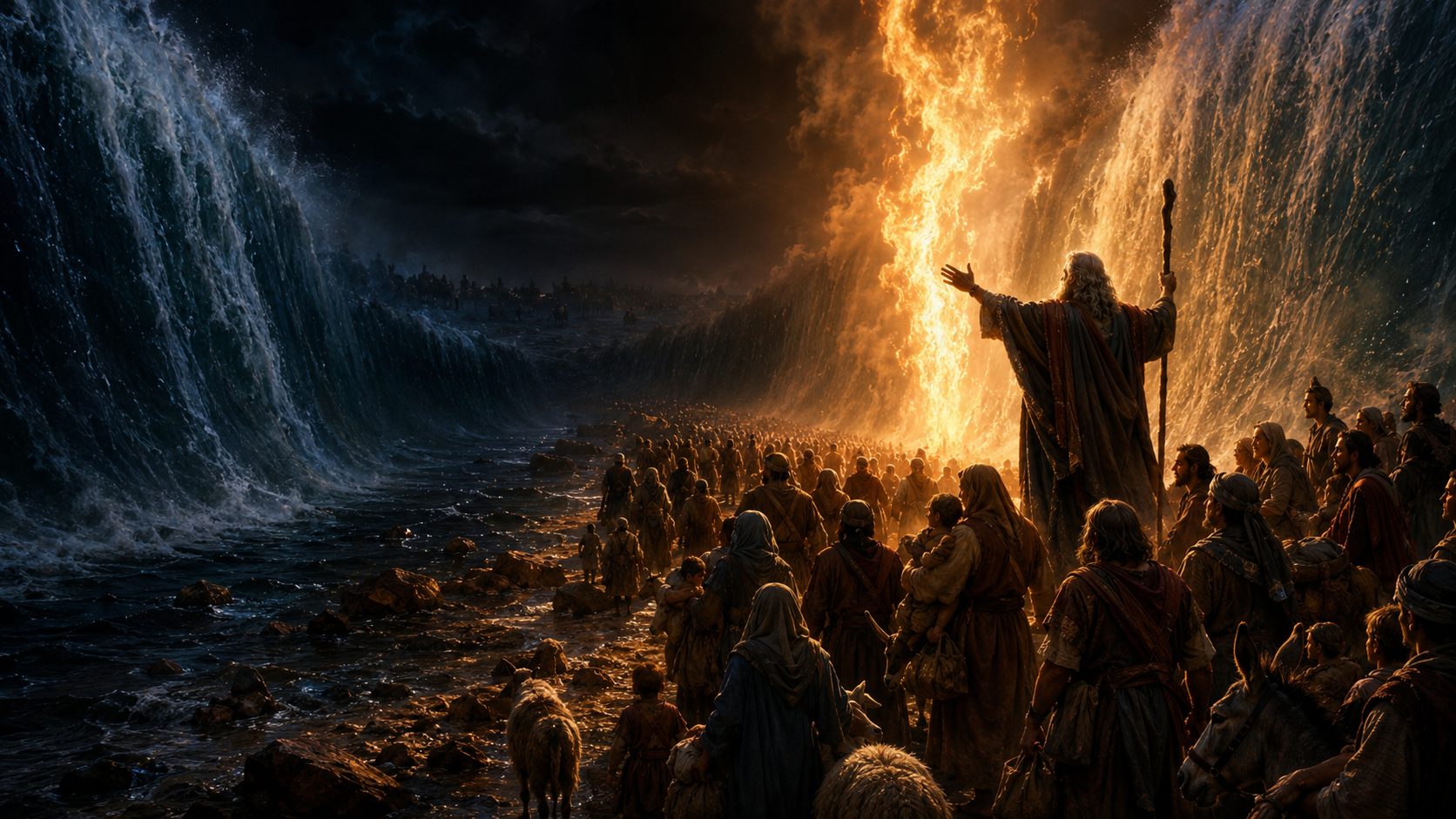
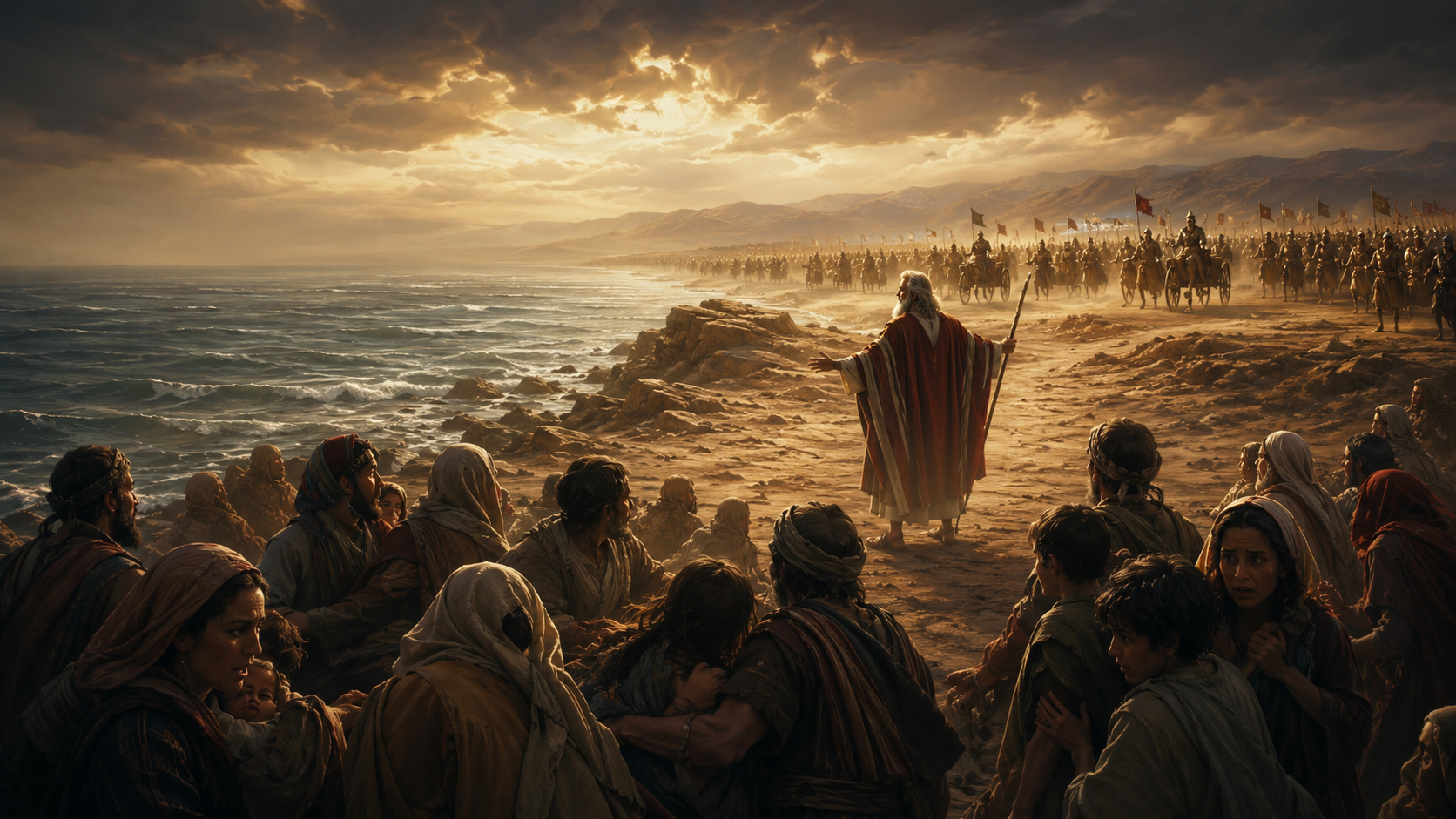
"Then Moses stretched out his hand over the sea, and the LORD drove the sea back by a strong east wind all night and made the sea dry land, and the waters were divided."
— Exodus 14:21
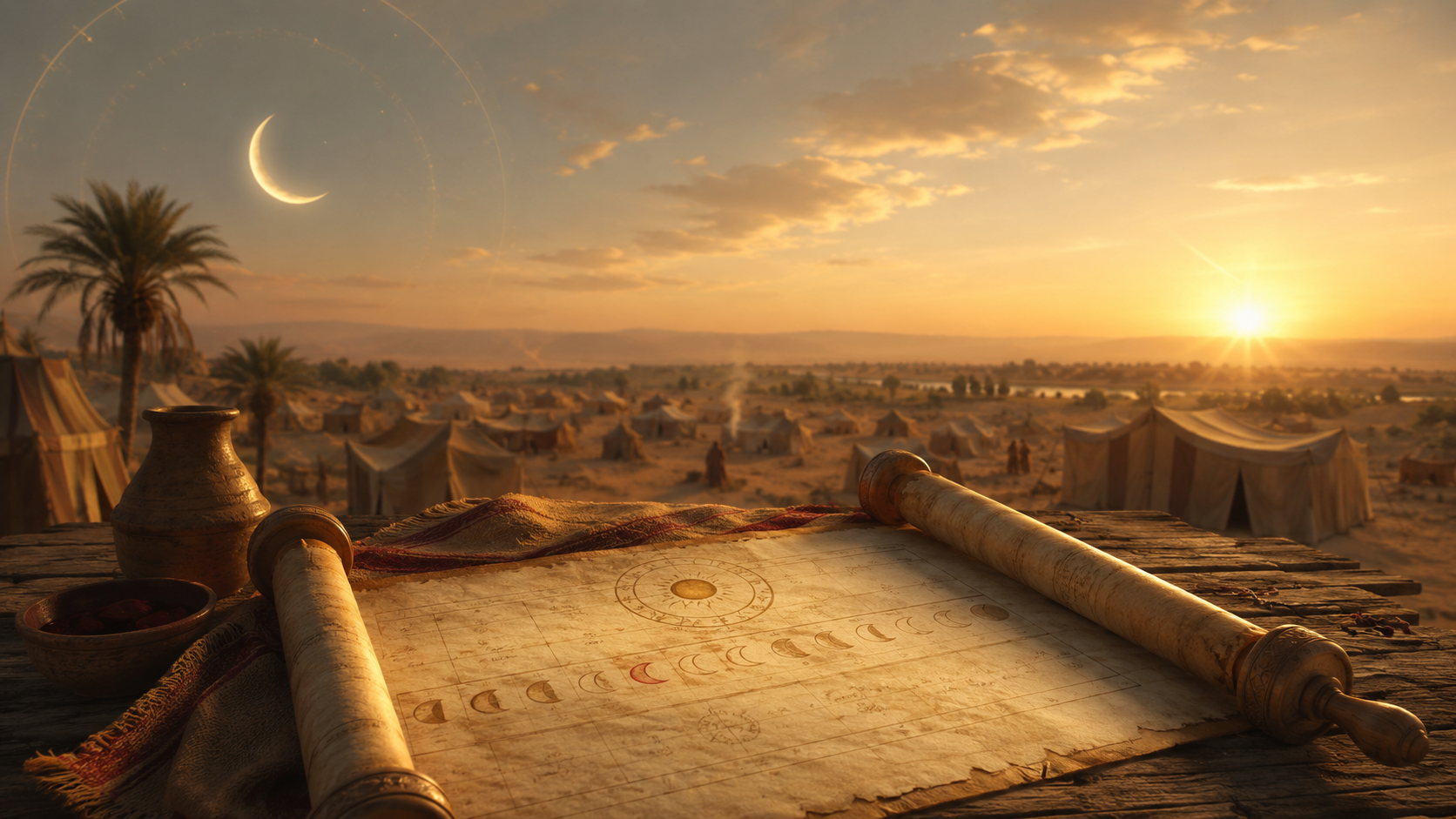
Please Read These Passages First
Part Twelve is one of the most visually dramatic passages in Scripture — but it is also one of the most theologically deep. Please read the full passage before engaging the commentary. Read Exodus 14 first, then Exodus 15 (the Song of Moses) all the way through. The Song is not an appendix — it is the theological interpretation of the event, written by the person who witnessed it. Do not skip it.
As you read, notice what happens to Moses and the Israelites before the sea parts — the fear, the accusation, the near-despair. The miracle does not happen to a confident people. It happens to a terrified people who have just told Moses they would rather have stayed as slaves. This detail is essential to understanding what the crossing means.
Exodus 13:17–22 Exodus 14:1–31 Exodus 15:1–21 1 Corinthians 10:1–4 Isaiah 43:1–3, 16–17
Optional deeper reading:
Psalm 77:13–20 (the crossing through the deep);
Psalm 114 (one of the most beautiful short poems about the crossing);
Hebrews 11:29 (crossing by faith);
Revelation 15:3 (the Song of Moses sung by the redeemed in heaven);
Romans 6:3–4 (baptism as dying and rising through water).
Exodus 13:17-22
Exodus 14:1-14
Exodus 14:15-31
Exodus 15:1-21
A Telling: Between the Army and the Deep
This is the moment everything the Exodus had built toward came to its crisis — and its answer.
The Story
They did not take the short road.
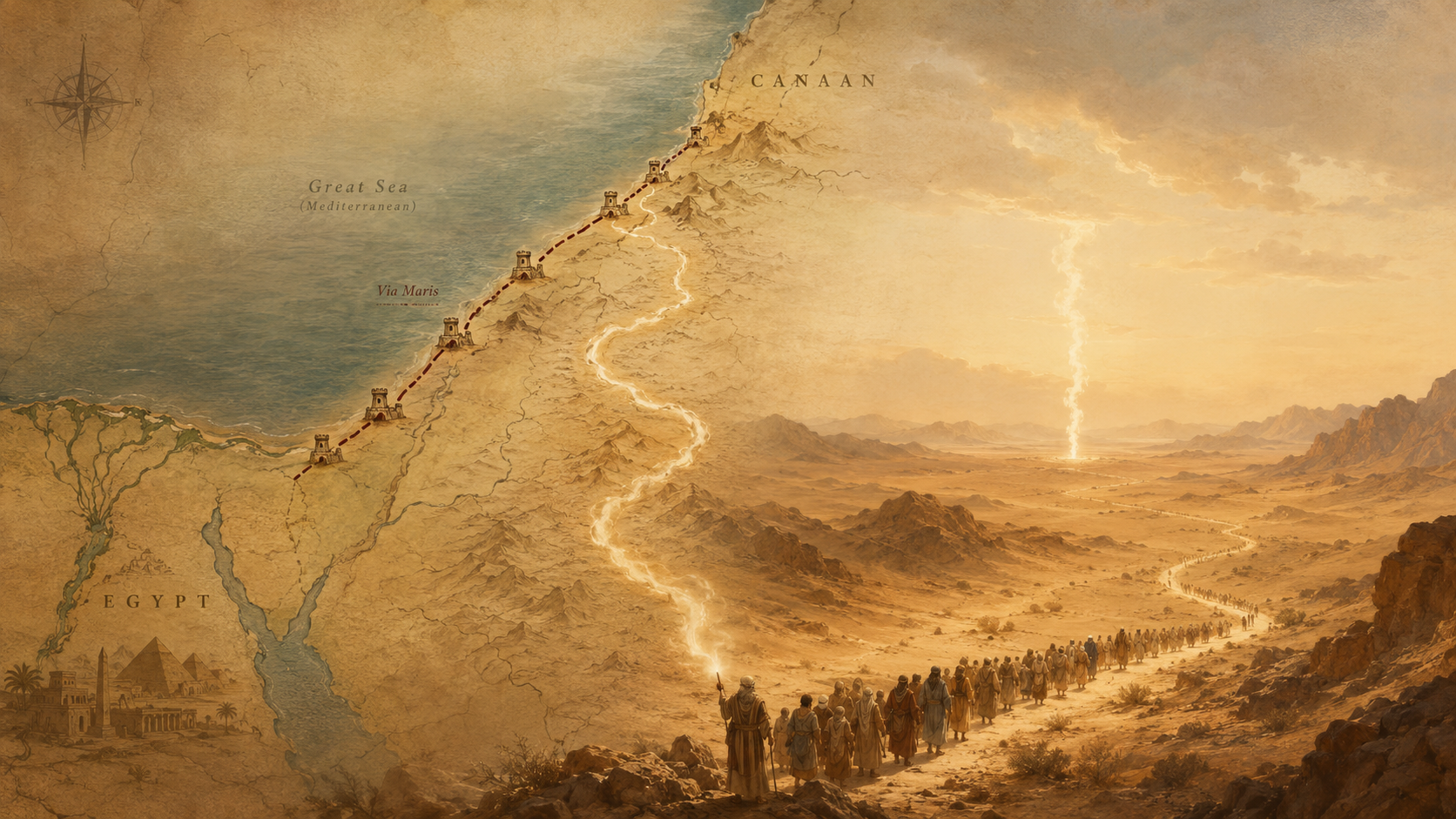
This is the first thing most people miss about the crossing of the sea. There was a direct route from Egypt to Canaan — the coastal road, the Via Maris, the Way of the Philistines, a well-travelled trade and military highway that could have taken Israel from Egypt to the borders of Canaan in eleven days on foot. Eleven days. And God said: no. Not that road.
Exodus 13:17–18:"When Pharaoh let the people go, God did not lead them by way of the land of the Philistines, although that was near. For God said, 'Lest the people change their minds when they see war and return to Egypt.' But God led the people around by the way of the wilderness toward the Red Sea."
God gave us His reason. He knew that the straight road would put His newly liberated people in immediate contact with military conflict, and He knew they were not ready. Four hundred years of slavery does not produce a battle-hardened army. It produces people who have learned to survive by compliance, by endurance, by keeping their heads down. The shorter road would have broken them before they were formed. So God took them the long way round — not because He didn't know where He was going, but because He knew exactly who He was taking there and how much they still needed to become.
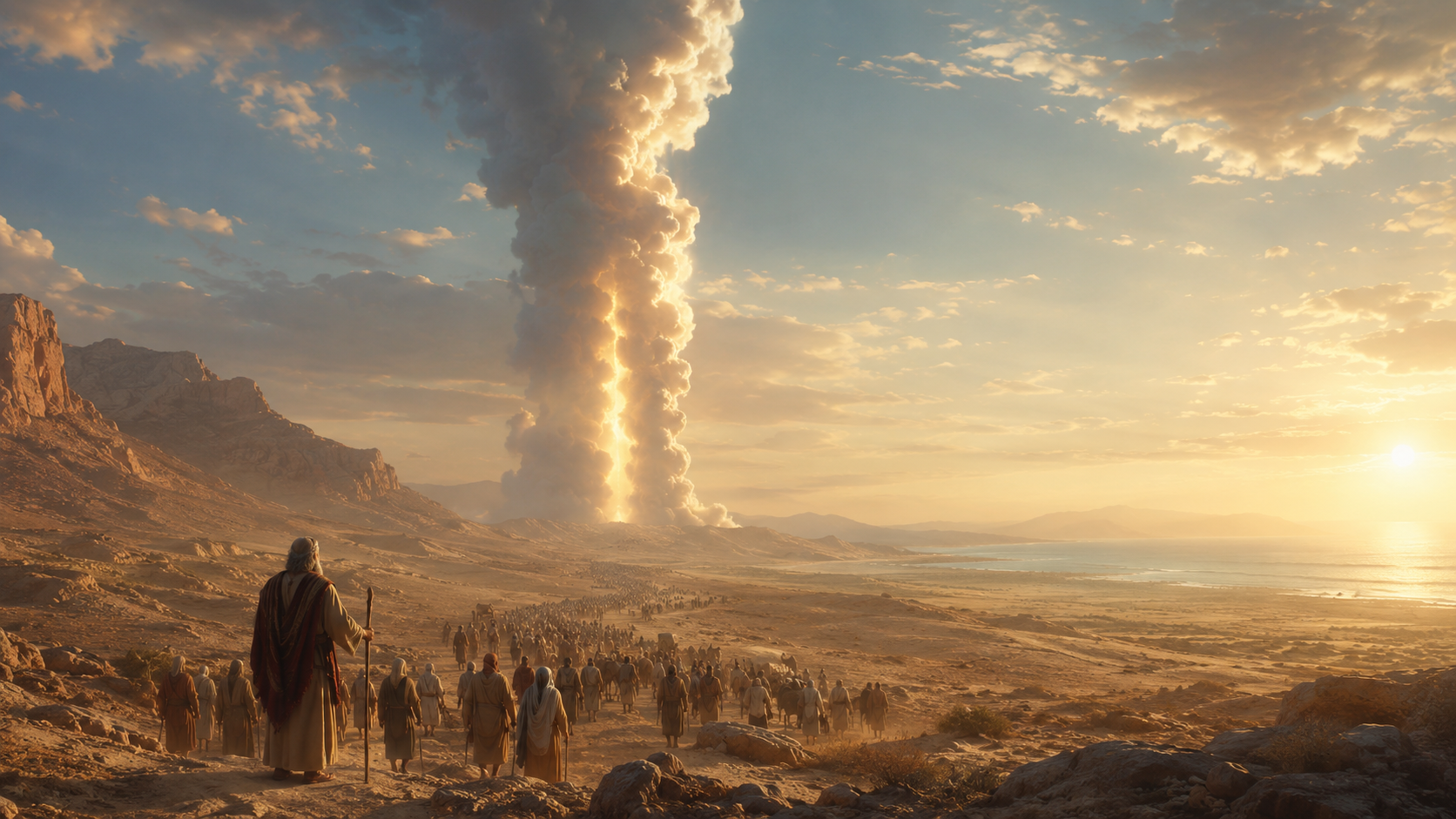
And He went with them. Physically. Visibly. In a way no previous generation of God's people had ever experienced. A pillar of cloud by day. A pillar of fire by night. Not a promise to look for somewhere in the sky. A presence. An actual column of divine manifestation that Israel could look at, follow, and rest beneath. It never left them. Exodus 13:22:"The pillar of cloud by day and the pillar of fire by night did not depart from before the people."
Two million people following a cloud through a desert. Think about what that looks like. Not a map. Not a compass. Not a scout's report. A cloud. And when the cloud moved, they moved. And when the cloud stopped, they stopped. The entire navigational system of the Exodus was: look up. Follow that.
Scene Two: The Trap
Then God told Moses to turn back.
Exodus 14:1–3: The LORD said to Moses, "Tell the people of Israel to turn back and encamp before Pi-hahiroth, between Migdol and the sea, in front of Baal-zephon." And then:"For Pharaoh will say of the people of Israel, 'They are wandering in the land; the wilderness has shut them in.'"
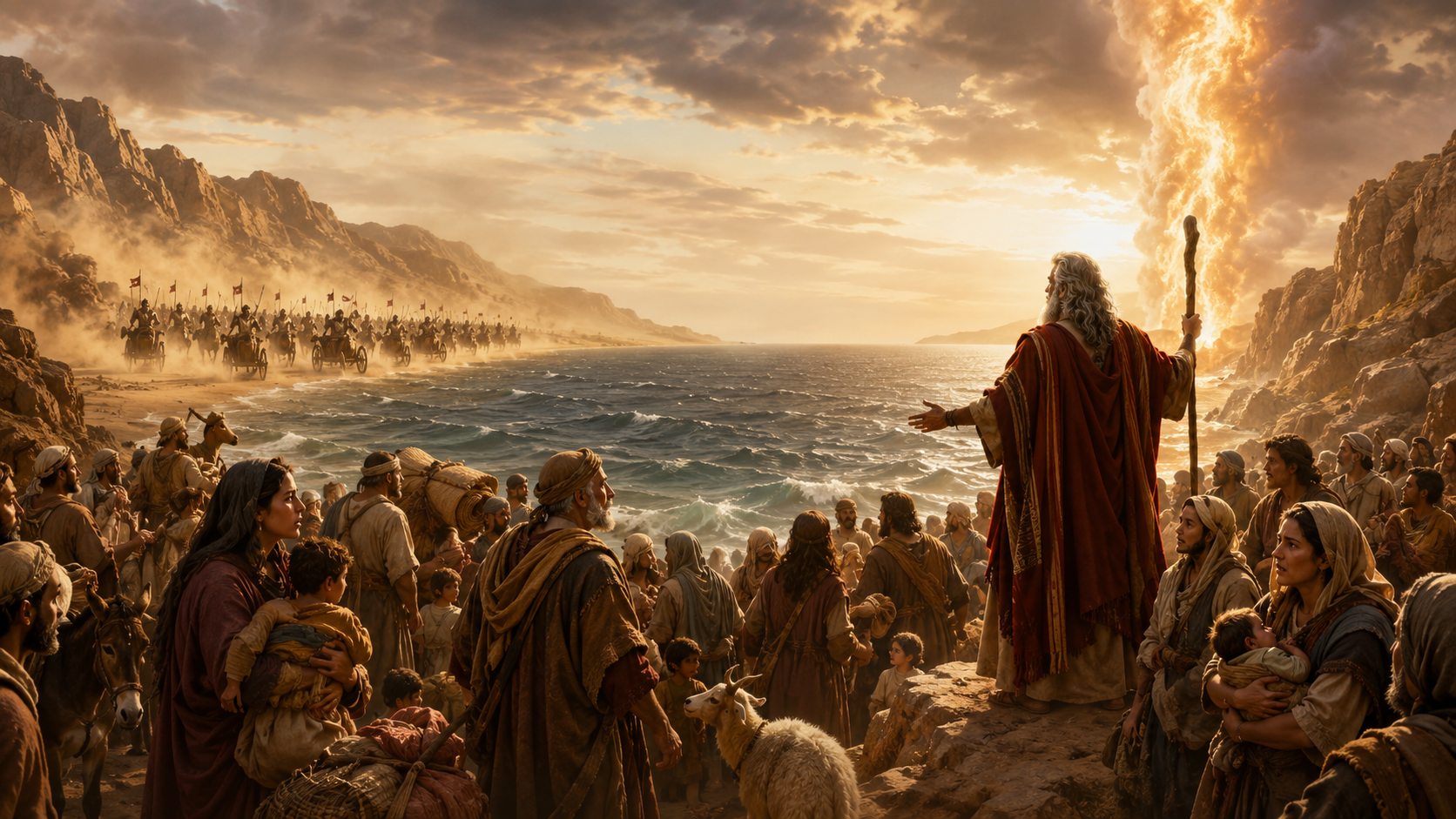
God deliberately manoeuvred Israel into an indefensible position. The sea in front. Migdol behind. Mountains on the sides. And then He waited for Pharaoh to see it.
In Egypt, the news reached the palace. Israel had turned back. They were boxed in at the shore. And something happened inside Pharaoh — and inside his officials — that the text describes with an almost clinical precision: their hearts turned. The word in Hebrew is the same root as the turning of the Nile to blood, the same root as transformation. Pharaoh's heart was transformed, reversed — flipped back to where it had been before the Passover night broke it open. He said: why did we let Israel go? Why did we lose our workforce?
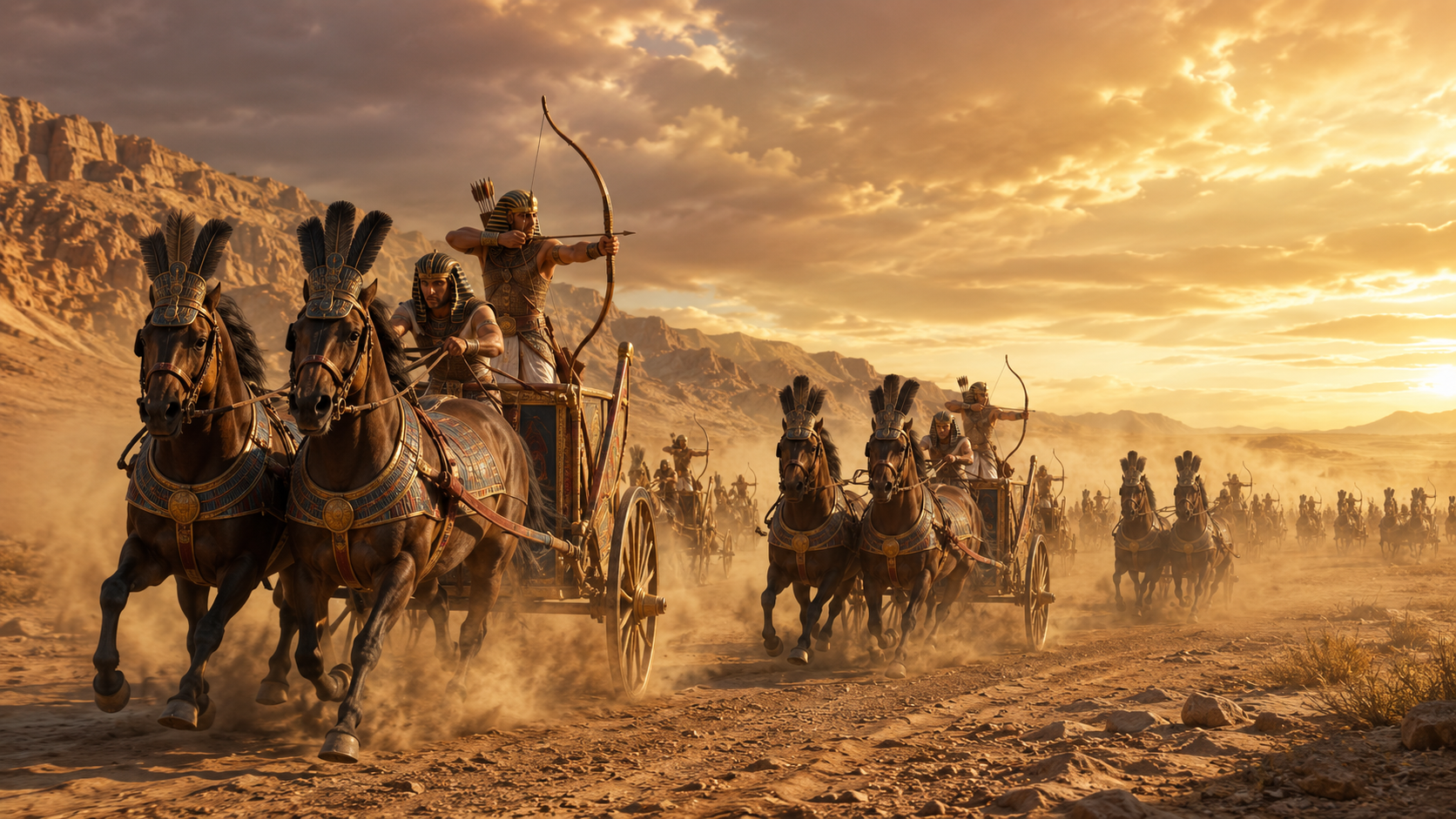
He harnessed six hundred chosen chariots — the elite chariot corps of the Egyptian military, the most feared mobile strike force in the ancient world — and all the other chariots of Egypt with officers over all of them. And he pursued. The full military might of Egypt, moving at chariot speed across the desert, closing on a people on foot with women and children and livestock and bundles of unleavened dough still in their arms.
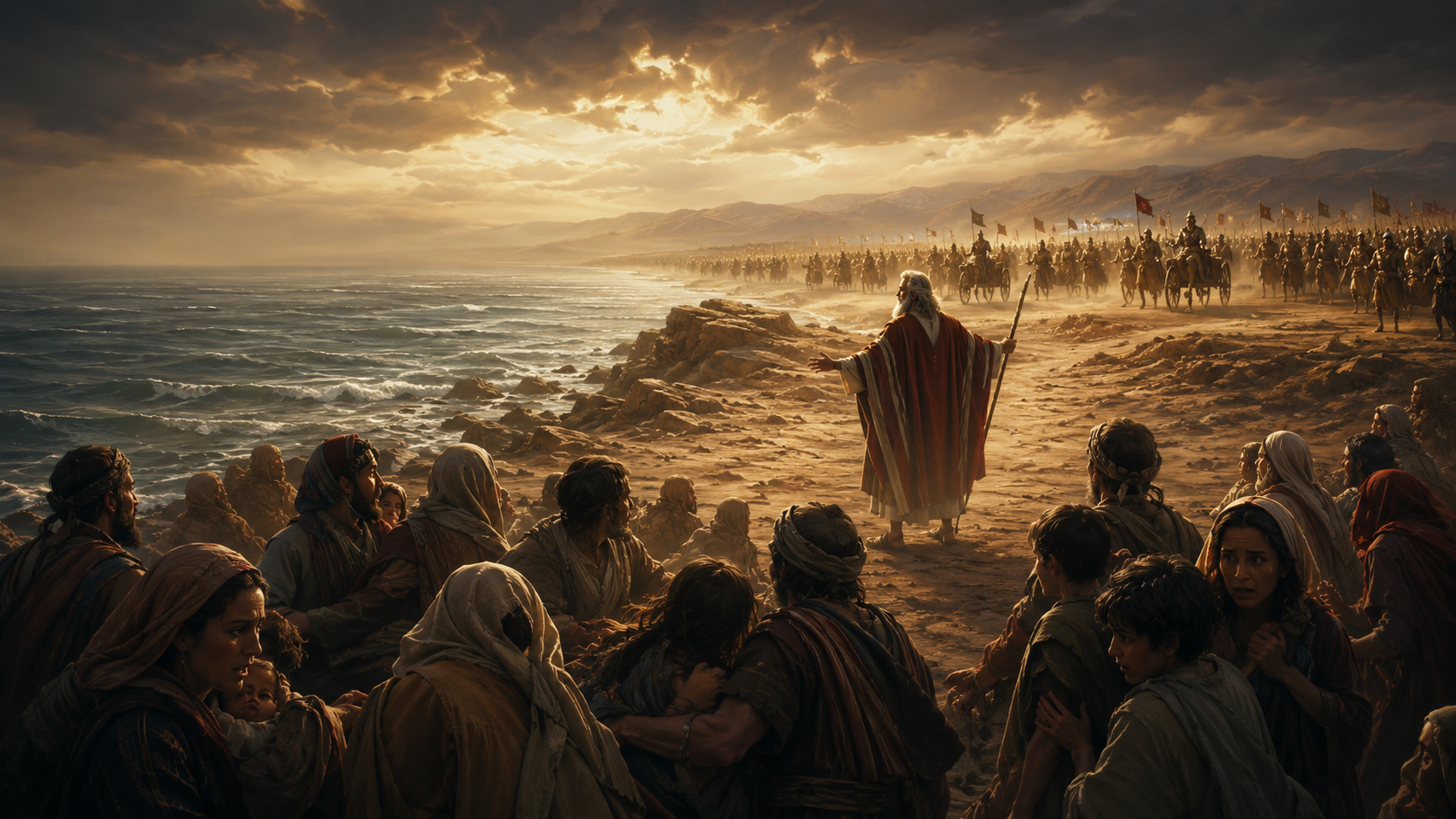
The Israelites looked up and saw the Egyptians marching after them. And they were terrified. And they cried out to the LORD. And then — in one of the most devastatingly human moments in the entire narrative — they turned on Moses. Exodus 14:11–12:"Is it because there are no graves in Egypt that you have taken us away to die in the wilderness? What have you done to us by bringing us out of Egypt? Is not this what we said to you in Egypt: 'Leave us alone that we may serve the Egyptians'? For it would have been better for us to serve the Egyptians than to die in the wilderness."
Four hundred years of slavery. Ten plagues. The Passover night. The plundering of Egypt. The pillar of fire. And at the first sign of real military danger, the people of Israel turned around and said: we would rather go back to being slaves.
This is not a moral failing unique to Israel. This is the human condition. Familiarity — even painful, degrading, soul-destroying familiarity — is less terrifying than the unknown. The Egypt they knew was survivable. The sea in front of them was not. And the army behind them was closing fast.
Moses said: Fear not. Stand firm. And watch.
"The LORD will fight for you, and you have only to be silent."
The Crossing
The pillar moved.
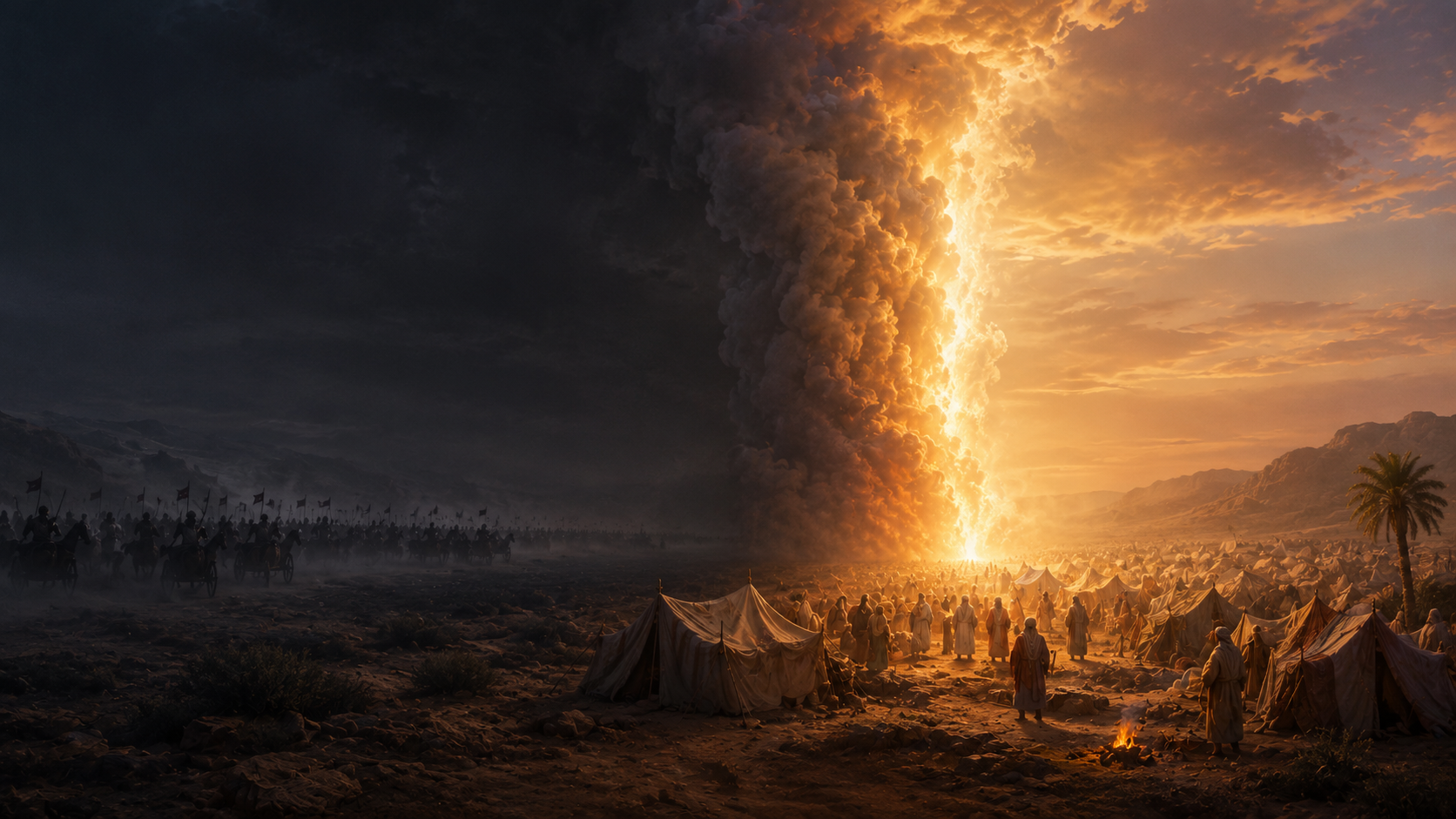
All night, the pillar of cloud that had been leading Israel from the front repositioned itself — moved to the rear, placed itself between the Israelite camp and the Egyptian army. To Egypt, it was darkness. To Israel, it gave light. The two groups spent all night separated by a divine presence that showed one face to each side: darkness to the pursuers, light to the pursued.
And Moses stretched out his hand over the sea.
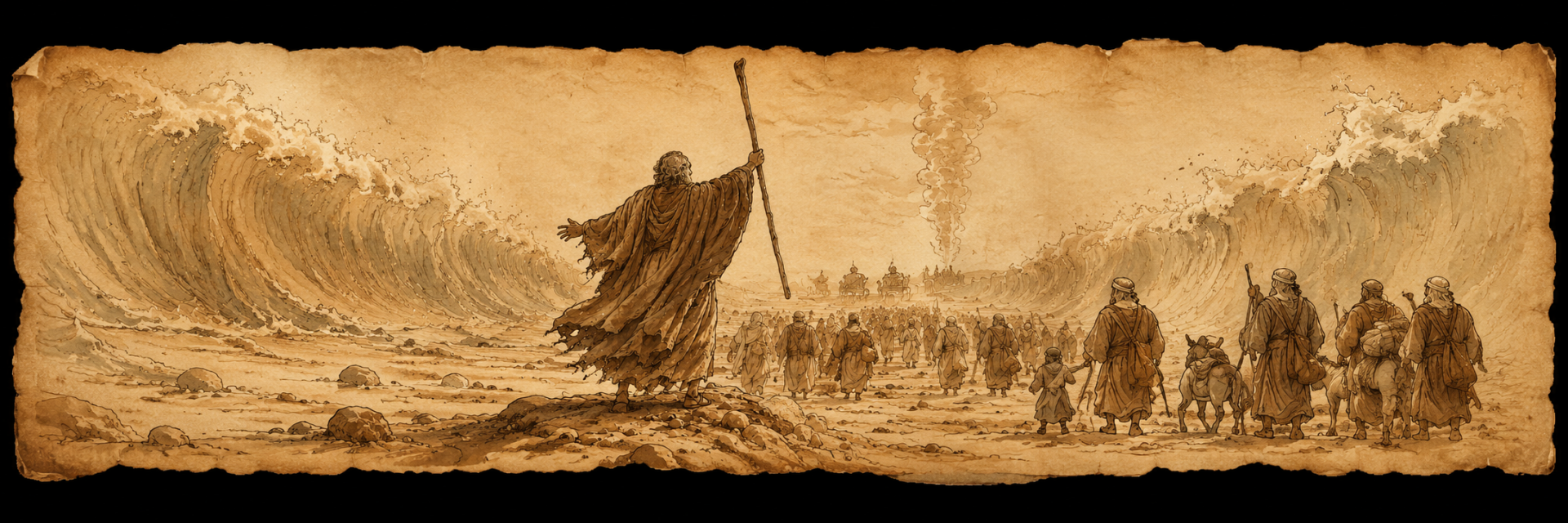
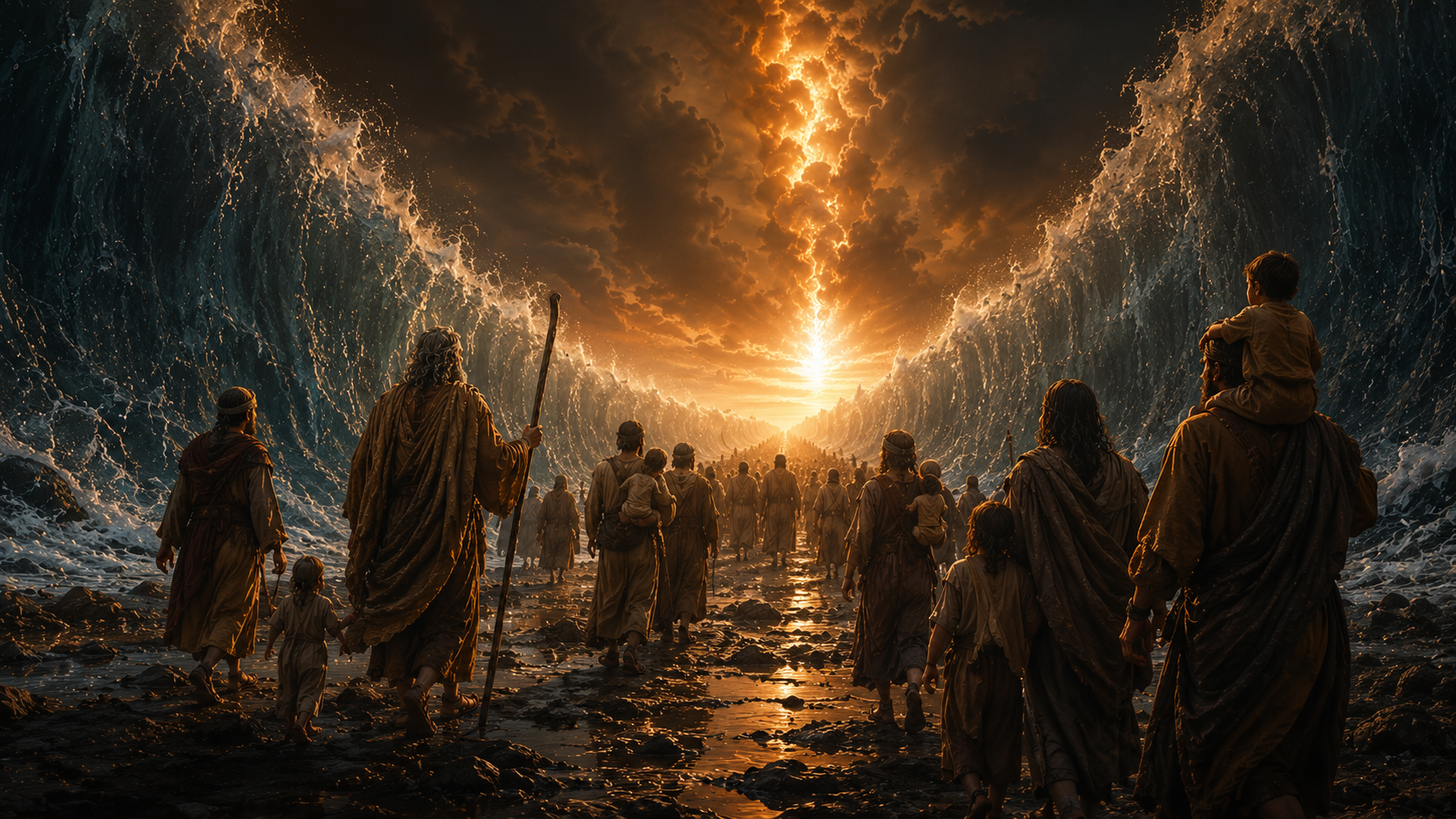
The LORD drove the sea back with a strong east wind all night, and made the sea dry land. The waters divided. And the people of Israel went into the midst of the sea on dry ground — the waters forming a wall for them on their right hand and on their left.
This is what they saw: two walls of water. Not a shallow ford where the tide happened to be out. Not a dramatic wave action that briefly reduced depth. Walls. The Hebrew word is chomah — the same word used for the walls of a fortified city. Standing water, vertical, on both sides, while the ground beneath their feet was dry. This is not a natural event. This is the God who made the sea commanding the sea to do something it has never done before or since.
And two million people walked between them in the dark.
Think about what that crossing was like. The sound of water walls — the rush and pressure of it, held back by nothing visible, the spray perhaps reaching their faces, the salt smell of deep water, the darkness lit only by the pillar of fire ahead of them. Children being carried. Animals being driven. Old men and women walking on ground that had never known a foot before and would never know one again. The horizon behind them glowing with the fire that held Pharaoh at bay. The horizon ahead of them: unknown, unwalked, everything that had been promised but not yet seen.
The Egyptians followed. Pharaoh's six hundred chariots moved into the parted sea after them — through the same corridor of walls that had been made for the Israelites. And in the morning watch, the LORD looked down on the Egyptian forces through the pillar of fire and confused them. He made their chariot wheels come off, so that they drove heavily. And the Egyptians said:"Let us flee from before Israel, for the LORD fights for them against Egypt."
Too late.
Moses stretched out his hand over the sea again. And the sea returned to its normal course when the morning appeared. And the waters covered the chariots and the horsemen; of all the host of Pharaoh that had followed them into the sea, not one of them remained.
And Israel saw the great power that the LORD used against the Egyptians, so the people feared the LORD, and they believed in the LORD and in his servant Moses.
And then — on the far shore, with the water still settling behind them, with the Egyptian army on the bottom of the sea floor — Moses sang.
The Road God Chose: Why the Long Way Round
The theology of detour — and what it tells us about how God forms people
Exodus 13:17 is one of the most understated and underappreciated verses in the Exodus narrative. God does not lead Israel by the shortest, most obvious route. He gives His reason explicitly — and it is not about geography. It is about Israel's readiness. The straight road would produce the wrong outcome: confrontation with hostile forces before Israel had any framework for fighting, trusting, or understanding what kind of nation they were supposed to become.
Did You Know — The Via Maris
The Via Maris (Latin: "Way of the Sea") — the coastal road along the Mediterranean that ran from Egypt through Gaza and up into Canaan — was one of the most heavily trafficked routes in the ancient Near East. Egyptian military and commercial traffic moved along it constantly. Egyptian fortresses and outposts dotted its length, with major garrison installations at Raphia, Gaza, and Megiddo.
Archaeological excavations of these fortresses — particularly the excavations at Tel Mor, Deir el-Balah, and the Sinai coastal sites by Eliezer Oren in the 1970s–1990s — have revealed a series of Egyptian administrative buildings, water facilities, and military outposts spaced roughly a day's march apart along the entire route. This was not a peaceful country road. It was an Egyptian military highway. Israel would have encountered armed Egyptian presence within hours of beginning the journey.
God's decision to avoid this road was not weakness. It was strategic mercy. A newly freed slave people, psychologically broken by generational bondage, was in no condition to fight Egypt's frontier military establishment. The wilderness route — longer, harder, more disorienting — would do something the short road never could: it would teach Israel to depend entirely on God rather than on geography or military advantage.
There is a pastoral principle embedded in Exodus 13:17 that the rest of Scripture returns to repeatedly: God's chosen route for His people is not always the shortest. It is always the formative. The detour is not a mistake in the navigation. It is the curriculum. The wilderness that lay between Egypt and Canaan was not wasted space — it was, as we will see in later parts of this series, the classroom in which Israel learned everything it needed to know about who YHWH was and who they were supposed to be.
And this pattern has a name in the New Testament. Romans 5:3–4 maps the same formation sequence that Israel underwent in the wilderness: suffering produces endurance, endurance produces character, character produces hope. The wilderness is not the absence of God's plan. It is the deep interior of it.
The Pillar of Cloud and Fire
The most continuous, most visible, most intimate divine presence in the entire Old Testament
The pillar of cloud and fire is one of the most remarkable features of the Exodus narrative — and one of the most theologically under-examined. It appears in Exodus 13:21–22 and remains with Israel throughout the entire wilderness period. Understanding what it was, what it meant, and where else it appears in Scripture transforms how you read the next thirty chapters of Exodus and the entire book of Numbers.
What the Pillar Was — And What It Wasn't
The pillar was not a symbol or a metaphor. It was a visible, physical manifestation of the divine presence accompanying Israel — the same presence that had appeared in the burning bush, in the fire on Sinai, and in the thick cloud that would later fill the Tabernacle. The Hebrew word for this divine presence — Shekinah (from shakan, to dwell, to tabernacle) — became the rabbinic term for God's dwelling presence among His people.
By day it appeared as a cloud — providing shade in the ferocious desert heat. By night it appeared as fire — providing warmth in desert cold that can drop to near-freezing after sunset. God's provision for Israel's physical comfort was built into the very structure of His manifest presence. He was not merely a theological concept they carried. He was the one who kept them cool and warm.
The pillar functioned as: a navigational guide (when it moved, Israel moved; when it stopped, Israel camped), a military shield (positioned between Israel and Egypt on the crossing night), a sign of divine approval and presence, and the physical form of the angel of the LORD who led and protected the camp.
Did You Know — The Pillar Through the Whole Bible
The pillar of cloud and fire is not limited to the Exodus account. Its appearances and echoes run through the entire biblical narrative:
At Sinai: The LORD descended on Mount Sinai in fire, and the smoke of it went up like the smoke of a kiln (Exodus 19:18). The same pillar-fire presence that guided Israel through the wilderness now descended on the mountain where the covenant was given.
Over the Tabernacle: When the Tabernacle was completed and consecrated, the cloud covered the tent of meeting, and the glory of the LORD filled the Tabernacle (Exodus 40:34). The pillar settled on the structure built to house it. The pattern of fire-and-cloud dwelling with Israel became the theological basis for the entire Tabernacle and Temple system.
At the Transfiguration: Matthew 17:5 — "a bright cloud overshadowed them, and a voice from the cloud said, 'This is my beloved Son.'" The same cloud-and-voice combination that appeared at Sinai now appears over Jesus. The Transfiguration is explicitly structured as a new Sinai encounter, with Moses himself present as a witness.
At Pentecost: Acts 2:3 — "divided tongues as of fire appeared to them and rested on each one of them." The fire that once rested on a pillar above Israel's camp now rests on individual believers. The Shekinah glory, which in the Old Testament was the exclusive presence of God accompanying Israel, is democratised at Pentecost — no longer above the community but within each member of it.
At the Second Coming: Matthew 24:30, Revelation 1:7 — "every eye will see him, coming on the clouds." The cloud that led Israel through the wilderness becomes the vehicle of the returning King.
Exodus 14:19–20 — The Pillar Moves
Verses 19–20
"Then the angel of God who was going before the host of Israel moved and went behind them, and the pillar of cloud moved from before them and stood behind them, coming between the host of Egypt and the host of Israel. And there was the cloud and the darkness. And it lit up the night without one coming near the other all night."
Hebrew Analysis — The Two-Faced Presence
This verse describes one of the most extraordinary moments in the Exodus narrative: the pillar simultaneously providing opposite effects to the two groups it stands between. Darkness to Egypt — the Egyptian army, blinded or at minimum severely impeded, unable to advance. Light to Israel — the camp illuminated throughout the night, able to see and move.
vayahi he'anan v'hachoshech — "and there was the cloud and the darkness." The cloud brought darkness to one side. vayaer et-halailah — "and it lit up the night." The same object, simultaneously dark and light — depending entirely on which side you were on.
This is the same dynamic we observed at Plague Nine: the darkness that fell on Egypt while Israel had light. The pillar is the living embodiment of YHWH's consistent pattern: His presence means light and life to those who belong to Him; shadow and obstruction to those who set themselves against His purposes. The same sun that softens wax hardens clay. The same presence that is salvation to the saved is judgment to the unrepentant.
The People's Terror and the Theology of "Stand Firm"
Exodus 14:10–14 — The most important thing Moses says in the entire crossing
Exodus 14:10–14 — Terror and Command
Verses 10–12
"When Pharaoh drew near, the people of Israel lifted their eyes, and behold, the Egyptians were marching after them, and they feared greatly. And the people of Israel cried out to the LORD. They said to Moses, 'Is it because there are no graves in Egypt that you have taken us away to die in the wilderness? What have you done to us in bringing us out of Egypt? Is not this what we said to you in Egypt: Leave us alone that we may serve the Egyptians?'"
Hebrew Analysis — The Grumbling Pattern Begins
vayirau me'od — "they feared greatly." The adverb is emphatic. This is not a slight anxiety. It is the kind of fear that produces complete cognitive override — the panic that makes people say things they would not otherwise say, make decisions they know are wrong.
The sarcasm in the people's words — "because there are no graves in Egypt" — is the sarcasm of people whose terror has tipped into gallows humour. It is also the first recorded instance of what will become a defining pattern in the wilderness narrative: the grumbling of Israel. The people look backward rather than forward, preferring known misery to unknown liberation. This is not unique to Israel. It is the universal human response to the wilderness between the old life and the promised life — the place where it feels like the miracle is not working and the enemy is gaining.
And the specific complaint — "did we not say in Egypt, leave us alone that we may serve the Egyptians?" — is striking. There is no recorded instance of this complaint earlier in the narrative. Either this is a paraphrase of unrecorded murmuring, or the people are so frightened that they have rewritten their own history — convincing themselves they had always preferred slavery, when in fact they had cried out to God for deliverance (Exodus 2:23). Fear distorts memory. Terror rewrites the past to justify the impulse to retreat.
Verses 13–14
"And Moses said to the people, 'Fear not, stand firm, and see the salvation of the LORD, which he will work for you today. For the Egyptians whom you see today, you shall never see again. The LORD will fight for you, and you have only to be silent.'"
Four Commands — Four Theological Movements
Moses' four-word response is a compressed theology of divine rescue. Each word is a command. Each command is a posture of faith:
al-tira'u — "Do not fear." The single most repeated command in the entire Bible (appearing in various forms over 365 times in Scripture). Fear is not a sin — the people's fear is understandable and human. But it is an obstacle to perceiving what God is about to do. Fear distorts perception. The command to not fear is a command to hold the space for God to act rather than contracting into survival mode.
hityatzvu — "Stand firm / station yourselves." The same verb used for the pillar stationing itself between Egypt and Israel. Take a position. Hold it. Do not move from where God has placed you, even when everything around you is moving and closing in.
ur'u et-y'shua't YHWH — "See the salvation of the LORD." This is the first use of the word yeshua (salvation) in the context of the Exodus — and it is used as a noun, as a thing to be witnessed. The salvation YHWH is about to perform is not something to produce or earn. It is something to see. Open your eyes. Watch.
YHWH yilachem lachem v'atem tacharishun — "The LORD will fight for you, and you have only to be silent." The last phrase is literally "you shall be silent." Not merely quiet. Still. Do nothing. Say nothing. Take no action. The salvation God is about to perform requires zero human military contribution. Israel is not a co-combatant here. They are witnesses. The battle is entirely the LORD's.
The Crossing: Verse by Verse
Every detail of Exodus 14:21–31 examined — including the things you have never noticed
Exodus 14:21 — The Mechanism of the Miracle
Verse 21
"Then Moses stretched out his hand over the sea, and the LORD drove the sea back by a strong east wind all night and made the sea dry land, and the waters were divided."
Hebrew Analysis — Nature and Miracle Together
b'ruach kadim azah — "by a strong east wind." This is one of the most interesting mechanical details in the crossing narrative. God uses a wind. A real, meteorological, natural east wind. The miracle does not bypass nature — it directs it at sovereign scale. God does not make the water disappear by fiat. He drives it back with an instrument of His creation, deployed at His command.
This is theologically significant. Throughout the Exodus, the miracle and the natural mechanism often coexist: the red algae bloom and the Nile, the east wind and the locusts, the strong east wind and the crossing. God's sovereignty does not require the suspension of natural processes. It works through them, over them, at a scale and timing that no natural process could achieve independently.
kol-halailah — "all night." The wind blew all night. This was not an instantaneous miracle. It was a sustained overnight event. The crossing of Israel happened at night, with the sea walls held open by continuous divine action throughout. Every moment of the crossing, God was actively maintaining the conditions that made it possible. The miracle was not a single act — it was continuous, sustained, unbroken provision.
vayibake'u hamayim — "the waters were divided." The same root baka (to split, to cleave) is used in Genesis 1:6 for the division of the waters at creation, and in Isaiah 63:12 for this same crossing. The parting of the sea is described in biblical theology as a creational act — YHWH exercising the same authority over water that He exercised at the beginning, when He separated the waters and made dry land appear.
Verses 22–23
"And the people of Israel went into the midst of the sea on dry ground, the waters being a wall for them on their right hand and on their left. The Egyptians pursued and went in after them into the midst of the sea, all Pharaoh's horses, his chariots, and his horsemen."
The Walls of Water
chomah — "wall." This word appears twice in this verse (right side and left side) and is the standard Hebrew word for a fortified city wall — a solid, imposing, structural barrier. This is not a gentle parting of knee-deep water. These are water walls — the depths of the sea standing vertical on either side of a dry corridor.
Why did the Egyptians follow into the same corridor? After chasing Israel all night, having watched the corridor open from a distance, Pharaoh's commanders apparently saw an opportunity: their enemy was crossing in a defined, channelled path. The military instinct was to pursue through the same channel and catch them on the far shore. It was the tactically logical decision. And it was fatal.
The detail that all Pharaoh's horses, chariots, and horsemen entered the sea is important. This was not a partial force. The entire elite strike capacity of Egypt — the army that had terrorised the ancient world — followed Israel into the sea. When the waters returned, it was total. Exodus 14:28: "the waters returned and covered the chariots and the horsemen; of all the host of Pharaoh that had followed them into the sea, not one of them remained." Not one.
Verses 24–25
"And in the morning watch the LORD in the pillar of fire and of cloud looked down on the Egyptian forces and threw the Egyptian forces into a panic, clogging their chariot wheels so that they drove heavily."
The Tactical Disruption
vayahom — "threw into a panic / confused them." The verb means to create turmoil, disorder, confusion — the same verb used for God throwing enemy armies into confusion throughout the conquest narratives. This is divine battlefield confusion — a form of divine warfare that appears in Joshua and Judges as well, where God himself disrupts the enemy's tactical cohesion from within.
vayasar et ofan merkavotav — "removed the wheels of their chariots." The chariot wheels were locked or removed — possibly the ground in the sea corridor, softened by water, caused them to sink and seize. The most advanced military technology of the ancient world — Egypt's chariot corps, the equivalent of armoured vehicles — was rendered useless by soft ground. Their greatest tactical advantage became their greatest liability the moment they pursued into the wrong terrain.
And then the Egyptian officers said something extraordinary: "Let us flee from before Israel, for the LORD fights for them against Egypt." The same army that had been hunting Israel now recognised that they were fighting God, not just Israel. Recognition — too late to save them, just early enough to be recorded for the generations who would read this account and need to understand what it means when God takes a side.
Verses 29–31
"But the people of Israel walked on dry ground through the sea, the waters being a wall for them on their right hand and on their left. Thus the LORD saved Israel that day from the hand of the Egyptians, and Israel saw the Egyptians dead on the seashore. Israel saw the great power that the LORD used against the Egyptians, so the people feared the LORD and believed in the LORD and in his servant Moses."
The Result: Faith
vayar Yisrael et-hamitzrim met — "Israel saw the Egyptians dead on the seashore." The bodies of the Egyptian army were washed up on the shore. Israel did not merely survive and escape. They stood on the far shore and looked back at the physical evidence of what had been done. The dead bodies of their former masters lying on the beach — this was not a rumour, not a report, not a message received. It was something they saw with their own eyes.
vaya'aminu b'YHWH u'v'Moshe avdo — "they believed in the LORD and in his servant Moses." The word he'emin (believed) is the root of amen — to consider firm, reliable, trustworthy. Israel trusted YHWH and Moses in a way they had not before the crossing. Exodus 14:31 is the first full affirmation of Israel's faith in the narrative. It has taken twelve chapters to get here — and it has cost everything to get here. But it is real.
Red Sea or Reed Sea? The Geography Debate
The biggest question in Exodus geography — honestly and fully examined
Few questions in Exodus scholarship are more debated — or more frequently misrepresented — than the location of the sea crossing. Where, exactly, did it happen? And was it the Red Sea or the Reed Sea? Let us look at this honestly.
The Hebrew — Yam Suph (יַם־סוּף)
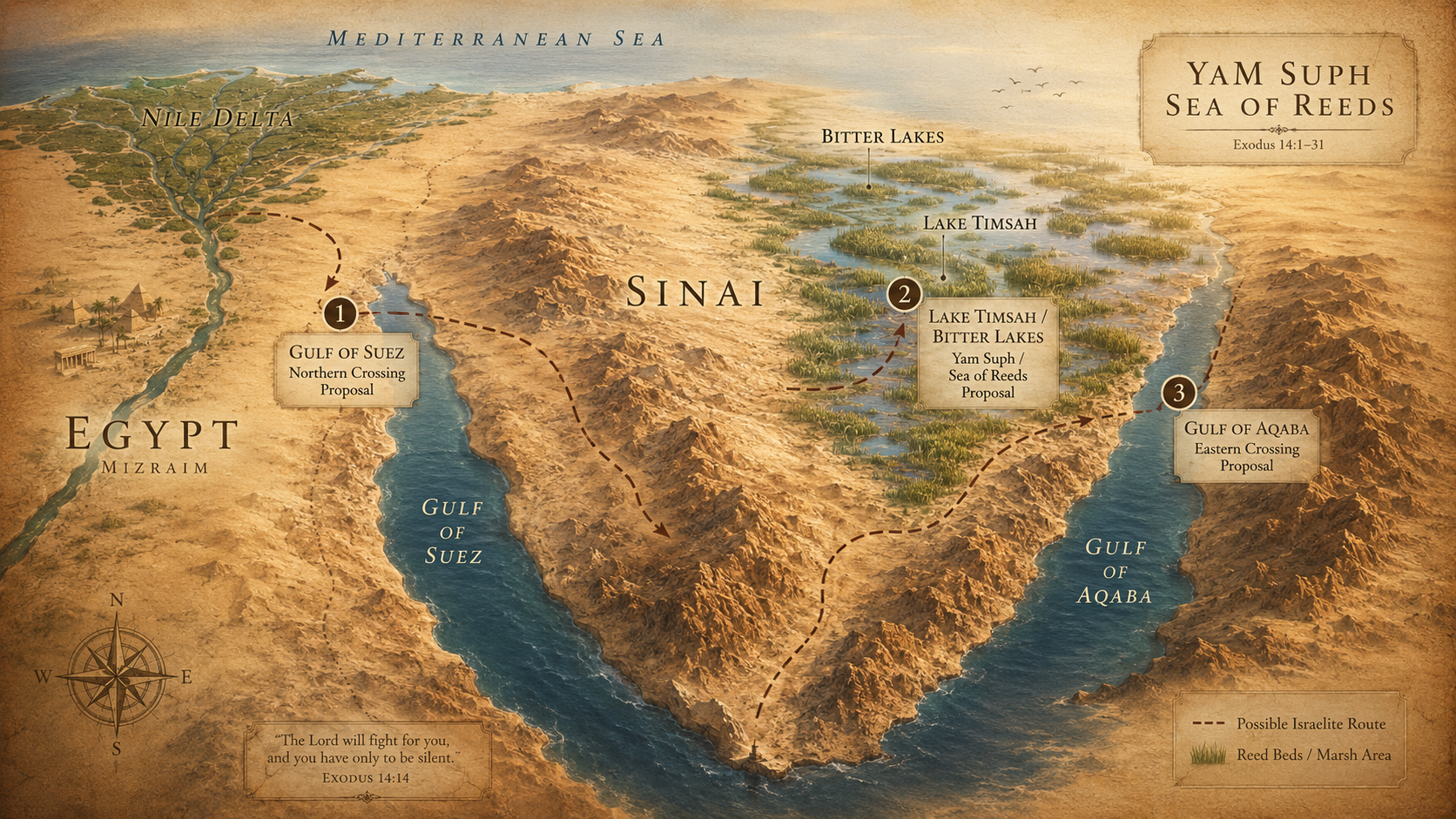
The Hebrew name for the sea Israel crossed is Yam Suph — often translated "Red Sea" in English Bibles, following the ancient Greek translation (the Septuagint, c. 250 BC) which rendered it Erythra Thalassa ("Red Sea"). However, the Hebrew word suph does not mean "red." It means reed, rushes, or seaweed — aquatic plants. The direct translation of Yam Suph is therefore "Sea of Reeds" or "Reed Sea."
This matters enormously for the geographic debate, because reeds do not grow in the saltwater Red Sea. They grow in shallow freshwater marshes and the shallow brackish coastal lagoons at the northern end of the Red Sea arms (Gulfs of Suez and Aqaba) and in the Bitter Lakes region of the Sinai.
The word suph appears in other contexts: Exodus 2:3 uses it for the "reeds" of the Nile where Moses' basket was placed. Jonah 2:5 uses it for the "seaweed" around Jonah's head. The same word covers aquatic vegetation generally.
Did You Know — Where the Septuagint Gets "Red Sea" From
When Jewish scholars in Alexandria translated the Hebrew Scriptures into Greek around 250 BC, they rendered Yam Suph as Erythra Thalassa — Red Sea. Why? By that period, Jewish memory of the precise geographical location of the crossing had possibly faded, or the translators identified Yam Suph with the body of water Greeks and Romans knew as the Red Sea (which at that time could refer to both the modern Red Sea and the Gulf of Aden/Arabian Sea region). The Septuagint translation then influenced the Latin Vulgate (mare Rubrum — Red Sea), which influenced virtually all subsequent European translations including the King James Bible.
So the "Red Sea" in your English Bible is a translation of a Greek translation of a Hebrew term that means "Reed Sea" — three layers of translation away from the original. This is not a cover-up or a mistake. It is simply the history of how ancient texts travel through languages. The important question is not what the Greek says but what the Hebrew says — and the Hebrew says suph: reeds.
The Three Main Proposed Locations
The Gulf of Suez (Northern End):
The traditional location in popular imagination. The northern end of the Gulf of Suez has shallow areas that could have been more fordable in ancient times, and the geography of the Sinai Peninsula could accommodate the narrative's details (Migdol, Pi-hahiroth, Baal-zephon). However, the Gulf of Suez is saltwater — no reeds — and the deep channel in the centre would present significant crossing challenges even with dramatic water movement.
The Lake Timsah / Bitter Lakes Region:
A series of shallow, reed-choked lagoons and lakes in the northern Sinai isthmus, connected to the Gulf of Suez. In antiquity, before the Suez Canal (constructed 1859–1869) reorganised the water system, this area had extensive shallow lakes with reedy margins — exactly the habitat wheresuphwould grow. A strong east wind in this region could indeed drive water back from a shallow lake and create a temporary dry crossing, while the returning waters could trap an army in the soft lakebed. This is favoured by many modern scholars.
The Gulf of Aqaba (Eastern Arm of the Red Sea):
Popularised by certain researchers and documentarians who connect Midian's location east of Aqaba with a crossing point on the Aqaba coast. If Midian is in northwest Arabia (a viable reading of the geographical data), then the crossing at the Gulf of Aqaba would make the subsequent direction of travel logical. The Gulf of Aqaba can reach depths of 1,800 metres — which would require a miracle of far larger scale than the Reed Sea options, but which some see as fitting the overwhelming supernatural character of the event.
The honest scholarly position is: we do not know with certainty. The text's geographical references (Pi-hahiroth, Migdol, Baal-zephon) have not been definitively identified on the modern map. Each proposed location has evidence for and against it. What all three agree on is the theological reality: Israel crossed a body of water on dry ground while their pursuers drowned. The exact GPS coordinates do not change what happened or what it means. The miracle was real. The location remains uncertain.
The Six Hundred Chariots: Egyptian Military Technology
What Pharaoh sent after Israel — and why it was terrifying
Archaeological & Historical Context — New Kingdom Egyptian Chariots
Exodus 14:7 specifies "six hundred chosen chariots" from Pharaoh's best, along with "all the other chariots of Egypt." The Egyptian chariot of the New Kingdom period (c. 1550–1070 BC) was the most advanced military vehicle in the ancient world — the equivalent of a modern tank or armoured fighting vehicle in terms of psychological and tactical impact on an opponent who had never faced one.
Genuine Egyptian chariots have been found in archaeological contexts. The chariots of Tutankhamun (c. 1323 BC) — several of which are preserved in the Cairo Museum — give us precise physical information: lightweight wooden frame construction using imported wood (cedar from Lebanon, birch from Syria), bent wood wheels with four or six spokes, leather and rope bindings, and a standing platform barely large enough for two people. They weighed approximately 30–35 kg (66–77 lbs) — extraordinarily light for their structural strength.
The New Kingdom chariot operated as a mobile archery platform. A pair — driver and archer — could maintain speeds of up to 38 km/h (24 mph) while the archer fired composite bows with an effective range of 175+ metres. Against infantry, this combination was essentially irresistible in open terrain. The Kadesh inscriptions of Ramesses II describe chariot charges with thousands of vehicles — a scale of armoured assault that no Bronze Age infantry could withstand in the open.
This is what was coming across the desert toward Israel: six hundred of the best, most battle-hardened chariot crews in the world, backed by the rest of the Egyptian chariot corps. Against a group that included women, children, elderly people, and livestock. The terror Exodus 14:10 describes — they feared greatly — is entirely proportionate.
Did You Know — Chariot Wheels and the Sea Floor
Exodus 14:25 says God "clogged their chariot wheels so that they drove heavily." The lightweight construction that made Egyptian chariots deadly in open terrain became catastrophic in the sea corridor. The sea floor, even if temporarily dry, would have been waterlogged, soft sediment — exactly the terrain that would cause lightweight wooden wheels to sink, seize, or break under the weight of a moving vehicle.
In 2011, a YouTube video claiming to show chariot wheels from the Red Sea floor went viral, attributed to archaeologist Ron Wyatt. This claim is not accepted by any mainstream Egyptologist or archaeologist and the "wheels" have never been verified by independent examination. We mention this only because many readers will have encountered it — it is important to distinguish genuine archaeological investigation from unverified claims. The theological reality of the crossing does not need unverified physical evidence to be credible.
What is genuinely interesting archaeologically: chariot equipment from New Kingdom Egyptian military expeditions has been found at various Sinai sites, confirming Egyptian military presence throughout the Sinai Peninsula in exactly this period — consistent with the Exodus narrative's setting.
The Song of Moses: The First Great Hymn
Exodus 15:1–21 — The oldest continuous piece of Hebrew poetry, and its extraordinary theology
Exodus 15 contains what many scholars believe is one of the oldest pieces of continuous poetry in the Hebrew Bible — possibly among the oldest literary texts in the world. The Song of Moses and Miriam was composed and sung on the far shore of the sea, with the Egyptian bodies still washing up behind them. It is not a calm retrospective composed years later. It is the immediate, overwhelming outpouring of a people who have just experienced the impossible.
Did You Know — The Age of the Song
Scholars who study ancient Hebrew poetry — including Frank Moore Cross, David Noel Freedman, and more recently Richard Hendel — have argued on linguistic grounds that Exodus 15 preserves archaic Hebrew that predates most of the prose narrative surrounding it. Features like the absence of certain grammatical particles common in later Hebrew, specific archaic verbal forms, and the poetic metre all suggest this poem was composed very early — possibly in the period of the Exodus itself or shortly after, preserved essentially unchanged as it was transmitted.
If this analysis is correct, the Song of Moses may be the earliest piece of writing we have from the Israelite tradition — a direct window into the language and theology of people who actually experienced the crossing. When you read Exodus 15, you may be reading words composed and sung by eyewitnesses on the day it happened.
The Song of Moses — Exodus 15:1–11 (Selected)
"I will sing to the LORD, for he has triumphed gloriously; the horse and his rider he has thrown into the sea."
— Exodus 15:1 — The opening line. Not: we have survived. Not: we have escaped. He has triumphed gloriously. The song begins not with human relief but with divine victory. The crossing was God's triumph, not Israel's deliverance. The theology is right from the first word.
"The LORD is my strength and my song, and he has become my salvation; this is my God, and I will praise him, my father's God, and I will exalt him."
— Exodus 15:2 — The word translated "salvation" here is yeshua. He has become my yeshua. The same word Moses used in Exodus 14:13 — "see the salvation of the LORD." Now it is sung. The name that would one day be borne by the Son of God is here applied to YHWH's act of rescue at the sea: He has become my Yeshua.
"The LORD is a man of war; the LORD is his name. Pharaoh's chariots and his host he cast into the sea, and his chosen officers were sunk in the Red Sea. The floods covered them; they went down into the depths like a stone."
— Exodus 15:3–5 — "The LORD is a man of war." This is the first appearance of this divine title. YHWH as divine warrior — a theme that runs through the Psalms, Isaiah, and Revelation. The God who fights for His people is not a domesticated theological abstraction. He is a God who gets involved in history, who uses cosmic power in real conflicts, who fights on behalf of the oppressed and against the oppressor.
"Who is like you, O LORD, among the gods? Who is like you, majestic in holiness, awesome in glorious deeds, doing wonders?"
— Exodus 15:11 — Mi chamocha ba'elim YHWH — "Who is like You among the gods?" This is the great rhetorical question of the Song — a question that echoes through the Psalms (Psalm 35:10; 71:19; 86:8; 89:6–8). It is not a question that expects an answer. It is a declaration: nothing is like YHWH. The Egyptian gods — every one of them addressed by the ten plagues — cannot approach this. The contest is over. The verdict is in. Who is like the LORD? No one.
Miriam's Response — Exodus 15:20–21
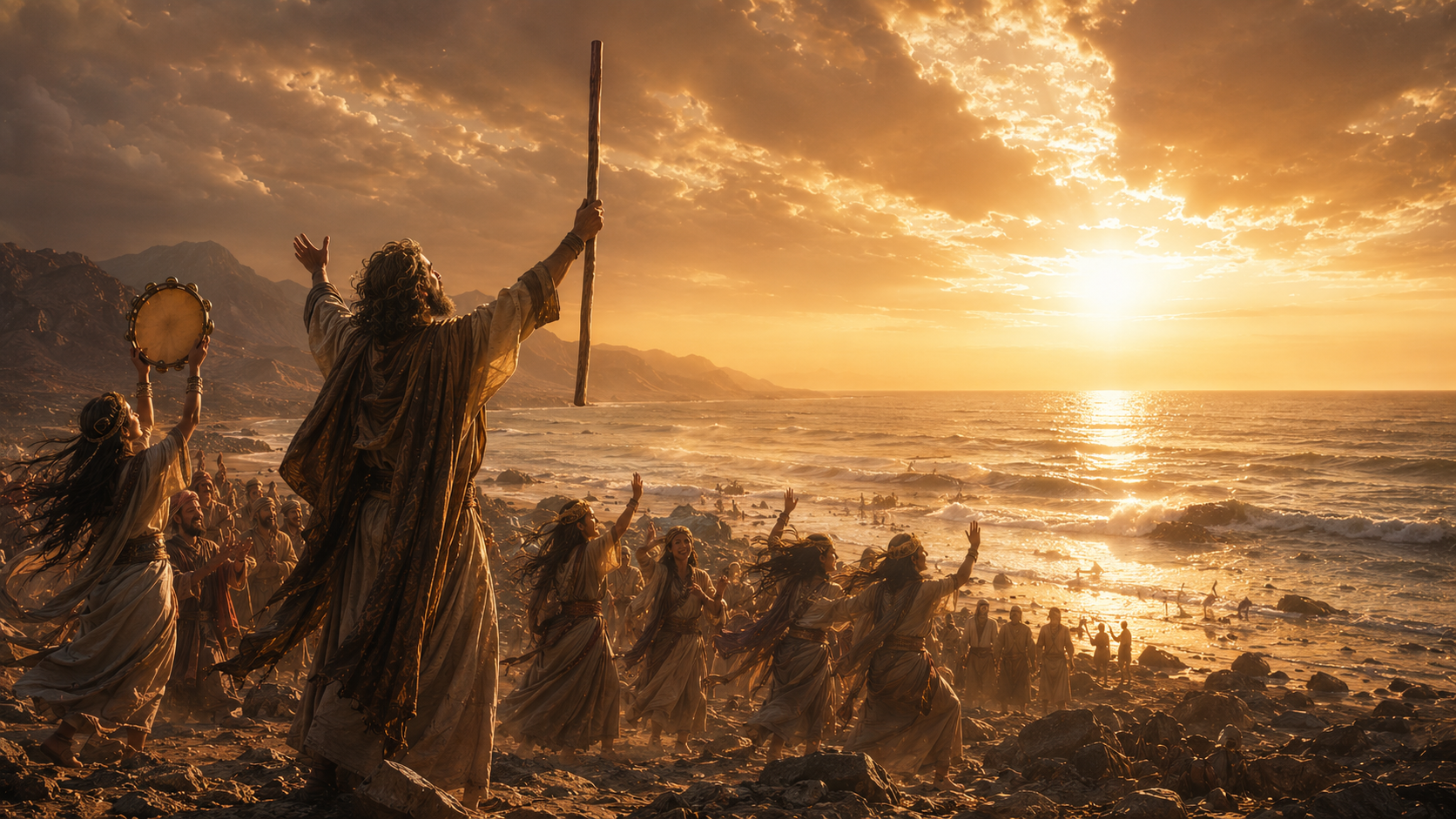
Then Miriam the prophetess, the sister of Aaron, took a tambourine in her hand, and all the women went out after her with tambourines and dancing. And Miriam sang to them:
"Sing to the LORD, for he has triumphed gloriously; the horse and his rider he has thrown into the sea."
The woman who had stood at a distance in the reeds of the Nile as a ten-year-old child, watching her baby brother float toward a princess — this woman now stood on the far shore of the sea with a tambourine in her hand, leading the women of Israel in the first worship song of the liberated nation.
The whole arc of her life in five words: Sing to the LORD. Eighty years from the Nile to the sea. From watching a basket float to leading a nation sing. The sister who stepped out from the reeds was the prophetess who stepped out on the shore. And she called the women — all the women, with their tambourines, with their dancing — into the worship that the crossing had made possible.
This is not a minor detail. Miriam's leadership at the Song of the Sea is the founding moment of women's prophetic and worship leadership in Israel. Micah 6:4 names her explicitly alongside Moses and Aaron as a leader of the Exodus generation: "I sent before you Moses, Aaron, and Miriam." The Song of the Sea would not be complete without her voice.
The Song of Moses in Revelation 15 — Still Being Sung
Revelation 15:3–4: "And they sing the song of Moses, the servant of God, and the song of the Lamb, saying, 'Great and amazing are your deeds, O Lord God the Almighty! Just and true are your ways, O King of the nations! Who will not fear, you, O Lord, and glorify your name?'"
The song composed on the far shore of the sea — the oldest piece of Hebrew poetry, sung by Moses and Miriam after the crossing — is still being sung at the end of time. John sees the redeemed in heaven, those who have come through the final tribulation, standing on what appears to be a sea of glass mingled with fire. And they are singing. The same song. Expanded, transformed, completed — but the same song.
The crossing of the sea is not a one-time historical event that Israel celebrated and moved on from. It is the template for all of God's saving acts in history. Every liberation, every rescue, every passing through the waters of judgment into the freedom of the other shore — all of it is the same song, repeated in variations, until the final shore is reached and the redeemed of all ages stand together and sing it in full for the last time.
Moses began it at the sea. The Lamb completes it at the end of history.
Baptised Into Moses: 1 Corinthians 10:1–4
Paul's staggering reinterpretation of the Exodus — and what it means for Christian baptism
"For I want you to know, brothers, that our fathers were all under the cloud, and all passed through the sea, and all were baptised into Moses in the cloud and in the sea, and all ate the same spiritual food, and all drank the same spiritual drink. For they drank from the spiritual Rock that followed them, and the Rock was Christ."
1 Corinthians 10:1–4
This is one of the most compressed and explosive pieces of New Testament theology in Paul's letters. In four verses, he makes claims that connect the Exodus crossing to Christian baptism, the wilderness manna to the Lord's Supper, and the water from the rock to Christ Himself. Let us unpack each.
1 Corinthians 10:1–4 — Paul's Exodus Theology
"All were baptised into Moses in the cloud and in the sea"
1 Cor 10:2
Baptism Into Moses — What This Means
Paul uses the technical baptismal language of the early church — baptizo — and applies it retroactively to the crossing of the sea. The Israelites were "baptised" into Moses through the cloud (the pillar above them) and the sea (the waters on either side and below them). They were, in the language of Romans 6:3–4, immersed — surrounded by water — and emerged on the other side into a new existence.
This is stunning. Paul is saying that Christian baptism is the fulfilment of the same redemptive pattern enacted at the sea. As Israel went down into the sea corridor (surrounded by walls of water and the pillar cloud above) and emerged on the far shore as a redeemed nation — so the Christian goes down into the baptismal waters and emerges on the other side as part of the redeemed community of the new covenant.
"Into Moses" — the baptism constituted their union with Moses as their leader and representative. "Into Christ" — Christian baptism constitutes union with Christ as the believer's leader, representative, and Saviour. The structure is identical. The person at the centre is different — and infinitely greater.
"The Rock was Christ"
1 Cor 10:4
Christ in the Wilderness — Pre-Incarnate Presence
Paul's most startling claim: the rock from which Israel drank water in the wilderness (Exodus 17:6; Numbers 20:8–11) was Christ. Not a type of Christ, not a symbol of Christ — was Christ. Paul is asserting the pre-incarnate presence of the second person of the Trinity actively sustaining Israel through the wilderness, manifested in the rock that produced water.
This is rooted in Jewish tradition as well: the rabbinic tradition spoke of a miraculous rock that "followed" Israel through the wilderness, providing water at each encampment. Paul takes this tradition and names the rock: it was Christ. The Word who was "in the beginning" and through whom "all things were made" (John 1:1–3) was present and active in Israel's wilderness experience. Every time they drank from the rock, they were, unknowingly, drinking from the One who would say in John 7:37: "If anyone thirsts, let him come to me and drink."
The crossing of the sea, the pillar, the manna, the water from the rock — Paul sees all of it as Christ. Not as anticipation of Christ. As Christ. The entire Exodus was, in Paul's reading, a sustained encounter with the pre-incarnate Son of God, whose people Israel was, and to whom Israel was being formed to belong.
Romans 6:3–4 and the Crossing — Death and Resurrection Through Water
"Do you not know that all of us who have been baptised into Christ Jesus were baptised into his death? We were buried therefore with him by baptism into death, in order that, just as Christ was raised from the dead by the glory of the Father, we too might walk in newness of life."
The structure of the crossing maps precisely onto Paul's baptism theology in Romans 6. Before the crossing: Israel in Egypt — enslaved, under Pharaoh's dominion. In the sea: the old life left behind, passing through waters that buried the pursuing enemy. On the far shore: new existence, new identity, new song. Dead to Egypt. Alive to YHWH.
Before baptism: the believer under sin's dominion. In the water: the old self buried with Christ. After baptism: resurrection life, new identity, new song. Dead to sin. Alive to God. The structure is identical. Paul is not creating a loose analogy. He is tracing the same redemptive shape that God established at the crossing of the sea and fulfilled at the cross and resurrection of Jesus Christ.
Every time a believer is baptised, they are re-enacting the crossing of the sea at the most personal level possible: going down into the water as an enslaved person, emerging on the other side as a member of the liberated community of God's redeemed people. The sea crossing is not just Israel's history. It is the template for every Christian's initiation into the Body of Christ.
Devotional
The LORD Will Fight for You — You Have Only to Be Silent
The people who crossed the sea did not do it confidently. They did it terrified.
Moses' four commands — do not fear, stand firm, see the salvation of the LORD, be silent — were given to people who had Egyptian chariots bearing down on them from behind and a wall of deep water in front. They were not in a place of spiritual victory and calm certainty when the miracle happened. They were in a place of absolute panic, saying things they didn't really mean, accusing their leader, wishing they were back in chains.
The crossing of the sea did not happen because Israel found their courage. It happened because God drove back the water while Israel stood still — terrified, but still there. That is enough. That is sufficient. The requirement was not bravery. The requirement was presence. Stay where I have placed you. Stop running backward. Don't move until I move you. And watch.
There is a specific season in the Christian life that looks exactly like this moment at the sea. You have come a long way from Egypt — the old life, the old bondage — but you are not yet in the promised land. There is something in front of you that looks impassable. And something behind you — old habits, old fears, old voices — that seems to be gaining ground. And the temptation is to turn around and go back. Back to the familiar. Back to the manageable. Back to Egypt.
The word for that moment is the same word Moses spoke on the shore: stand firm. The LORD will fight for you. You have only to be silent.
Not passive — silent. There is a kind of silence that is the deepest form of trust: the refusal to fill the space of your situation with your own noise, your own plans, your own arrangements for a retreat. The silence that says: I am here. I am not going back. I do not yet see how this opens. But I am watching. I believe it will open. And I will sing about it on the other side.
The walls of water do not part before you step in. They part as you step in. The miracle meets the obedience. Not the confidence — the obedience. Just step forward. The sea will open.

Reflection & Discussion Questions
Personal Reflection
1. God led Israel the long way round — deliberately avoiding the short road because they weren't ready for it. Can you identify a "long way round" in your own life — a season where God clearly chose the harder, longer route? Looking back, what do you think He was forming in you that the short road could not have produced?
2. The Israelites, in their terror, said they would rather have stayed as slaves — and they rewrote their own history to justify it ("did we not say in Egypt: leave us alone?"). Have you ever been so afraid that you told yourself a story about the past that wasn't quite true, in order to justify going backward? What does Moses' response to the people teach about the pastoral care of frightened people?
3. Moses' fourth command was "be silent" — the LORD will fight for you. Is there a situation in your life right now where the call is to do less, not more — to stop filling the space with action and noise, and simply wait for God to act? What makes that kind of silence so difficult?
Deeper Study
4. The pillar of cloud and fire appears at the Exodus, on Sinai, over the Tabernacle, at the Transfiguration, at Pentecost, and at the Second Coming. Trace this motif through the Bible. What is being communicated about the nature of God's presence with His people at each appearance? And what does its democratisation at Pentecost (fire resting on individuals) represent theologically?
5. Read 1 Corinthians 10:1–4 carefully. Paul says Israel "ate the same spiritual food" and "drank the same spiritual drink" as Christians — and that "the Rock was Christ." What does Paul's identification of Christ as present and active in the Old Testament wilderness experience do to your understanding of the relationship between the two Testaments? And how does it change how you read the Exodus story?
6. Read Revelation 15:2–4. John sees the redeemed in heaven singing "the song of Moses" alongside "the song of the Lamb." What does it mean that the oldest song in the Hebrew Bible is still being sung at the end of history? What does this tell us about how God sees the Exodus — and how it relates to the full arc of redemption?
7. Miriam leads the women of Israel in worship at the sea with tambourines and dancing — and Micah 6:4 names her as a co-leader of the Exodus alongside Moses and Aaron. How does understanding Miriam's full role — from the reeds of the Nile to the shore of the sea — change how you understand female prophetic and worship leadership in Scripture? What was she carrying all those years that finally found its full expression in Exodus 15?
Closing Prayer
A Prayer on the Far Shore
LORD, who triumphed gloriously —
Who is like you O Lord?, none. We thank you that you are dear Lord, that you fight for us and we only need to stand firm and be still.
We thank you that we see that your are still the amazing sea splitting God , still working as we groan through our day to day. That the only present consistent anchor in our life is you. We may be walking in times and places that is unknown and not see the whole picture, but we can trust, that you are still working, still making a path, still shining a way through the difficult blinding periods in our lives.
And we thank You that the Song of Moses is still being sung. That the redeemed of all ages will stand one day on a shore we have not yet reached and sing it together — the same song, completed and perfected, the song of Moses and the song of the Lamb woven into one voice that goes on forever.
lead us. By cloud and by fire. By the long way round if that is what it takes. We will follow.
In your sons name Jesus,
Amen.
Coming Next in the Series
Part Thirteen: The Wilderness School Begins — Bitter Water, Bread from Heaven, and the Sabbath
Israel has crossed the sea. Now the formation begins in earnest. In Part Thirteen we enter the wilderness of Shur, where the first test comes immediately: water that cannot be drunk. We examine the theology of Marah (bitter) and its sweetening, the miraculous provision of manna (and the extraordinary details of what it looked like, tasted like, and what happened when people tried to hoard it), the Sabbath instituted in the wilderness before Sinai, and what the wilderness between the sea and the mountain is designed to teach about trust.
Add comment
Comments