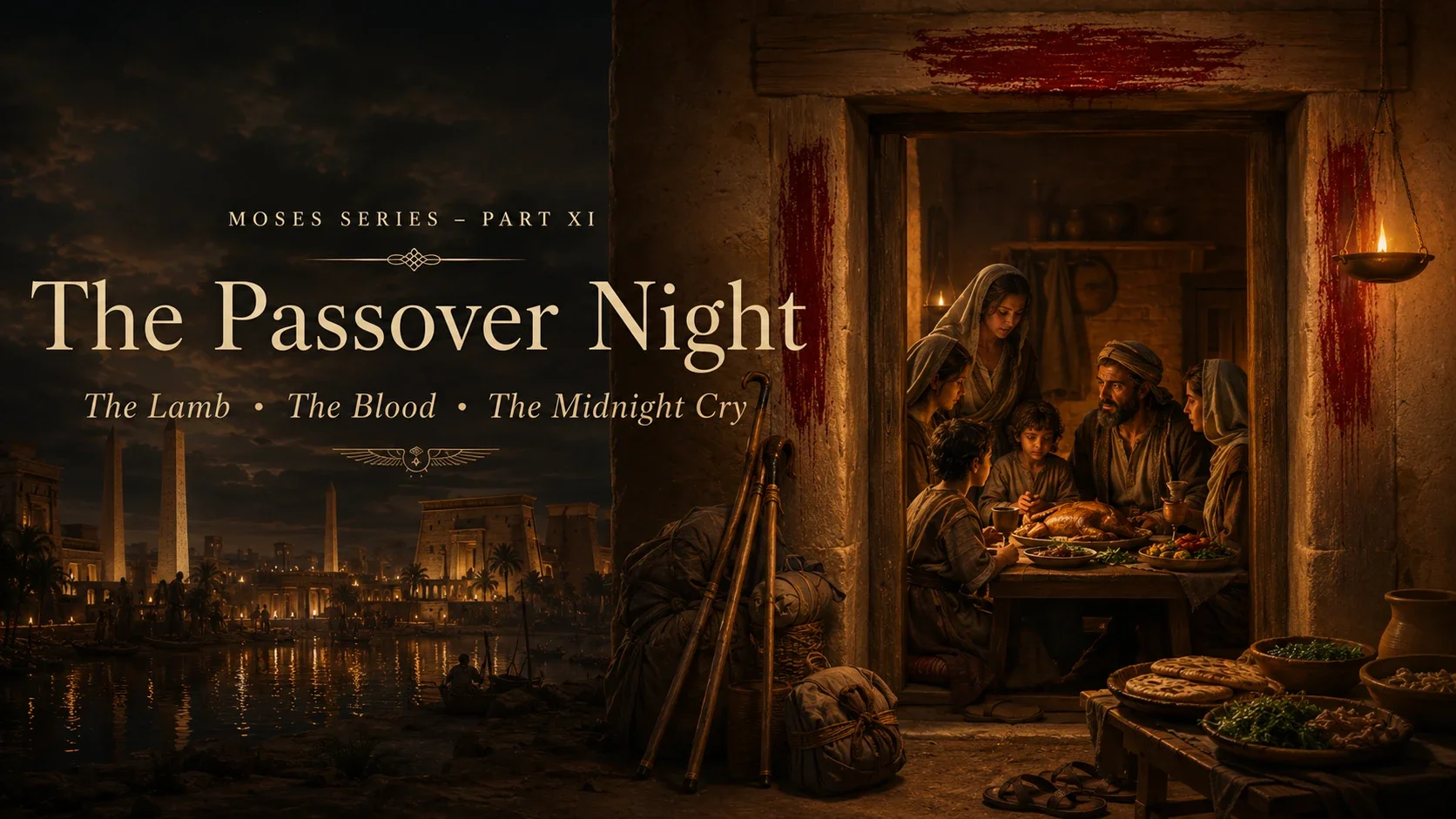
"The blood shall be a sign for you, on the houses where you are. And when I see the blood, I will pass over you, and no plague will befall you to destroy you, when I strike the land of Egypt."
— Exodus 12:13
Please Read These Passages First
Part Eleven covers the most consequential night in the Old Testament — the night that gave Israel its calendar, its identity, and its central act of worship for the next three thousand years. Please read the full passage straight through, slowly, before the commentary begins. This is not a chapter to skim.
As you read, notice the precision of the instructions — the specific day the lamb is chosen, the specific way it must be eaten, the specific posture (dressed, sandaled, staff in hand). Notice what is commanded to be remembered forever. And notice the single sentence that holds the entire night together: "When I see the blood, I will pass over you."
Exodus 11:1–10 Exodus 12:1–51 Exodus 13:1–16 1 Corinthians 5:6–8 Luke 22:7–20
Optional deeper reading:
John 19:31–37 (the unbroken bones of Jesus, echoing the Passover lamb regulation);
Hebrews 11:28 (Moses' faith in the Passover);
1 Peter 1:18–19 (redeemed by the precious blood of Christ, like a lamb without blemish);
the Mishnah tractate Pesachim (the earliest rabbinic instructions for conducting the Seder).
Exodus 11:1-10
Exodus 12:1-14
Exodus 12:15-28
Exodus 12:29-36
Exodus 12:37-42
Exodus 12:43-51
Exodus 13:1-16
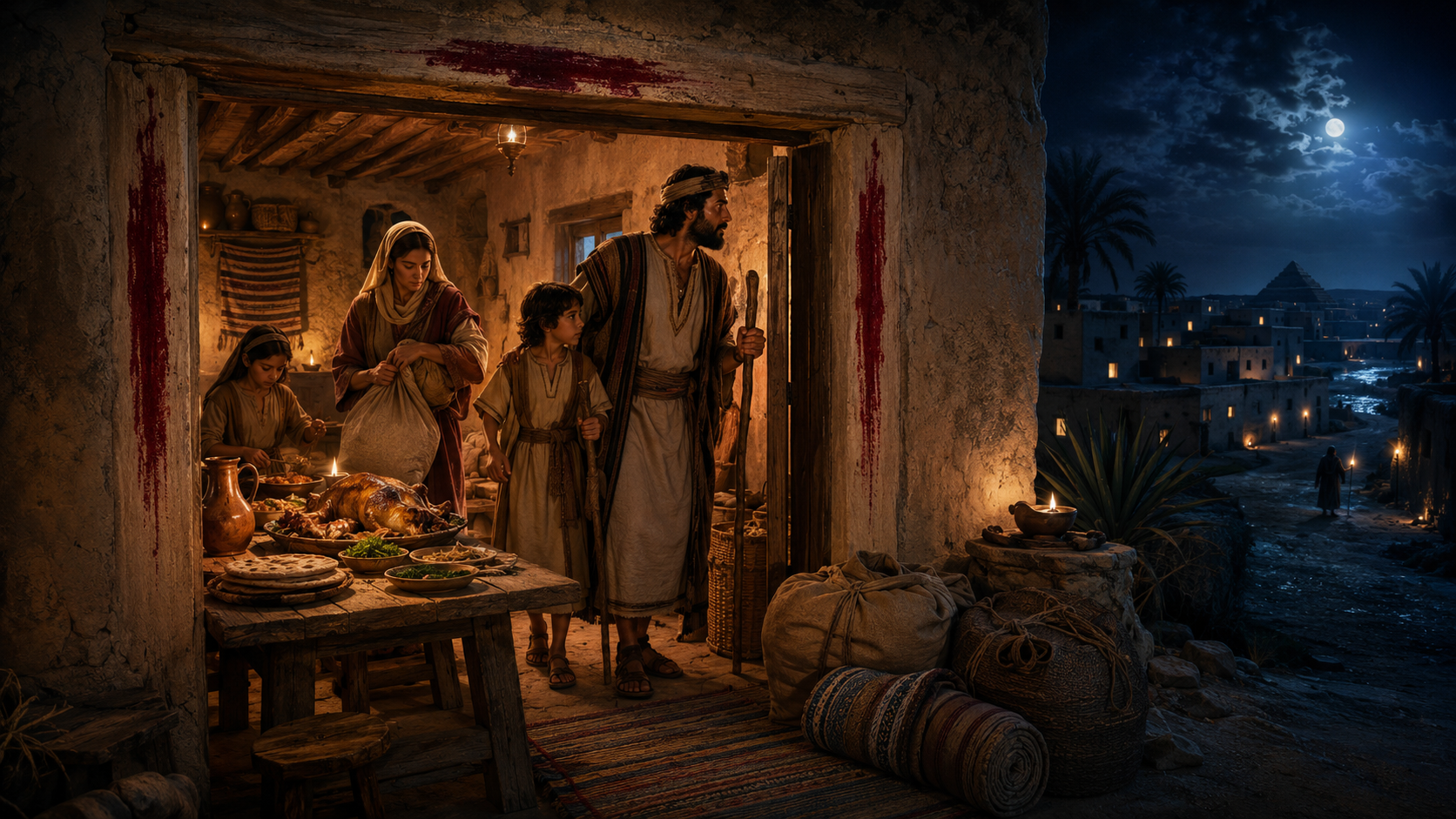
A Campfire Telling: The Night the Angel Walked Through Egypt
The Story
There was one plague left.
Pharaoh had said: get away from me. Never see my face again. And Moses had said: as you say. The door had closed between them. But before Moses walked out of that palace for the last time, God gave him one final word for Pharaoh — and it was the heaviest word of all.
About midnight I will go out in the midst of Egypt, and every firstborn in the land of Egypt shall die, from the firstborn of Pharaoh who sits on his throne, even to the firstborn of the slave girl who is behind the handmill, and all the firstborn of the cattle. There shall be a great cry throughout all the land of Egypt, such as there has never been and never will be again.
And then: but not a dog shall growl against any of the people of Israel, that you may know that the LORD makes a distinction between Egypt and Israel.
The distinction. The same word, the same theology, that had marked Goshen through nine plagues — the flies, the livestock, the boils, the hail, the darkness — was about to be drawn one final time, in the most terrible and most tender way imaginable.
But this time, the distinction would not come from geography. It would not come from simply living in the right region of Egypt. This time, it would come from blood.
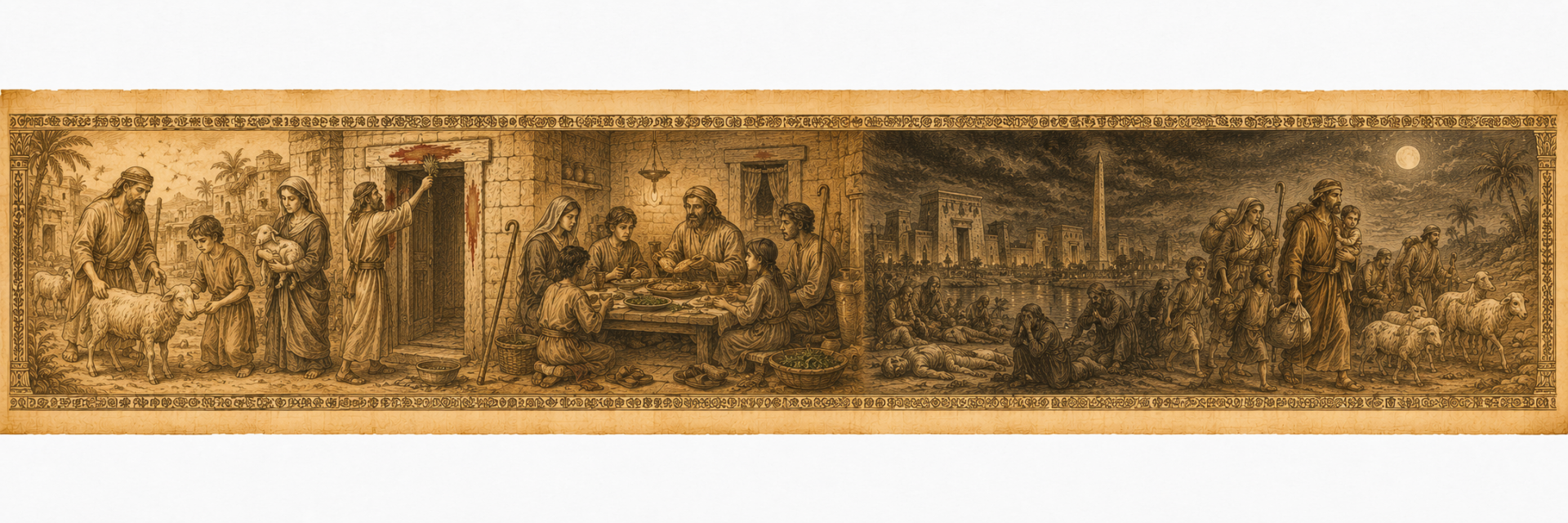
God gave Moses instructions ten days before the night itself. On the tenth day of the month, each household was to select a lamb — a male, a year old, without blemish, without defect of any kind. They were to keep that lamb in their home for four days. Four days of living with the animal that would die for them. Four days of a child, perhaps, growing fond of the creature that slept in the corner of the house, not yet knowing what its blood would mean.
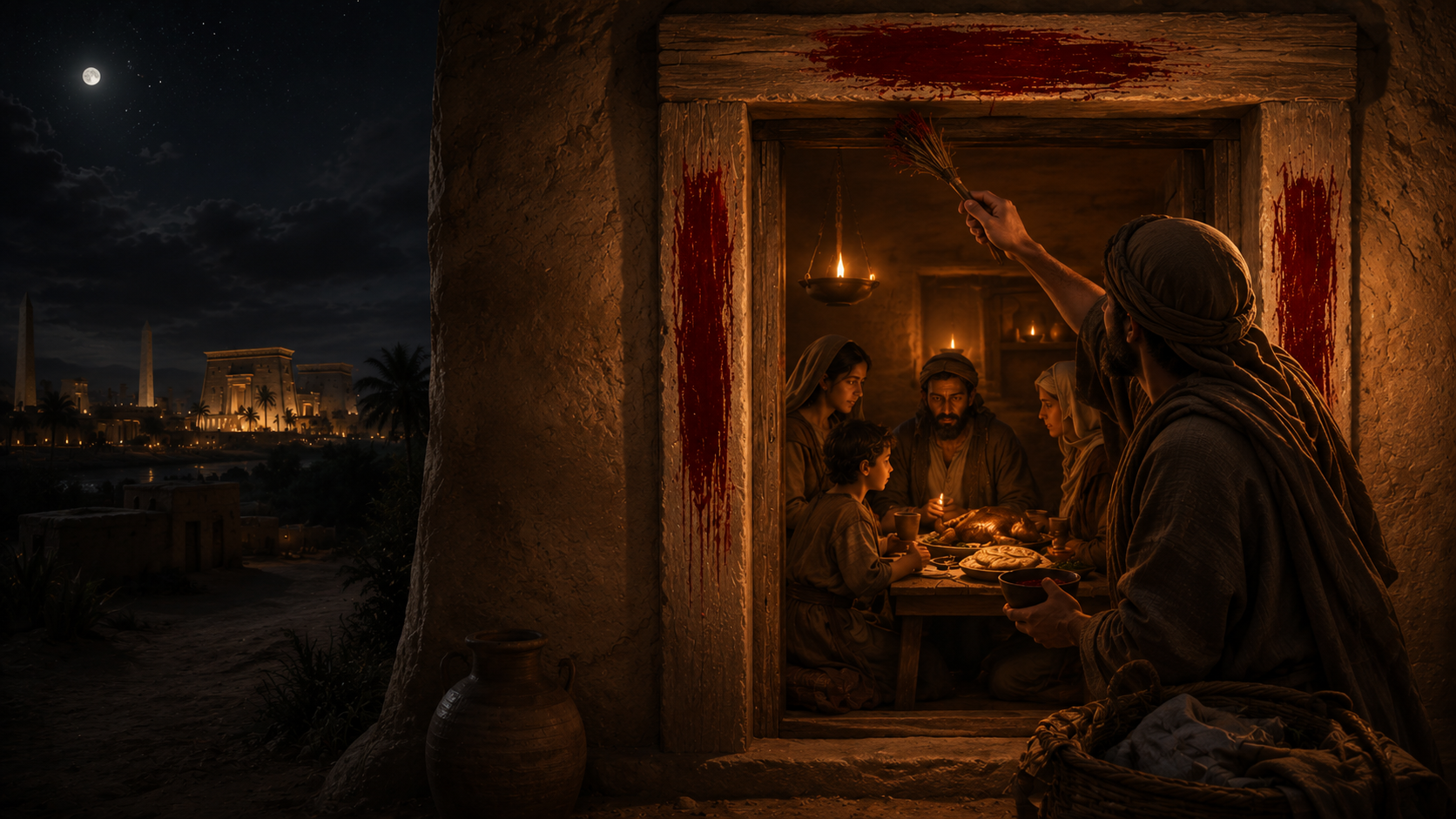
On the fourteenth day, at twilight, the whole assembly of the congregation of Israel was to kill their lambs. And they were to take some of the blood and put it on the two doorposts and the lintel of the houses in which they would eat the lamb.
Imagine it. Across the entire delta, in every Hebrew household, at the same hour, on the same evening — the sound of a blade. The cry of an animal. And then hands, dipped in blood, reaching up to mark a doorway. Not a temple. Not an altar in some distant sanctuary. A doorway. The threshold of an ordinary home. The blood was not for display in a holy place. It was for the entrance to where families slept.
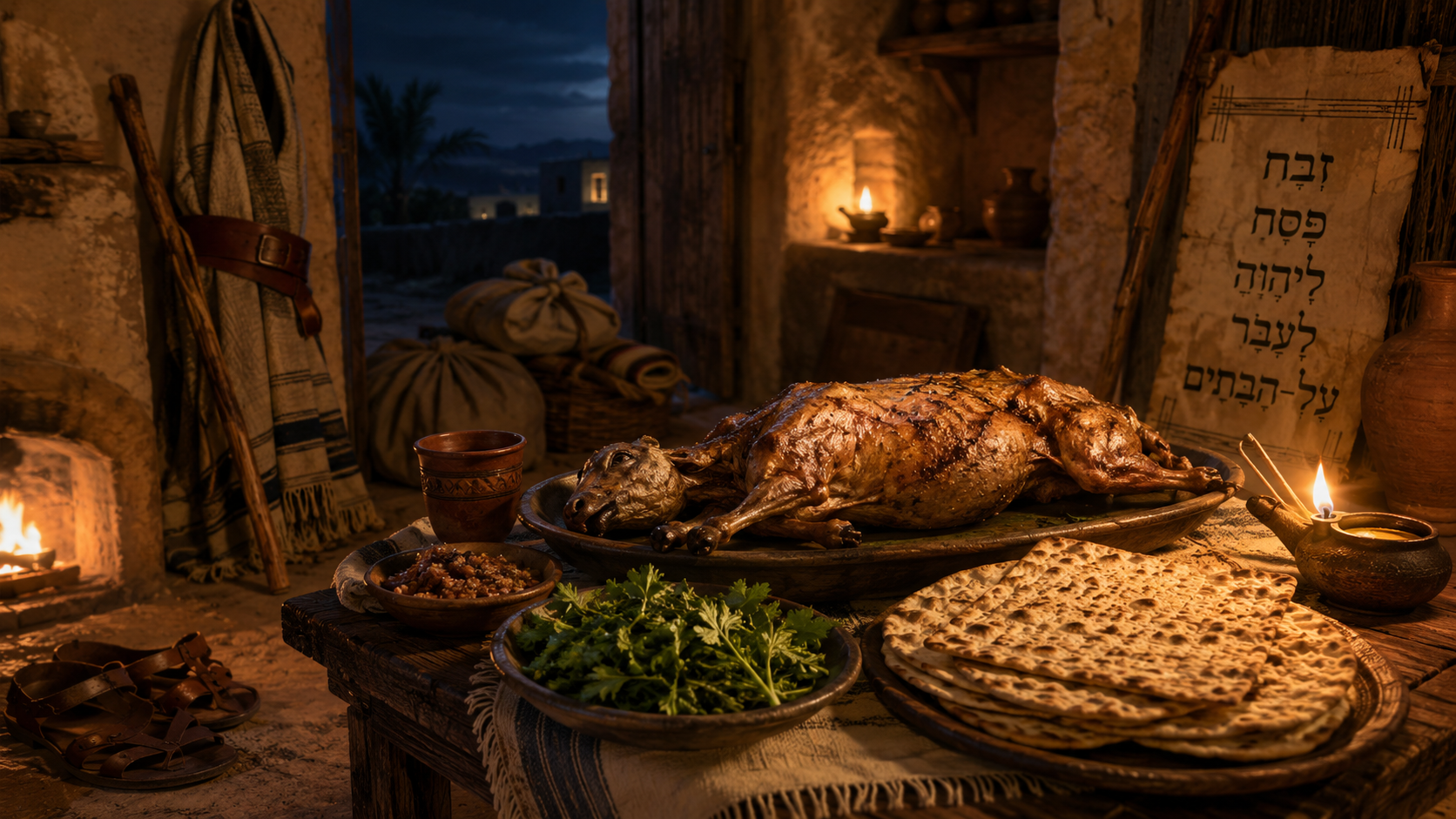
They were to roast the lamb whole — not boiled, not raw, but roasted over fire, head and legs and entrails together. They were to eat it with bitter herbs and unleavened bread. And they were to eat it standing, dressed for travel, sandals on their feet, staff in hand, eating in haste.
It is the LORD'S Passover.
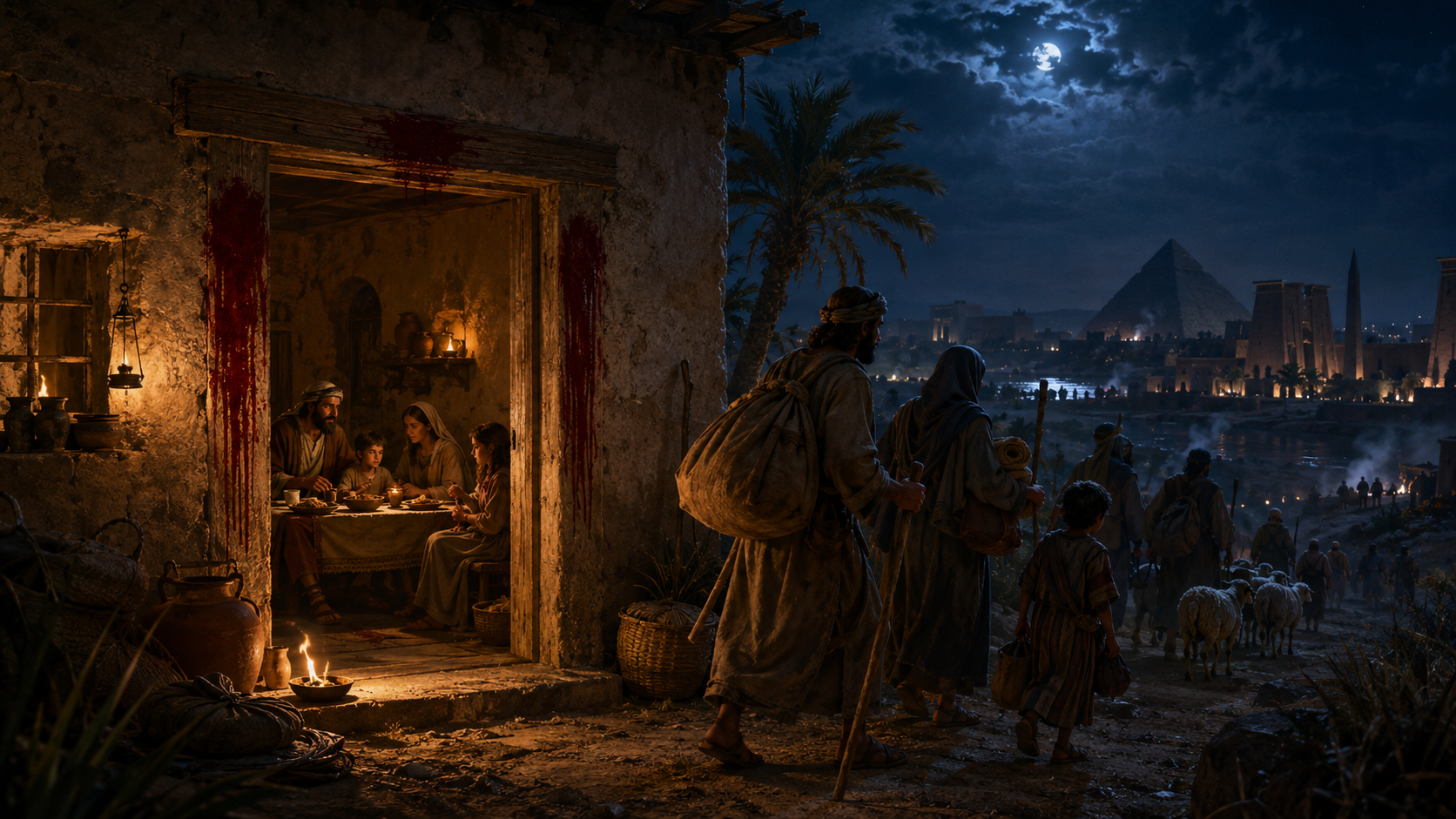
The Story Continues — The Night Itself
Night fell over Egypt.
In the Hebrew quarter, families sat inside houses marked with blood — doorposts dark and wet in the lamplight, the smell of roasting meat filling small rooms, children dressed not for sleep but for departure. They ate quickly. They did not linger over the meal the way you linger over a feast of celebration. This was not leisure. This was readiness. Every family in Goshen sat that night with their sandals already on their feet.
And somewhere outside, in the dark, something moved through Egypt that no eye recorded and no hand could stop.
The text does not give us the angel's footsteps or the sound of wings. It gives us only the aftermath. At midnight the LORD struck down all the firstborn in the land of Egypt, from the firstborn of Pharaoh who sat on his throne to the firstborn of the captive who was in the dungeon, and all the firstborn of the livestock.
And Pharaoh rose up in the night, he and all his servants and all the Egyptians. And there was a great cry in Egypt, for there was not a house where someone was not dead.
Try to imagine that sound. Not one household. Not one street. Every house in Egypt — the palace, the temples, the markets, the prisons, the farms — all of it, at the same hour, breaking into the same grief. A cry that the text says had never been heard before and would never be heard again. A nation's collective scream rising into the dark.
And in Goshen — silence. Or perhaps not silence. Perhaps the low murmur of families finishing their meal, checking their bundles, making sure the children had their shoes on. A different kind of waiting. Not the waiting of grief, but the waiting of imminent departure.
Pharaoh summoned Moses and Aaron in the night — not in the morning, not through intermediaries, not with royal protocol. In the night, in his own grief, the king who had said never see my face again sent for the two men he had expelled.
And he said: rise up, go out from among my people, both you and the people of Israel. And go, serve the LORD as you have said. Take your flocks and your herds, as you have said, and be gone. And bless me also.
Every demand granted. The men, the women, the children, the flocks, the herds — everything Moses had refused to leave behind. All of it, given. And one more thing: bless me also. The man who had said I do not know the LORD now asked, in his grief, for the blessing of the God he had spent nine plagues refusing to acknowledge.
The Egyptians urged the people to hurry, to send them out of the land quickly, for they said, "We shall all be dead." And the people of Israel went, just as Moses had said, and they asked the Egyptians for silver and gold jewelry and for clothing. And the LORD had given the people favour in the sight of the Egyptians, so that they let them have what they asked. Thus they plundered the Egyptians.
They left in haste. The bread had not had time to rise — they carried their kneading bowls, dough still flat, wrapped in their cloaks on their shoulders.
And they walked out.
Six hundred thousand men on foot, besides women and children. A mixed multitude went up with them as well, and very much livestock, both flocks and herds. Four hundred and thirty years — the text counts the precise number — to the very day, all the hosts of the LORD went out from the land of Egypt.
It was a night of watching for the LORD, to bring them out of the land of Egypt; this same night is a night of watching kept to the LORD by all the people of Israel throughout their generations.
A night of watching. Still kept. Still watched for. Still, every spring, when Jewish families around the world sit at a table and ask: why is this night different from all other nights? — they are remembering this exact night. The blood. The lamb. The cry in Egypt. The silence in Goshen. The walking out under a moon that watched an empire break and a nation born in a single hour.
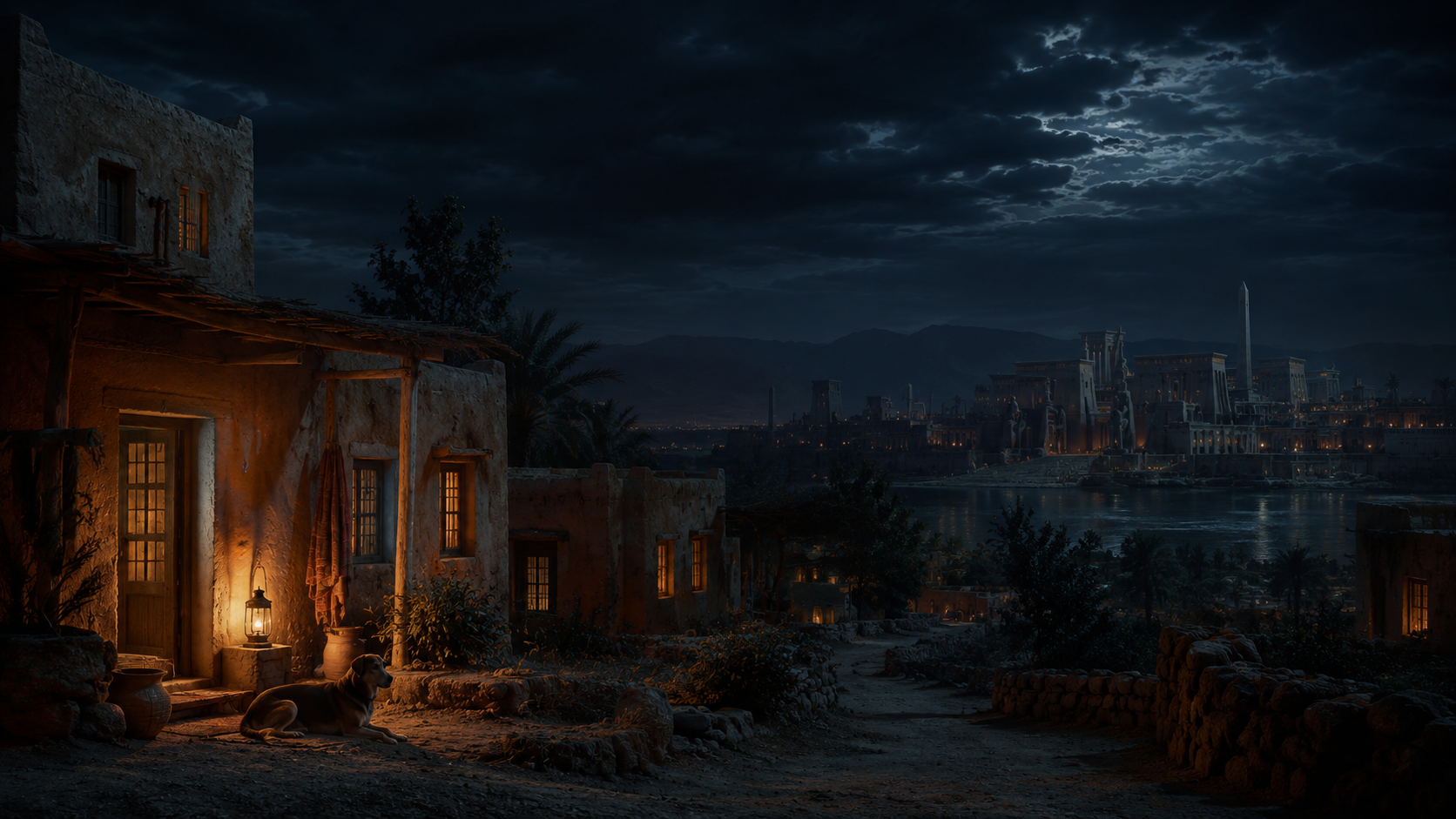
The Announcement: Exodus 11
The final warning, and the strangest verse in the whole sequence
"About midnight I will go out in the midst of Egypt, and every firstborn in the land of Egypt shall die... There shall be a great cry throughout all the land of Egypt, such as there has never been and never will be again. But not a dog shall growl against any of the people of Israel, that you may know that the LORD makes a distinction between Egypt and Israel."
Exodus 11:4–7
Exodus 11 is the announcement of the tenth plague — and it is structured differently from every announcement before it. There is no demonstration, no sign, no staff raised. There is only a declaration of timing and scope: at midnight, every firstborn, with no exceptions across class or species.
The detail about the dog is one of the strangest and most evocative in the entire narrative. Not even a dog will growl. The Hebrew is lo yecheratz-kelev l'shono — literally "a dog shall not sharpen its tongue." It is an idiom for complete silence, complete absence of disturbance. In the ancient Near East, dogs were associated with chaos, scavenging, and the boundary between order and disorder — they growled at intruders, at danger, at anything threatening the household. The image is total tranquility surrounding Israel even as the most catastrophic judgment in Egyptian history unfolds a few miles away.
Theological Significance — Firstborn for Firstborn
The death of the firstborn is the precise, full-circle answer to where this entire story began. Exodus 1:22: Pharaoh commanded that every Hebrew son be thrown into the Nile. Exodus 4:22–23: God told Moses to tell Pharaoh, "Israel is my firstborn son... if you refuse to let him go, behold, I will kill your firstborn son."
This warning was given before a single plague had been sent — back at the burning bush, before Moses had even returned to Egypt. The tenth plague was not improvised in response to Pharaoh's hardness. It was declared from the very beginning as the ultimate consequence if the demand was refused. Nine plagues were the slow unfolding of warnings before the warning that had been spoken first came finally to pass.
Pharaoh killed Hebrew sons. YHWH names Israel His son. The death of Egypt's firstborn is not arbitrary cruelty — it is the precise lex talionis (measure for measure) response embedded in the text from the start. What you did to My son's people, I will do to your own house.
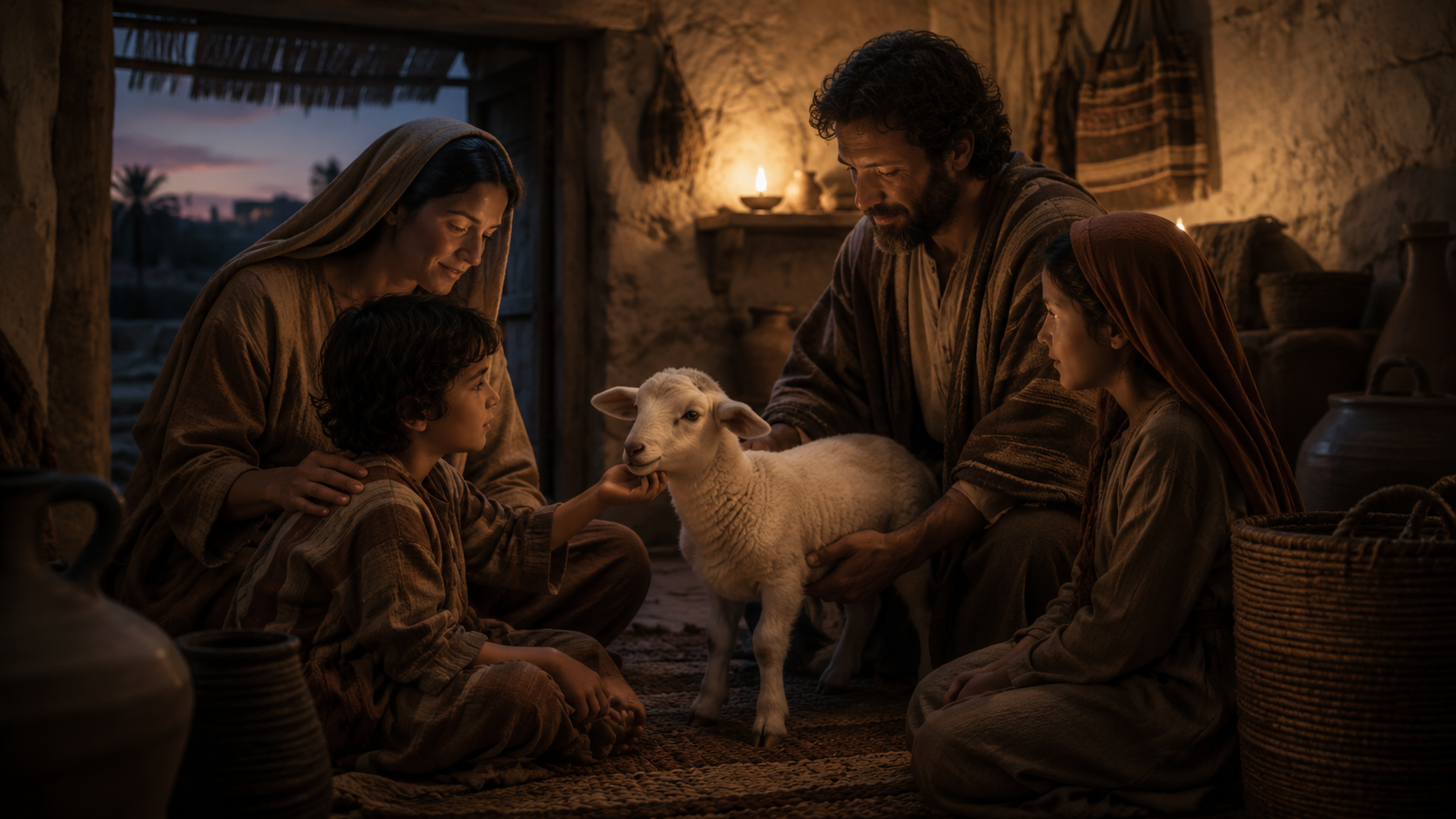
Choosing the Lamb: Exodus 12:1–6
Four days of living with what would die for you
Exodus 12:3–6 — The Selection
Verses 3–5
"On the tenth day of this month every man shall take a lamb according to their fathers' houses, a lamb for a household... Your lamb shall be without blemish, a male a year old. You may take it from the sheep or from the goats."
Verse 6
"You shall keep it until the fourteenth day of this month, when the whole assembled congregation of Israel shall kill their lambs at twilight."
seh tamim — "a lamb without blemish" — the word tamim (complete, whole, without defect) is the same word used throughout Leviticus for sacrificial animals and famously in Genesis 17:1 where God tells Abraham to "walk before me and be blameless" (tamim). Physical perfection in the animal pointed toward a moral and spiritual ideal that the animal itself could only symbolise, never achieve.
zachar ben-shanah — "a male a year old." A specific age — mature enough to be a meaningful sacrifice, young enough to represent the fullness of unspent life. The animal had not yet bred, had not yet fulfilled its natural purpose. Its entire potential life was being given.
The instruction allows for sheep or goats — practical flexibility for households of different means, but also significant: this was not a sacrifice limited to the wealthy. Every household, regardless of economic status, was to participate.
The Significance of the Four Days
Why four days? This detail — the lamb selected on the tenth, kept until the fourteenth — has occupied rabbinic and Christian commentators for centuries. The most compelling explanation is relational: by keeping the lamb in the household, eating with the family, becoming familiar, the animal ceased to be an abstraction and became a member of the household. Its death, four days later, would not be the killing of an anonymous animal but a genuine loss — a real death of something the family had come to know.
This detail intensifies the weight of the sacrifice immeasurably. It is one thing to slaughter a stranger's animal. It is another to slaughter the lamb that has slept in your house for four days, that your children have likely petted and fed. The Passover lamb's death was designed to cost something emotionally, not just economically.
bein ha'arbayim — "at twilight," literally "between the two evenings." This phrase has generated significant rabbinic debate about the precise time — likely referring to the period between when the sun begins to decline and full sunset, or possibly the period after sunset before full darkness. The Mishnah (Pesachim 5:1) records detailed instructions for the timing of the slaughter at the Second Temple, which occurred communally with priests assisting.
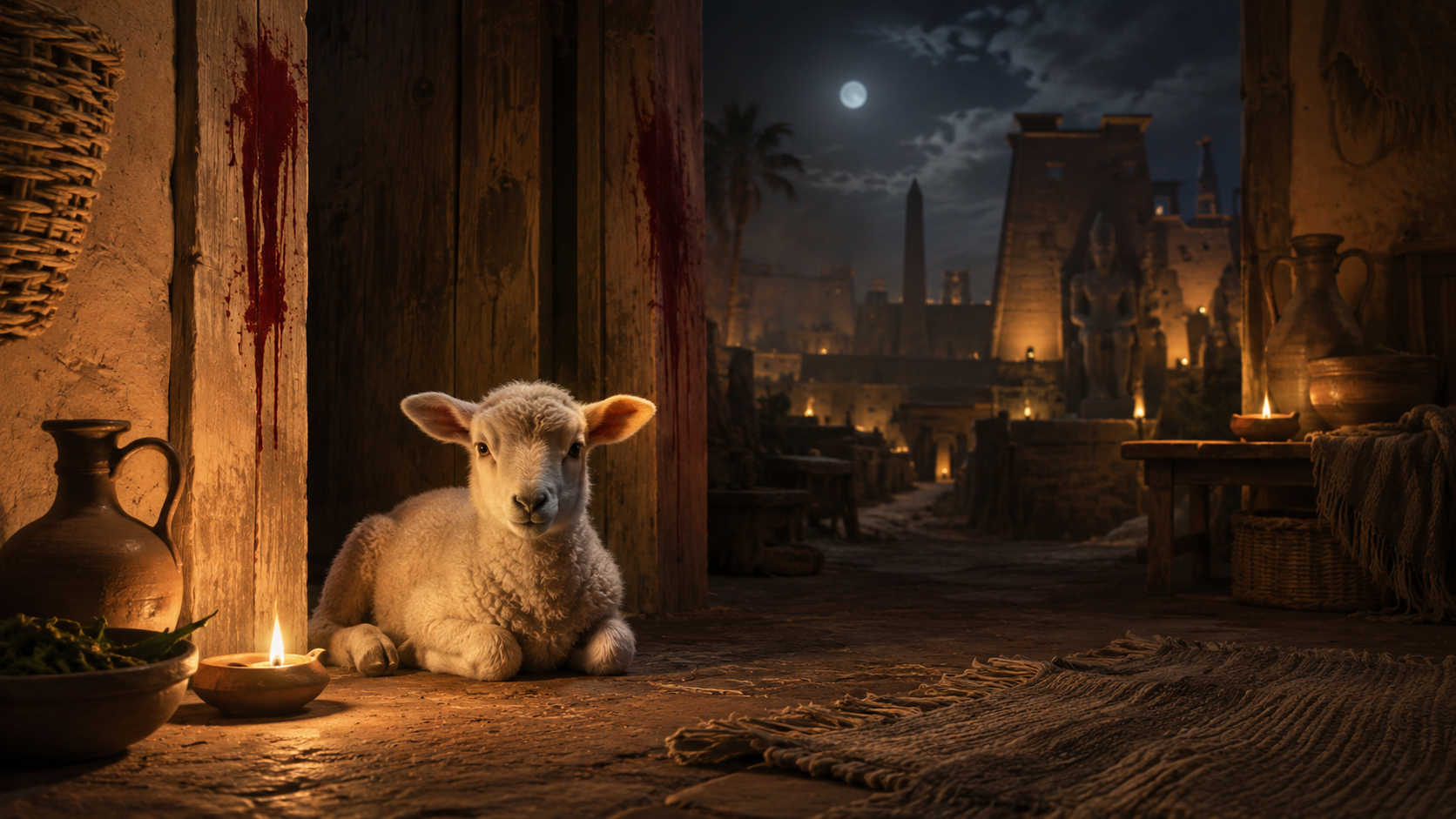
Archaeological & Historical Context — The Egyptian Sacred Ram and Sheep
The choice of a lamb or young goat as the Passover sacrifice carries direct theological confrontation with Egyptian religion. Khnum, the ram-headed god who moulded humanity on his potter's wheel, was worshipped at Elephantine and throughout Egypt. The ram and sheep were sacred animals in several Egyptian cult centres — at Mendes, the ram (associated with Banebdjed) was venerated as a living incarnation of several major deities combined.
For the Israelites to select, keep, slaughter, and eat a lamb — and to mark their doorposts with its blood — was an open act of religious defiance conducted in the heart of Egyptian territory. This is part of why God gave the instruction for sacrifice in the wilderness in Exodus 8:26: Moses tells Pharaoh that sacrificing in Egypt would be detestable to the Egyptians and would provoke them to stone the Israelites. The Passover, conducted on the very night of departure, is this same provocative act — but now performed without asking permission, in the final hours before Egypt's judgment falls.
The slaughter of sacred Egyptian animals by an enslaved population, on a night when Egypt itself was about to suffer its greatest catastrophe, was a complete and total declaration: your gods could not save your firstborn, and the very animal you worship is the substance of the meal we eat as we walk free.
Choosing the Lamb: Exodus 12:1–6
The Blood on the Doorposts: Exodus 12:7, 13, 22–23
The most important ritual act in the Old Testament
The Central Verse of the Entire Old Testament Sacrificial System
Exodus 12:13: "The blood shall be a sign for you, on the houses where you are. And when I see the blood, I will pass over you, and no plague will befall you to destroy you, when I strike the land of Egypt."
This single verse establishes the theological grammar that will govern the entire sacrificial system of Israel — and ultimately the entire logic of the cross. Substitutionary atonement, in its first full biblical expression, is established here: the death due to the household is averted because a substitute death — the lamb's — has already occurred, and its blood marks the place of refuge.
Exodus 12:7, 22 — The Specific Mechanics of the Blood Application
Verse 7
"Then they shall take some of the blood and put it on the two doorposts and the lintel of the houses in which they eat it."
mezuzot — "doorposts" (the two vertical posts of the doorframe) and mashqof — "lintel" (the horizontal beam above the door). Blood applied to two sides and the top creates a deliberate shape — three points forming, in effect, an inverted U or open frame around the entrance. Some Jewish and Christian commentators have noted that this shape anticipates the form of a doorway that one must pass beneath and between — echoing, whether intentionally in the original text or providentially in its typological reading, the shape of a cross turned upside down or sideways, an architectural frame of protection through blood.
The blood was not sprinkled randomly or poured out as a general offering. It was applied with precision, to specific architectural points, marking the entrance through which the family would pass in and out. Every time a family member entered or left the house during that period, they passed beneath and beside the blood — a constant, unavoidable visual reminder of what had purchased their safety.
Verse 22
"Take a bunch of hyssop and dip it in the blood that is in the basin, and touch the lintel and the two doorposts with the blood... none of you shall go out of the door of his house until the morning."
Hyssop — A Recurring Instrument of Purification
ezov — hyssop, a small bushy plant with absorbent stems and a cluster structure ideal for applying liquid in controlled amounts. Hyssop reappears throughout the Old Testament purification system: Leviticus 14 (cleansing from skin disease), Numbers 19 (the red heifer ritual for purification from contact with death), and famously in Psalm 51:7 — David's penitential prayer: "purge me with hyssop, and I shall be clean."
The command to remain inside until morning — "none of you shall go out of the door of his house until the morning" — is a command of trust. The blood had been applied. The instructions had been followed. And now the family had to remain inside, in the dark, trusting that the sign on their door was sufficient. They could not see the angel. They could not verify the protection was working. They simply had to stay inside and trust what God had said about the blood.
"When I See the Blood" — The Theological Heart of the Passover
There is a question worth sitting with: did God need to see the blood to know which houses were Israelite? Of course not. The omniscient God who had been tracking Pharaoh's heart through nine plagues, who knew the exact location of Goshen, did not require a visual marker to identify His people.
So why blood on the door?
The blood was not for God's information. It was for Israel's formation. The ritual act of selecting the lamb, keeping it, slaughtering it, and applying its blood required Israel's active participation in their own salvation narrative — not earning it, but enacting their trust in it. Faith in the Exodus story was never merely intellectual assent. It was embodied obedience: take the lamb, kill the lamb, apply the blood, eat the meal, stay inside. Every step required active trust translated into action.
This is the same pattern that runs throughout Scripture's theology of faith: belief that does not act is not yet the kind of faith Scripture commends. James 2:17 — faith without works is dead. The Passover instructs Israel, from its very first moment as a redeemed community, that salvation requires trusting obedience, not merely correct belief held privately.
The Meal: Roasted, Bitter, Unleavened, Eaten in Haste
Exodus 12:8–11 — Every detail of the meal carries meaning
The Elements of the Passover Meal and Their Significance
ROASTED MEAT
"They shall eat the flesh that night, roasted on the fire" (Exodus 12:8). Not boiled (which would require the meat to be cut up, potentially mixing pieces with adjacent households) and not raw (forbidden as a pagan ritual practice). Roasting whole over fire kept the animal's integrity intact — connecting to the later instruction that not a bone of it shall be broken (Exodus 12:46). The fire itself recalls the burning bush, the pillar of fire, and the constant divine association with purifying flame throughout the narrative.
UNLEAVENED BREAD
Matzah — bread made without yeast, flat and quickly baked. Practically, this reflects the urgency of departure (no time for dough to rise — Exodus 12:39). Theologically, leaven becomes throughout Scripture a symbol of corruption, pride, and the slow permeating influence of sin (1 Corinthians 5:6–8; Matthew 16:6). The bread of the Exodus is a bread without the agent of spiritual corruption — a meal eaten in purity and readiness.
BITTER HERBS
Maror — traditionally horseradish or bitter lettuce in later Jewish practice. The bitterness was to be tasted, not merely discussed — a sensory, embodied remembrance of the bitterness of slavery. Exodus 1:14 says the Egyptians "made their lives bitter [vayemareru] with hard service." The same Hebrew root. The meal makes the historical memory physically present in the mouths of every generation that eats it.
EATEN IN HASTE
"In this manner you shall eat it: with your belt fastened, your sandals on your feet, and your staff in your hand. And you shall eat it in haste. It is the LORD's Passover" (Exodus 12:11). This is the only meal in Scripture eaten in full travel dress. Every other meal in the ancient world was a moment of rest, leisure, and social settledness. This meal was the opposite: eaten standing, dressed for the road, ready to move the instant the command came. The posture of the meal teaches the posture of faith — alert, prepared, unsettled by design.
The Name Itself: Pesach
Hebrew Word Study — Pesach (פֶּסַח)
The name Pesach comes from the verb pasach — traditionally translated "to pass over," but the precise meaning has been debated. Three main proposals:
1. "To pass over/by" — the traditional reading: God passed over the marked houses without entering to strike. This is reflected in most English translations and the Septuagint's Greek translation pascha.
2. "To protect/hover over" — some scholars, drawing on a possible Akkadian cognate, suggest the meaning is closer to "to hover protectively," like a bird guarding its nest. This reading emphasises active divine protection rather than mere avoidance — God was not simply skipping the marked houses, He was actively shielding them.
3. "To limp/to skip" — the same root appears in 1 Kings 18:21, where Elijah challenges Israel for "limping between two opinions" (the same verb), and in 2 Samuel 4:4 for Mephibosheth's lameness. This may suggest a kind of "skipping" motion — the judgment skipping over the marked houses rather than walking straight through.
Whichever nuance is primary, all three readings agree on the central reality: the houses marked by blood experienced something different than the houses without it. Not absence of danger nearby — the danger was everywhere that night — but active divine differentiation based on the sign of blood.
Archaeological & Historical Windows
What can be traced of this night in the historical record
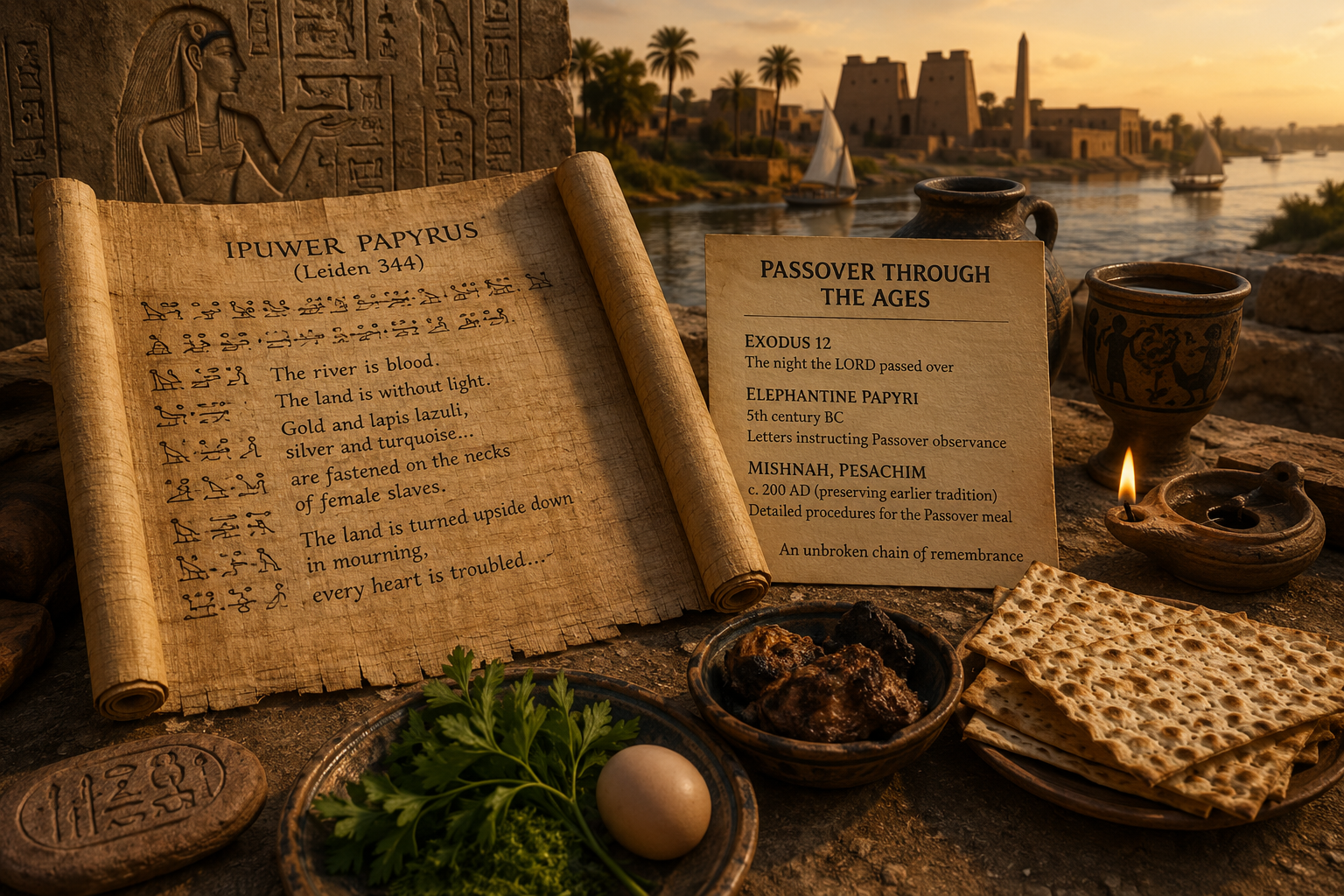
The Ipuwer Papyrus — A Contested but Fascinating Parallel
The Ipuwer Papyrus (officially Papyrus Leiden 344), an Egyptian text of debated date (estimates range from the late Middle Kingdom to the Second Intermediate Period, roughly 1850–1600 BC, though some scholars place its composition closer to the events it may describe), contains a lament describing societal collapse in Egypt with language that some have found strikingly resonant with the Exodus account: "the river is blood," "the land is without light," "gold and lapis lazuli, silver and turquoise... are fastened on the necks of female slaves" (cf. the Israelites' plundering of Egyptian jewelry), and repeated references to social inversion, death, and mourning throughout the land.
Scholarly opinion is sharply divided on this text. Mainstream Egyptology generally dates Ipuwer too early to correspond directly to either proposed Exodus date and reads it as a conventional "chaos" lament genre common in Egyptian literature during periods of political instability, not a historical record of the Exodus events. Others, including some who favor an earlier or differently-dated Exodus chronology, argue the parallels are too specific to dismiss entirely. We present this with appropriate scholarly caution: it is intriguing, contested, and should not be overstated as proof, but it remains a genuine and frequently discussed point of comparison in the broader conversation about extrabiblical evidence for the Exodus.
The Passover in Jewish Memory: An Unbroken Chain
Whatever one concludes about extrabiblical corroboration, the literary and liturgical evidence for the Passover's centrality in Jewish life is continuous and overwhelming. The earliest extra-biblical Jewish text describing Passover practice outside Scripture itself is the Elephantine Papyri (5th century BC) — letters from a Jewish military colony in Egypt that include explicit instructions for keeping the Passover festival, demonstrating that by the Persian period, Jewish communities even within Egypt itself were maintaining detailed Passover observance.
The Mishnah tractate Pesachim (compiled c. 200 AD but preserving much earlier oral tradition) provides the detailed procedural memory of Second Temple Passover practice — the communal slaughter of lambs by families assisted by Levites, the specific timing, the order of the meal. This tradition forms the basis of the modern Passover Seder, conducted by Jewish families worldwide to this day, an unbroken chain of practice stretching back, by the tradition's own claim, to the night described in Exodus 12.
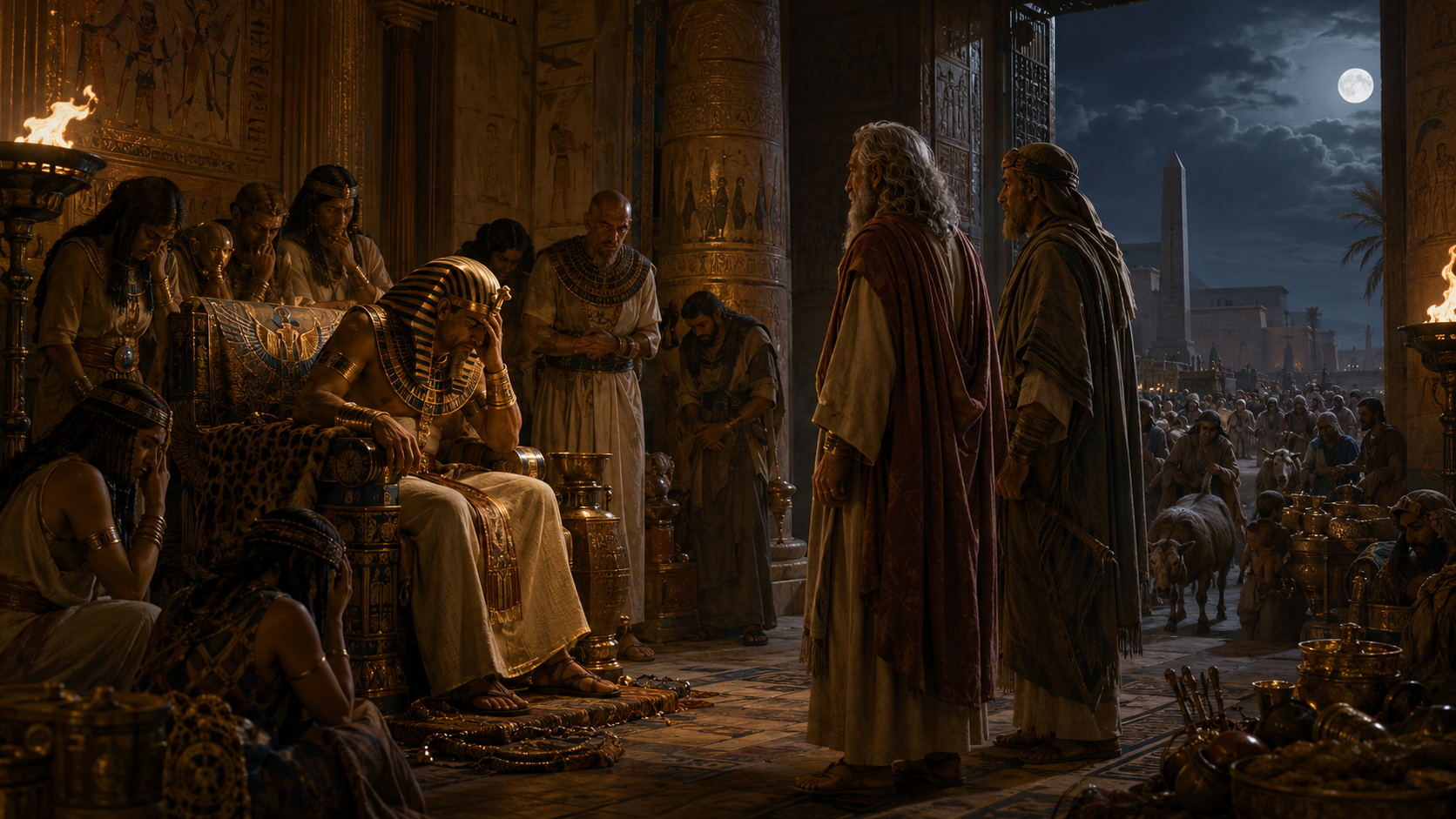
The Night Itself: Exodus 12:29–32
What most readers miss about Pharaoh's final words
At midnight the LORD struck down all the firstborn in the land of Egypt, from the firstborn of Pharaoh who sat on his throne to the firstborn of the captive who was in the dungeon, and all the firstborn of the livestock.
And Pharaoh rose up in the night, he and all his servants and all the Egyptians. And there was a great cry in Egypt, for there was not a house where someone was not dead.
Exodus 12:31–32 — Pharaoh's Final Words to Moses
Verses 31–32
"Then he summoned Moses and Aaron by night and said, 'Up, go out from among my people, both you and the people of Israel; and go, serve the LORD, as you have said. Take your flocks and your herds, as you have said, and be gone, and bless me also!'"
u'verachtem gam-oti — "and bless me also." This four-word phrase is one of the most theologically loaded moments in the entire narrative. Pharaoh — the man who said in Exodus 5:2 "I do not know the LORD" — now asks, in the wreckage of his own household, for that same LORD's blessing.
The structure of the request is significant. "Bless me also" — gam, "also" — implies Pharaoh recognises that YHWH's blessing is now operative for Israel and he wants some of it for himself. This is not conversion. The text gives no indication Pharaoh has come to worship YHWH or abandoned his own gods. But it is, perhaps, the most honest moment of his entire arc — a man whose denial has been completely shattered by grief, instinctively reaching for the one source of power he has spent eleven chapters refusing to acknowledge.
We are never told whether this blessing was given. The text moves immediately to Israel's departure. Pharaoh's request for blessing simply hangs in the air, unanswered, as the narrative moves forward without him. This may be intentional: even at the absolute limit of his own catastrophe, Pharaoh is asking for a transactional blessing rather than offering the surrender YHWH had been asking for throughout. He wants what Israel has without becoming what Israel is.
The Plundering of Egypt — A Fulfilled Promise from Four Hundred Years Before
Exodus 12:35–36 records something that connects directly back to a promise made to Abraham centuries earlier: "The people of Israel had also done as Moses told them, for they had asked the Egyptians for silver and gold jewelry, and for clothing. And the LORD had given the people favor in the sight of the Egyptians, so that they let them have what they asked. Thus they plundered the Egyptians."
This fulfills Genesis 15:14, where God told Abraham, in the covenant ceremony of the smoking firepot: "afterward they shall come out with great possessions." What looked for four hundred years like an unfulfilled promise — slavery, suffering, the apparent absence of divine action — comes to fulfillment in a single night. The Israelites do not leave Egypt destitute. They leave wealthy, carrying the resources that will, among other things, fund the construction of the Tabernacle that God will instruct them to build at Sinai (Exodus 25–31). The gold and silver plundered from Egypt becomes, ironically and beautifully, the material of Israel's worship of the true God.
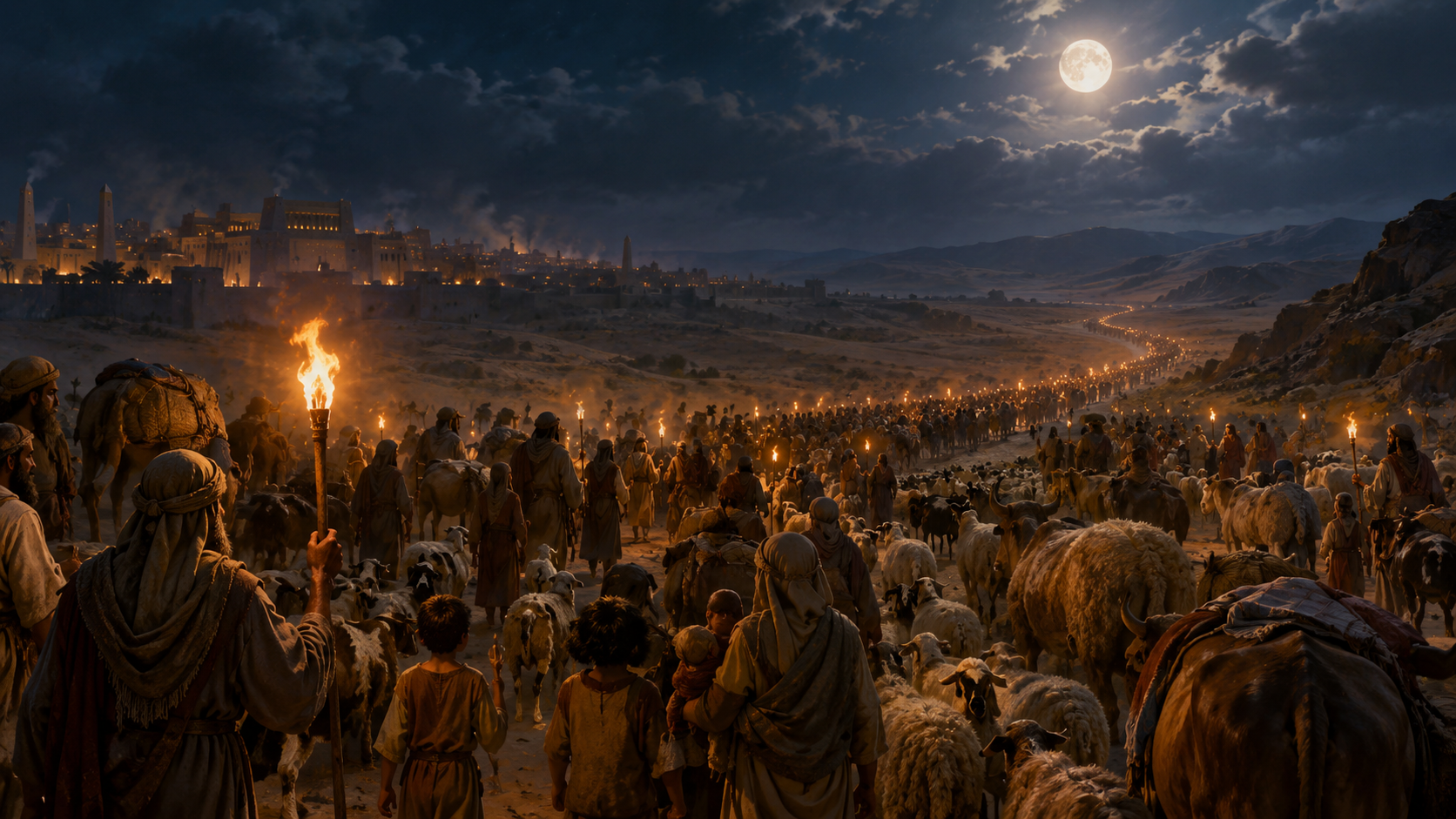
The Long Walk Out: Exodus 12:37–42
Six hundred thousand on foot, and the night kept forever
Exodus 12:37–42 — The Departure
Verses 37–38
"And the people of Israel journeyed from Rameses to Succoth, about six hundred thousand men on foot, besides women and children. A mixed multitude also went up with them, and very much livestock, both flocks and herds."
Scale and Significance
erev rav — "a mixed multitude." This phrase is theologically significant and frequently overlooked. Israel did not leave Egypt as an ethnically homogeneous group. Other peoples — likely including Egyptians sympathetic to YHWH (recall the servants who feared God's word at the seventh plague), other Semitic groups, and possibly other enslaved peoples — joined the Exodus. The community formed at Sinai will include this mixed multitude within its covenant identity, a detail with profound implications for understanding the openness of God's covenant community from its very founding moment.
Six hundred thousand men, not counting women and children, suggests a total population in the range of 2–2.5 million people — a number that has generated significant scholarly discussion about logistics, demographics, and possible alternative readings of the Hebrew eleph (which can mean "thousand" but also "clan" or "military unit" in some contexts, leading some scholars to propose smaller but still substantial numbers). Whatever the precise figure, the text intends to convey an enormous population movement — not a small band of refugees but the departure of an entire nation.
Verses 40–42
"The time that the people of Israel lived in Egypt was 430 years. At the end of 430 years, on that very day, all the hosts of the LORD went out from the land of Egypt. It was a night of watching by the LORD, to bring them out of the land of Egypt; this same night is a night of watching kept to the LORD by all the people of Israel throughout their generations."
A Night Kept Forever
leil shimurim — "a night of watching/keeping." The word shimurim derives from shamar — to watch, to guard, to keep. The night is doubly described: it was a night when God watched over and protected Israel, and it is a night that Israel is commanded to watch/observe/keep forever in return. The relationship is reciprocal: God kept watch that night; Israel keeps the memory of that watching, generation after generation, to this day.
The precision of "430 years, on that very day" reflects the careful theological record-keeping that runs throughout the Exodus narrative. This is not vague folk memory. The text insists on chronological precision because the events are not legend — they are history, anchored to specific times, meant to be remembered with the same precision with which they are recorded.
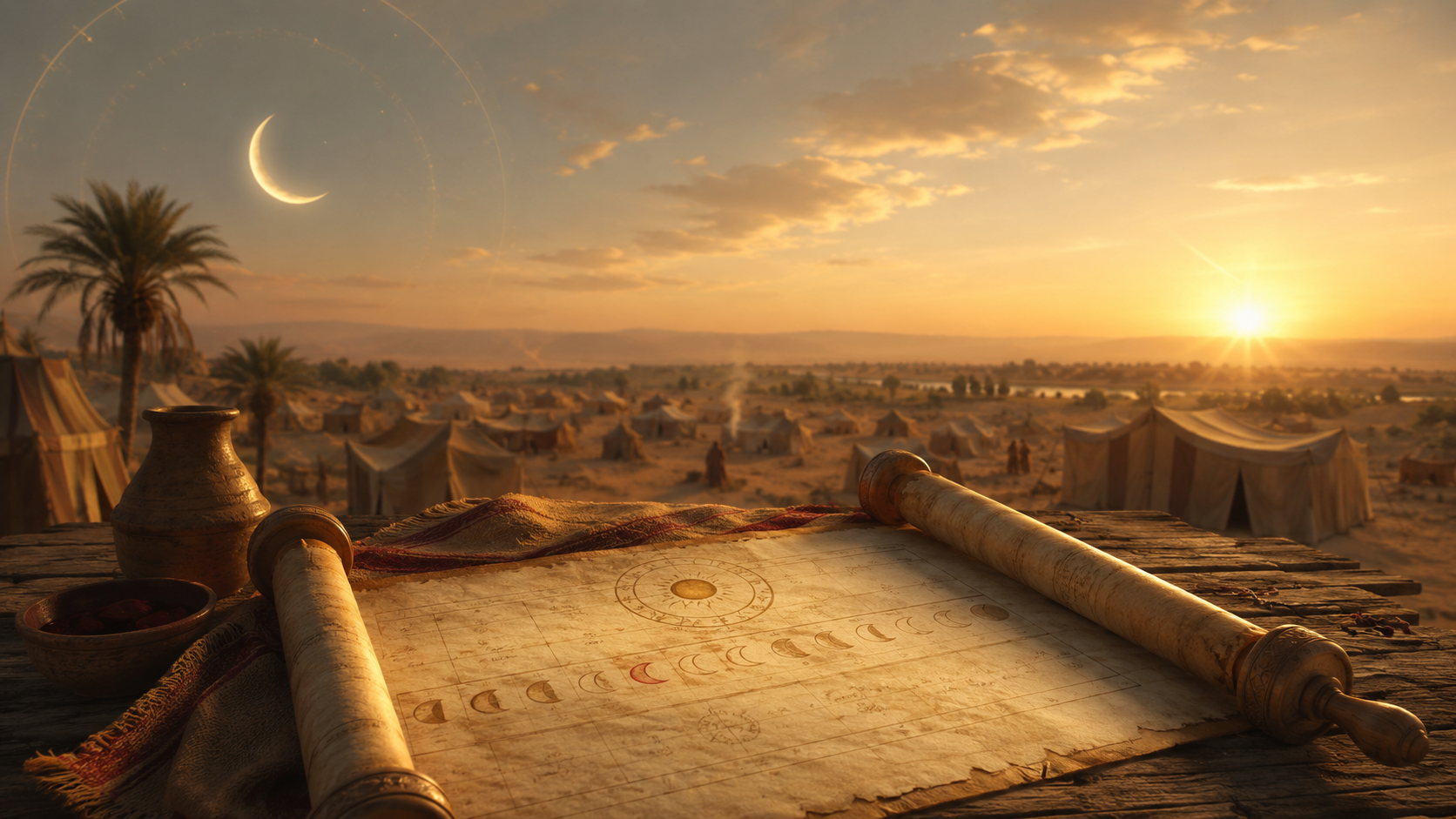
A New Calendar: Time Itself Reorganised
Exodus 12:2 — the verse that almost no one notices the weight of
"This month shall be for you the beginning of months. It shall be the first month of the year for you."
Exodus 12:2
Before any instruction about the lamb, before any mention of blood or doorposts, God's very first word to Moses and Aaron about the Passover is about time itself. This month — the month in which the Exodus would occur — was to become the first month of Israel's calendar year (later known as Nisan or Aviv).
This is an extraordinary claim. God is not merely instituting a festival. He is reorganising how Israel measures time itself. Every subsequent year, the calendar would begin with the memory of liberation. Time, for Israel, would forever be structured around the reality of redemption. You cannot tell an Israelite what month it is without implicitly reminding them when they were set free.
This pattern — a redemptive event becoming the structuring principle of how time itself is counted — recurs at the deepest level of Christian theology. The entire Western calendar, whatever one thinks of its accuracy, was built around the birth of Christ (BC/AD), an attempt, however imperfect in execution, to do exactly what Exodus 12:2 does: let the decisive act of divine redemption reorganize how a community marks the passage of time.
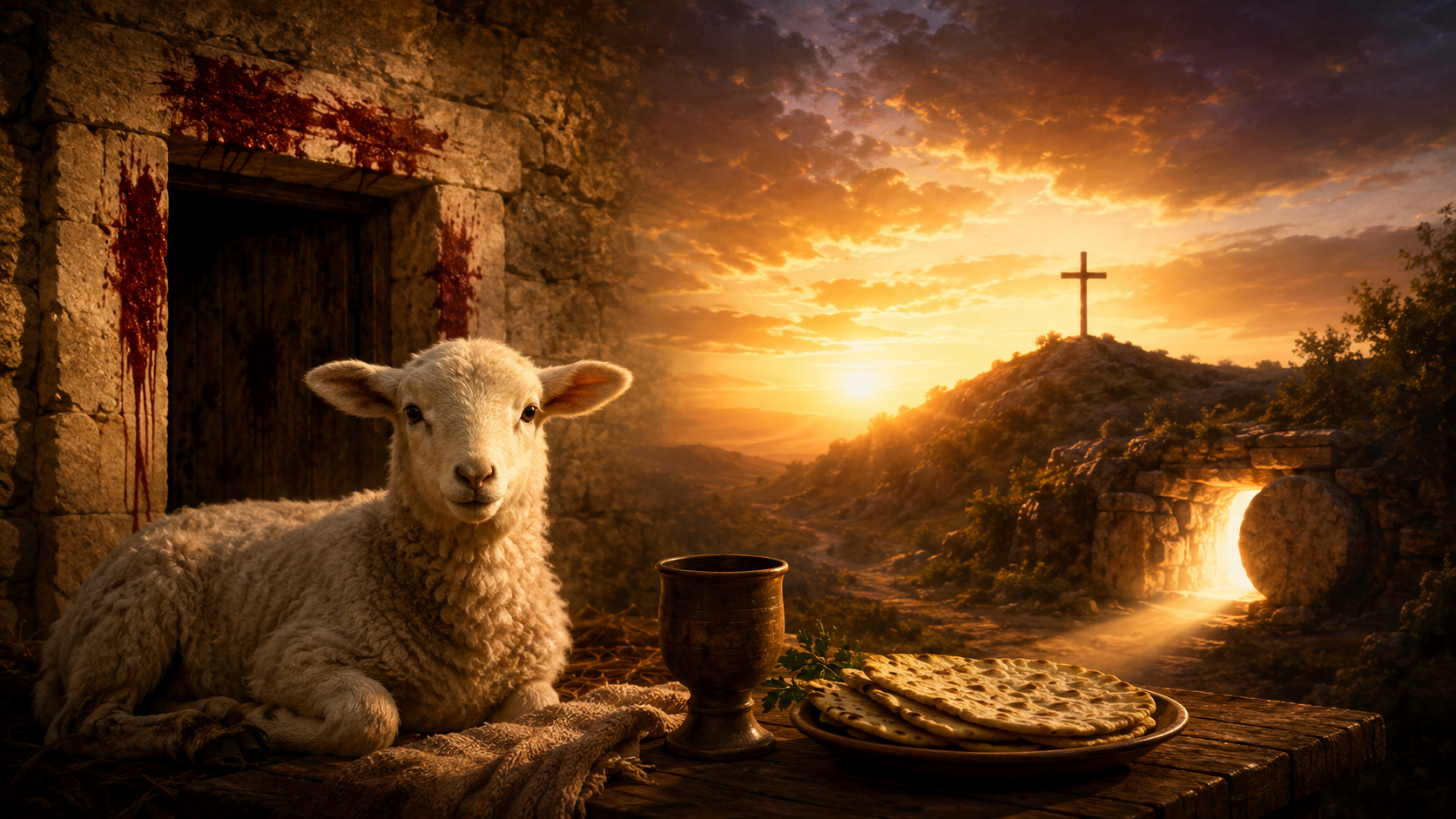
Christ Our Passover: The Full Typological Weight
Every detail of the Passover finds its fulfilment
No Old Testament event receives more explicit New Testament theological development than the Passover. The connections are not loose analogies — they are precise, deliberate, and woven into the very structure of how the New Testament writers understood what Jesus accomplished.
1 Corinthians 5:7 — The Foundational Statement
"Cleanse out the old leaven that you may be a new lump, as you really are unleavened. For Christ, our Passover lamb, has been sacrificed."
Paul does not say Jesus is like a Passover lamb. He says Christ is our Passover — present tense identity, not mere comparison. The entire framework of Exodus 12 — the lamb without blemish, the blood applied for protection, the meal eaten in readiness for departure — is the lens through which Paul wants the Corinthian church to understand both their salvation and their ethical obligation to "cleanse out the old leaven" of sin.
The Precise Correspondences — A Complete List
The Lamb Without Blemish (Exodus 12:5) → Christ Without Sin (1 Peter 1:19; Hebrews 4:15): "You were ransomed... with the precious blood of Christ, like that of a lamb without blemish or spot." Peter uses the exact sacrificial vocabulary of Exodus 12.
Selected on the Tenth, Sacrificed on the Fourteenth (Exodus 12:3, 6) → Jesus' Triumphal Entry and Crucifixion: Many scholars have noted that Jesus' entry into Jerusalem (traditionally observed on Palm Sunday) falls on the 10th of Nisan according to the Gospel chronology — the very day the Passover lamb was selected. He was crucified on the 14th — the very day of the Passover sacrifice. Whether intentional in the Gospel writers' chronological framing or providentially aligned in the actual historical events, the correspondence is striking.
Not a Bone Shall Be Broken (Exodus 12:46; Numbers 9:12) → John 19:33, 36: "But when they came to Jesus and saw that he was already dead, they did not break his legs... For these things took place that the Scripture might be fulfilled: 'Not one of his bones will be broken.'" John explicitly cites this as a fulfilled Passover regulation — the soldiers, breaking the legs of the other two crucified men to hasten death, find Jesus already dead and leave his body's bones intact, fulfilling the ancient instruction given to Moses.
The Blood Applied for Protection (Exodus 12:13) → The Blood of Christ Applied by Faith (Romans 3:25; Hebrews 9:14): The mechanism is identical in structure: judgment is coming, a substitute has died, and the application of that substitute's blood — not mere proximity to it, not mere awareness of it, but its active application — determines whether judgment passes over or falls.
Eaten in Haste, Dressed for Departure (Exodus 12:11) → The Christian Life as Pilgrimage: Hebrews 11:13–16 and 1 Peter 2:11 describe believers as "sojourners and exiles" — the posture of the original Passover meal (belted, sandaled, staff in hand) becomes the New Testament's metaphor for the entire Christian life: always ready, never fully settled in the present age, oriented toward departure to the true homeland.
The Night of Watching (Exodus 12:42) → The Last Supper and the Call to Watchfulness: Jesus institutes the Lord's Supper during a Passover meal (Luke 22:7–20), transforming the bread and wine of the Seder into the new covenant in His blood. And His repeated instruction to His disciples — "watch and pray" (Matthew 26:41) — echoes the leil shimurim, the night of watching, that Exodus 12:42 established as Israel's perpetual observance.
The Last Supper as the New Passover
Luke 22:15: "And he said to them, 'I have earnestly desired to eat this Passover with you before I suffer.'" Jesus does not merely happen to die during Passover week by coincidence of timing. He deliberately frames His final meal with His disciples as a Passover meal — and then transforms its central elements.
The bread that recalled hasty departure from slavery becomes "my body, given for you." The cup — traditionally the third cup of the Passover Seder, the "cup of redemption" — becomes "the new covenant in my blood." Jesus is not abolishing the Passover. He is revealing what it always pointed toward. The lamb whose blood protected Israel from the angel of death becomes the Lamb whose blood protects all who trust Him from the judgment due to sin. The meal eaten in readiness for departure from Egypt becomes the meal the Church eats in readiness for the final departure into the fullness of the Kingdom.
John 1:29 places this connection at the very opening of Jesus' public ministry: John the Baptist sees Jesus and declares, "Behold, the Lamb of God, who takes away the sin of the world!" Before a single miracle, before a single sermon, the very first public identification of Jesus' mission is Passover language. The entire Gospel narrative that follows is, in this light, the unfolding of what it means for this particular Lamb to be slain.

Devotional
When I See the Blood
There is a sentence in this story that deserves to be read slowly, more than once, until its weight settles: "When I see the blood, I will pass over you."
Not: when I see your good behaviour. Not: when I see how hard you have worked, how faithfully you have followed the rules, how impressive your record of obedience has been throughout your time in Egypt. Just: when I see the blood.
The family behind that door had not earned their protection through moral performance. They were the same people who had groaned under Pharaoh for four hundred years, who had complained, who had doubted Moses, who would, in a matter of weeks, build a golden calf and dance before it. They were not righteous enough to deserve exemption from judgment. They were covered by blood that was not their own.
This is the theology that the entire rest of Scripture will build on. Not human merit. Not moral sufficiency. A substitute. A lamb, without blemish, whose death stands in the place of the death that was due. And the application of its blood — not mere belief that blood exists somewhere, not mere awareness that a lamb died, but the active, specific, personal application of that blood to your own doorway — is what makes the difference between judgment and passing-over.
There is also something here about waiting in the dark. The family inside that house could not see the angel of death pass by. They could not verify, in real time, that the blood was working. They had done what they were told — selected the lamb, kept it four days, killed it, applied the blood, eaten the meal — and now they simply had to stay inside, in the dark, and trust.
Faith is often exactly this: having done what God asked, and then sitting in a dark room you cannot fully see out of, waiting for a morning you cannot yet observe, trusting a promise you cannot currently verify. The Israelites in Goshen that night were not experiencing visible proof of their safety. They were experiencing the same darkness that covered Egypt — minus the death.
If you are in a season of waiting in the dark right now — having done what you know to do, having applied what you know to apply, and now simply needing to trust that the morning is coming — you are in good company. The whole nation of Israel spent its founding night exactly there. Inside, in the dark, behind a door marked with blood, waiting for morning.
The blood was enough. It is still enough. When God sees it, He passes over. Not because you are sufficient. Because the Lamb was.

Reflection & Discussion Questions
Personal Reflection
1.The lamb was kept in the household for four days before its death — long enough to become known, perhaps even loved, before being sacrificed. How does this detail change the emotional weight of the Passover for you? What does it teach about the cost of substitutionary sacrifice?
2."When I see the blood, I will pass over you" — the protection was not based on the family's righteousness but on the application of the substitute's blood. Where in your life do you find yourself still trying to earn the protection or favour that has already been freely provided?
3.The family had to remain inside, in the dark, trusting the blood without being able to verify in real time that it was working. Are you in a season like this right now — having done what you know to do, and now needing simply to trust and wait? What would it look like to wait well?
Deeper Study
4.Read John 19:31–37 alongside Exodus 12:46 and Numbers 9:12. How does John's deliberate citation of the unbroken-bones regulation shape how the early church understood Jesus' death as a fulfilment of Passover? Why might this specific detail have mattered enough for John to highlight it?
5.Pharaoh's final words to Moses include "bless me also" — a request for blessing without surrender or worship. Have you ever wanted the benefits of God's favour without the full submission that genuine faith requires? What does Pharaoh's unanswered request teach about the difference between wanting blessing and wanting God?
6.Exodus 12:2 makes the Exodus month the first month of Israel's calendar — redemption reorganising how time itself is measured. In what ways does your own sense of "time" — the seasons and milestones that structure your life and memory — revolve around moments of God's deliverance? Could it more intentionally?
7.Read Luke 22:7–20 and 1 Corinthians 11:23–26 alongside Exodus 12. Map every element of the Passover meal (lamb, bread, cup, posture, remembrance command) onto its New Testament transformation in the Last Supper / Lord's Supper. How does this deepen your understanding of what happens when you take communion?

Closing Prayer
A Prayer for the Night of Watching
Lamb of God, who takes away the sin of the world —
We have walked through the longest night in Israel's history. The lamb selected. The four days of knowing what would die. The blood on the doorposts. The meal eaten standing, dressed for a journey we could not yet see the end of. The cry that rose across Egypt at midnight, and the silence — the watching, waiting silence — behind every blood-marked door in Goshen.
We thank You that we are not asked to earn what that blood purchased. That the criterion was never our righteousness but our trust — applying what You provided, believing what You promised, staying inside the shelter of the blood until the morning You promised would come.
We confess that we often want what Pharaoh wanted in his final hour — the blessing without the surrender, the favour without the faith, the benefits of belonging to You without actually becoming Yours. Forgive us for asking to be blessed while still standing outside the door.
Thank You for Jesus, our Passover Lamb, without blemish, whose bones were not broken, whose blood was not merely displayed but applied — applied to us, by faith, the night we believed. Thank You that the meal You gave us to remember Him is not a meal of leisure but a meal of readiness — bread and cup, eaten by a people still journeying, still watching, still waiting for the fullness of what this blood has purchased.
For those walking through their own night of watching right now — waiting in the dark for a morning they cannot yet see — be near. Let them trust the blood even when they cannot verify, in real time, that it is working. It is working. It has always been enough.
This is a night of watching, kept to You, by all who trust the Lamb, throughout all generations.
In the mighty name of Jesus, the lamb that was slain
Amen.
Coming Next in the Series
Part Twelve: Crossing the Sea — The Pillar of Fire and the Walls of Water
Pharaoh's final pursuit. The Israelites trapped between the Egyptian army and the sea. The pillar of cloud and fire that moves behind them. The waters that part. The walk through on dry ground. The collapse of the sea on Pharaoh's chariots. And the Song of Moses — the first great worship song in Scripture, sung on the far shore by a people who had just watched the impossible happen. We will explore the geography debate (Red Sea or Reed Sea), the Egyptian military technology that drowned, and how Paul describes this moment as the baptism of Israel.
Add comment
Comments