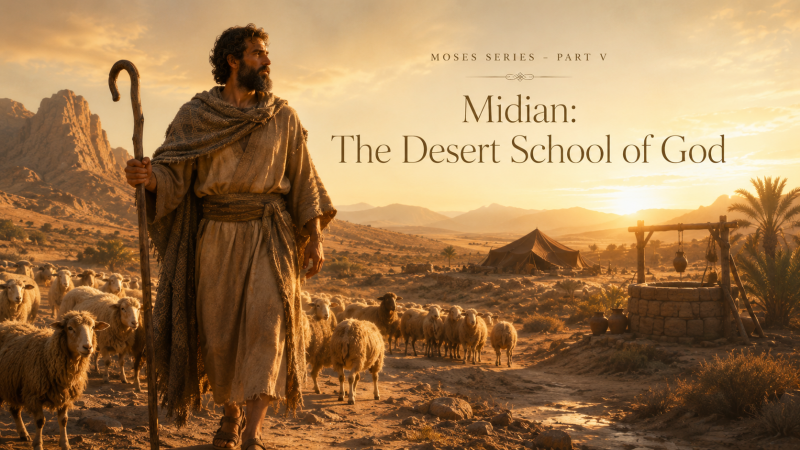
"Now Moses was keeping the flock of his father-in-law Jethro, the priest of Midian, and he led his flock to the west side of the wilderness and came to Horeb, the mountain of God."
— Exodus 3:1
Before we Begin
Please Read These Passages First
Part Five covers the forty years Moses spent in Midian — the longest, quietest, most hidden chapter of his life. Before reading the commentary, sit with the texts themselves. Let the silence of the desert settle before the theology opens it up.
As you read, notice: how ordinary the Midian years appear on the surface, what Moses names his son and why, and how Exodus 3:1 ends with Moses standing at the exact place where everything changes. The geography of his failure and his calling are the same geography.
Exodus 2:15–25 Exodus 3:1 Numbers 10:29–32 Exodus 18:1–12 Hebrews 11:24–27
Optional deeper reading: 1 Kings 19:1–18 (Elijah at Horeb — strikingly parallel to Moses); Matthew 4:1–11 (Jesus' forty days in the wilderness); Numbers 14:26–35 (Israel's forty years — the same motif). Also Genesis 25:1–6 to understand the Midianites as Abrahamic kin.
The Story
Forty Years of Ordinary Days
An imaginative reconstruction grounded in the historical and textual record
The following narrative reconstructs the biblical account using historical, geographical, and cultural context. Where Scripture is silent, sanctified imagination fills the texture — always in submission to the text.
The desert does not care about your past.
It does not care that you were educated in the greatest palace in the world. It does not care that you speak six languages or can calculate the load-bearing capacity of a mud-brick wall. It does not care that you grew up eating food off gold plates, or that your mother was a princess, or that somewhere in the administrative memory of Egypt there is a warrant for your arrest. The desert sees you the same way it sees every other creature that wanders into it: as something that needs water by nightfall or it will die.
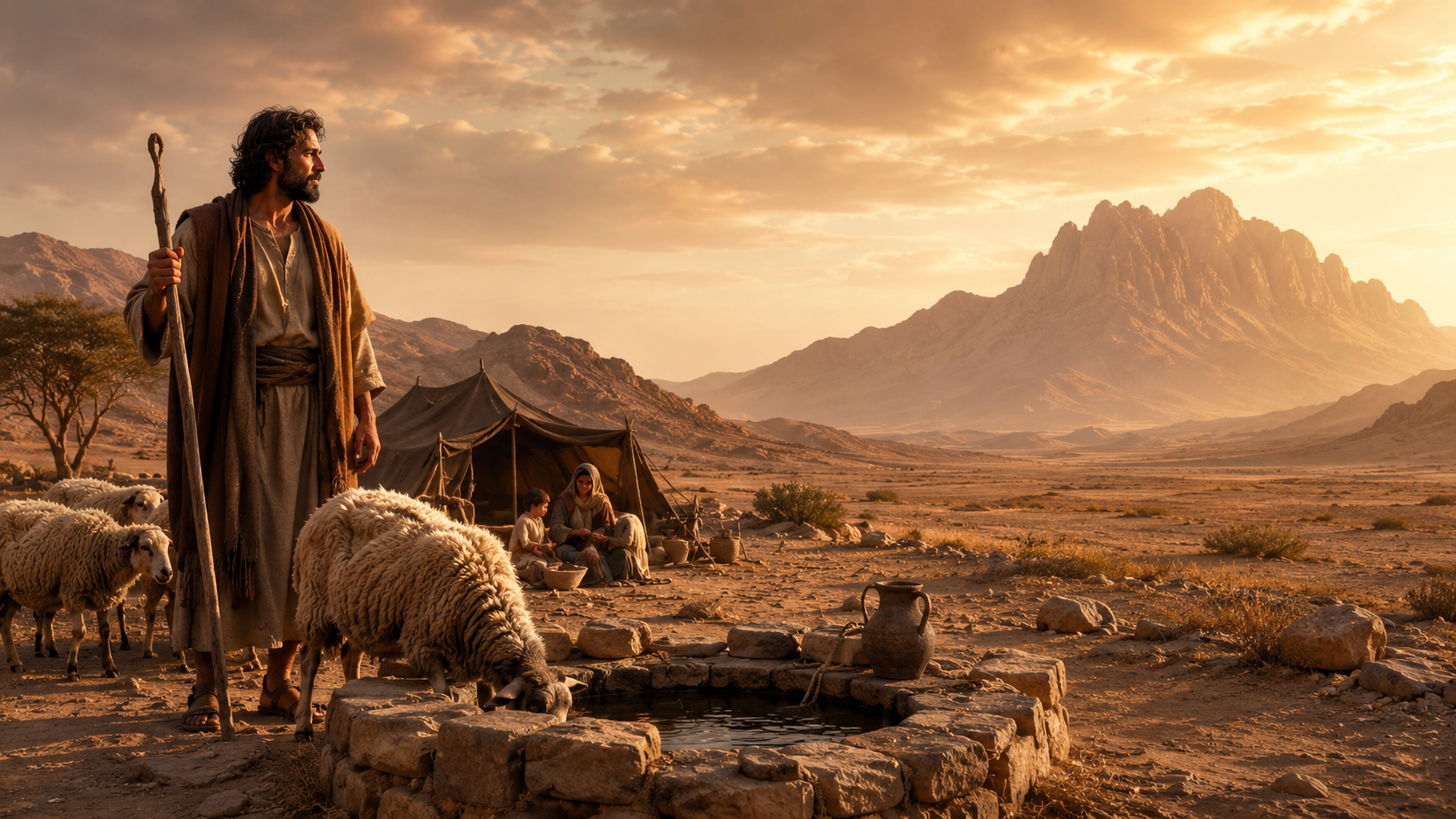
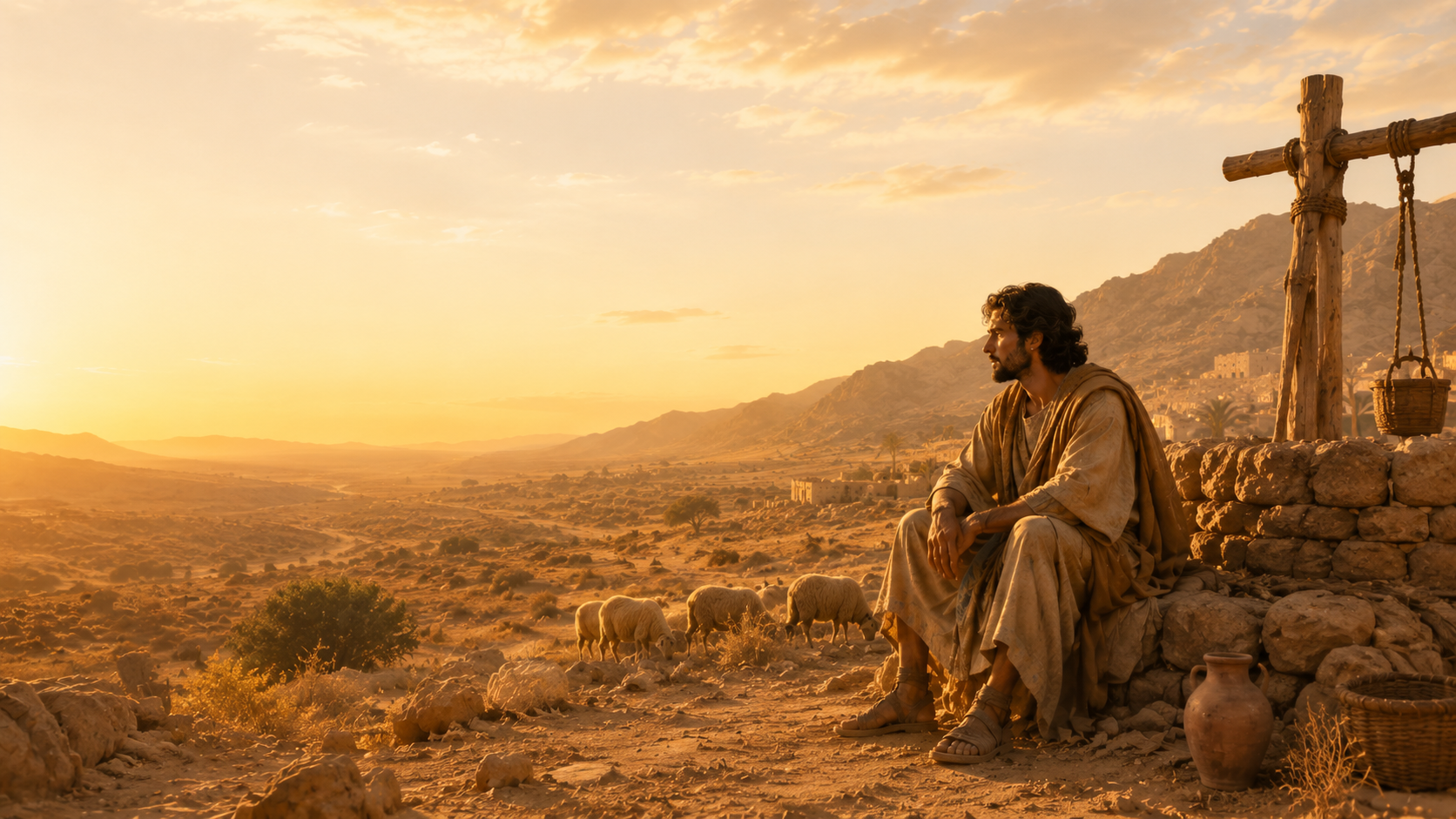
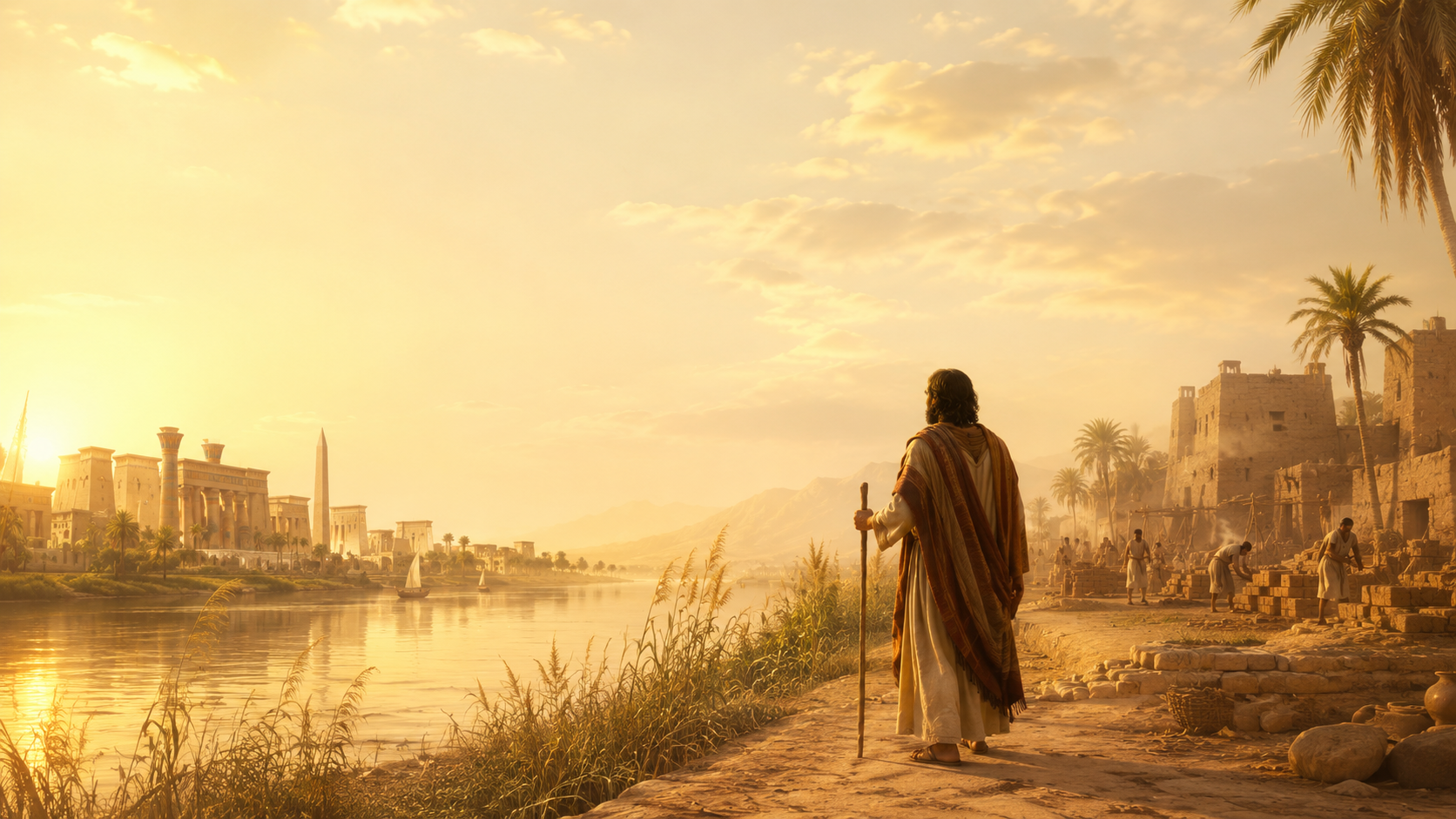
Moses arrived in Midian with nothing. The man who had spent forty years accumulating — education, identity, privilege, the slow compound weight of being important — arrived at a well in the desert with the clothes on his back and a story he could not tell anyone. The daughters of the priest of Midian thought he was Egyptian. He let them think it. What else was there to say?
The priest — Reuel, whom Moses would come to call Jethro — gave him a daughter and a corner of his tent and a flock of sheep. And Moses became a shepherd.
He was forty years old. He had forty years ahead of him in this desert. He did not know that. He only knew that morning after morning the sheep needed to be moved, and watered, and counted, and guarded from the predators that came in the dark. He only knew that Zipporah was kind, and that their son Gershom slept in the crook of his arm, and that the stars over the Arabian Peninsula were extraordinary, and that the silence of the desert at midday was unlike anything the palace had ever offered him.
He learned the desert the way you learn a language — slowly, by immersion, by making mistakes that cost you, by coming to understand its idiom through years of living inside it. He learned where water pooled after rain and where it did not, which ravines offered shade and which were death traps in a flash flood, where the grazing was rich in spring and where it turned to dust by summer. He learned the names of the constellations the Midianites used for navigation. He learned what a sheep looks like when it is about to die and what it looks like when it is thriving. He became, over the slow decades, very good at keeping things alive in a place designed to kill them.
He did not know he was being prepared. He only knew he was a shepherd.
Year ten. Year twenty. Year thirty.
Somewhere in Egypt, the generation that had known him was dying. The Pharaoh who had sought his life — the man who had sat across a formal dining hall from a young prince and never suspected that the prince was a Hebrew — that man was getting old. His bureaucracy ground on. The bricks were still being made. The quotas were still being enforced. The people of Israel were still groaning.
And Moses was watching sheep.
What does a man think about for forty years in the desert? The rabbis suggested he thought about God — that the Midian years were a long slow prayer, a sustained turning of the heart toward the God his mother had named in her own name, the God the patriarchs had known, the God who had been silent for four hundred years and was still silent. Perhaps. Or perhaps there were years when Moses did not think about any of this at all — when he was simply a man doing his work, loving his family, trying to get through the day without losing a sheep to a lion.
But at some point — and we cannot say exactly when, only that it was after the long work of the desert had done what it came to do — Moses brought his flock to the west side of the wilderness. To Horeb. The mountain of God.
He had been there before, surely. He knew this territory. He knew which hills held water and which were dry. He had probably sheltered under this mountain's shadow on dozens of occasions. But this time something was different. This time something was burning — a bush, engulfed in flame but not consumed — and a voice came out of the fire and called his name. Twice.
Moses. Moses.
And forty years of the desert fell away like a coat he had not known he was wearing, and the shepherd stood before his God for the first time, barefoot on holy ground, with everything the wilderness had taken from him — the presumption, the palace confidence, the idea that he could do this himself — already gone. And what was left was the right thing to start with: a man who had learned, finally, how to be small.
The Geography of Midian
Locating Midian in the Ancient World
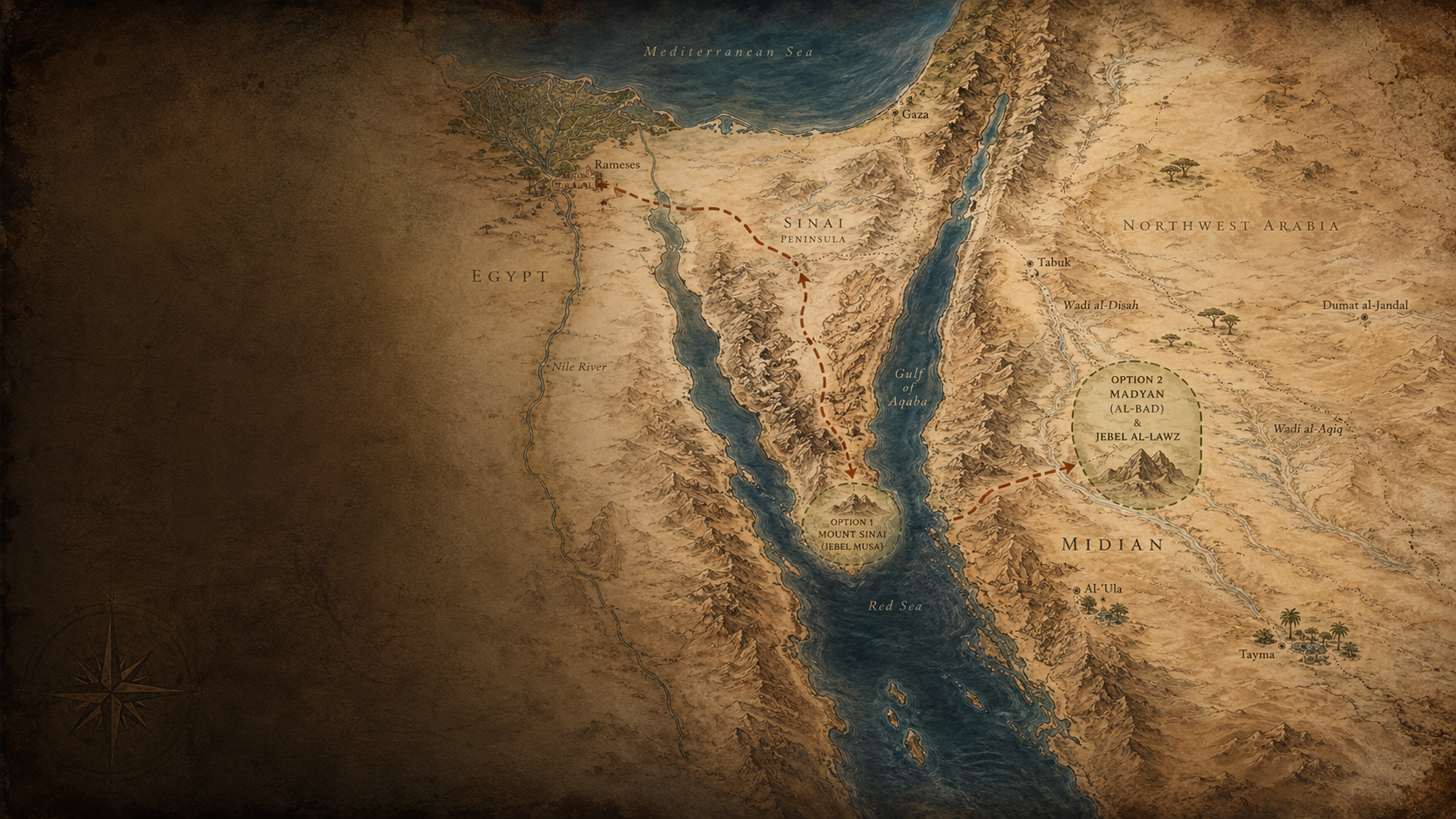
One of the most important and underappreciated questions in Moses scholarship is the exact location of Midian — because the answer directly affects our understanding of where the burning bush occurred, where Mount Sinai is located, and the route of the Exodus. It is not a merely academic question. The geography shapes the theology.
The traditional identification of Sinai — the mountain at which Moses received the Law, and which is almost certainly the same as the Horeb of the burning bush — places it at Jebel Musa ("Mountain of Moses") in the southern Sinai Peninsula. This location has been venerated since at least the 4th century AD, when Helena, mother of Emperor Constantine, identified it, and it remains the site of St. Catherine's Monastery today. The tradition is ancient. But it is not the only candidate.
Archaeological & Geographical Context
— The Saudi Arabia Hypothesis
A growing body of scholarship — including work by Charles Whittaker, Gordon Franz, and more popularly explored by Tim Mahoney's Patterns of Evidence series — argues that Midian was located not in the Sinai Peninsula but in the Hejaz region of northwestern Saudi Arabia, in the area around modern Tabuk and Al-Bad (the ancient Madyan). This identification rests on several lines of evidence:
1. Ancient sources. Josephus (Antiquities II.11.1) explicitly locates Midian across the Red Sea from Egypt, "near the city called Madiane." Eusebius and Jerome, writing in the 4th century, place Midian in Arabia. The Nabataean city of Madian (Al-Bad), in northwest Saudi Arabia, preserves the name to this day and contains ancient water sources, rock carvings, and cave structures with long traditions of Mosaic association.
2. Exodus 2:15 and the crossing. If Moses fled Egypt and crossed the Gulf of Aqaba (the eastern arm of the Red Sea), he would have arrived in the Hejaz — consistent with Midian being Arabian. The crossing point most often proposed is at Nuweiba, a wide coastal plain on the Sinai side, with the opposite shore at Al-Muwaileh in Saudi Arabia.
3. Jebel al-Lawz. A mountain in northwest Saudi Arabia called Jebel al-Lawz ("Mountain of Almonds") has drawn significant interest as a candidate for the biblical Horeb/Sinai. Its summit shows evidence of scorching, it has a large plain suitable for encampment at its base, and it sits near ancient water sources. Ron Wyatt, Larry Williams, and Bob Cornuke documented their controversial expeditions there in the 1980s and 1990s. Mainstream archaeology remains cautious about these claims, but the geographical and textual arguments for a non-Sinai-Peninsula location for Horeb deserve serious engagement.
For our study, we hold both locations with appropriate scholarly humility. What matters theologically is that Horeb/Sinai — wherever it is — was the mountain of God's self-disclosure, both to Moses at the burning bush and to all Israel when the Law was given.
What the Terrain Was Actually Like
Whether in the Sinai Peninsula or northwestern Arabia, the Midianite territory Moses inhabited was harsh, semi-arid terrain — rocky escarpments, narrow wadis (seasonal riverbeds) that flood violently in winter and bake dry in summer, scrubby acacia and tamarisk growth, occasional oases, and large open plains of gravel and sand. Summer temperatures regularly exceed 45°C (113°F). Winter nights drop near freezing. Water is everything.
This is not a landscape that accommodates human weakness. Everything that survives in it has been tested. The fauna of the Sinai and Arabian Peninsula — the ibex, the rock hyrax, the desert fox, the Arabian wolf — are creatures formed by the pressure of scarcity. The Bedouin communities who have inhabited this landscape for millennia are among the most expert readers of terrain, weather, and water in the world. Moses, over forty years, became one of them.
The Greek word for desert — eremos — gives us the word "hermit." The desert hermits and monks of the 3rd and 4th centuries AD, the Desert Fathers, deliberately chose this terrain as the crucible of spiritual formation. They were following a pattern they had learned from Scripture: the wilderness is where God does His deepest work.
Verse by Verse: Exodus 2:15b–25 and 3:1
Every word of the Midian passage examined closely
We covered verses 11–15a in Part Four (the killing and the flight). Now we take up the Midian narrative from verse 15b — Moses' arrival — through to the opening verse of Exodus 3, which is the hinge between the preparation and the calling.
Exodus 2:15b — He Sat Down by the Well
Verse 15b
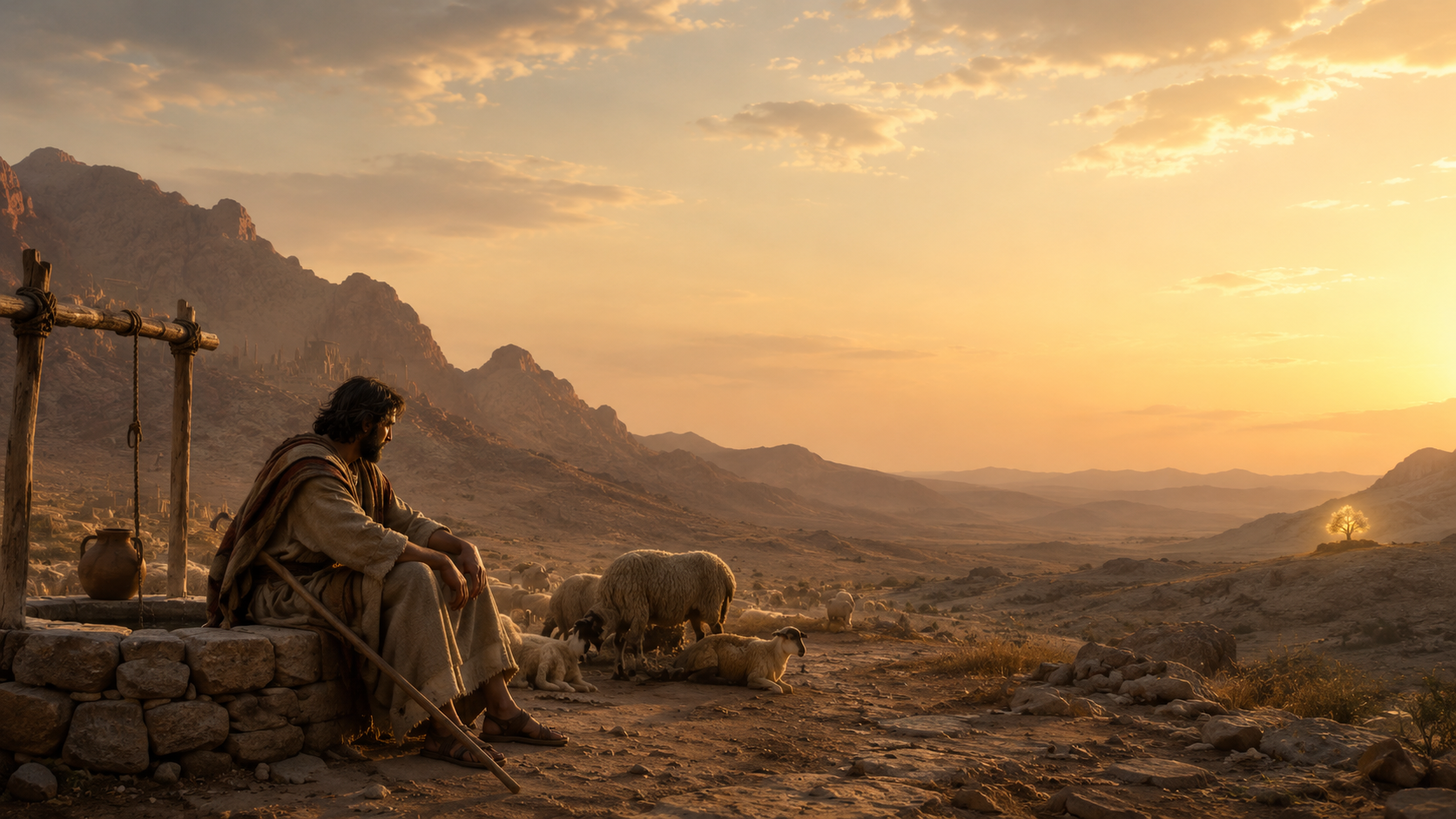
"But Moses fled from Pharaoh and stayed in the land of Midian. And he sat down by a well."
vayeshev al-hab'er — "He sat down by the well." In Hebrew, yashav (to sit, to dwell, to settle) is a weighty verb. It is used for permanent habitation: Abraham "dwelled" at Mamre; Israel "dwelled" in Egypt. By using this verb for Moses' stopping point at the well, the text is already signalling that this is not a brief rest — this is a settling. The desert is about to become home.
As we noted in Part Four, the well in the ancient Near East was the site of covenant encounters (Rebekah, Rachel, the Samaritan woman). Moses, at his lowest, sits by a well — and a story begins to form around him, unbidden. He has not sought it. He has only stopped moving. Sometimes that is the beginning of the most important things.
Exodus 2:16–22 — Jethro's Daughters, Marriage, and the Naming of Gershom
Verses 16–17
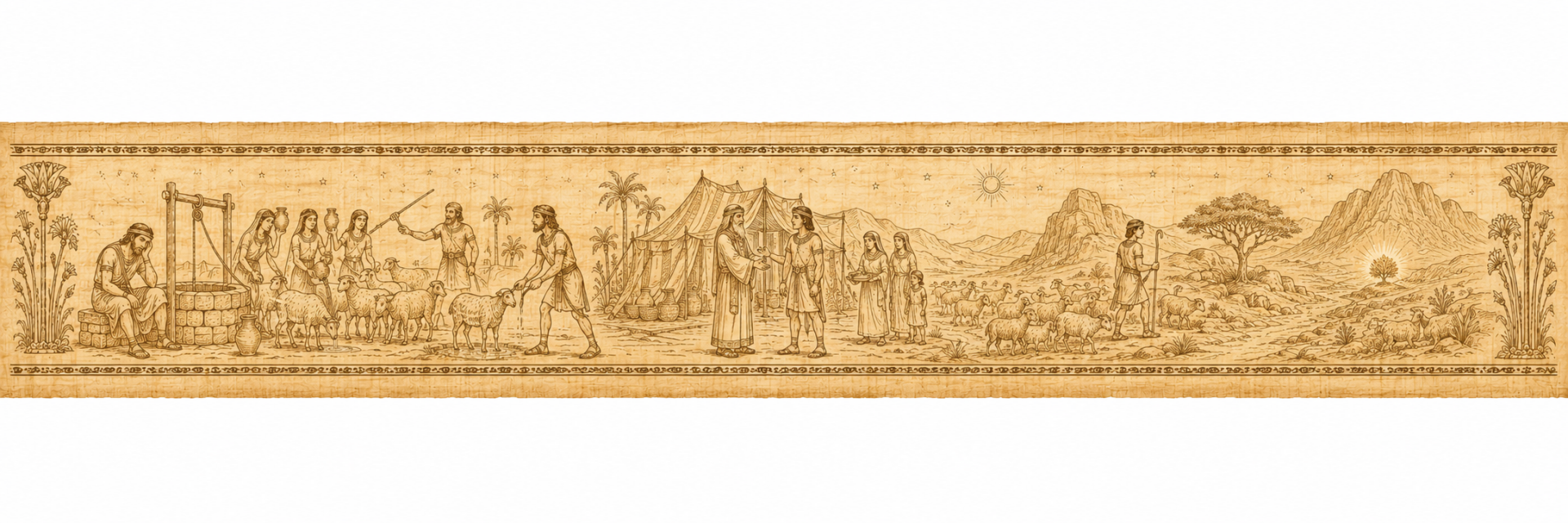
"Now the priest of Midian had seven daughters, and they came and drew water and filled the troughs to water their father's flock. The shepherds came and drove them away, but Moses stood up and saved them, and watered their flock."
vayosha moshe — "Moses saved them." The verb yasha — to save, to deliver, to rescue — is the root of the name Yeshua (Jesus). Moses cannot help himself. At the lowest point of his life, with no title and no nation and no authority, he performs an act of salvation. It is simply who he is. The deliverer delivers, even when no one commissioned him.
The seven daughters are a literary detail typical of Hebrew narrative — seven suggests completeness and blessing. The arrival of Moses as deliverer at the well begins the transformation of his exile into something generative.
Verse 18
"When they came home to their father Reuel, he said, 'How is it that you have come home so soon today?' They said, 'An Egyptian man delivered us out of the hand of the shepherds and even drew water for us and watered the flock.'"
ish mitzri — "An Egyptian man." The daughters see Moses' Egyptian exterior — his accent, his clothing, his bearing — and categorise him accordingly. He does not correct them. This is the first time Moses is identified as Egyptian by strangers since leaving Egypt, and the irony is acute: the man who killed for his Hebrew identity is now mistaken for Egyptian. The desert does not know, or care, about the wars inside him.
The father's name here is Reuel (meaning "friend of God" or "shepherd of God"). In Exodus 3:1 and 18:1 he is called Jethro. This is not a contradiction — both names were used, likely Reuel being his personal name and Jethro (from yeter, "excellence") a title or honorific. The Kenite genealogy in Numbers 10:29 and Judges 1:16 also refers to "the father-in-law of Moses" as Hobab, the son of Reuel — which may mean Hobab was Moses' brother-in-law, or that the names were used interchangeably within the family tradition.
Verse 21–22
"And Moses was content to dwell with the man, and he gave Moses his daughter Zipporah. She gave birth to a son, and he called his name Gershom, for he said, 'I have been a sojourner in a foreign land.'"
vayo'el moshe lashevet — "Moses was content to dwell." The word yo'el is rich — it can mean "was willing," "agreed," or "was pleased." It carries a sense of intentional consent, not reluctant surrender. Moses is not merely enduring Midian. He is, with some part of himself, choosing it. He is willing to stop.
Gershom (גֵּרְשֹׁם) — From ger (sojourner, stranger, resident alien) + sham (there). "A stranger there." The name is a lament embedded in a child's identity — a father telling his son, in the act of naming, that they do not fully belong to this place. Yet the very act of naming a son — of claiming a future, of giving a child a name — is itself a declaration that exile does not get the final word. Gershom is proof that the desert is not only a place of dying. Something new is being born here too.
Exodus 2:23–25 — The Four Verbs Revisited
Verses 23–25
"During those many days the king of Egypt died, and the people of Israel groaned because of their slavery and cried out for help. Their cry for rescue from slavery came up to God. And God heard their groaning, and God remembered his covenant with Abraham, with Isaac, and with Jacob. God saw the people of Israel — and God knew."
The phrase b'yamim harabim hahem — "in those many days" — is the Bible's quiet acknowledgment of how long Moses was in Midian. Many days. The Hebrew does not say forty years here; the number comes from Acts 7:30. But "many days" lands with weight. These were not a few months. They were a generation.
We examined the four divine verbs (heard, remembered, saw, knew) in detail in Part Four. What we note here is their placement in the narrative: they come at the end of the Midian section, as a transition. Moses is in the desert. God is responding to the cry of the people. The two storylines — Moses' formation and Israel's suffering — are about to converge. Exodus 3:1 is the hinge verse where they meet.
Exodus 3:1 — The Hinge Verse
Exodus 3:1
"Now Moses was keeping the flock of his father-in-law Jethro, the priest of Midian, and he led his flock to the west side of the wilderness and came to Horeb, the mountain of God."
v'Moshe hayah ro'eh — "Now Moses was keeping the flock." The Hebrew construction uses a participle — ongoing, habitual action. This was his normal life. He was not on a spiritual quest. He was doing his job. The burning bush does not interrupt a dramatic moment. It interrupts an ordinary Tuesday morning of shepherding.
tzon Yitro chotno — "the flock of Jethro his father-in-law." Moses is not even keeping his own flock. He is a hired shepherd, tending someone else's animals. The man who was adopted into the greatest royal household in the world is now a shepherd for his wife's father. The descent is complete. And it is exactly here that God shows up.
el-har ha'Elohim Chorevah — "to the mountain of God, to Horeb." The text calls it "the mountain of God" before the burning bush event — which means either this is a proleptic editorial note (the author already knows what happens here and names it accordingly), or Horeb was already known as a sacred place. Either way, the mountain of God is the destination Moses wanders to on an ordinary working day. Holiness does not always announce itself before you arrive.
Jethro: The Teacher Moses Didn't Expect
What the priest of Midian gave the deliverer of Israel
Who Was Jethro — and What Did He Know?
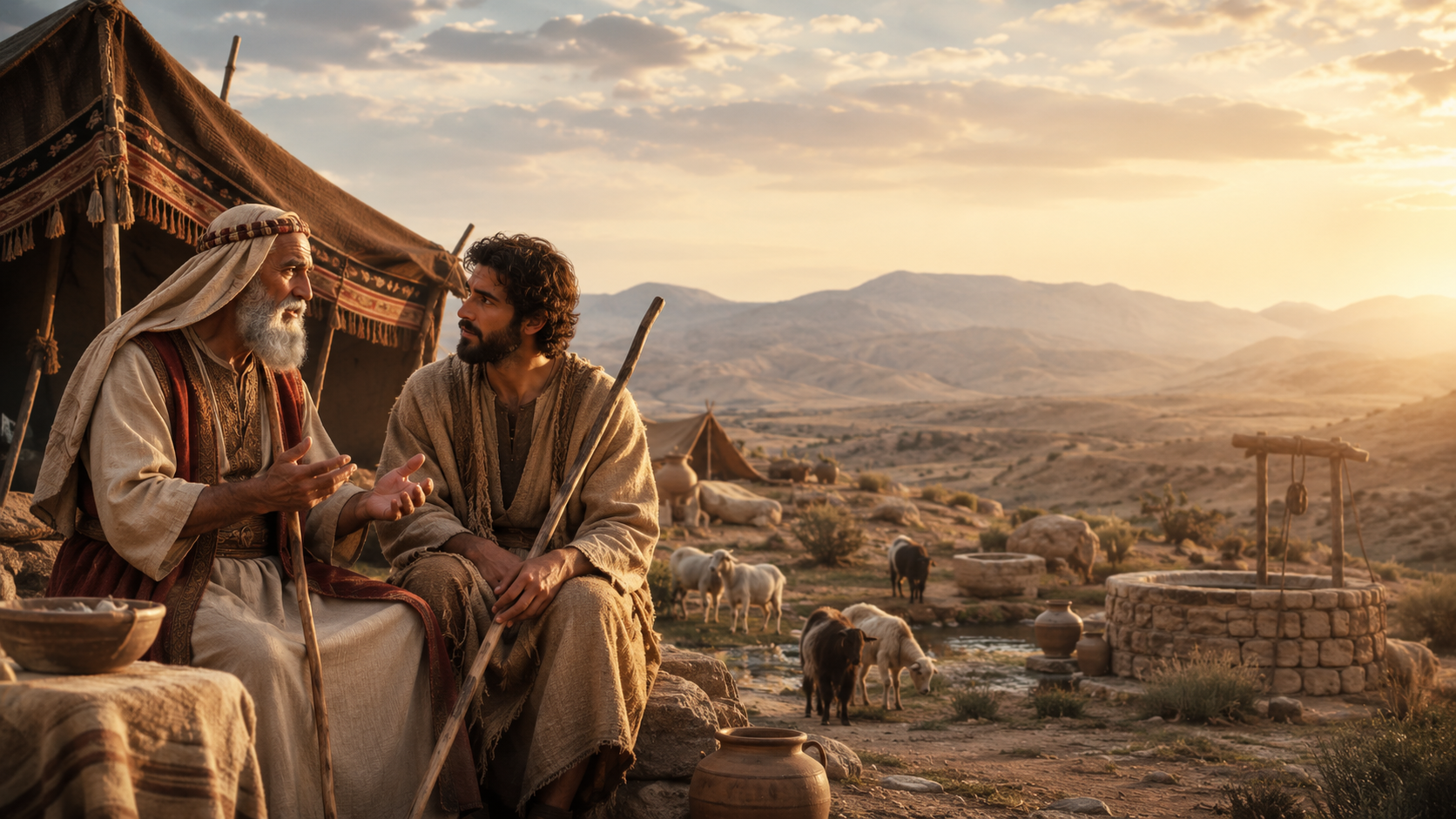
In our study of Part Two and Four, we established that Jethro (kohen Midian, the priest of Midian) was a descendant of Midian, son of Abraham through Keturah (Genesis 25:1–2). This makes him a distant cousin of the Israelites — an Abrahamic kinsman, outside the covenant of Moses, but carrying some thread of the theological tradition of Abraham.
The question of what Jethro worshipped before Moses arrived is genuinely fascinating. Three positions are worth noting:
- The mainstream biblical position: Jethro had knowledge of El — the high God of the ancient Near East — through the Abrahamic tradition passed through Keturah's line. When Moses arrives and recounts the Exodus, Jethro's response ("now I know that the LORD is greater than all gods," Exodus 18:11) is an escalation of existing monotheistic or monolatrous faith, not a conversion from paganism.
- The Kenite Hypothesis: A minority scholarly position (Budde, Rowley) argues that YHWH-worship originated with the Kenites/Midianites and was transmitted to Israel through Moses. Most biblical scholars and theologians reject this view as incompatible with the textual evidence, which presents YHWH as the God of Abraham centuries before Moses — but the hypothesis forces us to take seriously that Jethro's theological knowledge was genuine and substantial.
- Righteous Gentile: The most theologically coherent position is that Jethro, like Melchizedek (Genesis 14:18–20) before him and Cornelius (Acts 10) after him, was a righteous person outside the covenant community whom God had not abandoned. He worshipped truly if incompletely. Moses' testimony brought him into full knowledge of the covenant God.
What Jethro Taught Moses
Jethro gave Moses five things the palace never could:
- A family. Zipporah became Moses' wife and companion. Their two sons — Gershom and Eliezer — are the first family Moses has fully owned rather than borrowed. The palace gave him a position. Jethro gave him people.
- An apprenticeship in desert wisdom. Jethro was a priest and a tribal leader — which in a pastoral nomadic culture meant he was also a master of terrain, animal husbandry, weather reading, water finding, and community management. Moses spent forty years learning from a man who was arguably the wisest person in his immediate world.
- Spiritual formation in obscurity. There is no record that Jethro pushed Moses toward his destiny. He simply gave him work to do. The forty years of ordinary labor, under the guidance of a man who "feared God," was itself a spiritual curriculum.
- Organisational wisdom— which Jethro will offer explicitly in Exodus 18, when he watches Moses exhausting himself by personally adjudicating every dispute in Israel and tells him: delegate. Build a structure. You cannot do everything yourself. This counsel, given by a Midianite priest to the Hebrew prophet, becomes the foundation of Israel's judicial system.
- A model of what it looks like to honour God without the formal covenant. Jethro functions in the narrative as a reminder that God's general revelation is wider than Israel's particular revelation — that the knowledge of the Most High was not entirely extinguished in the nations, and that wisdom from outside the covenant community is still wisdom.
Jethro and Melchizedek: A Pattern of the Outside Priest
Theological Connection — The Outside Priest
Scripture contains a recurring figure: the priest outside the covenant line who nevertheless mediates genuine knowledge of God. Melchizedek, king of Salem and priest of El Elyon (God Most High), blesses Abraham and receives his tithe — and the writer of Hebrews devotes two entire chapters to demonstrating that Christ's priesthood is "after the order of Melchizedek," not after the Levitical order (Hebrews 6–7). Jethro occupies a structurally similar position: the priest-figure outside Israel who feeds, shelters, and forms the man who will bring God's Law to God's people.
The pattern points to a deep biblical conviction: God's purposes are not confined to the covenant community. He prepares His instruments through unexpected teachers, in unexpected places. Moses' formation in Midian under a Midianite priest is not a concession to necessity — it is part of the design. The desert was chosen. Jethro was chosen. The forty years were chosen.
And the ultimate expression of this pattern is the Incarnation itself: the Son of God entering the world outside the walls of power and privilege, formed in obscurity in Nazareth, shaped by the ordinary rhythms of a carpenter's workshop, before stepping into His public ministry at thirty years old. The parallel to Moses — forty years in the desert, then the burning bush — is not accidental.
The Life of a Shepherd
What forty years with sheep teaches a man about God and people
Shepherding in the Ancient Near East
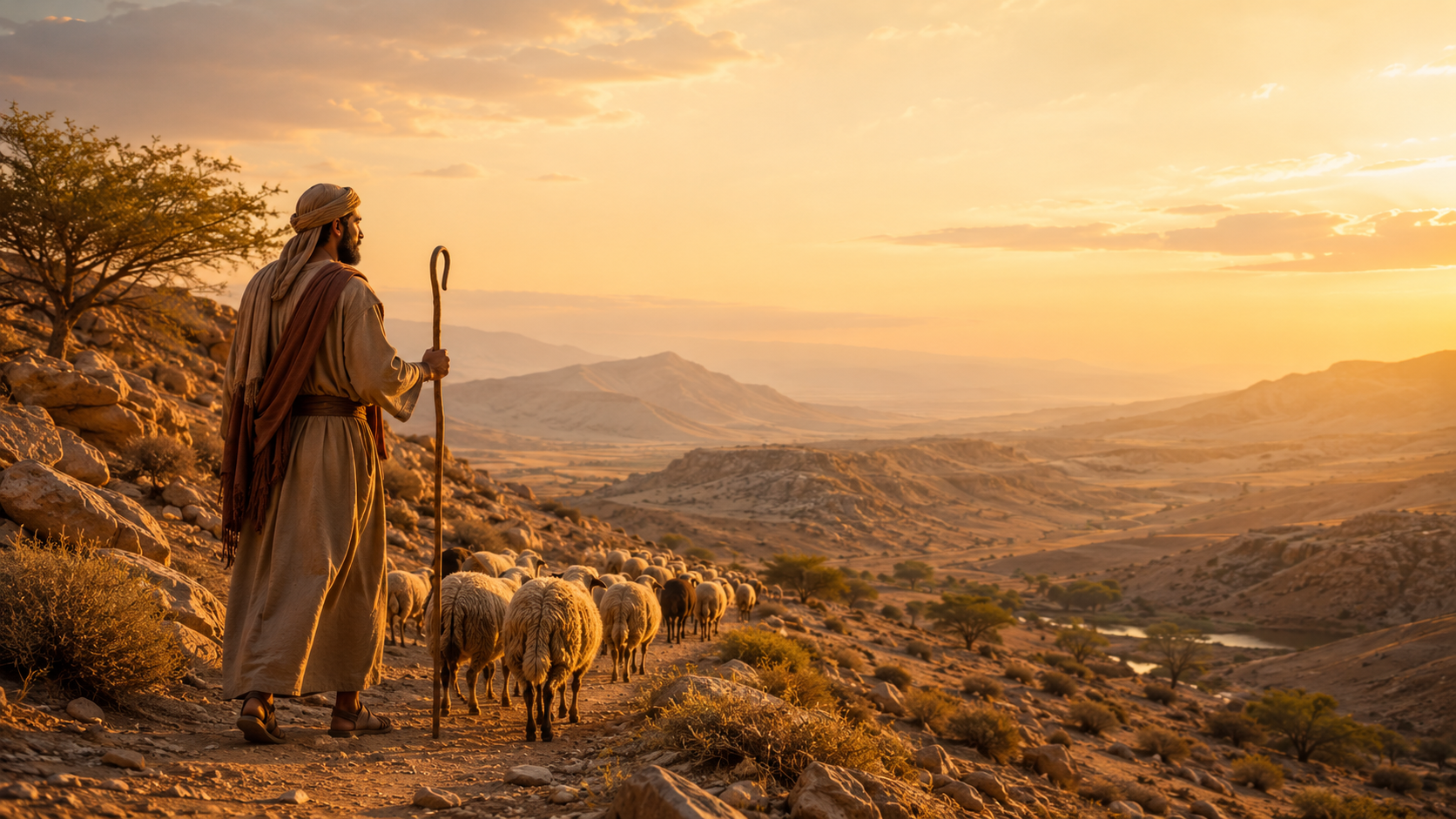
To modern Western readers, shepherding sounds picturesque — green hills, fluffy sheep, a pastoral idyll. The reality of ancient Near Eastern shepherding was entirely different. It was one of the hardest, most demanding, and most dangerous forms of labour available to a man in the Bronze Age world.
Historical & Cultural Context — The Shepherd's Life
Ancient Near Eastern shepherding required the shepherd to be simultaneously a navigator (moving flocks between seasonal pastures across hundreds of kilometres), a veterinarian (diagnosing and treating sick animals without modern medicine), a warrior (defending the flock from lions, wolves, bears, and human thieves — David's résumé in 1 Samuel 17:34–36 reflects the reality), a water engineer (knowing every spring, well, and seasonal pool in a wide territory), and a manager (keeping count of every animal, tracking breeding, culling the weak).
The Ugaritic texts (1400–1200 BC, contemporary with Moses) describe the ideal shepherd in terms strikingly similar to the ideal king — both are "feeders," "protectors," and "guides" of their respective flocks. This overlap between shepherd and ruler was not metaphorical in the ancient world. It was professional training. The shepherd who could keep a flock alive in hostile terrain for decades had already demonstrated the core competencies of leadership.
Jacob worked as a shepherd for twenty years under Laban. David was pulled from the sheepfolds to become king. Amos was a shepherd-prophet. The shepherd as leader is woven into the entire biblical narrative.
Moses spent forty years becoming expert in precisely the skills a wilderness leader would need. When he leads two million people through the same terrain he shepherded flocks across, he is not navigating blind. He knows where the water is. He knows how to keep living things alive in a place designed to kill them. He has spent four decades in the very school God needed him to attend.
The Shepherd and the Good Shepherd
Christological Connection — The Shepherd Motif
The shepherd image in Scripture reaches its Christological apex in John 10:11: "I am the good shepherd. The good shepherd lays down his life for the sheep." Jesus deploys this image knowing its entire weight — the centuries of shepherd-kings in Israel's imagination, the Psalms of David the shepherd, the shepherd imagery of Ezekiel 34 where God condemns the false shepherds of Israel and promises to shepherd His people Himself. All of it.
Moses, trained as a shepherd in Midian before becoming the shepherd of Israel, is a prefiguring of this pattern. He leads the people through the wilderness with a staff (the shepherd's primary tool). He feeds them (manna as the shepherd's provision). He protects them from enemies (battle and plague). He calls them by name and knows their condition. Psalm 77:20 sums it up: "You led your people like a flock by the hand of Moses and Aaron."
Moses the shepherd-leader is a shadow of Jesus the Good Shepherd — who does not merely lead from the front but lays down His own life for the sheep. The same divine impulse, the same pastoral calling, the same self-expenditure. Intensified to infinity at the cross.
The Forty Motif in Scripture
Why God measures His preparation time in forties
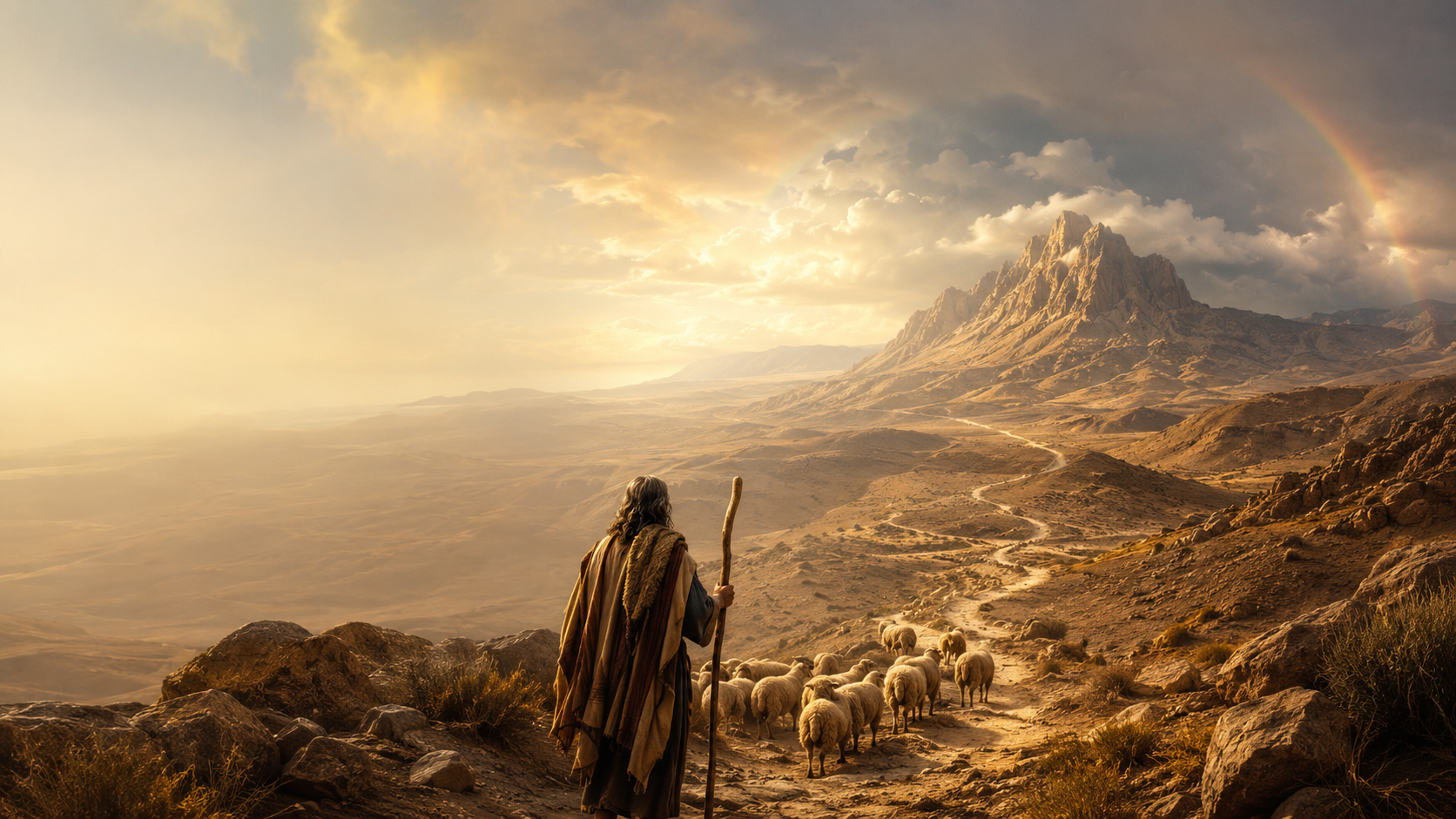
The number forty appears with extraordinary frequency at pivotal moments throughout the Bible — and almost always in the same theological context: a period of testing, preparation, or transition before something new begins. This is not coincidence. It is pattern. The biblical writers understood forty as the number of thorough preparation.
What Forty Means Theologically
The Hebrew number forty does not have a precise symbolic meaning assigned by any single text — but the cumulative biblical pattern establishes a clear theological significance. Forty is the number of complete testing that produces complete readiness. It is not punishment. It is preparation. And the preparation is always proportionate to what comes after it.
The Rabbinic Tradition on Forty
The rabbis noticed this pattern explicitly. The Talmud (Mishnah Avot 5:21) notes that the maturity of understanding comes at forty years of age — "at forty, understanding." The connection to Moses is not accidental: Moses was forty when he went to his people (Acts 7:23), and eighty (forty + forty) when he stood before Pharaoh. His public ministry began at the second forty. The desert years were exactly the preparation time wisdom required.
More than this, the rabbis taught that a student does not fully understand what his teacher has given him until forty years after receiving it. Learning takes time to settle into the bones. The burning bush Moses is not the palace Moses who could have died defending a slave. He is a man who has had forty years to discover, in the school of obscurity, what he was actually made of.
Elijah at Horeb: The Most Striking Parallel
One of the most illuminating parallels to Moses' Midian experience appears in 1 Kings 19 — the story of Elijah's flight to Horeb after his great victory over the prophets of Baal. The structural parallels are astonishing and clearly deliberate:
- Both Moses and Elijah flee into the desert after a moment of extreme stress following a violent act (Moses: the killing; Elijah: the slaughter of Baal's prophets).
- Both are fed by supernatural provision in the desert (Moses: manna; Elijah: the angel's cake and water — twice).
- Both travel forty days to the mountain of God — Horeb.
- Both hear the voice of God at Horeb, both receive a new commission, and both are told that God's people are not as abandoned as they fear.
- Both experience the presence of God not primarily in spectacular phenomena but in intimate speech.
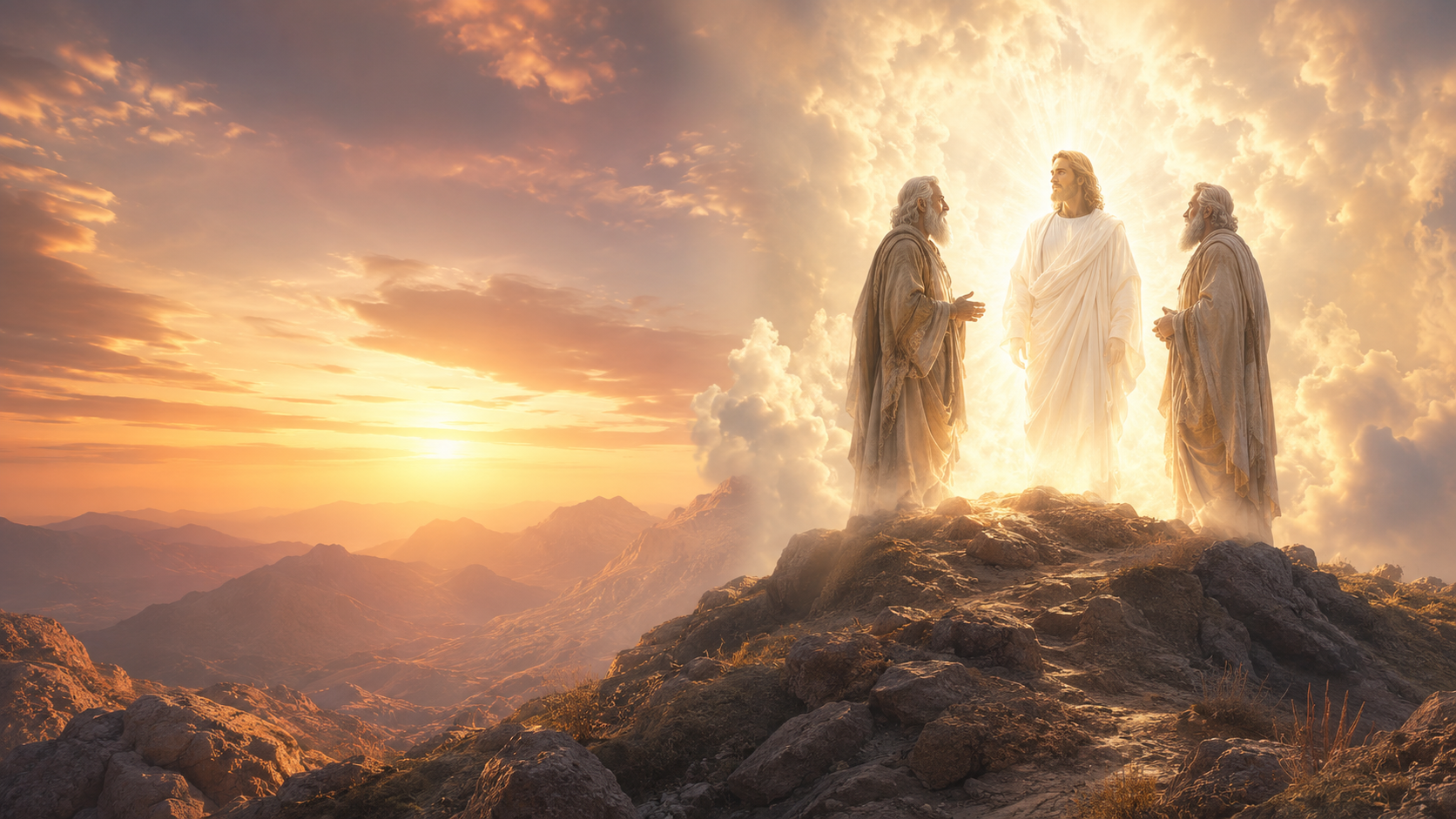
The author of 1 Kings is deliberately patterning Elijah's story on Moses' story. Elijah is a new Moses — a prophet in the Mosaic tradition, returning to the same mountain for a fresh commissioning. And when both figures appear together on the Mount of Transfiguration with Jesus (Matthew 17:3), the connection is complete: they represent the Law and the Prophets, the two great covenant traditions of Israel, both now present at the moment when the one they prefigured is revealed in glory.
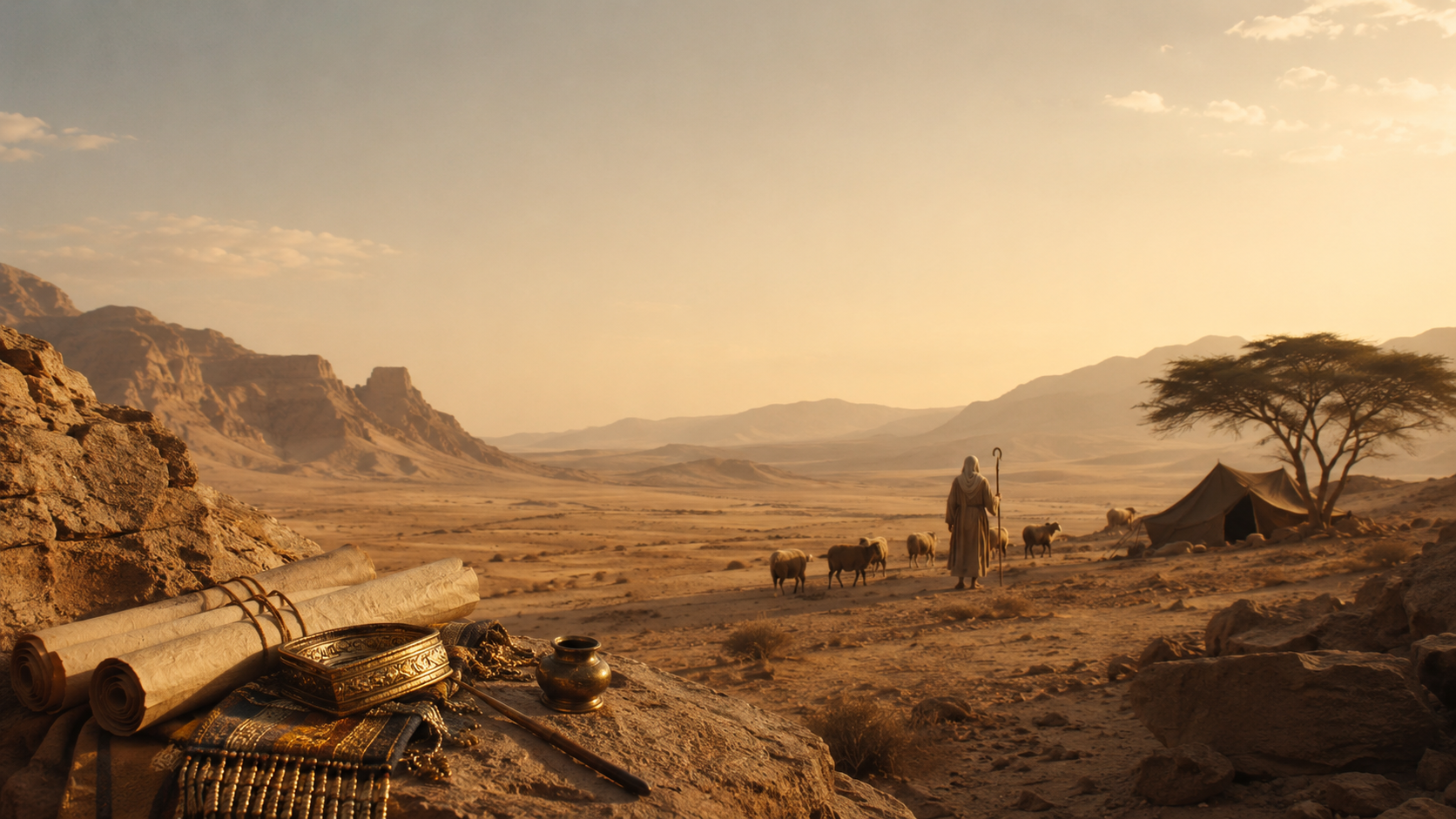
The desert where Moses was formed, and the mountain where Elijah was restored, and the summit where Jesus shone — it may all be the same mountain. Horeb. The mountain of God.
The Theology of Formation in Hiddenness
What the desert actually does — and why God uses it
What the Desert Strips
We have to be specific about what Moses lost in forty years of desert living, because the losses are as important as the gains. The desert is not primarily a place of acquisition. It is a place of subtraction. And what God subtracts is precisely what needed to go.
- The palace confidence. Moses arrived in Midian as a man formed by one of the most sophisticated institutions in the ancient world. He was capable, educated, multilingual, and trained in the assumption that things would work out because he was competent and well-placed. Forty years tending sheep — where competence counts but the wilderness still kills whoever it pleases — cures that. The wilderness is not impressed by credentials.
- The presumption of authority. The Hebrew who asked "who made you a judge?" wounded Moses deeply because Moses had assumed authority he had not been given. Forty years as a junior shepherd in someone else's household systematically removes the capacity for that kind of assumption. You cannot remain presumptuous in a context that daily demonstrates your smallness.
- The belief that urgency equals calling. Moses saw the oppression and felt the urgency and acted. The urgency was real. The oppression was real. But urgency is not the same as divine commissioning. Forty years in the desert teaches patience — not passive patience, but the active patience of someone who has learned that God's timing is not subject to his own schedule.
- The Egyptian layers. Language, accent, manner, assumption, worldview — the palace had formed Moses in ways he could not fully see from inside them. The desert, by its sheer otherness, made the Egyptian layers visible and gradually shed them. The man who emerges from Midian still knows Egyptian culture — but he is no longer owned by it.
What the Desert Builds
- Knowledge of the terrain. When Moses leads Israel through the Sinai and Arabian wilderness, he is not improvising. He knows this ground. He knows the water sources, the safe passes, the dangerous valleys. The forty years were not wasted time — they were his wilderness apprenticeship as a guide.
- The capacity for solitude. The desert enforces silence. In that silence, the internal noise gradually settles, and what remains is whatever is most essential about a person. Moses, at eighty years old, is a man who has lived with himself long enough to know what he is — which is why, when God appears in the burning bush, he can hear a Voice that does not shout.
- Genuine humility. Not the performed humility of someone who has been told to be humble — but the real thing, earned through years of being nobody in a place that doesn't know your name. When Moses protests at the burning bush "Who am I?" (Exodus 3:11), it is not false modesty. It is the honest confession of a man who has genuinely stopped believing in himself. Which is exactly where God can begin.
- A family to return to. When Moses eventually leads Israel out, he is not a lone heroic figure. He is a husband, a father, a son-in-law. The desert gave him people — roots — which paradoxically equipped him to lead millions of other people who were themselves rooted in family and kin.
The Desert Fathers and the Wisdom of Hiddenness
The 3rd and 4th century Desert Fathers — Antony of Egypt, Macarius, Poemen, Arsenius and hundreds of others — deliberately fled to the Egyptian and Syrian deserts for spiritual formation. Their writings, collected in the Apophthegmata Patrum (Sayings of the Desert Fathers), contain a consistent theology of hiddenness.
Abba Arsenius, who had been a tutor to the Roman Emperor's sons before retreating to the desert, was asked how someone so learned could seek instruction from an uneducated Egyptian peasant monk. His reply: "I have indeed been taught Latin and Greek, but I do not yet know even the alphabet of this peasant." The desert dissolves the hierarchy of human achievement and replaces it with a different measure: closeness to God, which is measured not in credentials but in the degree to which self has been emptied.
Moses is the prototype of this tradition. He is the first of the great biblical figures who had to be emptied by the desert before he could be filled by God. The tradition runs through him to John the Baptist in the wilderness of Judea, to Paul in Arabia, to Jesus in the Judean desert, and to every soul who has found that the most formative seasons of their life were the least visible ones.
The Hidden Years of Jesus — A Direct Parallel
Jesus' public ministry lasted approximately three years — from His baptism to His crucifixion. But He was thirty years old when that ministry began. The thirty years before it are the "hidden years" of Nazareth — the carpenter's workshop, the family, the ordinary rhythms of Galilean village life. Not a single word of those years is recorded in Scripture after the Temple incident at age twelve.
Luke 2:52 summarises them: "And Jesus increased in wisdom and in stature and in favour with God and man." He grew. He learned. He was formed. The eternal Son of God, in taking on human flesh, submitted Himself to the same process Moses submitted to: the long, slow, hidden preparation that precedes the public declaration.
Moses: forty years in the palace, forty years in the desert, forty years in ministry. Jesus: thirty years in Nazareth, three years in ministry, then death and resurrection and eternal reign. The proportions are different. The pattern is the same. The God who forms His servants in hiddenness before deploying them in history is completely consistent.
Moses, Elijah, and Jesus: The Mountain Convergence
How the desert preparation leads to the Transfiguration
We have been tracking the Moses-Christ typology through every part of this series. Here, at the culmination of the Midian section, we arrive at one of the most theologically breathtaking moments in all of Scripture — the Transfiguration — which brings together Moses, Elijah, and Jesus on a mountaintop, and in doing so, presents the entire arc of biblical history as a single, convergent story.
"And he was transfigured before them, and his face shone like the sun, and his clothes became white as light. And behold, there appeared to them Moses and Elijah, talking with him... He was still speaking when, behold, a bright cloud overshadowed them, and a voice from the cloud said, 'This is my beloved Son, with whom I am well pleased; listen to him.'"
Matthew 17:2–3, 5
Moses and Elijah do not appear at the Transfiguration randomly. They represent the two great streams of Old Testament revelation: Torah (the Law, given through Moses) and Nevi'im (the Prophets, represented by Elijah, greatest of the prophets). Together they are the Tanakh's core — and both of them now stand in the presence of the One they spent their entire lives pointing toward, discussing with Him "his departure" (Luke 9:31 — the Greek word is exodon — his Exodus) which He was about to accomplish in Jerusalem.
Moses' Exodus from Egypt, accomplished through the Passover, is the great redemptive act of the Old Covenant. Jesus' Exodus through death and resurrection, accomplished through the ultimate Passover, is the great redemptive act of the New. The two men stand together on the mountain and the subject of their conversation is the completion of everything Moses began — and everything Elijah continued.
And then the cloud — the same cloud that descended on Sinai, the same cloud that filled the Tabernacle, the same shekinah glory that Moses saw from the cleft of the rock — descends on the Transfiguration mountain. And the same voice that spoke at the Jordan ("This is my beloved Son") speaks again. But this time it adds three words that summarise the entire relationship between the Old and New Covenants: Listen to him. Moses gave you the Law. Elijah called you back to the Law. Now: listen to the Son.
The Shining Face — Exodus 34 and Matthew 17
One of the most precise Moses-Christ correspondences in Scripture is the shining face. When Moses came down from Sinai after forty days in God's presence, his face shone so brightly that the Israelites were afraid and he had to veil it (Exodus 34:29–35). The shining was derived — Moses radiated glory borrowed from proximity to God.
At the Transfiguration, Jesus' face shone "like the sun" (Matthew 17:2). The shining was intrinsic — not borrowed but native, not reflected but originated. Paul makes this distinction explicit in 2 Corinthians 3: Moses' glory was fading and had to be veiled; the glory of Christ does not fade. It is the source, not a reflection.
The Midian years — the forty years of hidden formation — are the preparation for the burning bush. The burning bush is the preview of the Transfiguration. And the Transfiguration is the preview of the Resurrection and the eternal glory into which Christ has entered and into which He draws His people. The whole arc runs from a fugitive sitting by a desert well to the shining of the face of God made flesh on a mountain in Galilee.

Devotional
The Holiness of the Ordinary Tuesday
Moses did not go looking for a burning bush. He was doing his job.
He had been doing his job for forty years — the same job, the same terrain, the same sheep, the same family, the same father-in-law, the same well. Day after day of ordinary faithfulness in a place where no one important was watching. Day after day of keeping something alive in a hostile landscape. Day after day of being nobody, with a past he couldn't talk about and a future he had long since stopped imagining.
And then, on what must have been an entirely unremarkable morning, he turned aside to look at a bush that was burning but not burning up. And everything changed.
There is a theology here that we desperately need in an age of highlight reels and instant platforms and the relentless pressure to be significant now: God shows up in ordinary Tuesdays. He shows up to people who are faithfully doing the next thing, the small thing, the unsexy thing — tending someone else's flock on a hillside that no one has ever heard of, in a country they fled to in disgrace.
The burning bush does not appear to the Moses of the palace — the impressive Moses, the capable Moses, the Moses with the full linguistic and military portfolio. It appears to the Moses who has been broken and reformed, who has sat with his own smallness long enough that he is no longer trying to manufacture significance. It appears to the Moses who, when God calls his name, simply says: Here I am.
Not "here I am, with all my qualifications." Not "here I am, ready to take charge." Just: here. Present. Available. Small. And astonished.
Your Midian is not wasted. Your ordinary Tuesdays are not placeholder days waiting for the real story to begin. The real story is happening in the ordinary Tuesdays. The formation is taking place right now, in the job that feels too small, in the season that feels too long, in the silence that feels too empty.
The bush will burn when it burns. Your job, until then, is to keep showing up. To keep bringing the flock to water. To be faithful in the terrain you have been given, not the terrain you planned for.
And one day you will turn aside to look, and the mountain of God will be right where you have been standing all along.
Reflection & Discussion Questions
Personal Reflection
1. Moses named his son Gershom — "a stranger there" — embedding his sense of displacement into the next generation. Have you ever been in a season where you felt permanently displaced, where even the name you would give things around you reflected exile? What did that season do to you over time?
2.The desert stripped Moses of his palace confidence, his presumed authority, and his belief that urgency equals calling. Which of these three things do you most need to have stripped from you right now? Which is hardest to release?
3.Jethro taught Moses things the palace never could — not because Jethro was greater than Egypt, but because he was present and faithful and wise in the right ways at the right time. Who is the "Jethro" in your life? Who has taught you things your official formation never did?
Deeper Study
4. Read 1 Kings 19:1–18 alongside Exodus 2:15–3:1.
List every parallel you can find between Elijah's desert experience and Moses'. What does the deliberate structural mirroring tell you about how the biblical authors understood the pattern of prophetic formation? What does it say about the God who forms prophets?
5.The Forty motif runs from Noah to the post-Resurrection appearances. Look at the table in Section V and identify the ones that resonate most with your own experience. Has there been a "forty" in your life — a sustained period of testing and preparation that preceded a new season? What came after it?
6.Exodus 3:1 says Moses came to Horeb — "the mountain of God" — while doing his ordinary job. The text does not record any spiritual effort or intentional pilgrimage. He simply ended up there. Can you think of a time when you "ended up" somewhere holy — a conversation, a moment, a realisation — without having sought it deliberately? What does that experience suggest about the nature of divine encounter?
7.Paul spent time in Arabia after his conversion before beginning his public ministry (Galatians 1:17–18). John the Baptist was in the wilderness before his public proclamation (Luke 1:80). Jesus spent thirty years in Nazareth. The pattern of hiddenness before public ministry is consistent. Why do you think God uses this pattern? What does it protect against? What does it build that could not be built any other way?
Closing Prayer
A Prayer for the Hidden Season
Dear Father, God of the desert, God of the mountain, God of the burning bush —
We thank You that You are the God of the ordinary Tuesday. That You do not only appear in the spectacular and the dramatic and the publicly significant. That You appeared to a fugitive shepherd, alone with his flock on a hillside, in the middle of the most ordinary possible morning.
We thank You for forty years. We thank You for the seasons that feel like waste but are not waste — for the Midian years in each of our lives, the seasons of hiddenness and smallness and apparent irrelevance that You are using to strip what needs to be stripped and build what cannot be built any other way.
Lord, we confess that we are often impatient with the desert. That we measure our value by our visibility. That we mistake obscurity for abandonment. Forgive us. Teach us the theology of the hidden years — that Jesus spent thirty years in Nazareth before three years in ministry, that Paul went to Arabia before he went to the nations, that Moses spent forty years with sheep before he spoke to Pharaoh. The preparation is not the interruption. The preparation is the work.
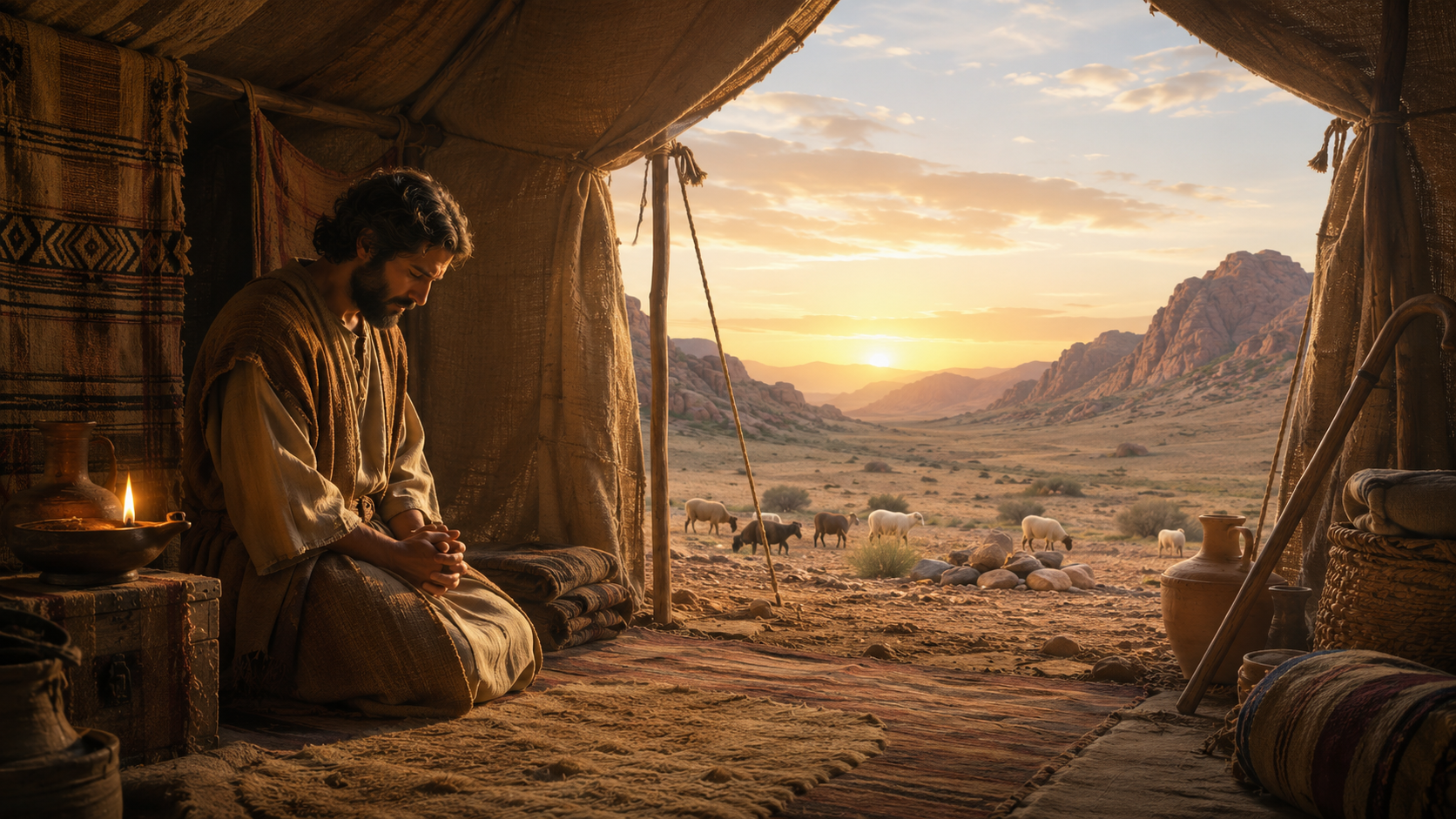
For those of us who are in Midian right now — who are faithfully tending something that feels too small, in a season that has gone on too long, in a landscape that was not what we planned — would You let us sense that You are here too. That the mountain we are standing on is holy ground, even before the bush ignites. That You see what no one else sees. That You are counting the years and not wasting a single one of them.
And when the burning bush comes — give us the courage to turn aside, to take off our shoes, and to say simply: Here I am.
In the name of the One who was hidden in Nazareth before He was revealed to the nations — and who is not finished with us yet — Jesus Christ,
Amen.
Coming Next in the Series
Part Six: The Burning Bush — God's Name, God's Character, God's Call
Exodus 3:1–4:17. After forty years of preparation, everything converges at a bush that burns but is not consumed. We will do a deep verse-by-verse study of the most theologically dense passage in Moses' life: the revelation of the divine name YHWH, the meaning of "I AM WHO I AM," the four objections Moses raises and what God says back each time, the burning bush as a symbol of Israel in Egypt, and how this entire passage connects to John 8:58 and Jesus' staggering claim about His own identity.
Pilgrims Candle
Add comment
Comments