Part Three of Thirty
The Palace and the Pit
Before You Begin This Study
Please Read These Passages First
Before diving into the commentary, historical research, and theology, sit with the biblical text itself. Read these passages slowly — more than once if you can. Pay attention to what surprises you, what troubles you, and what you notice for the first time. Bring those observations into the study.
Part Three covers Moses' formation in the Egyptian palace, his Hebrew identity beneath the surface, and the moment the two worlds finally collide. The key texts span his Egyptian education, his chosen act of solidarity, and the New Testament interpretation of that choice.
Exodus 2:1–15 Acts 7:17–29 Hebrews 11:24–26 Philippians 2:5–8
Optional deeper reading: Genesis 25:1–6 (the Midianite connection); Deuteronomy 34:10–12 (Moses' final epitaph); Isaiah 53:3–4 (the Suffering Servant — the same Hebrew root as "burdens" in Exodus 2:11).
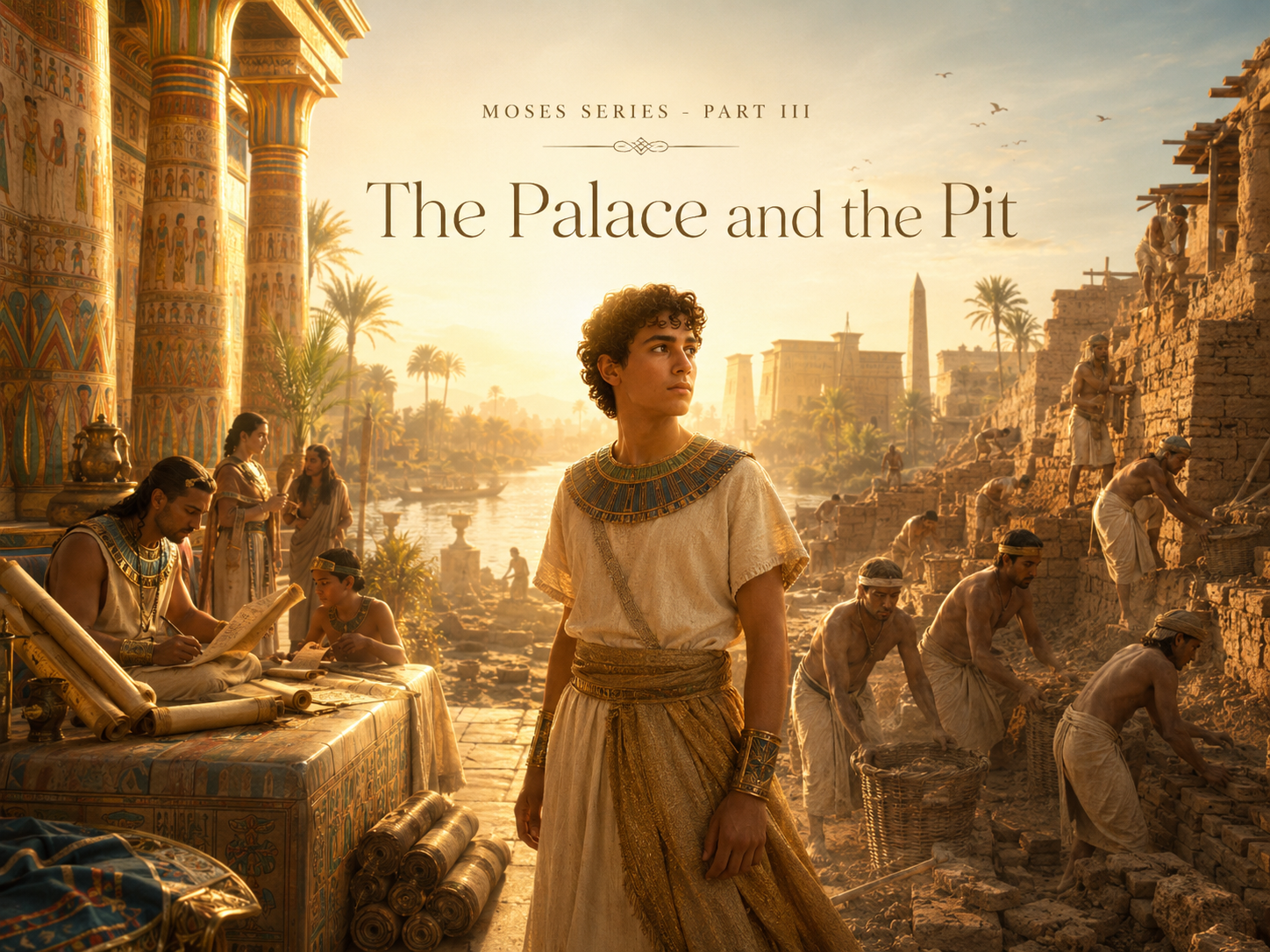
The Palace World
- Egyptian name — possibly Ra-mose or Ptah-mose
- Linen, gold, painted ceilings, servants
- The kap school: scribal arts, mathematics, theology
- Military training, diplomatic protocol
- Legal son of Pharaoh's daughter
- Known as a prince; insider to power
He learned to eat with golden spoons.
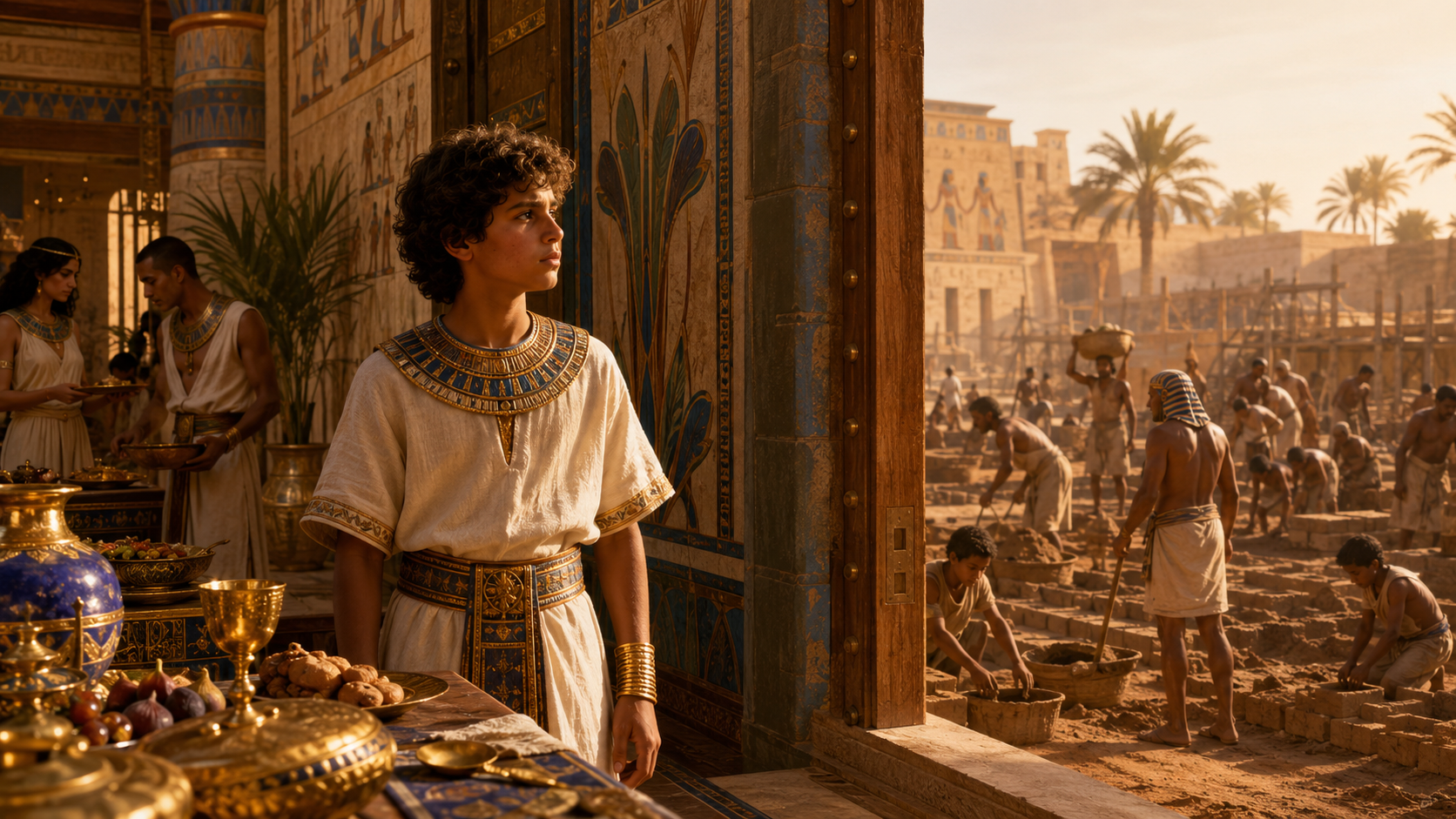
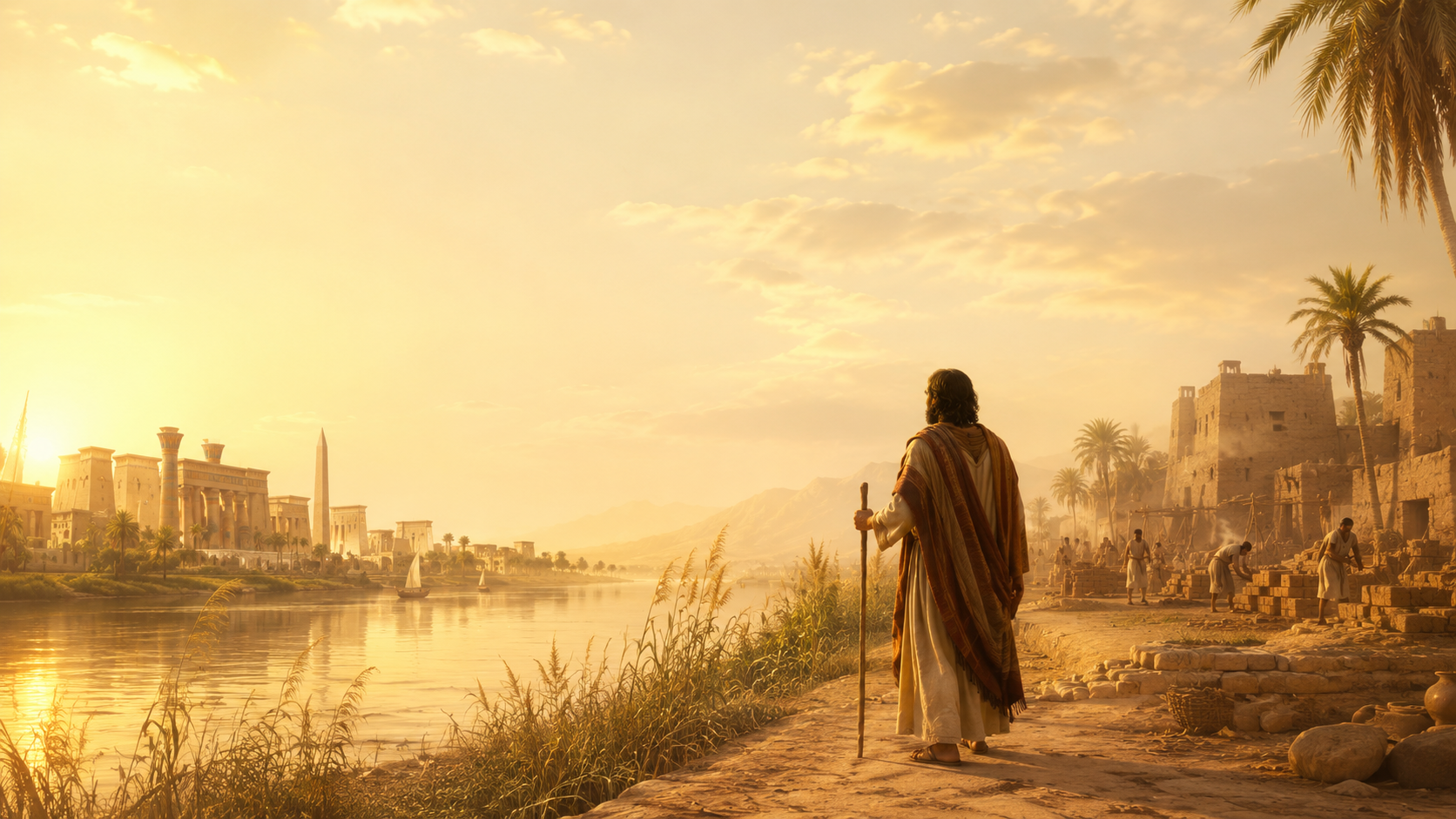
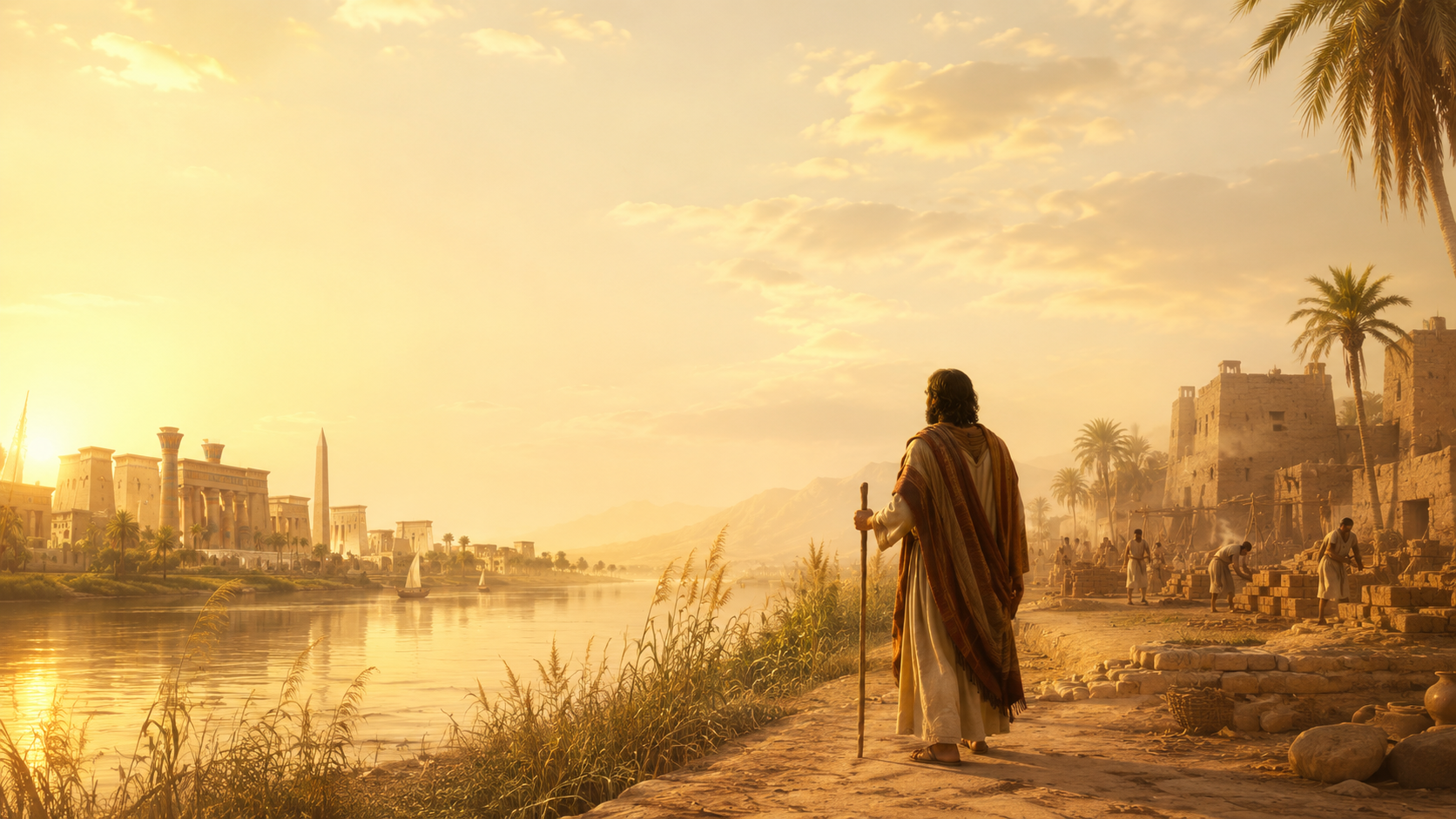
The kitchens of the palace at Pi-Ramesses turned out ten thousand loaves a day for the royal household and its retinue. There were cooks from Syria and Nubia, jars of wine from the delta vineyards, roasted ibis on feast days, honeyed figs from the orchards along the irrigation channels. The dining rooms had painted ceilings and lapis lazuli tiles. The servants bowed when he entered.
And then, somewhere in his growing years — perhaps on a day when the overseers led a work gang past the palace grounds — Moses looked through the cedar gates and saw the other world. Men with backs like old leather. Women carrying baskets of mud on their heads. Children already learning the weight of a brick. He would have known, on some level, that they were his people. His mother had told him. Jochebed had been careful about that.
But knowing and seeing are different things. And what Moses saw, in the gap between the golden spoons and the leather backs, was a question that would take forty years in the desert to begin to answer: Who am I? And what am I supposed to do about this?
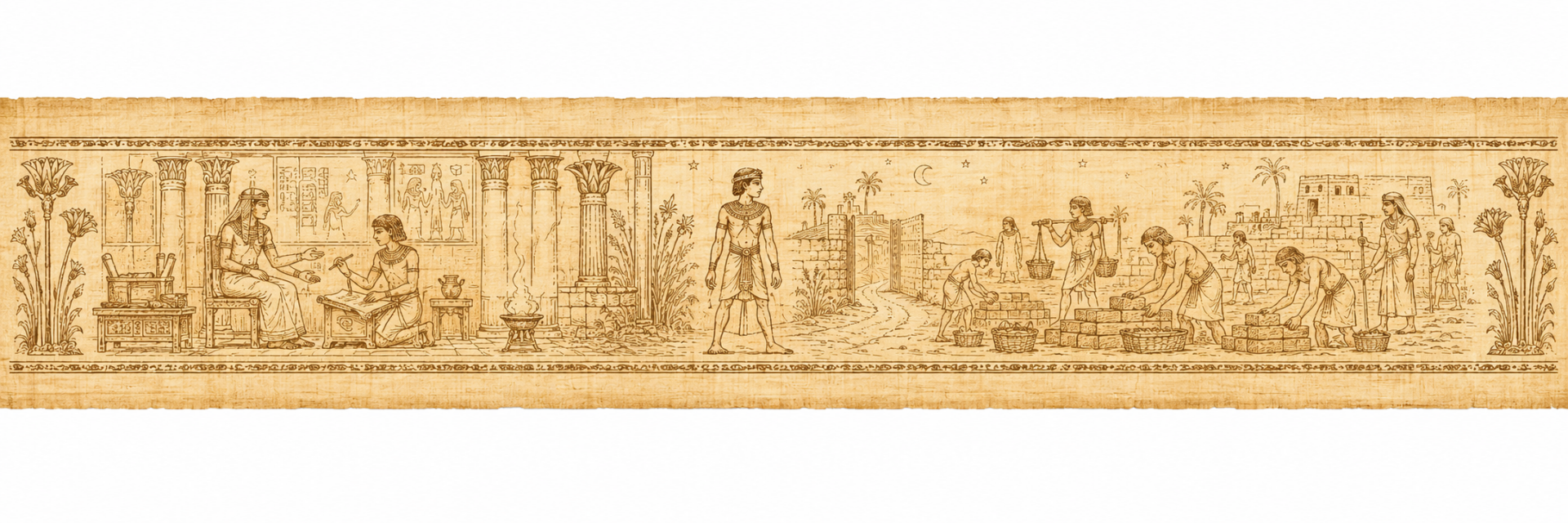
The Pit World
- Hebrew blood — son of Amram and Jochebed
- Mud bricks, quota systems, the overseer's stick
- Jochebed's lullabies and the old stories
- The language of the patriarchs
- Tribal identity, kinship, covenant memory
- Known as a slave; outsider to everything

Part Three — Section I
The Palace: Life Inside Pharaoh's Household
Pi-Ramesses, the Kap, and the formation of a world-class mind
Architecture and Daily Life of the Egyptian Court
Pi-Ramesses (the House of Ramesses), built by Ramesses II on the site of the earlier Hyksos capital at Tell el-Dab'a, was one of the great cities of the ancient world. The Anastasi II papyrus rhapsodizes: its granaries full of barley and wheat, its pools full of birds, its waterways flush with fish. Covering approximately ten square kilometers, it may have housed up to 300,000 people at its height.
The royal palace complex included audience halls for foreign delegations, harem complexes housing wives and royal children, temples to Amun and Ra, extensive gardens, and the military training grounds where royal sons learned chariotry and archery. Moses moved through all of this. As the adopted son of a royal princess, he had access to the upper levels of this world. He ate the food. He wore the linen. He was, by every outward measure, Egyptian.
The Kap: Egypt's Royal School
Historical Context — The Kap Institutio
Architecture and Daily Life of the Egyptian Court
The kap was the royal nursery and scribal school attached to Pharaoh's household — the mechanism by which Egypt reproduced its administrative class. Students included sons of the Pharaoh, children of high officials, and crucially, children of foreign princes and conquered rulers brought to Egypt as hostages.
The genius was political: you raised your potential enemies' children as Egyptians, returned them to their homelands speaking Egyptian, thinking in Egyptian categories, loyal in theory to Egyptian culture. Moses entered this system from an unusual direction — as an infant rather than a foreign prince — but the educational experience was similar.
The kap curriculum included hieroglyphic and hieratic writing, arithmetic and geometry, medical knowledge, religious texts including the Book of the Dead and Pyramid Texts, physical training, and diplomatic protocol. Acts 7:22 uses the word epaideuthe — trained, formed, discipled. This was not casual exposure. This was deep formation.
What Egyptian Theology Taught Moses
The most underappreciated aspect of Moses' Egyptian formation is what he absorbed about the divine. Egyptian religion was not primitive superstition — it was a sophisticated, internally coherent cosmological system over a thousand years in development.
Egyptian theology taught that the universe was sustained by ma'at — divine order, truth, justice, cosmic balance. The Pharaoh's role was to maintain ma'at on behalf of the gods. Creation was not a singular event but an ongoing process; the world had to be re-created each day. Everything in Egyptian life — agriculture, law, ritual, architecture — was oriented toward sustaining ma'at.
God's Educational Sovereignty
Moses absorbed Egyptian cosmological thinking. He understood the logic of a world undergirded by divine order, how to connect earthly events to cosmic significance, how to understand law as more than human convention. When God gave him the Torah, Moses had the conceptual architecture to receive it. The God of Israel used the most sophisticated pagan theological system in the ancient world to prepare the mind that would receive divine revelation.
— ✦ —
Part Three — Section II
The Pit: Life in the Hebrew Slave Quarter
What the other world looked like — and what Jochebed gave him before the palace took him
The Machinery of Oppression
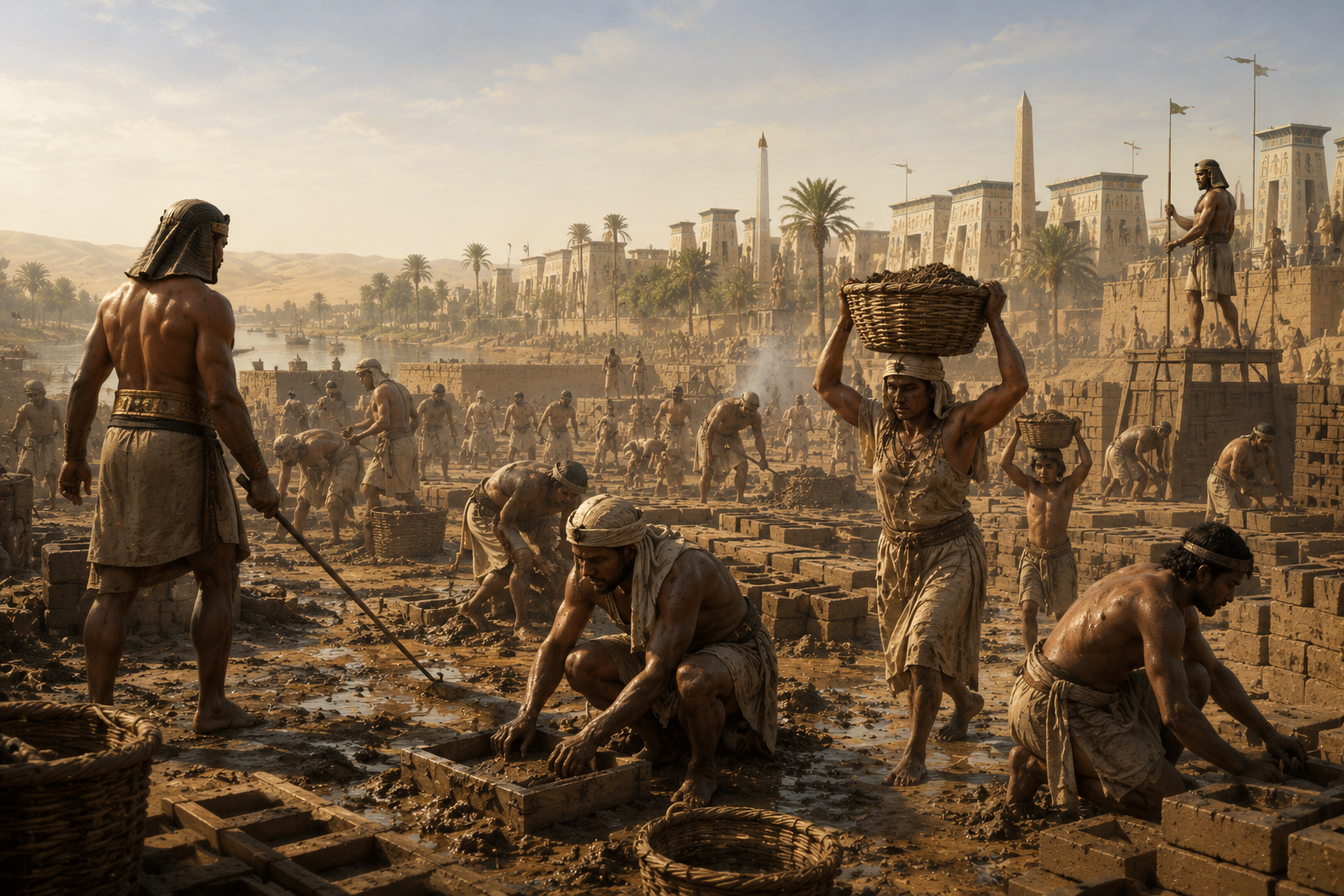
The world on the other side of the cedar gates was not merely poorer. It was a different ontological reality. Egyptian administrative records from the New Kingdom period give us detailed pictures of state labor organization. Workers were organized into gangs under appointed foremen, who were themselves under Egyptian overseers. Daily brick quotas were assigned and tracked.
When Moses and Aaron first approach Pharaoh in Exodus 5, Pharaoh responds by removing the straw supplied to the brick-makers — straw was mixed with Nile mud to prevent cracking — while maintaining the same production quota. The Hebrew foremen are beaten for failing to meet it. They come back to Moses and Aaron and say: "The LORD look on you and judge, because you have made us stink in the sight of Pharaoh and his servants, and have put a sword in their hand to kill us." This is not picturesque poverty. This is systematic brutalization on a production schedule.
What Jochebed Gave Him Before the Palace Took Him
The most significant detail in Moses' early narrative may be the one most easily overlooked: before Moses was handed over to Pharaoh's daughter, Jochebed nursed him.
Ancient Near Eastern weaning typically occurred between two and four years of age — sometimes later. What this means is that Moses spent his most formative cognitive years in his mother's arms, in the Hebrew slave quarter, hearing the Hebrew language, hearing the stories. Jochebed had three, perhaps four years to give her son the foundation that the palace would spend the next four decades trying to cover over.
She told him who he was. She told him about Abraham, Isaac, Jacob, and Joseph. She told him about the God who had made promises. The rabbis have a tradition that Jochebed sang to Moses in Hebrew — that the Psalms of Israel were in some form already present in those lullabies. Whether literally true or not, it captures something real: the Hebrew mother's voice was the first voice Moses ever heard, and it was singing of a God who was not Pharaoh.
The Double Consciousness of Moses
Concept — Double Consciousness
W.E.B. Du Bois, writing in 1903 about the experience of Black Americans in a white-dominated society, coined the term "double consciousness" — "a sense of always looking at one's self through the eyes of others... two souls, two thoughts, two unreconciled strivings; two warring ideals in one dark body."
Du Bois was describing a modern American experience, but the concept illuminates something ancient and real in Moses. Moses was a man with a double consciousness: an Egyptian face and a Hebrew heart. Every time he sat at an Egyptian banquet, part of him knew he was sitting across the table from the people who were working his relatives to death. Every time he put on the regalia of Egyptian privilege, he was wearing the system that was breaking Hebrew backs in the brick pits.
This tension — palace and pit, Egyptian privilege and Hebrew identity — is the engine driving everything that happens next. The killing of the Egyptian overseer in Exodus 2:11-12 is not a random act of violence. It is the explosion of a pressure that had been building for decades.
— ✦ —
Part Three — Section III
The Killing: Exodus 2:11–15
The day two worlds collided and Moses chose
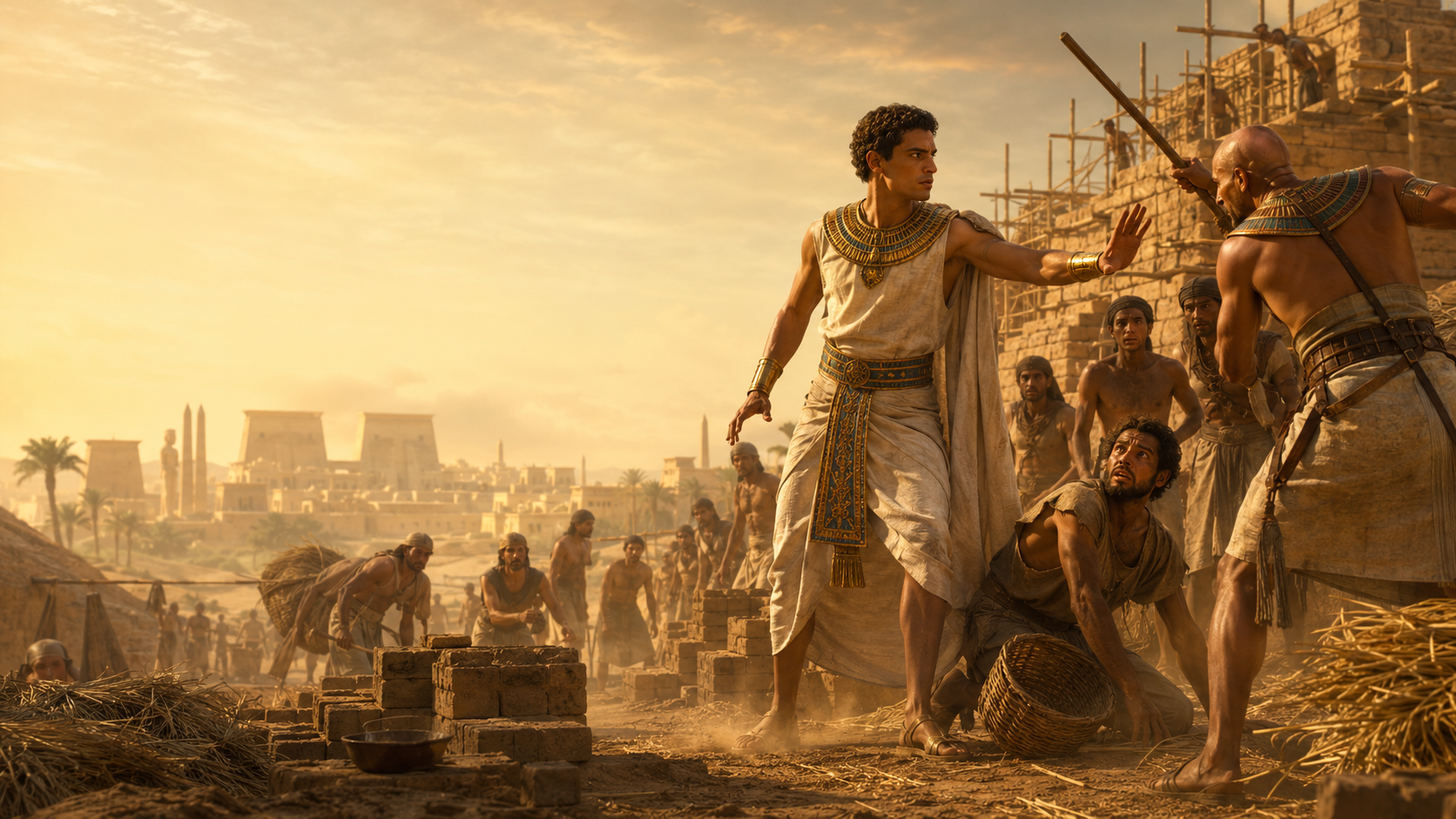
"One day, when Moses had grown up, he went out to his people and looked on their burdens, and he saw an Egyptian beating a Hebrew, one of his people. He looked this way and that, and seeing no one, he struck down the Egyptian and hid him in the sand."
Exodus 2:11–12
Four Details That Matter
- He went out to his people.The Hebrew isel-echav— to his brothers. Not "the Hebrews" — his brothers. Moses has made an internal choice: he identifies with the slaves, not the palace. This is not an accidental encounter. He goes looking.
- He saw the burden — the sevelot. The same word used in Exodus 1:11 for the oppressive labor. Moses is not seeing abstractions. He is seeing, with eyes newly opened, the full weight of what his people endure daily.
- He looked this way and that.The rabbis are divided: was this a moment of moral clarity and deliberate decision? Or evidence that Moses knew he was doing something he could not publicly defend? The text refuses to resolve the tension — and that honesty is itself significant.
- He hid him in the sand. Immediate, decisive, secret. Moses acts with the training of a man educated in military tactics. Whatever his moral framework, the palace has shaped his instincts.
Was Moses Right or Wrong? The Theological Question
This is one of the genuinely contested passages in Moses' biography, and it deserves honest engagement rather than easy answers.
Stephen in Acts 7:23-25 frames it charitably: Moses saw one of his brothers being wronged, "defended the oppressed man and avenged him by striking down the Egyptian. He supposed that his brothers would understand that God was giving them salvation by his hand." Stephen presents this as a proto-messianic act — genuine if premature. He does not condemn it.
Hebrews 11:24-26 takes a different angle, framing the entire sequence — refusal of Egyptian identity, identification with the oppressed — as an act of faith. Moses "chose rather to be mistreated with the people of God than to enjoy the fleeting pleasures of sin." He considered the reproach of Christ greater wealth than the treasures of Egypt.
What both perspectives agree on: Moses knew who he was, knew what was happening to his people, and acted out of that knowledge. Whether the action was morally perfect is secondary to the primary fact — Moses had made his choice. He was not an Egyptian. He was a Hebrew. And he was willing to pay for that identity.
The Response of the Hebrews — and What It Means
The next day, Moses intervenes in a fight between two Hebrews. The one in the wrong turns on him: "Who made you a prince and a judge over us? Do you mean to kill me as you killed the Egyptian?"
This moment is devastating. Moses goes out to defend his people — and his people reject him. The very act of solidarity he performed for them becomes a weapon against him. He is now a man with no home in either world: exposed in the palace, rejected by the pit.
Stephen's Pattern — Acts 7:35
Stephen frames Moses' rejection as paradigmatic: "
This Moses, whom they rejected, saying, 'Who made you a ruler and a judge?' — this man God sent as both ruler and redeemer."
The deliverer is rejected by the very people he comes to save. The parallel to Christ is explicit. Moses' rejection by the Hebrews is a shadow of the greater rejection to come.
— ✦ —
Part Three — Section IV
Archaeological & Cultural Context
Double identity in the ancient Near East — and the mystery of the name Moses
Semitic Identity Inside Egyptian Power
Historical Context — Semites in Egyptian Service
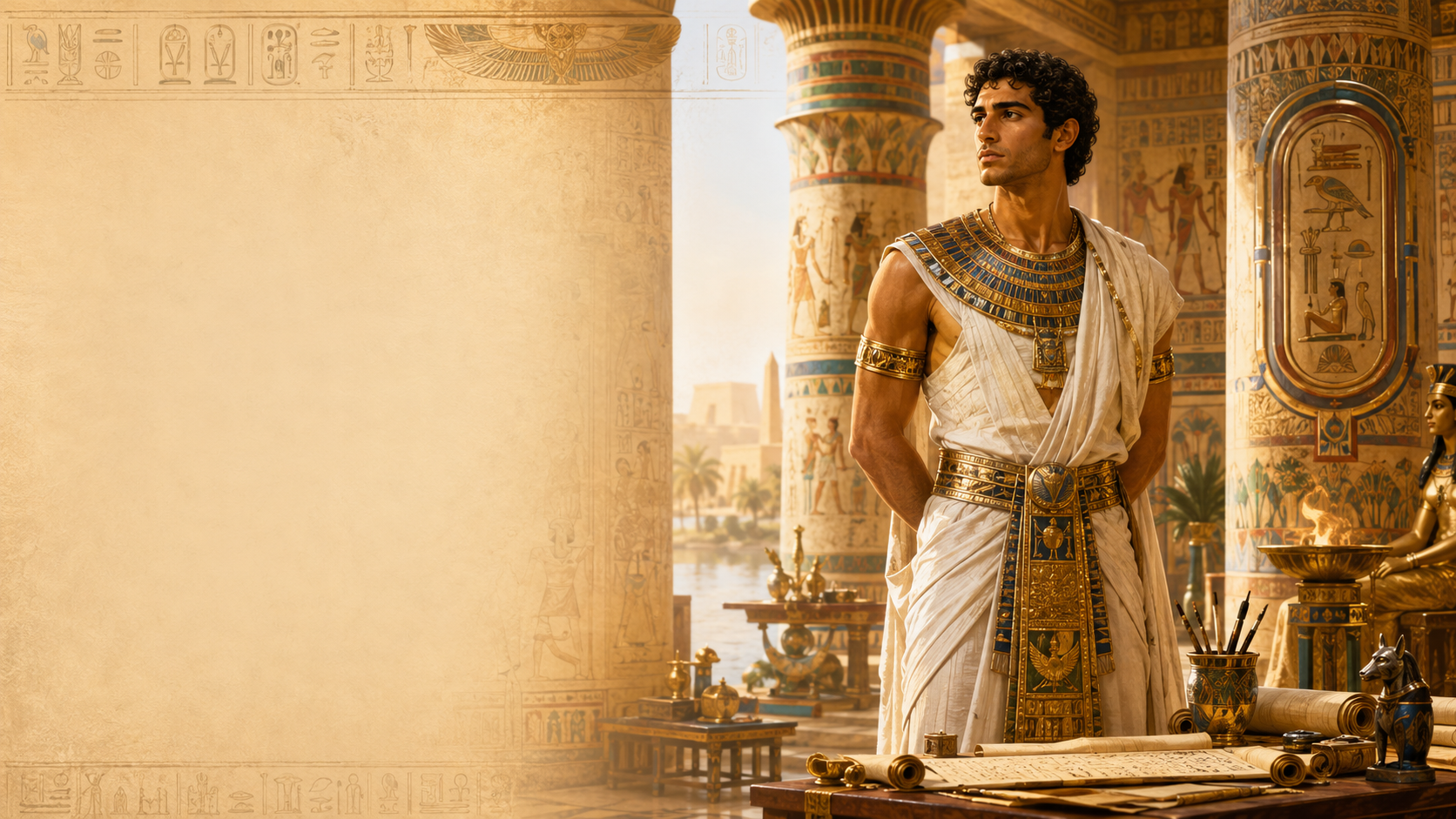
Egyptian records frequently mention foreigners who rose to high positions in the imperial system — Semites, Nubians, and others who adopted Egyptian names, dressed Egyptian, worshipped Egyptian gods, yet retained connections to their ancestral communities.
Aper-El, a vizier (the second highest office in Egypt) under Amenhotep III and IV, bore a name containing the Semitic word El — "God." His tomb, discovered at Saqqara in 1987, shows him in full Egyptian regalia while containing Semitic personal names in the family records. A Semitic man at the highest levels of Egyptian administration. Moses was not an anomaly.
The Hyksos kings who ruled Egypt during the Second Intermediate Period were of Canaanite/Semitic origin but adopted Egyptian forms wholesale. Yuya and Tuya — grandparents of Pharaoh Akhenaten — may have been of Semitic origin. Hybrid identity was woven into the fabric of the imperial world.
The Egyptian Name Moses and What It Hides
Name Study — Moses / Moshe / Mose
In Egyptian, the element -mose or -meses means "is born" or "child of" — as in:
- Thut-mose — child of Thoth (Egyptian god of wisdom)
- Ah-mose — child of Iah, the moon god
- Ra-messes — child of Ra (the sun god)
Moses' name may be the second half of a theophoric name — a name that originally contained a pagan deity's name which was later dropped. He may have been Ra-mose or Ptah-mose, with the god's name suppressed when he entered Hebrew tradition.
The theological irony is exquisite: Moses, the man whose name may have originally proclaimed him the child of a pagan deity, becomes the vessel through whom the God who overthrows all those deities reveals His own name. His Egyptian name — stripped of its false god — becomes in Hebrew a word about rescue: mashah, to draw out. Even his name was being redeemed.
— ✦ —
Part Three — Section V
Theological Depths: The Theology of the Two Worlds
Kenosis, chosen identification, and Moses as a type of Christ
Chosen Identification with the Oppressed
"By faith Moses, when he was grown up, refused to be called the son of Pharaoh's daughter, choosing rather to be mistreated with the people of God than to enjoy the fleeting pleasures of sin. He considered the reproach of Christ greater wealth than the treasures of Egypt, for he was looking to the reward."
Hebrews 11:24–26
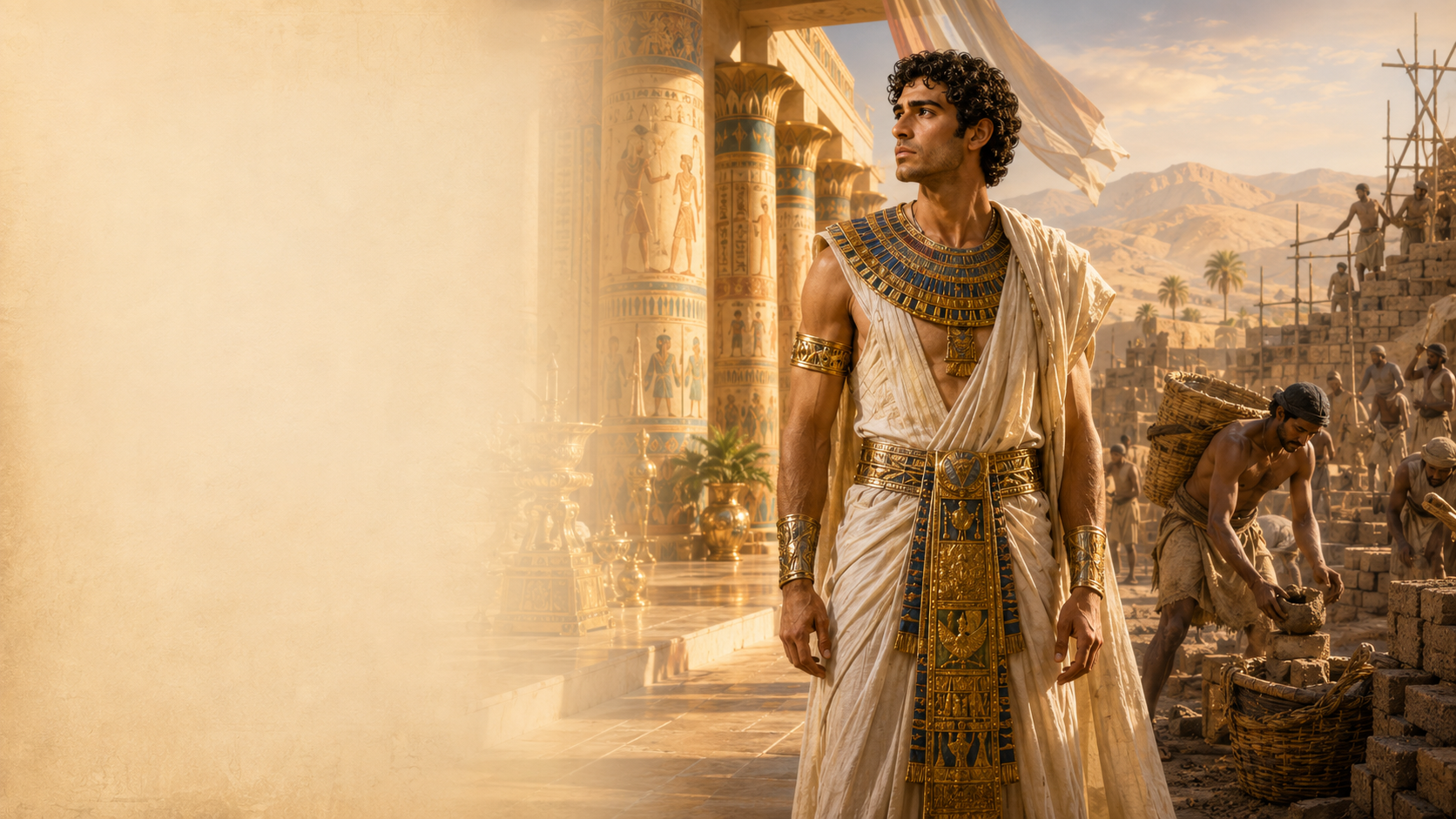
The phrase "the reproach of Christ" is startling. The writer of Hebrews is making a typological claim: when Moses chose to identify with the suffering Hebrew slaves rather than with Egyptian privilege, he was participating in the same dynamic that Christ later embodied when He "emptied himself, by taking the form of a servant" (Philippians 2:7).
This is the theology of kenosis — self-emptying. Jesus, who was in every sense the King of kings, laid aside the privileges of divine glory and took on the condition of the oppressed. Moses, who was in every sense an Egyptian prince, laid aside the privileges of palace life and took on the condition of the slave. Both acts were deliberate, costly acts of identification with those below.
The Timing Problem: Why God Waited
If Moses was the chosen deliverer, why did God not use the killing of the Egyptian as the trigger? Why forty more years in the desert?
Because Moses was not ready. The man who killed the Egyptian and looked over his shoulder was acting on passion and personal power. He had the tools of the palace — decisive action, superior force, individual initiative. God's method of deliverance was going to require something categorically different: a man broken of self-reliance, who had learned to wait on God's timing rather than manufacture his own.
The Moses of Exodus 3 — who protests at the burning bush that he cannot speak, that he is nobody, that no one will listen — is a man the palace could never have produced. He had to be formed in the wilderness. Forty years in Midian was not punishment. It was surgery.
Moses as a Type of Christ: The Two Natures Pattern
The early Church Fathers recognized in Moses a structural parallel to the Incarnation. Jesus Christ, fully God and fully man, existed in the tension of two natures. Moses, fully Egyptian and fully Hebrew, existed in the tension of two identities. Both figures had a dual identity hidden from public view. Both were rejected by the people they came to save. Both spent time in the wilderness before their public ministry began. Both functioned as prophet, priest, and mediator between God and the people.
The life of Moses is, in the deepest sense, a preparation of the imagination. God was training His people to recognize the shape of a deliverer — so that when the true Deliverer arrived, those with eyes to see would recognize the pattern.
— ✦ —
Part Three — Section VI
Devotional
The Gift of the In-Between
Devotional Reading
There is a particular loneliness that comes from belonging fully to nowhere.
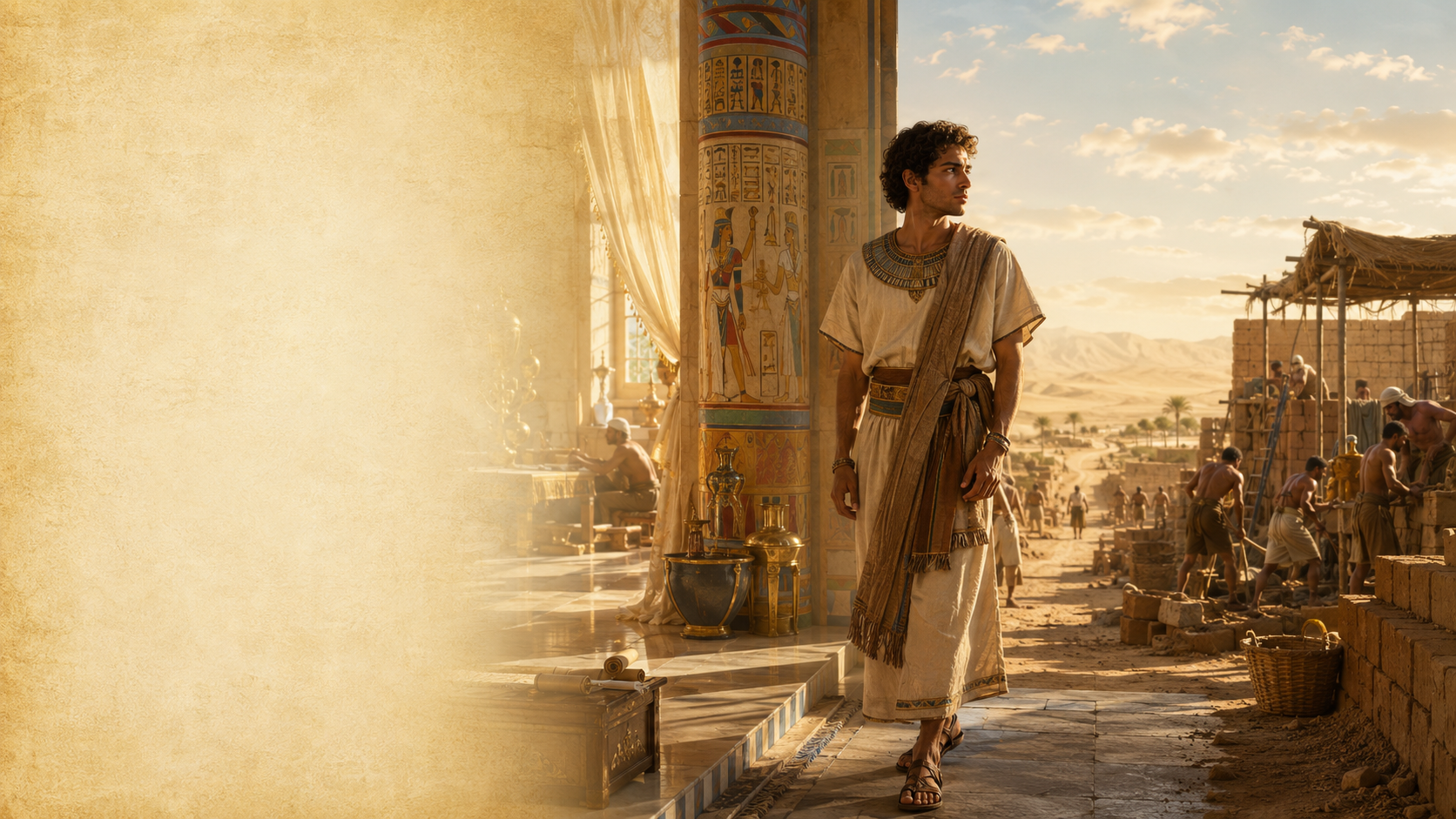
Moses knew this loneliness. He ate at Egyptian tables and dreamed Hebrew dreams. He walked through palace corridors wearing linen his people had woven under the overseer's stick. He was called by an Egyptian name that may have contained a god he did not believe in. He was a man in translation, and the translation was never quite finished.
Most of us know something about this. The person who grew up in the church and now lives in a secular world — belonging fully to neither. The immigrant who has learned to thrive in a new country but still hears their grandmother's language in their dreams. The one who has been so changed by suffering or transformation that they no longer fit the places they came from, but haven't fully arrived anywhere new.
The in-between is painful. But the Bible suggests it may also be a place of formation that nowhere else can provide. Moses could not have understood the full humanity of the Hebrew slaves if he had never lived among them. And he could not have understood the full power of the Egyptian system if he had never lived inside it. His double consciousness — painful as it was — gave him a clarity that neither Egyptian nor Hebrew alone could have possessed.
The God who allowed Moses to live in two worlds simultaneously was not being careless. He was building a deliverer who could understand both sides of the wall. A man who would one day stand between God and His people and speak in both directions — translating the holy to the human, and lifting the human to the holy.
Your in-between is not wasted. God knows what He is building.
— ✦ —
Reflection & Discussion Questions
Personal Reflection
1.Moses had a double identity — palace on the outside, Hebrew on the inside. Have you ever experienced a season of living with a divided self — belonging to one world outwardly while knowing your deepest identity lay somewhere else? What was that like?
2.Hebrews 11 says Moses "refused to be called the son of Pharaoh's daughter" and chose suffering with God's people over the pleasures of Egypt. What would it look like for you to make a similar choice today — to choose identification with something costly over the comfort of a privileged position?
3.Moses' act of solidarity was rejected by the very people he tried to help. Have you ever tried to stand with someone or serve someone, only to be rejected or misunderstood? How did that feel, and what did God teach you through it?
Deeper Study
4.Read Acts 7:17–29 (Stephen's speech about Moses). How does Stephen interpret Moses' killing of the Egyptian? What does he say the Israelites failed to understand? And how does Stephen connect this moment to the rejection of Jesus?
5.Hebrews 11:26 says Moses considered "the reproach of Christ" greater wealth than the treasures of Egypt. What do you think the writer of Hebrews means? How can Moses have weighed "the reproach of Christ" when Christ had not yet come?
6.The Egyptian name Moses may have originally contained a pagan deity's name that was later stripped away. How does this pattern — a name being emptied of a false god and redeemed for new meaning — reflect something you see in the wider biblical story, or in your own life?
— ✦ —
Closing Prayer
A Prayer for Those Living Between Two Worlds
Dear Lord,
You are the God of the in-between. You are the God who allows us to live in tensions that cannot yet be resolved, in identities that haven't finished forming, in seasons that feel like translation with no finished text.
We thank You for Moses — for his double consciousness, for the loneliness of the palace-and-pit years, for the passion that drove him out to see his people's burdens. We thank You that even his failures were not beyond Your purpose. That the premature act, the hasty burial in the sand, the flight to Midian — none of it was outside Your sovereign plan.
For those of us who feel like we belong fully nowhere today — who are carrying two worlds inside us and finding the weight heavy — remind us that You see the whole map. That You know why the in-between is necessary. That You are building something in us that requires both worlds to complete.
And for those of us who have acted with Moses-like passion and Moses-like timing — who have run ahead of You and are now sitting in our own kind of Midian — meet us there. The desert is not a dead end. It is a school. And You are the teacher.
Form in us the Moses of Exodus 3. The man who has been broken open enough to say: "Who am I?" And who has heard Your answer: "I AM with you."
Amen.
— ✦ —
Coming Next in the Series
Part Four: The Killing of the Egyptian — Identity Crisis and the First Failure
We go deeper into the theological and psychological significance of the act in Exodus 2:11–15. This is the hinge moment of Moses' early life: the day the two worlds collided and he chose. We will explore the ancient Near Eastern law of the go'el (the kinsman-redeemer), how Moses' act fits within it, the flight to Midian, and what it means when God allows the consequences of our choices to become the curriculum of our formation.
— ✦ —
Add comment
Comments