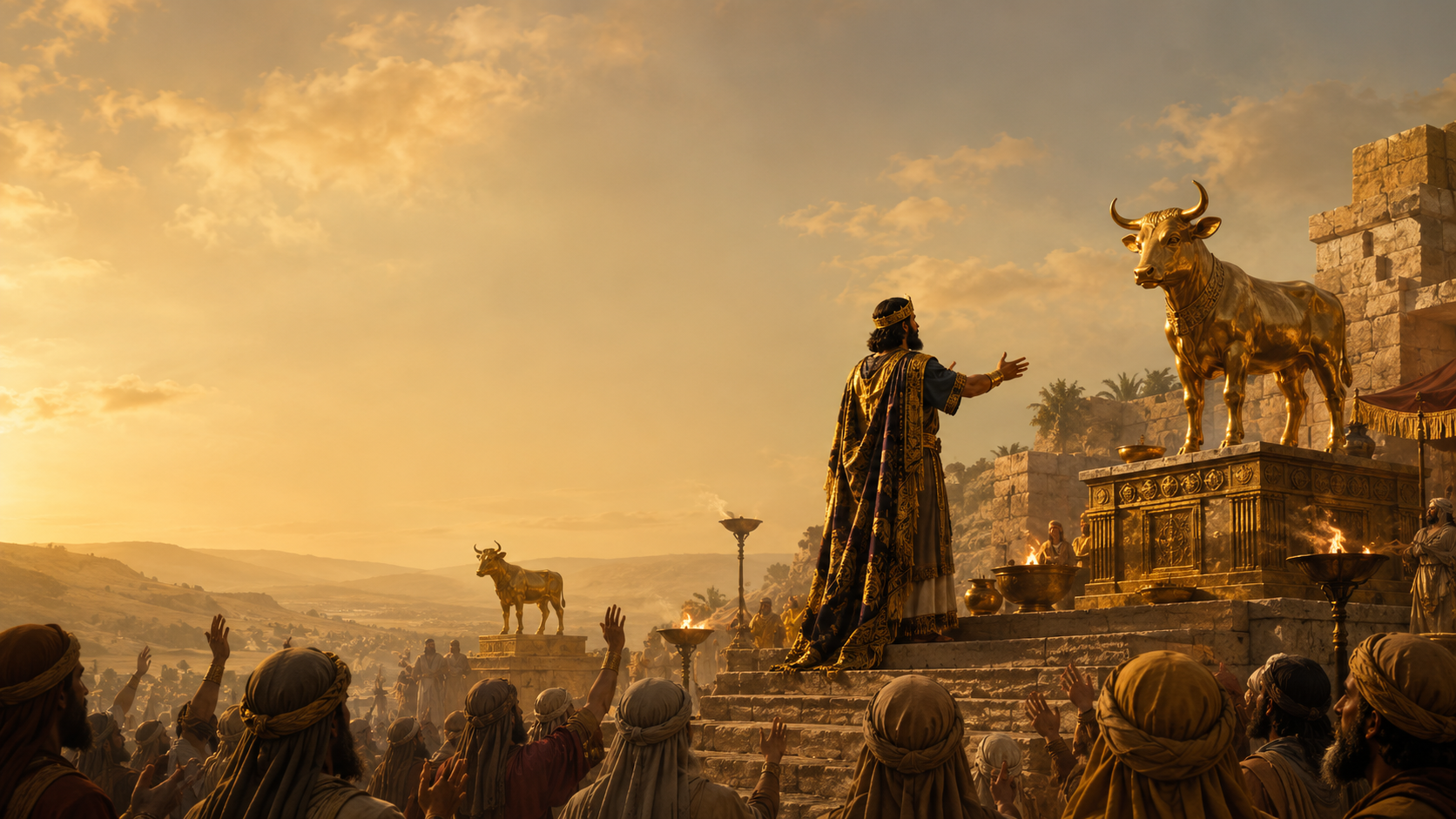
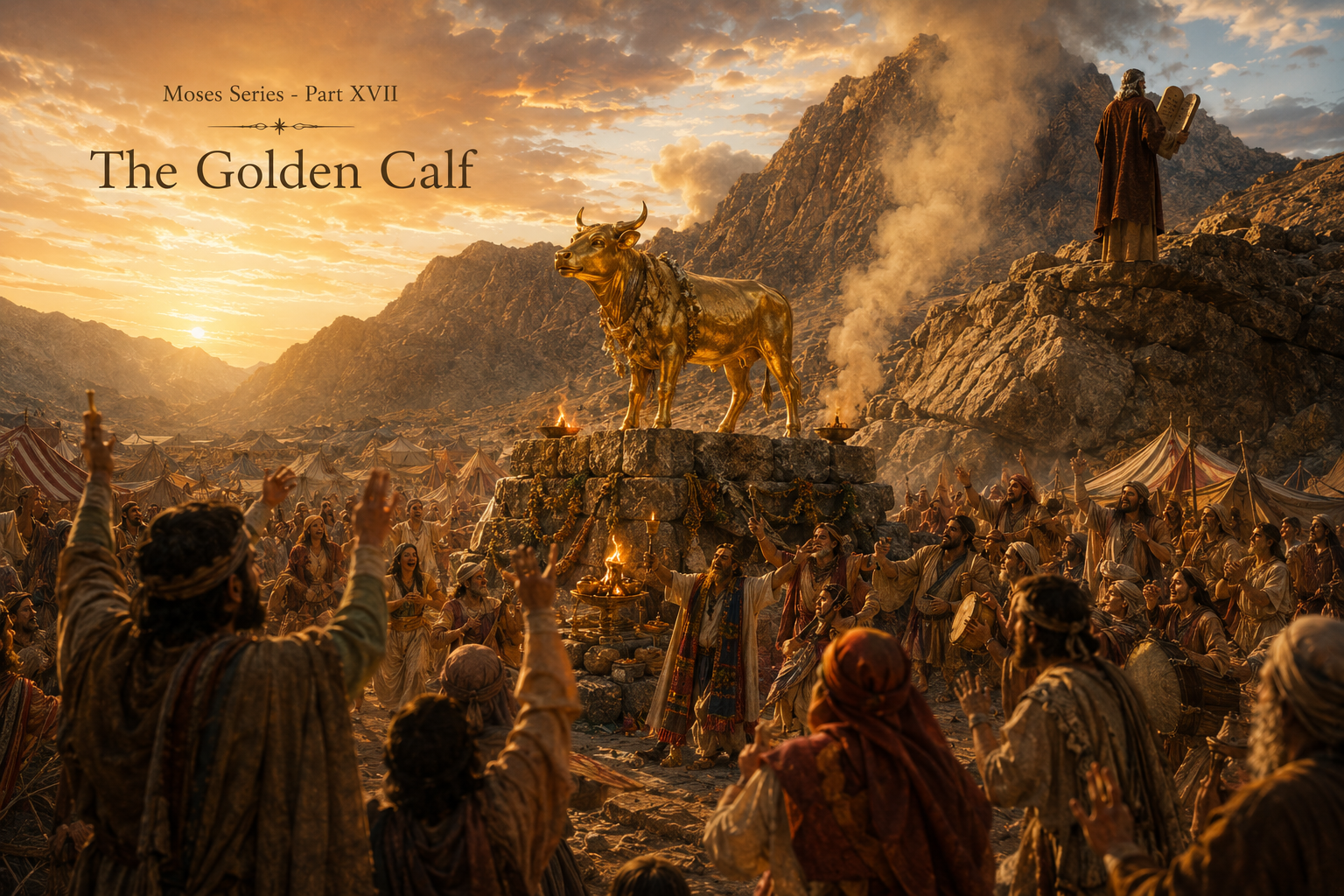
"And he received the gold from their hand and fashioned it with a graving tool and made a golden calf. And they said, 'These are your gods, O Israel, who brought you up out of the land of Egypt!'"
— Exodus 32:4
Before You Begin This Study
Part Seventeen covers one of the most catastrophic events in the entire Old Testament — and one of the most revealing about both human nature and divine character. Please read Exodus 32 in full before engaging the commentary. It is a single, unified narrative that should be read in one sitting before it is analysed in pieces.
As you read, notice three things simultaneously: (1) what Israel is doing in the valley while Moses is on the mountain; (2) what God says about it before Moses has even come down; and (3) what Moses says in response to God — because Moses' response in Exodus 32:11–14 is one of the most extraordinary intercessory prayers in all of Scripture, and most readers breeze past it on the way to the drama of the broken tablets.
Exodus 32:1–35 Exodus 33:1–23 Deuteronomy 9:6–21 Nehemiah 9:16–19 Psalm 106:19–23
Optional deeper reading:
1 Corinthians 10:6–7 (Paul's direct use of the golden calf as a warning to the church);
Acts 7:39–41 (Stephen's retelling of the calf in his speech before the Sanhedrin);
Romans 1:22–23 (Paul's theology of idolatry as suppression of truth);
1 Kings 12:26–30 (Jeroboam replicates Aaron's exact words and Aaron's exact act 500 years later — one of the most chilling moments of recurrence in Scripture).
Exodus 32:1-6
Exodus 32:7-14
Exodus 32:15-24
Exodus 32:25-35
Exodus 33:1-6
Exodus 33:7-11
Exodus 33:14-17
Exodus 33:18-23
DEUTERONOMY 9:6–11: Not for Your Righteousness
DEUTERONOMY 9:12–21: The Descent and the Intercession
Nehemiah 9:16–19
Psalm 106:19–23
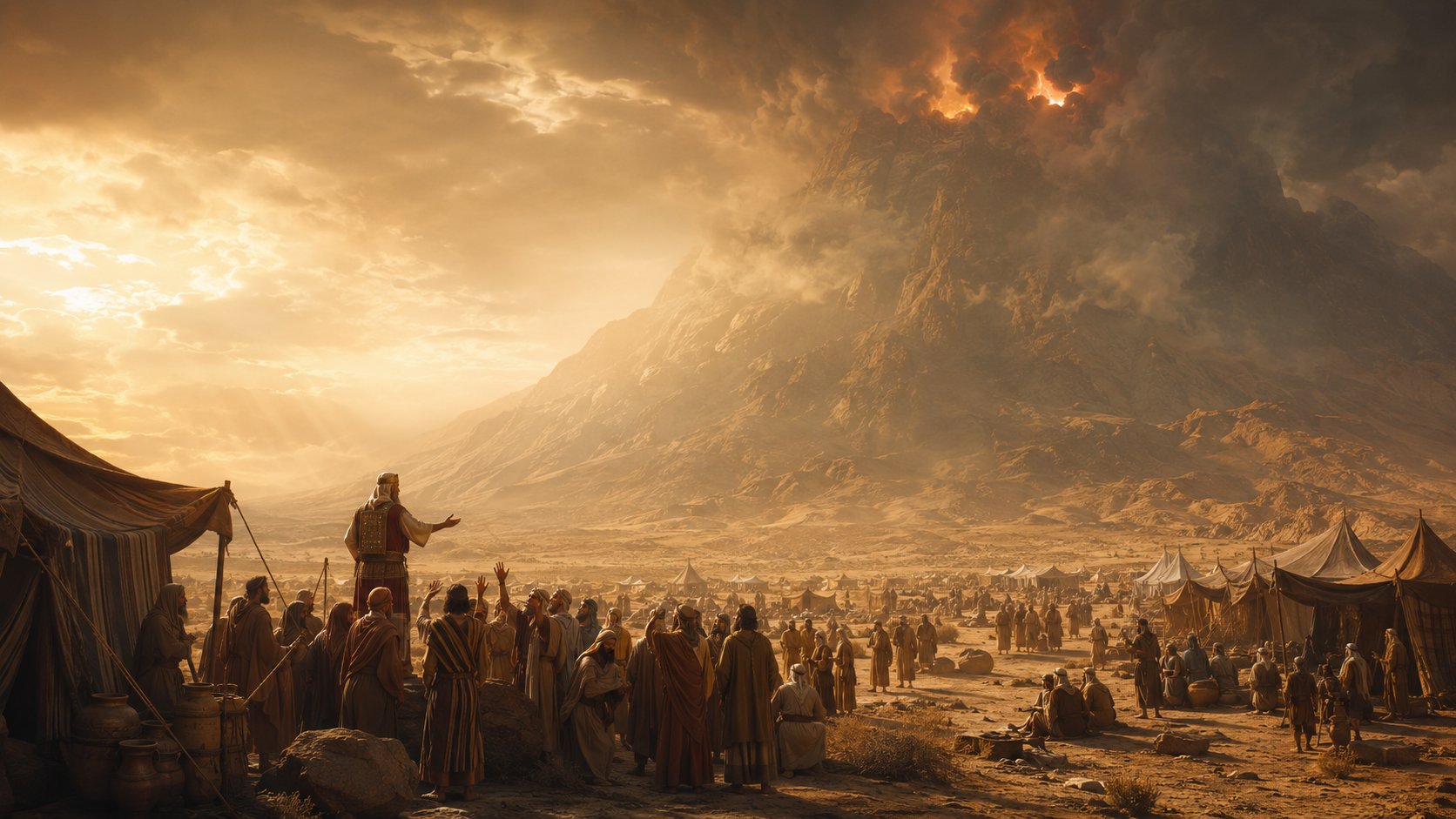
The Story - The Calf and the Fire
Forty days. That was all it took.
The People Waiting
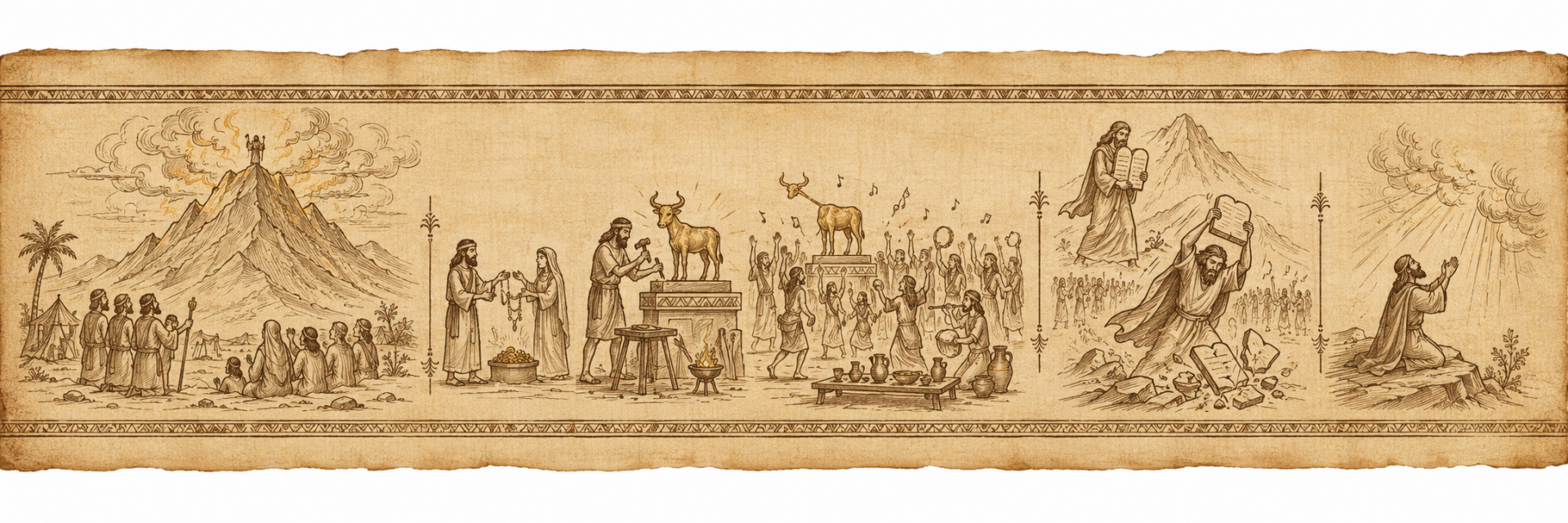
Forty days and forty nights Moses had been on the mountain. Forty days of the mountain still smoking, still wreathed in cloud and fire, still shaking with the weight of divine presence. Forty days since they had heard the voice from the fire. Forty days since they had backed away and said: you speak to us, Moses, and we will listen, but do not let God speak to us, lest we die.
And now Moses was not coming down.
Day after day. No Moses. No news from the summit. No messenger descending with a reassuring word. Just the mountain — still burning, still wrapped in cloud — and an increasing silence from the man who had gone into the thick darkness where God was.
The people gathered themselves to Aaron. And they said:"Up, make us gods who shall go before us. As for this Moses, the man who brought us up out of the land of Egypt, we do not know what has become of him."
Read that sentence carefully. This Moses. Not "Moses." Not "our leader" or "God's servant" or "the prophet." This Moses — said the way you refer to someone you are beginning to resent, someone whose absence you are beginning to interpret as abandonment. The man who brought us up. Not: the God who brought us up. Moses. In their fear, they have collapsed the entire Exodus narrative onto the human instrument and lost sight of the divine reality behind him. And now the instrument has disappeared, and they cannot see the reality without it.
We do not know what has become of him. Six weeks. Six weeks was all it took for the people who had crossed the sea on dry ground, who had eaten manna every morning, who had heard the voice from the fire — to reach the point of: we do not know what has become of him. The memory of miracle has a shelf life. And when the memory fades and the leader disappears, the question is not "where is God?" It is: "where is Moses?" They have confused the means of grace for the source of it.
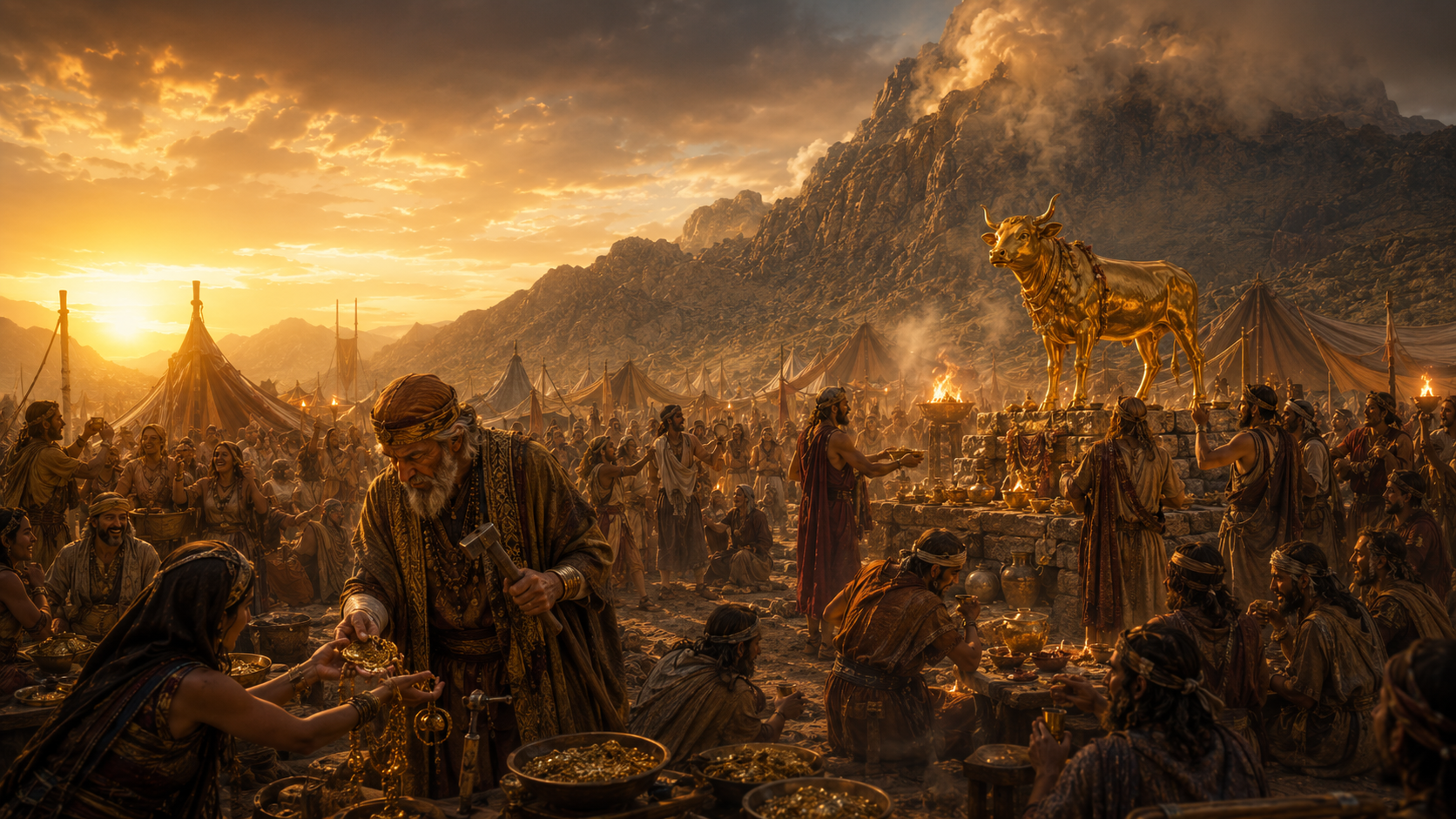
Aaron and the Calf
Aaron said: bring me the gold earrings of your wives, your sons, and your daughters. And the people did. They tore the rings from their ears — the same rings they had taken from Egypt, the plunder that was supposed to fund the Tabernacle, the gold that was meant for the dwelling place of YHWH — and they brought it to Aaron.
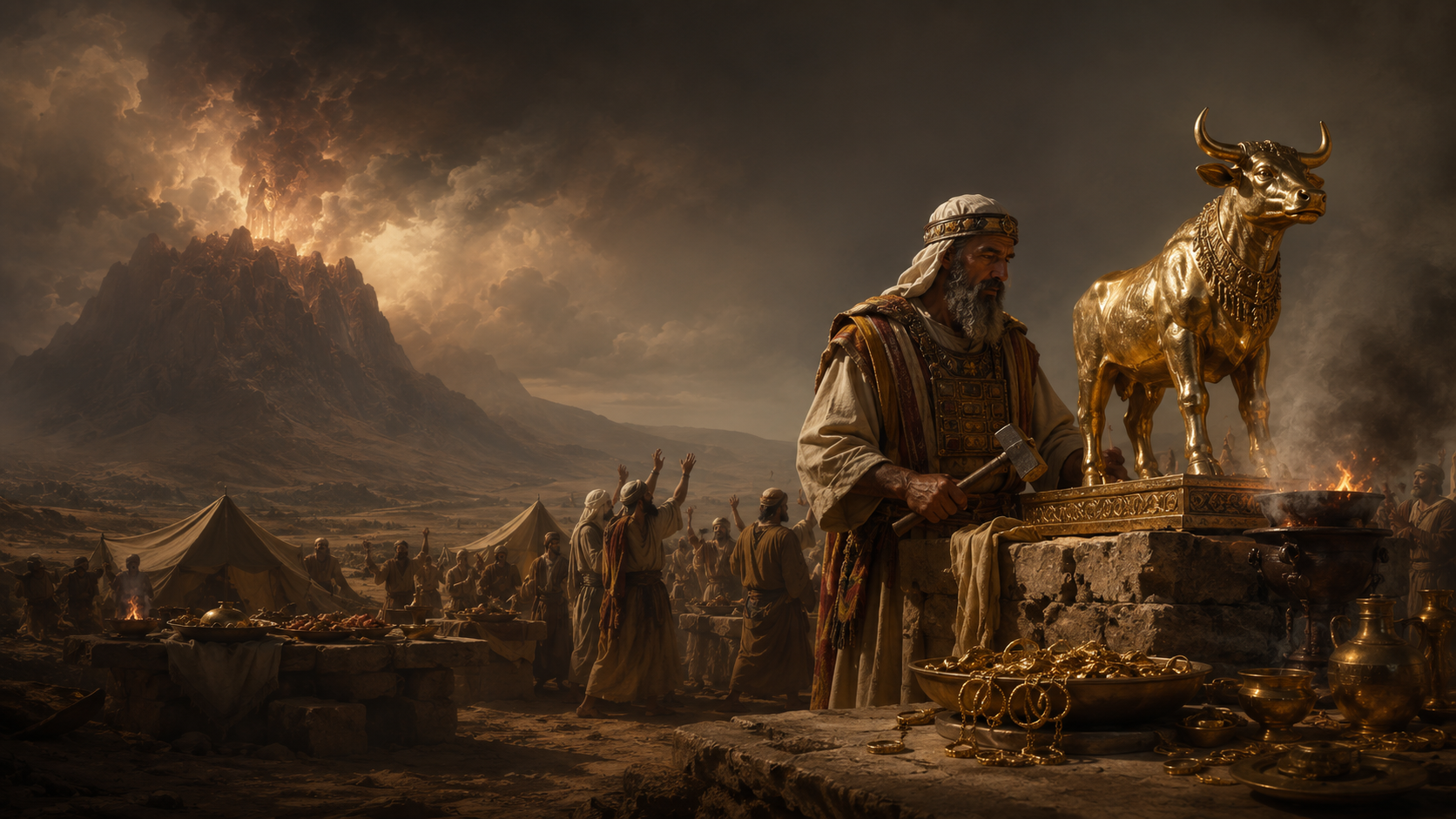
And Aaron received the gold from their hand and fashioned it with a graving tool and made a golden calf. And they said:"These are your gods, O Israel, who brought you up out of the land of Egypt!"
The horror of this sentence — the absolute, staggering theological horror of this sentence — is almost impossible to overstate. The same phrase that the prologue to the Ten Commandments had used just forty days earlier: "who brought you up out of the land of Egypt." The same words. Applied now to a golden animal they had just made with their own hands. With Aaron's own graving tool. Out of their own gold.
And Aaron built an altar before it and made a proclamation: "Tomorrow shall be a feast to the LORD."
There is something almost more disturbing about Aaron's altar than about the calf itself. Aaron did not declare a feast to Baal. He did not formally apostatise to an Egyptian god. He declared a feast to YHWH. He used the divine name. He tried to channel the people's religious energy toward the golden calf while simultaneously maintaining the vocabulary of YHWH worship. This is not outright polytheism. This is something more insidious: the worship of the true God through an unauthorised image. The mixing of YHWH's name with a form of representation that YHWH had explicitly forbidden. Aaron was trying to give the people what they wanted without outright violating his relationship with God — and in doing so, he violated both.
They rose early the next morning and offered burnt offerings and brought peace offerings. And the people sat down to eat and drink and rose up to play. The word translated "play" — tzachak — in this context carries sexual overtones in its biblical usage. The feast had become something that would make you look away.
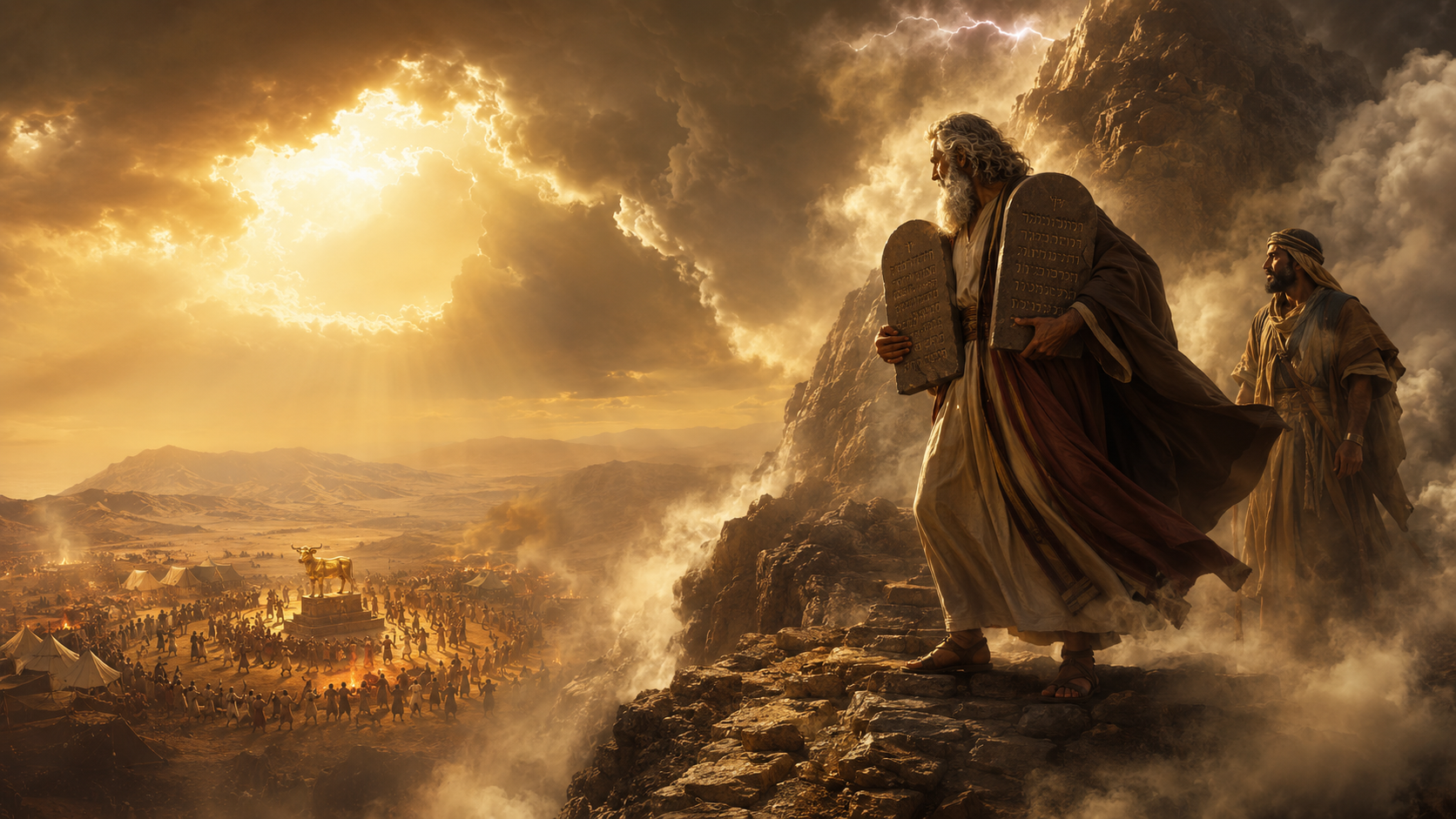
What Happened on the Mountain
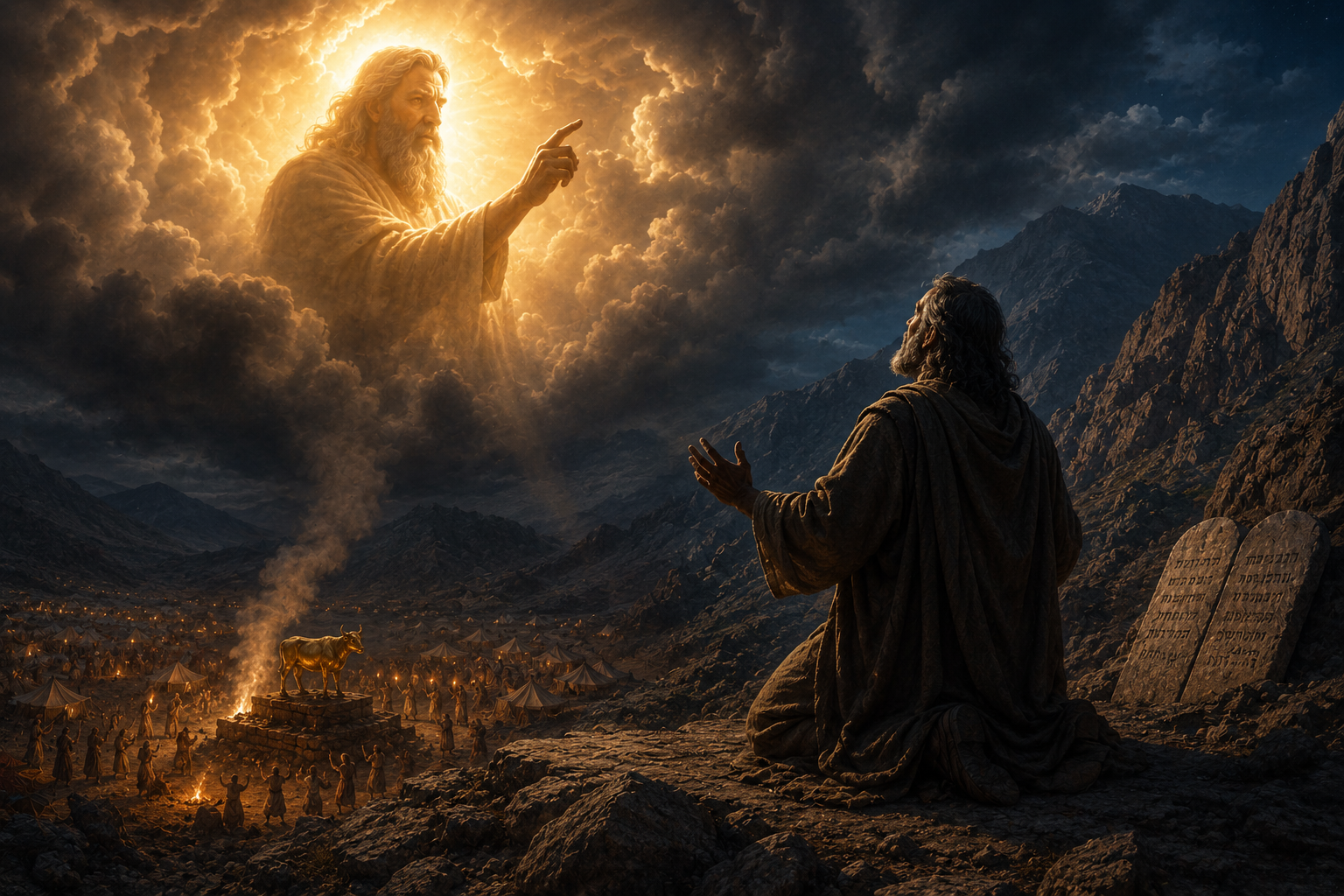
And the LORD said to Moses: go down, for your people, whom you brought up out of the land of Egypt, have corrupted themselves. They have turned aside quickly from the way that I commanded them. They have made for themselves a golden calf and have worshipped it and sacrificed to it and said, "These are your gods, O Israel, who brought you up out of the land of Egypt!" And the LORD said to Moses:"I have seen this people, and behold, it is a stiff-necked people. Now therefore let me alone, that my wrath may burn hot against them and I may consume them, in order that I may make a great nation of you."
Let me alone. The most terrifying two words in the passage — because they imply that Moses' response to this statement makes a difference. God is telling Moses that the intercession Moses has not yet offered is the thing that is standing between Israel and annihilation. Not informing him. Inviting him. The way a parent says to a child "I am very angry right now, leave me alone" — knowing the child will ask questions, knowing the child will argue, knowing this is the beginning of a conversation, not the announcement of a decision already made.
And Moses implored the LORD his God.
He did not go down immediately. He did not pick up the tablets and start his descent. He stayed on the mountain and argued with God on behalf of the people who were dancing around a golden calf forty days after God had spoken from fire. He argued for them. With everything he had. He said: Lord, why does your wrath burn hot against your people, whom you have brought out of the land of Egypt with great power and with a mighty hand? Why should the Egyptians say, "With evil intent did he bring them out, to kill them in the mountains?" Remember Abraham, Isaac, and Israel, your servants, to whom you swore. And the LORD relented of the disaster that he had said he would do to his people.
He relented. Before Moses had even seen the calf. Before he had broken the tablets. Before 3,000 had died. Before any of the subsequent events. God relented, on the mountain, in response to Moses' intercession. This matters enormously for how we read everything that follows.
Then Moses turned and went down the mountain with the two tablets of the testimony in his hands, tablets that were written on both sides, on the front and on the back they were written. The tablets were the work of God, and the writing was the writing of God, engraved on the tablets.
And when Joshua heard the noise of the people as they shouted, he said to Moses: there is a noise of war in the camp. Moses said: it is not the sound of shouting for victory, or the sound of the cry of defeat, but the sound of singing that I hear.
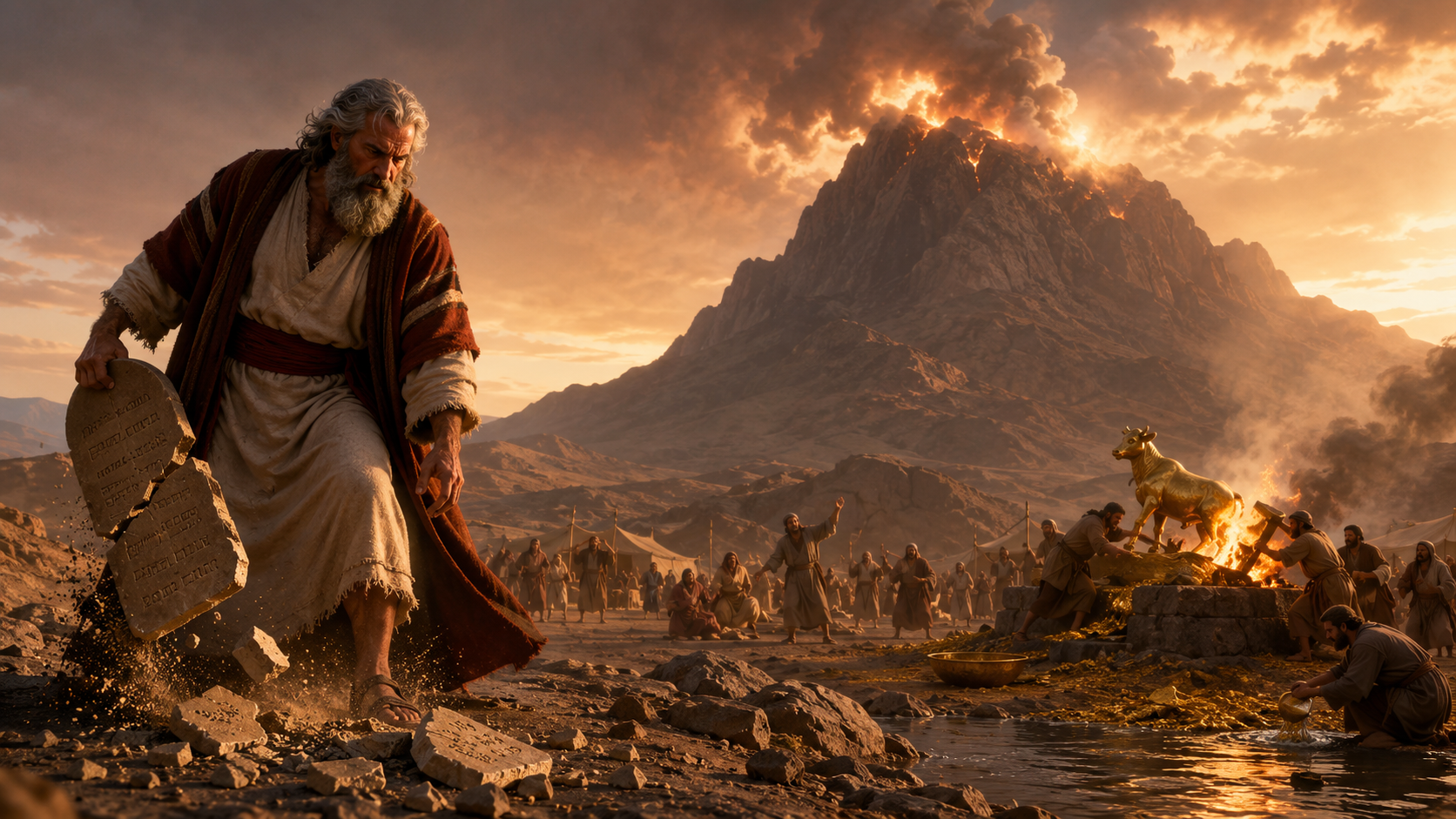
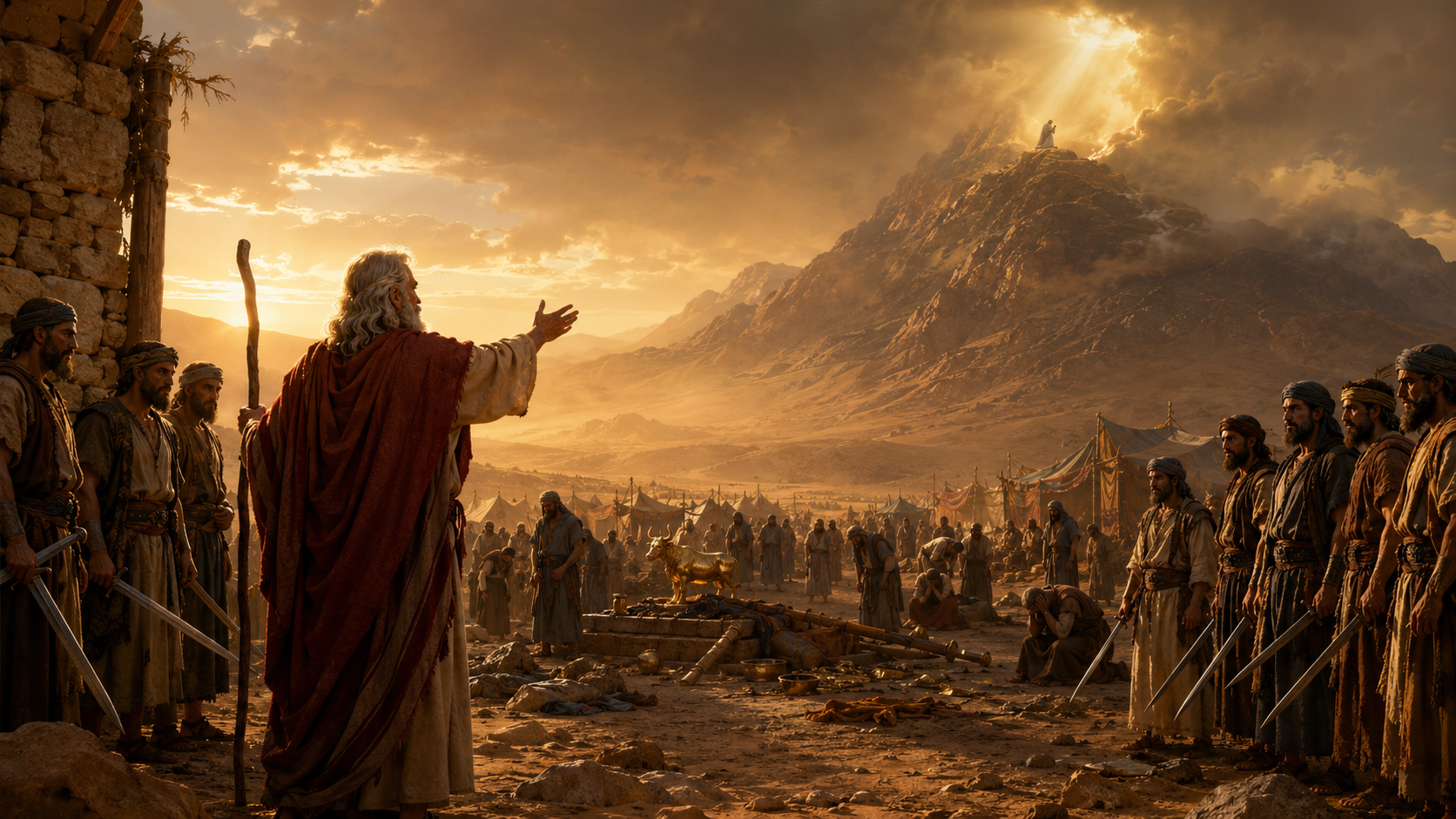
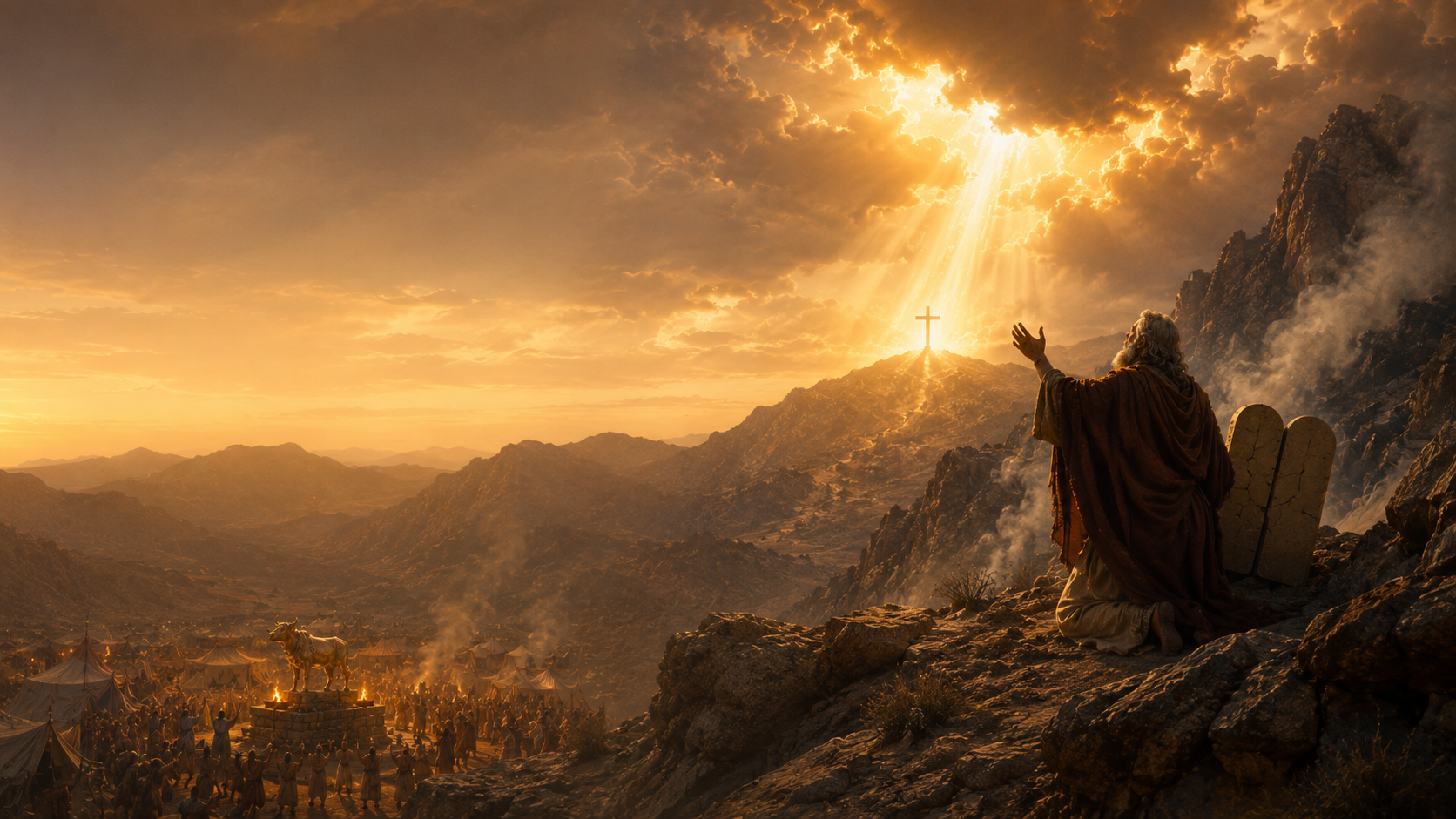
And as soon as Moses came near the camp and saw the calf and the dancing, his anger burned hot, and he threw the tablets out of his hands and broke them at the foot of the mountain.
The tablets that were the writing of God. The work of God. He broke them. On purpose. At the foot of the mountain. In front of everyone.
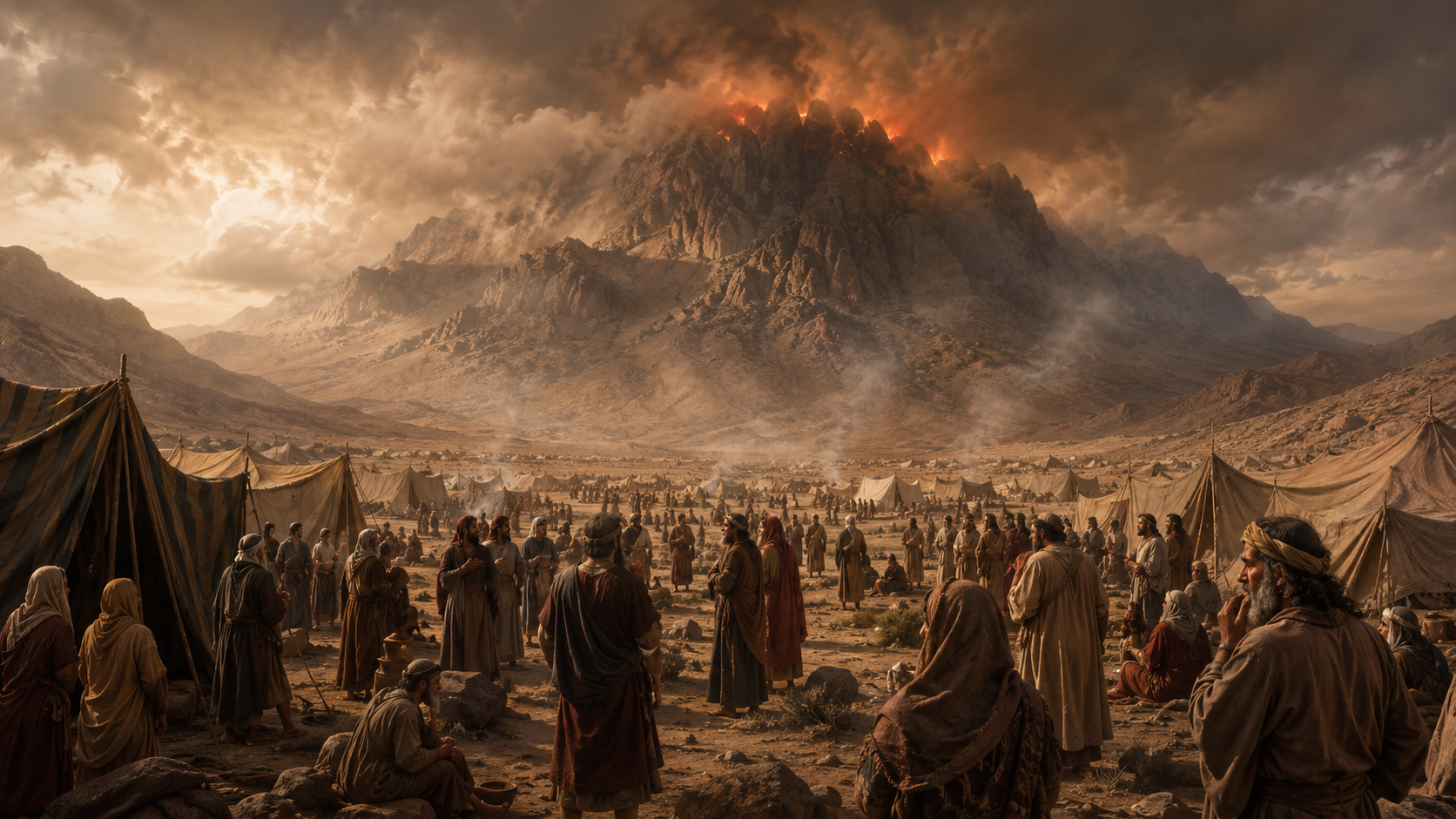
Forty Days: The Psychology of Waiting
Why six weeks was long enough to unravel everything
Exodus 24:18 establishes the timeline: "Moses entered the cloud and went up on the mountain. And Moses was on the mountain forty days and forty nights." During this period, God was giving Moses the full covenant instructions — Exodus 25–31 contains seven chapters of Tabernacle specifications, priestly garment designs, consecration rituals, and Sabbath regulations. Detailed, magnificent, and completely invisible to the two million people waiting at the foot of the mountain.
From Israel's perspective at the base of the mountain: the leader went into the cloud and did not come back. The cloud was still there. The mountain was still smoking. But Moses — the visible, human, accessible presence who had mediated every divine communication since Egypt — was gone. And week by week, the silence accumulated.
Hebrew & Cultural Analysis — "We Do Not Know What Has Become of Him"
ki-zeh Moshe ha'ish — "as for this Moses, the man." The demonstrative pronoun zeh (this) in this construction carries a distancing, even dismissive tone — "this fellow Moses." The definite article on "the man" (ha'ish) adds to the alienation: he has become just "the man," depersonalised, his relationship to them as their leader and mediator receding as his absence grows.
lo yadanu meh-hayah lo — "we do not know what has become of him." The verb yada — know — is the intimate, relational knowing that runs through the Exodus narrative. At the bush, God said He knew (yada) Israel's suffering. At the sea, Israel came to know (yada) the LORD through what He did. And now: we do not know. The deep knowing that the Exodus had built — the accumulating weight of signs and miracles and divine provision — has been eroded by six weeks of silence and the disappearance of the human channel through which it flowed.
This is the psychology of spiritual crisis: not the sudden disappearance of all faith, but the slow erosion of confidence when the channels of grace go quiet and the familiar presence is removed. The people at the foot of Sinai are not atheists. They still believe in divine power. They want a god who shall go before them. They are not rejecting the divine — they are seeking a replacement for the divine that feels more immediate, more controllable, more present. Which is the essence of idolatry in every age.
Aaron's Failure: The Most Theologically Disturbing Moment
What Aaron actually did, what he said, and why it is worse than simple apostasy
Exodus 32:2–6 — Aaron's Actions Examined Step by Step
Verses 2–4
"So Aaron said to them, 'Take off the rings of gold that are in the ears of your wives, your sons, and your daughters, and bring them to me.' So all the people took off the rings of gold that were in their ears and brought them to Aaron. And he received the gold from their hand and fashioned it with a graving tool and made a golden calf."
Hebrew Analysis — What Aaron Made and How
vayatzar oto bacherit — "and he fashioned it with a graving tool." The word tzar (to fashion, to form, to shape) is used throughout the Hebrew Bible for the work of a craftsman or sculptor. The word cherit (a graving tool, an engraving stylus) describes the instrument used to work metal into a specific form. Aaron did not casually pour molten gold into a mould. He worked the form with craftsmanship, with a graving tool — the same kind of skilled artistry that would later be applied to the Tabernacle's sacred objects.
The irony is devastating: the gold that was supposed to fund the Tabernacle, worked with the craftsman's care that was supposed to go into the Tabernacle's furnishings, fashioned into the one thing that the second commandment — given forty days earlier from that same mountain — explicitly forbade.
egel massechah — "a golden calf" or "a molten/cast calf." Massechah (molten, cast) emphasises the manufactured nature of the object — it was made, formed, produced. The word appears repeatedly in the prophets' denunciations of idolatry (Isaiah 30:22; 42:17; Hosea 13:2). A massechah is always something you made. Something you made cannot be the God who made you.
Verses 5–6
"When Aaron saw this, he built an altar before it. And Aaron made a proclamation and said, 'Tomorrow shall be a feast to the LORD.' And they rose up early the next day and offered burnt offerings and brought peace offerings. And the people sat down to eat and drink and rose up to play."
The Most Chilling Detail: "A Feast to the LORD"
Aaron used the divine name YHWH — the personal name revealed at the burning bush, the name of the covenant relationship — for the festival around the golden calf. He did not call it a feast to Apis or to El or to Baal. He called it a feast to the LORD.
This is not simple paganism. This is something more corrupted and more dangerous: it is the worship of the true God through an explicitly prohibited form, wrapped in legitimate divine vocabulary. Aaron was not converting Israel to another religion. He was offering them a version of YHWH worship that was visually accessible, emotionally manageable, and structurally identical to the idol-worship all around them — while using the name of the God who had forbidden exactly this.
vayakumu l'tzachek — "and they rose up to play." The verb tzachak (to play, to jest, to sport) appears in Genesis 26:8 in a sexual context (Isaac "sporting with" Rebekah). Its use here — combined with Paul's explicit commentary in 1 Corinthians 10:7 ("do not be idolaters as some of them were; as it is written, 'The people sat down to eat and drink and rose up to play'") — indicates the festival had taken on the character of the fertility cult worship common in Canaanite and Egyptian religion: sacred sexuality as part of the ritual experience.
Aaron's Excuse — One of the Most Embarrassing Moments in Scripture
When Moses confronts Aaron directly in Exodus 32:21–24, Aaron's response is one of the most cringe-inducing rationalizations in the entire Old Testament. Moses asks: "What did this people do to you that you have brought such a great sin upon them?" And Aaron says:
Exodus 32:22–24 — Aaron's Defence
"Let not the anger of my lord burn hot. You know the people, that they are set on evil. For they said to me, 'Make us gods who shall go before us. As for this Moses, the man who brought us up out of the land of Egypt, we do not know what has become of him.' So I said to them, 'Let whoever has gold take it off.' So they gave it to me, and I threw it into the fire, and out came this calf."
I threw it into the fire, and out came this calf. The calf emerged spontaneously from the fire. Aaron did not make it. The gold just — arranged itself into a calf. Completely of its own accord. Aaron was an innocent bystander who happened to be holding a graving tool at the time.
The text has already told us what actually happened: Aaron received the gold and fashioned it with a graving tool. Aaron made the calf. And now Aaron is standing before his brother with the most transparent lie in Scripture. He was overwhelmed by the people. He was frightened. He caved to pressure. And when asked to account for it, he blamed the people and invoked a kind of metal miracle rather than simply saying: I sinned.
The contrast with Moses — who immediately and repeatedly owns his advocacy for Israel, who stood between them and divine wrath without hesitation — makes Aaron's flinching all the more stark. Aaron had the greatest ministry partner in the world and the greatest theological education available. And under the pressure of a frightened crowd, he made a golden calf. Leaders fail. Even leaders who have seen the burning bush fail. What we do in the moment of crowd pressure reveals what we actually believe when no one terrifying is watching.
Did You Know — Why Aaron Was Not Destroyed
The text does not record any divine judgment against Aaron personally for building the calf. He is not struck dead like Nadab and Abihu will later be for offering unauthorised fire. He is not barred from the priesthood. He continues as High Priest. Moses intercedes for Aaron specifically in Deuteronomy 9:20 — which implies God's wrath burned against Aaron personally and Moses prayed specifically for him.
The theological significance is profound: Aaron presided over the golden calf and then presided over the construction of the Tabernacle. The man who built the calf later built the place where God would dwell. Grace is that inexplicable. The same hands that fashioned the prohibited image would later be consecrated with oil and blood to serve at the altar of YHWH. Aaron's survival is not an oversight in the narrative. It is the first instance of the mercy that Moses will preach on the mountain in Exodus 34 — the LORD, a God merciful and gracious, slow to anger and abounding in steadfast love and faithfulness.
The Calf and Egyptian Religion: What Israel Actually Built
The Apis bull, the Mnevis bull, and why a calf was the most loaded possible image
Archaeological & Cultural Context — The Bull Cult in Egypt and Canaan
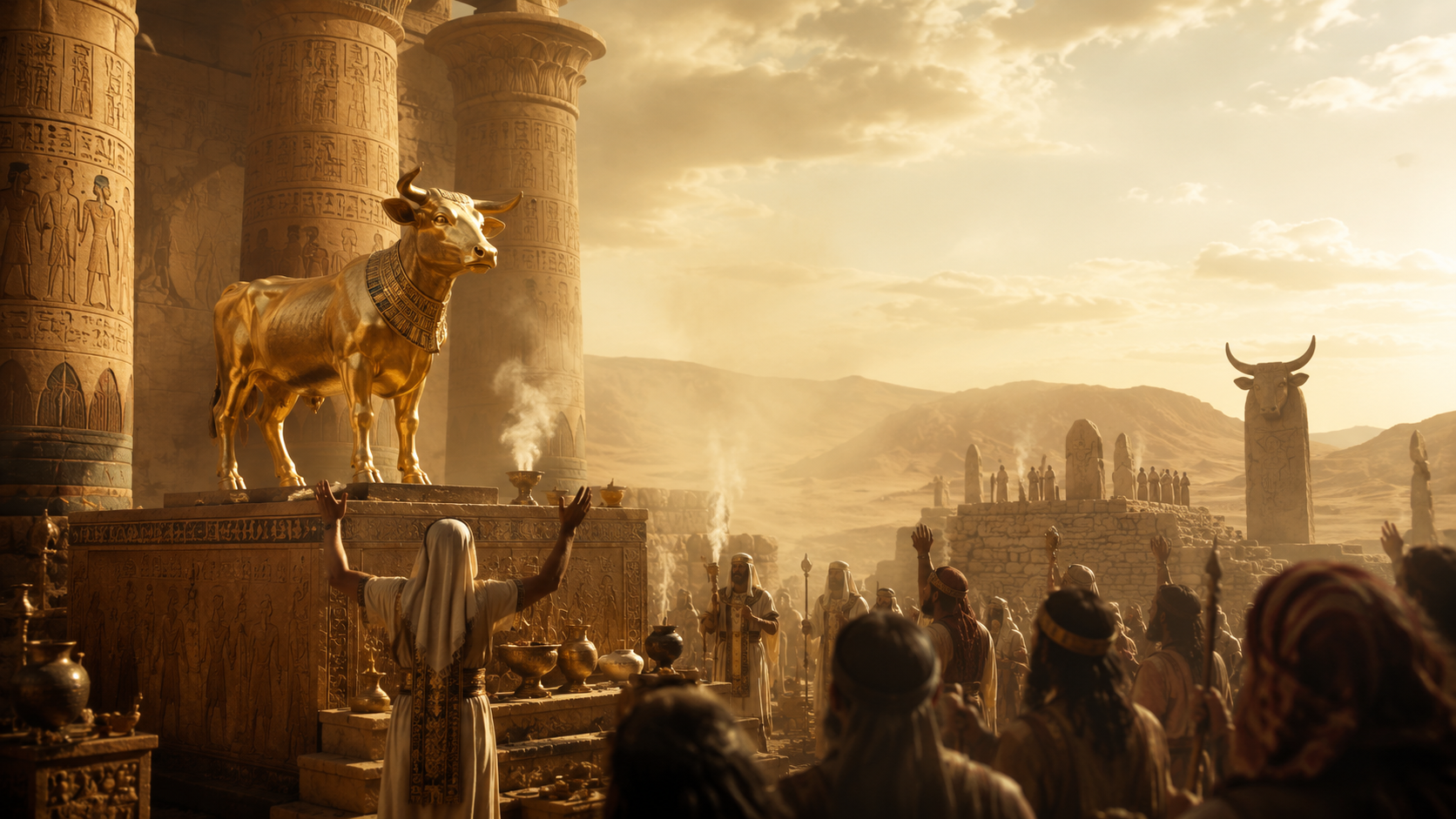
A golden calf was not a random choice of image. In the ancient Near East — and particularly in Egypt, where Israel had lived for four hundred years — the bull was one of the most powerful and pervasive symbols of divine strength, fertility, and power.
The Apis Bull (Hapi-Ankh) was the most important sacred animal in Egyptian religion — a living bull kept at Memphis, believed to be the incarnation of the god Ptah (the creator deity) and later associated with Osiris. The Apis bull was identified by specific markings, treated with full divine honours, and upon its death given a ceremonial burial in the Serapeum at Saqqara. The cult was so prominent that Saqqara contains sixty-four Apis bull burials spanning several dynasties — physical, archaeological evidence for a centuries-long cult of the divine bull.
The Mnevis Bull was similarly honoured at Heliopolis as an incarnation of the sun god Ra-Atum. The Buchis Bull was venerated at Hermonthis. Bull worship saturated Egyptian religious life at every level — from official state cult to popular household religion.
Israel had watched these bulls worshipped for four hundred years. They grew up in a culture where the bull was the most natural, most familiar, most culturally resonant image of divine power. When they asked Aaron for "gods who shall go before us," and Aaron made a golden calf, every person in the camp knew exactly what it meant and what religious vocabulary it was drawing on. They were reverting to the visual religious grammar of the culture from which YHWH had just delivered them.
This is the deepest irony of the golden calf: the gold used was from Egypt. The image made was Egyptian in form. The people had been physically delivered from Egypt but had not yet been spiritually delivered from the Egyptian theological framework within which they had been formed for four centuries. The Exodus brought them out of Egypt geographically. The wilderness was supposed to bring Egypt out of them spiritually. The golden calf reveals how far that second exodus still had to go.
Canaan — The Bull as Symbol of El and Baal
Beyond Egypt, the bull was also the primary symbol of the chief Canaanite deity El (often depicted as a seated elderly man, but with the epithet "Bull El") and of Baal, the storm and fertility god who was depicted riding a bull and sometimes represented as a bull himself. Extensive bull imagery has been found in Canaanite archaeological contexts — including a bronze bull figurine found at a Canaanite cultic site in the Samarian highlands (published by Amihai Mazar in 1982) that is often discussed in relation to Israelite bull imagery.
This means the golden calf was not merely a backwards glance toward Egypt. It was also a pre-figuring of the religious syncretism that would plague Israel throughout the period of the Judges and the Monarchy — the mixing of YHWH worship with bull imagery borrowed from Canaanite religion. And 1 Kings 12:26–30 makes the connection explicit: five hundred years after the golden calf at Sinai, Jeroboam makes two golden calves, places them at Bethel and Dan, and says exactly what Aaron said — the identical words: "Behold your gods, O Israel, who brought you up out of the land of Egypt." The act of the golden calf was not forgotten by Israel's history. It was repeated by Israel's kings.
What Happened Above: God's Response — Exodus 32:7–10
The most theologically charged conversation in the book of Exodus
Exodus 32:7–10 — God Informs Moses Before Moses Knows
Verses 7–8
"And the LORD said to Moses, 'Go down, for your people, whom you brought up out of the land of Egypt, have corrupted themselves. They have turned aside quickly from the way that I commanded them. They have made for themselves a golden calf and have worshipped it and sacrificed to it and said, "These are your gods, O Israel, who brought you up out of the land of Egypt!"
Hebrew Analysis — "Your People" and "Turned Aside Quickly"
lech-red ki shichet amcha — "go down, for your people have corrupted themselves." Notice the shift of ownership: God says "your people, whom you brought up." Earlier (Exodus 19:5) God called them "my people." In Exodus 3:10 God sent Moses to "my people." Now, in the moment of the golden calf, God distances Himself: your people. You brought them up. This is not God permanently disowning Israel — He will call them "my people" again. But the relational language has shifted to reflect the rupture.
saru maher min-haderech — "they have turned aside quickly from the way." The word maher (quickly, swiftly, soon) is emphatic. How quickly? Forty days after hearing the commandments from the fire of God's presence, they violated the first two commandments simultaneously. YHWH's comment on the speed — quickly, swiftly — suggests something like divine astonishment. Even given all YHWH knew about human nature, the speed of Israel's apostasy compressed more failure into less time than the sentence can quite accommodate.
Verses 9–10
"And the LORD said to Moses, 'I have seen this people, and behold, it is a stiff-necked people. Now therefore let me alone, that my wrath may burn hot against them and I may consume them, in order that I may make a great nation of you.'"
Hebrew Analysis — "Stiff-Necked" and "Let Me Alone"
am-ksheh-oref — "a stiff-necked people." Oref (the back of the neck) + ksheh (hard, stiff). The image is a work animal that refuses to respond to the yoke or the driver's guidance — it stiffens the neck and pulls against direction. The metaphor is agricultural: an ox whose neck is rigid cannot be guided, cannot be steered, cannot be used for the work it was made for. Israel, in refusing to be directed by YHWH's guidance — in stiffening against the yoke of the covenant — has become like an animal that cannot be worked with. This phrase will become one of the defining descriptions of Israel in the Old Testament, used repeatedly by Moses (Deuteronomy 9:6, 13) and by the prophets (Jeremiah 17:23).
hanicha li — "let me alone." This is one of the most remarkable things God says in the entire Old Testament. God is telling Moses to leave Him alone so that His wrath can operate without interference from Moses' intercession. The implication is stunning: Moses' intercession — which has not yet happened — is already anticipated as something that will affect what God does. God is, in essence, telling Moses what button to push. This is not God displaying weakness or being genuinely restrained by a human being. It is God displaying what prayer can do — placing on the table the extraordinary possibility that the intercession of the righteous has genuine effect on divine action.
"In order that I may make a great nation of you" — God offers Moses what He offered Abraham: to start over, to make Moses the new Abraham, to found a new people from Moses' lineage. This offer is designed to reveal what Moses is made of. Will he take it?

Moses' Intercession: Exodus 32:11–14
The greatest act of selfless prayer in the Old Testament — and the three arguments Moses makes
"But Moses implored the LORD his God and said, 'O LORD, why does your wrath burn hot against your people, whom you have brought out of the land of Egypt with great power and with a mighty hand?'"
Exodus 32:11
Moses does not take the offer. God has just told him: let me destroy Israel and make a great nation from you. And Moses' response is not gratitude for the opportunity. It is not even a moment's hesitation. It is immediate, passionate intercession for the people who are dancing around a calf forty days after hearing God's voice.
Moses makes three distinct arguments to God in these four verses. Each one is worth examining as a model of intercessory prayer — because together they represent the most powerful, most theologically sophisticated prayer in the Old Testament before the prophets.
Argument One — Ownership: "Your People, Whom You Have Brought Out" (v.11)
Moses immediately reverses the ownership language God had used. God said "your people, whom you brought up." Moses says "your people, whom you have brought out of the land of Egypt with great power and with a mighty hand." This is not merely a rhetorical correction. It is a theological argument. Moses is saying: You cannot call them my people now because they failed — they are your people. You brought them out. You chose them. You made the covenant. The failure of the human partner does not dissolve the ownership of the divine partner.
This is the boldness of biblical intercession: Moses is appealing not to Israel's merit (which is non-existent at this moment) but to God's own investment. What You have done, You will not abandon. What You have paid for, You will not waste. The argument is not about Israel's worthiness — it is about God's consistency with His own prior actions.
Argument Two — Reputation: "Why Should the Egyptians Say..." (v.12)
"Why should the Egyptians say, 'With evil intent did he bring them out, to kill them in the mountains and to consume them from the face of the earth'? Turn from your burning anger and relent from this disaster against your people."
Moses appeals to God's reputation among the nations. The destruction of Israel at the foot of Sinai — the annihilation of the people God had spectacularly rescued from Egypt — would be interpreted by every surrounding nation as either divine incompetence (He couldn't do the job He started) or divine malice (He brought them out only to destroy them). Either interpretation would be a desecration of the Name that Moses has just been commanded to protect.
This argument is not Moses telling God to care about His reputation for ego-protective reasons. It is Moses appealing to the missional purpose of the Exodus — that YHWH's rescue of Israel was intended to demonstrate His character to the nations. If Israel is destroyed, the demonstration collapses. The nations who were supposed to see what YHWH is like through the Exodus would instead see a God who rescues people from slavery and then slaughters them in the wilderness. This is not who YHWH is. And Moses is calling God to act consistently with who He actually is.
Argument Three — Covenant: "Remember Abraham, Isaac, and Israel" (v.13)
"Remember Abraham, Isaac, and Israel, your servants, to whom you swore by your own self, and said to them, 'I will multiply your offspring as the stars of heaven, and all this land that I have promised I will give to your offspring, and they shall inherit it forever.'"
The final and most powerful argument: the patriarchal promises. God swore to Abraham, Isaac, and Jacob. He swore by His own self — the strongest form of oath, binding His own nature and existence to the promise's fulfilment. The destruction of Israel at Sinai would mean the unilateral breaking of that oath. And God cannot be faithless to His own sworn word without being faithless to Himself.
Moses does not say: spare them because they deserve it. He says: spare them because You promised. The ground of intercession is not human merit but divine fidelity. The covenant made with the fathers is the anchor that holds even when the children have failed catastrophically. God's faithfulness to His promises is the last line of defence — and Moses knows it, and stands on it.
vayinachem YHWH al-hara'ah asher diber la'asot l'ammo — "And the LORD relented of the disaster that he had said he would do to his people." Exodus 32:14. The relenting happens here, in response to Moses' prayer, before Moses has even descended the mountain. This sequence is crucial and must not be glossed over. God had not irrevocably determined to destroy Israel. Moses' intercession genuinely changed what God did. We will examine the theology of divine relenting below — but first: notice what Moses did not do. He did not accept God's offer to become the new Abraham. He chose the people over his own legacy, his own family line, his own greatness. There is something specifically Christ-shaped about this choice — and we will return to it.
God Relents — The Theology of Divine Nacham
Hebrew Word Study — Nacham (נָחַם) — Relent/Repent/Be Moved to Pity
The word nacham — translated "relented" in most modern translations, "repented" in the KJV — is one of the most theologically significant and most frequently misunderstood words in the Hebrew Bible. It appears in two seemingly contradictory contexts:
Numbers 23:19: "God is not man, that he should lie, or a son of man, that he should change his mind (yinnachem). Has he said, and will he not do it? Or has he spoken, and will he not fulfil it?" God does not change His mind.
Exodus 32:14: "And the LORD relented (vayinachem) of the disaster that he had said he would do to his people." God changed His mind — or relented — in response to Moses' prayer.
How do we hold these two together? The resolution lies in the different kinds of divine statements. God's unconditional promises (to Abraham, to David, the gospel promises in Christ) are immutable — He does not change His mind about these. His conditional announcements of judgment — "I will destroy them unless..." — are expressions of what will happen if nothing changes, not sealed irrevocable decrees. When Moses prays, something changes. Not God's character. Not God's ultimate purposes. But the specific expression of His will in a specific situation.
The early Fathers and later Reformed theology described this as God "accommodating" to the human framework — speaking within the relational structure of prayer as a genuine dialogue partner, not as an immovable automaton. The model of prayer that nacham establishes is: prayer is not rearranging a predetermined universe. It is a genuine conversation with the living God whose will responds — within the infinite wisdom of His purposes — to the prayers of His people.
The Descent and the Broken Tablets: Exodus 32:15–20
Why Moses broke the writing of God — and what it meant
The Tablets — What They Were
Exodus 32:15–16 describes the tablets in detail that is often rushed past: "The tablets were the work of God, and the writing was the writing of God, engraved on the tablets." The tablets were not produced by Moses. They were not even produced by the artisan Bezalel, who would later craft the Tabernacle's furnishings. The tablets were made by God. The writing on them was written by God. Every letter of the Decalogue was engraved directly by the divine finger (Exodus 31:18: "tablets of stone, written with the finger of God").
Moses threw these tablets — the work of God, the writing of God — and broke them. This was not an accident or an involuntary act of rage. It was a deliberate, intentional, theologically loaded action performed in front of the entire community.
Verse 19
"And as soon as Moses came near the camp and saw the calf and the dancing, his anger burned hot, and he threw the tablets out of his hands and broke them at the foot of the mountain."
Why Moses Broke the Tablets — Three Interpretations
1. The Rabbinic Interpretation — Judicial Mercy: The majority of rabbinic interpretation reads the breaking of the tablets as an act of legal protection for Israel. If Moses had presented the covenant document to the people in their current state — while they were actively violating its first two commandments — the full force of the covenant's curse clauses would immediately have fallen on them. By breaking the tablets before presenting them, Moses invalidated the documentary evidence of the covenant violation. It is as if a lawyer destroyed the contract before a client who was in breach could be formally charged under it.
2. The Symbolic Interpretation — The Covenant Is Already Broken: The tablets were the physical embodiment of the covenant. Israel had already broken the covenant with the golden calf. Moses' physical act of breaking the tablets was a dramatic, public enactment of the theological reality: the covenant Israel had sworn at Sinai ("all that the LORD has spoken, we will do") was already broken by Israel's own action. Moses was not breaking the covenant. He was visually displaying the covenant that Israel had already broken.
3. The Prophetic Interpretation — Divine Wrath Enacted: Some commentators read the breaking as an expression of appropriate righteous anger — Moses channelling the divine wrath that had burned on the mountain against the visible evidence of Israel's apostasy. His anger that burned hot when he saw the calf is described in the same terms as YHWH's wrath burning hot against the people (verse 10). The breaking of the tablets is Moses embodying the divine response, making it visible, forcing Israel to see in physical form what their action had done to their relationship with God.
None of these interpretations is mutually exclusive. The richness of the act is that all three may be simultaneously true.
What Moses Did to the Calf — and Why
Exodus 32:20 — The Destruction of the Idol
"And he took the calf that they had made and burned it with fire and ground it to powder and scattered it on the water and made the people of Israel drink it."
This four-stage destruction is methodical and theologically intentional. Moses burned the calf (reducing it from solid to ash), ground it to powder (further reducing it), scattered it on water (dispersing it so it could not be reassembled), and made the people drink it. The ingestion of the ground-up idol has several possible resonances:
It recalls the "bitter water" ordeal of Numbers 5:11–31, where a suspected adulteress drank bitter water that would make her sick if guilty — the golden calf apostasy being precisely spiritual adultery against YHWH. It also forces the people to physically ingest the evidence of their sin — they cannot pretend it is separate from them. They consumed Egypt. Egypt is now inside them. They must now confront what they chose.
The total destruction of the idol — burned, ground, scattered, swallowed — leaves nothing remaining. The god they made does not survive contact with the man who had been with the real God. The calf that was supposed to go before them is now inside them in the most undignified form imaginable: dissolved in water and drunk.
The Levites, the 3,000, and the Second Intercession
Exodus 32:25–35 — the judgment that fell, and Moses' most extraordinary offer
The Levites' Action — Exodus 32:25–29
After destroying the calf, Moses stood in the gate of the camp and said: "Who is on the LORD's side? Come to me." And all the sons of Levi gathered to him. And Moses said to them: "Thus says the LORD God of Israel, 'Put your sword on your side each of you, and go to and fro from gate to gate throughout the camp, and each of you kill his brother and his companion and his neighbour.'"
Three thousand people died that day. The Levites executed the judgment on the most flagrant and unrepentant violators — not indiscriminately killing everyone in the camp (YHWH had already relented from consuming the whole people), but carrying out a proportional judicial action against those who had most actively led and sustained the apostasy.
The willingness of the Levites to act — even against family members — is the basis of Moses' declaration in verse 29: "Today you have been ordained for the service of the LORD, each one at the cost of his son and of his brother, so that he might bestow a blessing upon you this day." The Levites' consecration to priestly service in Israel is directly rooted in their faithfulness at the moment of the golden calf. The tribe chosen to stand between Israel and YHWH in worship was the tribe that stood on YHWH's side when it cost them dearly.
Moses' Second Intercession — The Most Extraordinary Verse in the Chapter
Exodus 32:30–32: "The next day Moses said to the people, 'You have sinned a great sin. And now I will go up to the LORD; perhaps I can make atonement for your sin.' So Moses returned to the LORD and said, 'Alas, this people has sinned a great sin. They have made for themselves gods of gold. But now, if you will forgive their sin — but if not, please blot me out of your book that you have written.'"
u'im-ayin m'cheni na misifrecha asher katavta — "but if not, please blot me out of your book that you have written." Moses is offering to be erased — to lose his place in God's covenant record, to forfeit his own standing before God — in exchange for Israel's forgiveness. He does not know what "the book" contains. He does not know if this offer is even possible. He simply places himself on the table: if someone must be blotted out, let it be me, not them.
This is the high-water mark of intercession in the entire Old Testament — a man standing before God and offering to trade his own eternal standing for the forgiveness of people who have just spectacularly failed. Paul echoes it directly in Romans 9:3: "I could wish that I myself were accursed and cut off from Christ for the sake of my brothers, my kinsmen according to the flesh." Moses is the model for this kind of intercession. And there is only one in human history who fully enacted what Moses only offered: the One who was actually blotted out — who was actually cut off — so that the people He interceded for could be written in.
Did You Know — God's Response to Moses' Offer
Exodus 32:33–34: "But the LORD said to Moses, 'Whoever has sinned against me, I will blot out of my book. But now go, lead the people to the place about which I have spoken to you; behold, my angel goes before you. Nevertheless, in the day when I visit, I will visit their sin upon them.'"
God declines the offer. He does not accept Moses as a substitute. The principle He articulates — "whoever has sinned against me, I will blot out of my book" — is the principle of individual accountability that underlies all of biblical justice. Each person is accountable for their own sin. Moses cannot carry another person's guilt, cannot substitute his own record for another's. Only One can do that — and Moses is not that One.
But God does not destroy Israel. He leads them. He sends His angel before them. He postpones rather than cancels the reckoning — "in the day when I visit, I will visit their sin" — a statement that opens a long arc of deferred judgment that stretches through the rest of the wilderness narrative and into the prophets. God is with His people. Still. After the calf. After the 3,000. After the broken tablets. He is still walking with them toward the promised land. This is the mercy that Moses will encounter in Exodus 34 as the fullest disclosure of divine character: the LORD, a God merciful and gracious, slow to anger and abounding in steadfast love and faithfulness, forgiving iniquity and transgression and sin.
The Tent of Meeting: Exodus 33 — After the Calf
The portable sanctuary, the withdrawal of divine presence, and what Israel learned from losing it
Exodus 33 is the aftermath of the golden calf — and one of the most theologically layered chapters in the entire book. It contains three distinct but interconnected developments: God's decision to send an angel instead of going Himself; Moses' negotiation with God for the restoration of His presence; and Moses' request to see God's glory — which leads directly to the renewal of the covenant in Exodus 34.
Exodus 33:1–5 — The Withdrawal of Presence
Verses 1–3
"Depart; go up from here... I will send an angel before you... but I will not go up among you, for you are a stiff-necked people, lest I consume you on the way."
The Withdrawal — A Punishment Worse Than Death
God offers Israel what seems like a reasonable arrangement: He will send an angel to drive out the Canaanites and deliver the land. Israel will get what they were promised — the land flowing with milk and honey. But God Himself will not go with them. He will stay back, send a representative, and let the angel do the work — because a stiff-necked people and a holy God in close proximity is a danger to the people.
Israel's response in verse 4 is extraordinary: "When the people heard this disastrous news, they mourned, and no one put on his ornaments." Losing the land would have been devastating. Losing God's presence is worse. The people who had asked for a god who would go before them now discover, in their mourning, that the only God who matters is the One who might not go with them. The removal of presence reveals what presence had meant. The threat of absence defines the value of company.
This is the spiritual dynamic that the golden calf has revealed: Israel did not understand what they had while they had it. The pillar of cloud and fire had become so familiar that they could contemplate replacing Moses — the human instrument of God's presence — with a golden calf. And now, when God threatens to withdraw Himself while still delivering the destination, Israel discovers that the destination without the Companion is no destination at all.
Verses 12–16
"Moses said to the LORD, 'If your presence will not go with me, do not bring us up from here. For how shall it be known that I have found favour in your sight, I and your people? Is it not in your going with us, so that we are distinct, I and your people, from every other people on the face of the earth?'"
Moses' Negotiation — The Most Honest Prayer in the Book
Moses makes what is perhaps his most transparent, most personally honest statement in the entire narrative. He tells God: if you don't go with us, we're not going. Not: if you don't give us the land. Not: if you don't guarantee our military victory. If you don't go with us personally — as Yourself, not as an angel — then the journey is not worth making.
u'mah yivadea eifoh ki-matzati chen b'eineicha ani v'amecha halo b'lech'techa imanu — "For how shall it be known that I have found favour in your sight, I and your people? Is it not in your going with us?" Moses has identified the one thing that makes Israel distinct from every other people on the face of the earth: not their military power, not their numbers, not their wisdom — YHWH going with them. Divine presence is Israel's defining characteristic. Without it, they are just another group of semi-nomads moving through the ancient Near East. With it, they are the people of the living God.
God responds: "This very thing that you have spoken I will do, for you have found favour in my sight, and I know you by name." The presence is restored. Not because Israel deserved it. Because Moses asked for it, and Moses had found favour, and God knew Moses by name. The restoration of divine presence after the golden calf comes entirely through the intercession of the one human being who had not participated in the apostasy.
The Tent of Meeting — A Theology of Accessible Presence
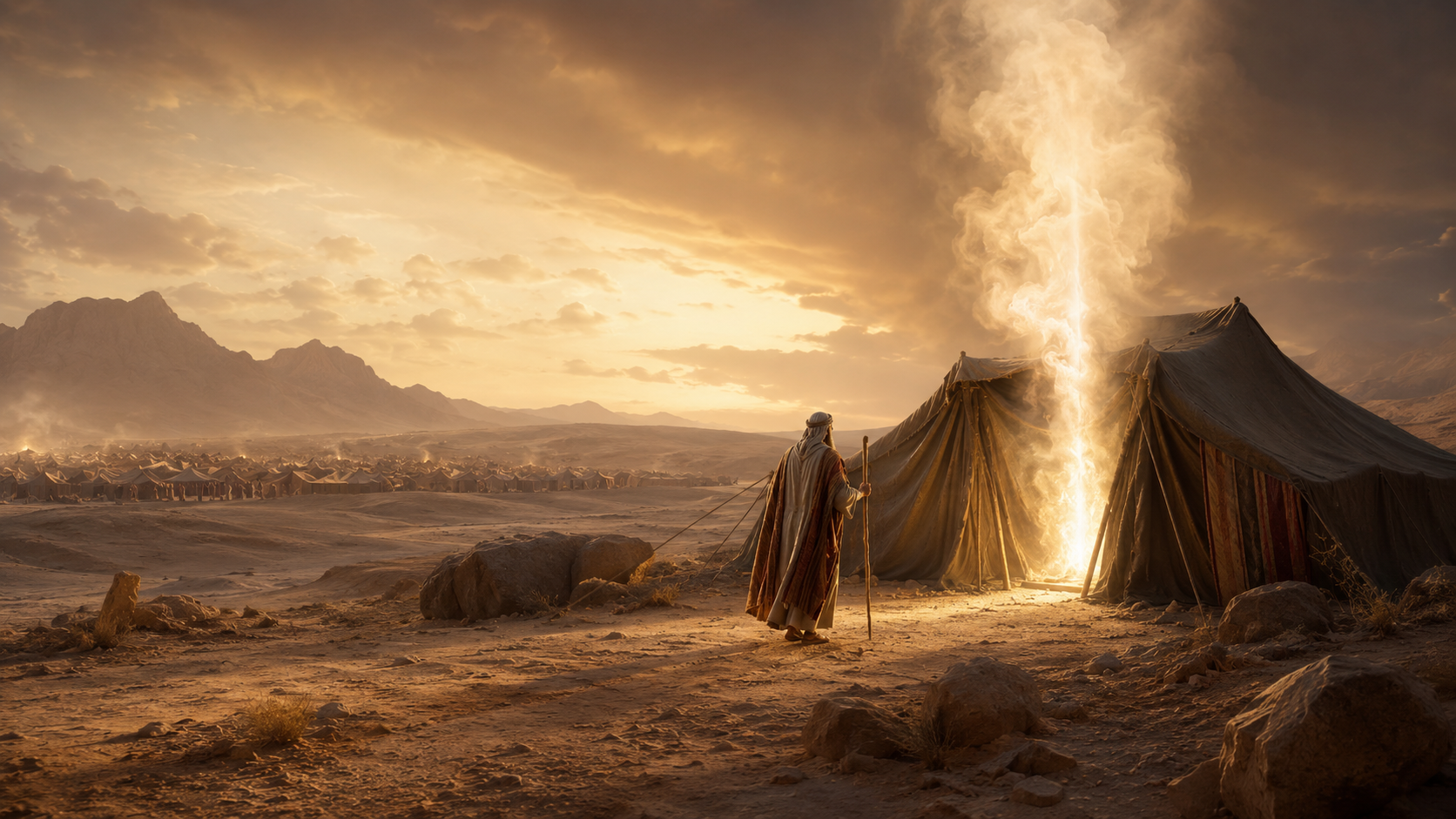
Exodus 33:7–11 describes the "tent of meeting" — a provisional worship structure distinct from the Tabernacle (which had not yet been built) — that Moses set up outside the camp. This tent was the place where Moses met with God during the interim period after the golden calf and before the Tabernacle's construction.
Verse 9: "When Moses entered the tent, the pillar of cloud would descend and stand at the entrance of the tent, and the LORD would speak with Moses." The cloud that had been above the whole camp now descended to the entrance of one tent, outside the camp, for the conversations between Moses and God.
Verse 11: "Thus the LORD used to speak to Moses face to face, as a man speaks to his friend." panim el-panim — face to face. This is the most intimate description of Moses' relationship with God in the entire Torah. At the burning bush, Moses hid his face. At Sinai, Moses entered the thick darkness. Here, after the worst failure in Israel's history, God speaks to Moses face to face, as a man speaks to his friend (re'a — the closest Hebrew word for intimate companion). The relationship between Moses and God, post-golden calf, is described as the most intimate relationship in the entire Old Testament. Failure did not permanently rupture the friendship. It revealed how deep the friendship was.
The Echo: Jeroboam's Golden Calves — 500 Years Later
1 Kings 12:26–30 — when the same sin, the same words, and the same images return
Did You Know — The Most Chilling Recurrence in Scripture
After the reign of Solomon, when the kingdom split in 931 BC, Jeroboam became the first king of the northern kingdom of Israel. He immediately faced a political problem: if his people kept going to Jerusalem to worship at the Temple (in the southern kingdom of Judah, his political rival Rehoboam's territory), their loyalty would drift southward. So Jeroboam developed a religious solution. 1 Kings 12:28–29:
"So the king took counsel and made two calves of gold. And he said to the people, 'You have gone up to Jerusalem long enough. Behold your gods, O Israel, who brought you up out of the land of Egypt.' And he set one in Bethel, and the other he put in Dan."
The exact words. "Behold your gods, O Israel, who brought you up out of the land of Egypt" — word for word, the identical declaration Aaron made at the foot of Sinai. Five hundred years later. Two golden calves, not one. Placed at the northern and southern extremities of the kingdom so the people would not need to travel to Jerusalem to worship.
This is not coincidence and it is not merely literary echo. The author of Kings is making a deliberate connection: Jeroboam's act is a recapitulation of Aaron's sin at Sinai. The same theological failure — the representation of YHWH through a bull image, the same vocabulary, the same combination of the divine name with a prohibited form. And just as the golden calf at Sinai became the defining moment of Israel's covenant failure, Jeroboam's calves become the defining sin that the books of Kings use to evaluate every subsequent northern king: "he did not depart from the sins of Jeroboam son of Nebat, which he made Israel to sin." Nineteen northern kings. Every single one is evaluated against Jeroboam's golden calves.
The sin of the golden calf did not stay at Sinai. It was institutionalised in the northern kingdom, repeated for two centuries, and ended only when the Assyrians destroyed the northern kingdom in 722 BC. What Aaron made at the foot of the mountain became the spiritual cancer that eventually killed a nation.
Christ Connection: The Intercessor, the Substitute, and the New Covenant After Failure
What the golden calf narrative points toward — and what it cannot reach
Moses' Offer to Be Blotted Out — Romans 9:3 and the Cross
Exodus 32:32: "But now, if you will forgive their sin — but if not, please blot me out of your book that you have written." Moses offers his own erasure — his own removal from the covenant record — as a substitute for the people's judgment. It is the most Christ-shaped moment in Moses' entire life. The structure is identical to the Atonement: an innocent person standing before God and offering to bear the consequence due to the guilty.
But God declines the offer: "Whoever has sinned against me, I will blot out of my book." Moses cannot substitute. The law of individual accountability prevents it. One human being cannot carry the guilt of another — not finally, not covenantally, not sufficiently. Moses can intercede, Moses can advocate, Moses can offer — but he cannot substitute.
Only One can. The One who was made sin who knew no sin (2 Corinthians 5:21). The One who was cursed so that the blessing of Abraham might come to the Gentiles (Galatians 3:13). The One who was blotted out — genuinely, on the cross, bearing the weight of the sin of the world — so that those who deserved to be blotted out could instead have their names written in the book of life. Moses offered what only Christ could accomplish. Moses pointed forward to the Intercessor who could not be refused — because He was also the Sacrifice.
Paul's Use of the Golden Calf — 1 Corinthians 10:6–7
Paul refers explicitly to the golden calf as a warning to the church in 1 Corinthians 10:6–7: "Now these things took place as examples for us, that we might not desire evil as they did. Do not be idolaters as some of them were; as it is written, 'The people sat down to eat and drink and rose up to play.'"
Paul is not treating the golden calf as ancient history. He is treating it as a contemporary warning. The specific pattern he highlights — eating and drinking followed by "play" (the sexual revelling) — maps onto the Corinthian church's own struggles with food offered to idols and with sexual immorality at worship gatherings. The golden calf is not merely Israel's failure. It is the template for any community that takes the grace of divine rescue and uses it as the occasion for the relaxation of holy standards.
The golden calf happened forty days after Sinai. It can happen forty days after conversion. It can happen forty days after any mountain-top spiritual experience. The distance between the encounter with holiness and the comfortable substitution of a golden calf for that encounter is always shorter than we think.
The New Covenant After Failure — Jeremiah 31 and Exodus 33
One of the most important things the golden calf narrative establishes is the pattern: the first covenant fails at the first opportunity, and God renews it anyway. The tablets are broken. God gives new tablets (Exodus 34). The covenant is broken by the people forty days after it was made. God reestablishes it in Exodus 34 with the revelation of His name and character: "The LORD, the LORD, a God merciful and gracious, slow to anger and abounding in steadfast love and faithfulness, keeping steadfast love for thousands, forgiving iniquity and transgression and sin."
This pattern — covenant failure followed by covenant renewal by divine initiative — is the structure of the entire Old Testament. And it is the structure that drives the prophets' expectation of a New Covenant (Jeremiah 31:31–34) in which the problem is addressed not merely by renewing the external covenant document but by addressing the internal source of the failure: "I will put my law within them, and I will write it on their hearts." Not new tablets. New hearts. The new covenant addresses the cause of the golden calf — the unreformed heart that reverts to familiar idolatry when the human mediator is absent — rather than merely reissuing the covenant that the unreformed heart will inevitably break again.
Jesus at the Last Supper (Luke 22:20): "This cup that is poured out for you is the new covenant in my blood." The new covenant that Jeremiah promised, that Moses was pointing toward from the moment he stood between Israel and divine wrath — established at last, in the body and blood of the One who could do what Moses offered to do, and actually accomplish it.

Devotional
Forty Days and the Calf We Build When God Goes Silent
Forty days.
That is how long it took the people who had heard God's voice from the fire to build a golden calf and declare it the god who had brought them out of Egypt. Forty days between the most overwhelming theophany in human history and the most catastrophic act of covenant betrayal in Israel's story. Six weeks from the mountain to the calf.
Before we judge Israel, we should ask ourselves: how long does it take us? How long from a powerful spiritual experience to the slow drift back toward the familiar substitutes for God? How long from the mountain-top retreat, the answered prayer, the genuine encounter with divine presence — to the creeping return of the golden calves we think we had left behind?
What is your golden calf? It is not necessarily something obviously sinful. Aaron's calf was made from legitimate gold, by a legitimate craftsman, with a declaration that it was a feast to the LORD. The golden calf does not usually look like outright rejection of God. It looks like a more manageable, more immediate, more emotionally accessible version of God — something you can see, something that responds to your shaping hand, something that feels less terrifyingly holy and more reliably comforting than the real thing.
It might be a theology that makes God smaller and less demanding than He is. A church community that substitutes warmth and belonging for the actual presence of the Holy One. A spiritual practice that feels devotional but never actually challenges or transforms. A version of Jesus constructed from the parts of Him you find comfortable and quietly excised of the parts that make you uncomfortable. Golden calves in the twenty-first century are rarely made of metal. They are made of selective theology, comfortable Christianity, and the chronic human preference for a god who makes no demands we haven't already agreed to.
The good news — the staggering, almost unbelievable good news — is what happens at the end of Exodus 32 and 33. God relents. God stays. God speaks to Moses face to face, as a man speaks to his friend, in the tent of meeting, after the worst failure in Israel's history. He does not abandon His people. He does not write them off. He walks with them toward the promised land — slowly, carefully, with the knowledge that they are stiff-necked and will fail again, and going anyway.
The mercy of God is not that He never sees the golden calf. It is that He sees it — sees all of it, the dancing, the declaring, the feast to the LORD that was a feast to the calf — and He keeps going. He relents. He renews. He writes new tablets. He offers His name again. He stays.

Reflection & Discussion Questions
Personal Reflection
1. The people said "this Moses, the man who brought us up out of Egypt — we do not know what has become of him." They had collapsed the Exodus onto the human instrument and lost sight of the divine reality behind it. Is there someone or something in your own spiritual life that functions as a channel of grace that you have confused with the source of grace? What would it look like to love the instrument without depending on it?
2. Aaron's sin was not outright paganism — it was offering YHWH worship through an explicitly prohibited form, using the divine name while violating the divine command. What are the golden calves of contemporary Christianity — the ways we use legitimate spiritual language while actually worshipping a version of God we have shaped to our own preferences? How do you distinguish between genuine worship and the worship of a calf we have named with the right words?
3.Moses, when offered the chance to become the new Abraham — to have Israel destroyed and a new nation made from him — immediately refused and interceded for the people instead. He chose the people over his own legacy. Is there a situation in your life where genuine love for others requires you to subordinate your own advancement, reputation, or comfort? What does Moses' refusal of the offer teach you about what intercession actually costs?
Deeper Study
4. Moses makes three arguments to God in Exodus 32:11–13: ownership (your people, not mine), reputation (what will Egypt say?), and covenant (you swore to Abraham). Which of these arguments strikes you as most powerful, and why? And what does the structure of Moses' intercession teach you about how to pray for others who have failed — what to appeal to, what not to appeal to?
5. God "relents" (nacham) in Exodus 32:14 in response to Moses' prayer. But Numbers 23:19 says "God is not man that he should change his mind (yinnachem)." How do you hold these two texts together? What does the theology of divine nacham — genuine divine responsiveness to prayer — teach you about the nature and purpose of intercessory prayer? Does it change how you pray?
6. Read 1 Kings 12:26–30 alongside Exodus 32. Jeroboam uses Aaron's exact words five hundred years later. What does this recurrence of the golden calf — institutionalised in the northern kingdom and used to evaluate every subsequent northern king — teach you about the long-range consequences of specific sins? Are there patterns in your own life, family, or community that function as institutionalised golden calves?
7. Read Moses' offer in Exodus 32:32 ("blot me out of your book") alongside Romans 9:3 (Paul's echo) and 2 Corinthians 5:21 (Christ "made to be sin"). What is the difference between what Moses offered and what Christ actually accomplished? Why could Moses not substitute for Israel in the way he offered — and why could Christ? How does this comparison deepen your understanding of the Atonement?

Closing Prayer
LORD, who saw the calf and relented —
We have walked through the worst forty days in the history of Your people. We have heard the thunder at Sinai, watched Moses go into the thick darkness, and then — six weeks later — watched the gold come off the ears and the calf come out of the fire. We have heard Aaron say "tomorrow shall be a feast to the LORD" and known, with the full weight of the text, what that feast actually was. We have seen the tablets break. We have watched 3,000 die.
We confess that we know this story from the inside. We know how it feels to have been on the mountain — to have heard, in some way, the voice from the fire — and to find ourselves, six weeks later, at the foot of a calf we shaped with our own hands, calling it by Your name. We confess the golden calves of our own construction: the theologies trimmed to our preferences, the Jesus assembled from the parts we found comfortable, the spiritual practices that feel devotional but never actually transform us.
We thank You for Moses. For the man who, when offered a way out — offered a legacy, a fresh start, a new people from his own lineage — said no. Who chose the people over himself. Who stood between wrath and Israel and argued with three arguments until You relented. Who offered his own name in exchange for theirs and could not accomplish it alone -- and pointed us forward, in that very failure, to the One who could.
We thank You for what Moses' offer pointed toward: the One who was actually blotted out. Who was actually made sin. Who was actually cut off from You on the cross so that the names of the people He interceded for could be written permanently in the book of life. The new covenant, not in tablets of stone but in His blood. The new heart You promised to Jeremiah, delivered at Pentecost, at work within us now.
Speak to us face to face, as a man speaks to his friend. As You spoke to Moses in the tent. After the calf. After the tablets. After everything. You stayed then. You stay now. Show us your glory work within us and remind us always to remember who you are, Our Lord , Our God. In the mighty name of Jesus, Amen.
Coming Next in the Series
Part Eighteen: Moses' Intercession — The Greatest Prayer of the Old Testament
After the golden calf, Moses asks God for one thing that goes beyond everything he has asked before: "Please show me your glory." And God says yes — partly. He hides Moses in the cleft of the rock, covers him with His hand, and passes by. Moses sees God's back. And what God declares in that passing — "The LORD, the LORD, a God merciful and gracious, slow to anger and abounding in steadfast love and faithfulness, forgiving iniquity and transgression and sin" — is the most complete self-disclosure of the divine character in the entire Old Testament. Part Eighteen examines this prayer, this answer, and what it means for every subsequent prayer made in Moses' name — and in the name of the One Moses was pointing toward.
Add comment
Comments