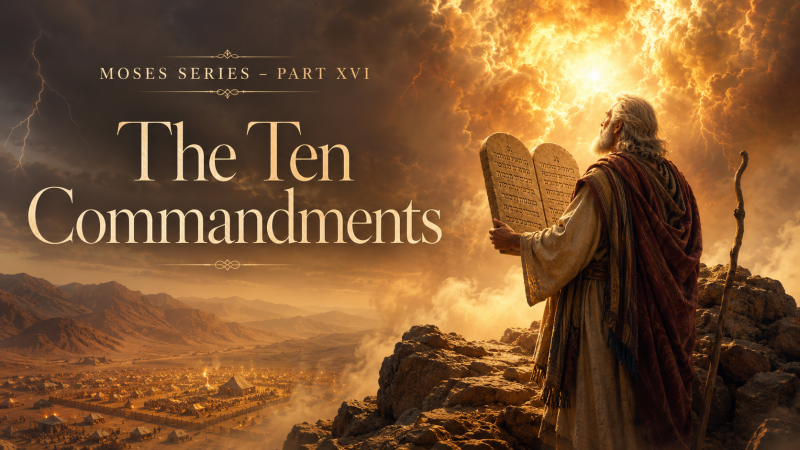
"I am the LORD your God, who brought you out of the land of Egypt, out of the house of slavery."
— Exodus 20:2
Before You Begin This Study
Part Sixteen is the deepest dive in the series so far — the Ten Commandments deserve nothing less. Please read the full Decalogue in both Exodus 20 and Deuteronomy 5 before beginning. They are not identical — the differences between them are theologically significant and we will examine them. Read both.
As you read, notice one thing above all: the Ten Commandments do not begin with a commandment. They begin with a declaration of identity. God identifies Himself and what He has done before He says a single word about what Israel must do. This sequence — grace before law, redemption before obligation — is the interpretive key to the entire Decalogue.
Exodus 20:1–17 Deuteronomy 5:6–21 Matthew 5:17–48 Romans 7:7–12 Mark 12:28–34
Optional deeper reading:
Deuteronomy 6:4–9 (the Shema — the daily Jewish confession arising from Commandment 1);
Psalm 19:7–11 (the great Psalm of love for the Torah);
Matthew 22:34–40 (Jesus summarising the whole law in two commandments);
Romans 13:8–10 (Paul's summary: love fulfils the law);
Galatians 3:24 (the law as a guardian/tutor pointing to Christ).
Exodus 20:1-6
Exodus 20:7-12
Exodus 20:13-17
Deuteronomy 5:6-10
Deuteronomy 5:11-15
Deuteronomy 5:16-21
MATTHEW 5:17–26
MATTHEW 5:27-37
MATTHEW 5:38-48
Romans 7:7-8
Romans 7:9-12

The Story
The Words That Shaped the World
The mountain was still burning. And God spoke.
The Morning the Law Was Given
The ground was still trembling beneath their feet. The mountain was still wrapped in smoke. The trumpet that had grown louder and louder was still reverberating through the valley. And then, out of all of it — out of the fire and the darkness and the sound and the shaking — God spoke.
Not to Moses alone. Not through Moses. Directly. To everyone. To the whole assembly. Two million people standing at the foot of the burning mountain, and God speaking in a voice that somehow reached them all at once. Deuteronomy 4:33:"Did any people ever hear the voice of a god speaking out of the midst of the fire, as you have heard, and still live?"
And what He said first was not a command. It was His name, and His résumé.
"I am the LORD your God, who brought you out of the land of Egypt, out of the house of slavery."
That is the first sentence. Everything else follows from it. The I AM who spoke to Moses at the burning bush — the God who had no beginning and needs no origin — is your God. Not a God. Yours. And here is the evidence of the relationship: I brought you out. Not you managed to escape. Not you were fortunate enough to get away. I brought you. Out of Egypt. Out of the house of slavery. The covenant offer began at Sinai with what God had already done. The law begins the same way. I am who I am. You are who I made you. Everything I am about to say is said to people who are already mine.
And then the ten words came. Not ten laws in the abstract. Ten words spoken by the God who had just done the impossible, spoken to people who had watched Him do it, spoken out of fire to people who had been told not to approach the fire on pain of death. The commands of the holy God came wrapped in the context of His holiness — the smoke was still rising, the ground was still moving, the trumpet was still fading — so that no one who heard them that morning could possibly mistake them for civic regulations or cultural customs. These were the words of the God who burned without consuming. They came from the mountain. They cost everything to approach. And they were worth everything that approach had cost.
When they heard the voice — the thunder that was also language, the fire that was also word — the people backed away. Even these ten words, spoken in the most carefully prepared moment of divine disclosure in all of history, were more than human beings at the foot of a burning mountain could sustain. They begged Moses to mediate. Moses went into the thick darkness. And the words that had been spoken continued to reverberate through the whole history of human civilization — through the lips of every prophet, the pens of every law-maker, the consciences of billions of people who would never hear the thunder or see the fire, but who would nonetheless find themselves inexplicably unable to shake the weight of what was spoken on that morning.
The Ten Commandments did not stay on the mountain. They walked down with Moses in his hands, carved in stone. But they had been carved in something deeper first — in the moral architecture of a universe whose Maker had just spoken His character as law to the people He called His own.
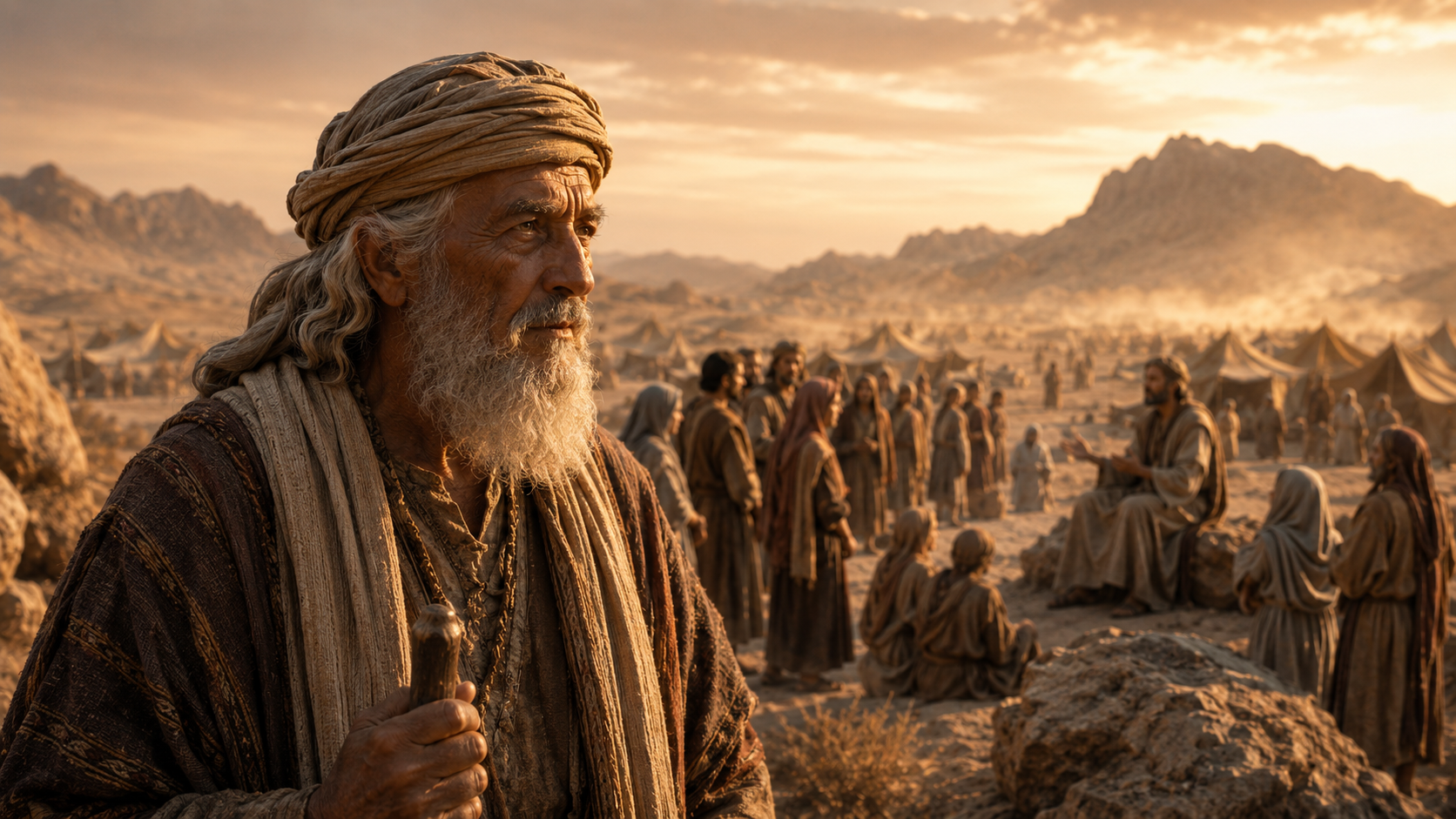
Moses
The Words were about to shape the world, but Moses has to walk on with millions watching and relying on him to deliver it.
THE BREAKING
Before the first word is ever carved into stone, Moses is already operating on the ragged edge of a psychological breakdown. Consider where this man has been. For forty years, he was a coddled prince of Egypt, drowning in luxury but fractured by an identity crisis—knowing he was a Hebrew but wearing the linen of the oppressor. Then, a murder. A panicked flight.
He spends the next forty years in absolute, deadening silence, tending sheep in the barren wastes of Midian. He became a man of the quiet. A man comfortable with isolation.
Then, the bush burns, and overnight, the quiet is shattered.
Suddenly, this eighty-year-old shepherd is thrust into the epicenter of a chaotic, screaming mass of two million highly traumatized, recently liberated slaves. He isn’t just their general; he is their everything. In Exodus 18, right before they hit the base of Sinai, we catch a glimpse of his daily reality: Moses sitting from sunup to sundown, absorbing the bitter disputes, the generational trauma, the petty complaints, and the heavy grief of millions. He is a one-man judicial system for an entire nation. His father-in-law, Jethro, takes one look at him and gives a blunt, terrifying diagnostic: "You will surely wear yourself out... The work is too heavy for you; you cannot handle it alone."
Moses is experiencing acute, chronic leadership burnout. His nervous system is completely fried.
And then, God tells him to climb the mountain.
As the mountain begins to smoke like a kiln, and the supernatural shofar blast grows deafeningly loud, the people draw back in sheer terror. They scream to Moses, "Speak to us yourself... but do not let God speak to us, or we will die!"
Think of the crushing weight of that isolation. The people get to retreat. The people get to stand at a safe distance. But Moses? Moses is forced to step into the thick darkness where God is. He is the fragile, trembling bridge balancing between a consuming fire and a hyper-reactive, terrified populace. He has no peers. He has no inner circle who understands the weight. He is utterly, terrifyingly alone in his bracket of responsibility, carrying the burdens of millions up a shaking mountain.
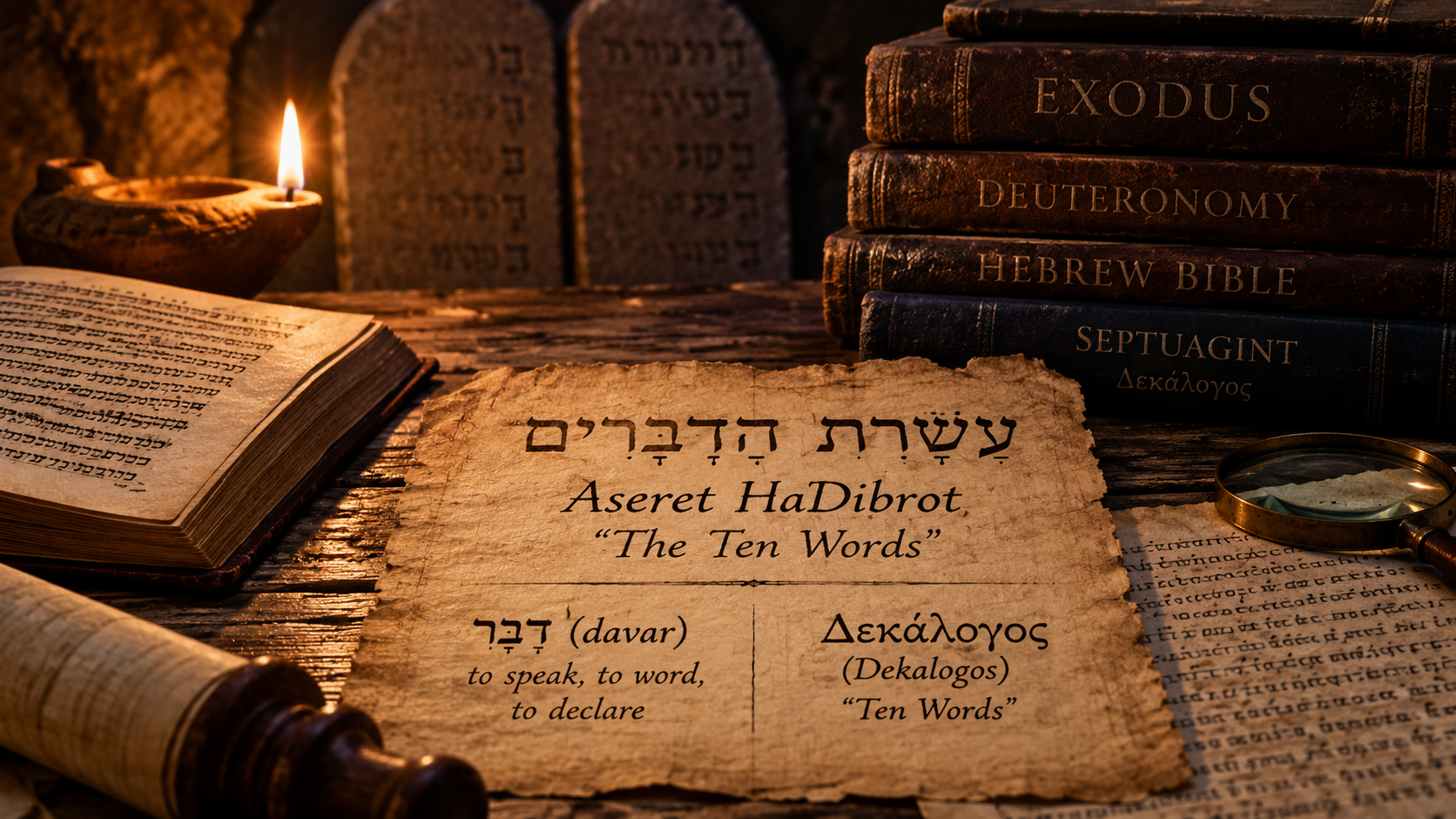
What Are They Actually Called? — "The Ten Words"
The first thing most people don't know about the Ten Commandments
The phrase "Ten Commandments" does not appear in Exodus 20. The text that contains the Decalogue never calls them "commandments." The Hebrew Bible uses a different term entirely.
Hebrew Word Study — Aseret HaDibrot (עֲשֶׂרֶת הַדְּבָרִים)
The technical Hebrew term for what we call the "Ten Commandments" is Aseret HaDibrot — "the Ten Words" or "the Ten Utterances." The word dibrot comes from the root davar — to speak, to word, to declare. A davar is not primarily a command or a law — it is a spoken word, a declaration, an utterance.
The Greek equivalent, used in the Septuagint and in scholarly literature, is Dekalogos — "ten words" — from which we get our English word "Decalogue." This too means ten words, not ten laws.
Why does this matter? Because calling them "ten words" rather than "ten commandments" fundamentally reframes what they are. Words proceed from a person. Laws proceed from a system. A word reveals the character of the speaker. A law reveals the requirements of an institution. The Ten Commandments are first and foremost a self-disclosure — God speaking His own character as the shape of His people's lives. The commands are what they are because they express who God is, not because a legislative body determined them to be useful social regulations.
Exodus 34:28 uses the term explicitly: "And he wrote on the tablets the words of the covenant, the ten words (aseret hadvarim)." Deuteronomy 4:13: "And he declared to you his covenant, which he commanded you to perform, that is, the ten words (aseret hadvarim)." In both cases: ten words, not ten commandments. The traditional English translation "Ten Commandments" comes from the Latin Decem Praecepta (ten precepts) used in early Latin Christianity — a translation of Dekalogos that emphasised the legal/imperative character over the declarative/revelatory character.
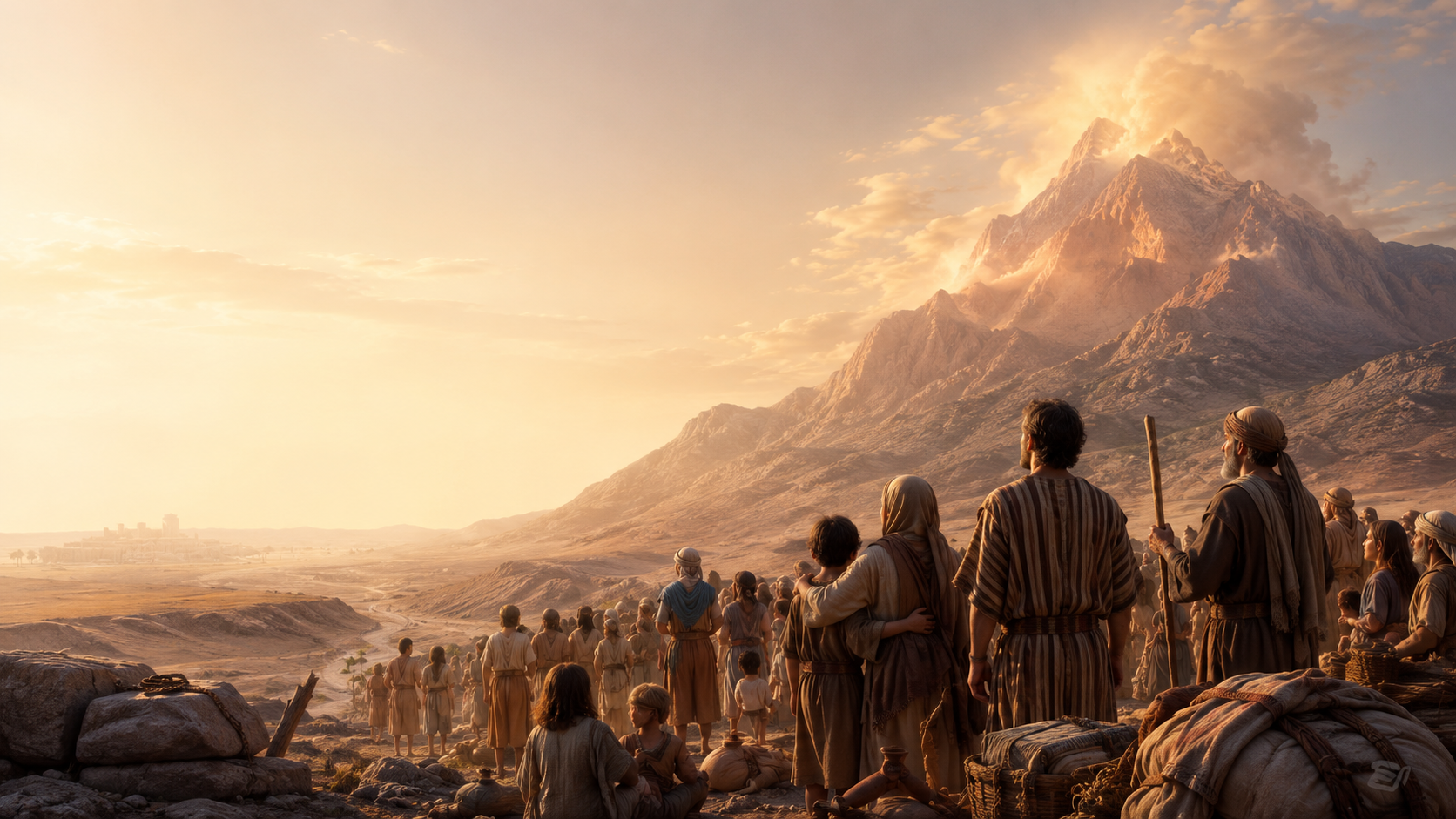
The Prologue: Exodus 20:2 — The Most Important Non-Commandment
Before the first command, a declaration of identity that changes everything
"I am the LORD your God, who brought you out of the land of Egypt, out of the house of slavery."
Exodus 20:2
Exodus 20:2 is not a commandment. It makes no demand. It issues no prohibition. It contains no imperative verb. It is a pure declaration — God identifying Himself by His personal name and His saving act before He says a single word about how His people should live.
This is the prologue to the entire Decalogue, and its placement is the most theologically significant structural feature of the Ten Commandments. Everything that follows — every "you shall" and every "you shall not" — is addressed to people who have already been defined by this verse. You are not people trying to earn the relationship through compliance. You are people who have already been brought out. The law is the shape of life for the already-redeemed, not the mechanism of becoming redeemed.
Hebrew Analysis — Every Word of the Prologue
Anoki — "I." The emphatic first-person pronoun — not the common ani but the stronger anoki, which insists on personal presence. This is not an announcement from an absent legislative authority. The speaker is present, personal, immediate. The law comes from an "I" who is here.
YHWH — the Tetragrammaton — the divine personal name revealed at the burning bush (Exodus 3:14 — Ehyeh asher ehyeh — I AM who I AM). This is not "the divine," not "the Almighty," not a title. It is a name. The personal name of the God who entered into a specific relationship with a specific people. The law comes from the One who has a name you can call.
Eloheicha — "your God." The possessive second-person singular suffix — "your," directed at each Israelite individually. Not "the God of Israel" in the abstract. Your God. Each person addressed personally, individually, directly. The law is not civic code. It is covenant obligation between persons who know each other by name.
asher hotzeitecha me'eretz Mitzrayim — "who brought you out of the land of Egypt." The participle hotzi (to bring out, to cause to go out) describes God as the one who performed the action. Israel did not escape. Israel was brought out. The passive-recipient character of the Exodus is embedded in the grammatical structure of the Decalogue's first sentence. Everything follows from what God did, not from what Israel achieved.
mibet avadim — "from the house of slavery." Eved (slave, servant) — the word used throughout Exodus for Israel's condition under Pharaoh. And now here in the opening of the law: you are not slaves. You were slaves. Now you are free people who serve a different master — not from compulsion but from covenant. The law is the charter of your freedom, not the terms of your captivity.
Did You Know — The Prologue as the "First Commandment" in Jewish Tradition
In the traditional Jewish numbering of the Decalogue, Exodus 20:2 — the prologue, the self-identification of God — is counted as the First Commandment. Not "you shall have no other gods" (which Jewish tradition counts as the Second). The First Commandment is simply: "I am the LORD your God."
This is an extraordinary interpretive decision. The "command" of the First Commandment, in Jewish understanding, is the command to believe — to acknowledge the existence and identity of this God. The obligation to believe in and know YHWH is itself a commandment, not merely a preamble to the commandments. This shapes the entire structure of Jewish law: the foundation is not prohibition or obligation but relationship — I am your God. Everything else is commentary.
It also means that in Jewish theology, the first and most fundamental failure of faith is not the breaking of a specific rule but the denial of the relationship itself. The deepest sin is not breaking commandments 2–10. It is forgetting or denying Commandment 1: I am the LORD your God.
Structure: Two Tablets, Two Directions
The architecture of the Decalogue — and why it matters
The Ten Commandments were written on two tablets of stone. The text does not tell us which commandments appeared on which tablet — this has been debated in Christian theology for centuries. But the most natural and widely held understanding divides the Decalogue into two groups based on their focus.
Tablet One — Commands Directed Toward God (Vertical Relationship)
Commands 1–4 (in the most common Protestant numbering): No other gods. No idols. Do not misuse the name. Keep the Sabbath. These four commands define Israel's relationship with YHWH — the exclusivity of worship, the prohibition of image-making, the holiness of the divine name, and the sacred rhythm of the week.
Jesus summarised these in what He called the "first and greatest commandment": "You shall love the Lord your God with all your heart and with all your soul and with all your mind" (Matthew 22:37–38, quoting Deuteronomy 6:5). The first tablet is the vertical relationship — the complete and undivided orientation of the whole person toward God.
Tablet Two — Commands Directed Toward Others (Horizontal Relationship)
Commands 5–10: Honour your parents. Do not murder. Do not commit adultery. Do not steal. Do not give false testimony. Do not covet. These six commands define Israel's relationship with the community — the family, the neighbour, the property and life and reputation of others.
Jesus summarised these in what He called "the second" commandment, like the first: "You shall love your neighbour as yourself" (Matthew 22:39, quoting Leviticus 19:18). The second tablet is the horizontal relationship — the complete and undivided orientation of the whole person toward the other.
"On these two commandments depend all the Law and the Prophets" (Matthew 22:40). The entire Decalogue — and through it, the entire Torah — hangs on this two-tablet structure of vertical love toward God and horizontal love toward neighbour.
| The Commandment (Exodus 20) | The Ancient Israelite Context | The New Testament Expansion | The Heart Transformation |
|---|---|---|---|
| No other gods before Me | Absolute, exclusive loyalty to YHWH over the pagan deities of Egypt and Canaan. | Matthew 6:24 – Jesus exposes our modern, polite idols: "You cannot serve both God and Money." | Shifting our ultimate trust from material security and self-preservation to divine provision. |
| No graven images/idols | Refusing to reduce, domesticate, or represent the Creator in physical, controllable forms. | John 4:24 / Colossians 1:15 – God is spirit; Jesus is the ultimate, living, visible image of the invisible God. | Ceasing our attempts to construct God in our own cultural, comfortable image. |
| Do not take the Name in vain | Prohibiting false oaths, perjury, or using God’s holy name for magical manipulation or personal gain. | Matthew 5:34-37 – "Do not swear oaths at all... Let your 'Yes' be 'Yes'." Also bearing the name of Christ worthily. | Total integrity of speech; dismantling the gap between our external religious profession and internal character. |
| Remember the Sabbath day | Ceasing from all economic labor to honor creation, celebrate freedom, and trust God's provision. | Mark 2:27 / Matthew 11:28 – "The Sabbath was made for man." Jesus invites us into Himself as our permanent, living rest. | Trading the exhausting, performance-driven cycle of self-justification for radical rest in Christ's finished work. |
| Honor father and mother | Actively providing elder care, financial support, and societal stability for aging parents. | Mark 7:9-13 – Jesus fiercely rebukes religious leaders who use theological loopholes (Corban) to avoid supporting their parents. | Elevating family and relational responsibility as an active, structural expression of spiritual devotion. |
| You shall not murder | Prohibiting the unauthorized, illegal taking of a human life within the community. | Matthew 5:21-22 / 1 John 3:15 – Anyone who harbors unchecked, bitter anger or contempt has already murdered in their heart. | Dismantling malice, hidden grudges, and systemic dehumanization at the silent thought level. |
| You shall not commit adultery | Guarding the sacred covenant of marriage and protecting the foundational family unit. | Matthew 5:27-28 – Cultivating a lustful gaze or viewing another image-bearer as a disposable object is heart-adultery. | Radical purity of intention; protecting the sacred dignity of the other person even in the secret spaces of the mind. |
| You shall not steal | Respecting the property of others and strictly protecting individuals from kidnapping and exploitation. | Ephesians 4:28 – Stop stealing; instead, work hard so you have something to share with those in genuine need. | Moving from a mindset of absolute scarcity (taking to survive) to radical kingdom generosity (giving to bless). |
| No false witness | Absolute truthfulness in legal testimony, protecting the innocent from community corruption. | Ephesians 4:25 / James 3 – Putting off falsehood, speaking absolute truth, and taming the tongue's destructive power. | Actively protecting our neighbor's reputation and honoring absolute reality over convenient lies. |
| You shall not covet | Legislate the interior desires, forbidding the toxic envy of a neighbor’s life, status, or possessions. | Luke 12:15 / Philippians 4:11 – Guarding against all greed; mastering the supernatural discipline of holy contentment. | Shifting the soul's focus from what we lack to profound gratitude for what God has sovereignly allocated. |
Did You Know — The Two Tablets Were Not a Split
Ancient Near Eastern treaty documents — particularly the suzerainty treaties between a great king and a vassal people — were written in two copies: one for the great king's archive and one for the vassal's. Both copies were kept together in the vassal's sanctuary before the deity who witnessed the covenant.
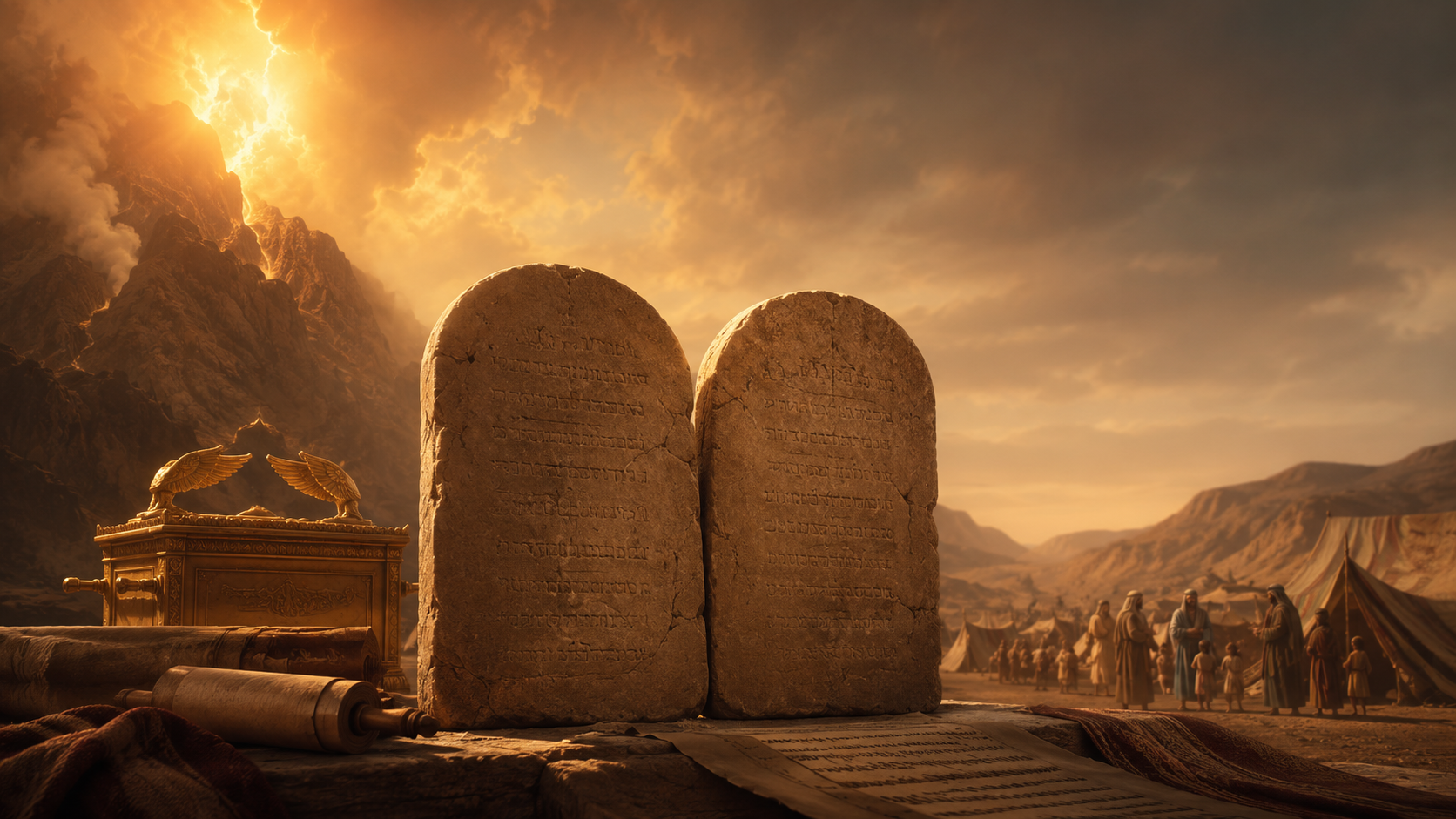
This means the two tablets of the Decalogue were likely not "tablet one/commands 1–4" and "tablet two/commands 5–10" — both tablets may have contained the complete text of the covenant. One copy for God (stored in the Ark — which was placed in the Holy of Holies, God's dwelling) and one copy for Israel (also stored in the Ark — the same Ark, in God's dwelling). This is the standard ancient Near Eastern covenant procedure: both copies kept in the temple of the witnessing deity.
The implication: the Ark of the Covenant was the covenant chest — God's own treaty document stored in His own house, with the two witness copies side by side. The Ark was not merely a religious object. It was the official legal deposit of the covenant between YHWH and Israel.

Ancient Law Codes: What Makes the Decalogue Different
Hammurabi, the Hittites, and what no other ancient code ever said
Archaeological Context — The Code of Hammurabi
The Code of Hammurabi (c. 1754 BC) is the most famous ancient law code before the Decalogue — a basalt stele nearly 2.25 metres tall, now in the Louvre, inscribed with 282 laws in cuneiform script. Discovered at Susa in 1901, it covers contracts, wages, trade, marriage, property, and criminal penalties with extraordinary specificity.
Hammurabi's code is genuinely impressive. It protects the weak in some respects, establishes principle of proportional justice, and demonstrates sophisticated legal thinking. But the differences from the Decalogue are as significant as the similarities:
Hammurabi is the mediator. The stele shows Hammurabi receiving the law from the sun god Shamash — the law is given to the king, who then gives it to the people. There is a human intermediary between the divine and the human community. In the Decalogue, YHWH speaks directly to the people — no human king mediates the law's origin.
Hammurabi's code is casuistic (case law: "if X, then Y") — specific situations generating specific penalties. The Decalogue is almost entirely apodictic (absolute commands: "you shall" / "you shall not") — unconditional declarations rather than conditional case law. Casuistic law defines the minimum; apodictic law describes the ideal.
Hammurabi's code is class-stratified — penalties differ based on whether the victim is a free man, a freed slave, or a slave. The Decalogue does not stratify by class. "You shall not murder" is addressed to and protects every member of the community regardless of social status.
Hammurabi's code has no Sabbath — no weekly rest for anyone. The Decalogue's fourth command extends Sabbath rest to servants, sojourners, and even animals — a protection of the most vulnerable members of society that has no parallel in any other ancient law code.
The Hittite Suzerainty Treaty Structure
The work of scholars Klaus Baltzer, George Mendenhall, and Meredith Kline in the 1950s–1970s demonstrated that the Decalogue (and the broader Sinai covenant structure) closely follows the literary form of Hittite suzerainty treaties (c. 1400–1200 BC) — formal agreements between a great king and a vassal people. These treaties follow a specific pattern:
1. Preamble: "I am [name of the great king]." — Parallel: "I am the LORD your God"
2. Historical Prologue: what the great king has done for the vassal — Parallel: "who brought you out of Egypt"
3. Stipulations: the obligations the vassal owes the great king — Parallel: the Ten Commandments themselves
4. Document Deposit: the treaty text stored in the sanctuary — Parallel: the tablets placed in the Ark
5. List of Witnesses: gods called as witnesses — Parallel: "heaven and earth" called as witnesses in Deuteronomy 30:19
6. Blessings and Curses: consequences for obedience and violation — Parallel: Deuteronomy 28
This structural correspondence is strong evidence that the Sinai covenant was understood and structured in terms the ancient world would immediately recognise as a formal covenant treaty — with YHWH as the great king and Israel as the vassal nation. The Decalogue is not a random collection of moral principles. It is a covenant charter, structurally coherent with the formal international agreements of its time.
Did You Know — The One Thing No Other Ancient Code Said
There is one commandment in the Decalogue that has no parallel anywhere in ancient Near Eastern law. Not in Hammurabi. Not in the Egyptian wisdom literature. Not in the Hittite, Assyrian, or Babylonian codes. Not anywhere.
The commandment against coveting.
Every other ancient law code legislated behaviour — external actions that could be observed, adjudicated, and punished. Hammurabi could set a penalty for theft. Egyptian law could prosecute adultery. No ancient law code attempted to legislate the interior life — what you thought, what you wanted, what you wished you had. No court in the ancient world could adjudicate covetousness. There was no evidence to present, no punishment to impose, no case to bring.
The tenth commandment reaches where no human court can reach. It claims jurisdiction over the interior life — the desires, the wants, the secret envies — that are invisible to every human observer. This is only possible if the Lawgiver is omniscient. And it implies something about the nature of law that every other ancient law code missed: the real problem of human community is not primarily behaviour. It is the heart from which the behaviour flows. All the external violations covered by commandments 6–9 (murder, adultery, theft, false witness) begin, not with an action, but with a want. The tenth commandment reaches behind all the other commandments to address their common source.
Paul understood this exactly. Romans 7:7: "I would not have known what it is to covet if the law had not said, 'You shall not covet.'" The covet commandment was the one that broke Paul — because it was the one that reached into the interior where all his attempts at external compliance could not follow.
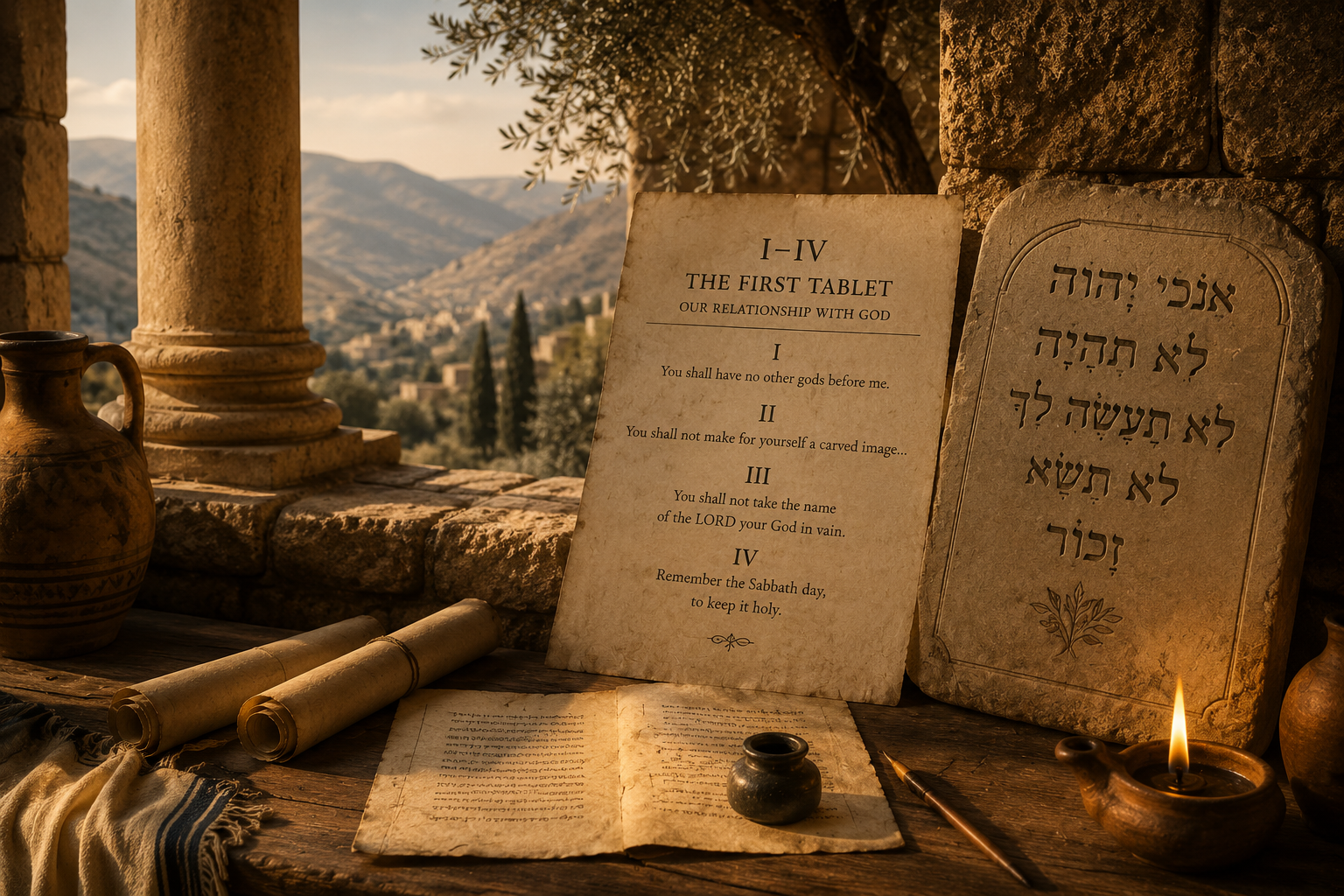
The First Tablet: Commandments One Through Four
The vertical relationship — how Israel was to relate to their God
I
No Other Gods Before Me
"You shall have no other gods before me." — Exodus 20:3
lo-yihyeh lecha elohim acherim al-panai — "there shall not be to you other gods before my face." The phrase al-panai — "before my face" — is more precise than the English "before me." It means: in my presence, in my sight, at my face. There shall be no other god in the space before YHWH's face — which is to say, anywhere, because YHWH is omnipresent.
This is not the same as saying other gods do not exist. The command acknowledges that Israel lived in a world filled with divine claimants — the gods of Egypt, of Canaan, of Babylon. The Decalogue does not begin by debating metaphysics. It begins with a relational claim: you are mine. You shall have no others. The command is not primarily philosophical (are there other gods?) but covenantal (will you be faithful to this God?).
The Hebrew construction lo-yihyeh lecha — "there shall not be to you" — is strikingly intimate. Not "you shall not worship other gods" (which would focus on the act of worship) but "other gods shall not be yours" (which focuses on the relationship). The command forbids the possession of another divine relationship. Israel was to belong to YHWH exclusively — not as a doctrinal position but as a lived reality, the way a spouse belongs to their partner exclusively.
Cultural confrontation: In every surrounding culture, having multiple gods was normal and prudent. You worshipped the storm god when you needed rain, the fertility goddess for crops, the war god before battle, the household gods for daily protection. Religious pluralism was the default. YHWH's first word at Sinai declares religious exclusivity — not as a new idea but as the foundational covenant term. This exclusive claim will drive every subsequent crisis in Israel's history from the golden calf to the prophets' denunciations of idolatry to the Babylonian exile.
II
No Images — The Idol Prohibition
"You shall not make for yourself a carved image... You shall not bow down to them or serve them, for I the LORD your God am a jealous God, visiting the iniquity of the fathers on the children to the third and the fourth generation of those who hate me, but showing steadfast love to thousands of those who love me and keep my commandments." — Exodus 20:4–6
The longest commandment in the Decalogue — and the only one accompanied by both a warning and a promise. The prohibition is not merely against worshipping images of other gods. It prohibits making carved images (pesel) of YHWH Himself — any attempt to represent the invisible, imageless God in physical form.
This was radical. Every ancient religion had visual representations of its deity. The Egyptians had elaborate iconographies — Ra as a sun disk, Horus as a falcon, Osiris with specific regalia. The Canaanites had Baal figurines, Asherah poles. Even Israel's neighbouring kin had divine images. The prohibition against images was not merely anti-idolatry toward other gods. It was a positive theological claim: YHWH cannot be captured in matter. No image does justice to His reality. Any image of God is, by definition, a reduction of God — a making of Him less than He is, a domestication of the wild and holy One.
El kanna — "a jealous God." The Hebrew kanna describes the passion of a spouse who cannot tolerate the sharing of their partner's exclusive devotion. This is marital language applied to the divine-human covenant — the same metaphor that Hosea, Jeremiah, and Ezekiel will develop in painful detail when Israel breaks it. God's "jealousy" is not petty ego-protection. It is the ardent love of the One who will not be satisfied with partial devotion, who insists on the whole heart because the whole heart is what He gave and what He deserves.
Generational consequences: "Visiting the iniquity of the fathers on the children to the third and fourth generation of those who hate me." This is one of the most discussed and misunderstood passages in the Decalogue. It does not mean innocent children are punished for their parents' sins — Deuteronomy 24:16 and Ezekiel 18 explicitly forbid that. It means the consequences of sin have generational reach: a father who worships idols produces a household shaped by that worship, children formed in that culture, grandchildren who inherit the distorted theological framework. Sin is not merely personal — it creates environments, cultures, and patterns of perception that outlast the individual sinner. The text immediately balances this with "showing steadfast love to thousands" — the reach of grace is incomparably longer than the reach of judgment.
III
The Name in Vain — The Weightiest Prohibition
"You shall not take the name of the LORD your God in vain, for the LORD will not hold him guiltless who takes his name in vain." — Exodus 20:7
The most persistently misunderstood commandment in the Decalogue. Most people interpret it as a prohibition against casual profanity — using God's name as a swear word. This is not wrong, but it is a tiny corner of what the third commandment actually prohibits.
lo-tissa et-shem-YHWH Eloheicha lashav — "you shall not lift/carry/bear the name of the LORD your God in vain/emptiness/worthlessness." The verb nasa (to lift, to carry, to bear) does not primarily describe speaking. It describes carrying — taking something up and bearing it. And shav (in vain, to no purpose, emptiness, worthlessness) is the word for what makes a thing hollow or false.
The commandment forbids bearing the name of YHWH emptily — which covers far more than profanity:
False oaths: In the ancient world, oaths were made by invoking the name of a god as witness — "as YHWH lives, I will do X." To swear a false oath by YHWH's name was to use the divine name to guarantee a lie. This is the most direct target of the commandment.
Hypocrisy: To bear the name "people of YHWH" (as Israel did by covenant) while living in ways that contradicted YHWH's character was to bear the name in vain — emptily, without the substance the name claimed. This is what the prophets thundered against: "This people honours me with their lips, but their heart is far from me" (Isaiah 29:13).
Magical use of the name: In the ancient Near East, divine names were used in spells and incantations — invoking the name of a powerful god to compel the deity or work magic. The commandment forbids using YHWH's name as a tool of magical manipulation.
Casual speech: And yes, also — the habitual use of the holy name as an intensifier, a punctuation mark, an expression of surprise, without any weight or intentionality. Not because the sounds themselves are dangerous, but because the habitual careless use of the name trains the heart to treat as ordinary what is holy.
The warning — "the LORD will not hold him guiltless" — is the only commandment in the Decalogue accompanied by this specific formula. Every other commandment's penalty is left implicit or stated elsewhere. This one gets its own declaration of consequence, as if the Lawgiver knew this particular commandment would be most casually violated and most deeply dismissed.
Did You Know — Why Jewish Tradition Stopped Pronouncing the Name
By the Second Temple period (c. 500 BC–70 AD), Jewish tradition had developed the practice of not pronouncing the Tetragrammaton (YHWH) at all — reading Adonai (Lord) whenever the divine name appeared in Scripture. This practice continues in Orthodox Jewish tradition to this day, where Hashem (the Name) is used in casual speech to avoid even indirect pronouncing of the divine name.
This was not the original practice — the name was clearly spoken in worship, in prayer, and in daily life throughout the biblical period. But the development of this extreme caution reflects a deepening theological seriousness about the third commandment. Better to err on the side of never saying the name than risk saying it carelessly.
This is why most English Bibles write "LORD" (small capitals) wherever the Hebrew has YHWH — following the Jewish reading tradition of substituting Adonai. The four letters YHWH appear approximately 6,828 times in the Hebrew Bible — and in standard English Bible translations, they are invisible, replaced by "the LORD" throughout.
IV
The Sabbath — Creation Rest as Covenant Obligation
"Remember the Sabbath day, to keep it holy. Six days you shall labour, and do all your work, but the seventh day is a Sabbath to the LORD your God... For in six days the LORD made heaven and earth, the sea, and all that is in them, and rested on the seventh day. Therefore the LORD blessed the Sabbath day and made it holy." — Exodus 20:8–11
The longest of all ten commandments — four verses in its Exodus form. Already examined as a concept in Part Thirteen (where we showed it preceded Sinai in the manna narrative), but now its full covenantal form deserves complete examination.
Zachor et-yom haShabbat l'kadsho — "Remember the Sabbath day, to keep it holy." Note: remember, not "observe for the first time." As we established: the Sabbath was already known from the manna experience. The Sinai commandment calls Israel to sustain, embed, and formally covenant what had already been revealed in the wilderness rhythm.
The Exodus grounding (Exodus 20:11): "For in six days the LORD made heaven and earth... and rested on the seventh day." The Exodus version roots the Sabbath in creation — God's own rest on the seventh day of Genesis 2. You rest because God rested. Your weekly rhythm mirrors the cosmic rhythm of creation itself.
The Deuteronomy grounding (Deuteronomy 5:15): "You shall remember that you were a slave in the land of Egypt, and the LORD your God brought you out from there with a mighty hand and an outstretched arm. Therefore the LORD your God commanded you to keep the Sabbath day." The Deuteronomy version roots the Sabbath in redemption — you were slaves, now you rest. The Sabbath is the weekly reenactment of liberation. Slaves do not get a day off. Free people do. Every seventh day is a re-declaration of freedom.
Both groundings are true simultaneously. The Sabbath is both a creation ordinance (the rhythm of the cosmos) and a redemption declaration (the liberty of the redeemed). It is cosmological and soteriological — written into the universe and written into the covenant at the same time.
Its scope: "You, your son, your daughter, your male servant, your female servant, your livestock, and the sojourner who is within your gates." The Sabbath is the most inclusive commandment in the Decalogue — it extends to servants, foreigners, and animals. The only commandment in the ancient world that gave mandatory rest to slaves and livestock. This is social legislation born of theological conviction: all creatures share in the creational rest, because all creatures belong to the Creator who rested.
The Fifth Commandment — The Hinge Between the Two Tablets
Honour your father and your mother — and why this commandment appears where it does
V
Honour Your Father and Your Mother
"Honour your father and your mother, that your days may be long in the land that the LORD your God is giving you." — Exodus 20:12
Kabed et-avicha v'et-imecha — "Honour your father and your mother." The verb kabed — honour — is the same root as kaved (heavy, weighty), the word we have encountered repeatedly: Pharaoh's heavy heart, Moses' heavy arms, the heavy cloud at Sinai. To honour someone is to give them weight — to treat them as significant, weighty, consequential. The opposite of honour is to treat someone as light, trivial, dismissible.
The fifth commandment is the hinge commandment of the Decalogue — the transition point between the two tablets. It belongs structurally to the second tablet (the human-directed commands) but has features that link it to the first tablet (the God-directed commands). Specifically: it is the only commandment in the second tablet that comes with a promise ("that your days may be long in the land"). This is the same structure as the first-tablet commandments which offer consequences — the second/idol commandment has its generational warning and promise, the third has its non-guiltless formula, the fourth has its creation grounding. The fifth commandment, uniquely among the second-tablet commands, carries a covenant promise.
Paul notices this in Ephesians 6:2–3: "Honour your father and mother (this is the first commandment with a promise), 'that it may go well with you and that you may live long in the land.'" The fifth commandment is the pivot — it closes the first tablet by carrying its structure (command with consequence/promise) while opening the second tablet with its focus (human relationships).
Why parents as the bridge? Because parents are the first human representatives of divine authority that every person encounters. Before a child can understand God, they understand a father and mother — authority figures who create, sustain, discipline, and love. Honouring parents is the first practice of the kind of relationship that the first four commandments require toward God: acknowledging the authority of one who existed before you, who created the context for your life, whose word shapes your reality.
This is also why rabbinic tradition notes that the fifth commandment technically belongs to the first tablet — some traditions place it there. The honouring of parents and the honouring of God are theologically linked: one who cannot honour visible parental authority is unlikely to honour invisible divine authority.
Did You Know — The Fifth Commandment Applied to Adult Children
The fifth commandment is almost universally applied in modern practice to children obeying their parents. But the Hebrew word kabed (honour) is never used in Scripture to describe a child's obedience to a parent. Shama (obey, listen) is the word for a child's obedience. Kabed (honour) is the word used for how adults treat people of significance.
The fifth commandment was addressed to adult Israelites at Sinai — not to children. It was telling grown members of the community how to treat their aging parents. The commandment's context is not child discipline; it is elder care. The Talmud interprets it primarily as an obligation of adult children to provide for elderly parents — food, clothing, and dignity. The "long life in the land" promise is correspondingly understood: the society that cares for its elderly will be a stable and enduring society. The society that abandons its aged will not.
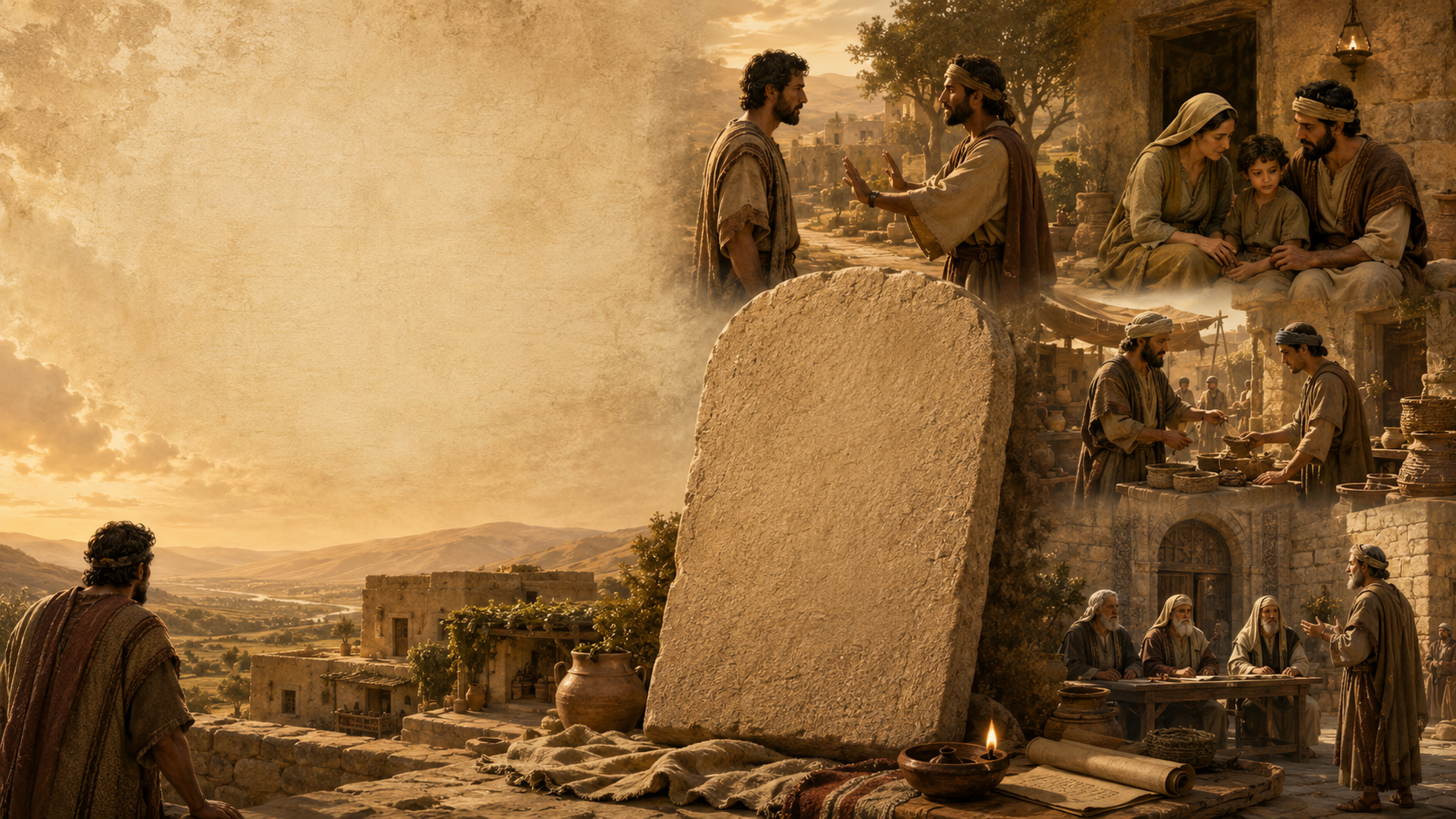
Commands Six Through Ten — The Second Tablet in Full
Each commandment examined in its Hebrew, its cultural context, and its New Testament fulfilment
VI
You Shall Not Murder
"You shall not murder." — Exodus 20:13
The shortest commandment in the Decalogue — two words in Hebrew: lo tirtzach. And one of the most important to translate correctly.
The Hebrew verb ratzach does not mean "kill" in the general sense — it means specifically to kill a person illegally, to murder, to shed human blood unjustifiably. The Hebrew Bible uses different words for different kinds of killing: harag for general killing (including of animals), muth for putting to death (including judicial execution), shachat for slaughtering animals. Ratzach is the specific word for the unjustified killing of a human being — a person's life taken outside of lawful authority or legitimate defense.
This distinction matters enormously. The sixth commandment does not prohibit capital punishment (which the same Torah permits in specific cases), warfare (which the Torah commands in specific contexts), or self-defence. It prohibits the private, unauthorised taking of human life — the assertion that one person has the right to extinguish another person's existence by their own decision.
Jesus' expansion (Matthew 5:21–22): "You have heard that it was said to those of old, 'You shall not murder'... But I say to you that everyone who is angry with his brother will be liable to judgment." Jesus does not abolish the commandment. He extends its reach — following the same logic as the tenth commandment, reaching behind the prohibited action to address the interior state that generates it. Unjustified anger, contemptuous speech, deliberate degradation of a person's dignity — these are the commandment's violation at its root. The commandment prohibits the full spectrum of the dehumanisation of another person, beginning at the level of the heart.
VII
You Shall Not Commit Adultery
"You shall not commit adultery." — Exodus 20:14
lo tin'af — two words again. The Hebrew na'af specifically describes sexual unfaithfulness within a marriage — entering into sexual relations with someone who belongs in covenant to another. In the ancient Near East, adultery was defined primarily as a violation of another man's property rights (his wife was legally his). The Decalogue's prohibition of adultery is not merely about property rights — it is about covenant faithfulness, the violation of a sworn bond between persons.
The marriage covenant runs as a parallel throughout the Hebrew Bible to the covenant between YHWH and Israel — and the prohibition of adultery runs parallel to the prohibition of idolatry. Hosea's entire prophetic ministry is built on this parallel: God married Israel at Sinai, and Israel's idolatry is adultery against the divine spouse. The seventh commandment is not merely social regulation of sexual behaviour. It is a covenant term that carries the full weight of the first commandment's exclusivity, applied to the human institution that most closely mirrors the divine-human relationship.
Jesus' expansion (Matthew 5:27–28): "Everyone who looks at a woman with lustful intent has already committed adultery with her in his heart." Again, reaching behind the action to the interior desire that generates it. The commandment claims jurisdiction over the look, the imagination, the cultivated desire — not only the physical act.
VIII
You Shall Not Steal
"You shall not steal." — Exodus 20:15
lo tignov — two words. The verb ganav covers all forms of taking what belongs to another — property theft, wage theft, kidnapping (Exodus 21:16 uses the same verb for stealing a person). In its original context, some scholars have proposed the commandment primarily addresses kidnapping — taking a person — rather than property theft, since property theft was already covered by extensive casuistic law. Whether this is the original referent or not, the full meaning covers all forms of taking what one does not have legitimate claim to.
The eighth commandment is the positive acknowledgment that property rights exist — that what a person has acquired legitimately is theirs, and taking it violates not merely their economic interest but their dignity and their place in the community. Theft is never merely economic. It is a power assertion — one person claiming the right to take what another person worked to create or accumulate.
IX
You Shall Not Bear False Witness
"You shall not bear false witness against your neighbour." — Exodus 20:16
lo-ta'aneh v'rei'acha ed shav — "you shall not answer against your neighbour as a false witness." The specific legal context is the courtroom — the witness stand. Ed shav (a false/empty witness) is testimony given in a legal proceeding that misrepresents the truth, whether through outright fabrication or through selective presentation.
This commandment is not simply "don't lie" in general. It specifically targets the subversion of justice through false testimony — the abuse of the legal system to destroy an innocent person. In the ancient world, testimony was the primary form of legal evidence. There were no forensic labs, no security camera footage. A case was made by witnesses. False witnesses could therefore do catastrophic harm — destroying reputations, stripping people of property, and causing death sentences for the innocent.
The ninth commandment is the foundation of a functioning legal system. Without the sanctity of witness testimony, justice collapses. Proverbs 14:5: "A faithful witness does not lie, but a false witness breathes out lies." Proverbs 12:17: "An honest witness tells the truth, but a false witness tells lies." The entire legal machinery of Israelite society was built on this commandment's reliability.
The New Testament extension is clear: James 3, Matthew 5:37 ("let your yes be yes and your no be no"), and the pastoral epistles' repeated emphasis on truthfulness in speech. From the courtroom outward — the prohibition on false testimony becomes the positive obligation to be the kind of person whose word can be trusted in every context, not merely in formal proceedings.
X
You Shall Not Covet — The Interior Commandment
"You shall not covet your neighbour's house; you shall not covet your neighbour's wife, or his male servant, or his female servant, or his ox, or his donkey, or anything that is your neighbour's." — Exodus 20:17
The most distinctive commandment in the Decalogue — and the one that reaches where no human court can follow. Already introduced as a "Did You Know" in the Ancient Context section, but deserving full analysis here.
lo tachmod — "you shall not covet/desire/crave." The verb chamad describes a strong, burning desire for something — a desire that, if unchecked, moves toward acquisition. It is not merely the wish that one had more — it is the specific desire for what belongs to someone else, the wish that their thing were yours.
The Deuteronomy version (Deuteronomy 5:21) uses a slightly different word for the second half: lo titavveh — "you shall not long for" — from ta'avah, which describes an intense appetite, a craving. The double prohibition (chamad + titavveh) covers both the cool calculating desire and the hot passionate craving. Thinking about it intellectually and wanting it viscerally.
Notice the list of things not to covet: house, wife, male servant, female servant, ox, donkey, anything that is your neighbour's. The list is deliberately comprehensive — not a partial catalogue but a total sweep. Everything your neighbour has is included. Nothing that belongs to another person is eligible for the covetous desire that would make it yours.
The theological implication: The tenth commandment implies that having enough is possible. Contentment is achievable. The commandment would be meaningless if craving were simply the unavoidable human condition. It implies that a person can reach a state of genuine satisfaction with what they have — not stoic resignation but genuine gratitude for their portion, genuine delight in their neighbour's flourishing rather than envy of it. This is the radical vision of human community the Decalogue is working toward: a people who are genuinely glad for each other.
Paul in Philippians 4:11: "I have learned, in whatever situation I am, to be content." Learned. Not born with it. Not automatically achieved. Learned — the same daily discipline of formation that the manna taught, now applied to the interior life. Contentment is the positive obedience to the tenth commandment. It is what the commandment looks like from the inside.
How Many? The Numbering Controversy
Three different traditions — Jewish, Catholic/Lutheran, and Protestant Reformed — number the commandments differently
The Hebrew Bible gives us "ten words" but does not number them or divide them. It simply gives the text. The question of how to count to ten has produced three different traditions in the history of Jewish and Christian interpretation — and they produce genuinely different results.

Three Numbering Traditions — A Comparison Table
Jewish Tradition: Commandment 1 = "I am the LORD your God" (the prologue). Commandment 2 = no other gods AND no images (combined). Commandments 3–10 = the name, Sabbath, parents, murder, adultery, theft, false witness, covet.
Catholic & Lutheran Tradition (following Augustine): Commandment 1 = no other gods AND no images (combined). No separate commandment for images. Commandments 2–9 = the name, Sabbath, parents, murder, adultery, theft, false witness. Commandment 10 = coveting is split into two: do not covet your neighbour's wife (10a) and do not covet your neighbour's goods (10b). This allows the total to reach ten without the prologue as a commandment.
Protestant Reformed Tradition (following Origen and most Eastern churches): Commandment 1 = no other gods. Commandment 2 = no images (separate). Commandments 3–9 = the name, Sabbath, parents, murder, adultery, theft, false witness. Commandment 10 = do not covet (the full verse, unified).
None of these numbering systems changes the actual content of the Decalogue — all three work with the same text. They reflect different judgments about how to divide and count what is a single continuous passage. The text itself does not number the commandments. The Jewish tradition (prologue as first commandment) is arguably the most theologically coherent: the first commandment is not a prohibition but a gift — the gift of the divine identity, given before any demand is made.
Need Help remembering the commandments. Here is a little nursery rhyme style song, to help you remember.
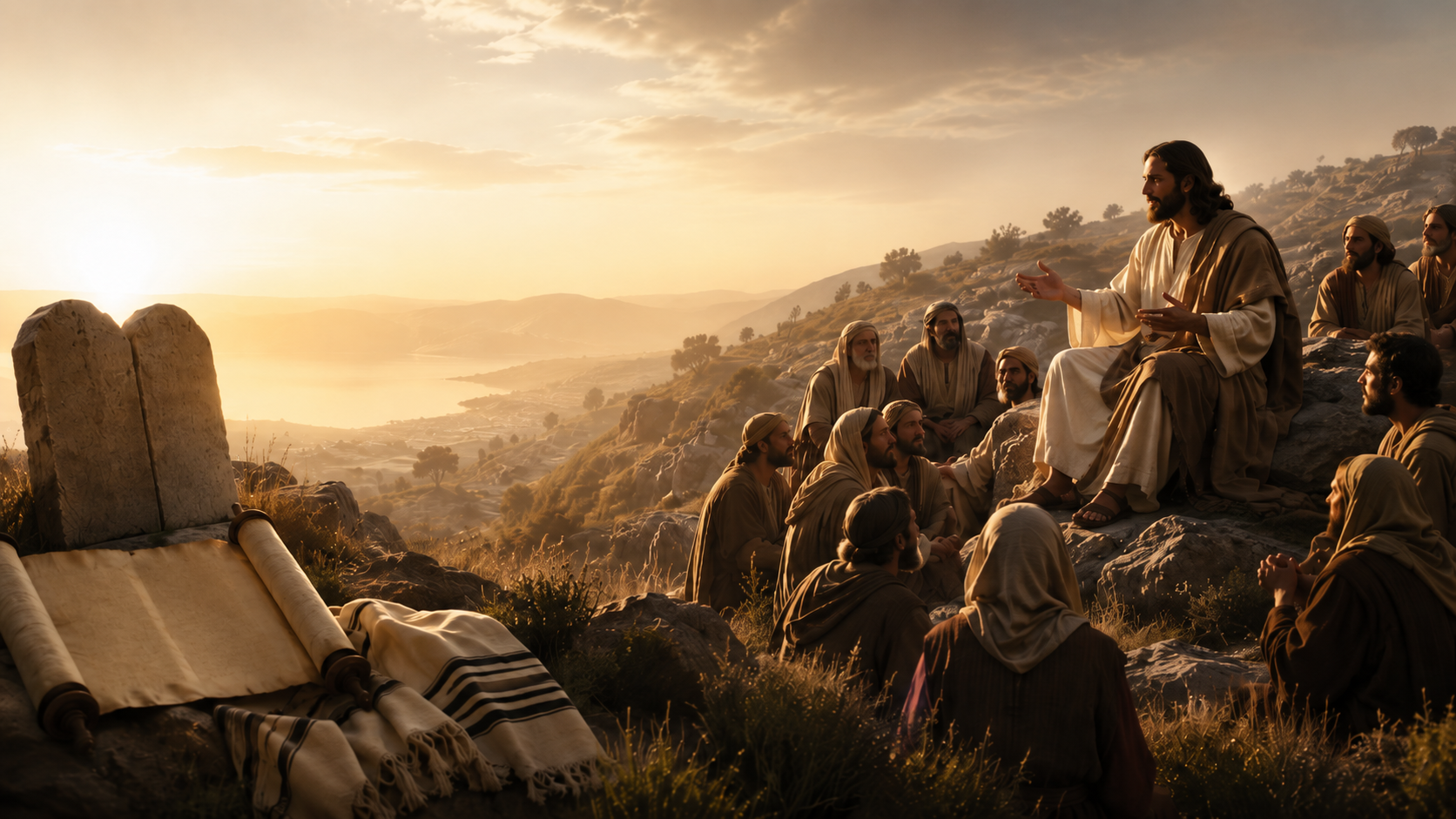
Jesus and the Ten Commandments
"Do not think that I have come to abolish the Law or the Prophets" — Matthew 5:17
Matthew 5:17–48 — The Sermon on the Mount and the Decalogue
Jesus' treatment of the Ten Commandments in the Sermon on the Mount (Matthew 5:17–48) is one of the most theologically important passages in the New Testament for understanding the relationship between the law and Christ. Jesus says: "Do not think that I have come to abolish the Law or the Prophets; I have not come to abolish them but to fulfil them."
The word plēroō (fulfil) is the same word used for the fulfilment of prophecy — bringing to completion, filling out to its full measure. Jesus is not repealing the Decalogue. He is filling it out — revealing the full intended meaning that the bare commandments pointed toward but did not fully express. Six times in Matthew 5 He says: "You have heard that it was said... but I say to you." Each time, He takes a commandment and presses it deeper, further, into the interior life where the commandment was always aiming.
The pattern is consistent: the commandment addresses behaviour, Jesus addresses desire; the commandment addresses the act, Jesus addresses the heart from which the act flows. This is not the abolition of the law. It is the completion of the law — the revelation that the law was always trying to produce a certain kind of person, not merely a certain kind of behaviour, and that the person who is genuinely transformed needs no external prohibition because they have no internal inclination toward violation.
The Two Greatest Commandments — Mark 12:28–34
A teacher of the law asks Jesus: "Which commandment is the most important of all?" Jesus answers by quoting Deuteronomy 6:4–5 (the Shema) and Leviticus 19:18 — love God with everything, love your neighbour as yourself. "There is no other commandment greater than these." And the teacher responds: "You are right, Teacher... this is much more than all whole burnt offerings and sacrifices." And Jesus says: "You are not far from the kingdom of God."
Jesus does not pick one commandment from the Decalogue. He picks two summary principles from the rest of the Torah that encapsulate the entire two-tablet structure of the Decalogue — one summarising the first tablet (love God), one summarising the second (love your neighbour). The Ten Commandments are not the foundation — they are the specific application of these two foundational loves to concrete situations.
Paul says it even more compressedly in Romans 13:10: "Love does no wrong to a neighbour; therefore love is the fulfilling of the law." Not the abolition of the law — the fulfilling of the law. The law is the shape of love worked out in specific prohibitions. The person who loves their neighbour will not murder, steal, commit adultery, lie, or covet — not because they are prohibited, but because love cannot do these things to the beloved. The law is internalized, as Jeremiah 31:33 promised, when love becomes the governing disposition of the heart.
Galatians 3:24 — The Law as Paidagōgos
Paul's most controversial statement about the law comes in Galatians 3:24: "So then, the law was our paidagōgos until Christ came, in order that we might be justified by faith." The word paidagōgos has been translated variously as "tutor," "guardian," "schoolmaster," and "custodian." In the Greek world, a paidagōgos was not a teacher — he was the household slave who accompanied a young son from home to school and back, ensuring he arrived safely and behaved appropriately, using strict oversight and even physical correction. He was necessary, protective, and temporary — his role ended when the child reached adulthood.
Paul's metaphor is not a dismissal of the law. It is a statement of the law's purpose and its temporal relationship to Christ. The law was a protective guardian for the period before Christ — maintaining the covenant relationship, defining the shape of righteous behaviour, and revealing the depth of human sin ("I would not have known what it is to covet if the law had not said, 'You shall not covet'" — Romans 7:7). The law did its job. It kept Israel until the appointed time. And when Christ came — when the Son reached full age and the new covenant was inaugurated — the paidagōgos was no longer needed in the same role, because the Spirit had come to write the law directly on the heart.
This does not mean the moral content of the Decalogue is obsolete. Paul himself quotes the Decalogue in Romans 13. It means the relational structure has changed: the law is no longer the external custodian watching you from outside and restraining behaviour through prohibition. It has become internal — the Holy Spirit writing the character of God on the human heart so that the person who is transformed by the Spirit walks in ways that the law prescribed, but from the inside out.

Devotional
I Am — Before You Do
The Ten Commandments do not begin with a command.
They begin with an "I." I am the LORD your God, who brought you out of Egypt, out of the house of slavery. Before God says a word about what Israel should do, He says who He is, and what He has already done. The law comes wrapped in the prior grace of the one who gives it. You are not reading a list of requirements for becoming acceptable. You are reading a description of what the life of the already-accepted looks like from the outside.
This is the grammar of the gospel, hiding in plain sight at the beginning of the law. God does not say: do these things, and I will be your God. He says: I am your God — and here is what the life of someone who belongs to me looks like. The commandments are not a ladder to climb toward God. They are a portrait of the person who has already been brought to God on eagles' wings and is now learning to live in the freedom they have been given.
The tenth commandment tells us not to covet — and as Paul discovered, this is the hardest one. Not because we are unusual in our hunger, but because we are ordinary human beings living in a world that tells us we need what others have, that our portion is inadequate, that if we only had the house, the spouse, the career, the body, the recognition — then we would be content. The tenth commandment says: no. Contentment is not achieved by having more. It is practised by trusting that what you have been given is enough. By genuinely rejoicing in your neighbour's flourishing instead of resenting it. By orienting your whole heart back toward the One who is Himself the source of all good things — including the good things your neighbour has, which are just as much His gift as yours.
And here is where all ten words come together: if you genuinely know who I am (Commandments 1–2), if you genuinely speak and think of me with the weight I deserve (Commandment 3), if you genuinely rest in me weekly (Commandment 4), if you genuinely honour the authority structures I built into human flourishing (Commandment 5) — then you will not need the prohibitions of Commandments 6–10. Not because you are naturally virtuous, but because the love of God crowds out the desires that generate murder, adultery, theft, lies, and coveting.
The Ten Commandments are not a performance review. They are a love letter written in law. They say: here is what I am like. Here is what your life looks like when it is shaped by who I am. Here is the portrait of freedom — not the absence of constraints, but the presence of a character formed by knowing me.

Reflection & Discussion Questions
Personal Reflection
1. The Decalogue begins not with a command but with "I am the LORD your God, who brought you out of Egypt." Grace precedes law. How does reading the Ten Commandments as a description of the redeemed life rather than the requirements for becoming redeemed change how you relate to them? Do you experience them primarily as a burden or as a gift? What would need to change for them to feel like the latter?
2. The third commandment prohibits bearing the name of YHWH "in vain" — emptily — which covers not just profanity but false oaths, hypocrisy, and magical manipulation of the divine name. In what ways might you be "bearing the name" of a Christian — claiming the identity without the substance? What is the equivalent of bearing the name in vain in a contemporary context?
3. The tenth commandment — "you shall not covet" — is the only ancient law to legislate the interior life. Paul said it was this commandment that broke him (Romans 7:7). Which of the ten words do you find hardest, not at the level of behaviour, but at the level of the interior life the commandment is actually addressing? What does that tell you about where your formation most needs to continue?
Deeper Study
4. Compare Exodus 20:8–11 (the Sabbath grounded in creation) with Deuteronomy 5:12–15 (the Sabbath grounded in redemption from slavery). What is the theological significance of each grounding? Why might Deuteronomy need a different grounding than Exodus? And how do both groundings together give a fuller picture of what the Sabbath is and why it matters?
5.The Code of Hammurabi and the Hittite suzerainty treaty structure both illuminate different aspects of the Decalogue's context. What does the Hittite treaty structure tell you about the kind of relationship Sinai established between YHWH and Israel? And what does the comparison with Hammurabi reveal about what is genuinely unprecedented in the Decalogue?
6.Read Matthew 5:17–48 carefully. Jesus says he came not to abolish the law but to fulfil it — and then proceeds to take six commandments and press them deeper into the interior life. What is the difference between abolishing a law and fulfilling it? What does "fulfilment" of the law look like in a Spirit-filled life, according to Paul in Romans 13:8–10 and Galatians 5:22–23?
7.Galatians 3:24 calls the law a paidagōgos — the household guardian who kept the child safe until adulthood. This was a temporary protective role, not a permanent one. What does it mean for the law to have fulfilled its guardian role now that Christ has come? Does this mean the moral content of the Decalogue no longer applies? Or does it mean the relationship has changed — from external guardian to internal Spirit-written character? How does your church or tradition navigate this?

Closing Prayer
Dear Father, you are I AM, My LORD My God —
You began there. Not with demands. With Your name, and what You had done. Before You said a word about what we owe You, You told us who You are and what You have already given us. You are a God who introduces Himself before He gives instructions. A God who rescues before He commands. A God who declares "I am yours" before He asks us to live like it. Even when we mess up, you start with a question not an accusation.
Forgive us for reading Your ten words as a performance review rather than a love letter. For approaching them as the conditions of acceptance rather than the portrait of the accepted. For treating them as the ceiling we must reach rather than the life we have been invited into and you have claimed us into.
We confess that we know how to manage behaviour and how little we know about managing desire. That we can mostly avoid murder but cannot always avoid contempt. That we keep our hands off what is not ours but cannot always keep our eyes and our hearts from wanting it. That the tenth commandment reaches where our self-management cannot follow — into the interior, into the want, into the covetous glance we took before we knew we were looking.
Write these words on our hearts, as You promised — not on stone, but on the interior of who we are. Give us the new heart that Jeremiah described and Ezekiel foretold -- the heart from which the law flows because it has been formed in the character of the Lawgiver. Make us into people for whom the ten words are not external constraints but expressions of who we have become. Holy spirit, embed your law in our hearts and search us and help us gently form.
We love Your law, LORD. We love that You spoke it from fire. We love that it begins with I AM. We love that it ends with the interior life where You alone can go. Write us into it. In the mighty name of Jesus, the law giver and lamb, Amen.

Coming Next in the Series
Part Seventeen: The Golden Calf — Aaron's Failure and God's Mercy
Forty days. That is how long Moses was on the mountain receiving the full covenant instructions. And in those forty days, at the foot of the same mountain where God had just spoken the Ten Commandments out of fire — Israel built a golden calf and declared it the god who brought them out of Egypt. Part Seventeen examines the most catastrophic act of covenant betrayal in Israelite history: what Aaron actually did and why, what Moses saw when he came down and why he broke the tablets, how 3,000 died, and the extraordinary mercy of a God who decided — after all of this — to go with His people anyway.
Add comment
Comments