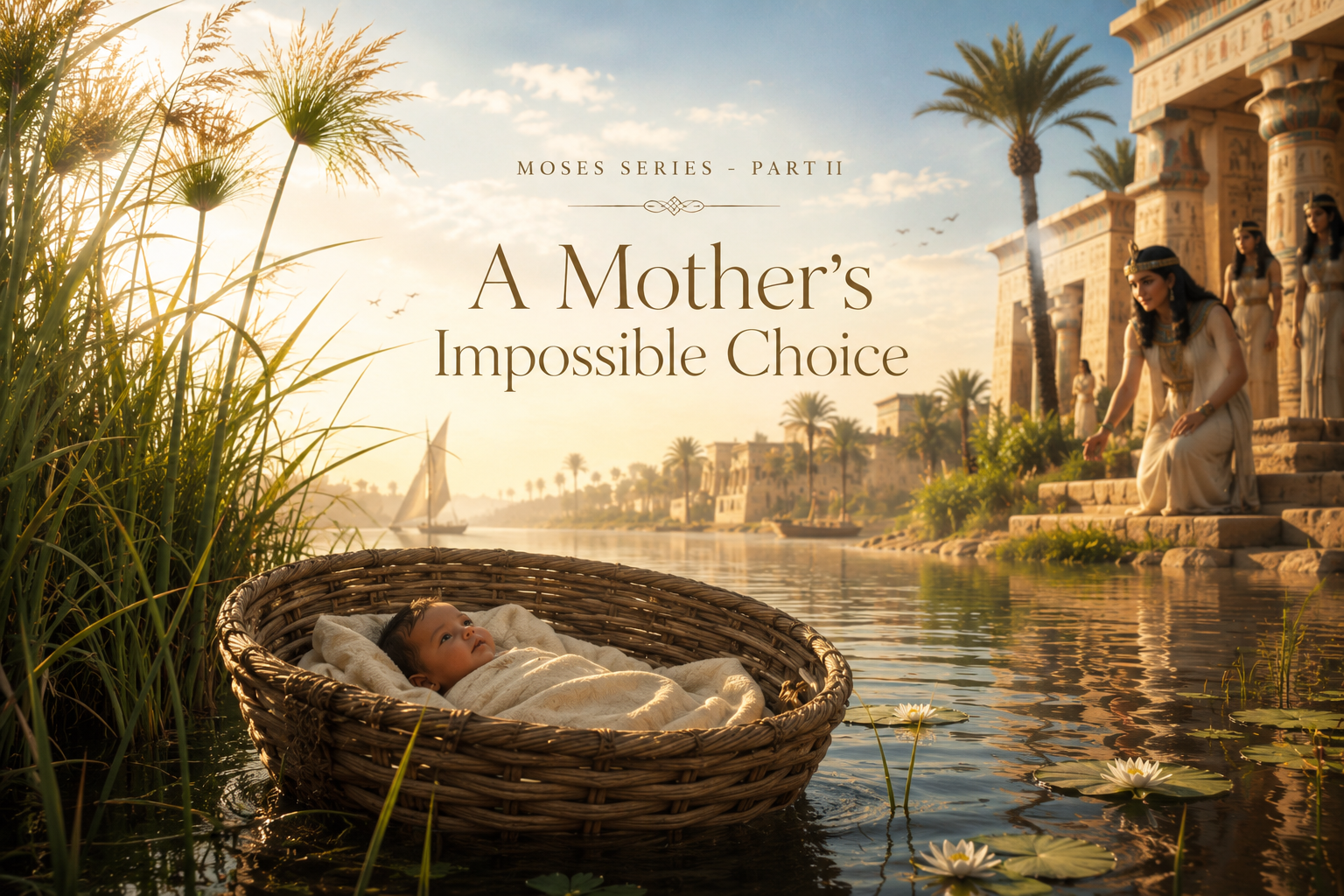
Part Two of Thirty
A Mother's Impossible Choice
Todays Study is based on Exodus 2. Please read Exodus 2 before continuing or listen below.
Part Two — Section I
Who Was Jochebed? Recovering a Lost Hero
The woman whose name carries the Name that shakes the world
She had three months.
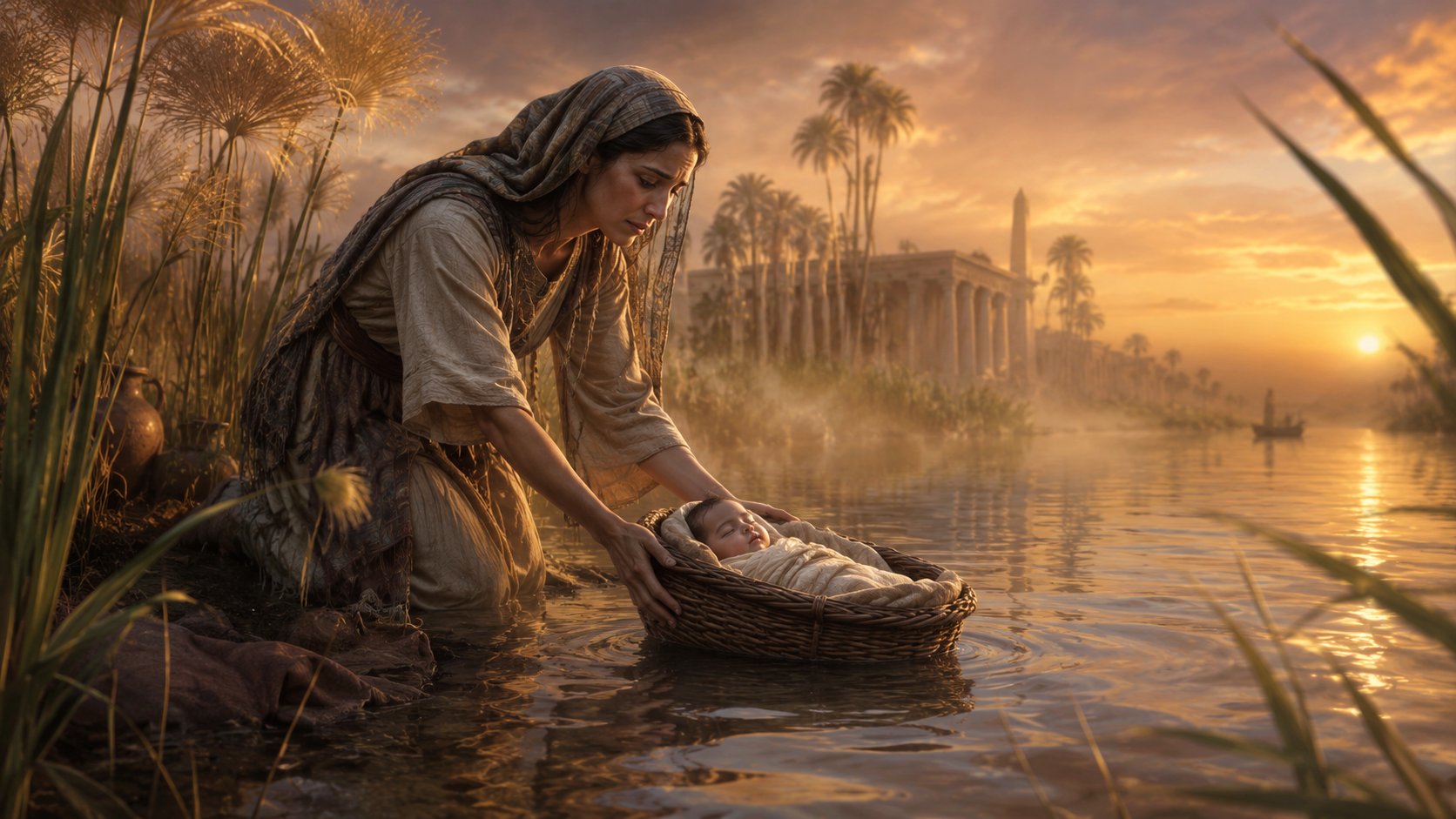
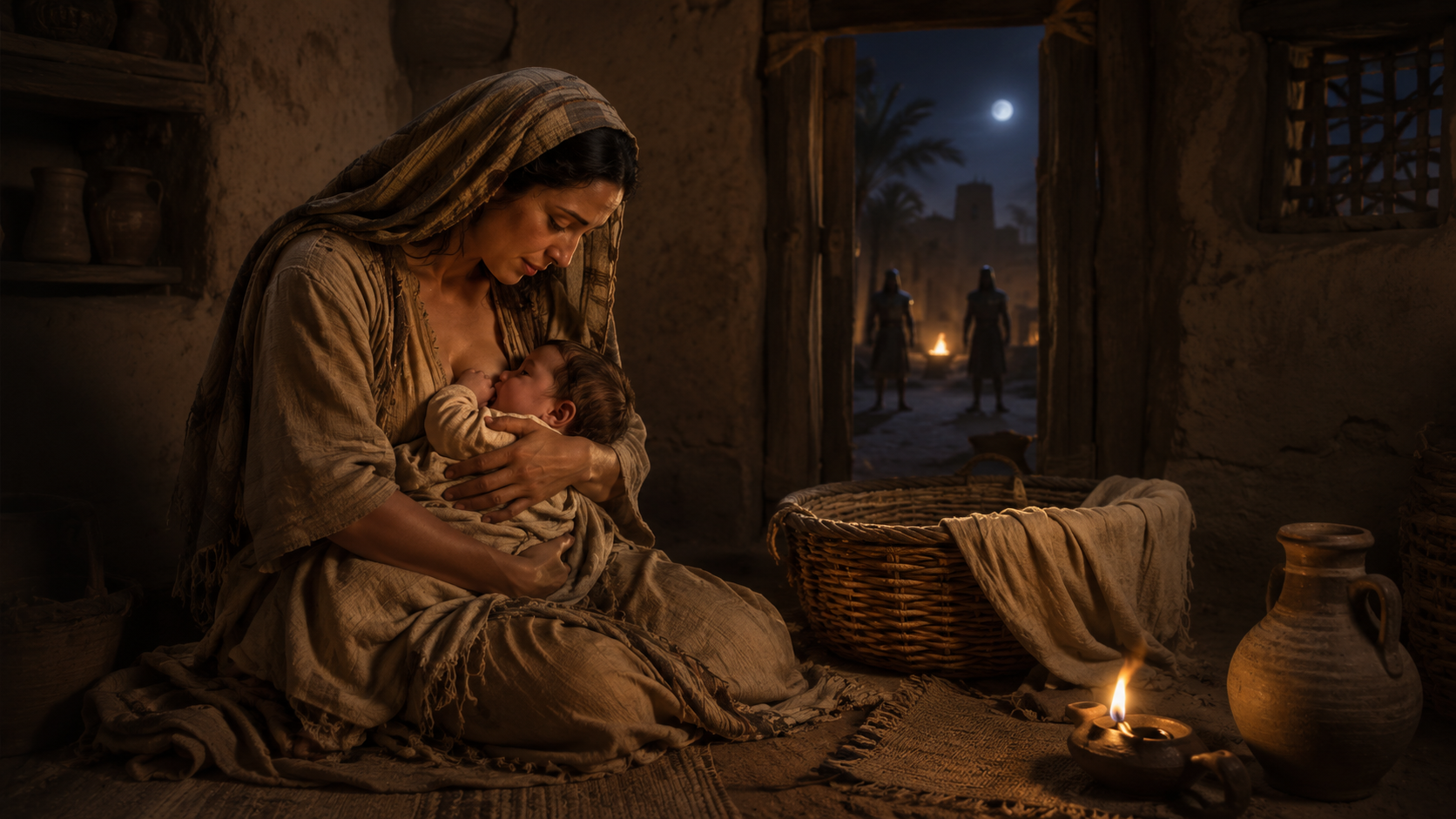
That was all. Three months before the neighbors noticed, before someone talked, before the overseers came. She had watched him from the moment he drew breath — this strange, beautiful child who barely cried, who seemed to understand already that silence was survival. She had nursed him and held him in the dark and pressed her lips to his forehead and bargained with God in whispers, and now the three months were up and she had to make the only decision a mother should never have to make.
She could not keep him. She could not kill him. So she would give him to the river.
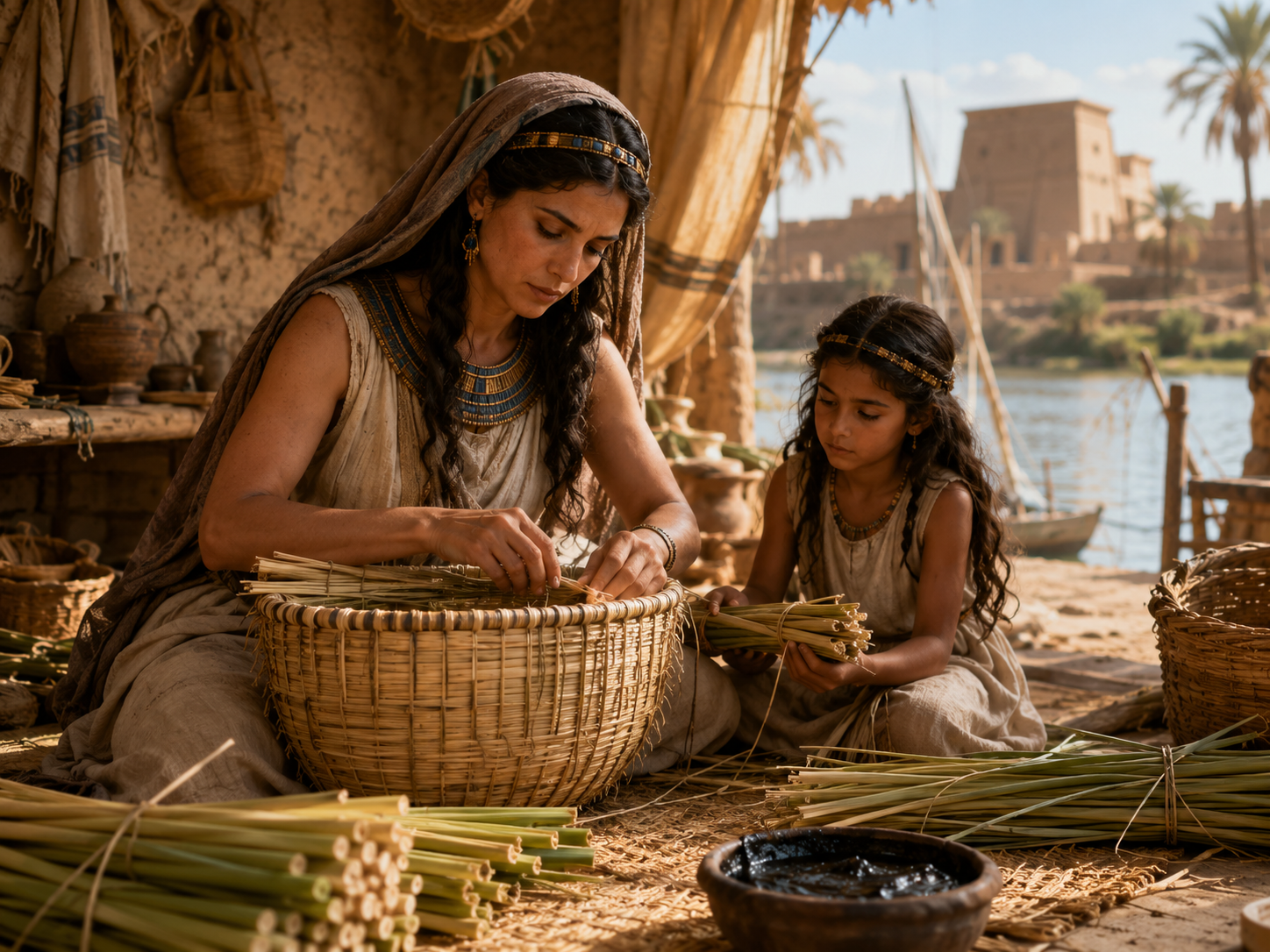
Jochebed, daughter of Levi, wife of Amram, mother of Miriam and Aaron — this woman whose name means the LORD is glory — went down to the papyrus marshes and began to weave.
Her Name and What It Means
Jochebed is one of the most understated figures in all of Scripture. She appears by name only twice in the entire Bible — in Exodus 6:20 and Numbers 26:59 — and yet she is the mother of three of the most significant figures in Israel's history: Miriam the prophetess, Aaron the first high priest, and Moses the deliverer.
Hebrew Word Study
Yocheved (יוֹכֶבֶד) — from Yo (a shortened form of YHWH, the personal covenant name of God) + kaved (glory, honor). Her name means YHWH is glory or the LORD is my glory.
This is remarkable: scholars widely note that Jochebed's name is possibly the earliest recorded personal name containing the divine name YHWH in all of Scripture. The full revelation of that name comes at the burning bush in Exodus 3. But here, encoded in Moses' own mother, is the Name that will shake the world.
Her father was Levi — making her a daughter of one of Jacob's twelve sons, born into the very generation that came down to Egypt with the patriarch's family. She did not merely hear stories about the God of the promise. She was one generation from the patriarchs themselves.
Her Marriage: A Difficult Text
Exodus 6:20 tells us that Amram took Jochebed, his father's sister, as his wife — a relationship that the later Mosaic Law would explicitly prohibit (Leviticus 18:12–13). The people who became the conduits of God's law were living by pre-law standards. The Law had not yet been given. We are watching the formation of the people who will receive it.
The deeper point: God works through imperfect families in imperfect circumstances to accomplish His perfect purposes. Moses came from a union the later Law would restrict. Think of the genealogy of Jesus in Matthew 1, which includes Tamar, Rahab, Ruth, and Bathsheba. God is not intimidated by the mess of human history.
— ✦ —
Part Two — Section II
The Edict and the Child
Exodus 1:22 – 2:2
Pharaoh's Command: The Logic of Genocide
After the midwives' resistance, Pharaoh escalated. Exodus 1:22 records one of the most chilling sentences in the Old Testament — a call to mass civilian participation in genocide.
Every Egyptian citizen was now potentially an informant, an enforcer, a killer. The command was designed to make the entire population complicit and Hebrew survival impossible.
"Every son that is born to the Hebrews you shall cast into the Nile, but you shall let every daughter live."
Exodus 1:22
The Nile — the sacred body of the god Hapi, the source of all Egyptian life — was to become a mass grave for Hebrew infant boys. The theological irony is breathtaking: the river Egyptians worshipped as the source of all life was being weaponized to end life. And it is into this very river that God's answer to Pharaoh would be placed.
"She Saw That He Was Good" — Exodus 2:2
When Moses was born, Exodus 2:2 says his mother saw that he was a fine child. The Hebrew word is tov — the same word used in Genesis 1 when God looks at creation and declares it good. Six times in the creation narrative God sees what He has made and declares it tov.
The author of Exodus is intentional with this word. Jochebed looks at her son and sees what God sees: tov. To destroy him would be to destroy something bearing the Creator's imprint. And she refuses. The Septuagint renders this as beautiful, and Stephen in Acts 7:20 calls him beautiful in God's sight — asteios to theo. This child carries divine goodness. Jochebed sees it. She will not let the river have him.
Three Months of Hiding
Think about what three months of hiding actually meant. A newborn cannot be silenced on command. Ancient Egyptian housing had shared walls, communal courtyards, overseers walking the lanes daily. To hide a male infant in a Hebrew slave quarter for ninety days — with neighbors commanded by Pharaoh to report such children — required the cooperation of the entire family, trusted neighbors, and enormous, daily, heart-stopping courage.
Every morning for three months, Jochebed woke up and chose to resist. Every night she nursed him in the dark, praying he would not cry. This is not passive faith. This is the kind of faith that requires muscle.
— ✦ —
"By faith Moses, when he was born, was hidden for three months by his parents, because they saw that the child was beautiful, and they were not afraid of the king's edict."
Hebrews 11:23
Part Two — Section III
The Basket: Archaeology and Craft
A tebah, a river, and the echo of Noah
What Was a Tebah?
Hebrew Word Study — Tebah (תֵּבָה)
The word tebah (translated "basket" or "ark") appears only twice in the entire Old Testament:
- Genesis 6 — Noah's ark, the vessel carrying eight people through the waters of judgment
- Exodus 2:3 — the basket carrying one infant through the waters of Pharaoh's decree
Both are vessels of salvation. Both ride on waters of death. Both carry the future of God's people. The parallel is exact and deliberate.
In both cases the tebah is sealed against the water. Genesis 6:14 uses kopher (pitch) to seal Noah's ark. Exodus 2:3 uses chemar and zepheth — bitumen and pitch — the same substance. The author of Exodus wants you to feel the weight of this echo.
Papyrus Construction: What Archaeology Tells Us
Archaeological Context
The basket was made of gome — papyrus (Cyperus papyrus), the same plant used to make Egyptian writing material. Growing in dense stands in Nile delta shallows, papyrus stalks were bundled and used for everything from scrolls to lightweight watercraft.
Tomb paintings and Egyptian manuscript art confirm papyrus skiffs in widespread use for millennia. Ethiopian lake communities still build papyrus vessels using techniques unchanged from antiquity. Thor Heyerdahl crossed the Atlantic in 1970 in Ra II, a papyrus vessel built with ancient Egyptian methods — demonstrating the material's remarkable seaworthiness.
A sealed papyrus basket in the Nile shallows would have been lightweight, buoyant, and visually unremarkable among the delta reeds. Jochebed was not acting blindly. She was thinking.
— ✦ —
The Geography of the Decision
Exodus 2:3 says she placed the basket among the suf — reeds or rushes. This is the same word used in Yam Suph, the Sea of Reeds that Israel will cross in Exodus 14. The word echoes through the entire Moses narrative.
The placement was strategic. The delta marshes at the Nile's edge were used as bathing areas by Egyptian women of means — as Exodus 2:5 confirms, Pharaoh's daughter comes there to bathe. Jochebed is not throwing her child blindly into the current. She is placing him in the precise location where he has the best chance of being found by someone with the power to protect him.
This is the theology of strategic surrender — giving your irreplaceable thing into a situation you cannot control, but positioning it as wisely as you can, then entrusting the rest to God. It is not passive. It is calculated faith.
Part Two — Section IV
Miriam: The Watching Sister
Exodus 2:4, 7–8
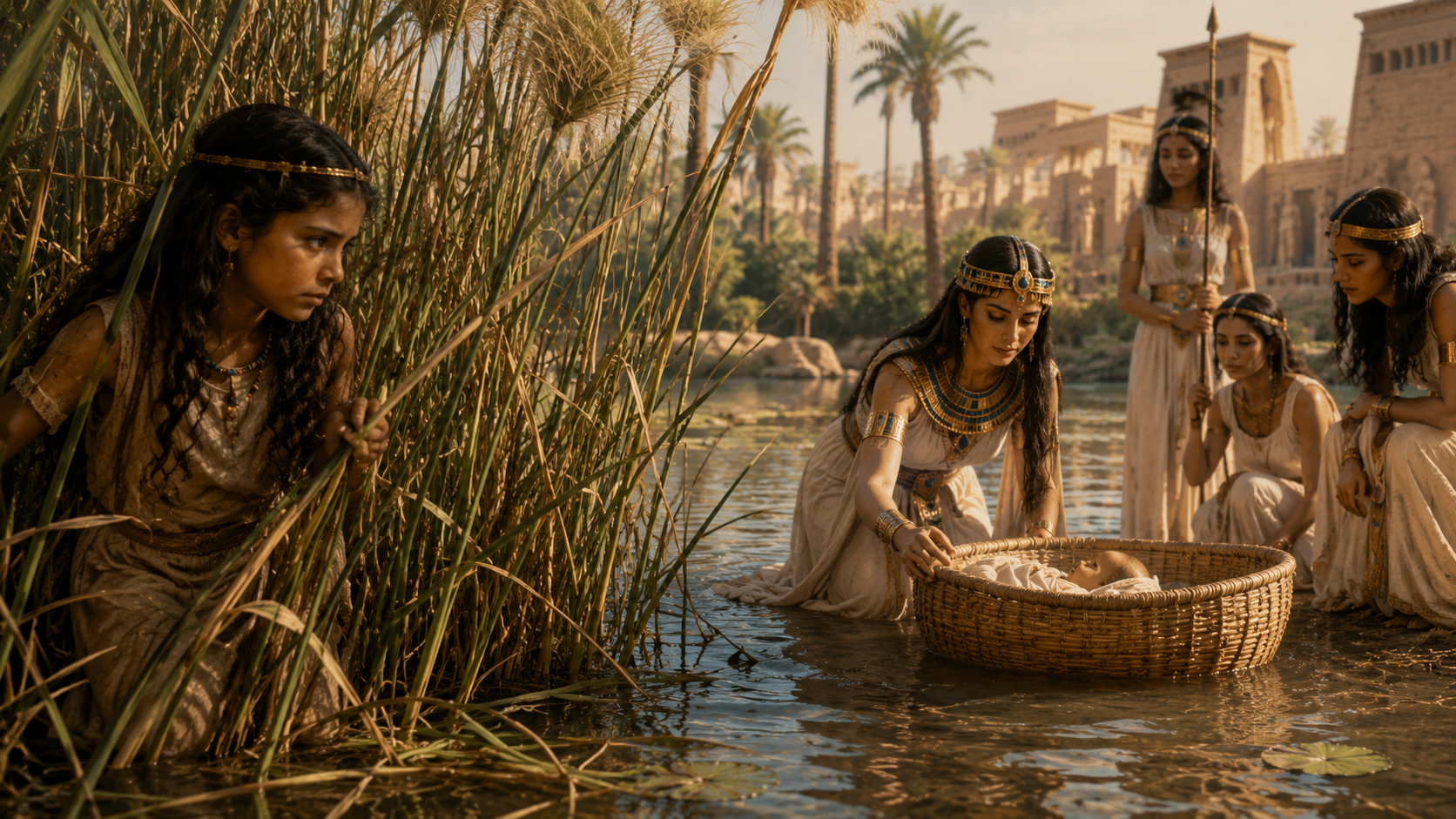
Exodus 2:4 mentions almost in passing: "And his sister stood at a distance to know what would be done to him."
This is Miriam — not named until Exodus 15:20 but already defined here. Somewhere between seven and twelve years old. Stationed there by her mother. This was a planned operation: place the baby, watch from a distance, be ready to act.
The phrase "to know what would be done to him" is significant. The Hebrew yada — to know — carries more weight than simple observation. It implies invested concern, relational knowledge. Miriam is not a neutral observer. She has skin in this. She loves this child.
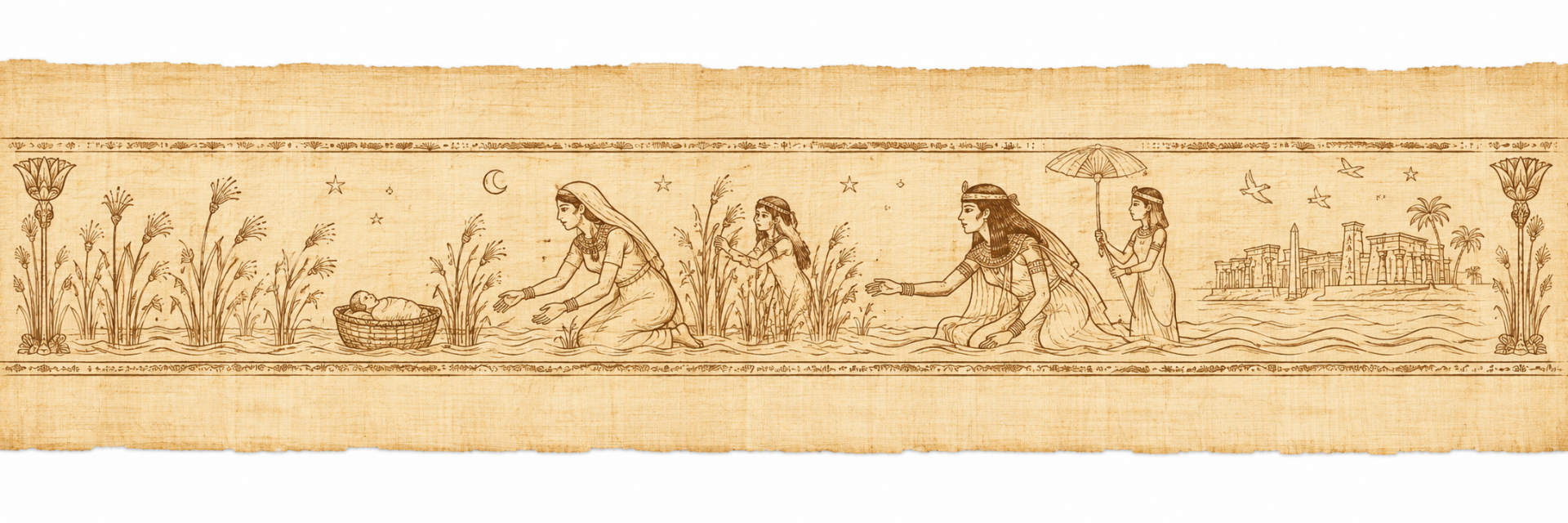
When Pharaoh's daughter finds the basket and responds with compassion, it is Miriam who steps forward — a slave girl approaching the princess of Egypt — and calmly offers to find a Hebrew wet nurse. The audacity is staggering. She is a child. She is a slave. She approaches royalty with a proposal, as if she had every right to be there. And it works.
Pharaoh's daughter says yes. Miriam runs to get her mother. And Jochebed is paid wages — by Pharaoh's own daughter — to nurse her own son. What Pharaoh meant for death, God turned into a paycheck. The irony is so complete it can only be divine.
— ✦ —
Part Two — Section V
Pharaoh's Daughter: Who Was She?
Compassion across every line that mattered
The Identity Question
Exodus 2:5 identifies the woman who finds Moses only as "Pharaoh's daughter." She is not named in the Hebrew text. But she has been one of the most debated figures in the historical study of the Exodus.
1 Chronicles 4:18 mentions a woman named Bithiah (also Bityah or Batya) as "the daughter of Pharaoh." Her name means daughter of YHWH or daughter of God — a remarkable name for an Egyptian princess, suggesting she was honored in Israel's memory for her act of faith.
Rabbinic Tradition — Talmud, Megillah 13a
The Talmud contains an extended and beautiful tradition about Bithiah. The rabbis say God renamed her "daughter of God" in honor of her compassion: "You called him my son when he was not your son. I will call you my daughter when you are not my daughter."
In this tradition she is honored as a righteous gentile — a woman who performed an act of radical mercy across every line of power, ethnicity, and law.
If Ramesses II is the Pharaoh of the Exodus, she may have been one of his more than 100 recorded children. Under the early date, the princess may have been Hatshepsut — who famously became co-regent and pharaoh herself. This identification is historically intriguing but unprovable. What matters theologically is this: the very instrument of Moses' salvation was Pharaoh's own household. The man who ordered Hebrew boys drowned in the Nile funded, through his daughter, the nursing and upbringing of the man who would undo everything he had built.
Her Compassion Across the Divide
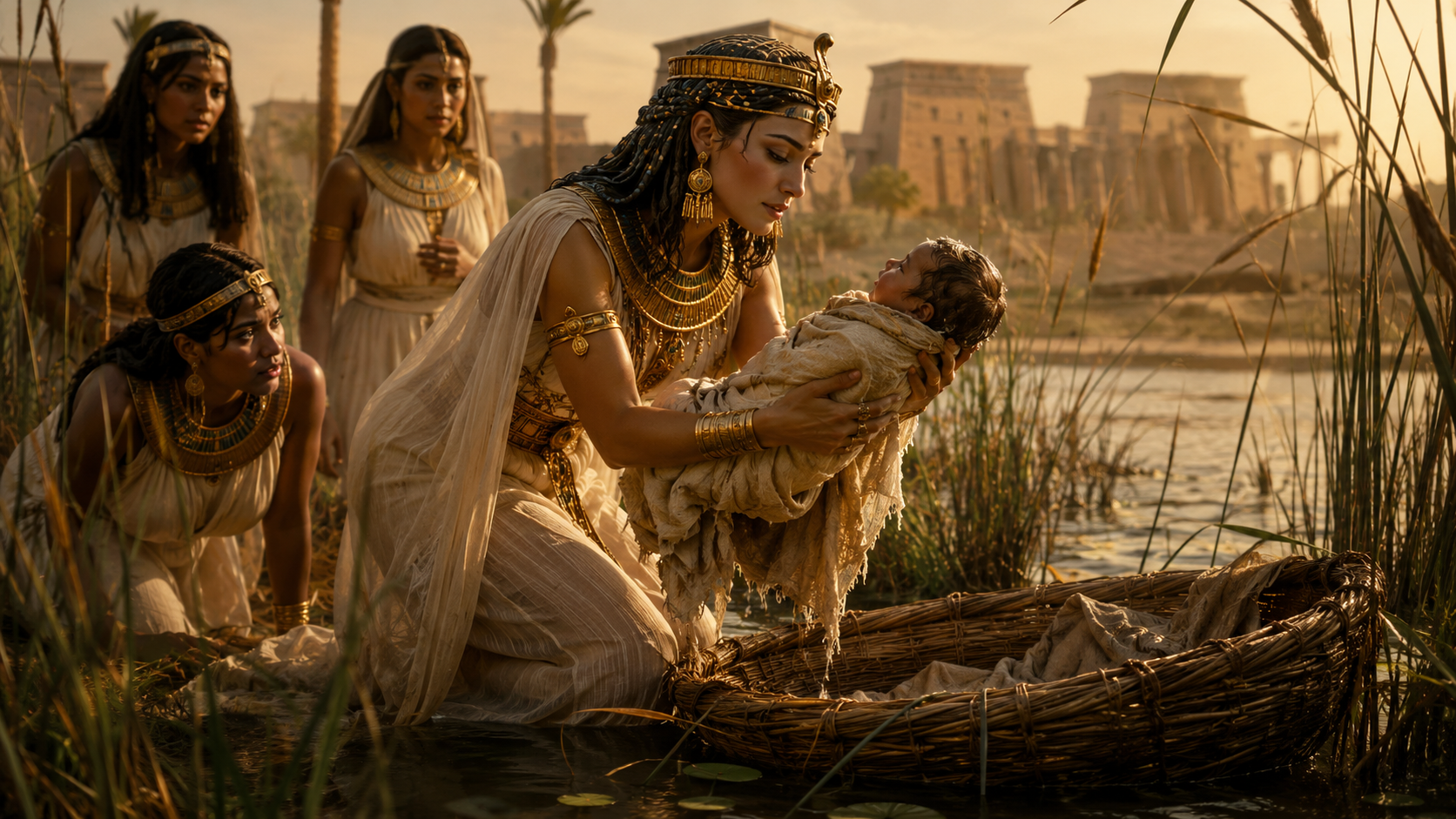
Exodus 2:6 says she opened the basket, saw the weeping child, and vatachmel alav — she had compassion on him. The root chamal means a deep, visceral mercy — the kind that stops you in your tracks. She knew immediately: "This is one of the Hebrews' children." She says it plainly. She knows this child is supposed to be dead. She knows her father's law. And she picks him up anyway.
She becomes, in her way, a type of grace — receiving the outcast, giving him identity, even giving him his name. She named him Moses, saying, "Because I drew him out of the water." The name Moshe in Hebrew sounds like mashah — to draw out. He was drawn out of water. He will one day draw an entire nation out through water. The name given by a pagan princess in a language she may not have fully understood contains his destiny.
— ✦ —
Part Two — Section VI
The Egyptian Palace: What Moses Inherited
Acts 7:22 — instructed in all the wisdom of the Egyptians
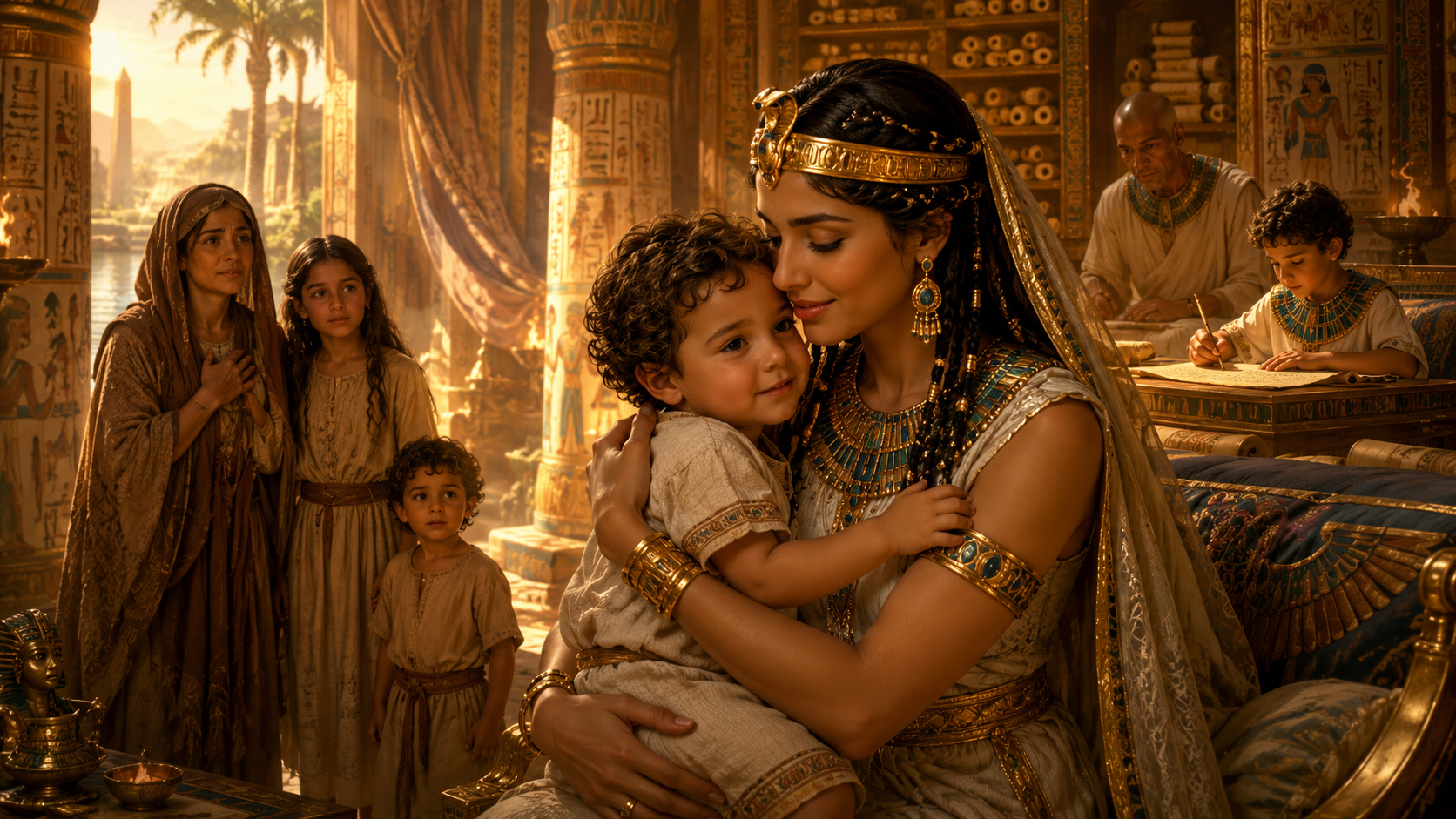
Exodus 2:10 says Moses "became her son" — carrying full legal and social weight. He was adopted into the royal household. Acts 7:22 tells us Moses was "instructed in all the wisdom of the Egyptians, and he was mighty in his words and deeds."
Egyptian royal education in the New Kingdom period was among the most sophisticated in the ancient world. It included:
- Scribal training— reading and writing hieroglyphics, hieratic script, and likely cuneiform for diplomatic correspondence. A man who could not read was a man who could not lead.
- Mathematical and engineering knowledge— the precision required for pyramid and temple construction demanded sophisticated geometry, surveying, and logistics management.
- Military training— royal sons were trained for potential military command, including tactics, weaponry, and the management of forces.
- Religious and theological education— the systems of the Egyptian gods, the rituals of the priesthood, the mythology that undergirded the entire state. Moses knew exactly what he was dismantling when the plagues came.
- Diplomatic protocol— how to address foreign rulers, how to negotiate, how to understand power. None of this was wasted when Moses stood before Pharaoh as God's spokesman.
Divine Irony
God trained His deliverer inside the enemy's own household for forty years. He used Pharaoh's system to educate the man who would break it. The palace that was meant to oppress Israel funded and formed the one who would liberate Israel.
— ✦ —

Part Two — Section VII
Theological Depths: The Theology of the Basket
Surrender, irony, and the fingerprint of God
Surrender as an Act of Faith
The central theological act of this narrative is not the parting of a sea or the descent of fire. It is a mother placing a baby in a basket and letting go.
Hebrews 11:1 defines faith as "the assurance of things hoped for, the conviction of things not seen." Jochebed could not see what would happen once the basket left her hands. No angel appeared to her saying "it will be okay." She acted on hope — hope that the God who made promises to Abraham, Isaac, and Jacob was still paying attention; that tov was worth fighting for; that the Nile did not have the final word.
This is the pattern of what we might call the theology of release: Abraham releasing Isaac on Mount Moriah. Hannah releasing Samuel to Eli. Mary releasing Jesus to a ministry she did not fully understand. The basket in the reeds is the first of these great moments of surrender-as-trust in the Bible.
The Irony Structure of Providence
God consistently uses the instruments of the enemy to accomplish His purposes. The basket story is a masterpiece of this structure:
- Pharaoh commanded Hebrew boys to be drowned in the Nile. God used the Nile to carry His deliverer to safety.
- Pharaoh's daughter — member of the household that decreed genocide — became the instrument of Moses' salvation.
- Jochebed was paid wages by the royal household to nurse the very child Pharaoh wanted dead.
- The palace that was meant to crush Israel funded and educated the one who would liberate Israel.
This irony structure is the fingerprint of God throughout Scripture. "What you intended for evil, God intended for good" — Joseph's words in Genesis 50:20 — is the governing principle of the entire Moses narrative, and ultimately of the entire biblical story. The cross is its ultimate expression: what the enemy intended as the final humiliation of God's Son became the instrument of cosmic redemption.
— ✦ —
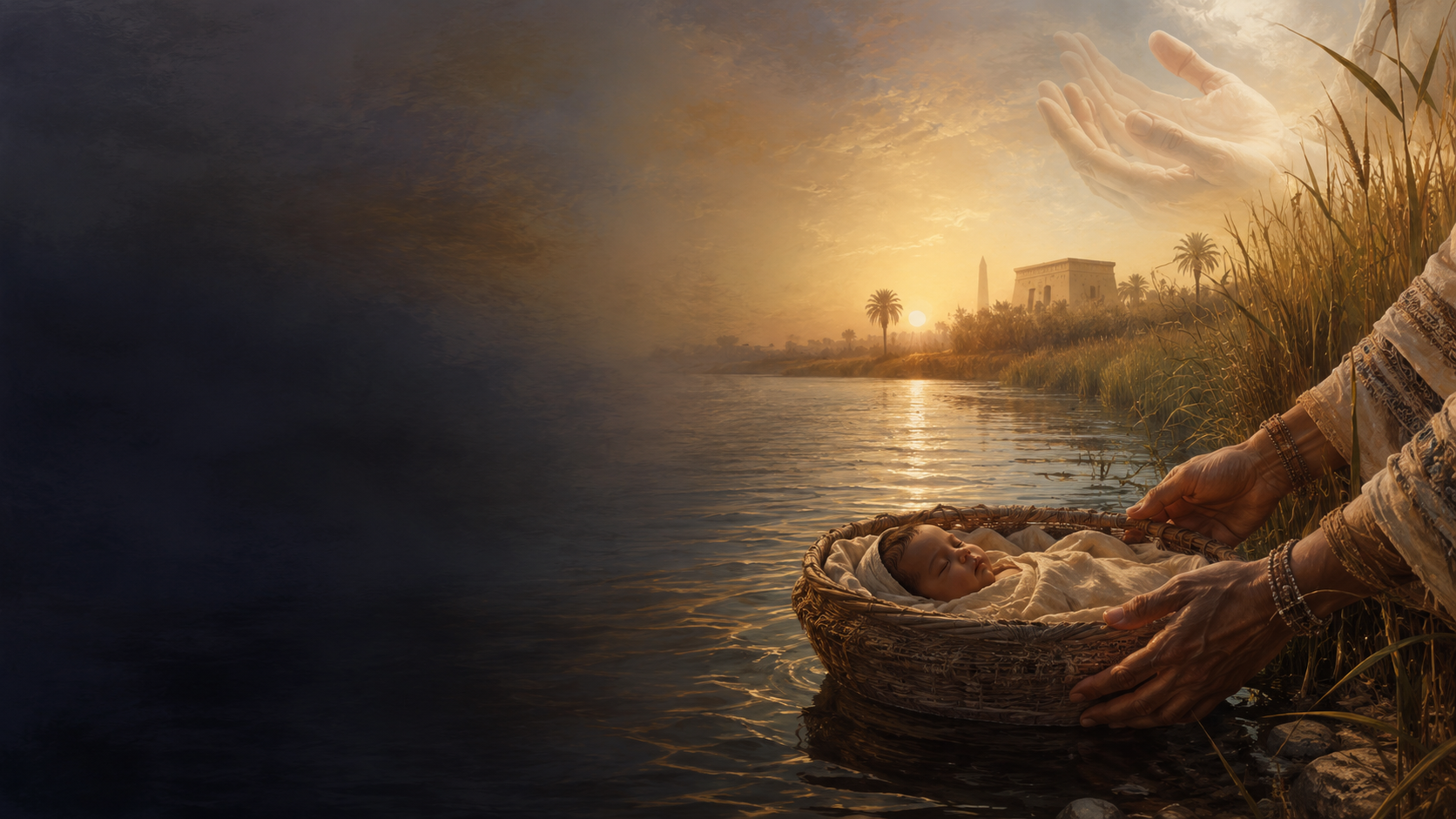
Part Two — Section VIII
Devotional
Letting Go of What You Cannot Keep
Devotional Reading
Some things cannot be kept by holding them tightly.
Jochebed understood this. She had held Moses for three months — longer than was safe, longer than was rational, longer than any mother should have had to. And then she built a basket, sealed every crack, and placed her entire heart in it and pushed it into a river that had already swallowed other children. She did not know what would happen. She only knew she could not keep him and could not kill him, and so she trusted him to something larger than herself.
There is a basket in most of our lives. Some love we've been holding past the point where holding is possible. A child who needs to make their own mistakes. A dream that has to be surrendered before it can be given back. A grief that cannot heal until it's released. A relationship that must be placed in God's hands or it will suffocate under ours.
The act of putting Moses in the basket was not giving up. It was the most active, most courageous, most intentional thing Jochebed ever did. She built the vessel carefully. She sealed it thoroughly. She positioned it deliberately. She stationed a daughter to watch. And then she opened her hands.
This is what faith looks like when it is most costly. Not the faith of the sermon illustration, clean and triumphant. The faith of the mother walking home with empty arms, not knowing if her son is alive, trusting that the God who named Himself glory in her own name — the God who was the LORD is my glory — would not abandon what she had released to Him.
What are you holding past the point where holding is possible? What needs to go into the basket today?
Reflection & Discussion Questions
Personal Reflection
1.Jochebed hid Moses for three months through daily, costly acts of courage. What does this tell you about what faith looks like in practice — not as a single dramatic moment, but as a daily choice sustained over time?
2.The basket narrative is built on strategic surrender — doing everything you can, then releasing the outcome. Is there something in your life right now that you need to "put in the basket"? What is making it hard to let go?
3.Pharaoh's daughter had compassion on Moses despite knowing he was a child her father had condemned to death. What does her act of mercy across every social, ethnic, and legal boundary say to you about the nature of compassion?
— ✦ —
Deeper Study
— ✦ —

Closing Prayer
Dear Father, My Father, Father of Moses, Father of Jochebed, Father of us all —
We come to You, always holding on to things too tightly. We hold on to Children. Dreams. Relationships. Goals and Outcomes. We come to You with white-knuckled hands and hearts afraid that if we let go, the river will win and we will lose.
But with you, the Great I Am, you are God and nothing is out of your reach.
Teach us the faith of the basket. Teach us, The faith that seals every crack it can seal, positions every thing it can position, stations every watchman it can station — and then opens its hands and let it go to you, the grower of seeds, the nurturer that tends the garden with his everlasting love. The God that shaped the world, built nations and restored us through his son.
Remind us that the Nile was not in charge that morning. You were.
Remind us that the compassion that moved in Pharaoh's daughter was not accidental — it was placed there, by You, at the precise moment it was needed.
Remind us that You are sovereign over the rivers, mountains and valleys that frighten us.
For those of us who are walking home with empty arms right now — who have released something precious and don't yet know the outcome — be near. For you are near the brokenhearted. And it can feel like heartbreak when we surrender something.
You are the God whose name means glory. You are the God who was paying attention when no one else seemed to be.
And for those of us who have found our Moses — those people or things restored to us from the waters — let us receive them with the gratitude of those who know it was not our own cleverness that brought them back, but your work in your plans. Let us sing songs of praise and gratefulness for you are the God of epic testimonies.
In the name of Jesus, who was Himself placed in a vessel of wood and carried through death to resurrection,
Amen.
Coming Next in the Series
Part Three: The Palace and the Pit
Moses grows up straddling two worlds — the marble halls of the Egyptian palace and the mud-brick hovels of the Hebrew slave quarter. We explore what the Egyptian education system looked like, the psychological formation of a man with a double identity, what it means to know who you are when the world tells you something different, and the theological significance of Moses' Hebrew mother nursing him in those critical early years before the palace claimed him.
Add comment
Comments