"Your word is a lamp to my feet and a light to my path."
— Psalm 119:105
Have you ever sat down to read your Bible and felt unsure where to start — or walked away feeling like you barely scratched the surface? You're not alone. The Bible is the living Word of God, rich with history, poetry, prophecy, wisdom, and truth. But knowing how to study it can make all the difference between a surface-level read and a life-changing encounter with Scripture.
Whether you're a new believer just getting started or a seasoned Christian looking to go deeper, having a structured study method can help you slow down, engage more intentionally, and walk away truly transformed by what you've read.
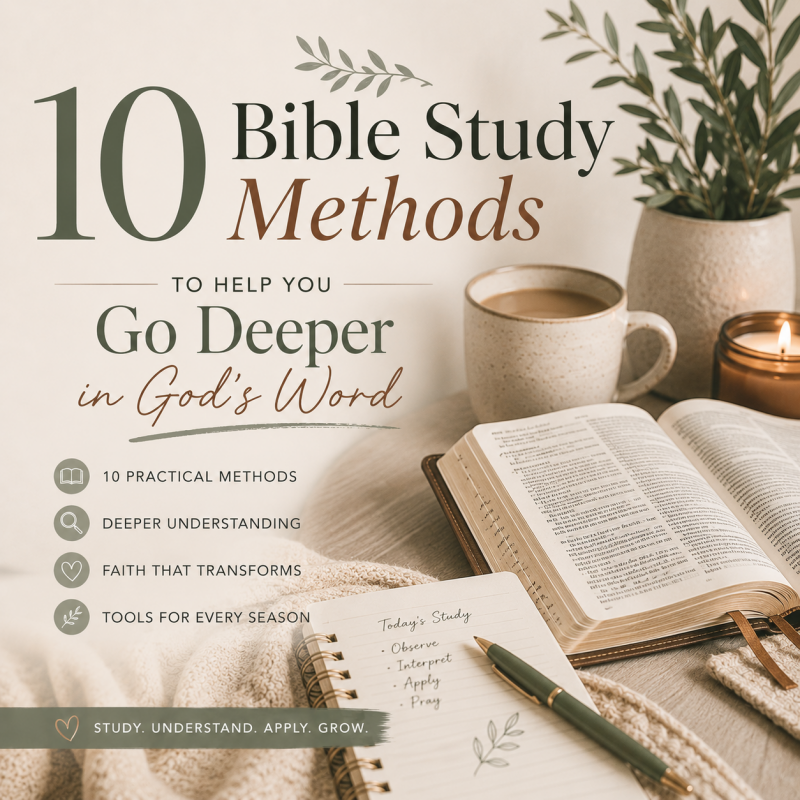
In this post, I'm sharing 10 Bible study methods — including all the methods featured in my free downloadable Bible Study Journal — along with tips for using them well. By the end, you'll have a toolkit you can draw from every time you open God's Word.

Why Use a Bible Study Method?
Reading the Bible is always valuable. But studying it is different. A study method gives you:
- Focus — you're not just reading words, you're seeking meaning
- Structure — a framework keeps your thoughts organized
- Depth — prompts push you past the surface into real understanding
- Application — methods help you connect Scripture to your actual life
The goal isn't to turn Bible study into homework. It's to create space for God to speak — and for you to truly listen.
The 10 Methods
1. The OIA Method (Observe · Interpret · Apply)
Best for: Inductive Bible study | Beginners and experienced students alike
The OIA Method is one of the most widely taught inductive Bible study approaches. It walks you through three essential questions:
- Observe — What does the text say? Read slowly and prayerfully. Note who, what, when, where, why, and how. List key words, phrases, and repeated ideas.
- Interpret — What does the text mean? What is the author communicating? What is the main point? How does it fit the surrounding context, and what other scriptures shed light on it?
- Apply — What does the text mean for me? What is God teaching you personally? How should this shape your thoughts, attitudes, or actions today?
Pro Tip: The biggest mistake people make is jumping straight to application before doing the hard work of observation. Slow down in step one — the richest insights come from careful observation.
2. The SOAP Method (Scripture · Observation · Application · Prayer)
Best for: Daily devotionals | Quick but meaningful engagement with Scripture
SOAP is one of the most popular Bible study methods because of its simplicity. It works beautifully as a daily devotional rhythm.
- S — Scripture: Write out the specific verse(s) you're reading. Writing slows you down and helps the words sink in.
- O — Observation: Note key themes, main ideas, or anything that stands out to you.
- A — Application: Write a sentence or two about how you can live out this truth today.
- P — Prayer: Turn your reflections into a direct prayer to God.
Pro Tip: Don't rush the prayer step. This is where study becomes conversation — where you bring what you've learned directly back to God - here is an amazing SOAP Journal for women.

3. The TEXT Method (Talk · Encounter · eXamine · Talk)
Best for: Connecting Scripture to your heart and others | Small groups or personal devotions
TEXT is a beautifully holistic method that bookends your study with prayer and community:
- T — Talk to God in prayer before you read. Invite the Holy Spirit to open your heart and mind.
- E — Encounter God and humanity in Scripture. Ask: What does this passage say about God? What does it say about humanity?
- X — eXamine your heart. What needs to be confessed, added, taken away, or maintained as a follower of Jesus?
- T — Talk to God and others. Thank God for what He's shown you. Then share it with someone else.
Pro Tip: The final "T" is often overlooked — but sharing what God is teaching you multiplies the impact and builds community. Look up this method in the bible study book.

4. The Verse-Mapping Method
Best for: Deep word-level study | Understanding the original meaning of a passage
Verse mapping is a more intensive method perfect for when you want to go deep on a single verse or passage.
The 5 Steps:
- Write out your chosen verse(s) in your own Bible translation.
- Write it out in at least two other translations to see how the wording shifts.
- Circle keywords and look them up in the original Hebrew or Greek. Note the transliteration, definition, synonyms, and root word.
- Explore the meaning and message — consider people, places, context, and cross-references.
- Summarize in 1–2 sentences and write your application.
Pro Tip: Free tools like Blue Letter Bible make it easy to look up original language meanings without knowing Hebrew or Greek. Another Verse Mapping workbook to look at.
5. The Topical Bible Study Method
Best for: Studying a specific theme, doctrine, or life question | Research-style learners
Rather than studying passage by passage, a topical study follows a theme (like grace, prayer, forgiveness, or identity) across multiple scriptures.
The 7 Steps:
- Choose a topic you want to explore
- Look up key references using a concordance or Bible search
- Choose the verses you'll study
- Ask guiding questions: What does this teach about God? About Jesus? About people? What promises, commands, or warnings are here?
- Read each verse and note how it addresses your questions
- Summarize your conclusions
- Write your application — how will this truth change how you live?
Pro Tip: Start with a topic that's personally relevant. You'll engage more deeply when the subject connects to something you're actually walking through. Here is a great guide on this study method.
6. The Systematic Theology Method
Best for: Building a solid theological foundation | Understanding what the whole Bible teaches on key doctrines
Systematic Theology sounds intimidating — but the method is simply about studying what the entire Bible says about a specific doctrine or belief.
The categories to explore include:
- Bibliology (The Study of the Bible)
- Theology Proper (The Study of God)
- Christology (The Study of Christ)
- Pneumatology (The Study of the Holy Spirit)
- Soteriology (The Study of Salvation)
- Eschatology (The Study of Last Things) — and more
The 6 Steps:
- Choose a major theological category
- Define the doctrine in your own words
- Gather key scriptures that teach on this doctrine
- Organize and compare — group related truths and themes
- Synthesize the teaching into a clear statement of belief
- Apply — What should you believe, value, and do?
Pro Tip: This method pairs beautifully with a good systematic theology book (like Wayne Grudem's Systematic Theology) for reference and background.

7. The 4-H Method (History · How · Him · Hope)
Best for: Christ-centered, gospel-focused Bible study | Seeing how all of Scripture points to Jesus
The 4-H method is grounded in the conviction that all of Scripture — Old and New Testament — ultimately points to Jesus Christ.
- H — History: What is the history of this text? Consider context, setting, characters, and what is literally happening.
- H — How: How do I do what this text says? What is it teaching me to do, and how can I apply it to my life today?
- H — Him: Does the text teach me about Jesus? How does this passage point to His character, work, or plan of redemption?
- H — Hope: Where does this text give me hope? What eternal truth does it reveal, and how does it point to the hope we have in Christ?
Pro Tip: The "Him" question is powerful for Old Testament passages. Ask: How does this foreshadow, point to, or find its fulfillment in Jesus?
le make it easy to look up original language meanings without knowing Hebrew or Greek.
8. The Word Bible Study Method
Best for: Deep word-level study | Serious students of Scripture
This method takes a single biblical word and studies it thoroughly — tracing its meaning, usage, and significance across the whole Bible.
The 8 Steps:
- Find the English definition of the word
- Look up the original word (Hebrew, Greek, or Aramaic) and its short definition
- Compare how the word is translated across different Bible versions (NIV, ESV, NLT, KJV)
- Research biblical usage — how often does it appear? In which books?
- Find the root meaning and etymological origin
- Explore how it was used in the culture of the day
- Study how it's used in Scripture to reveal truths about God, humanity, sin, and redemption
- Write your application and prayer response
Suggested words to study: Grace, Faith, Redemption, Love, Peace, Mercy, Gospel, Sanctify, Repent, Covenant
Pro Tip: Use Strong's Concordance to find original language definitions for any word.
9. Chapter Analysis Method
Best for: Thorough passage study | Understanding a chapter in its full context
The Chapter Analysis method takes you through an entire chapter of the Bible with structured questions:
- Read the chapter through at least three times — once for overview, once slowly for detail, once prayerfully
- Title the chapter — what one phrase captures the main theme?
- Outline the major sections — break it into paragraphs or thought units
- Identify key people, places, and events
- Note repeated words and phrases
- Find the key verse — which single verse best captures the chapter's message?
- Connect to the rest of Scripture — how does this fit in the broader context of the book and the Bible?
- Write your application — what one truth will you take with you?
Pro Tip: Reading the chapter in multiple translations before studying helps you catch nuances you might miss in one version alone.
10. The Devotional / Meditation Method
Best for: Quiet, reflective time with God | Anyone who wants to simply sit with Scripture
Not every Bible study needs to be structured or academic. The devotional method is about lingering in the Word — letting it speak to you personally.
A simple approach:
- Choose a short passage (1–5 verses)
- Read it slowly, multiple times
- Ask: What word or phrase stands out to me?
- Sit quietly and let God speak to your heart
- Respond in writing — a prayer, a declaration, or a simple reflection
- Memorize a key phrase or verse to carry with you through the day
Pro Tip: This method works beautifully alongside lectio divina, an ancient Christian practice of slow, prayerful Scripture reading.
Tools to Help You Study the Bible Well
No matter which method you choose, these tools will take your study deeper:
| Tools | Best For |
|---|---|
| Blue Letter Bible (blueletterbible.org) | Original language study, commentaries, cross-references |
| Bible Gateway (biblegateway.com) | Reading in multiple translations, searching passages |
| Strong's Concordance | Finding every occurrence of a word in the Bible |
| Bible Dictionary / Encyclopedia | Background on people, places, and culture |
| Commentary (e.g. Matthew Henry, ESV Study Bible) | Historical and theological context |
| Bible Atlas | Understanding geography and historical setting |
| Prayer journal | Recording what God speaks to you |
Which Method Is Right for You?
There's no single "best" method — the best one is the one you'll actually use. Here's a quick guide:
| If you want to… | Try this method |
|---|---|
| Build a simple daily habit | SOAP |
| Study a passage thoroughly | SOAPStudy a passage thoroughlyOIA or Chapter Analysis |
| Go deep on a single verse | Verse Mapping or Word Study |
| Study a theme across the Bible | Topical |
| Build theological understanding | Systematic Theology |
| See Jesus throughout Scripture | 4-H Method |
| Combine prayer and community | TEXT Method |
| Simply sit and listen to God | Devotional / Meditation |
Download the Free Bible Study Journal
To help you put all of these methods into practice, I've created a free Bible Study Journal you can download and print. It includes fillable worksheets for:
✅ The OIA Method
✅ The SOAP Method
✅ The TEXT Method
✅ The Verse-Mapping Method
✅ The Topical Bible Study Method
✅ The Systematic Theology Method
✅ The 4-H Method
✅ The Word Bible Study Method
✅ Chapter Analysis

Links to some cool free resources
- Blue Letter Bible (blueletterbible.org
- Bible Gateway (biblegateway.com)
- https://biblehub.com/
- https://www.biblestudytools.com/concordances/strongs-exhaustive-concordance/
- https://www.eliyah.com/lexicon.
- https://www.internationalstandardbible.com/
- https://thekingsbible.com/Atlas
- https://enduringword.com/
- https://www.netbible.org/bible/Matthew+1
- https://thetreasuryofscriptureknowledge.com/
- https://bibleproject.com/
- https://www.biblestudytools.com/
- Bible Atlas for beginners
A Final Word
However you study God's Word — whether you're a list-maker or a free-writer, a deep-diver or a daily-devotional person — what matters most is that you show up. Open the Bible. Ask God to speak. And trust that His Word never returns empty.
"So is my word that goes out from my mouth: It will not return to me empty, but will accomplish what I desire and achieve the purpose for which I sent it."
— Isaiah 55:11
Happy studying. 💛
Did this help you? Share it with a friend who wants to go deeper in God's Word!
Add comment
Comments