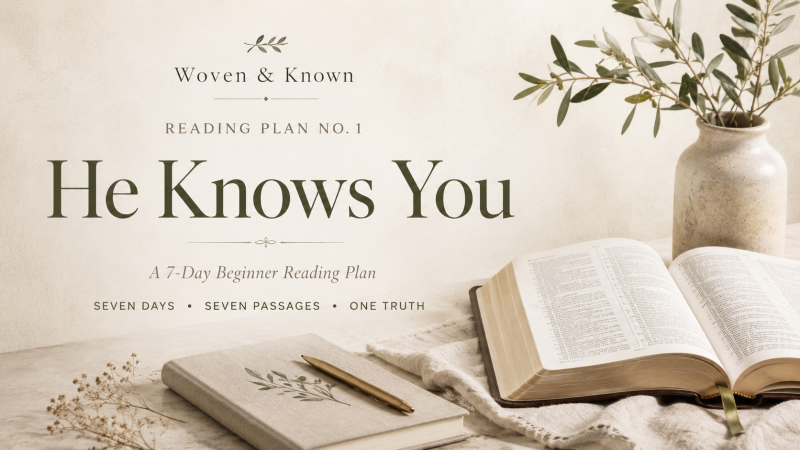
A 7-Day Beginner Reading Plan
Seven days · Seven passages · One truth
Before I formed you in the womb I knew you,
before you were born I set you apart.
Jeremiah 1:5 · NIV
Before you begin
This isn't a study. There are no right answers, no essays to write, no theology to master. This is simply an invitation to open the Bible and let it speak.
Seven passages. One thread: the idea that God has always known you, always seen you — and that nothing changes that.
Come as you are.
1
Find a quiet moment
Even 10 minutes is enough.
2
Open your Bible or Bible Gateway
The translation for each day is listed. All are free online.
3
Read once through
Don't stop to analyse. Just read..
4
Read again, slowly
Notice what catches you. A word. An image. A question..
5
Make a note
A journal, your phone, or just hold it in your mind.
6
That's enough
You did it. Well done.
Before You Were Born
Grab your bible or your bible app or use the links below to read the full passage.
Todays reading is Psalm 139:1-18
so let's begin.
Read Psalm 139 : 1 – 18
For the Chief Musician. A Psalm by David.
139 Yahweh, you have searched me,
and you know me.
2 You know my sitting down and my rising up.
You perceive my thoughts from afar.
3 You search out my path and my lying down,
and are acquainted with all my ways.
4 For there is not a word on my tongue,
but behold, Yahweh, you know it altogether.
5 You hem me in behind and before.
You laid your hand on me.
6 This knowledge is beyond me.
It’s lofty.
I can’t attain it.
7 Where could I go from your Spirit?
Or where could I flee from your presence?
8 If I ascend up into heaven, you are there.
If I make my bed in Sheol,[a] behold, you are there!
9 If I take the wings of the dawn,
and settle in the uttermost parts of the sea,
10 even there your hand will lead me,
and your right hand will hold me.
11 If I say, “Surely the darkness will overwhelm me.
The light around me will be night,”
12 even the darkness doesn’t hide from you,
but the night shines as the day.
The darkness is like light to you.
13 For you formed my inmost being.
You knit me together in my mother’s womb.
14 I will give thanks to you,
for I am fearfully and wonderfully made.
Your works are wonderful.
My soul knows that very well.
15 My frame wasn’t hidden from you,
when I was made in secret,
woven together in the depths of the earth.
16 Your eyes saw my body.
In your book they were all written,
the days that were ordained for me,
when as yet there were none of them.
17 How precious to me are your thoughts, God!
How vast is their sum!
18 If I would count them, they are more in number than the sand.
When I wake up, I am still with you.
WEB Version - Public Domain

Context
Psalm 139 is a poem written by King David — a man who had known great triumph and devastating failure. He writes this not from a mountaintop but from a place of deep honesty. He is not performing for God. He is sitting with the reality that God has always known him completely, and choosing to rest in that rather than hide from it.
What to notice as you read
- Notice every verb David uses to describe what God does — search, know, understand, perceive, hem in. Count them.
- Where is David when he writes this? Is he at peace, or is there an undercurrent of something?
- The very last two verses shift. What does David ask for at the end, and why might that matter?
Reflect
- What would it feel like to be fully known and not run from it?
- Is there a word or image in this passage that stays with you?
The God Who Sees
Grab your bible or your bible app or use the links below to read the full passage.
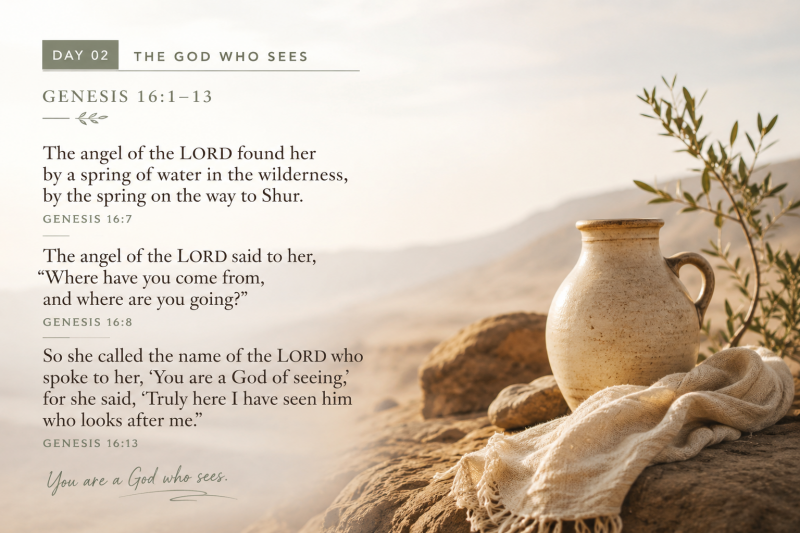
Todays reading is Genesis 16 : 1 – 13
so let's begin.
Read Genesis 16 : 1 – 13
16
Now Sarai, Abram’s wife, bore him no children. She had a servant, an Egyptian, whose name was Hagar. 2 Sarai said to Abram, “See now, Yahweh has restrained me from bearing. Please go in to my servant. It may be that I will obtain children by her.” Abram listened to the voice of Sarai. 3 Sarai, Abram’s wife, took Hagar the Egyptian, her servant, after Abram had lived ten years in the land of Canaan, and gave her to Abram her husband to be his wife. 4 He went in to Hagar, and she conceived. When she saw that she had conceived, her mistress was despised in her eyes. 5 Sarai said to Abram, “This wrong is your fault. I gave my servant into your bosom, and when she saw that she had conceived, she despised me. May Yahweh judge between me and you.”
6 But Abram said to Sarai, “Behold, your maid is in your hand. Do to her whatever is good in your eyes.” Sarai dealt harshly with her, and she fled from her face.
7 Yahweh’s angel found her by a fountain of water in the wilderness, by the fountain on the way to Shur. 8 He said, “Hagar, Sarai’s servant, where did you come from? Where are you going?”
She said, “I am fleeing from the face of my mistress Sarai.”
9 Yahweh’s angel said to her, “Return to your mistress, and submit yourself under her hands.” 10 Yahweh’s angel said to her, “I will greatly multiply your offspring, that they will not be counted for multitude.” 11 Yahweh’s angel said to her, “Behold, you are with child, and will bear a son. You shall call his name Ishmael, because Yahweh has heard your affliction. 12 He will be like a wild donkey among men. His hand will be against every man, and every man’s hand against him. He will live opposed to all of his brothers.”
13 She called the name of Yahweh who spoke to her, “You are a God who sees,” for she said, “Have I even stayed alive after seeing him?”
WEB Version - Public Domain
Context
Hagar is an Egyptian slave woman — not a matriarch, not a hero of the faith. She has been used, mistreated, and driven out into the desert alone and pregnant. And yet God finds her. She gives God a name — and this is the only place in all of Scripture where a human being names God. That is not a small thing.
What to notice as you read
- Who initiates the encounter — Hagar or God?
- What is the very first thing the angel asks her? Why might that question matter?
- She gives God a name. This is the only place in the Bible where a human being names God. Sit with that.
Reflect
- Have you ever felt like you were somewhere no one could see you? What does this story say to that?
- What does it mean that God came to someone outside the 'main story'?
What You Were Made For
Todays reading is Genesis 1 : 26 – 31 + Genesis 2 : 7, 15 – 25
so let's begin.
Read Genesis 1 : 26 – 31 + Genesis 2 : 7, 15 – 25
26 God said, “Let’s make man in our image, after our likeness. Let them have dominion over the fish of the sea, and over the birds of the sky, and over the livestock, and over all the earth, and over every creeping thing that creeps on the earth.” 27 God created man in his own image. In God’s image he created him; male and female he created them. 28 God blessed them. God said to them, “Be fruitful, multiply, fill the earth, and subdue it. Have dominion over the fish of the sea, over the birds of the sky, and over every living thing that moves on the earth.” 29 God said, “Behold,[a] I have given you every herb yielding seed, which is on the surface of all the earth, and every tree, which bears fruit yielding seed. It will be your food. 30 To every animal of the earth, and to every bird of the sky, and to everything that creeps on the earth, in which there is life, I have given every green herb for food;” and it was so.
31 God saw everything that he had made, and, behold, it was very good. There was evening and there was morning, a sixth day.
7 Yahweh God formed man from the dust of the ground, and breathed into his nostrils the breath of life; and man became a living soul.
15 Yahweh God took the man, and put him into the garden of Eden to cultivate and keep it. 16 Yahweh God commanded the man, saying, “You may freely eat of every tree of the garden; 17 but you shall not eat of the tree of the knowledge of good and evil; for in the day that you eat of it, you will surely die.”
18 Yahweh God said, “It is not good for the man to be alone. I will make him a helper comparable to[a] him.” 19 Out of the ground Yahweh God formed every animal of the field, and every bird of the sky, and brought them to the man to see what he would call them. Whatever the man called every living creature became its name. 20 The man gave names to all livestock, and to the birds of the sky, and to every animal of the field; but for man there was not found a helper comparable to him. 21 Yahweh God caused the man to fall into a deep sleep. As the man slept, he took one of his ribs, and closed up the flesh in its place. 22 Yahweh God made a woman from the rib which he had taken from the man, and brought her to the man. 23 The man said, “This is now bone of my bones, and flesh of my flesh. She will be called ‘woman,’ because she was taken out of Man.” 24 Therefore a man will leave his father and his mother, and will join with his wife, and they will be one flesh. 25 The man and his wife were both naked, and they were not ashamed.
WEB version - Public domain

Context
Before anything goes wrong in the Bible — before betrayal, exile, or struggle — there is this. A God who creates on purpose, who steps back and calls it very good, who breathes life directly into human beings. This is the foundation. Whatever else the Bible says about brokenness, it says this first.
What to notice as you read
- How does God create everything else in chapter 1 — and how is the creation of humans different in chapter 2?
- The phrase 'in our image' — what do you think that includes?
- Notice the rhythm of chapter 1. God speaks. It happens. God sees that it is good. What does that rhythm feel like?
Reflect
- You were called 'very good' before you did anything. How does that land?
- What does it mean to be made from earth but given divine breath?
When God Calls You By Name
Today's reading is John 10 : 1 – 15
so let's begin.
Read John 10 : 1 – 15
10
“Most certainly, I tell you, one who doesn’t enter by the door into the sheep fold, but climbs up some other way, is a thief and a robber. 2 But one who enters in by the door is the shepherd of the sheep. 3 The gatekeeper opens the gate for him, and the sheep listen to his voice. He calls his own sheep by name and leads them out. 4 Whenever he brings out his own sheep, he goes before them; and the sheep follow him, for they know his voice. 5 They will by no means follow a stranger, but will flee from him; for they don’t know the voice of strangers.”
6 Jesus spoke this parable to them, but they didn’t understand what he was telling them.
7 Jesus therefore said to them again, “Most certainly, I tell you, I am the sheep’s door. 8 All who came before me are thieves and robbers, but the sheep didn’t listen to them. 9 I am the door. If anyone enters in by me, he will be saved, and will go in and go out and will find pasture. 10 The thief only comes to steal, kill, and destroy. I came that they may have life, and may have it abundantly.
11 “I am the good shepherd. The good shepherd lays down his life for the sheep. 12 He who is a hired hand, and not a shepherd, who doesn’t own the sheep, sees the wolf coming, leaves the sheep, and flees. The wolf snatches the sheep and scatters them. 13 The hired hand flees because he is a hired hand and doesn’t care for the sheep. 14 I am the good shepherd. I know my own, and I’m known by my own; 15 even as the Father knows me, and I know the Father. I lay down my life for the sheep.
WEB Version - Public Domain

Context
Jesus is speaking to a crowd in Jerusalem, many of whom are sceptical. He uses the image of a shepherd — something completely ordinary to his audience — to explain something extraordinary: that he knows each person individually. Not as a crowd. Not by type. By name.
What to notice as you read
- In ancient shepherding, the shepherd walked ahead and the sheep followed. What does that suggest about how God leads?
- Jesus uses the phrase 'I am the good shepherd' — in John's Gospel, every 'I am' statement carries great weight. Note it.
- What is the contrast Jesus draws between a hired hand and a true shepherd?
Reflect
- What does it mean to you that you are known by name, not just as part of a group?
- Have you ever recognised a voice before you saw the face? What made it familiar?
Chosen, Not Earned
Todays reading is Deuteronomy 7 : 6 – 9
so let's begin.
Read Deuteronomy 7 : 6 – 9
6 For you are a holy people to Yahweh your God. Yahweh your God has chosen you to be a people for his own possession, above all peoples who are on the face of the earth. 7 Yahweh didn’t set his love on you nor choose you, because you were more in number than any people; for you were the fewest of all peoples; 8 but because Yahweh loves you, and because he desires to keep the oath which he swore to your fathers, Yahweh has brought you out with a mighty hand and redeemed you out of the house of bondage, from the hand of Pharaoh king of Egypt. 9 Know therefore that Yahweh your God himself is God, the faithful God, who keeps covenant and loving kindness to a thousand generations with those who love him and keep his commandments,
WEB Version - Public Domain

Context
Moses is speaking to the Israelites before they enter the promised land. They are a small, former-slave nation — not impressive by the world's standards. And yet God chose them. Not because they earned it, not because they were the best option, but simply because He loved them and He is faithful. That logic has not changed.
What to notice as you read
- What reasons does Moses give for why God chose them? What reasons does he rule out?
- Some translations use 'set his affection on' rather than 'devoted.' What does that feel like compared to a more formal word like 'selected'?
- Verse 9 ends with a statement about God's character. What does it say?
Reflect
- Where in your life do you try to earn what has already been freely given?
- What would change if you fully believed you were chosen before you performed?
Known in Your Weakness
Today's reading is 1 Kings 19 : 1 – 18
so let's begin.
Read 1 Kings 19 : 1 – 18
19 Ahab told Jezebel all that Elijah had done, and how he had killed all the prophets with the sword. 2 Then Jezebel sent a messenger to Elijah, saying, “So let the gods do to me, and more also, if I don’t make your life as the life of one of them by tomorrow about this time!”
3 When he saw that, he arose and ran for his life, and came to Beersheba, which belongs to Judah, and left his servant there. 4 But he himself went a day’s journey into the wilderness, and came and sat down under a juniper tree. Then he requested for himself that he might die, and said, “It is enough. Now, O Yahweh, take away my life; for I am not better than my fathers.”
5 He lay down and slept under a juniper tree; and behold, an angel touched him, and said to him, “Arise and eat!”
6 He looked, and behold, there was at his head a cake baked on the coals, and a jar of water. He ate and drank, and lay down again. 7 Yahweh’s angel came again the second time, and touched him, and said, “Arise and eat, because the journey is too great for you.”
8 He arose, and ate and drank, and went in the strength of that food forty days and forty nights to Horeb, God’s Mountain. 9 He came to a cave there, and camped there; and behold, Yahweh’s word came to him, and he said to him, “What are you doing here, Elijah?”
10 He said, “I have been very jealous for Yahweh, the God of Armies; for the children of Israel have forsaken your covenant, thrown down your altars, and killed your prophets with the sword. I, even I only, am left; and they seek my life, to take it away.”
11 He said, “Go out and stand on the mountain before Yahweh.”
Behold, Yahweh passed by, and a great and strong wind tore the mountains and broke in pieces the rocks before Yahweh; but Yahweh was not in the wind. After the wind there was an earthquake; but Yahweh was not in the earthquake. 12 After the earthquake a fire passed; but Yahweh was not in the fire. After the fire, there was a still small voice. 13 When Elijah heard it, he wrapped his face in his mantle, went out, and stood in the entrance of the cave. Behold, a voice came to him, and said, “What are you doing here, Elijah?”
14 He said, “I have been very jealous for Yahweh, the God of Armies; for the children of Israel have forsaken your covenant, thrown down your altars, and killed your prophets with the sword. I, even I only, am left; and they seek my life, to take it away.”
15 Yahweh said to him, “Go, return on your way to the wilderness of Damascus. When you arrive, anoint Hazael to be king over Syria. 16 Anoint Jehu the son of Nimshi to be king over Israel; and anoint Elisha the son of Shaphat of Abel Meholah to be prophet in your place. 17 He who escapes from the sword of Hazael, Jehu will kill; and he who escapes from the sword of Jehu, Elisha will kill. 18 Yet I reserved seven thousand in Israel, all the knees of which have not bowed to Baal, and every mouth which has not kissed him.”
WEB Version - Public Domain

Context
Elijah has just experienced one of the greatest miracles in the Old Testament — and then immediately collapses in burnout and despair, asking God to let him die. He is done. He is empty. God's response is striking: not a rebuke. First, food. Then rest. Then a gentle voice in the silence. God meets him exactly where he is.
What to notice as you read
- What does God do before He says anything to Elijah? What does that tell you about how God approaches the exhausted?
- How does God appear — in wind, earthquake, fire, or silence? Why do you think that is?
- Elijah says the same thing twice (verses 10 and 14). God does not argue with him — but then gives him something to do. What might that suggest?
Reflect
- Have you ever felt spiritually or emotionally emptied out? What did you need in that moment?
- What does it mean to you that God speaks in a whisper — not always in the dramatic?
Nothing Can Separate You
Today's reading is Romans 8 : 31 – 39
so let's begin.
Read Romans 8 : 31 – 39
What then shall we say about these things? If God is for us, who can be against us? 32 He who didn’t spare his own Son, but delivered him up for us all, how would he not also with him freely give us all things? 33 Who could bring a charge against God’s chosen ones? It is God who justifies. 34 Who is he who condemns? It is Christ who died, yes rather, who was raised from the dead, who is at the right hand of God, who also makes intercession for us.
35 Who shall separate us from the love of Christ? Could oppression, or anguish, or persecution, or famine, or nakedness, or peril, or sword?
36 Even as it is written,
“For your sake we are killed all day long.
We were accounted as sheep for the slaughter.”
37 No, in all these things we are more than conquerors through him who loved us. 38 For I am persuaded that neither death, nor life, nor angels, nor principalities, nor things present, nor things to come, nor powers, 39 nor height, nor depth, nor any other created thing will be able to separate us from God’s love which is in Christ Jesus our Lord.
WEB Version - Public Domain

Context
Paul writes to the church in Rome — people navigating real danger, real hardship, real doubt. This passage is the crescendo of Romans 8, widely considered one of the greatest chapters in all of Scripture. Paul builds like a courtroom case: who can accuse us? Who can condemn us? Who can separate us? His answer to every question is the same.
What to notice as you read
- Paul asks a series of rapid questions. List them. Notice what he is dismantling with each one.
- Verse 37 says 'more than conquerors.' Not just surviving — more than. What is the difference?
- Paul ends with a list of things that cannot separate us. Read it slowly. Is anything on that list something that has felt like a barrier to you?
Reflect
- After seven days — what has shifted in how you see yourself in relation to God?
- Which day's passage will you carry with you? Why?

You made it
Seven Days.
One Truth.
You sat with the Word. You showed up. That matters more than you know.
Over these seven days you've read about a God who searches and knows you before you speak, who sees the ones the world overlooks, who made you on purpose and called you very good, who knows you by name, who chose you not because you earned it but because He loves you, who meets you in exhaustion with gentleness before He speaks — and who guarantees that nothing can undo that love.
That is not a small thing. That is the whole foundation.
See, I have engraved you on the palms of my hands.
Isaiah 49:16 · NIV

Add comment
Comments