A Devotional Study on the Vine, the Branches,
and the Fruit We Were Always Meant to Bear
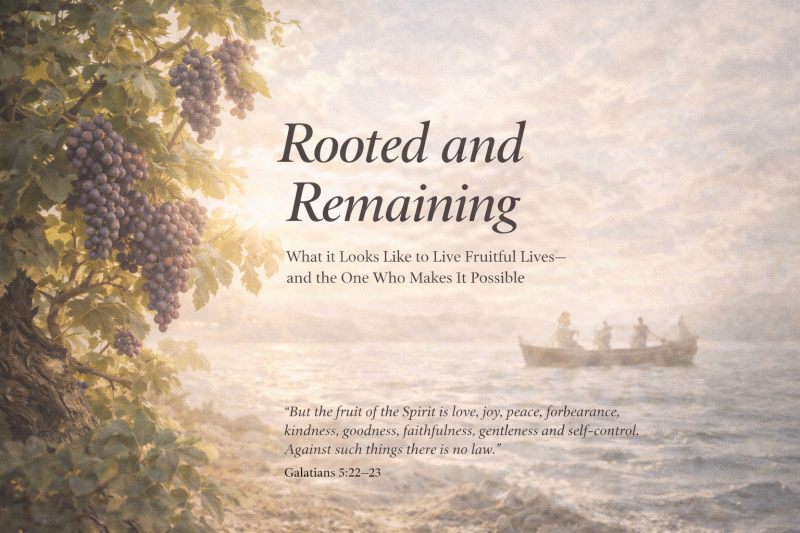
“I am the vine; you are the branches. If you remain in me and I in you, you will bear much fruit; apart from me you can do nothing.”
— John 15:5 (NIV)
There is something quietly radical about sitting with the idea that you are a branch. Not the root. Not the soil. Not the gardener tending rows of green in the morning light. A branch. Dependent. Connected. Meant, by your very design, to produce something that exists not for you but for someone else.
This devotional was born out of a real conversation — the kind that happens on a Sunday morning when something from the pulpit lands in the middle of your chest and stays there. The thought was simple and profound all at once: the fruit of a tree is always visible. It always reflects the nature of the tree. And it never exists for the tree itself. It exists to feed, to nourish, to bring life to others.
Somewhere in that truth, there is everything the Christian life is meant to be.
We will walk through the Vine and Branches passage in John 15, understand what Jesus’ listeners would have heard in their bones, explore the Fruit of the Spirit in Galatians 5, and we will do it all honestly — including the hard parts. The parts about worrying whether you have any fruit at all. The parts about feeling like your fruit should be bigger, more plentiful, more impressive by now. The parts about understanding that fruit takes time, and that the very fact you care so much about it is itself a sign of something alive inside you.
This is not a study about performance. It is a study about abiding.
Let’s begin.
Part One: The Vine
What Jesus Said — and What His Listeners Heard
On the night before His crucifixion, Jesus sat with His disciples in the upper room. The meal was ending. The shadows were gathering. And Jesus, knowing what was coming, gave them one final teaching before Gethsemane. He said:
“I am the true vine, and my Father is the gardener. He cuts off every branch in me that bears no fruit, while every branch that does bear fruit he prunes so that it will be even more fruitful. You are already clean because of the word I have spoken to you. Remain in me, as I also remain in you. No branch can bear fruit by itself; it must remain in the vine. Neither can you bear fruit unless you remain in me. I am the vine; you are the branches.”
— John 15:1–5 (NIV)
The Weight of the Word “True”
To a first-century Jewish listener, this statement was not gentle poetry. It was a bold, world-rearranging claim.¹
For centuries, Israel had been described as God’s vine. The prophets knew the image well. “Israel was a luxuriant vine,” Hosea had written (Hosea 10:1). The Psalmist sang of how God had brought “a vine out of Egypt” (Psalm 80:8). Isaiah described God’s vineyard as the house of Israel (Isaiah 5:7). The vine was not merely a metaphor — it was a national identity. Archaeologists have found it stamped on the coins of the Maccabees. More remarkably, a great golden vine decorated the entrance to the Temple itself in Jerusalem, and it was considered such an honour to contribute to it that wealthy families donated gold to have new grapes added to its branches.²
But here is where the prophets’ story always turned painful: in every single instance where the vine appeared in the Old Testament, it carried a shadow of failure. The vineyard had gone wild. The grapes had turned bitter. Israel had not borne the fruit God longed for.³
So when Jesus stood before His disciples and said “I am the true vine,” the word “true” — alethinos in Greek — carried enormous meaning. He was saying: I am what Israel was always meant to be but could never be on its own. I am the vine that will not fail. I am doing what you could not do. And now, grafted into Me, you can do what you never could alone.⁴
“The vineyard of the Lord Almighty is the nation of Israel, and the people of Judah are the vines he delighted in. And he looked for justice, but saw bloodshed; for righteousness, but heard cries of distress.” — Isaiah 5:7 (NIV)
A Cultural Note: The Vineyard in Daily Life
Vineyards blanketed the hills of Judea, Samaria, and Galilee. For the disciples who walked with Jesus — even the fishermen from Galilee — the sight of grapevines growing on terraced hillsides, the sound of pruning in early spring, the ache of the harvest season: all of it was as familiar as breathing.⁵
Ancient viticulture involved two distinct types of pruning. In spring, the new shoots were trimmed back so the vine would put its energy into producing fruit rather than simply growing more greenery. Then after the harvest, in the dormancy of autumn, exhausted branches were cut away entirely, leaving only the buds that would bear fruit in the new season.⁶
Jesus drew on both images. The Greek word used for “prunes” in John 15:2 is kathairein, which also means to cleanse or purify. Pruning and cleansing were, in the mind of any first-century vinedresser, almost the same act: removing what hinders, so that what remains can flourish.⁷
There is also a remarkable translation note worth sitting with. The word commonly rendered “takes away” in John 15:2 — the branch that bears no fruit — comes from the Greek word airō. While it can mean to remove, it also literally means to lift up. Some scholars suggest that the Father’s first movement toward an unfruitful branch is not removal but restoration: lifting it off the ground, turning it toward the light, giving it every chance to live.⁸ That is the kind of Father we have.
Part Two: The Branches
What It Means to Abide
The word Jesus uses repeatedly in John 15 is remain — or in older translations, abide. In Greek it is menō, and it appears eleven times in just eleven verses. Jesus is not being repetitive for lack of vocabulary. He is hammering a nail of grace into something deeply important.
To abide means to stay. To dwell. To make your home in. It is not the language of striving. It is the language of belonging.
“If you remain in me and my words remain in you, ask whatever you wish, and it will be done for you. This is to my Father’s glory, that you bear much fruit, showing yourselves to be my disciples.” — John 15:7–8 (NIV)
Notice the logic of this passage. Jesus does not say: try very hard to bear fruit, and that will prove you are connected to me. He says the opposite: remain connected to me, and you will bear much fruit. The fruit is the evidence of the connection. It is not the means of earning it.
A branch does not strain to produce grapes. It does not wake up each morning with a plan to squeeze out some fruit by sheer effort. It simply stays. It remains attached. And from that place of connection, life flows, and fruit appears naturally.
The Expositor’s Bible Commentary captures this beautifully: we should think of the fruit of the Spirit not as separate pieces of fruit to be gathered one by one, but as a single bunch of grapes — a unified, inseparable whole that grows from one source.⁹
“So then, just as you received Christ Jesus as Lord, continue to live your lives in him, rooted and built up in him, strengthened in the faith as you were taught, and overflowing with thankfulness.” — Colossians 2:6–7 (NIV)
The Vine and the Branch Cannot Be Separated
There is a particular tenderness in the way Jesus frames this passage. He does not say you are workers in my vineyard. He does not say you are guests in my garden. He says you are the branches. You are part of Me. What flows through the vine flows through you. The same life, the same sap, the same source.
This is not a relationship of distance and effort. It is a relationship of intimacy and union. The branch and vine share a single circulatory system. When you are in Christ, His life is your life. His character flowing through you is not a performance — it is a natural result of being connected to who He is.
“I have been crucified with Christ and I no longer live, but Christ lives in me. The life I now live in the body, I live by faith in the Son of God, who loved me and gave himself for me.” — Galatians 2:20 (NIV)
Part Three: The Fruit
Always Visible. Always For Someone Else.
Here is what struck the heart in that Sunday morning message, and it is worth lingering on:
Fruit is always visible. You cannot hide an apple tree’s apples. You cannot pretend a fig tree is a different kind of tree when the season comes. The fruit exposes the nature of the tree before any label is attached.
Fruit always reflects the nature of the tree. An apple tree does not try to produce apples. It does not study how apples are made and work hard to imitate them. It produces apples because that is its nature. The nature of the tree determines the nature of the fruit.
Fruit never exists for the tree itself. The tree does not eat its own harvest. The fruit exists for the birds, for the creatures, for the people passing through hungry. It exists to be given away.
This is a portrait of what Jesus is inviting us into. When we are connected to Him — truly abiding, truly remaining — what grows from our lives reflects His nature, not our effort. And that fruit is not for us. It is for the world that is watching and hungry.
“In the same way, let your light shine before others, that they may see your good deeds and glorify your Father in heaven.” — Matthew 5:16 (NIV)
“By their fruit you will recognise them. Do people pick grapes from thornbushes, or figs from thistles? Likewise, every good tree bears good fruit, but a bad tree bears bad fruit.” — Matthew 7:16–17 (NIV)
What Is the Fruit?
When the Apostle Paul writes to the church in Galatia, he names the fruit that the Spirit produces in the life of a connected believer:
“But the fruit of the Spirit is love, joy, peace, forbearance, kindness, goodness, faithfulness, gentleness and self-control. Against such things there is no law.” — Galatians 5:22–23 (NIV)
Notice that the word fruit is singular in the original Greek — karpos.¹⁰ This is significant. Paul is not describing a grocery list of separate items you can select from. He is describing one thing: the character of Christ, expressed through a person wholly connected to the Holy Spirit. Thomas Aquinas observed that the fruit is generically one, though it appears in many beautiful forms.¹¹
Here is what each aspect of that fruit looks like in its original Greek depth:
Love — agapē. Not an emotion but a choice. An undefeatable goodwill toward others that does not depend on what they deserve or how they behave. This is the love that God first showed us.
Joy — chara. Not happiness tied to circumstances, but a deep delight in God for who He is. A joy that holds steady even in suffering, because its root is not in what we have but in who He is.
Peace — eirenē. More than the absence of conflict. It is the Hebrew concept of shalom: wholeness, completeness, a flourishing that touches every part of life.
Patience — makrothumia. Literally “long-tempered.” The capacity to endure and wait without breaking, not passively but with active, hopeful endurance.
Kindness, goodness, faithfulness, gentleness, self-control — each one a facet of the same single diamond: the character of Jesus, forming in a life that stays close to Him.
The works of the flesh, by contrast, are listed in the plural — erga, deeds, actions. The implication is profound: human striving produces scattered, competing, self-centred works. But the Spirit produces one integrated, outward-flowing, other-centred fruit. Because it comes from one Source.¹²
“You did not choose me, but I chose you and appointed you so that you might go and bear fruit — fruit that will last. And so that whatever you ask in my name the Father will give you.” — John 15:16 (NIV)
Part Four: How Fruit Grows
The Hidden Season
Here is something we rarely talk about when we talk about fruit: it starts small, hidden, and invisible. No fig appears overnight. No cluster of grapes is there one day simply because you wished for it.
A grapevine in its first three years of growth is not permitted to bear fruit.¹³ The vine must spend that time building strength, putting down roots, developing the kind of internal resilience that will allow it to carry the weight of a harvest. Ancient viticulturists knew this. You do not rush a vine. You do not demand fruit from something still becoming.
The fruit begins as a blossom. Then a tiny, hard, inedible thing. Then slowly, with sunlight and rain and time, it grows and sweetens and becomes what it was always meant to be. Most of this process is invisible to the eye. The real work is happening beneath the surface, inside the branch, in the sap flowing from the vine.
This matters enormously for how we understand our own spiritual growth.
“This is what the kingdom of God is like. A man scatters seed on the ground. Night and day, whether he sleeps or gets up, the seed sprouts and grows, though he does not know how. All by itself the soil produces grain — first the stalk, then the head, then the full kernel in the head.” — Mark 4:26–28 (NIV)
Notice those stages. First the stalk. Then the head. Then the full kernel. The kingdom grows in stages that we often cannot see and do not control. This is not a failure of the process. This is the process.
Hebrews speaks of seasons of discipline that, in the moment, feel like anything but growth:
“No discipline seems pleasant at the time, but painful. Later on, however, it produces a harvest of righteousness and peace for those who have been trained by it.” — Hebrews 12:11 (NIV)
The harvest of righteousness comes later. Not never. Later. The pruning that feels like loss is preparing the branch for a fuller season than it has ever known.
The Fruit You Cannot Yet See
Perhaps there is fruit in your life that you are simply too close to see. The friend you stayed loyal to through a hard season. The moment you chose to be gentle when sharpness would have been easier. The quiet faithfulness of showing up, again and again, even when no one noticed. The love you offered without needing it returned.
These things are fruit. They may not feel dramatic. They may not feel spiritual. But a tree does not know when its shade is cooling someone’s tired afternoon. It simply grows, and the benefit flows outward without the tree calculating it.
“Now he who supplies seed to the sower and bread for food will also supply and increase your store of seed and will enlarge the harvest of your righteousness.” — 2 Corinthians 9:10 (NIV)
Part Five: The Worry About Fruit
What Your Concern Is Already Telling You
Now for the most personal part of this study.
Many of us have spent time — too much time, perhaps — worried that we don’t have enough fruit. Lying awake wondering if our lives are actually showing anything of Jesus. Looking at other believers and feeling like their harvest is more visible, more impressive, more clearly Spirit-given than ours.
Here is what needs to be said gently but clearly:
The fact that you worry about your fruit is itself evidence of something alive in you.
A dead branch does not worry about whether it is bearing fruit. A detached branch does not look at its lack of grapes with aching concern. Only something living, something connected, something that genuinely wants to reflect its Source — only that kind of branch cares.
The Apostle Paul, one of the most fruitful lives in the history of the church, described himself as the chief of sinners (1 Timothy 1:15). Not as a performance of humility. As a genuine reckoning with the gap between who he was and who Christ was calling him to be. That reckoning did not indicate fruitlessness. It indicated a soul that was still growing, still in the process, still tender enough to feel the distance.
“Being confident of this, that he who began a good work in you will carry it on to completion until the day of Christ Jesus.” — Philippians 1:6 (NIV)
This is not a verse about what you need to do. This is a verse about what God has promised to do. He began a good work. He will carry it on. Your job is not to manufacture the completion. Your job is to remain in the Vine.
The Trap of Comparison
There is also the particular exhaustion that comes from measuring your fruit against someone else’s. We look at a believer who seems full of peace and wonder why we still struggle with anxiety. We see someone whose joy appears effortless and feel ashamed of our own hard-won gladness. We compare harvests without knowing what season the other branch is in, without knowing what pruning they endured to get there, without knowing how long they sat in the dark before the fruit appeared.
The vinedresser does not compare branches. He tends each one according to what it needs in this season, at this stage, given this particular root system, on this particular slope of the hill.
“And we know that in all things God works for the good of those who love him, who have been called according to his purpose. For those God foreknew he also predestined to be conformed to the image of his Son.” — Romans 8:28–29 (NIV)
Conformed to the image of His Son. That is the goal. Not conformed to the image of the most impressive Christian you follow online. The image of Jesus. And that is a lifetime’s work, which is exactly how long God has given us to do it.
The Freedom of Not Having to Be Finished
One of the most liberating truths in all of Scripture is that you are not required to be a finished product. You are a branch in process. You are something that is being grown, shaped, pruned, and tended by a Gardener who knows exactly what He is doing.
The question is not: is my fruit perfect and plentiful and beyond reproach? The question is: am I remaining in the Vine? Am I choosing, today, to stay close to Jesus? Am I letting His words remain in me?
If the answer is yes — even a stumbling, imperfect, trying-again yes — then fruit is coming. It may be forming in places you cannot yet see. It may be growing in someone you spoke to three years ago who still carries something you said. It may be visible in the patience you barely managed last Tuesday, or the kindness you showed when you were tired and didn’t have to.
Fruit is being borne. Stay connected to the Vine.
“They will be called oaks of righteousness, a planting of the Lord for the display of his splendour.”
— Isaiah 61:3 (NIV)
Part Six: The Walk
From Knowledge to a Living Posture
Here is where this whole study must come to rest, because this is ultimately what it is all about.
We can know every verse in John 15. We can understand the Greek words for fruit and abide and prune. We can comprehend the cultural significance of the golden vine on the Temple gates. We can discuss the fruit of the Spirit with theological precision. And all of it — every single word — can be, quite literally, fruitless.
Because knowledge about the vine is not the same as abiding in it.
“Do not merely listen to the word, and so deceive yourselves. Do what it says.” — James 1:22 (NIV)
“Not everyone who says to me, ‘Lord, Lord,’ will enter the kingdom of heaven, but only the one who does the will of my Father who is in heaven.” — Matthew 7:21 (NIV)
The invitation of this devotional is not simply to have better theological knowledge about fruit. It is to walk differently. To move through each day with a different kind of question running quietly in the background:
Does this reflect Jesus?
Not as a source of guilt or anxiety. Not as a performance audit. But as a gentle, living orientation. A posture. Like a branch turning naturally toward the light because that is where the life is.
Think about what changes when that question becomes our internal compass. In the conversation where you could be harsh: does this reflect Jesus? In the moment where you could withhold grace: does this reflect Jesus? In the choice between what is easy and what is right: does this reflect Jesus?
This is not about trying harder. It is about staying closer. Because the branch that stays close to the vine does not need to strain for fruit. It simply cannot help producing it.
“Whoever claims to live in him must live as Jesus did.” — 1 John 2:6 (NIV)
“Follow God’s example, therefore, as dearly loved children and walk in the way of love, just as Christ loved us and gave himself up for us as a fragrant offering and sacrifice to God.” — Ephesians 5:1–2 (NIV)
The Greatest Evidence
Jesus made clear what the defining fruit of His people would be. Not miracles. Not eloquent doctrine. Not the size of the ministry or the influence of the platform. He said:
“A new command I give you: Love one another. As I have loved you, so you must love one another. By this everyone will know that you are my disciples, if you love one another.” — John 13:34–35 (NIV)
By this everyone will know. Not by your Bible knowledge. Not by your theological correctness. By your love — the visible, present, inconvenient, costly, other-centred love that looks like Jesus. That is the fruit that changes the world. Not from platforms or programmes but from the ordinary, daily texture of a life that abides in the True Vine.
All the devotionals, all the Bible studies, all the knowledge we gather — beautiful as they are — are in service of this: a life that produces love because it is rooted in Love itself.
Reflection Questions
For Personal Study or Group Discussion
Part One — The Vine
- Israel was called God’s vine but could never fully bear the fruit He longed for. How does it change your understanding of Jesus to see Him as the “true” vine — the fulfilment of everything Israel was meant to be?
- The Father’s first movement toward an unfruitful branch may be to lift it up, not cut it off. How does that image of the Father change how you see your own dry seasons?
Part Two — The Branches
- What does abiding actually look like in your daily life? What are the things that help you remain connected, and what are the things that pull you away?
- Jesus says “apart from me you can do nothing.” Is there an area of your life where you have been trying to produce fruit through effort rather than connection?
Part Three — The Fruit
- The fruit is singular — one unified expression of Christ’s character. Which aspect of the fruit of the Spirit do you feel is most visible in your life right now? Which feels most like a small, still-forming blossom?
- Fruit exists not for the tree but for others. Who in your life might be nourished by the fruit that is growing in you — even fruit you cannot see yourself?
Part Four — How Fruit Grows
- A vine is not allowed to bear fruit in its first three years. Are you in a season that feels more like preparation than harvest? What might God be developing in you in this hidden season?
- Can you look back and identify fruit in your life that you couldn’t see while it was forming?
Part Five — The Worry
- Have you spent time worried about whether you have enough fruit? How does it feel to consider that this very concern is evidence of something alive in you?
- Where have you been comparing your fruit to someone else’s harvest? What would it mean to trust the Gardener’s individual care for your particular branch?
Part Six — The Walk
- If you carried the question “does this reflect Jesus?” through your day tomorrow, what is one situation where you think it would change your response?
- What is the difference between doing more for God, and staying closer to God? Which one does Jesus seem to be calling us to in John 15?
Source
Scriptures and Footnotes
John 15:1–17 • Isaiah 5:7 • Psalm 80:8 • Hosea 10:1 • Hosea 14:8 • Galatians 5:22–23 • Galatians 2:20 • Colossians 2:6–7 • Romans 8:28–29 • Philippians 1:6 • Matthew 5:16 • Matthew 7:16–17 • Matthew 7:21 • Mark 4:26–28 • Hebrews 12:11 • 2 Corinthians 9:10 • 1 Timothy 1:15 • Isaiah 61:3 • James 1:22 • John 13:34–35 • 1 John 2:6 • Ephesians 5:1–2
1 For the cultural weight of Jesus’ claim to be the “true vine,” see Ian Paul, “Jesus the True Vine in John 15,” Psephizo (April 2021). Paul notes that Jesus was appropriating the vine imagery of Israel as a national symbol, making a sweeping claim about His own identity.
2 William Barclay, Daily Study Bible: John, StudyLight.org. Barclay describes the golden vine at the Temple entrance and the tradition of wealthy families contributing gold to add new grapes to it.
3 Barclay, ibid. The vine symbol in the Old Testament consistently appears in contexts of failure and degeneracy — a vine that had gone wild or produced bitter fruit (cf. Isaiah 5:1–7; Jeremiah 2:21).
4 Lysa TerKeurst, Finding I Am (Nashville: Lifeway, 2017), cited in “The True Vine and the Branches,” Hope & Light (April 2024). TerKeurst writes that Jesus stepped in to be what Israel could not be — the True Vine.
5 Gary W. Derickson, “Viticulture and John 15:1–6,” Faith Alone Magazine. Derickson notes that the disciples, even the Galilean fishermen, would have been thoroughly familiar with vineyard practices through their villages and surrounding hillsides.
6 Ian Paul, Psephizo, ibid. Paul describes the two types of pruning — spring trimming of new shoots and autumn removal of exhausted branches — as background to Jesus’ teaching.
7 David Guzik, “John 15,” Enduring Word Bible Commentary (EnduringWord.com, 2015). Guzik notes that the Greek kathairein (prune/cleanse) and airo share the same root, and that the Father’s work in us encompasses both pruning and purifying.
8 James Montgomery Boice, cited in Guzik, ibid. Boice and Merrill C. Tenney both suggest airo may be better rendered as “lift up” — describing the viticulturalist’s practice of lifting low branches off the ground toward sunlight.
9 The Expositor’s Bible Commentary, cited in “What is the Fruit of the Spirit?” The Word Seattle (February 2018). The commentary suggests thinking of the fruit of the Spirit as a bunch of grapes rather than separate individual fruits.
10 Precept Austin, “Galatians 5:22 Commentary.” The Greek karpos is singular, indicating that the fruit of the Spirit is a unified whole, not a checklist of separate virtues.
11 Thomas Aquinas, Summa Theologica, cited in “Fruit of the Holy Spirit,” Wikipedia. Aquinas explains the singular karpos by noting that fruit is “generically one, though divided into many species.”
12 Edward D. Andrews, “The Fruit of the Spirit in Galatians 5:22–23,” Updated American Standard Version (uasvbible.org, 2023). Andrews notes the contrast between the plural “works” of the flesh and the singular “fruit” of the Spirit as theologically significant.
13 Barclay, ibid. Barclay notes that in ancient viticulture, a young vine was not permitted to fruit for its first three years, and was pruned drastically each year to develop internal strength.
Add comment
Comments