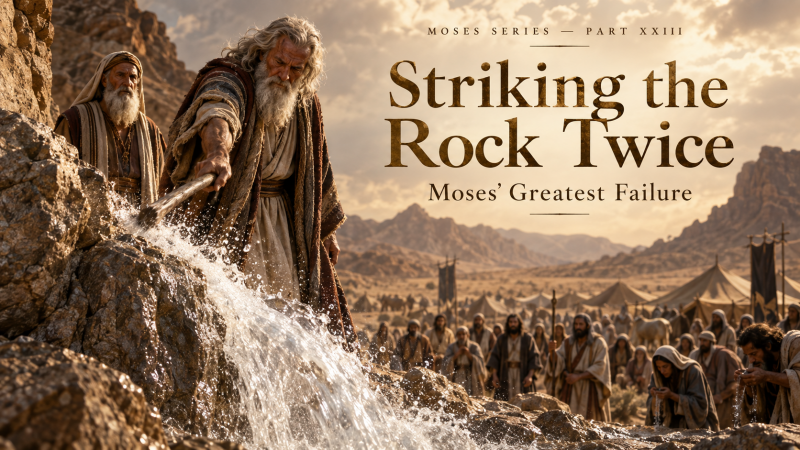
"Because you did not believe in me, to uphold me as holy in the eyes of the people of Israel, therefore you shall not bring this assembly into the land that I have given them." — Numbers 20:12

Before You Begin This Study
Part Twenty-Three covers Numbers 20:1–13 — the moment at Meribah where Moses struck the rock instead of speaking to it, and the verdict that followed: he would not enter the land he had spent forty years leading Israel toward. This is the most painful chapter in Moses' story, and one of the most theologically dense in the entire Pentateuch.
It raises questions that have occupied scholars, rabbis, and theologians for millennia: What exactly did Moses do wrong? Why was the punishment so severe? What does this reveal about God's holiness — and about what it means to represent God before people? Read slowly. The passage is only thirteen verses. The weight of it is enormous.
Numbers 20:1–13 Numbers 20:22–29 Numbers 27:12–14 Deuteronomy 3:23–29 Deuteronomy 32:48–52 1 Corinthians 10:4 Psalm 106:32–33
Optional:
Exodus 17:1–7 (the first water-from-the-rock at Rephidim — where God commanded Moses to strike);
Numbers 20:14–21 (Edom's refusal of passage, immediately following);
Deuteronomy 32:1–52 (Moses' final song, which contains his reflection on this failure);
Psalm 106:32–33 for the psalmist's interpretation of what went wrong.
Numbers 20:1-8
Numbers 20:9-13
Numbers 20:22–29
Numbers 27:12–14
Deuteronomy 3:23–25
Deuteronomy 3:26–29
Deuteronomy 32:48–52
Psalm 106:32–33
1 Corinthians 10:4
Highlights of Study
The Strike That Cost Everything
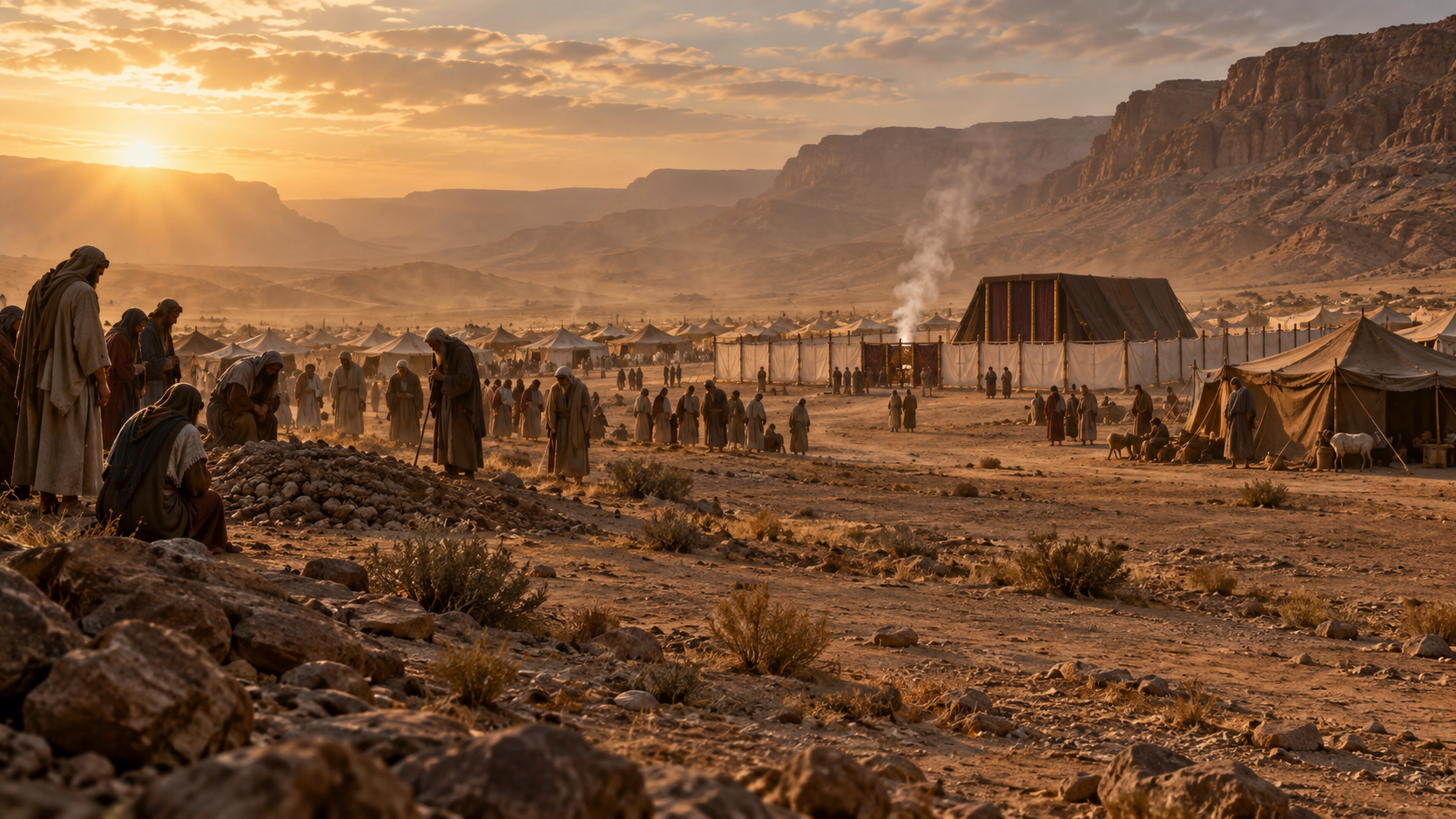
Thirty-eight years into the wilderness. A new generation. The same complaint. And Moses, exhausted and grieving, did something he had never done before — he disobeyed God in public, in front of everyone, in the very act of performing a miracle.
The First Month of the Fortieth Year
Numbers 20 opens with a date and a death. "And the people of Israel, the whole congregation, came into the wilderness of Zin in the first month, and the people stayed in Kadesh." The first month of the fortieth year — scholars calculate this from Numbers 33's wilderness itinerary. Thirty-eight years had passed since Kadesh Barnea. The generation that had wept at the border was almost gone — dying one by one in the wilderness, exactly as God had said they would. Their children had grown up in the desert, eating manna, following the cloud, carrying the Tabernacle forward and backward through the years of consequence.
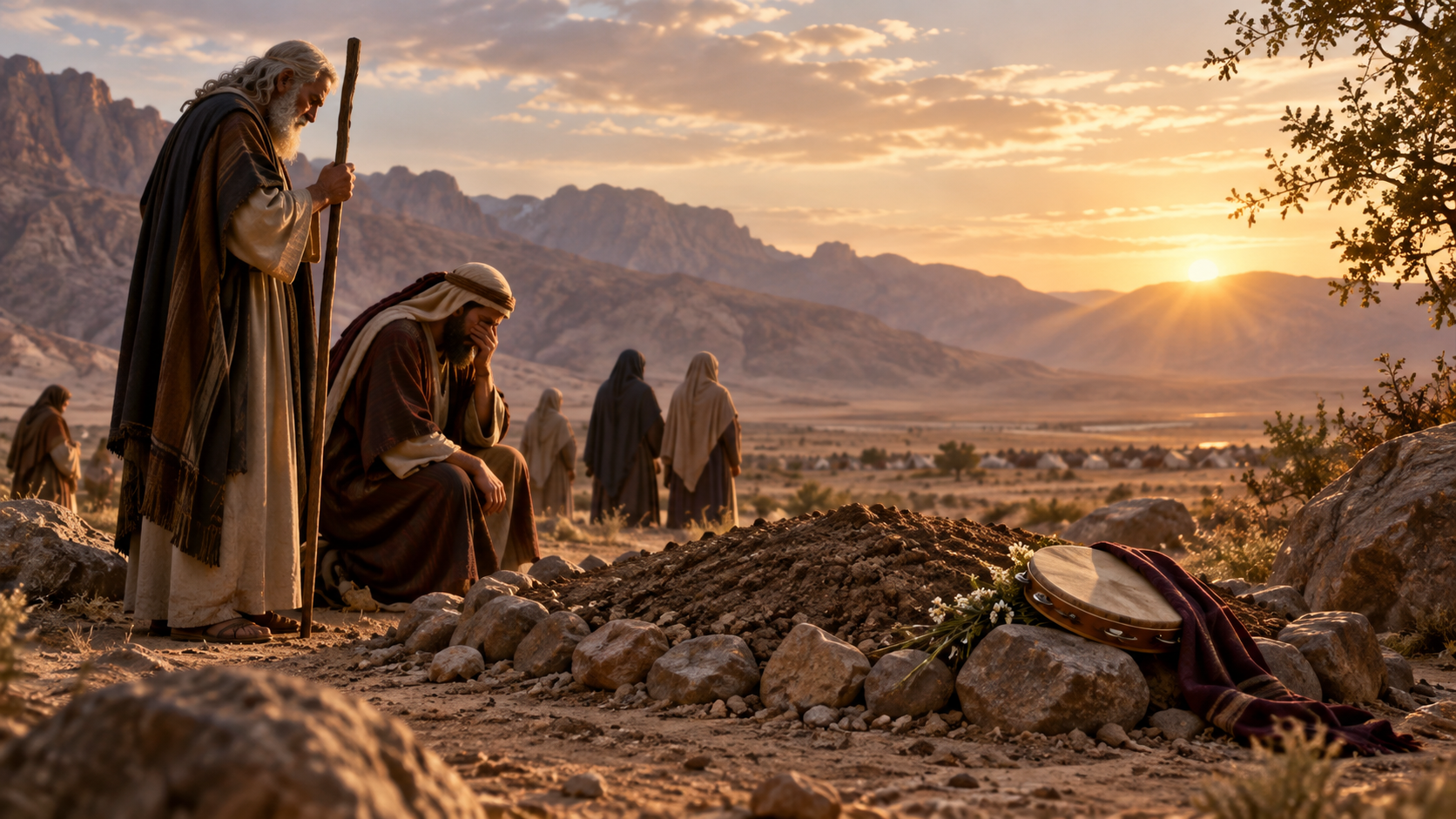
And the first thing Numbers 20 records about the fortieth year is this: "And Miriam died there and was buried there." One sentence. No ceremony described, no mourning period extended in the text, no eulogy. The woman who had stood at the edge of the Nile as an infant watching her brother's basket. The woman who had led the women of Israel in the song of the sea — "Sing to the LORD, for he has triumphed gloriously; the horse and his rider he has thrown into the sea." The prophetess, the worship leader, the co-leader of Israel alongside Moses and Aaron. She died. And the text moves on immediately to the water crisis.
There was no water for the congregation. The people assembled against Moses and Aaron — again. The complaint was identical to the complaint at Rephidim in Exodus 17, word for word: "Why have you brought the assembly of the LORD into this wilderness, that we and our cattle should die here? And why have you made us come up out of Egypt to bring us to this evil place? It is no place for grain or figs or vines or pomegranates, and there is no water to drink." A new generation using the exact language of their parents. The liturgy of complaint had been faithfully transmitted, if nothing else had.
Moses and Aaron went from the presence of the congregation to the entrance of the tent of meeting and fell on their faces. The glory of the LORD appeared to them. And God spoke to Moses: "Take the staff, and assemble the congregation, you and Aaron your brother, and tell the rock before their eyes to yield its water. So you shall bring water out of the rock for them and give drink to the congregation and their cattle."
Take the staff. Assemble the congregation. Tell the rock. Speak. That was the command.
Moses Struck
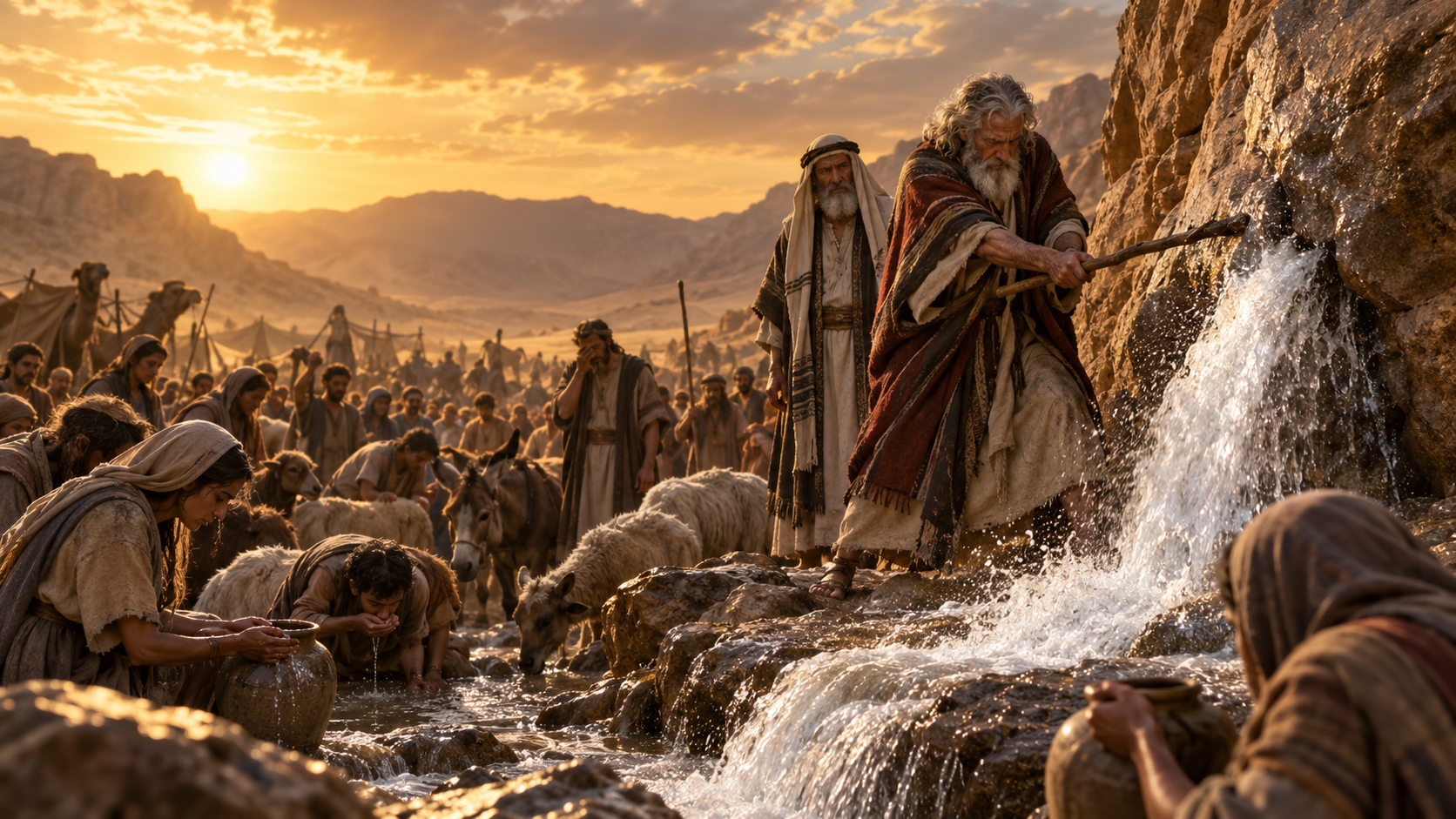
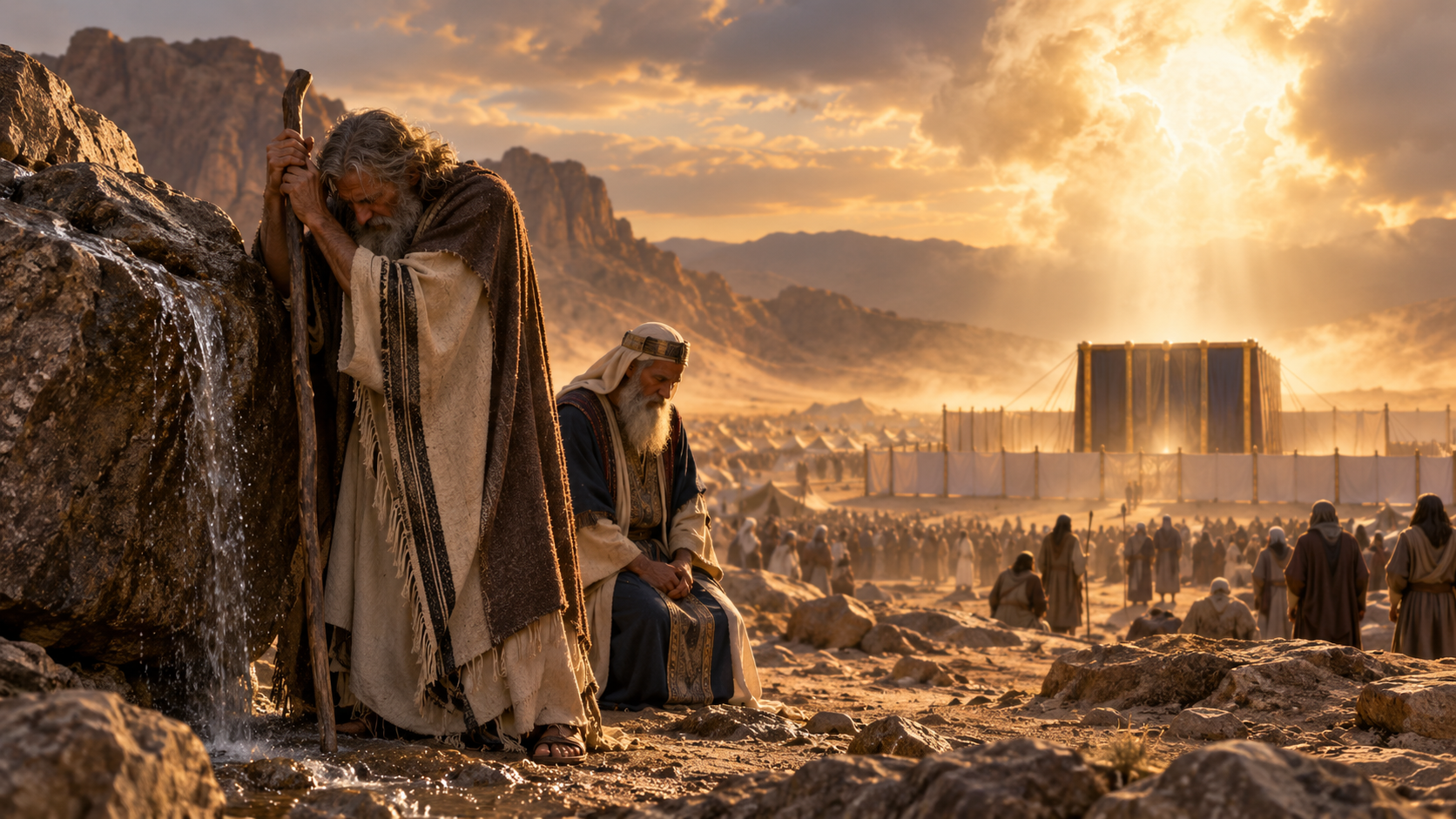
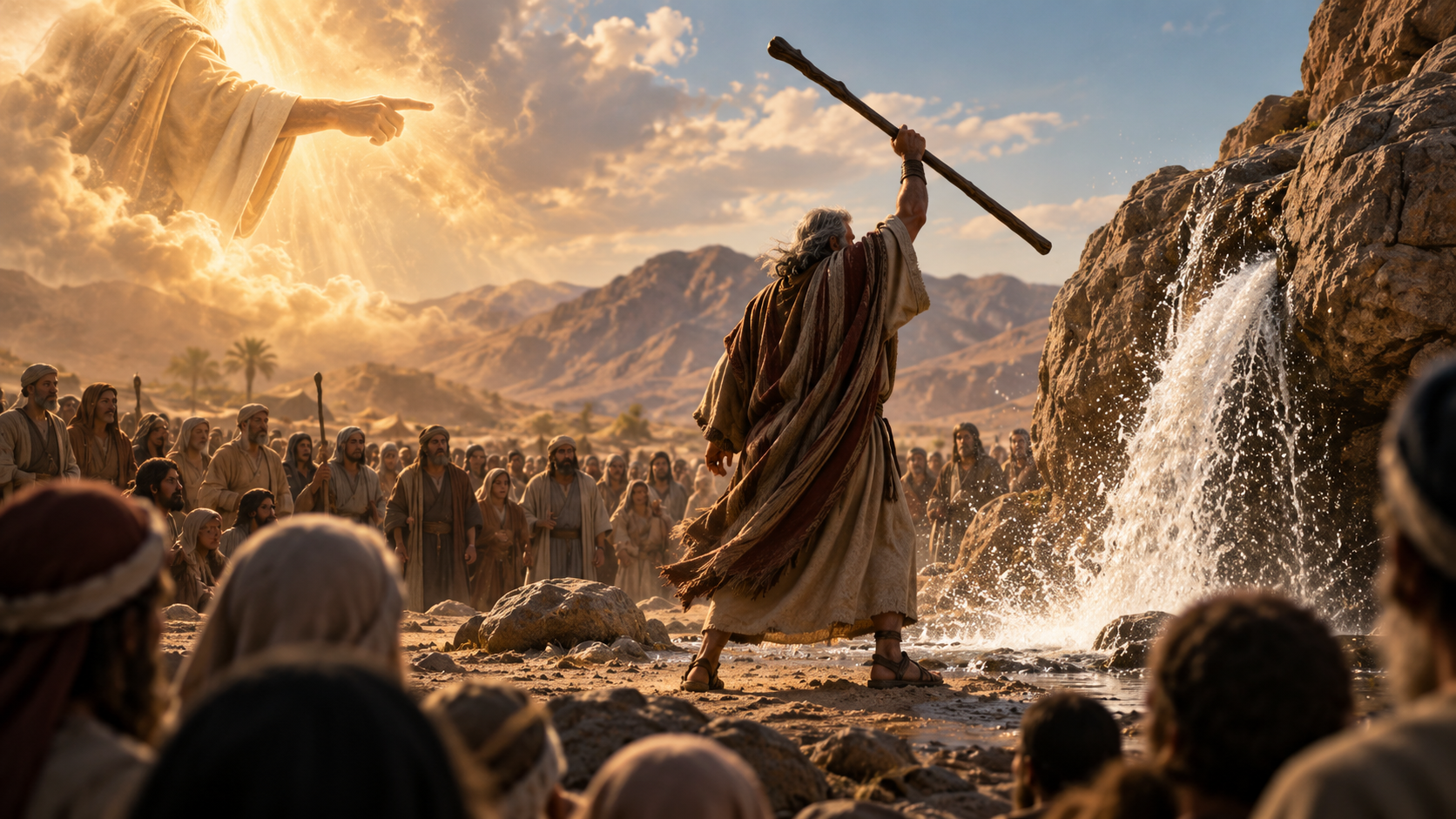
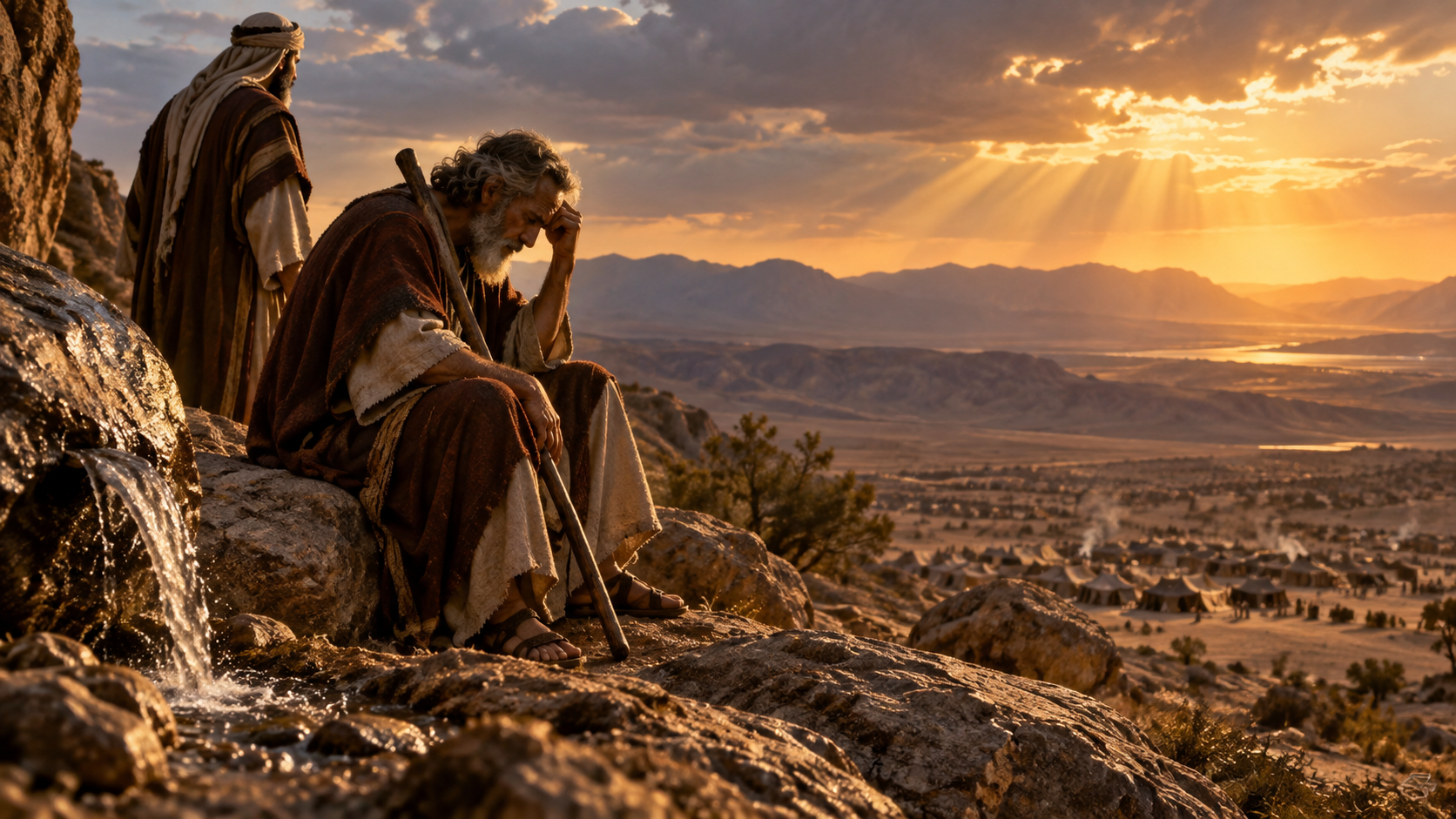
Moses took the staff from before the LORD, as he commanded him. And Moses and Aaron gathered the assembly together before the rock, and he said to them: "Hear now, you rebels: shall we bring water for you out of this rock?" And Moses lifted up his hand and struck the rock with his staff twice, and water came out abundantly, and the congregation drank, and their livestock.
Read those words again slowly. God said speak. Moses struck. God said once — or at minimum, a single commanded act of speaking. Moses struck twice. Water came out. Abundantly. Two million people and their livestock drank.
By any visible measure — by the measure the congregation could see and evaluate — the miracle was spectacular. Water poured from solid rock. The crisis was solved. The animals drank. The people drank. No one in the congregation had any reason to think something had gone wrong. Moses looked like Moses always looked: the man through whom God worked miracles.
But God saw something no one else saw. And what God said next changed everything.
The Verdict
And the LORD said to Moses and Aaron: "Because you did not believe in me, to uphold me as holy in the eyes of the people of Israel, therefore you shall not bring this assembly into the land that I have given them."
Thirteen words in English for the verdict: you did not believe in me, to uphold me as holy, therefore you shall not bring this assembly into the land. Moses had led Israel for forty years. He had argued with Pharaoh through ten plagues. He had stretched out his hand over the sea. He had gone up into the cloud on Sinai. He had seen the back of God's glory in the cleft of the rock. He had interceded at the golden calf and again at Kadesh Barnea, twice throwing himself into the breach between the wrath of God and the failure of the people. He had carried Israel for forty years.
And he would not enter the land. The place called Meribah — strife, contention — named for what happened there. The waters of strife. The moment where Moses failed to uphold God as holy in the eyes of Israel. The moment that cost him the land.
Numbers 20 then records the death of Aaron — stripped of his priestly garments on Mount Hor, the garments transferred to Eleazar his son. Aaron died on the summit of the mountain. And all the house of Israel wept for Aaron thirty days. The two brothers were now separated. Moses alone, leading a generation he had not failed, toward a land he would never enter.
The World at This Time — Kadesh in the Fortieth Year
Understanding the geography, the timing, and the context of the water crisis
Numbers 20 in Context — Geography and Chronology
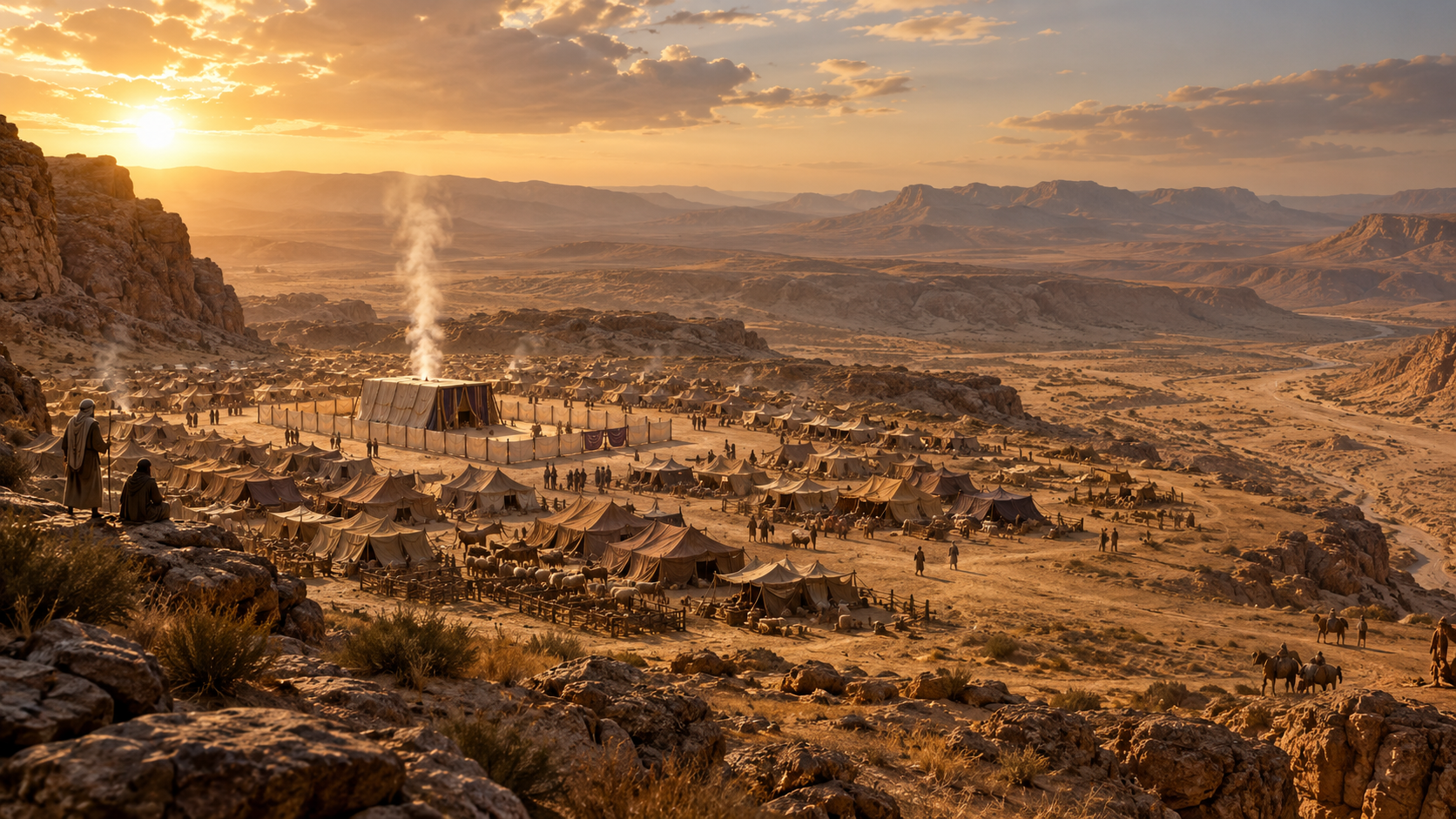
Kadesh in the fortieth year: Numbers 20:1 places the congregation at Kadesh in the first month of the fortieth year — the same Kadesh Barnea where the spy catastrophe had occurred thirty-eight years earlier. The wilderness itinerary of Numbers 33 lists the stations between the two Kadesh appearances, showing Israel's long circuit through the desert. They had returned to the starting point of their greatest failure just as the generation of that failure was nearly extinct.
The wilderness of Zin: Kadesh Barnea sits on the edge of the Wilderness of Zin — a harsh, arid plateau in the northeastern Sinai. The name "Zin" may relate to a word meaning "low" or it may be a place name. It was waterless terrain, which made the water crisis at Meribah both understandable and urgent. The geography was not the same as Rephidim (where the first rock-striking occurred in Exodus 17). This was a different place, a different rock, and — crucially — God gave a different command.
The first rock-striking vs. Meribah: The Exodus 17 incident at Rephidim and the Numbers 20 incident at Kadesh/Meribah are the two water-from-the-rock episodes in the wilderness. The difference in what God commanded is significant: at Rephidim, God explicitly said "strike the rock" (Exodus 17:6). At Meribah, God said "speak to the rock" (Numbers 20:8). Moses struck both times. The first striking was obedience. The second striking was disobedience — performing the earlier commanded act on the later occasion when God had given a different instruction. The rock did not need to be struck a second time. The first Rock had already been struck. Something different was being asked of Moses at Meribah — and he did not do it.
The name Meribah: Meribah — from rib, to contend, to strive, to bring a legal dispute. The waters of striving, the waters of contention. The same name was given to the Rephidim location (Exodus 17:7: "And he called the name of the place Massah and Meribah"). Two places, two incidents, same name — both places where Israel tested God. Psalm 95:8 (quoted in Hebrews 3:8) warns: "do not harden your hearts as at Meribah" — the name that carries the weight of Israel's pattern of testing God, concentrated into its most consequential expression in Numbers 20.
Miriam's Death — The Chapter Opens with Loss
Numbers 20:1 — why the text places her death immediately before the water crisis, and what it means
The placement of Miriam's death at the opening of Numbers 20 is not incidental. The text gives her death a single sentence — "And Miriam died there and was buried there" — with no mourning period recorded, no thirty-day weeping as there will be for Aaron, no ceremony described. Then the water crisis begins.
Who Miriam Was — And What Her Death Cost
Miriam was the firstborn of Amram and Jochebed, the eldest of the three siblings. It was Miriam who stood at the Nile and watched the basket, who arranged for Jochebed to nurse her own son back from Pharaoh's household (Exodus 2:4–8). She is called a prophetess in Exodus 15:20 — one of only five women given that title in the Hebrew Bible. She led the women of Israel in the song of the sea — "Sing to the LORD, for he has triumphed gloriously" — with tambourine and dancing, in the immediate aftermath of the greatest act of deliverance in Israel's history. She was one of the three leaders of Israel during the wilderness years: Micah 6:4 records God saying "I sent before you Moses, Aaron, and Miriam."
She had also failed spectacularly: Numbers 12 records her and Aaron speaking against Moses regarding his Cushite wife and challenging his exclusive prophetic authority. God's response was severe — Miriam was struck with leprosy for seven days, excluded from the camp, and the entire congregation waited for her healing before moving on. That combination of extraordinary calling and painful failure is part of what makes her a fully human figure — not a footnote but a co-leader whose life encompassed both great faithfulness and significant sin.
Rabbinic tradition suggests that a miraculous well — the "well of Miriam" — had accompanied Israel through the wilderness because of her merit. When she died, the water ceased. This would explain the immediate connection between her death in verse 1 and the water crisis in verse 2. Whether or not the rabbinic tradition is exact, the literary structure of Numbers 20 — death of Miriam, then water crisis, then Moses' failure at the water crisis — places Moses' worst moment in the immediate context of fresh grief. He had just buried his sister. He had watched the generation of the Exodus die year by year. And now the new generation brought him the same complaint as the old one, and he was exhausted and grieving, and he struck.
What Moses Did — and What God Said He Did
The five actions and the three charges — understanding the most debated passage in Moses' story
What exactly did Moses do wrong? This question has generated more commentary across Jewish and Christian tradition than almost any other in the Pentateuch. The text gives us five observable actions and three divine charges. The gap between the visible actions and the invisible diagnosis is what makes the passage so theologically rich — and so personally confronting.
The Five Observable Actions
1. He took the staff. God said to take it (Numbers 20:8) — so this was commanded. Not wrong.
2. He called the congregation rebels. "Hear now, you rebels" — shim'u-na hamorim. Whether this was wrong is debated. The congregation had spent forty years in rebellion. The characterisation was arguably accurate. But the tone — public accusation of the people Moses was serving — may reveal the emotional state that led to what followed.
3. He said "shall we bring water out of this rock?" The "we" — nontsi'a lachem — is striking. God had not said "you shall bring water." God had said "you shall bring water out of the rock for them" — but the agency was implicitly God's. Moses' "shall we" — substituting a human "we" for the divine "I" — may be one element of the failure: attributing to himself and Aaron what belonged to God alone.
4. He struck the rock — twice. God said "speak to the rock." Moses struck it. Not once but twice. The doubling of the strike is noted in every major interpretation: it was not an accidental gesture, not a slight misremembering of the instruction. It was a deliberate act, performed twice, in front of the entire congregation, using the action God had commanded at Rephidim but explicitly not commanded here.
5. The water came out. And Moses did nothing to correct the interpretation of the miracle — did not say "God has done this" or redirect the glory. The miracle happened; the water flowed; and the theological meaning of what had occurred — God's word commanding, God's provision following the word — had been obscured by Moses' action of striking rather than speaking.
The Three Divine Charges — Numbers 20:12
Charge 1 — "You did not believe in me." Lo ya'aminu bi — you did not believe, you did not have faith in Me. This is startling. Moses did not openly deny God. He performed a miracle. Water came out. By every external standard, the miracle was an act of faith. But God called it the opposite — an act of unbelief. The charge of unbelief here is not about intellectual denial of God's existence or power. It is about trust in the specific word God had spoken for this specific occasion. God said speak. Moses did not trust that speaking would be enough. He struck — because striking had worked before, because striking was something tangible, because speaking to a rock in front of two million people required a faith in the word alone that Moses, in that moment, could not muster.
Charge 2 — "To uphold me as holy in the eyes of the people of Israel." L'hakdisheni l'einei bnei Yisrael — to sanctify me, to treat me as holy, before the eyes of Israel. The people were watching. Moses was always performing the acts of God in public — the plagues, the sea, the manna, the miracles were all public acts done before the congregation. The way Moses handled this particular public act was supposed to carry a message about who God is and how He works. Speaking to the rock would have said: God's word alone is sufficient to produce life, to split stone, to bring water from the impossible. Striking said: force is required. Power is needed. The rock must be compelled by violence. The theological statement made by striking rather than speaking was a false statement about God — and Moses made it in front of everyone.
Charge 3 — "Therefore you shall not bring this assembly into the land." The consequence follows from the nature of the sin. Moses' role was to represent God before the people — to show them who God was through every act he performed in God's name. The man who misrepresented God in the act of the miracle could not complete the role that required him to represent God all the way to its conclusion. The consequence is precise: the failure was in representation; the exclusion is from the final act of leading the represented people to their destination.
The Great Debate — What Exactly Did Moses Do Wrong?
Jewish and Christian interpretation has offered multiple explanations of Moses' sin across the centuries — and every one of them catches something real about the text:
Maimonides: Moses' sin was his anger — calling the people "rebels" in public, losing his temper. The great leader must never show anger; it distorts the representation of God and leads people astray.
Nachmanides: Moses' sin was the double striking. He struck once; water may not have come immediately; and he struck again in impatience or doubt. The second strike was the failure of faith — an implicit "once was not enough."
Rashi: Moses should have spoken to the rock. The sin was simple disobedience — God said speak, Moses struck. The Rephidim instruction (strike) was for that occasion. Meribah required something different: a miracle of the word alone, which would have been an even greater demonstration of God's power than a strike of the staff.
The "we" interpretation: Moses' use of "shall we" attributed to himself and Aaron what belonged only to God, claiming credit for the miracle that God alone was performing.
The text does not definitively settle the debate — perhaps because all of these elements are present simultaneously. Moses was angry, did not speak, struck twice, used "we," and failed to sanctify God in the eyes of the people. The sin was likely not a single act but a convergence of emotional state, departure from the specific command, and the resulting misrepresentation of God before the congregation.

Key Verses
Eight Verses That Define the Meribah Narrative
Numbers 20:8 — The Command: Speak to the Rock
Numbers 20:8
"Take the staff, and assemble the congregation, you and Aaron your brother, and tell the rock before their eyes to yield its water. So you shall bring water out of the rock for them and give drink to the congregation and their cattle."
Hebrew Analysis — V'dibbartem el-ha'sela: Speak to the Rock
v'dibbartem el-ha'sela l'eineihem — "and you shall speak to the rock before their eyes." Dibar — to speak, to declare, to command with words. The instruction is unmistakably verbal: address the rock, give it a command, and the water will come. The phrase "before their eyes" is important — this was a public act of theological demonstration, not a private miracle. Every person watching would see whether Moses spoke or struck. The visibility of the act was part of its purpose.
Compare with Exodus 17:6 — "Behold, I will stand before you there on the rock at Horeb, and you shall strike the rock (v'hikita baṭṣur), and water will come out of it." Strike the rock — that was Rephidim's command. Speak to the rock — that was Meribah's command. The staff Moses took to Meribah was the same staff — a reminder of Rephidim's miracle — but the instruction for this occasion was different. The staff was a visual aid; the word was the instrument.
The theological significance of speaking rather than striking is profound: it would have demonstrated that God's word alone is creative and sufficient — that the same word that called the world into existence in Genesis 1 ("God said... and it was so") could call water from stone without any force applied. The rock would obey the word, not the staff. This was the miracle God wanted Moses to perform. Moses performed a different one.
Numbers 20:10–11 — Moses Struck Twice
Numbers 20:10–11
"And Moses and Aaron gathered the assembly together before the rock, and he said to them, 'Hear now, you rebels: shall we bring water for you out of this rock?' And Moses lifted up his hand and struck the rock with his staff twice, and water came out abundantly."
Hebrew Analysis — Shim'u-na Hamorim: Hear, You Rebels
shim'u-na hamorim — "hear now, you rebels." Morim — rebellious, defiant, disobedient. Psalm 106:33 offers an interpretive commentary on this moment: "for they made his spirit bitter, and he spoke rashly with his lips." The psalmist identifies both the emotional cause (a bitter spirit, produced by the people's provocation) and the result (rash speech). Moses was not speaking from a place of composed authority. He was speaking from a place of accumulated grief, exhaustion, and anger.
han'totsi lachem mayim min-ha'sela hazeh — "shall we bring forth for you water from this rock?" The interrogative "shall we" (han'totsi) with the first-person plural is what identifies Moses and Aaron as the agents rather than God. It may be a rhetorical question expressing frustration. But in public, before the congregation, the "we" says: Moses and Aaron are doing this. God's name is not spoken. God's instruction is not referenced. The miracle, when it comes, will appear to be Moses' miracle.
vayach et-ha'sela b'mattehu pa'amayim — "and he struck the rock with his staff twice." Pa'amayim — two times, twice. The detail of the double strike is present in every major Hebrew witness to the text. It is not accidental. The doubling suggests urgency, frustration, or doubt — not the calm, confident obedience of a man who trusted that the first act was sufficient. Moses struck because striking was what had worked at Rephidim. He struck twice because once may not have produced immediate results. Both strikes were expressions of a trust in the method rather than in the word.
Numbers 20:12 — The Verdict
Numbers 20:12
"And the LORD said to Moses and Aaron, 'Because you did not believe in me, to uphold me as holy in the eyes of the people of Israel, therefore you shall not bring this assembly into the land that I have given them.'"
Hebrew Analysis — Lo Ya'aminu Bi: The Charge of Unbelief
ya'an lo-he'emantem bi — "because you did not believe in me." He'eman — to be faithful, to trust, to believe, to be firm. The root aman is the root of amen — the declaration of truth, firmness, reliability. Moses' failure was described as a failure of emunah — faith, trustworthiness, reliability in relation to God's word. He had not been amen to what God had said. He had not treated God's word as the sufficient, reliable instrument it was.
l'hakdisheni l'einei bnei Yisrael — "to treat me as holy before the eyes of the children of Israel." Kadash in the Hiphil (causative) form: to cause to be regarded as holy, to sanctify in the eyes of others, to cause others to see God as holy. Moses' role as God's representative was always partly a teaching role — his actions taught the congregation who God was. By striking instead of speaking, he taught them the wrong lesson: that God required compulsion, that the word alone was insufficient, that force was the instrument of divine power. He desanctified God's name in public.
lachen lo tavi'u et-ha'qahal hazeh el-ha'aretz — "therefore you shall not bring this assembly into the land." The verdict is precise, measured, and connected to the specific nature of the failure. Moses had failed to represent God truly in the act that was his entire calling. The consequence is the failure to complete what the calling required. This is not arbitrary punishment. It is the natural and exact consequence of a specific kind of representational failure: the man who misrepresented God in the act of the miracle cannot be the man who represents God in the final act of the entry.
Numbers 20:13 — The Waters Were Named
Numbers 20:13
"These are the waters of Meribah, where the people of Israel quarrelled with the LORD, and through them he showed himself holy."
The Name That Preserved the Lesson
v'yiqqadesh bam — "and he showed himself holy among them" (or "through them"). The verb is the Niphal (passive/reflexive) of kadash — God was sanctified, showed himself holy, in and through this event. The same root as the charge in verse 12 (l'hakdisheni — to sanctify me) — but now in a different form. Moses was supposed to sanctify God actively (causing the people to see God as holy). Instead, God sanctified himself — the verdict on Moses' failure was itself a display of divine holiness. When God announced that Moses would not enter the land, the congregation would know that God takes seriously how He is represented. The holiness Moses failed to uphold in the act of the miracle, God upheld in the act of the verdict. The place that witnessed Moses' failure was preserved with the name that described the people's contention — and was used throughout later Scripture as the archetype of testing God.
Psalm 106:32–33 — The Psalmist's Interpretation
Psalm 106:32–33
"They angered him at the waters of Meribah, and it went ill with Moses on their account, for they made his spirit bitter, and he spoke rashly with his lips."
The Psalmist's Reading — Spirit Made Bitter
ki-himru et-rucho vayivatte bis'fatav — "for they caused his spirit to be bitter, and he spoke rashly with his lips." The psalmist's interpretation focuses on two elements: the people's provocation (himru et-rucho — they embittered his spirit, they made his spirit rebellious) and Moses' response (vayivatte bis'fatav — he spoke rash/hasty words with his lips).
The psalmist holds both together: the people were responsible for the provocation, and Moses bore responsibility for how he responded to it. This is one of the most pastorally accurate readings of the passage. Moses did not sin in a vacuum. He sinned in a context of accumulated grief (Miriam had just died), exhaustion (forty years of carrying this people), and fresh provocation (the same complaint, the same words, a new generation). None of that context excuses the failure — but it makes it comprehensible. The man whose spirit had been made bitter by decades of wilderness ministry finally allowed that bitterness to surface in public, in the act of the miracle, in front of everyone. And God held him accountable for it — not because He didn't understand the context, but because the representative of God cannot afford to let the people's provocation distort the representation of God's character.
Deuteronomy 3:23–26 — Moses Pleaded
Deuteronomy 3:23–26
"And I pleaded with the LORD at that time, saying, 'O Lord GOD, you have only begun to show your servant your greatness and your mighty hand... Please let me go over and see the good land beyond the Jordan... But the LORD was angry with me because of you and would not listen to me. And the LORD said to me, "Enough from you; do not speak to me of this matter again."'"
Moses Pleaded — And Was Refused
In Deuteronomy, Moses reveals something Numbers 20 does not record: he had pleaded with God to reverse the verdict. Not just once — the word va'etchanan (I pleaded) suggests sustained, earnest supplication, the kind of prayer that asks repeatedly and urgently. Moses, who had successfully interceded for Israel at the golden calf and at Kadesh Barnea, could not intercede successfully for himself. His intercession for others had moved God from destruction to mercy. His intercession for himself met: "Enough from you; do not speak to me of this matter again."
rav-lach al tosef daber eilai od badavar hazeh — "enough for you; do not continue to speak to me about this matter again." Rav lach — "much/enough for you" — the same phrase Korah had used against Moses ("rav lachem" — "you have gone too far"), now turned around. The man who had told Korah "enough" is now being told by God "enough." The irony is not cruel. It is precise. Moses cannot apply the grace that let Israel's rebellion be forgiven to his own failure, because his failure was of a different kind — a failure of representational integrity in the very act of serving as God's representative. The verdict stands.
Numbers 27:12–14 — The Command to Go Up and See
Numbers 27:12–14
"The LORD said to Moses, 'Go up into this mountain of Abarim and see the land that I have given to the people of Israel. When you have seen it, you also shall be gathered to your people, as your brother Aaron was gathered... because you rebelled against my word in the wilderness of Zin when the congregation quarrelled, failing to uphold me as holy at the waters before their eyes.'"
See, But Do Not Enter — Grace in the Verdict
The command to go up and see the land is not only an enforcement of the verdict. It is also an act of grace within the verdict. God does not say "you will die without seeing it." He says: go up, and see it. The man who cannot cross the Jordan can still see — from the mountain — the breadth and beauty of the land his people will enter. This is not nothing. It is the grace of the partial — not the fullness of the promise, but enough of it for Moses to die having seen what he spent his life moving toward.
God reiterates the charge at this moment: "because you rebelled against my word (merit'em et-pi) in the wilderness of Zin." Merah — to rebel, to disobey, to be defiant. The same root used for the charge against Israel in many of Moses' rebukes of them — and now God uses it for Moses. Moses was not exempt from the vocabulary of rebellion. The man who called the congregation "rebels" at Meribah was himself described by God as having rebelled against His word. The symmetry is not lost in the Hebrew text.
1 Corinthians 10:4 — The Rock Was Christ
1 Corinthians 10:4
"...and all drank the same spiritual drink. For they drank from the spiritual Rock that followed them, and the Rock was Christ."
Paul's Typological Reading — The Rock That Was Christ
(Greek) hē petra de ēn ho Christos — "and the Rock was the Christ." Paul makes an explicit typological identification: the rock in the wilderness — both the Rephidim rock and, by extension, the Meribah rock — was a type of Christ. The water that sustained Israel in the wilderness came from the Rock; the life that sustains the people of God comes from Christ. The rock that was struck at Rephidim, and struck again (wrongly) at Meribah, and from which life-giving water flowed both times, is identified by Paul as the pre-incarnate Christ accompanying Israel through the wilderness.
This gives the Meribah incident a depth that Numbers 20 alone cannot contain. If the Rock was Christ — if the rock Moses was commanded to speak to was a type of the Messiah — then the instruction to speak to the rock (rather than strike it) carries enormous theological weight. The first rock had already been struck. The first Rock had already been smitten. At Rephidim, the striking was the commanded act — pointing to the cross, the once-for-all sacrifice, the blow that needed to fall. At Meribah, the command was to speak — because the Rock does not need to be struck again. Access to the water of life comes now not through another blow but through the word, through prayer, through calling on the name. Moses struck the second time what should only be spoken to — and the error, in Paul's typological framework, carries a shadow of the grave theological error of treating Christ's sacrifice as something that must be repeated, something that can be compelled rather than invoked.
The Verdict — Was It Fair?
The most instinctive question — and the theological answer the whole of Scripture gives
The instinctive reaction to Numbers 20:12 is that the punishment was disproportionate. Moses had given forty years. He had interceded when God would have destroyed Israel. He had argued with Pharaoh, split the sea, climbed Sinai, endured the golden calf, carried the Kadesh catastrophe, survived Korah's rebellion. And for one moment of anger and disobedience — the land was taken away.
Why the Verdict Was Not Disproportionate — Three Answers
Answer 1 — The nature of Moses' role made the standard higher. The greater the representation, the greater the responsibility for accurate representation. Moses was not an ordinary Israelite who struck a rock in private frustration. He was God's designated representative, performing a public miracle, in front of two million people, in God's name. What he did with the staff in that moment communicated something to every person watching about who God is and how God works. The standard for that role is not the same as the standard for the ordinary worshipper, because the consequences of failure are not the same. The teacher who misrepresents Christ to a thousand students is not held to the same standard as the student who is confused. This is not unfairness. It is the logic of representational responsibility.
Answer 2 — The "unfairness" instinct applies what Moses himself argued against. At the golden calf and at Kadesh Barnea, Moses had argued that God should not destroy the people because His reputation was at stake — "what will the nations say?" Moses appealed to God's own holiness as a reason for mercy. But at Meribah, Moses failed to uphold that same holiness. If holiness in representation mattered enough for Moses to use as an argument for Israel's survival, it matters enough to apply to Moses himself. The principle Moses deployed in intercession was the principle God applied in judgment. The standard was not new. Moses had known it all along.
Answer 3 — The verdict was not the end of the relationship. Moses did not lose his relationship with God. He did not lose his place in the covenant, his standing before God, his identity as the one who had seen God's glory. What he lost was the specific role of leading Israel into the land — the completion of a particular mission. God allowed him to see the land from Nebo's heights. God buried him personally (Deuteronomy 34:6). Moses appeared at the Transfiguration in the land he could not enter during his lifetime (Matthew 17:3). The verdict at Meribah was a consequence within a relationship that was never broken. That distinction matters. Judgment and rejection are not the same thing. Moses experienced the one and never the other.
Aaron's Death — Numbers 20:22–29
The passing of the High Priest on Mount Hor — and what it cost Moses
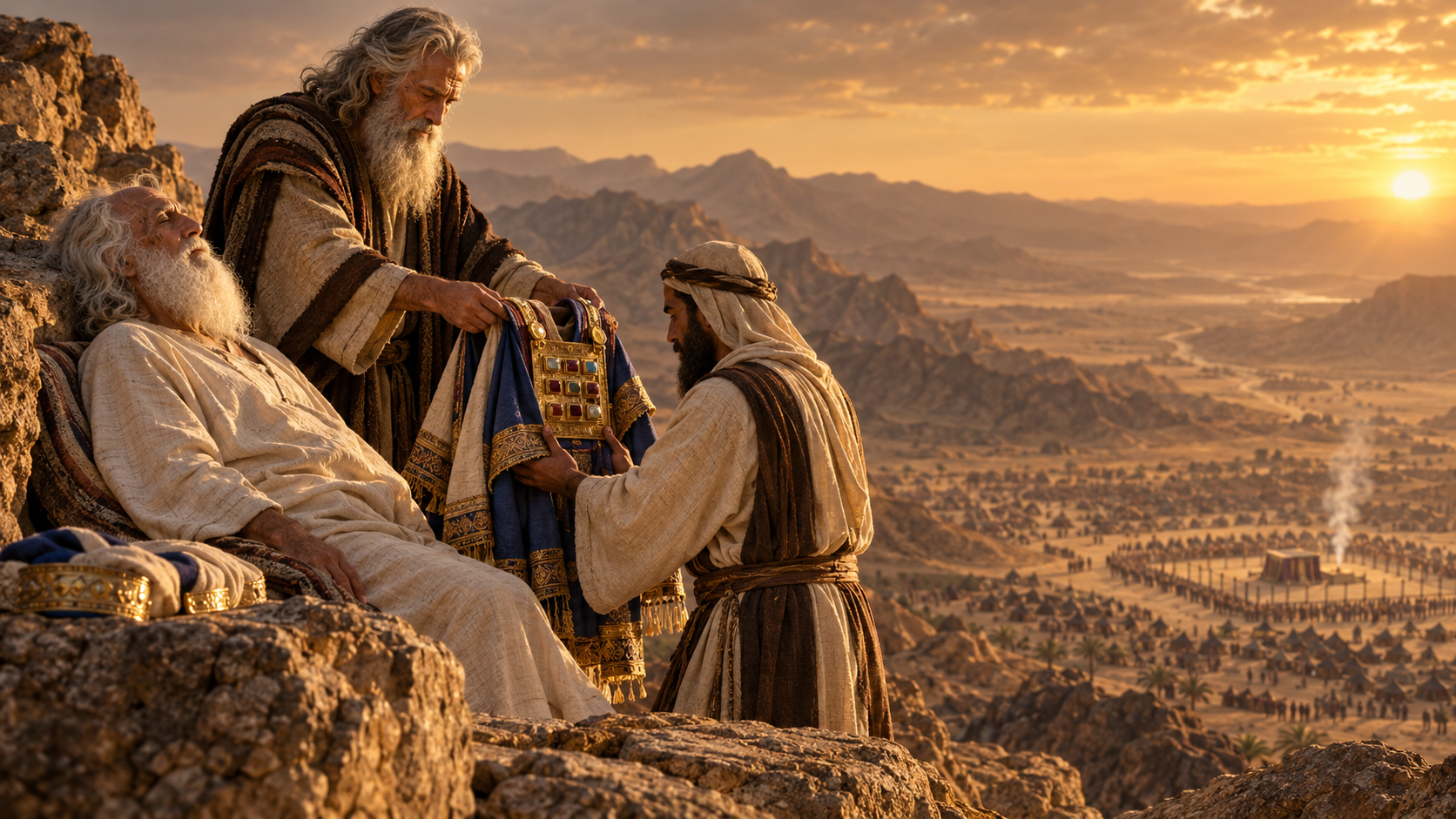
The same chapter that records Moses' failure and its verdict also records the death of Aaron — and the transfer of the high priesthood to his son Eleazar. God told Moses and Aaron to go up to Mount Hor, along with Eleazar Aaron's son. And Moses stripped Aaron of his garments — the linen ephod, the breastpiece with the names of the twelve tribes, the robe of the ephod, the turban with the golden plate inscribed "Holy to the LORD" — and put them on Eleazar. Aaron died on the summit of the mountain. And all the house of Israel wept for Aaron thirty days.
What Aaron's Death Cost Moses — The Last of the Siblings
In the same chapter: Miriam died (verse 1). Moses received the verdict that he would not enter the land (verse 12). And Aaron died on Mount Hor (verse 28). Numbers 20 is the chapter that strips Moses of both his siblings and his future. By the end of it, he is alone — the last of the three who had led Israel together since Egypt, and the only one excluded from the land by his own action rather than by age or natural death.
The transfer of the priestly garments is one of the most tender and painful scenes in the entire Pentateuch. Moses himself removed the garments from Aaron — the garments he had put on Aaron at the consecration in Leviticus 8, when he had anointed him and dressed him in the full priestly regalia, when Aaron had stood before God for the first time as High Priest. Now Moses took them off. He dressed Eleazar in them. And Aaron died. Whether Aaron was conscious for the dressing of his son — whether he saw the priestly garments transferred to the next generation — the text does not say. But Moses was there for all of it. He was the one who put the garments on and the one who took them off. The intimacy of that act, between two brothers at the end of one brother's life, is not noted by the text in emotional terms. It is simply recorded. Which somehow makes it more moving.
Thirty days of mourning for Aaron — the same mourning period commanded for Moses (Deuteronomy 34:8). The community that had challenged Aaron's authority (Korah's rebellion), that had accused Aaron of killing the people (the day after the earth opened), that had worshipped the golden calf while Aaron watched, mourned him for a month. Leaders who are imperfectly loved while living are often more clearly understood when gone.
Moses in This Moment — What Meribah Reveals About the Interior Life of a Leader
The most honest portrait of exhaustion, grief, and the limits of even the greatest human faithfulness
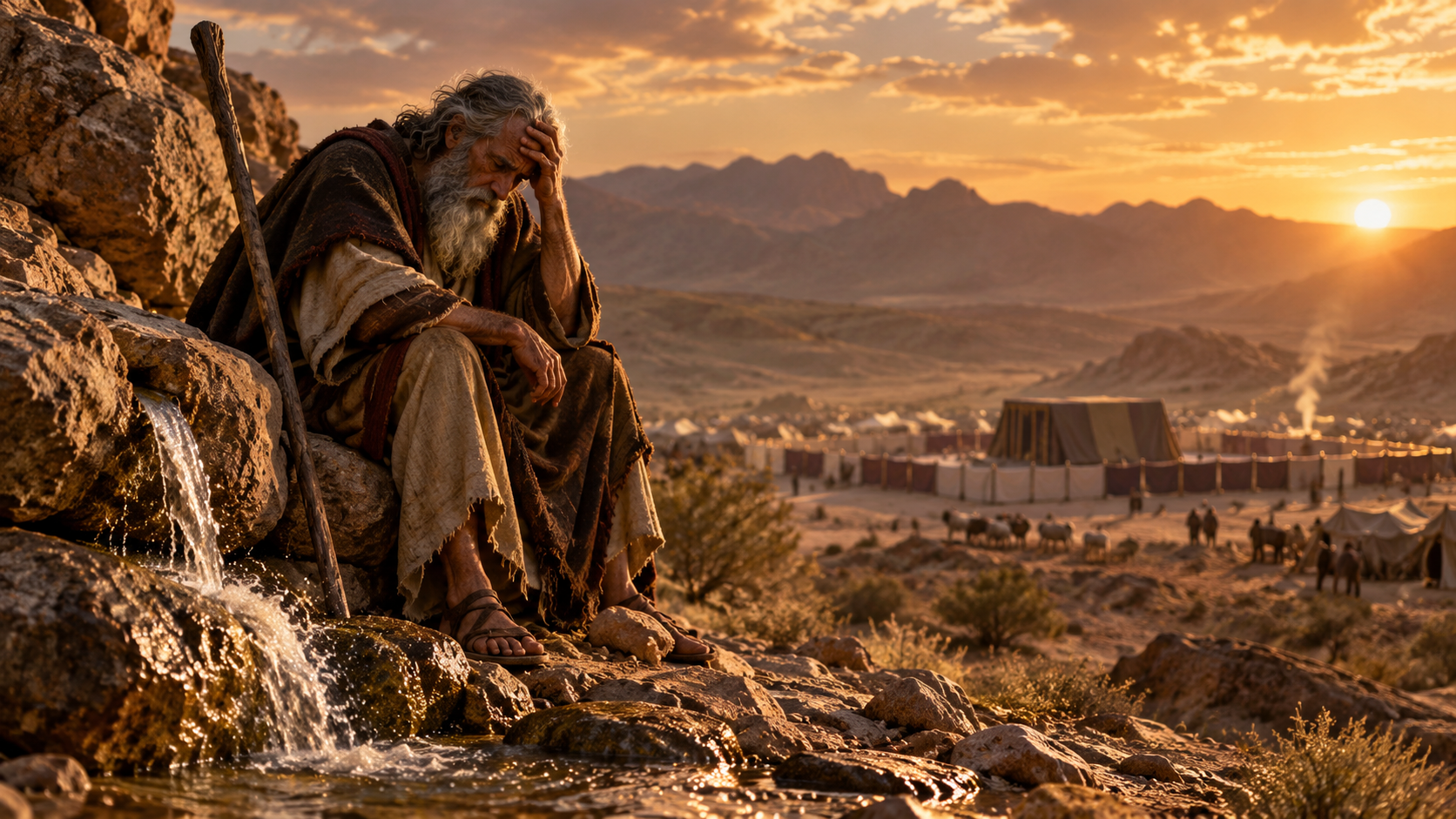
Numbers 20 is the most important chapter in the entire Moses narrative for understanding what Moses was like as a human being — not as a symbol, not as a theological type, not as a figure of intercession and faithfulness, but as a man. A man who buried his sister and three verses later was being confronted by the same complaint he had heard for forty years. A man whose spirit, the psalmist tells us, had been made bitter by the people he was serving. A man who, in a moment of accumulated grief and exhaustion, picked up a staff and struck a rock instead of speaking to it.
Moses did not commit a moral atrocity at Meribah. He did not murder, steal, worship other gods, or commit adultery. He struck a rock with a staff in the wrong way and said the wrong words before doing it. By any ordinary human standard, what Moses did was mild — especially in the context of forty years of extraordinary faithfulness, extraordinary intercession, extraordinary suffering on behalf of a people who gave him extraordinary difficulty.
But Moses was not held to an ordinary human standard. He held himself, in his best moments, to a higher one. He was the man who had argued God's own holiness back at God as the basis for Israel's survival. He knew — he had always known — that how God's representative acts before the congregation shapes what the congregation believes about God. At Meribah, in a moment of human exhaustion and grief, he forgot what he knew. And the thing he forgot had consequences that lasted for the rest of his life.
The Grief of Moses — Forty Years of Being a Conduit
There is a particular kind of exhaustion that belongs to people who spend decades being a channel for something greater than themselves — pastors, intercessors, caregivers, long-serving leaders. The exhaustion is not only of the body but of the soul. It is the exhaustion of a spirit that has been repeatedly emptied — emptied for the people, for the intercession, for the complaint sessions and the crises and the rebellions — and has not had adequate time or space or community to be refilled. Moses had borne Israel's complaints for forty years. He had interceded through the golden calf, through Kadesh, through Korah's rebellion, through crisis after crisis. And Miriam was dead. And the same complaint came again. And something in him that had held for four decades finally gave way.
The text does not excuse this. But the text, through Psalm 106:33, names it: "they made his spirit bitter." The people who provoke their leaders past the point of composure bear something of the responsibility for what happens in that moment. Not all of it — Moses is still accountable for his response. But the psalmist, under inspiration, records the provocation alongside the response. God's verdict addressed Moses' failure. The psalmist's record addresses the context that produced it. Both are part of the truth.
Moses After Meribah — He Did Not Stop
Perhaps the most extraordinary thing about Moses' response to the Meribah verdict is what he did next. He did not collapse. He did not resign. He did not become bitter and punitive toward the congregation that had provoked him. He received the verdict, pleaded once for its reversal (and was refused), and then spent the rest of his life doing what he had always done — leading Israel, interceding for them, preparing the next generation for the land he would not enter.
The whole of Deuteronomy is the testament of this. Deuteronomy is Moses' final gift to the generation that would cross the Jordan — five final addresses, a review of the law, the great covenant renewal, the Shema, the blessings and curses, the song of Moses, the blessing of the tribes. Moses spent the last months of his life giving everything he had to a people who would receive what he could not. He wrote the book he would never fully inhabit. He blessed the tribes whose territory he would only see from a mountain. He prepared Joshua to do what he had been prevented from doing. The failure at Meribah did not define the rest of Moses' ministry. It became the context within which his final and perhaps most extraordinary faithfulness was displayed.

The Meribah Pattern in Our Lives Today
Five ways the striking-the-rock failure lives in modern experience
Comparison 1 — When Method Replaces the Word
Moses struck because striking had worked. Rephidim had confirmed it: staff to rock produces water. He had the method, the tool, and the track record — and in the moment of crisis he reached for the proven method rather than the new instruction. The pattern of substituting a previously successful method for the specific word God is speaking now runs through every area of Christian life. The ministry approach that produced fruit ten years ago. The prayer method that worked in the last season. The leadership style that built the previous church. God's word for this occasion may be different from God's word for the last one — and the failure to trust the specific word for this occasion, defaulting instead to the proven method, is the Meribah pattern. The striking is not wrong because it was always wrong. It was wrong at Meribah because speak was the word for Meribah.
Comparison 2 — The Bitter Spirit That Leaks Into Ministry
Psalm 106:33: "they made his spirit bitter, and he spoke rashly with his lips." The accumulated weight of carrying difficult people, absorbing difficult complaints, interceding through difficult seasons — without adequate refilling, without community, without space for grief — produces a bitter spirit that eventually leaks into public representation. This is not a failure of will. It is a failure of sustainability. Moses had not built adequate structures for his own spiritual replenishment. The result was that the people's forty years of provocation deposited into his spirit, and at Meribah the deposit finally overflowed into his public ministry. The question this raises for every person in sustained ministry or service: what is filling you as fast as you are being emptied? Where are you being refilled? The bitter spirit is not a character flaw — it is a warning sign that the leader needs what they have been giving.
Comparison 3 — The Misrepresentation of God
Moses' failure was not primarily a failure of obedience (though it was that). It was primarily a failure of representation — he showed the congregation a God who needed to be compelled rather than a God whose word alone creates and sustains. Every person who represents God before others — in any capacity, in any context — carries the same responsibility: to represent accurately who God is and how God works. The way a parent talks about God in a moment of domestic crisis. The way a pastor handles a question from the pulpit when they are not sure of the answer. The way a leader responds to a congregational challenge. In all of these moments, the representation of God either sanctifies or desanctifies His name in the eyes of the people watching. Moses' failure was public. Most of ours are smaller in scale. But the principle is the same: the people who are watching learn something about God from how we handle the moment.
Comparison 4 — Consequence Without Abandonment
Moses lost the land but not the relationship. He was refused entry but not rejected. He experienced consequence but not exile from God's presence. The Meribah verdict is one of the most important passages in Scripture for understanding the difference between the consequences of sin and the abandonment of the sinner. God said "you shall not bring this assembly into the land" — not "you are no longer my servant" or "I no longer know you." Moses continued to lead Israel, to speak with God face to face, to pray, to intercede, to write Deuteronomy. The relationship was the same. The specific mission was curtailed. For every person who has experienced the consequence of a failure in ministry, leadership, or personal faithfulness — the Meribah narrative says: consequence is real, relationship is not necessarily ended. God buries Moses personally (Deuteronomy 34:6). That is not the action of a God who has discarded a failed servant.
Comparison 5 — The Ministry That Continues After the Failure
Deuteronomy exists because Moses continued after Meribah. The five final addresses, the Shema, the great covenant renewal, the blessing of the tribes — none of it would exist if Moses had stopped when he received the verdict. The failure at Meribah did not end Moses' usefulness to God or his fruitfulness in ministry. It redirected and recontextualised it. Deuteronomy is in many ways Moses' richest and most profound contribution to Scripture — the book he wrote from the position of a man who knew he would not receive what he was giving. The theologian who does not get what they teach. The pastor who gives the congregation a future they themselves will not fully inhabit. The parent who plants trees whose shade they will not sit under. Moses' Deuteronomy is the testimony of someone who kept giving after the possibility of personal receiving had been removed. That is a different and perhaps deeper kind of faithfulness than the faithfulness that gives in the expectation of receiving.

Christ Connection — The Rock Already Struck
1 Corinthians 10:4, the typology of the two rock incidents, and what Moses' failure reveals about the once-for-all sacrifice
The Two Rocks — The Typology of Rephidim and Meribah
The Rock at Rephidim — Exodus 17: "Strike the rock, and water will come out of it, and the people will drink." God stood before Moses at the rock. Moses struck. Water came. This is the type of the cross: the rock of divine provision is struck, and from the striking comes the water of life. Paul's identification in 1 Corinthians 10:4 — "the Rock was Christ" — means that the striking at Rephidim foreshadowed the striking of Christ at Calvary. The blow fell on the Rock so that the water of life could flow.
The Rock at Meribah — Numbers 20: "Speak to the rock before their eyes." God's instruction for the second occasion was not to strike again but to speak. The rock had already been struck. The water of life was already available. Access to it now came not through another blow but through the word, through prayer, through calling on the One who had already been smitten. Moses struck it again — and Paul's typological framework illuminates why this was wrong at a level deeper than mere disobedience: it repeated, in type, what could not and should not be repeated in substance. The sacrifice of Christ is once-for-all (Hebrews 7:27; 9:28; 10:10). The Rock does not need to be struck again. To speak to it is to pray in the name of the One who was struck; to strike it again is to act as if the first striking were insufficient — as if the cross needed supplementing, as if the water of life required another wound to flow.
Hebrews 6:6 — The impossibility of a second striking: The writer of Hebrews warns that it is impossible to restore those who have fallen away and are "crucifying once again the Son of God to their own harm." This is not primarily about Moses — but the logic is related. There is no second crucifixion available. The Rock was struck once. The water flows. Access is through the word, through prayer, through calling on the name. The Meribah error — reaching for the strike when the instruction was to speak — is the error of every theology that supplements the cross with additional sacrifice, additional merit, additional human achievement. The work is complete. Speak to the Rock.
Moses at the Transfiguration — Matthew 17:3: "And behold, there appeared to them Moses and Elijah, talking with him." Moses, who could not enter the land during his lifetime, appeared in the land — on a mountain in Galilee — speaking with the One who is the fulfilment of everything Moses had pointed toward. The land Moses could not enter as the leader of Israel, he entered as a participant in the Transfiguration of the One who is greater than Moses. The verdict of Meribah excluded him from one way of being in the land. The grace of God gave him another. The man who failed to represent God at Meribah stood on a mountain in the land, with the One who is the perfect representation of the Father (Hebrews 1:3), and was seen by the disciples who would carry the gospel to the world. Moses' story does not end at Meribah. It ends — and continues — in Jesus.

Devotional
The Man Who Struck When God Said Speak — A Meditation on Faithfulness After Failure
Moses buried his sister. Three verses later, the people brought him the same complaint they had brought for forty years. And he picked up the staff — the staff of miracles, the staff he had held at the sea and at Sinai and at Rephidim — and he struck.
God said speak. Moses struck. And two million people drank.
The failure was invisible to everyone present. The water came. The miracle happened. The people were satisfied. If you had been standing in the crowd that day, you would have seen Moses do what Moses always did — hold up the staff, and the impossible became possible. You would have had no reason to think anything had gone wrong.
Only God saw the difference between what was commanded and what was done. Only God saw the word that was not spoken, the trust that was not extended to the instruction that said "speak." Only God saw the accumulated grief and exhaustion that came out in the double strike, in the "hear now, you rebels," in the "shall WE bring water from this rock."
And only God knows the things in us that look fine from the outside but are a departure from what He said.
The Meribah story is not primarily about punishment. It is about how seriously God takes the representation of Himself. Moses did not fail in a private moment of moral weakness. He failed in the act of representing God before the people — and the representation was wrong. Not dramatically wrong. Not obviously wrong to any human observer. But wrong in the specific, particular, quiet way that only matters if you believe that how God is represented shapes what people come to believe about God.
And Moses believed that. He had always believed that. He had argued it to God at Sinai: "what will the nations say?" He had built his whole intercession on the premise that God's reputation before the people matters, that the way God appears to be treated corresponds to how God appears to be — and how God appears to be shapes how people relate to Him. Moses knew all of this. And in a moment of grief and exhaustion, he did what he knew not to do.
What does it do to us that even Moses had this moment? That the man who had seen God's glory in the cleft of the rock, who had spoken face to face with God as a man speaks with his friend, who had interceded through the golden calf and Kadesh and Korah — that this man, in the forty-first year of his ministry, struck when God said speak?
It does what it always does when we find the failure of the faithful: it locates the failure where it belongs, in a human being under pressure, and it refuses to let that failure be the whole story. Moses went on. He wrote Deuteronomy. He blessed the tribes. He died on Nebo having seen the land. He appeared at the Transfiguration. He is listed in Hebrews 11 — "by faith Moses" — not by faith except for Meribah, but by faith, full stop. The failure is not erased. The faith that surrounded it is not erased either.
The Rock does not need to be struck again. Speak to it. Call on the name. The water is already flowing from the One who was smitten once, for all, for you. And if you have already struck when God said speak — if there is a Meribah in your history — know this: the verdict does not end the relationship. The consequence is real. And the ministry continues. Moses proved it. Deuteronomy exists to say so.

Reflection & Discussion Questions
Personal Reflection
1. God said "speak to the rock." Moses struck it with the method that had worked at Rephidim. Where in your own life are you reaching for the method that worked last time rather than attending to what God is specifically saying for this season? What would it look like to trust the word alone — to "speak to the rock" — rather than defaulting to the proven technique?
2. Psalm 106:33 says the people "made his spirit bitter, and he spoke rashly with his lips." The provocation and the response are both recorded. Where is your spirit being made bitter by the people or circumstances you are serving? And what do you do with that bitterness before it surfaces in the public acts of your ministry or leadership or parenting?
3. Moses' failure was invisible to every human observer — the water came, the people drank, the miracle happened. Have you ever experienced a moment of private departure from what God commanded, in the middle of something that looked successful from the outside? What was the interior reality of that experience?
Deeper Study
4. The verdict at Meribah felt disproportionate to many readers — forty years of faithfulness and Moses loses the land for one moment of failure. But the charge was specifically about representational integrity: he failed to uphold God as holy in the eyes of the people. How does understanding the specific nature of the charge (misrepresentation, not just disobedience) change your view of the verdict's proportionality?
5. Moses pleaded with God to reverse the Meribah verdict (Deuteronomy 3:23–26) and was refused: "Enough from you; do not speak to me of this matter again." Have you ever prayed for God to reverse a consequence that He has maintained? How did you process the refusal? What does Moses' continuation after that refusal teach about living under an unanswered prayer for change?
6. Paul says "the Rock was Christ" (1 Corinthians 10:4). The first rock was struck (type of the cross); the second rock was to be spoken to (type of prayer in Christ's name, approaching the One already smitten). How does this typological reading change the way you understand access to God — moving from the language of striking/compelling to the language of speaking/calling on the name?
7. Moses appeared at the Transfiguration in the land he could not enter in his lifetime (Matthew 17:3). The Meribah verdict was not the last word on Moses' relationship with the land or with God. Is there a verdict in your life — a consequence, a door that closed, a role that was forfeited — that you have been treating as the final word on your future? What does Moses' Transfiguration appearance say about the limits of verdicts that operate within time?

Closing Prayer
God of the Rock —
We have stood at Meribah today and understood something we would rather not understand: that the failure of the faithful is real, that even the man who had seen Your glory could strike when You said speak, that exhaustion and grief and forty years of carrying difficult people can deposit in the spirit and overflow in the most consequential public moment.
We also feel that frustration, give in to our feelings on a situation or being overwhelmed , But you offer your love and care and support through those times, offering us an opportunity to share you yolk.
Forgive us for the times we have struck when You said speak — when we reached for the method that worked last time rather than trusting the word You were giving for this time. Forgive us for the "shall we" moments, when we attributed to ourselves what was Yours, when we put our name on Your miracle rather than Your name on our obedience.
We ask for what Moses did not build adequately: the structures of replenishment, the community of refilling, the space for grief to be processed before it becomes the bitter spirit that leaks into the public representation of who You are. Give us the wisdom to be emptied slowly enough to be refilled, to grieve long enough to heal, to not speak rashly in the moments when the people have made our spirit bitter. And to always represent you with the lamp we are, may it always be a positive testimony of your love and grace.
And for those of us carrying a Meribah — a consequence that is real, a verdict that has been maintained despite our pleading, a door that closed on something we had given years to — we receive today the truth that consequence and abandonment are not the same thing. You buried Moses personally. He appeared at the Transfiguration. He is in Hebrews 11. The verdict did not end the story. Let us live the rest of ours accordingly.
The Rock has already been struck. We speak to it now, in the name of the One who was smitten once for all, from whom the water of life flows freely, without another blow required. Let us be people who trust the word enough to speak rather than strike — and let what flows from that trust be the evidence that Your word alone is sufficient.
In your mighty name, Jesus
Amen.
Coming Next in the Series
Part Twenty-Four: The Bronze Serpent — Looking Ahead to the Cross
Numbers 21:4–9. The people spoke against God and against Moses — "Why have you brought us up out of Egypt to die in the wilderness?" — and fiery serpents came among them, and many died. Then God told Moses to make a bronze serpent and put it on a pole: everyone who had been bitten and looked at it would live. Jesus quoted this story directly in John 3:14–15: "And as Moses lifted up the serpent in the wilderness, so must the Son of Man be lifted up, that whoever believes in him may have eternal life." The bronze serpent is one of the most direct Old Testament types of the crucifixion in all of Scripture.
Moses: A Deep Theological & Historical Study · Part Twenty Four
Add comment
Comments